Book Report: October Round-Up

November 3, 2022

Oh my goodness, what a good reading month it has been. You would think this was a hibernation month, when, in reality, the weather has been fall perfect.

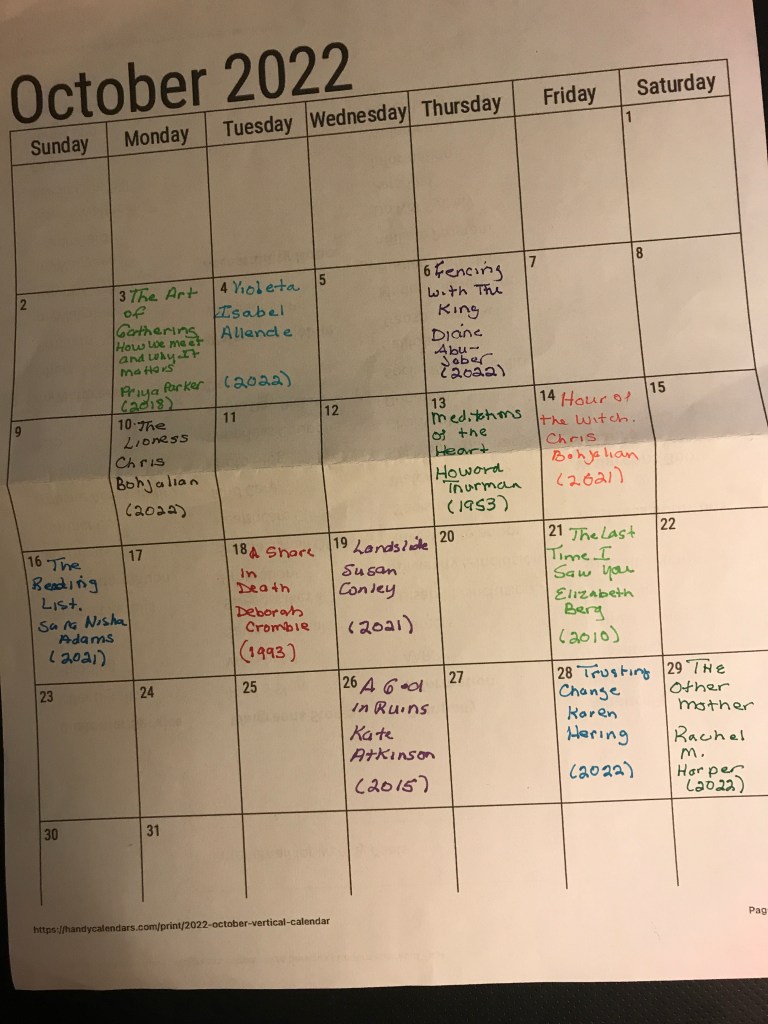
I read thirteen books this month, but who’s counting! People ask me how I manage to read so much. (Is there an implication that my life is dull?) I guess the answer is that I structure reading into my day, beginning with my morning meditation time, which includes reading a book on a spiritual topic. This month I read three books in that category:

  • The Art of Gathering, How We Meet and Why It Matters by Prya Parker (2018). I am quite sure this would not be shelved in the spirituality section of a book store, but thinking about how we connect with one another and how we offer hospitality is a totally spiritual topic, I think. Written in a breezy, conversational style, this book has lots of helpful and insightful ideas that can make a difference when you plan a small dinner party or a big work or community event.
  • Meditations of the Heart by Howard Thurman (1953). This book had been on my list for a long time, and I read it slowly, savoring one brief meditation at a time. For example, in #10, “In the Moment of Pause, the Vision of God,” he writes, “It is good to make an end of movement, to come to a point of rest, a place of pause. There is some strange magic in activity, in keeping at it, in continuing to be involved in many things that excite the mind and keep the hours swiftly passing. But it is a deadly magic; one is not wise to trust it with too much confidence.” Keep in mind, if you read this, the time period, for the language is sexist, but there are gifts to be found here, and Thurman is one of the greats of the 20th century.
  • Trusting Change, Finding Our Way Through Personal and Global Transformation by Karen Hering (2022). One of the first programs I attended at Wisdom Ways when we moved back to St Paul in 2013 was a book launch for Karen Hering’s Writing to Wake the Soul, Opening the Sacred Conversation Within (2013), a book that has inspired my own writing. Since then I have participated in writing retreats and sessions with her. She is a gifted teacher and writer, and this book is packed with insights and inspiration. The book offers ten skills for living on the threshold (actually, I wish the title included the word “threshold”) and deep and creative exercises to do by oneself or with others. I have a feeling I will refer to this book often as I plan for the writing and other groups I lead. Hering is an ordained Unitarian Universalist minister who has worked as a literary minister. Isn’t that intriguing?

Along with devoting part of my meditation time to reading, I read during lunch, but I also try to leave my garret desk at about 4 and read before I start fixing dinner, and, of course, I read before going to bed. That time adds up to a bunch of books. I guess I am a fast reader, and sometimes that is not a good thing, for I don’t always retain what I read. That is one reason why I keep a journal of what I read.

Here are my top four October novels:

  • The Lioness by Chris Bohjalian (2022). An American movie star invites friends and colleagues to join her and her new husband on a honeymoon safari in Tanzania. The novel is set in the 1960’s when the country was still called Tanganyika. Kidnapping, murder, page-turning suspense. The big question is who survives? The descriptions of the Serengeti and the animals they see are breath-taking, but be still my heart, so is what happens. This is the first book I’ve read by this author and I went on to read The Hour of the Witch (2021), which, even though I have never been drawn to books about the days of witch-hunts in the colonies, this book intrigued me, and I am afraid I am going to have to read Bohjalian’s extensive back list.
  • Fencing with the King by Diane Abu-Jaber (2022). Amani accompanies her father from the U.S. back to their Jordan homeland where he has been invited to celebrate the birthday of the king by engaging in a fencing match with him. What is more important about the story is Amani’s search to learn about her father’s mother, whom she resembles. Secrets are uncovered in this beautifully told story.
  • Landslide by Susan Conley (2021). I almost read this book in one sitting, for the witty and natural dialogue moved the story along so easily. Set in Maine, Kit has a serious fishing accident and Jill needs to cope with their two teenage sons, whom she calls “the wolves.” I loved all the mother-son interactions, reflecting teenage angst, the mother’s typical, but also difficult worries, and all the love needed to survive and move forward.
  • The Other Mother by Rachel M. Harper (2022). A complicated story of secrets and trauma related to the secrets. Two women are in a relationship with one another, but one is more committed to the relationship, and she wants a baby. The other woman agrees, but even though she adores the child, does not want to adopt him. Much of the story takes place when the child, Jenry, starts college at Brown University where the man whom he believes is his grandfather is a famous African-American professor. Some secrets are revealed, but others….well, I don’t want to reveal too much. I was intrigued by this book.

I also read five other books, each worth reading or I would have discarded them fairly early on!

  • Violeta by Isabel Allende (2022)
  • The Reading List by Sara Nisha Adams (2021)
  • A Share in Death by Deborah Crombie (1993)
  • The Last Time I Saw You by Elizabeth Berg (2010)
  • A God in Ruins by Kate Atkinson (2015)

One more book note. This past weekend our roaming destination was Red Wing, MN, and, of course, we visited the library. I was impressed with the comfortable and set-apart reading room, but also liked some of the hand-outs available to patrons, including this one:
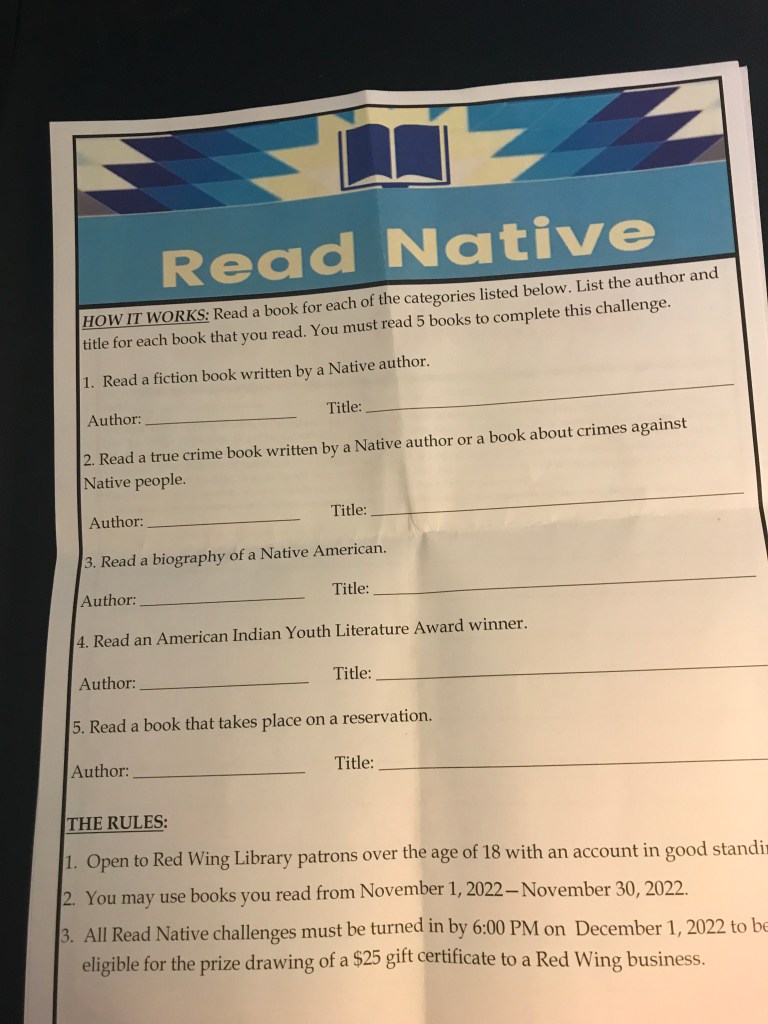
I would love to know what books are read to fulfill this challenge.

An Invitation

What did you read this past month? How are you challenging yourself in your reading life? I would love to know.

NOTE:

I loved this article about one’s personal library. https://psyche.co/guides/how-to-nurture-and-grow-a-personal-library-of-books
October into November

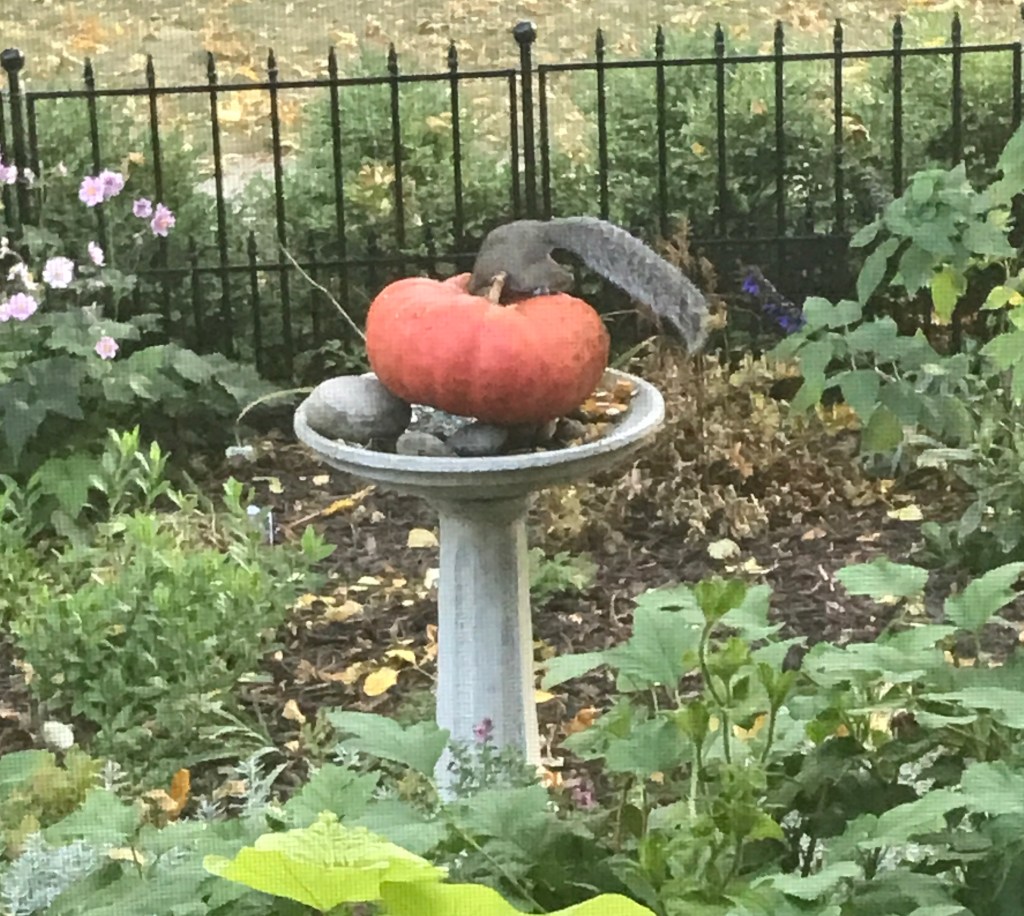
Some people hide their heads in the sand, but, I guess, squirrels choose to hide their heads in the pumpkin. I love my pumpkins, and seeing them become squirrel food is frustrating, but I had to laugh. And some days you need to laugh.

We are bombarded these days with so much that worries us, especially as we head towards election day. How important it is to open ourselves to what amuses us and makes us smile, even if I wish my pumpkins had not become a feeding trough.

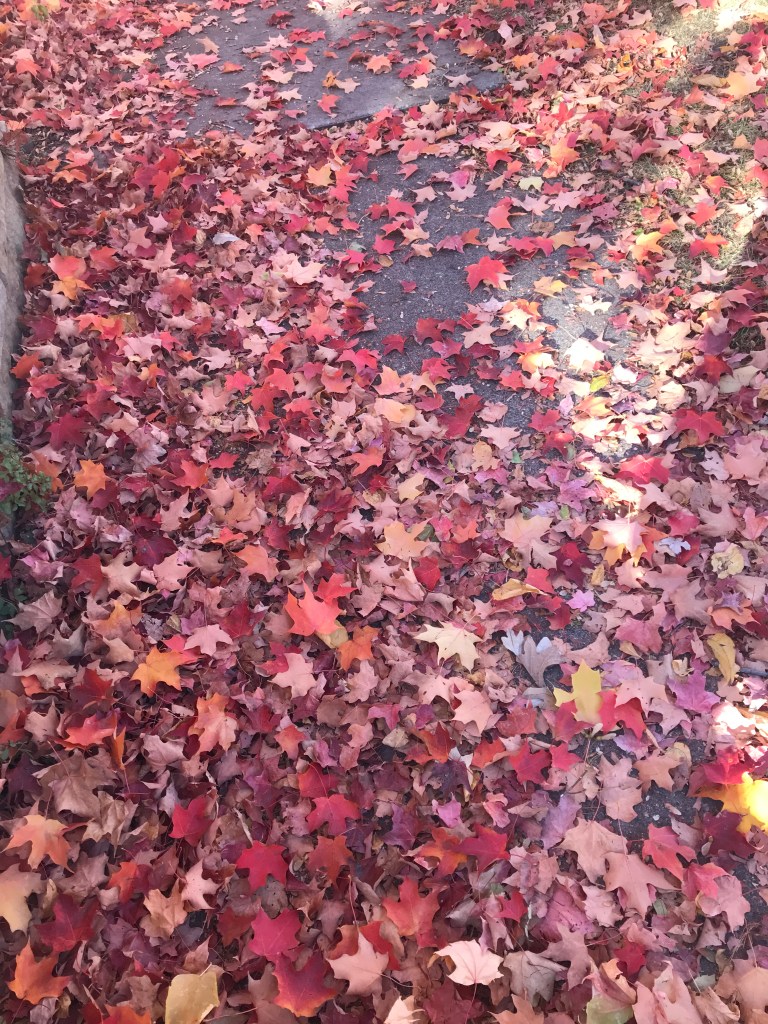
Sunday I drove through the neighborhood, stopping to fill Little Free Libraries with a stack of books —food for other readers, and I felt fed by what I saw.

What a gorgeous fall it has been, and I am grateful for each of these days; each one calling me to open my eyes, to find beauty, to notice what brings us comfort and joy. And to smile.

An Invitation

What feeds you these days. What has made you smile? I would love to know.

Book Report: Library Field Trips

October 27, 2022

Public Library, St Peter, Minnesota

My husband and I love to roam. “Roaming,” I think is a bit different than traveling. No tickets are involved or reservations. There is no need to stop the mail, board the dog, if you have one, or hire the neighbor kid to shovel your walk it if snows. Nope, all we do is pick a destination, make sure the car is filled with gas, the plat book is handy, and off we go.

This fall we decided to include in our casual itinerary the libraries in the towns we visit. Because it has been such a busy fall, we have only explored two Minnesota towns so far, St Peter and New Ulm. At some point I intend to write about what we learned about each of these towns, but since it is Book Report Thursday, I will focus just on the libraries.

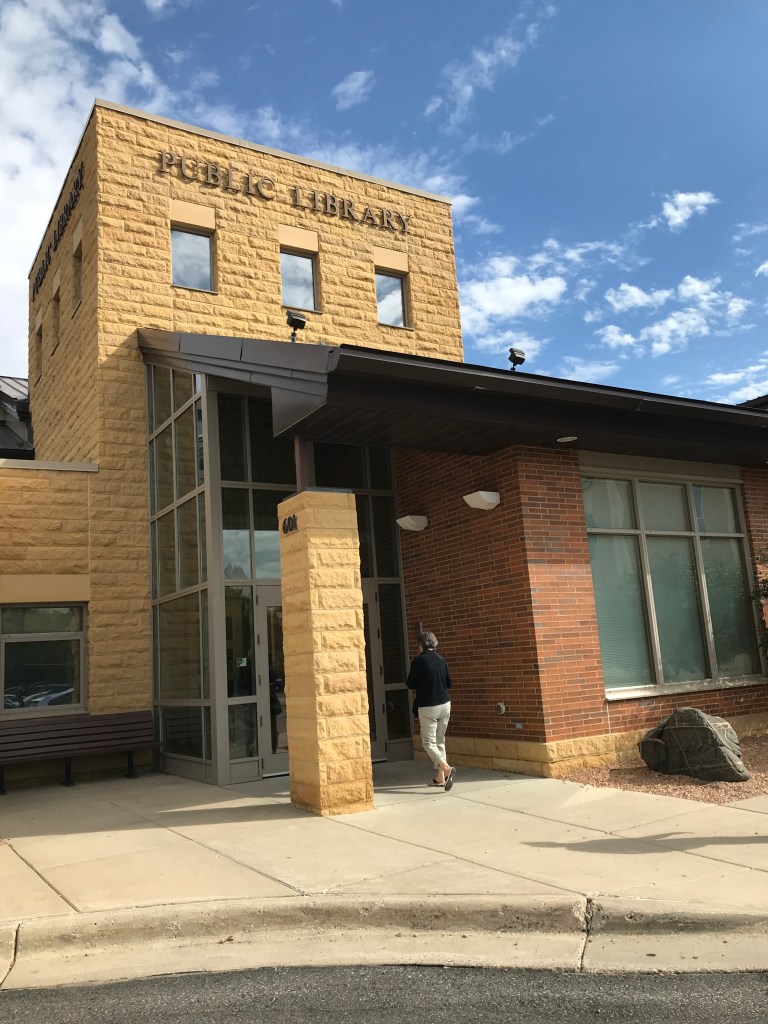
The St Peter library is a new structure–not particularly inviting from the outside, but the inside was an entirely different experience.

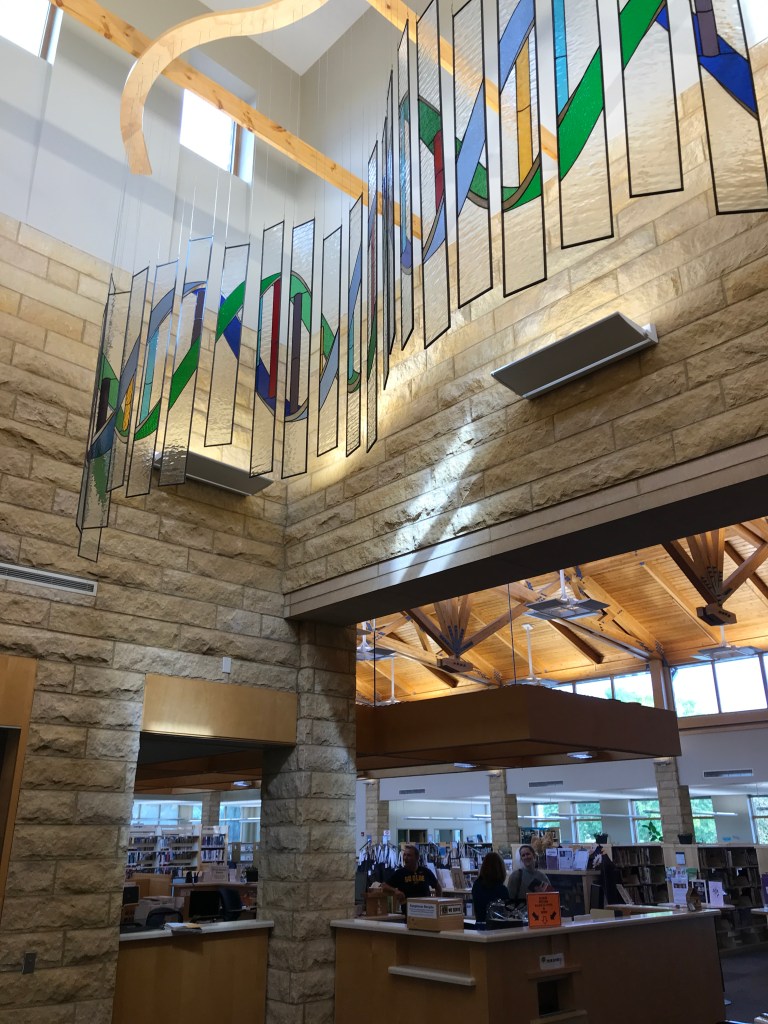
I immediately felt welcomed and uplifted without feeling overwhelmed. Even though the limestone could have felt cold and unapproachable, the light pouring in from above and the entire perimeter of the building added to the hospitality of the space. And it was busy. Not noisy, but buzzing with people of all ages.

I know libraries these days are not just places for books and readers, but are an integral part of the community, responding to community needs and interests, and that was evident in the St Peter library.

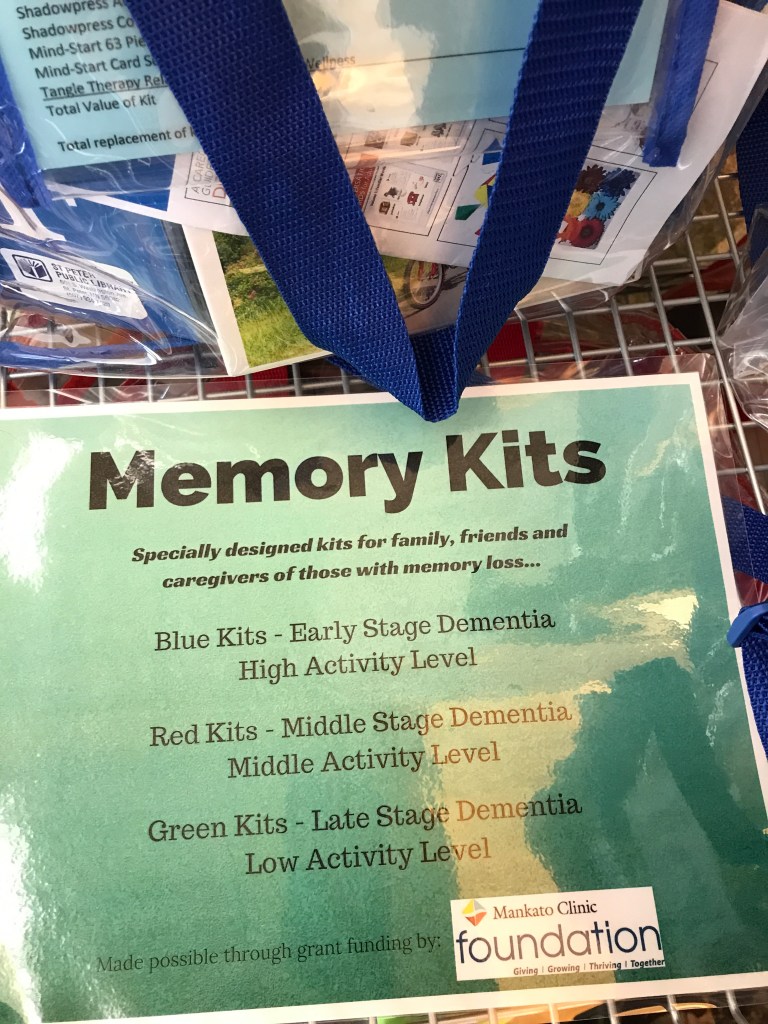
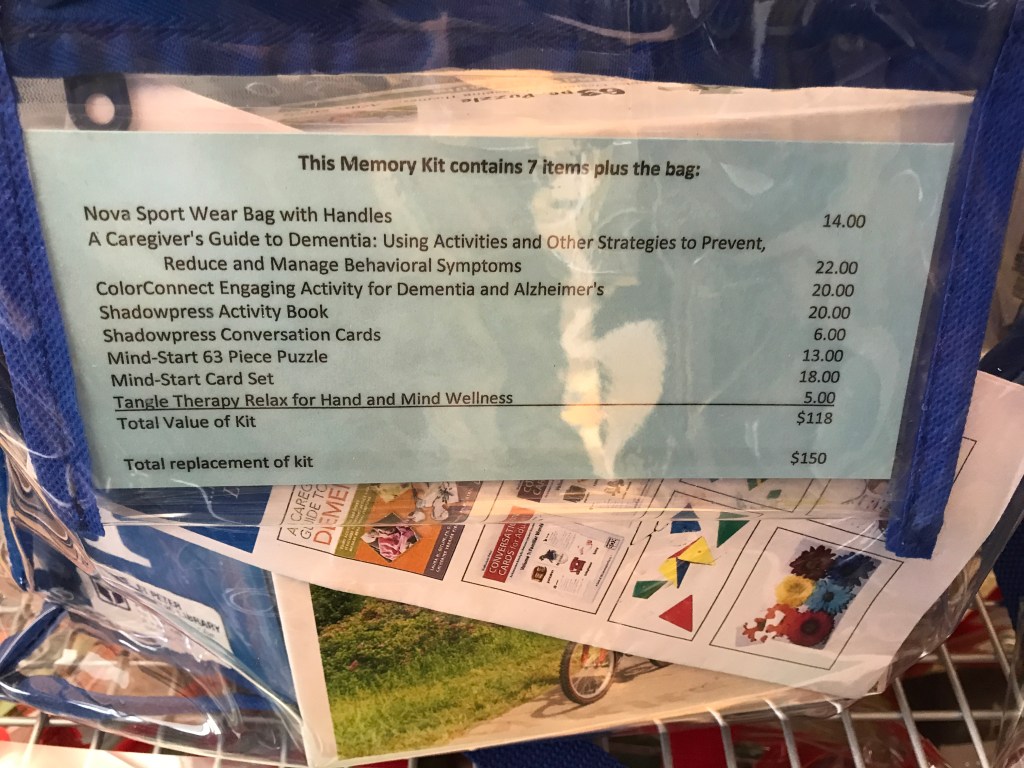
Along with bags of books for book groups, we spotted these Memory Kit bags. Clever, creative, helpful, innovative, and accessible. Good job, St Peter.

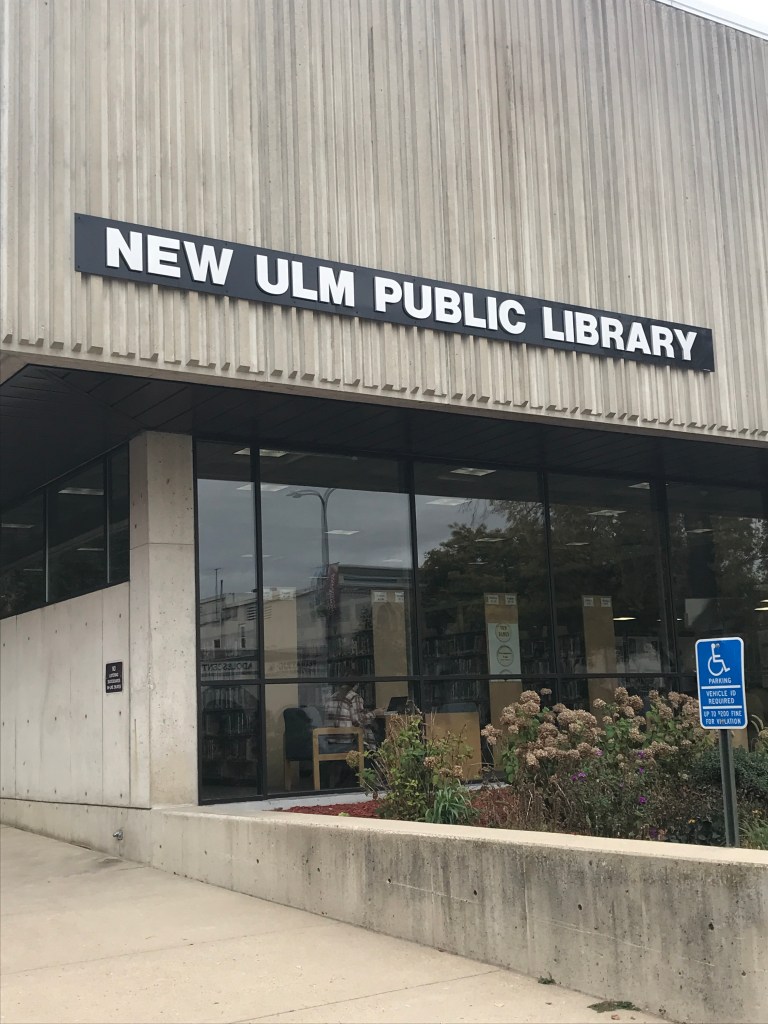
We visited New Ulm on a Friday and the downtown was active and bustling, but that was not the case in the library, even though it is located not far from the downtown area. In fact, Bruce and I were the only people in the library other than the librarians who quizzed us about why we were there. Did they think we were state library officials on a surprise inspection?

That isn’t quite fair, for I think the library staff have done the best they could do with an extremely unattractive building in the Brutalist style of architecture.

Brutalism dates from the 1950’s and is characterized by minimalist constructions showcasing bare building materials and structural elements over decorative designs. Cold concrete, and I ask you is that the look you want in a library!

As I said, however, they have done the best they could do with what they have, and I loved the sculpture of children’s writer/illustrator Wanda Gag (Millions of Cats) outside. We had hoped to tour the house where she grew up, but it wasn’t open.

The saving grace of this library was the spacious and bright children’s space. This was the old Carnegie Library and is attached to the newer facility. The space was filled with art work and areas for creative activities. I hope on other days and times the space is alive with children and their excitement for books and reading.

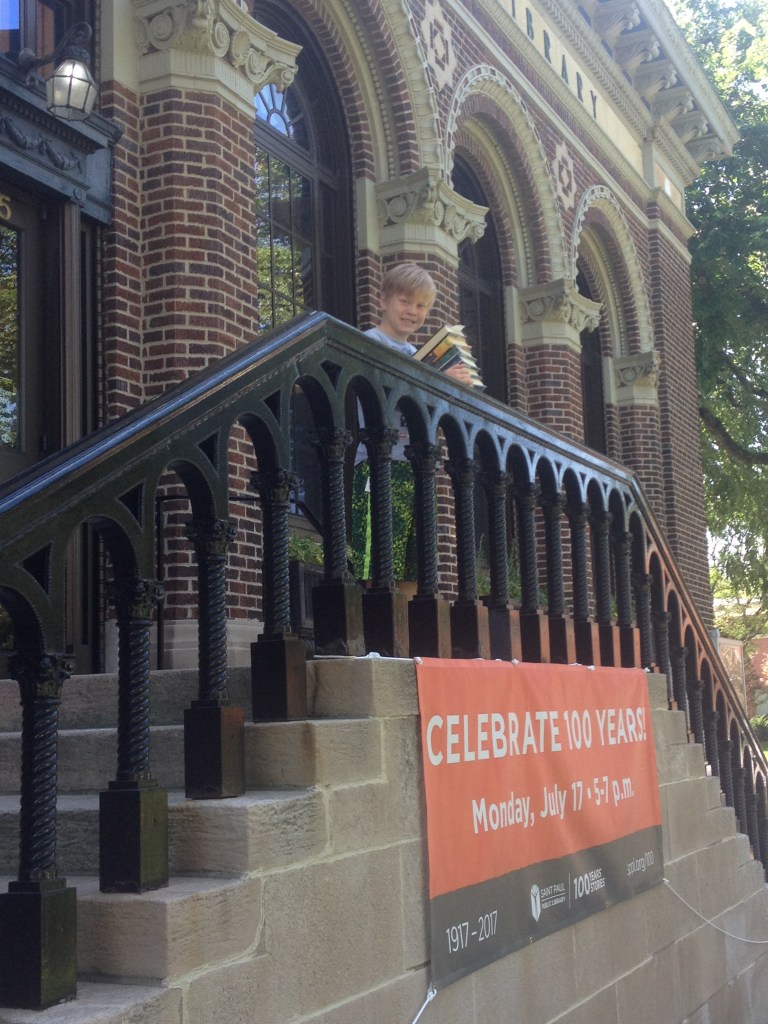
We intend to continue our library tours, including ones in our own area. One summer when our grandson who is now fourteen was nine, he and I visited a few St Paul libraries, and, of course, came home with stacks of books. Obviously, we don’t do that when we visit libraries in other parts of the state.

How grateful I am for the public libraries and urge you to use and support them in your community. In fact, I am about to head to my library where a stack of books I have placed on hold is waiting for me. Happy reading!

An Invitation

What do you appreciate about your library? I would love to know.

Note:

Next week I will share my October round-up of books read in the past month.

Dilemmas in Downsizing #2

October 25, 2022

The love of variety is one of my challenges when I think about downsizing/decluttering.

I love decorating for the seasons, and the house never looks the same, one season after another. Not only is that because I have so much stuff, but because I enjoy rearranging and using what I have in new ways. I’m not very good with my hands–don’t sew, don’t do crafts, but I know I have a good eye and know how to put things together. And oh, how fun it is to discover something tucked away in a cupboard that is just the perfect touch on a tabletop or shelf.

My mother once commented on a neighbor, a dear friend of hers, who in all the years they knew each other never changed the centerpiece on their kitchen table. A wooden bowl of artificial fruit, if I recall. She couldn’t imagine living that way. At least I know where my comfort and desire for change comes from, but as I declutter, little by little, I wonder if there will be a time when I won’t feel the urge to change the dining room centerpiece or the living room coffee table? As I continue this process of simplifying what is tucked in cupboards and closets, will I simplify my interest in and need for variety?

Here are some positive signs:

One day last week when I sat with a client in the snug, I noticed cobwebs floating under a bookshelf. Ugh! It was time to do a more thorough cleaning, and as I did that, I gathered a few small pieces of silver sitting on top of piles of books. Just sweet little accessories collected over the years with no real purpose, but adding a touch of shine to the shelf. Each one needed to be polished, which I started doing, and then I asked myself, “How would it feel to add these to our garage sale pile? Will I miss them if I no longer own them?”

Much to my surprise, I was ready to release them. I know it doesn’t seem like much, but one thing leads to another. By the way, I did keep two pieces I particularly love–a small English chocolate or tea pot from a hotel and a creamer.

As I continued cleaning, I pulled a few books off the shelves and added them to the Little Free Library basket, and I also made another decision. Decades ago when I worked in an independent bookstore, I bought books signed by every author who visited the store, usually for a book signing event. Many of those books I have never read, and as I stood in front of the living room bookcase, I realized I probably never will read them. Obviously, I will confer with my husband about this, but I envision clearing much more space soon.

Bruce and I have been antique collectors all our married life. Going to antique shows and shops has been our hobby, a form of entertainment, and although that activity has decreased in recent years, it has not disappeared. This past weekend, however, we decided not to go to an annual fall show; one we have always enjoyed and where we have often found treasures. Making that decision wasn’t difficult. Not a sacrifice. We quite simply didn’t feel a pull to go. I recognize that doesn’t mean our interest in antiquing has retired, but it is more moderate. That feels like a good thing.

Decluttering is a process. Unless you have a team of people who swoop in, take over, and do it all, once and for all, decluttering can not be done in one big now or never moment. Decluttering is a one drawer at a time process. One closet at a time. Even one shelf at a time. And as a process, it is possible to integrate it into my daily life–to organize what is scattered and to choose what still gives joy and what just feels like stuff, and to clear space as I clean.

Stay tuned, for I have a feeling there will be more Dilemmas in Downsizing to share.

An Invitation

What are you learning in this process? I would love to know.

Book Report: The Reading List

October 20, 2022

Recently I read The Reading List by Sara Nisha Adams (2021). I am attracted to books about books, bookstores, booksellers, and libraries –both fiction and nonfiction–and this one is a delightful example of that genre. Another example is The Sentence by Louise Erdrich (2021), which is set in a bookstore and is one of my recent favorites. I also remember reading years ago a memoir by the mystery writer Susan Hill, Howard’s End is on the Landing (2009) about the year she read only books she already owned. I could do that, but then I better hurry up and buy the new Maggie O’Farrell and Barbara Kingsolver and…

Back to The Reading List. I loved each of the characters, especially the two main characters. Mukesh is an elderly man who is grieving the death of his wife and Aleisha is a young woman who has a complicated family. They meet at the library where Aleisha has a summer job. A list of books labeled “In case you need it:” appears to both Mukesh and Aleisha as well as other characters and thus begins a reading adventure, but more than that, support and even transformation.

And what a great list this is! I have read each of these books; some, more than once. I love how the lessons and the insights gleaned from these books are woven into the narrative–once again suggesting the power of books and reading.

Thinking about my own “In case you need it list,” I remember a charming illustrated book, My Ideal Bookshelf, Art by Jane Mount, Edited by Thessaly La Force. (2012). Over 100 cultural figures share the books that matter the most to them and why. Here, for example is librarian Nancy Pearl’s bookshelf as depicted by Jane Mount.

I am not familiar with most of Pearl’s choices, and that, of course, could lead to an even longer TBR list.

Here’s doctor and writer Atul Gawande’s shelf. I’ve read more of these books, but this isn’t a contest. Rather, an insight into a person’s life and development.

Naturally, this makes me think about what would be on my shelf. These are a few of the possibilities–novels I have read more than one time and that have impacted my life.

  • Giants in the Earth by Ole Rolvaag
  • All of Jane Austen’s books
  • The Scarlet Letter by Nathaniel Hawthorne
  • Grapes of Wrath by John Steinbeck
  • The Color Purple by Alice Walker
  • Bel Canto by Ann Patchett
  • The Great Gatsby by F. Scott Fitzgerald
  • Poisonwood Bible by Barbara Kingsolver
  • Persuasion by A.S. Byatt
  • A sampling of Nancy Drew books
  • Crossing to Safety by Wallace Stegner
  • Great Expectations by Charles Dickens
  • Fresh Water for Flowers by Valerie Perrin
  • A Tree Grows in Brooklyn by Betty Smith
  • The Seed Keeper by Diane Wilson
  • Mrs Dalloway by Virginia Woolf

I need to stop or I will need a very long and sturdy book shelf.

An Invitation:

What is on your “ideal bookshelf”? I would love to know.

Dilemmas In Downsizing

October 18, 2022

“I don’t want my children to deal with this when I’m gone.”

I wonder how many times I’ve heard someone declare this as a reason for downsizing and decluttering.

On one level that is a noble idea, with which it is hard to disagree. Bravo, you! And yet at the same time, there is something inside me that isn’t 100% aboard that idea.

If you read my post on Thursday, October 13, 2022, https://livingonlifeslabyrinth.com/2022/10/13/book-report-downsizing-my-books/ you know that I am not ignoring the challenge of my own stuff. That post focused on books, but I could have written about my “Dish Problem.” I inherited the problem, along with actual dishes, from my mother, and my sister has the same problem. We love setting a beautiful table with dishes appropriate to the season or the occasion. Perhaps the problem would have been more under control, if my husband didn’t also love dishes and if we hadn’t been antique collectors all our married life.

Even though I still have enough dishes to serve the neighborhood, I want you to know that I no longer have as many sets as I once did. I have pared back significantly, and am proud to say, all our dishes, other than a set of Christmas dishes, are easily assessable in cupboards and not packed away in bins. I know I will continue to evaluate what I really want to keep and use for now, and it’s certainly possible there will be more than two place settings of the white dishes we use everyday when I die or move into a care center.

Our children will have to deal with our stuff.

Is that so bad?

First of all, let me say I believe in the principle of “like with like, ” which means staying organized, and I also believe in knowing what one has, which also means staying organized and not storing “maybe I’ll use this one day” items in difficult to reach storage items. I also don’t believe in keeping things like 25 year old tax returns, and clothes that haven’t fit for 5 years and if they ever were to fit again will be out of style anyway, and stacks of jigsaw puzzles that were fun to put together once, but twice? Not so much.

All that being said, I think there is some value for our children in dealing with the stuff that remains.

A story about my mother.

My mother loved jewelry, and she was blessed with my father who loved giving her beautiful jewelry. Before she died she designated her major pieces, but that still left boxes and drawers full of necklaces, bracelets, earrings, and rings.

One of the first days after she died, we opened up the dining room table as far as it could go and filled it with piles of her jewelry–the pearl pile, the turquoise pile, the silver pile, the costume jewelry pile. You get the idea. Then we all gathered and starting with the oldest, which was me, went around the table one by one selecting one item from one of the piles. We went round and round and round draping ourselves in the treasures until what was left was not wanted by anyone. My father in the meantime sat nearby beaming. He was so happy we were delighting in these bits and pieces of Betty Ann’s baubles.

I still fill with tears as I think about that day, which was almost 20 years ago. That day was part of our grieving process, and because my mother had not figured out what to do with all those boxes and drawers of jewelry, she gave that day to us. We told stories and laughed and honored her gypsy nature.

When my father died, there was less to do because he had moved into a senior living facility a few years before, but, trust me, there was still enough stuff. Strange as it may sound, I am grateful for the days my sister and brother and husband and brother-in-law spent together sorting and tossing and packing and moving. Because of COVID, the grands and greats were not able to be with us, and they missed our storytelling and the moments when each of us needed some comfort.

I hope when the time comes my family won’t resent the fact that somehow I never got around to creating beautiful family albums and instead left boxes of loose photos. I hope they will pass around pictures and tell stories and comfort each other. I hope when they pack up the dishes I only use in the fall they will remember how good my applesauce tasted and the baked spaghetti hot dish and the pork loin with wild rice and how I loved setting a pretty table even when dinner was only pizza.

I am not suggesting you avoid what must be done or use this post as a justification for holding on tightly to what is only cluttering your present life, but going through the stuff of our loved ones’ lives also can be a tool in the process of grieving. Just a thought.

An Invitation

What are your thoughts about stuff and grieving? I would love to know.

Book Report: Downsizing My Books

October 13, 2022

A frequent conversation among elders is what to do with our stuff. We all have it.

We know it’s only stuff. But it’s our stuff, and we don’t want anyone telling us what to do with our stuff.

I can feel my body become rigid, my throat constrict, and my eyes narrow if anyone dares tell me I have too many books. What is too many? I am not willing to have that conversation.

But, of course, the truth is I do have lots of books.

What to do?

I know that the next move, if and when that happens, will be to a much smaller space; one in which there will be much less room for all our books. Does that mean I need to empty our bookshelves now and never purchase another book? Or do I just ignore the elephant –in this case hundreds of books–in the room(s)?ownsizing

Strategies and Process

My main strategy is to recognize and to practice the PROCESS of downsizing. Here’s what that means:

  1. Use the library more and buy fewer books. So far this year I have checked out almost 80 books from the library, and I have purchased a little more than half that amount.
  2. Every time I read a book I own I consider if it is one I might want to read again or refer to in my work as a spiritual director or small group facilitator. If I decide I don’t need or want to keep it, it is placed in a basket of books to take to a Little Free Library or set aside for our annual garage sale or pass on to someone else and say, “No need to return.” Occasionally, I want to re-read a book I no longer own. Well, there’s the library to save the day!
  3. The last two years my Lenten spiritual practice has been to eliminate at least one book from my spirituality/theology bookshelves each day. I intend to continue that practice this year, too.
  4. Each time I return a book to a shelf or find space for a new book, I spend time looking at the other books on those shelves and often I decide I don’t need to save one of the nearby books any longer.
  5. No books are allowed to gather in piles on the floor. Books do not become the base for a lamp or prop up a table leg.
  6. There are no boxes of books in storage areas. Seeing my books not only gives me pleasure, but that prevents the “out of sight, out of mind” issue that solves nothing.
  7. The books I have acquired, but not yet read are kept on two shelves. Nonfiction books are on a shelf in the garret and fiction in the snug. That means I am aware of them when I finish a book and wonder what to read next.

Practicing Awareness

Part of this downsizing process is to ask myself –not just once, but periodically–what is the meaning of this specific category of stuff? Why do I hold on to these books?

There is more than one answer. First of all, I am a passionate reader, and I prefer to read books in their paper form. You may prefer listening to books or reading on a Kindle. Good for you, and maybe, someday I will do that, too, but not now. Books are beautiful and are part of my decor and add to the warmth and personality of our home. I feel the presence of the writer and their words by having books physically present. Also, I am a writer and a teacher and browse my books for inspiration, for answers, for reinforcement and support and for ideas to broaden my perspective. I suppose I can do that on the internet, but it’s not the same. Finally, my books offer a glance into my history, a view into who I am. And my books remind me to continue the process of growth and evolution.

I know someday I will have to face (or my family will) the challenge of what to do with all these books, and I guess should apologize for that, but oh well… I continue to remind myself that downsizing is a process, and I am in the midst of that process. I am becoming aware that each book I let go of makes it easier to let go of another one.

One more thing: I’ve noticed it is much easier to prod someone else to do something about their stuff, than it is to tackle our own stuff. I’m guilty of that, and I am trying to reform and focus on my own stuff. Enough said!

An Invitation:

What stuff is plaguing you and what are you doing about it? I would love to know.

Pantry Envy: A Hometender’s Sin

October 11, 2022

This past weekend we visited family in Nebraska, including our niece and her husband. We had dinner in their lovely new home, and I have a confession. I had an extreme case of pantry envy. Kitchen envy, too.

Their pantry is the size of my kitchen. Need I say more?

And it was organized, spacious, and beautiful.

I was in love. Or should I say, IN ENVY.

Envy is not an unknown feeling for me. I am an enneagram FOUR and envy is the “sin” or “passion” of this personality type. In this case “sin” is not meant to be viewed as something bad or evil, but rather as the tendency to miss the mark in some way. When experiencing the sin or passion, we lose our center and are not our best selves.

Envy and the Enneagram

First a word about the enneagram.

The enneagram is an ancient system of self-understanding and self-discovery; a tool for personal transformation and development. Pronounced “ANY-a-gram,” the enneagram is a geometric figure that maps out nine fundamental personality types of human nature and their complex relationships.

My husband and I were introduced by a friend to the enneagram many years ago and studying it, returning to its subtleties and complexities over and over has been life-enhancing. The key step is to determine which of the nine personality types one is. After being introduced to the types, I knew almost immediately that I am a FOUR: an individualist or some times called the romantic or artist.

Envy is the sin or passion of the four.

Envy is based on the feeling that something is missing. Envy leads Fours to feel that others possess qualities that they lack. Fours long for what is absent but often fail to notice the many blessings in their lives.

The Wisdom of the Enneagram, The Complete Guide to Psychological and Spiritual Growth for the Nine Personality Types, by Don Richard Riso and Russ Hudson.

They see immediately who has more style, more class, more taste, more talent, more unusual ideas, more genius than they do. They see who is simpler, more natural, more normal, and ‘healthier’ than they are. There is nothing that a FOUR couldn’t be envious about.

The Enneagram, A Christian Perspective by Richard Rohr and Andreas Ebert

Noticing Envy

Envy has been an issue in my life, for sure. And while I am not able to say it has disappeared nor have I conquered the green-eyed monster, but I am more apt to recognize it quickly and ask, “What is this about and why am I feeling this now?” Plus, I am more able to turn the feeling into gratitude for my own blessings and to honor the gifts in someone else’s life.

So here’s how my pantry envy evolved.

What happened first was genuine delight for my niece. She and her husband had waited a long time for their dream house, and they had worked hard to make it happen. Bravo to them. In addition, how fun it was to see my niece’s hometending skills, her creativity, ingenuity, and her love of beauty, and I hope I expressed my appreciation for her gifts.

Then I sat with what I was experiencing within myself. Here’s what I uncovered:

I am living in what is sure to be my last house. I assume wherever I live next I will have a kitchen, but chances are it will be smaller and simpler, more basic than what I have now. This is because I am in my mid 70’s and closer to the end of my life than the beginning. I have had many kitchens –some bigger, some smaller–than my current kitchen and I have cooked and entertained no matter the size or the design, but I realize I no longer do that on the scale I once did. I feel some sadness about that. I know it is time to let go of some of that need. How grateful I am for all the times we have gathered family and friends around our table. How grateful I am for the ability to feed others and ourselves and to never lack for food in our home.

My envy opened me just a bit more to what I still store in my inner pantry, and that is a good thing.

By the way, my current pantry, which is a closet a couple steps down from the kitchen, is adequate. More than adequate for my current needs, and I need to remember that. It could use a bit tidying, however. I will put that on my list.

An Invitation

What moments of envy do you experience and how can they be a teacher? I would love to know.

Note:

If you are interested in the enneagram, I highly recommend the Riso and Hudson book I quoted. Also, you can take a test at https://www.bestenneagramtest.com/enneagram-test-how-can-i-find-out-my-enneagram-type?gclid=Cj0KCQjwhY-aBhCUARIsALNIC07jjnNA_X_HrH9lNQdBDKXoPBsrWeDvITTlnE0DmY_Djx4qJ4_NBCEaAiFWEALw_wcB OR https://mypersonality.net/quiz?afid=gdnmps&gclid=Cj0KCQjwhY-aBhCUARIsALNIC06glsDnVpEU2cYZ57KvpeykthSx5vfm7ZF01bWCnk_u6VGSKENcuH4aAolZEALw_wcB

Book Report: September Round-Up

October 6, 2022

Elly Griffiths’ Ruth Galloway mysteries dominated my September reading time. I read the last four in the series of fourteen books, but the last line in the most recent book certainly indicates there will be a fifteenth book to come.

Along with the Ruth Galloway books, I read other mysteries this month.

  1. The second Richard Osman, The Man Who Died Twice (2021). His third in the series featuring old and retired characters solving mysteries was recently released and is, of course, on my list–The Bullet That Missed.
  2. Fox Creek by William Kent Krueger (2022). I enjoyed it and swallowed it almost whole in a couple chunks of reading time, but I didn’t think it was his best. But, that being said, his best is better than good.

The novel I want to highlight from this month’s reading, however, is The Midcoast by Adam White. (2022) I wish I knew who recommended this or where I learned about it. Sometimes I note in my TBR list the source of a recommendation, but I didn’t in this case. The title refers to a section in Maine where the story takes place. The narrator, Andrew, grew up in the area and returns there with his family. He is a teacher and a writer and becomes an observer of another family: Ed, a lobsterman, his wife Steph and two children, Alli who is a lacrosse star and son EJ, a police officer. How is it that this family seems to have unlimited funds and money is no object? Thus, the story unfolds.

I also recommend a nonfiction title, Windswept, Walking the Paths of Trailblazing Women by Annabel Abby (2022). I’ve always been attracted to books about walking; for example, Wanderlust, A History of Walking by Rebecca Solnit. I do like to walk, but I am not a long-distance walker or major hiker, so I laugh at myself when I read a book about walking. Am I like the woman I once knew who collected a pile of books about running, but never put on her running shoes and headed out the door? Oh well.

This book features women for whom walking, and often walking solo, was a major part of their lives–Georgia O’Keefe, Simone de Beauvoir, and others unfamiliar to me. The author then decides to walk some of those same paths, musing that the women walkers she admires, “walked to become,” and also how walking often leads to new thoughts. That is certainly true for me–even my short walks in the neighborhood.

The author also writes that silence is an element–like water and fire–and I keep thinking about that.

September was an incredibly busy month, and I was grateful, as always for my book companions, which allowed me to pause and take a deep breath. As much as I enjoyed the mysteries I tended to reach for in recent months, I now feel a desire to read fiction with a bit more substance. I’ll keep you posted.

An Invitation

What did you read in September? I would love to know.

NOTE:

For two other nonfiction books I read in September and highly recommend see my September 15th post.

Closing the Door

October 4, 2022

I love fall. The crispness. The colors. The sweaters. The apples and cider. And, of course, the pumpkins.

But oh how hard it is to shut the door. I know it is necessary to close the door, as the weather gets colder, but I miss the light pouring in through the storm door.

May the door of this home be wide enough
to receive all who hunger for love,
all who are lonely for friendship.
May it welcome all who have cares to unburden,
thanks to express, hopes to nurture.
May the door of this house be narrow enough
to shut out pettiness and pride, envy and enmity...
May this home be for all who enter
the doorway to richness and a more meaningful life.
           "The Siddur of Shir Chadish in Life Prayers from Around the World
           edited by Elizabeth Roberts and Elias Amidon

Doors in our Lives

Many years ago I asked the women in a retreat I facilitated to draw a picture of a door and its threshold. An outside door or an inside door. A real door or an imagined door. The door could be from their present life or one from the past. I asked them to draw the image of what came into their minds when they heard the word “door,” and to draw a door with as much detail as possible, but assured them this exercise was not about being an artist.

The group moved into silence and using the offered crayons and markers drew their doors. Here are some of the questions we discussed after drawing our doors.

  • Is this a door that welcomes or does it feel unwelcoming?
  • Who enters this door? Is there anyone who is not welcome at this door?
  • What do you notice about this door that you have not noticed before?
  • How do you know when someone is at the door?
  • What is on the other side of the door?
  • What does this door reveal about you?
  • What needs to be healed as you enter the door?

What a rich discussion we had as we shared the drawings of our doors. Some sweet memories. Some painful ones. Some surprises and new insights, and even a few intentions to make their doors more welcoming and inviting.

The Door as a Symbol of My Heart

What is it, I wondered, that we were really talking about when we reflected on the doors of our lives? What happens if we substitute the word “heart” for “door.”

  • Is my heart a welcoming one or does it feel unwelcoming?
  • Who enters my heart? Is there anyone who is not welcome in my heart?
  • What do I notice about my heart that I did not know before?
  • How do I know when someone is waiting outside my heart?
  • What is outside my heart?
  • What does my heart reveal about me?
  • What needs to be healed in order to live with a full heart?

What would a picture of your heart look like? Are there any improvements you would like to make in the doorway of your heart?

The Door as a Spiritual Practice

Every time you open or close your door can be a moment of prayer, of blessing your home and all those who cross that threshold. As you stand at your door, pause, give thanks, and imagine God in your doorway. Every time you open or close your door, put your hand on your heart and feel it beating love and openness and welcome. Your door can remind you to invite God, the Sacred the Holy into your life.

Nightfall...morning
I lock the door. I unlock it.
My days are punctuated with this act.
It is a rhythm, a kind of pulse.

Just now the door is locked.
I want to think of this not as 
shutting the world out or shutting me in.
I want to think of this more
like dwelling in a rhythm...
sweet measure. Soon it will be morning
and the door will be unlocked again.

I can dwell in this home as if it were a heart. When I feel that pulse
I know that all that comes to me will also go.
Living in this stream I understand
You are my lifeblood. Let me feel
You course through me, through this door,
throughout my life.
             "Locking the Door" by Gunilla Norris in Being Home, A Book of Meditations

An Invitation

What do you notice about a door you open and close everyday? I would love to know.