Dilemmas in Downsizing #2

October 25, 2022

The love of variety is one of my challenges when I think about downsizing/decluttering.

I love decorating for the seasons, and the house never looks the same, one season after another. Not only is that because I have so much stuff, but because I enjoy rearranging and using what I have in new ways. I’m not very good with my hands–don’t sew, don’t do crafts, but I know I have a good eye and know how to put things together. And oh, how fun it is to discover something tucked away in a cupboard that is just the perfect touch on a tabletop or shelf.

My mother once commented on a neighbor, a dear friend of hers, who in all the years they knew each other never changed the centerpiece on their kitchen table. A wooden bowl of artificial fruit, if I recall. She couldn’t imagine living that way. At least I know where my comfort and desire for change comes from, but as I declutter, little by little, I wonder if there will be a time when I won’t feel the urge to change the dining room centerpiece or the living room coffee table? As I continue this process of simplifying what is tucked in cupboards and closets, will I simplify my interest in and need for variety?

Here are some positive signs:

One day last week when I sat with a client in the snug, I noticed cobwebs floating under a bookshelf. Ugh! It was time to do a more thorough cleaning, and as I did that, I gathered a few small pieces of silver sitting on top of piles of books. Just sweet little accessories collected over the years with no real purpose, but adding a touch of shine to the shelf. Each one needed to be polished, which I started doing, and then I asked myself, “How would it feel to add these to our garage sale pile? Will I miss them if I no longer own them?”

Much to my surprise, I was ready to release them. I know it doesn’t seem like much, but one thing leads to another. By the way, I did keep two pieces I particularly love–a small English chocolate or tea pot from a hotel and a creamer.

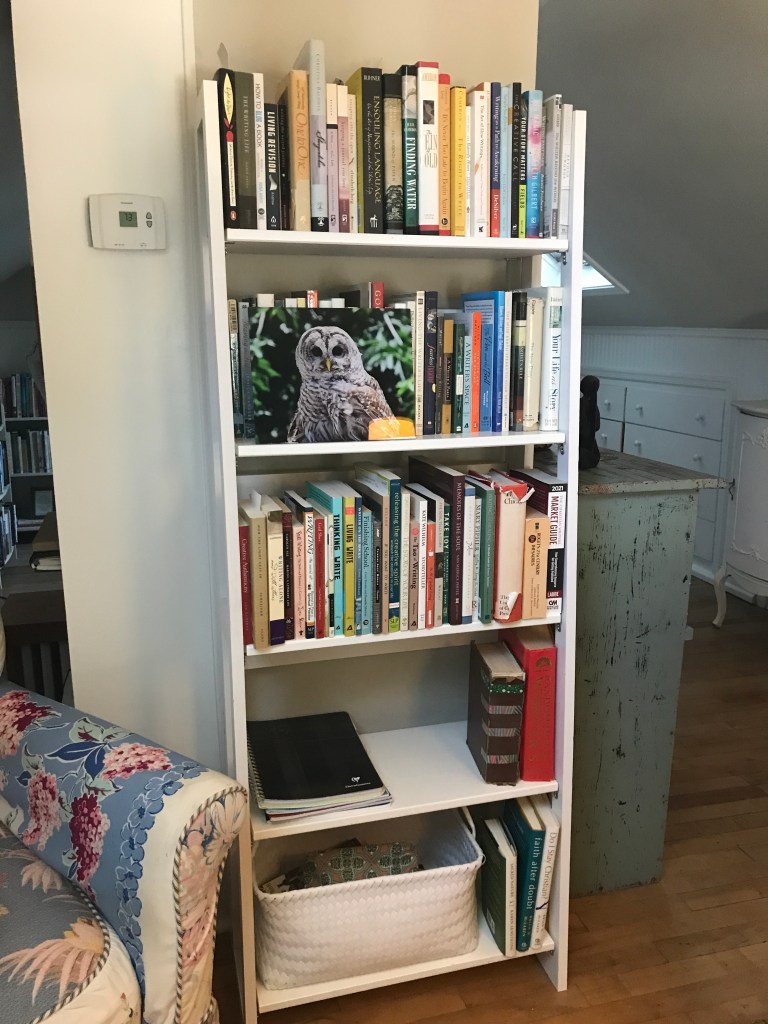
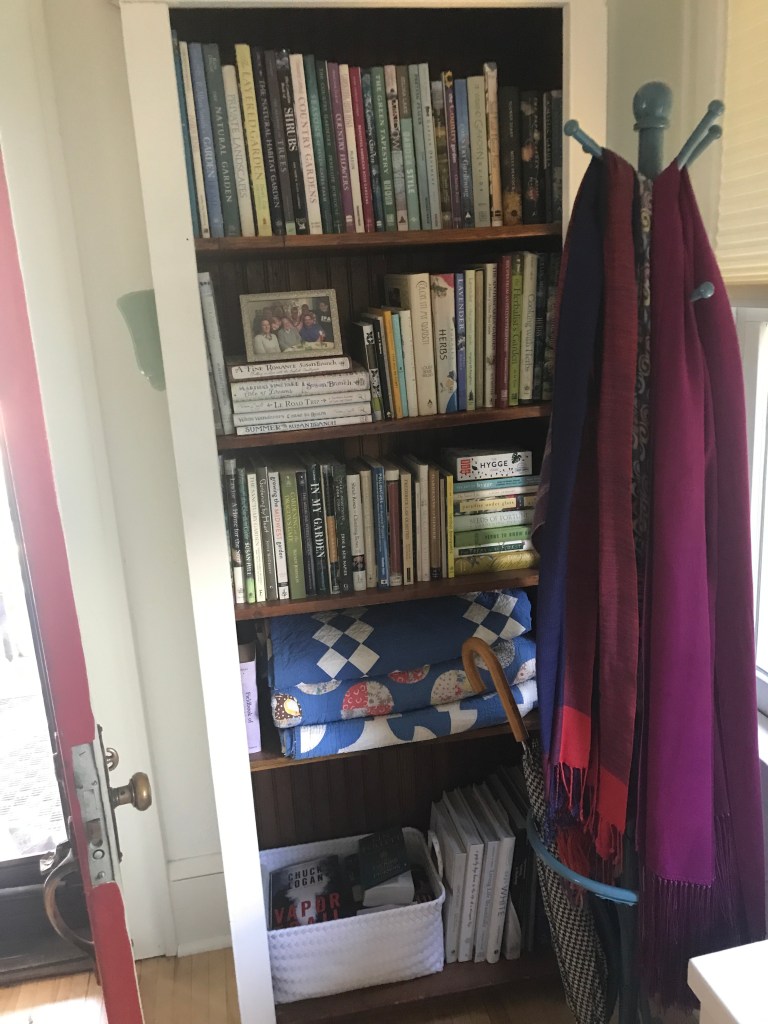
As I continued cleaning, I pulled a few books off the shelves and added them to the Little Free Library basket, and I also made another decision. Decades ago when I worked in an independent bookstore, I bought books signed by every author who visited the store, usually for a book signing event. Many of those books I have never read, and as I stood in front of the living room bookcase, I realized I probably never will read them. Obviously, I will confer with my husband about this, but I envision clearing much more space soon.

Bruce and I have been antique collectors all our married life. Going to antique shows and shops has been our hobby, a form of entertainment, and although that activity has decreased in recent years, it has not disappeared. This past weekend, however, we decided not to go to an annual fall show; one we have always enjoyed and where we have often found treasures. Making that decision wasn’t difficult. Not a sacrifice. We quite simply didn’t feel a pull to go. I recognize that doesn’t mean our interest in antiquing has retired, but it is more moderate. That feels like a good thing.

Decluttering is a process. Unless you have a team of people who swoop in, take over, and do it all, once and for all, decluttering can not be done in one big now or never moment. Decluttering is a one drawer at a time process. One closet at a time. Even one shelf at a time. And as a process, it is possible to integrate it into my daily life–to organize what is scattered and to choose what still gives joy and what just feels like stuff, and to clear space as I clean.

Stay tuned, for I have a feeling there will be more Dilemmas in Downsizing to share.

An Invitation

What are you learning in this process? I would love to know.

Dilemmas In Downsizing

October 18, 2022

“I don’t want my children to deal with this when I’m gone.”

I wonder how many times I’ve heard someone declare this as a reason for downsizing and decluttering.

On one level that is a noble idea, with which it is hard to disagree. Bravo, you! And yet at the same time, there is something inside me that isn’t 100% aboard that idea.

If you read my post on Thursday, October 13, 2022, https://livingonlifeslabyrinth.com/2022/10/13/book-report-downsizing-my-books/ you know that I am not ignoring the challenge of my own stuff. That post focused on books, but I could have written about my “Dish Problem.” I inherited the problem, along with actual dishes, from my mother, and my sister has the same problem. We love setting a beautiful table with dishes appropriate to the season or the occasion. Perhaps the problem would have been more under control, if my husband didn’t also love dishes and if we hadn’t been antique collectors all our married life.

Even though I still have enough dishes to serve the neighborhood, I want you to know that I no longer have as many sets as I once did. I have pared back significantly, and am proud to say, all our dishes, other than a set of Christmas dishes, are easily assessable in cupboards and not packed away in bins. I know I will continue to evaluate what I really want to keep and use for now, and it’s certainly possible there will be more than two place settings of the white dishes we use everyday when I die or move into a care center.

Our children will have to deal with our stuff.

Is that so bad?

First of all, let me say I believe in the principle of “like with like, ” which means staying organized, and I also believe in knowing what one has, which also means staying organized and not storing “maybe I’ll use this one day” items in difficult to reach storage items. I also don’t believe in keeping things like 25 year old tax returns, and clothes that haven’t fit for 5 years and if they ever were to fit again will be out of style anyway, and stacks of jigsaw puzzles that were fun to put together once, but twice? Not so much.

All that being said, I think there is some value for our children in dealing with the stuff that remains.

A story about my mother.

My mother loved jewelry, and she was blessed with my father who loved giving her beautiful jewelry. Before she died she designated her major pieces, but that still left boxes and drawers full of necklaces, bracelets, earrings, and rings.

One of the first days after she died, we opened up the dining room table as far as it could go and filled it with piles of her jewelry–the pearl pile, the turquoise pile, the silver pile, the costume jewelry pile. You get the idea. Then we all gathered and starting with the oldest, which was me, went around the table one by one selecting one item from one of the piles. We went round and round and round draping ourselves in the treasures until what was left was not wanted by anyone. My father in the meantime sat nearby beaming. He was so happy we were delighting in these bits and pieces of Betty Ann’s baubles.

I still fill with tears as I think about that day, which was almost 20 years ago. That day was part of our grieving process, and because my mother had not figured out what to do with all those boxes and drawers of jewelry, she gave that day to us. We told stories and laughed and honored her gypsy nature.

When my father died, there was less to do because he had moved into a senior living facility a few years before, but, trust me, there was still enough stuff. Strange as it may sound, I am grateful for the days my sister and brother and husband and brother-in-law spent together sorting and tossing and packing and moving. Because of COVID, the grands and greats were not able to be with us, and they missed our storytelling and the moments when each of us needed some comfort.

I hope when the time comes my family won’t resent the fact that somehow I never got around to creating beautiful family albums and instead left boxes of loose photos. I hope they will pass around pictures and tell stories and comfort each other. I hope when they pack up the dishes I only use in the fall they will remember how good my applesauce tasted and the baked spaghetti hot dish and the pork loin with wild rice and how I loved setting a pretty table even when dinner was only pizza.

I am not suggesting you avoid what must be done or use this post as a justification for holding on tightly to what is only cluttering your present life, but going through the stuff of our loved ones’ lives also can be a tool in the process of grieving. Just a thought.

An Invitation

What are your thoughts about stuff and grieving? I would love to know.

Book Report: Downsizing My Books

October 13, 2022

A frequent conversation among elders is what to do with our stuff. We all have it.

We know it’s only stuff. But it’s our stuff, and we don’t want anyone telling us what to do with our stuff.

I can feel my body become rigid, my throat constrict, and my eyes narrow if anyone dares tell me I have too many books. What is too many? I am not willing to have that conversation.

But, of course, the truth is I do have lots of books.

What to do?

I know that the next move, if and when that happens, will be to a much smaller space; one in which there will be much less room for all our books. Does that mean I need to empty our bookshelves now and never purchase another book? Or do I just ignore the elephant –in this case hundreds of books–in the room(s)?ownsizing

Strategies and Process

My main strategy is to recognize and to practice the PROCESS of downsizing. Here’s what that means:

  1. Use the library more and buy fewer books. So far this year I have checked out almost 80 books from the library, and I have purchased a little more than half that amount.
  2. Every time I read a book I own I consider if it is one I might want to read again or refer to in my work as a spiritual director or small group facilitator. If I decide I don’t need or want to keep it, it is placed in a basket of books to take to a Little Free Library or set aside for our annual garage sale or pass on to someone else and say, “No need to return.” Occasionally, I want to re-read a book I no longer own. Well, there’s the library to save the day!
  3. The last two years my Lenten spiritual practice has been to eliminate at least one book from my spirituality/theology bookshelves each day. I intend to continue that practice this year, too.
  4. Each time I return a book to a shelf or find space for a new book, I spend time looking at the other books on those shelves and often I decide I don’t need to save one of the nearby books any longer.
  5. No books are allowed to gather in piles on the floor. Books do not become the base for a lamp or prop up a table leg.
  6. There are no boxes of books in storage areas. Seeing my books not only gives me pleasure, but that prevents the “out of sight, out of mind” issue that solves nothing.
  7. The books I have acquired, but not yet read are kept on two shelves. Nonfiction books are on a shelf in the garret and fiction in the snug. That means I am aware of them when I finish a book and wonder what to read next.

Practicing Awareness

Part of this downsizing process is to ask myself –not just once, but periodically–what is the meaning of this specific category of stuff? Why do I hold on to these books?

There is more than one answer. First of all, I am a passionate reader, and I prefer to read books in their paper form. You may prefer listening to books or reading on a Kindle. Good for you, and maybe, someday I will do that, too, but not now. Books are beautiful and are part of my decor and add to the warmth and personality of our home. I feel the presence of the writer and their words by having books physically present. Also, I am a writer and a teacher and browse my books for inspiration, for answers, for reinforcement and support and for ideas to broaden my perspective. I suppose I can do that on the internet, but it’s not the same. Finally, my books offer a glance into my history, a view into who I am. And my books remind me to continue the process of growth and evolution.

I know someday I will have to face (or my family will) the challenge of what to do with all these books, and I guess should apologize for that, but oh well… I continue to remind myself that downsizing is a process, and I am in the midst of that process. I am becoming aware that each book I let go of makes it easier to let go of another one.

One more thing: I’ve noticed it is much easier to prod someone else to do something about their stuff, than it is to tackle our own stuff. I’m guilty of that, and I am trying to reform and focus on my own stuff. Enough said!

An Invitation:

What stuff is plaguing you and what are you doing about it? I would love to know.

Pantry Envy: A Hometender’s Sin

October 11, 2022

This past weekend we visited family in Nebraska, including our niece and her husband. We had dinner in their lovely new home, and I have a confession. I had an extreme case of pantry envy. Kitchen envy, too.

Their pantry is the size of my kitchen. Need I say more?

And it was organized, spacious, and beautiful.

I was in love. Or should I say, IN ENVY.

Envy is not an unknown feeling for me. I am an enneagram FOUR and envy is the “sin” or “passion” of this personality type. In this case “sin” is not meant to be viewed as something bad or evil, but rather as the tendency to miss the mark in some way. When experiencing the sin or passion, we lose our center and are not our best selves.

Envy and the Enneagram

First a word about the enneagram.

The enneagram is an ancient system of self-understanding and self-discovery; a tool for personal transformation and development. Pronounced “ANY-a-gram,” the enneagram is a geometric figure that maps out nine fundamental personality types of human nature and their complex relationships.

My husband and I were introduced by a friend to the enneagram many years ago and studying it, returning to its subtleties and complexities over and over has been life-enhancing. The key step is to determine which of the nine personality types one is. After being introduced to the types, I knew almost immediately that I am a FOUR: an individualist or some times called the romantic or artist.

Envy is the sin or passion of the four.

Envy is based on the feeling that something is missing. Envy leads Fours to feel that others possess qualities that they lack. Fours long for what is absent but often fail to notice the many blessings in their lives.

The Wisdom of the Enneagram, The Complete Guide to Psychological and Spiritual Growth for the Nine Personality Types, by Don Richard Riso and Russ Hudson.

They see immediately who has more style, more class, more taste, more talent, more unusual ideas, more genius than they do. They see who is simpler, more natural, more normal, and ‘healthier’ than they are. There is nothing that a FOUR couldn’t be envious about.

The Enneagram, A Christian Perspective by Richard Rohr and Andreas Ebert

Noticing Envy

Envy has been an issue in my life, for sure. And while I am not able to say it has disappeared nor have I conquered the green-eyed monster, but I am more apt to recognize it quickly and ask, “What is this about and why am I feeling this now?” Plus, I am more able to turn the feeling into gratitude for my own blessings and to honor the gifts in someone else’s life.

So here’s how my pantry envy evolved.

What happened first was genuine delight for my niece. She and her husband had waited a long time for their dream house, and they had worked hard to make it happen. Bravo to them. In addition, how fun it was to see my niece’s hometending skills, her creativity, ingenuity, and her love of beauty, and I hope I expressed my appreciation for her gifts.

Then I sat with what I was experiencing within myself. Here’s what I uncovered:

I am living in what is sure to be my last house. I assume wherever I live next I will have a kitchen, but chances are it will be smaller and simpler, more basic than what I have now. This is because I am in my mid 70’s and closer to the end of my life than the beginning. I have had many kitchens –some bigger, some smaller–than my current kitchen and I have cooked and entertained no matter the size or the design, but I realize I no longer do that on the scale I once did. I feel some sadness about that. I know it is time to let go of some of that need. How grateful I am for all the times we have gathered family and friends around our table. How grateful I am for the ability to feed others and ourselves and to never lack for food in our home.

My envy opened me just a bit more to what I still store in my inner pantry, and that is a good thing.

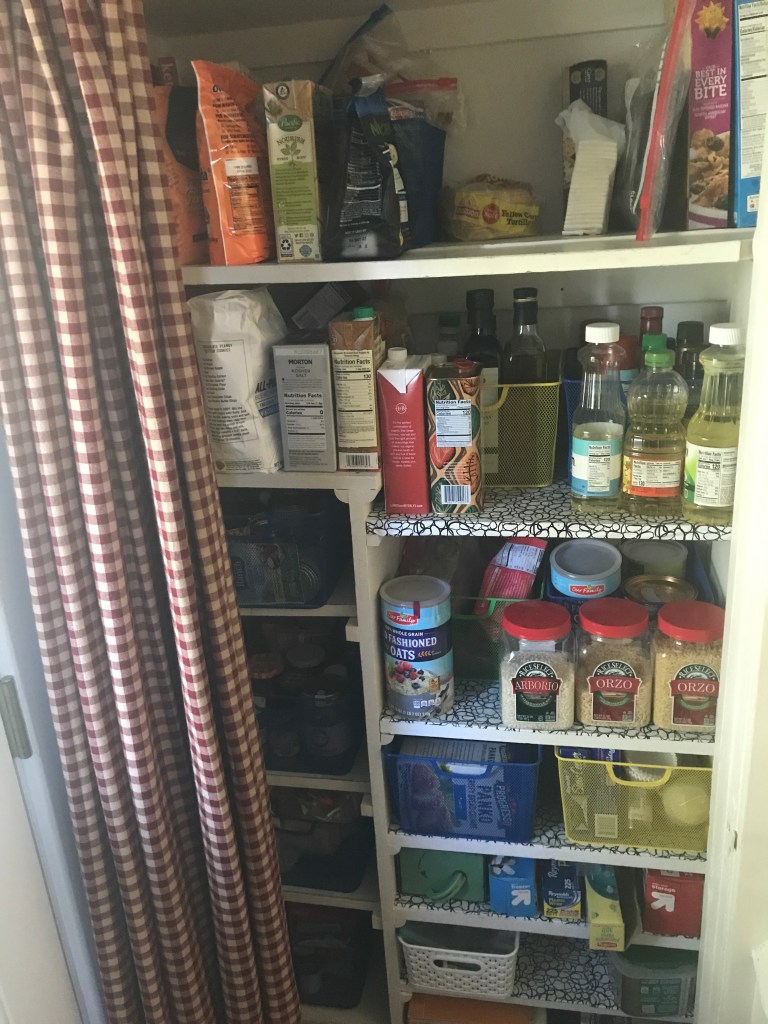
By the way, my current pantry, which is a closet a couple steps down from the kitchen, is adequate. More than adequate for my current needs, and I need to remember that. It could use a bit tidying, however. I will put that on my list.

An Invitation

What moments of envy do you experience and how can they be a teacher? I would love to know.

Note:

If you are interested in the enneagram, I highly recommend the Riso and Hudson book I quoted. Also, you can take a test at https://www.bestenneagramtest.com/enneagram-test-how-can-i-find-out-my-enneagram-type?gclid=Cj0KCQjwhY-aBhCUARIsALNIC07jjnNA_X_HrH9lNQdBDKXoPBsrWeDvITTlnE0DmY_Djx4qJ4_NBCEaAiFWEALw_wcB OR https://mypersonality.net/quiz?afid=gdnmps&gclid=Cj0KCQjwhY-aBhCUARIsALNIC06glsDnVpEU2cYZ57KvpeykthSx5vfm7ZF01bWCnk_u6VGSKENcuH4aAolZEALw_wcB

Book Report: September Round-Up

October 6, 2022

Elly Griffiths’ Ruth Galloway mysteries dominated my September reading time. I read the last four in the series of fourteen books, but the last line in the most recent book certainly indicates there will be a fifteenth book to come.

Along with the Ruth Galloway books, I read other mysteries this month.

  1. The second Richard Osman, The Man Who Died Twice (2021). His third in the series featuring old and retired characters solving mysteries was recently released and is, of course, on my list–The Bullet That Missed.
  2. Fox Creek by William Kent Krueger (2022). I enjoyed it and swallowed it almost whole in a couple chunks of reading time, but I didn’t think it was his best. But, that being said, his best is better than good.

The novel I want to highlight from this month’s reading, however, is The Midcoast by Adam White. (2022) I wish I knew who recommended this or where I learned about it. Sometimes I note in my TBR list the source of a recommendation, but I didn’t in this case. The title refers to a section in Maine where the story takes place. The narrator, Andrew, grew up in the area and returns there with his family. He is a teacher and a writer and becomes an observer of another family: Ed, a lobsterman, his wife Steph and two children, Alli who is a lacrosse star and son EJ, a police officer. How is it that this family seems to have unlimited funds and money is no object? Thus, the story unfolds.

I also recommend a nonfiction title, Windswept, Walking the Paths of Trailblazing Women by Annabel Abby (2022). I’ve always been attracted to books about walking; for example, Wanderlust, A History of Walking by Rebecca Solnit. I do like to walk, but I am not a long-distance walker or major hiker, so I laugh at myself when I read a book about walking. Am I like the woman I once knew who collected a pile of books about running, but never put on her running shoes and headed out the door? Oh well.

This book features women for whom walking, and often walking solo, was a major part of their lives–Georgia O’Keefe, Simone de Beauvoir, and others unfamiliar to me. The author then decides to walk some of those same paths, musing that the women walkers she admires, “walked to become,” and also how walking often leads to new thoughts. That is certainly true for me–even my short walks in the neighborhood.

The author also writes that silence is an element–like water and fire–and I keep thinking about that.

September was an incredibly busy month, and I was grateful, as always for my book companions, which allowed me to pause and take a deep breath. As much as I enjoyed the mysteries I tended to reach for in recent months, I now feel a desire to read fiction with a bit more substance. I’ll keep you posted.

An Invitation

What did you read in September? I would love to know.

NOTE:

For two other nonfiction books I read in September and highly recommend see my September 15th post.

Closing the Door

October 4, 2022

I love fall. The crispness. The colors. The sweaters. The apples and cider. And, of course, the pumpkins.

But oh how hard it is to shut the door. I know it is necessary to close the door, as the weather gets colder, but I miss the light pouring in through the storm door.

May the door of this home be wide enough
to receive all who hunger for love,
all who are lonely for friendship.
May it welcome all who have cares to unburden,
thanks to express, hopes to nurture.
May the door of this house be narrow enough
to shut out pettiness and pride, envy and enmity...
May this home be for all who enter
the doorway to richness and a more meaningful life.
           "The Siddur of Shir Chadish in Life Prayers from Around the World
           edited by Elizabeth Roberts and Elias Amidon

Doors in our Lives

Many years ago I asked the women in a retreat I facilitated to draw a picture of a door and its threshold. An outside door or an inside door. A real door or an imagined door. The door could be from their present life or one from the past. I asked them to draw the image of what came into their minds when they heard the word “door,” and to draw a door with as much detail as possible, but assured them this exercise was not about being an artist.

The group moved into silence and using the offered crayons and markers drew their doors. Here are some of the questions we discussed after drawing our doors.

  • Is this a door that welcomes or does it feel unwelcoming?
  • Who enters this door? Is there anyone who is not welcome at this door?
  • What do you notice about this door that you have not noticed before?
  • How do you know when someone is at the door?
  • What is on the other side of the door?
  • What does this door reveal about you?
  • What needs to be healed as you enter the door?

What a rich discussion we had as we shared the drawings of our doors. Some sweet memories. Some painful ones. Some surprises and new insights, and even a few intentions to make their doors more welcoming and inviting.

The Door as a Symbol of My Heart

What is it, I wondered, that we were really talking about when we reflected on the doors of our lives? What happens if we substitute the word “heart” for “door.”

  • Is my heart a welcoming one or does it feel unwelcoming?
  • Who enters my heart? Is there anyone who is not welcome in my heart?
  • What do I notice about my heart that I did not know before?
  • How do I know when someone is waiting outside my heart?
  • What is outside my heart?
  • What does my heart reveal about me?
  • What needs to be healed in order to live with a full heart?

What would a picture of your heart look like? Are there any improvements you would like to make in the doorway of your heart?

The Door as a Spiritual Practice

Every time you open or close your door can be a moment of prayer, of blessing your home and all those who cross that threshold. As you stand at your door, pause, give thanks, and imagine God in your doorway. Every time you open or close your door, put your hand on your heart and feel it beating love and openness and welcome. Your door can remind you to invite God, the Sacred the Holy into your life.

Nightfall...morning
I lock the door. I unlock it.
My days are punctuated with this act.
It is a rhythm, a kind of pulse.

Just now the door is locked.
I want to think of this not as 
shutting the world out or shutting me in.
I want to think of this more
like dwelling in a rhythm...
sweet measure. Soon it will be morning
and the door will be unlocked again.

I can dwell in this home as if it were a heart. When I feel that pulse
I know that all that comes to me will also go.
Living in this stream I understand
You are my lifeblood. Let me feel
You course through me, through this door,
throughout my life.
             "Locking the Door" by Gunilla Norris in Being Home, A Book of Meditations

An Invitation

What do you notice about a door you open and close everyday? I would love to know.

Breaking the Sabbath to Keep It Holy?

September 27, 2022

“Remember the Sabbath day and keep it holy.” Exodus 20:8

Sunday afternoon I cleaned the kitchen. All afternoon.

I emptied the refrigerator, throwing out what was no longer edible, and scrubbed the inside. I rearranged some of the cupboards, moving what is used most frequently onto the lower shelves and what is used less frequently onto higher shelves. I finally tackled the space under the kitchen sink where I keep cleaning supplies –a task that had been on my list for a long time. I sanitized the garbage can, scoured the microwave, re-organized the pots and their covers in the oven drawer. I moved methodically from one area to another, shining and cleansing and tidying and finished by washing the floor cloth first and then the floor.

I enjoyed every minute of the process.

In fact, when I stood in the dining room looking into my small kitchen, I felt refreshed.

This feeling of refreshment felt like my version of a “Sabbath exhale.”

Without the Sabbath exhale, the life-giving inhale is impossible.”

Sabbath, Finding Rest, Renewal, and Delight In Our Busy Lives by Wayne Muller

Sunday Routine

My Sabbath started more traditionally the night before–taking a shower, washing my hair, deciding what to wear to church the following morning, and getting a good night’s sleep. We had missed church the previous Sunday when we were staying with friends in their northern Minnesota lake home and that was its own kind of Sabbath, but I was eager to return to the Sunday morning ritual.

How good it was to sit in the sanctuary before the service started–to take a deep breath and release the busyness of the previous week. How good it was to close my eyes, to pause, to remind myself to be there, only there, to listen to the music and prepare myself for the gifts of that time. How good it was to be in community, to witness the baptism of a beloved baby and to receive the bread and the wine. I sent blessings to each person who came to the table.

How good it was to greet one another and to rejoice in this gathering, both during worship and during the education hour.

Sabbath time, and I felt refreshed.

Our tradition for many years, beginning when our children were young, was to go out for lunch after church. More than giving me a break from fixing a meal, although that was greatly appreciated, Sunday lunch in a casual restaurant was a time to relax with one another. To check-in. To remind ourselves of who we were as a family. To pause before moving forward into what was sure to be another busy week often of conflicting and complicated schedules and responsibilities. My husband and I have continued the tradition throughout our empty nest years. Now, I confess, we take the NYT with us, but it is a time of ease, an in-between time.

This past Sunday our grandson Peter joined us. He had been staying with us for a few days while his parents were out of town. He is a good conversationalist and oh how good it was to have him all to ourselves.

Sabbath time, and I felt refreshed.

Paying Attention

Once home I continued my Sabbath–by cleaning the kitchen. Yes, by cleaning the kitchen. Doing that felt like a kind of rest because I didn’t approach it as drudgery or something that needed to be done or something to cross off my too long and too dictatorial TO DO list. No, one of my spiritual practices is hometending, and cleaning the kitchen that afternoon was a Sacred Yes. I entered the time with joy and gratitude for the privilege of living in a lovely home, for the delight of sharing my life with my husband of 51 years and in remembrance of all those who have crossed our threshold and in hopes and expectation of future gatherings.

Sabbath time, and I felt refreshed.

Here’s a warning–mainly to myself. How easy it would have been for the pleasure to have turned into obsession. To clean out all the cupboards and drawers. To clean the inside of the oven, and yes, it needs it. To polish all the copper pots hanging in the window. And then to push myself to continue into a cleaning frenzy of the first floor.

The refreshment could easily have become exhaustion. And that would not have been Sabbath rest.

Dinner was easy–only leftovers. I spent the rest of the day reading in the snug.

The day had been “a piece of time that opens space for God.” (Dorothy C. Bass)

I realize my Sabbath rest may not have been a literal or traditional way of keeping and remembering the Sabbath, and many Sundays I attempt to be more intentional about resting, but this past Sunday I paid attention to my own rhythm, and I felt refreshed.

An Invitation

What does Sabbath rest look like for you? I would love to know.

NOTE:

Here are three resources about the Sabbath from my library:

  • Sabbath by Dan Allender (2009)
  • Sabbath Keeping, Finding Freedom in the Rhythms of Rest by Lynne M. Baab (2005)
  • “Keeping Sabbath” by Dorothy C. Bass in Practicing Our Faith, A Way of Life for a Searching People, Dorothy C. Bass (editor) (1997)
  • The Sabbath by Abraham Joshua Heschel (1951)
  • A Sabbath Life, One Woman’s Search for Wholeness by Kathleen Hirsch (2001)
  • Sabbath, Finding Rest, Renewal, and Delight in Our Busy Lives by Wayne Muller (1999)
  • The Sabbath World, Glimpses of a Different Order of Time by Judith Shulevitz (2011)

Going with the Flow

September 20, 2022

Since returning from our Labor Day weekend road trip to Cleveland, the days have been full. Notice I said “full,” not “busy.”

For me “full” indicates choice. What do I choose to do? What do I prefer to do? What brings meaning into my life and in what ways do my choices have potential meaning for others?

“Fullness” versus “busyness” reminds me to pay attention. When am I responding from my essence, from the person I hope to be, was created to be, instead of responding out of duty or obligation? Obviously, sometimes a task simply needs to be done, but the more I open to the life I think I am asked to live right now, the more those tasks fall into place.

All that being said, during these last two weeks I have needed to use my time and energy well, moving from task to task deliberately and intentionally and calmly. And that’s the way the next couple weeks will be, as well.

As I have moved through these days, I have thought about my word of the year, rhythm, and also the flow I hope to experience.

Word of the Year: Rhythm

As you listen closely for your deepest call, what are the greater rhythms to which you must accommodate yourself.

Christine Valters Paintner

You may recall that my word of the year is “rhythm.” I’ve been more aware in the last few months of how I need to respond to the rhythm of a day–what is planned and required in a day–but also I am more able to notice and create my own rhythm.

For example, I know my rhythm becomes raggedy and I begin to unravel when I don’t begin my day meditating, praying, reading sacred texts. Doing that faithfully, allows me to adjust my preferred rhythm to the needs of the day. At the same time immersing myself in slow silence also helps me adjust the needs of the day to my own rhythm. Much to my amazement when I ground myself in that spiritual practice, the needs of the day and my needs accommodate one another.

When that happens, I experience flow–when one thing streams into another naturally and easily.

A Reminder

Sometimes I need a physical reminder, an illustration of what flow looks and feels like.

We spent the weekend at the home of friends who live in northern Minnesota, and one afternoon we cruised their beautiful lake. We were the only ones on the water, except for a few loons, who have not yet migrated.

My favorite part was going through a narrow and shallow channel to enter another lake. Our friend turned the motor down and guided the boat under the low bridge, reminding us to keep our hands inside the boat and to lower our heads.

How appropriate was that–to bow our heads as we crossed a threshold.

Pause and bow your head.

Rest in the silence.

Experience the flow.

Discover the rhythm.

Often when I lead a guided meditation instructing participants to breathe deeply in and out, I include the phrase, “find your own rhythm.” I think I need to add, “Feel the flow. Notice the flow around and through you.”

This morning when I closed my eyes, lightly, not tightly, and breathed in and out, gently and deeply, finding my own rhythm, I imagined the shallow water in that channel, and I remembered the feeling of unrushed, undemanding, gentle and yet noticeable flow.

Are you tired? Worn out? Burned out on religion? Come to me. Get away with me and you’ll recover your life. I’ll show you how to take a real rest. Walk with me and work with me–watch how I do it. Learn the unforced rhythms of grace. I won’t lay anything heavy or ill-fitting on you. Keep company with me and you’ll learn to live freely and lightly.

The Message, Matthew 11: 28-30

May I live my life that way.

An Invitation

When have you experienced flow? I would love to know.

Note:

Here is my post on my Word of the Year: https://wordpress.com/post/livingonlifeslabyrinth.com/362

Book Report: Reflecting on Home

September 15, 2022

Sometimes a book does everything but jump into your hands. That was the case with two books I read recently.

I must have read a review of The Green Hour, A Natural History of Home by Alison Townsend (2021), for I added it to my TBR list, but when I saw it in Arcadia Books on our recent trip to Spring Green, WI, I knew I could not wait for it to come out in paperback or for the library to add it to their shelves.

First of all, look at that cover. So beautiful, and it is the kind of book that simply feels good to hold. But more than that is the topic, the themes. The author grew up in Pennsylvania and as a young adult lived in Oregon and California, but later in adulthood moved to the Madison, Wisconsin area. She writes beautifully, richly about each landscape–the kind of multi-layered, descriptive writing I love–but having lived in Madison, those are the sections I loved the most.

Her essay, “Strange Angels: Encounters with Sandhill Cranes,” is perhaps the best nature essay I’ve ever read.

Like a group of pilgrims or spiritual seekers collecting before their journey begins and uttering preliminary prayers, the cranes seem to be readying themselves, preparing for the long flight they must make, some of them for the first time.

p. 159

Like the author I love the sound of the cranes and always feel blessed hearing them. “Perhaps that is why their call is so evocative, why it seems to float across the millennia as it does, immutable and enduring.” p. 160. Cranes are not part of my life here in St Paul, and I miss them.

I also loved the essay “An Alphabet of Here, A Prairie Sampler” as well. C is for Canada Geese. G is for Great-Horned Owl. Q id for Queen Anne’s Lace and Queen of the Prairie.

Z is for zigzags, zaps, and zings of summer lightning, the zed-shaped folds of the aurora opening its luminescent green curtains on a winter’s night when it’s twenty degrees below zero, and the z-z-z-z-z-ing as we sleep–cat on the bed, collies on the floor beside us–the zodiac swirling around us like the well of life that is here, now, the only one we are given.

p. 187

Some books beg to be read aloud, and I am grateful my husband was willing to listen as I read select essays to him while driving through the countryside on our way to Cleveland recently. This books was our perfect companion.

I discovered The White Stone, The Art of Letting Go by Esther de Waal (2021) when we toured the gardens at St John’s University, Collegeville, MN this summer. Because I can never resist a bookstore, we browsed the Liturgical Press bookstore on campus, and I found this little treasure. Years ago I read her book Seeking God, her book on Benedictine spirituality, but it is no longer in my library–I may need to get another copy. This book was written during the pandemic and at a time when she is moving from one home to another, and she employs what has sustained her through the years–the Rule of St. Benedict, the gifts of Celtic spirituality, the teachings of Thomas Merton, and the Psalms–to guide her through a time of transition.

I hold on to stability but I must not be static. Here is the paradox…I must be prepared for the continual transformation in which God is bringing the new out of the old…It is just a matter of somehow keeping on keeping on, a continual bending one’s life back to God whatever happens.

p. 64

I was especially moved by the chapter titled “Diminishment,” in which she reflects on how time seems different as we age, but also that “Life now brings a greater opportunity to pay attention to look consciously at the ordinary minutiae of daily life in the things around…”

She also underscores the key question of Benedictine life: “Am I becoming a more loving person?” When we were driving through Indiana, I noticed a small sign on the edge of a cornfield, “Fear God,” it said, and I thought to myself, “How does fearing God make me a more loving person?” Instead, I suspect adhering to that idea would make me a more fearful person. I want to be a more loving person. Thanks for the reminder, Esther de Waal.

Ok, that’s it. I am so happy these two books will live on our bookshelves.

An Invitation

Have any books found their way into your hands, your heart recently? I would love to know.

Pictures I Didn’t Take

September 13, 2022

This is the only photograph I took while visiting our son and daughter-in-love in Cleveland.

I could have taken pictures of the backyard party at Geof and Cricket’s house the night of the first football game of the season (OSU 21, Notre Dame 10) or the delicious BBQ ribs prepared by Cricket.

Perhaps I should have taken pictures of the many friends who came to see the game projected on the inflatable outdoor screen or the array of dishes spread on the dining room table–as good as any church potluck. Why didn’t I take a picture of the many pots of flowers framing the backyard?

The view of Lake Erie from the restaurant where we enjoyed snacks and something to drink was certainly lovely enough to warrant a photograph and what about the cute cottage, soon to-be-an AirB&B where we stayed–just three houses away from Geof and Cricket’s house?

And why-oh-why didn’t I ask someone to take a picture of the four of us together? Silly me!

Here’s why: I was simply being present. Enjoying the conversations, the companionship, not only with our dear ones, but also with their friends. I was content to be in their presence, to feel the love and the delight in one another’s company.

And that was enough.

Don’t get me wrong. I am grateful for the ability to take pictures on my phone and I do that often. And sometimes I regret not taking pictures–like our grandson at his first football game this fall or this past Sunday at the potluck after church. I love documenting the change of seasons and oh, how I love scrolling through my visual library of past events.

There are also times, however, when what I most need to do is rest in the presence and allow my memory, the camera inside my head and heart, to take the pictures.

Sometimes I need to be part of the scene and not separate from it. Sometimes I need to let the moment flow, instead of attempting to freeze it into a particular time and place.

And let’s be honest, sometimes I simply get so caught up in the moment that I forget to take a picture. Oh well.

An Invitation

What pictures live in your memory alone? I would love to know.