NOTE: After my post on Thursday, July 14, I will take a brief break. I will return with new posts beginning Tuesday, July 26, 2022.
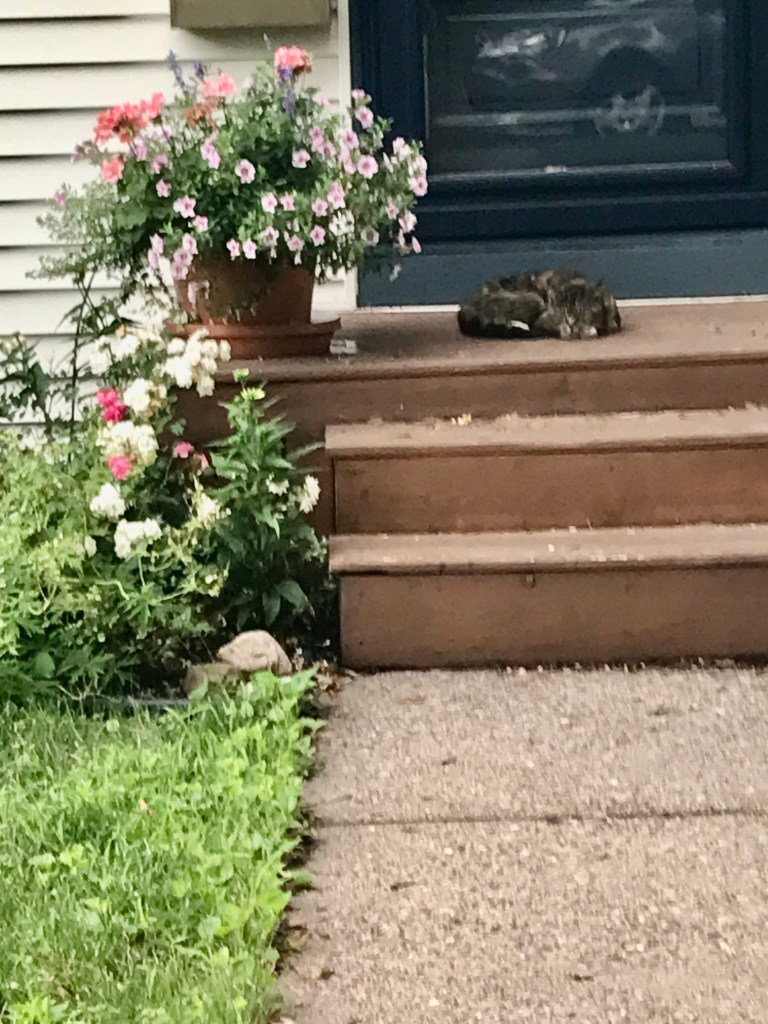
While on my morning walk, I spotted this dozing kitty. Clearly, its rhythm for the morning was rest. Perhaps later it would play with a ball of yarn, give itself a bath or scamper after a bug in the grass, but for right now, “Take it easy.”
You may recall that my Word for the Year is “rhythm;” a word that has proven to be so helpful as I move through my days. Many times a day I stop and read Sue Patton Thoele’s words, which I have taped to my laptop.
I ask myself, What is today’s rhythm? Or the rhythm needed for this exact moment? What is my rhythm and how does my rhythm meet the needs and demands and expectations for right now?
Sunday mornings, usually before going to church for the early service, I consult my calendar for the new week, noting appointments and events, and I make the week’s To Do list.
My lists include writing plans; social events to arrange; preparation for the writing group I lead and the one in which I am a participant; household tasks like paying bills, as well as a list of names–those I want to email or send a card or letter. Some weeks the list feels more manageable than others. Some weeks the list contains items moved from one week to another. “Leftovers,” I call them. Some weeks feel more spacious than others and others, full of possibilities.
This list outlines the external rhythm for the week, but not to be ignored is my internal rhythm. How will the two fit together? And how will the rhythm of “doing” match the rhythm of “being”?
As I enter Sunday morning worship, I hold this peek into the coming days in my heart. I pray I might be open to what I am asked to do, what I need to do, and that I might be a welcoming presence for those scheduled to meet with me in spiritual direction sessions. I pray I might be flexible when needed, but also that I not ignore the internal call of my own rhythms, whether it is to rest and restore in solitude or to seek companionship.
Being aware of the days’ rhythms means paying attention to my body. One morning last week I slept over an hour later than I normally do, and I was shocked when I looked at the clock. My first inclination was to chastise myself and to think about the time lost. Oh, what I could have done in that hour and how would I make up the time! Then, however, and I am pleased to say this, I relaxed into the rhythm of the rest of the day. I had worked hard the day before, doing some cleaning I had not done in quite some time, and my body needed the extra rest. My body knew it and took over.
is this attention to rhythm just a sneaky way to talk about changes as I age? Maybe, but sitting at my desk in the garret, I hear the soft ripple of water in my tabletop fountain and I see the collage of pieces done by friend and artist Steve Sorman, and I sense the rhythm of God in my life now, and the invitation to live that rhythm. Right now.
Joan Chittister, O.S.B., is a Benedictine nun, theologian, speaker, and prolific author. As a visionary voice in church and society, she has served in a variety of leadership roles, including co-chair of the UN sponsored Global Peace Initiative of Women.
Occasionally, actually more than occasionally, Chittister is the object of controversy and criticism–for her stances on contraception, abortion, women’s ordination as contradicting Roman Catholic teaching. Several years ago she was prohibited by the Catholic patriarchy from attending the first Women’s Ordination Worldwide Conference, and –no surprise–she not only attended, but gave the opening address.
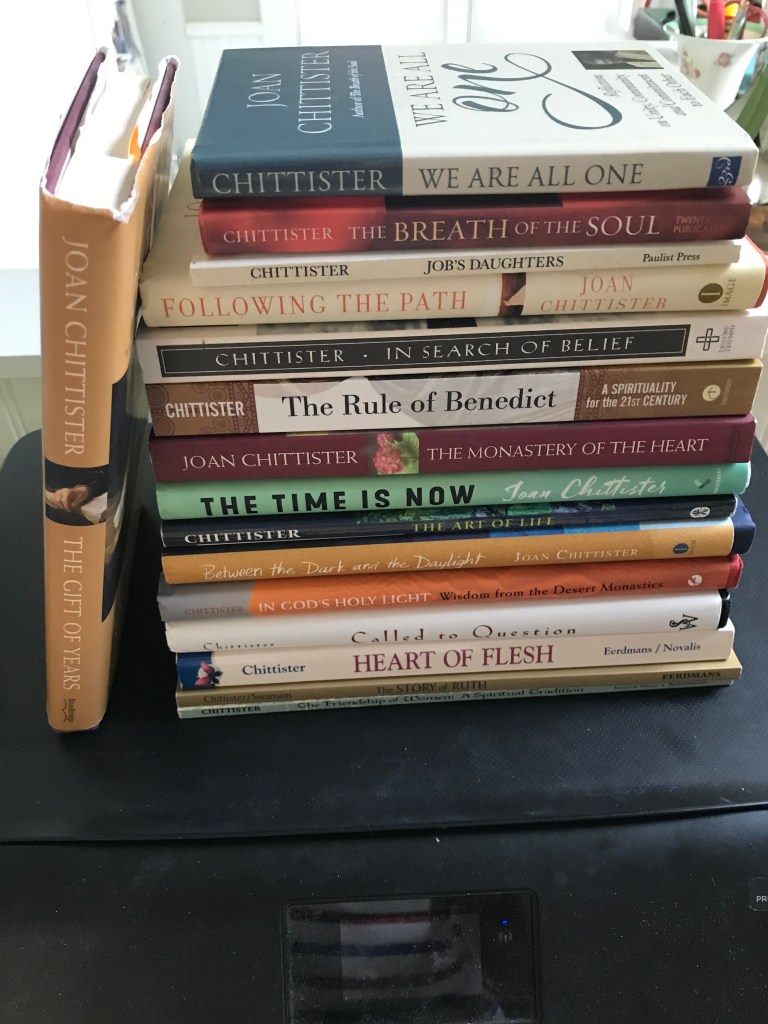
Even though I have never met her I consider her one of my spiritual directors. I have heard her speak many times, most often at the Chautauqua Institution in New York, where she is a frequent and popular speaker at the afternoon theology forums, and, of course, I have read many of her books.
We Are All One, Reflections on Unity, Community, and Commitment to Each Other (2018)
This small book is my current “before I make the bed” book.
One of the chapters, “Holy Accountability” begins with this quote:
It is not God’s fault that things are as they are at present, but our own.
Etty Hillesum
Not the Republicans’ fault. Not the former President’s fault (or the current one). Not the superintendent of schools or the mayor or police department or the neighbor who doesn’t mow his lawn or the parent who doesn’t discipline his child or…..
No, the fault is our own. My own.
As if that weren’t enough, Chittister asks,
Here’s a quiz: What do the Adam and Eve story and the presidential election of 2016 in the United States have in common? Give up? It’s easy: free will, accountability–and oh, yes, a snake in the tree.
p. 41
Does that grab you? Chittister goes on to remind us that Adam and Eve lost “paradise” because they ignored their responsibilities. Ouch.
One of her attributes as a writer and a speaker is her ability to target the heart of a matter in a few words and to challenge the reader/listener to examine beliefs and perspectives and then to respond.
The great human task is to make life better for everyone. To be satisfied with anything less marks us as less than fully developed human beings.
p. 45
The Gift of Years, Growing Older Gracefully (2008)
I own sixteen Joan Chittister books; many I have read more than once. The Gift of Years has become sacred text for me, and I consult it frequently, trusting its wisdom and its ability to challenge my fears and enlarge my vision.
Again, in a few words, Chittister tackles big topics, such as regret, letting go, loneliness, transformation, forgiveness, faith. With each topic she opens me to both burden and the blessing. For example:
The burden of regret is that, unless we come to understand the value of the choices we made in the past, we may fail to see the gifts they have brought us.
The blessing of regret is clear–it brings us, if we are willing to face it head on, to the point of being present to this new time of life in an entirely new way. It urges us on to continue becoming.
p. 5
Chittister does not have her head in the sand about the challenges of becoming older, of being old, (She wrote this at age 72 and is now 86 and still writing and speaking and influencing.) but, instead, she reminds us that even in this stage of life there is life to live. I am still becoming.
Other Chittister Books
I think it may be time to re-read The Time is Now, A Call to Uncommon Courage (2019) and Between the Dark and the Daylight, Embracing the Contradictions of Life (2015). I am also tempted to add The Monastic Heart: 50 Simple Practices for a Contemplative and Fulfilling Life to my library.
As I said, Joan Chittister is one of my spiritual guides, and I need more time with her.
When my husband and I were first married, and he was in medical school, I taught high school English at a large and diverse public high school in Webster Groves, Missouri. That job supported us during those years, but that was in 1971 and my income didn’t make a difference when I applied for a credit card. Only my husband’s income counted, but he didn’t have an income.
In his last year of medical school I was pregnant. Our first child was due in August, which meant I would be able to teach through the end of the school year, and then we would move back to Minnesota where Bruce would be a resident in family practice. He would have an income.
What I didn’t know those first months of my pregnancy was that the superintendent of schools and the principal (both white men) conferred to decide if I would be allowed to continue teaching. Apparently, school board members were consulted as well. You see, I was the first female teacher in the school district who didn’t lose my job because of pregnancy.
There is another piece to this story. There were a number of students, who were also pregnant, and during the lunch hour we gathered in my classroom to talk about how we were feeling and what we saw in our futures. I was the only one who had a bright future; a future that included a husband with a good job; a future that included good medical care; a future that welcomed this new life I was growing.
I know some faculty members felt those young women should not have been allowed to continue attending classes, and I also recall some of my colleagues who were uncomfortable working with a pregnant teacher and expressed that discomfort, making off-color remarks.
I have often thought about those young women sitting uncomfortably in my classroom on chairs not made for pregnant women. What has happened to them and to their babies? And what do they think about the recent Supreme Court decision.
I tell these stories because they are examples of women not being viewed as full human beings, as people deserving of all the rights assumed by men, especially white men.
Others decided what I and other women were allowed to do and how to move forward in our lives.
The next decades saw lots of changes. Thank you feminists of both sexes for working to make these changes. Not all was perfect. Not everything changed, and the fight for equality for all has continued, but now, just like the children’s game, Simon Says, the Supreme Court has dictated, “Take a giant step backwards.” The writer Glennon Doyle calls this time “The Great Backslide.”
I am angry and I am sad. And I am scared about the future.
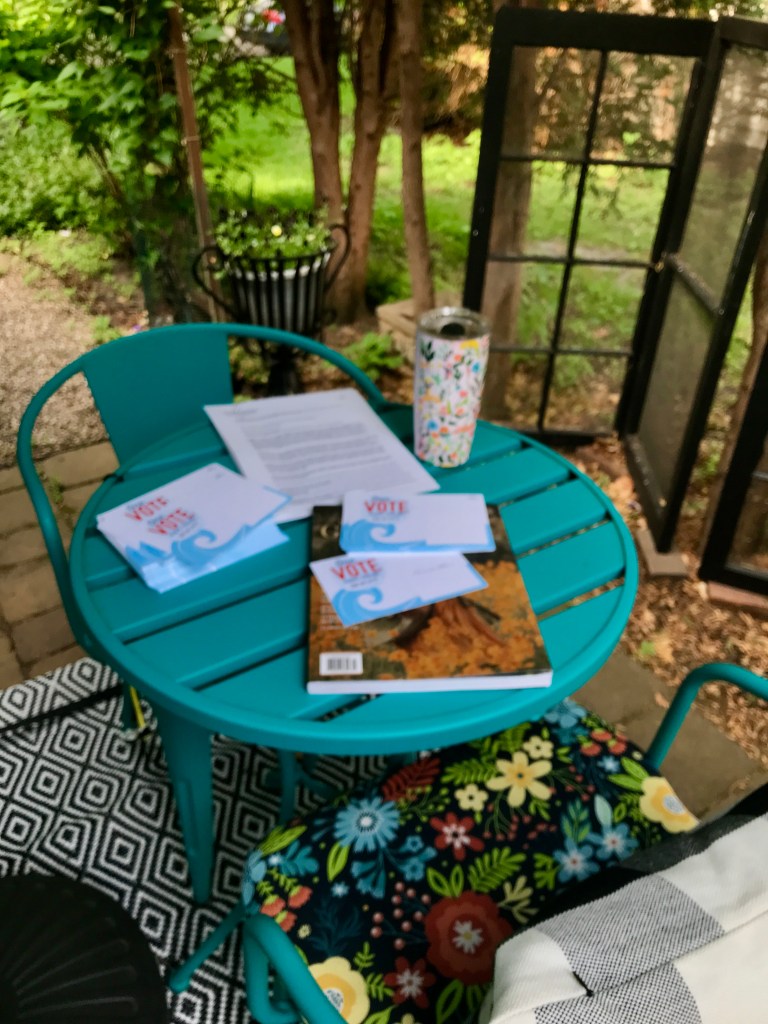
Earlier in the week I sat in my “Paris” garden and addressed and wrote messages on postcards to be sent to registered Democratic voters in Florida. The message was a simple reminder to request mail-in ballots for the upcoming election. I supplied the postcards, the stamps, and the time, and Postcards to Voters sent me the instructions and a mailing list. The morning’s task felt like prayer.
Be angry. Be sad, and acknowledge your fear, but at the same time lift your voice in the way that truly makes a difference: VOTE.
Vote and remind others to vote. Are there young people in your lives who are eligible to vote? Ask them if they have registered? If they haven’t, let them know what they need to do and help them do that, if necessary. Share stories and experiences with them about what it means to live without the right to live authentically and fully. Tell them to celebrate your birthday or the 4th of July by requesting a mail-in ballot.
It is good to march and protest and certainly to support worthy candidates and causes financially, but ultimately, what each of us can do and needs to do is vote. Vote for candidates who are willing to support the rights of all people.
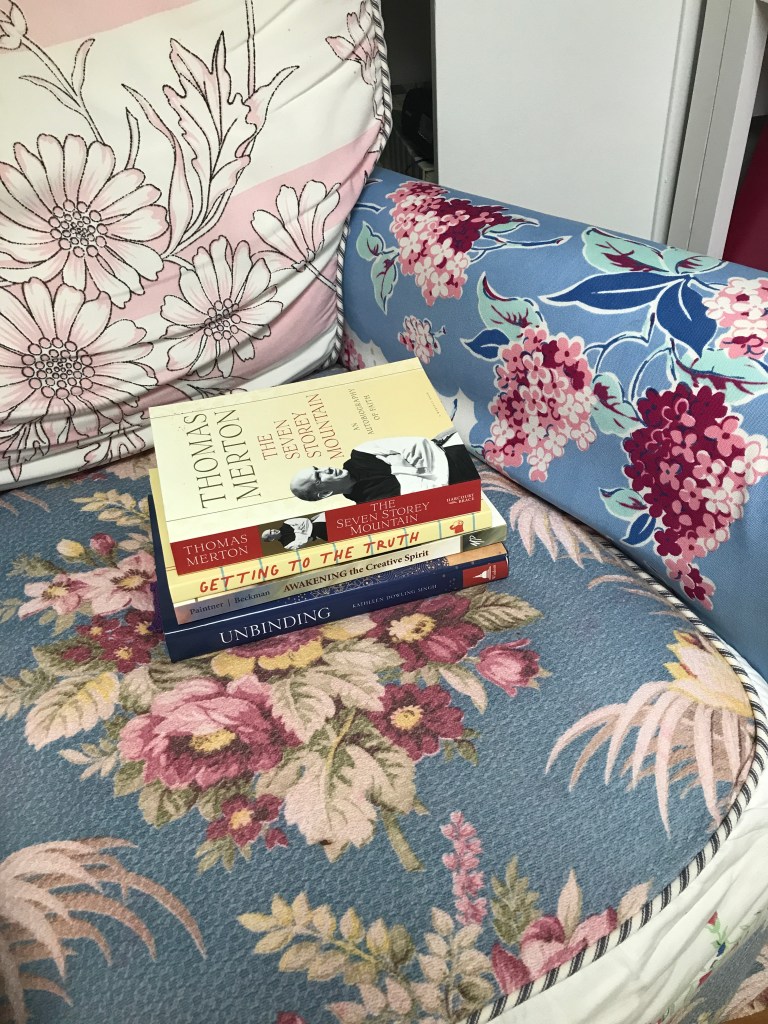
In the summer I am more apt to begin my day with a walking meditation than reading, writing in my journal, and praying in my Girlfriend Chair in the garret. However, some days I still create time for devotions, study, and reading. My current stack is enticing.
The Seven Story Mountain, An Autobiography of Faith by Thomas Merton (1948). I can’t quite believe I have never read this classic, although I have read a number of other Merton titles. For example, both New Seeds of Contemplation (1961) and Spiritual Direction and Meditation (1960) have been important books in my own spiritual development. This spring I found a copy of The Seven Story Mountain in a Little Free Library. “Now is the time.” In the introduction Robert Giroux, Merton’s friend and editor, relates a story about receiving a piece of hate mail. “Tell this talking Trappist who took a vow of silence to shut up!” Giroux’s answer was “Writing is a form of contemplation.” That was all I needed to begin reading this work of contemplation, which I am reading contemplatively. An aside: Merton was accidentally electrocuted in Bangkok in 1968. I was a student there then, but knew nothing about Merton or his death and only later was drawn to his work.
Unbinding, The Grace Beyond Self by Kathleen Dowling Singh (2017). I bought this book when I attended a writing retreat led by Karen Hering at the Christine Center, Willard, WI, in 2019. Sometimes books just need to percolate on my shelves, but like the Merton book, this seems like the right time. Both The Grace in Aging, Awaken As You Grow Older (2014) and The Grace in Living, Recognize It, Trust It, Abide in It (2016) have become sacred texts in my life, and I was so pleased to find a more recent book. Singh died in 2017. I am reading this slowly, too, and resting in her wisdom.
Awakening the Creative Spirit, Bringing the Arts to Spiritual Direction by Christine Valters Paintner and Betsey Beckman (2010). You may recognize Paintner as the abbess for Abbey of the Arts. https://abbeyofthearts.com Beckman is a dancer and a practitioner of dance therapy. Over the years I have read many books by Paintner and have been privileged to be a guest writer in her weekly newsletter. I decided to dip into this book right now for a couple reasons. First, I think it may inspire some prompts for the weekly writing group I facilitate, but second, I am feeling a bit dry creatively myself, and I expect I will find inspiration on these pages. I’ll let you know.
Getting to the Truth, The Craft and Practice of Nonfiction from the editors of Hippocampus Magazine (2021). I almost added this to my discard pile after I decided to set aside any further work on my spiritual memoir, but some of the essay titles intrigue me, like “Why You Should Write About What You Don’t Remember” by Wendy Fontaine and “One-Moment Memoir” by Jenna McGuiggan. I don’t promise to read every essay nor do I imagine doing the exercises, but I intend to read this more as a contemplative reflection on next steps in my own writing. Again, I’ll let you know.
Off the meditation cushion, aka my Girlfriend Chair, I continue to read good fiction. I’ll give the June Book Report on Thursday, June 30.
An Invitation
What are you reading that you hope will inspire you or will lead you into deeper reflection? I would love to know.
This is what summer looks like in our backyard, thanks to the resident gardener in our house.
Each time I walk from the backdoor to the garage or look out the kitchen window or sit, book in hand, on the patio, I am reminded to savor this season and to notice the gifts of God in these days and in our lives.
If you are an ongoing reader of this blog, you know that I am not a summer person. I am a winter person who relishes hibernation and cave time. I meet God in the stillness, the quiet, the dark that arrives early in the afternoon and leaves late in the morning. In stews and soups simmering in my small kitchen, in sweaters and shawls and cozy throws thrown over my legs. Winter feeds my introverted soul.
My Summer Story
Because my father worked for a large corporation and was transferred and promoted often, summer began when a moving van pulled up in front of our house, usually as soon as the school year ended. For me, summer was a time of loss, leaving my friends and all that was familiar and known. Instead of a time of fun and freedom, summer was a time of loneliness. I yearned for school to begin in the fall where I could meet kids my own age and find a place for myself in new classrooms. But I also felt anxiety during those summer months. Would I like my new school? Would I make new friends?
In my adult years I’ve reframed that loneliness into solitude, and I wrap my spiritual practices in silence and stillness. I realize, however, that I still carry with me the stigma of those empty summer days of my childhood.
Leave them behind, I remind myself, but also learn from them. What can summer mean for me now?
Now is the time, I tell myself, to open to the invitations of this season–to live beyond the irritation of mosquitos and sweat and frizzy hair and nonexistent breezes.
Now is the time to both create and respond to the rhythm of this summer.
Opening to this Summer
As always I begin in silence. Sitting in my comfortable chair in the garret, I close my eyes lightly, not tightly, and take a couple deep cleansing breaths, finding my own rhythm. I allow questions to emerge:
How am I as I enter this summer season?
What do I need now? Do I need rest? Change of place, of pace? Inspiration? Connection? What is the call of this summer? What is possible this summer?
How can this summer season meet my needs? How can I invite God to be with me during this time?
Is there a spiritual practice calling me or a new way of becoming present to something I currently do in my life?
What have I learned during the winter and spring months that will enhance these summer months? What do I bring with me from those recent seasons? What is unfinished? What do I need to put down?
I open my journal and jot down a few words–“spaciousness,” for example, but I make no attempt to answer all these questions in one sitting. I know some questions will answer themselves as I move through the days, and others will emerge, but in the silence I become more aware of who I am and how and to what God calls me at this time.
Summer Spaciousness
Instead of that summer loneliness I experienced as a child, I relish these open days. Days that unfold. Spacious days offering time to read, to doze, to celebrate the glories of the June color blast garden.
When our children were young, we made summer lists –things we wanted to do and places we wanted to go–but now we mention in passing trips we could take or things we could do, but neither of us seems to be making the arrangements or plans. We are both content right here, right now.
Instead of a hummingbird who is in constant motion, vibration that delights, I am more like our big old dog, Boe, who lived with us at Sweetwater Farm. He was content no matter where he was. Stretched out under the harvest table, he opened one eye as I passed through from my office to the kitchen, and maybe he thumped his tail greeting me, but otherwise he didn’t move.
These days seem to stretch out before me, and I feel the twists and turns of life untangle. No, those twists and turns don’t quite disappear, but they feel more manageable, more breathable in the slightest of summer breezes.
Summer Themes
The arrival of summer solstice can be an invitation to notice the unfolding and opening of summer days in your life. Do any of the following summer themes resonate with you? Do any of them open memories of past summers? Which of these summer themes shimmer and tickle and lift an “ah” to your lips? Pay attention. God is moving in your summer days.
Summer Spontaneity
Summer Senses
Summer Spaciousness
Summer Simplicity
Summer Shifts
Summer Sacred Space
Summer Silliness
Summer Stillness
Summer Stretching
Summer Celebrations
Summer Support
Summer Sadness
Summer Sweetness
Summer Spiritual Practices
Is a new spiritual practice beckoning you? Or is summer a chance to adapt your ongoing spiritual practice in a new way? For example, moving your prayer and meditation time outside. Here are some possibilities:
Keep a summer journal. Pilgrims carried a small book with them a vade mecum, which means “go with me.” In the journal they wrote prayers, poems, and wisdom for the journey, but it would also be a way to record what you notice and learn and feel as you wander and roam. Where do you notice the movement of God?
Practice visio divina (sacred seeing), which is similar to lectio divina (holy reading). This practice invites you to see with the eyes of the heart and to pay attention to what shimmers, what invites you, what startles or amazes you. Where do you discover outdoor “chapels”? Perhaps commit to taking one photo a day and at the end of the summer print your photos. Do you notice any patterns? Where did God appear for you?
Other practices include extending hospitality to guests, gardening, walking outdoor labyrinths, spending time in nature, stargazing, pausing to send blessings out into the world as you open windows, volunteering in some new way in the community, trying something new that challenges you. Change your routine in some way and notice what that opens for you.
How about inviting a loved one to a practice of sharing daily with each other one gift, one expression of God, noticed or experienced?
I invite you and I invite myself to open to summer.
A Blessing
May the God of summer give us beauty.
May the God of summer give us rest.
May the God of summer give us joy.
May the God of summer give us inner light.
May the God of summer gives us what we need for healing.
May the God of summer give us a sense of satisfaction in the work of our hands.
May the God of summer lead us to amazing discoveries as we travel the inner roads of our soul.
Amen.
adapted from Joyce Rupp
An Invitation
What intentions do you have for this summer? I would love to know.
I heard voices. I thought I was dreaming until I heard the distinctive “thump, thump, thump” of someone jumping on the neighbors’ trampoline.
I got out of bed and walked to the kitchen window where I could see the trampoline in the backyard next door, and three boys were laughing and talking and jumping.
Did I mention that it was 11:45 PM?
Perhaps they heard me or felt my presence, but they then quietly disappeared into the house.
I wish I could say that I slept well the rest of the night, but that was not the case. I knew I needed to talk with the parents, for middle of the night trampoline parties held by elementary school-aged children is not ok. I was quite certain it was not ok with the parents either and for whatever reason they were not aware of the backyard action, but still I was not eager to be the mean old woman on the block.
The next afternoon I went next door, and when the young Dad came to the door, I said, “I hate to do this, but did you know your boys were jumping on the trampoline at 11:45 last night?”
No, he had no idea. The boys had a sleepover and after setting them up with a movie at 10:00 pm, he and his wife went to bed, congratulating themselves that all seemed to be well. He apologized and assured me they would take care of it.
I reassured him that we thoroughly enjoy the boys and emphasized my hope that the boys knew they could always turn to us if they needed help of any kind.
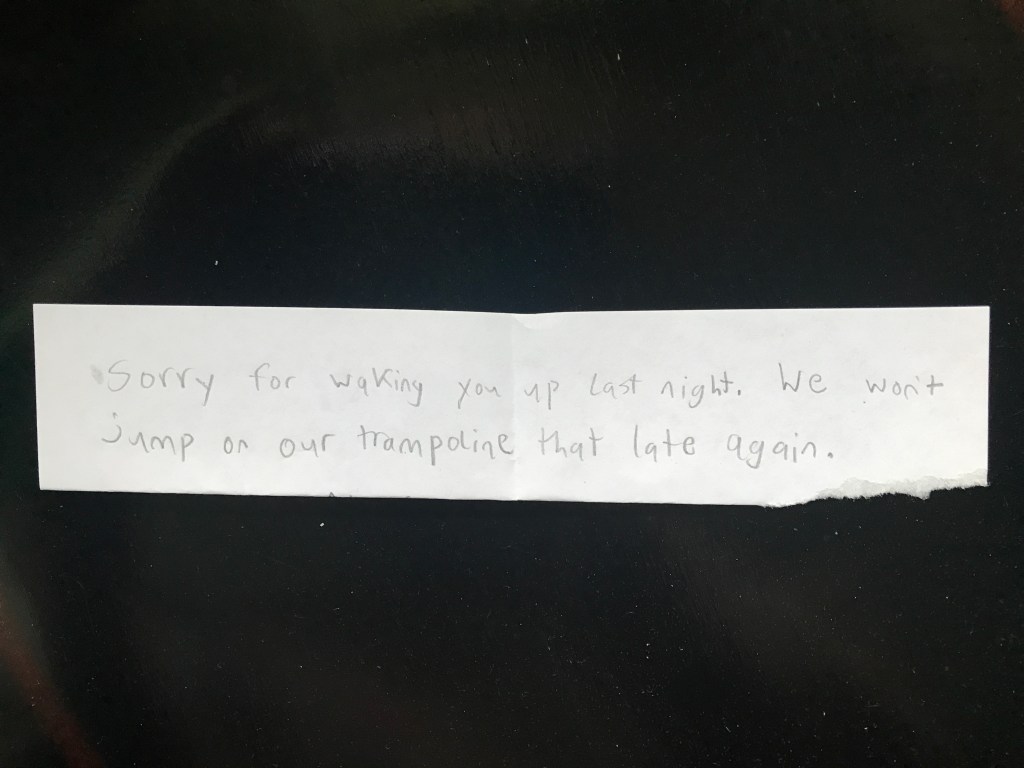
A bit later I received a note of apology. The note is now on my bulletin board–a sweet treasure and a symbol of how it, indeed, takes a village to care for our children.
We have 22 children on our block, and it delights my husband and I to see them playing with each other outside, racing up and down the block, making up games, and enjoying big chunks of non-screen time. There is an air of safety, and I trust that everyone on the block takes responsibility for the care and protection of those children.
However, I also know that in the bigger picture we have failed our children. We have failed to protect them. Parents are afraid. Teachers are afraid. Children are afraid. And yet, we continue to ignore ways to protect our children, and, in fact, all of us by not enacting gun regulation laws. And it is up to each of us, everyone in the village, to create the change that will allow our children to grow without fear or trauma that will color the way they live the rest of their lives.
An Invitation
How are you willing to be part of the village that cares and protects our children? I would love to know.
What was once overflowing is now orderly and neat.
I even have empty drawers and shelves in the garret.
Such a good feeling.
Cleaning and home tending is one of my spiritual practices, and clearing the space is often the first step (or is it the last step?) when I move into the next stage of a project or prepare to start something new. That was true this time, for I have been in the process of discernment about ongoing work on my memoir. But this time the process of cleaning and sorting and discarding and letting go has also been a process of life review.
Each folder contained plans for a class I taught, a retreat I led, a talk I presented or a collection of ideas for an article to write or one already written.
One folder bulged with all the plans and materials for spirituality groups I led years ago at a center for those touched by cancer. I felt myself doing a bit of time-traveling, remembering the openness and vulnerability in those groups. I called one of those sessions “When Cancer Rearranges Your Furniture,” and brought in pieces of dollhouse furniture, which led to deep sharing about all the ways the participants experienced change in their everyday lives. In another session, I used Christina Baldwin’s book The Seven Whispers, Listening to the Voice of Spirit (2002) to discuss the topic “ask for what you need, offer what you can.” Such a privilege it was to sit with people willing to explore their spirituality during difficult times. Later I was diagnosed with cancer myself and needed to probe my own spiritual grounding for strength and comfort.
Over the years I have considered writing a compilation of those ideas and exercises, and maybe now is the time. I keep that folder.
I also keep folders of materials about this stage of life, including the folder labeled “Growing Older with Grace, Spiritual Practices for the Second Half of Life,” a retreat I co-led in 2015; one of the first programs I did for my church. That event opened the door to ongoing ministry to older adults, a focus for me in recent years. As I toss duplicate copies and handwritten notes and scraps of paper, I remember individual interactions and responses to topics like “gratitude,” and “letting go,” and “entering the new year.”
The process continued, and I filled the recycling bin with what no longer feels relevant or no longer holds my interest or quite simply, feels done. Been there, done that.
I simplified physical space, a task many of us at this stage of our lives feel compelled to do, but I honored myself. “Nancy, you have done good work.” As I opened each folder I retraced paths of what have been important to me and ways I have used my gifts. I delighted in my own creativity and my teaching and organizational skills
And that is a good thing.
I am not done teaching or leading groups, but this clearing the space process, which is ongoing, opens me to what is possible and life-enhancing in my life. Where do I need and want to spend my energy at this stage of my life? And that is the key question for me.
The garret feels fresh and clean. And open.
An Invitation
How is the process of downsizing or simplifying the contents of your home, also a process of life review for you? I would love to know.
I have grieved the loss of parents, grandparents, aunts and uncles.
I have grieved the loss of friends who died far too young and hospice patients with whom I sat at the end of their lives.
I have grieved the impending loss of others who are facing serious health concerns.
I have grieved the loss of so many in our country killed unjustly. Murdered.
I have grieved roads not taken.
I have grieved unwelcome changes.
Grief is not an unknown in my life, and I know it is not unfamiliar to you, either.
But this…
Years ago in a class on spiritual practices I taught, the participants made their own string of prayer beads. I have used mine occasionally since then, but not regularly. Now seemed like the right time.
Sitting in silence, I fingered the beads; each one a symbol for one of the children slaughtered and their beloved teachers. My string of beads were not long enough and I returned to the beginning again and again, holding the loss of all those who loved them. I wish I could say I felt calmer as my fingers moved from bead to bead, but that was not the case. Instead, I felt the pain more deeply.
I think I am to feel that pain sear through my body, for only then can change begin to take shape.
I don’t know what kind of action that means for me, other than making donations to worthwhile organizations, but in the meantime I sit with the beads; the beads that leave an impression on my fingertips.
Part Two
I gave the weekly writing group I facilitate at church the following prompt:
Write what is on your heart. Write your tears, your rage, your fears. Write what is at the bottom of your heart, and write what is touching your heart. Write your prayers. Write your lament. Write as a mother. Write.
During the sharing/listening time, one of the participants, who gave me permission to share the following, said her adult daughter had asked her, “What did you worry about when we were growing up?” She admitted she had to think about her answer. She thought she had probably worried about her children getting good grades and using good manners and living with a love of God and family.
I am not a huge worrier, but I suspect I worried about our children doing well in school and having good friends and making good decisions about difficult choices.
Not once did I worry about our children being murdered at school. That never occurred to me.
Part Three
Does anyone else see the irony, the inconsistency with the NRA forbidding the presence of weapons at their convention in Texas this past weekend, but at the same time they think providing teachers with weapons in the classroom is the answer?
Part Four
Pray AND…
You decide what that means; what action you can perform. Begin with prayer and then…
An Invitation
So many wise and important words and reflections have been offered in recent days, and I am grateful for how they have helped me sit with what we have created and allowed to happen in this country. I wonder what has been meaningful to you these past days and now where the wisdom gained will lead you. I would love to know.
First thing Monday morning my husband headed to church to confront the nasty thistles invading the gardens. This has been and continues to be an ongoing battle, and one that will not be won today or tomorrow, but I admire his determination and commitment.
Thistles appear in our lives in many ways, and lately, thistles seem to be conducting on assault.
Daily, it seems, I hear news of family and friends challenged by serious health or economic concerns or the death of a loved one. Sunday morning, even before I was dressed, my husband showed me a post on Facebook about someone in our extended family who is experiencing hard times. We discussed ways to respond, but at the same time we can not make the basic problem disappear.
That’s a big thistle.
Thistles are prickly. They sting and their roots are deep. They don’t give up easily the places they’ve claimed in the garden. They tend to take over everything that has been loving and intentionally planted, and sometimes it is hard to see the growth, other than the unwanted thistle.
No one chooses a thistle. No one says, “Do we have room in the garden for a thistle?” Nope, they assert themselves without our consent or design.
So what do we do with these thistles?
Here’s what I am learning as a woman in her mid seventies: I have to leave room in my day for grieving, for feeling loss and sadness and sometimes shock. That means being even more intentional about my morning meditation time, which more and more means holding those in my heart who need tender care.
But I also have to leave room in my day for responding to those with tangible needs. Sometimes that means an in-person response –a meal, a visit, an offer to….–or it may mean a more distanced response, writing a note, sending a check, making sure others who need to know do, in fact, know.
Dealing with thistles takes energy, and I sometimes feel the toll encountering so many thistles takes on my spirit. I know that being present to the pain of others means I must be aware of my own feelings and what I am able to do at this stage of my life.
Doris Grumbach in her memoir The Pleasure of Their Company (2000,) which she wrote as she approached her 80th birthday, used the term, “lessening.”
I prefer lessening as both instruction and slogan for my old age.
page 50.
What that suggests to me in my life is choosing carefully, thinking wisely about how I use my energy, for one thing I know for sure: There will be more thistles.
Now is a good and necessary time to ask myself how many commitments are reasonable? What is the call in my life now and how can I respond? How do I best live my essence in this third chapter of my life? How do I create spaciousness in my life to be with the expected unexpected?
Two Thoughts for Reflection
The times are urgent; let us slow down.
African Saying
May you embrace this day, not just as any old day, but as this day. Your day. Held in trust by you, in a singular place, called now.
Carrie Newcomer
May your thistles not overwhelm your garden.
An Invitation
How do you respond to your thistles? I would love to know?
How many times in recent months or, let’s face it, these past few years, have you said, “I just can’t watch (or listen) to the news anymore”? Or perhaps you have been addicted to the news, watching and listening more hours of the day than you know is healthy for you. Perhaps the radio or a cable news station accompanies your every move, wherever you are, whatever you are doing.
No surprise, for the news –local, national, and global–is upsetting, and that is stating it mildly.
Approaching the News as a Spiritual Practice
Jane Vennard in her book, Fully Awake and Truly Alive, Spiritual Practices to Nurture Your Soul (2013) says all spiritual practices can be divided into three categories. (page 87)
Contemplative: caring for my body, resting, being silent, practicing solitude, praying, writing in my journal, walking mindfully,
Communal: participating in the life of a faith community or other communities in which you gather with others to pay attention to the holy in your life,
Missional: hospitality and service.
While the lines dividing the three types of spiritual practice are not always clear and well-defined, as Vennard points out, these categories of spiritual practice can help us become more intentional about our approach to the news.
Part of my morning meditation time, my intentional contemplative time sitting quietly in the garret or walking alone in the neighborhood, often is devoted to praying the news. I may simply name the issues or the people that worry me or touch my heart. I don’t pretend to have answers, but I lean my heart in the direction of those in need, those in pain or in the midst of sorrow and loss, and those who are trying to make a positive difference. Plus, I acknowledge and give thanks for the many gifts in my life; a life lived with ease and privilege and prosperity. I must never take that for granted.
Do my prayers matter? Well, that is a big question, but what I’ve noticed is that when I pray regularly I am more aware of the life around me. Near and far. When I watch or listen to or read the news, I pay attention to my responses. In a way I test my empathy level. Have I become hardened to the news? Do I sigh in disgust (“How could things possibly be worse?”) or descend into hopelessness (“That’s the way things are and what can we do about it anyway?”) Or do I approach the news looking for connection, for our common humanity, for reminders that God is counting on us to live into his love for us?
What I’ve discovered is that the more I pray, the more I find to pray about and the more I find to pray about the more I pray. And the more I pray, I don’t just pray the hurts, the losses, the fears, the unending challenges, but I also pray the love shown, the paths created, the courage, the care, and the revealed movement of God.
Along with this contemplative approach to the news, I have a communal practice. I am an active member of a faith community with a strong commitment to social justice issues. I value our gathering times when we lift not just our individual concerns, but our concerns for the world. Being part of a community gives me a base from which to move in the world, to respond to the news, and provides opportunities for the missional type of spiritual practice. Ways to serve.
Receiving the news is not only a way to stay informed, as important as that is, but it is also a way to strengthen my way of being in the world–as a contemplative who lives and serves with purpose in community. At least that is my aspiration.
My Choices: My News Sources
Even though I try to view my approach to news as a spiritual practice, the choices are overwhelming. Here’s my current buffet of choices:
I listen to Minnesota Public Radio/National Public Radio when I get dressed in the morning and when I prepare meals or clean.
I receive daily emails from The Washington Post and The New York Times.
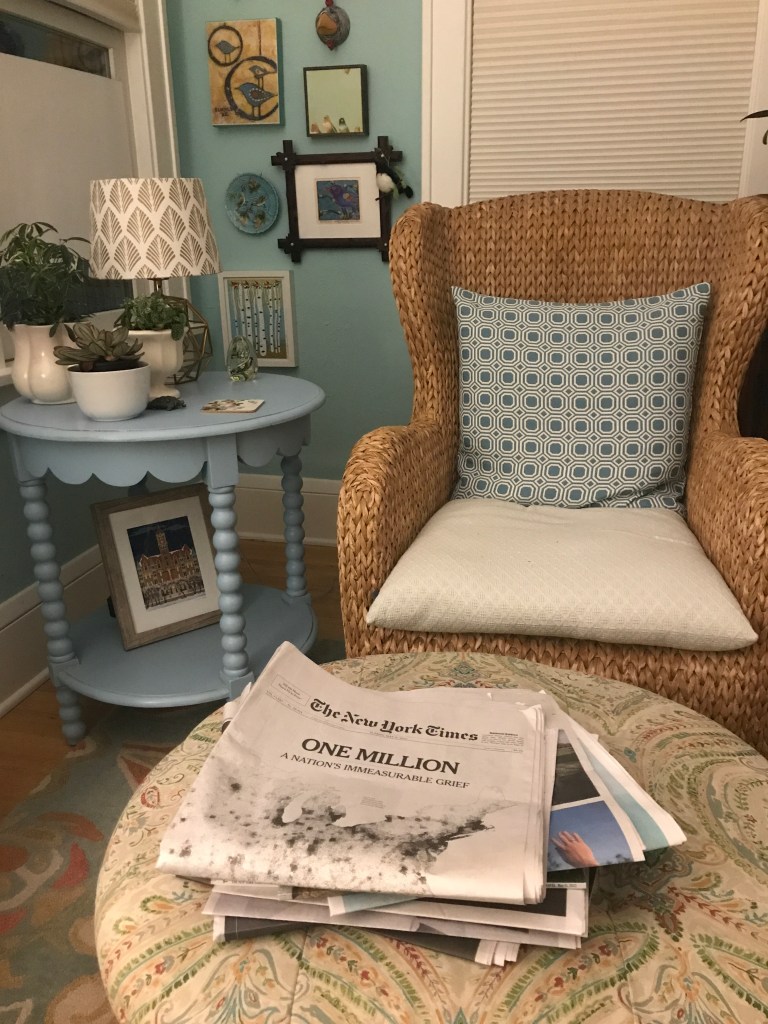
I read the Sunday New York Times–not always on Sunday, however. I admit I start with the Book Review and some Sundays I don’t get much further than that, but even reading the rest of the paper on Tuesday or Wednesday is valuable.
We watch the nightly PBS News Hour. Lately, we have fasted from watching any television news, but when we do, this is our choice.
A Thought
it isn’t more light we need, it’s putting into practice what light we already have. When we do that, wonderful things will happen within our lives and within our world.
Peace Pilgrim
An Invitation
What is your relationship to the news? What is your news strategy? I would love to know.







 Living on Life's Labyrinth