Even though I have MANY books on my shelves I have not yet read, including those recently acquired, and even though my list of books I intend to request from the library is long, I still covet many new books–yet to be released this fall or recently released. Here’s my list:
Fiction
Lucy By The Sea by Elizabeth Strout
A World of Curiosities by Louise Penny (Nov 29)
Killers of a Certain Age by Deanna Rayburn
The Marriage Portrait by Maggie O’Farrell
The Bullet That Missed by Richard Osman
The Ski Jumpers by Peter Geye
The Evening Hero by Marie Myung-Ok Lee
Lessons by Ian McEwan
Oh, and I am attracted to the British Library Women Writers Series–forgotten works by mid-century women writers. I think there are 18 in the series.
Nonfiction
Sacred Nature: Restoring Our Ancient Bond with the Natural World by Karen Armstrong
A Place in the World, Finding the Meaning of Home by Frances Mayes
Hagitude, Reimagine the Second Half of Life by Sharon Blackie
How We Live Is How We Die by Pema Chodron
The scary thing is that I know I will be enticed by many other titles along the way–and every time I enter a bookstore. I guess as addictions go this problem isn’t too bad.
An Invitation
What new books are tempting you? I would love to know.
Sometimes a book does everything but jump into your hands. That was the case with two books I read recently.
I must have read a review of The Green Hour, A Natural History of Home by Alison Townsend (2021), for I added it to my TBR list, but when I saw it in Arcadia Books on our recent trip to Spring Green, WI, I knew I could not wait for it to come out in paperback or for the library to add it to their shelves.
First of all, look at that cover. So beautiful, and it is the kind of book that simply feels good to hold. But more than that is the topic, the themes. The author grew up in Pennsylvania and as a young adult lived in Oregon and California, but later in adulthood moved to the Madison, Wisconsin area. She writes beautifully, richly about each landscape–the kind of multi-layered, descriptive writing I love–but having lived in Madison, those are the sections I loved the most.
Her essay, “Strange Angels: Encounters with Sandhill Cranes,” is perhaps the best nature essay I’ve ever read.
Like a group of pilgrims or spiritual seekers collecting before their journey begins and uttering preliminary prayers, the cranes seem to be readying themselves, preparing for the long flight they must make, some of them for the first time.
p. 159
Like the author I love the sound of the cranes and always feel blessed hearing them. “Perhaps that is why their call is so evocative, why it seems to float across the millennia as it does, immutable and enduring.” p. 160. Cranes are not part of my life here in St Paul, and I miss them.
I also loved the essay “An Alphabet of Here, A Prairie Sampler” as well. C is for Canada Geese. G is for Great-Horned Owl. Q id for Queen Anne’s Lace and Queen of the Prairie.
Z is for zigzags, zaps, and zings of summer lightning, the zed-shaped folds of the aurora opening its luminescent green curtains on a winter’s night when it’s twenty degrees below zero, and the z-z-z-z-z-ing as we sleep–cat on the bed, collies on the floor beside us–the zodiac swirling around us like the well of life that is here, now, the only one we are given.
p. 187
Some books beg to be read aloud, and I am grateful my husband was willing to listen as I read select essays to him while driving through the countryside on our way to Cleveland recently. This books was our perfect companion.
I discovered The White Stone, The Art of Letting Go by Esther de Waal (2021) when we toured the gardens at St John’s University, Collegeville, MN this summer. Because I can never resist a bookstore, we browsed the Liturgical Press bookstore on campus, and I found this little treasure. Years ago I read her book Seeking God, her book on Benedictine spirituality, but it is no longer in my library–I may need to get another copy. This book was written during the pandemic and at a time when she is moving from one home to another, and she employs what has sustained her through the years–the Rule of St. Benedict, the gifts of Celtic spirituality, the teachings of Thomas Merton, and the Psalms–to guide her through a time of transition.
I hold on to stability but I must not be static. Here is the paradox…I must be prepared for the continual transformation in which God is bringing the new out of the old…It is just a matter of somehow keeping on keeping on, a continual bending one’s life back to God whatever happens.
p. 64
I was especially moved by the chapter titled “Diminishment,” in which she reflects on how time seems different as we age, but also that “Life now brings a greater opportunity to pay attention to look consciously at the ordinary minutiae of daily life in the things around…”
She also underscores the key question of Benedictine life: “Am I becoming a more loving person?” When we were driving through Indiana, I noticed a small sign on the edge of a cornfield, “Fear God,” it said, and I thought to myself, “How does fearing God make me a more loving person?” Instead, I suspect adhering to that idea would make me a more fearful person. I want to be a more loving person. Thanks for the reminder, Esther de Waal.
Ok, that’s it. I am so happy these two books will live on our bookshelves.
An Invitation
Have any books found their way into your hands, your heart recently? I would love to know.
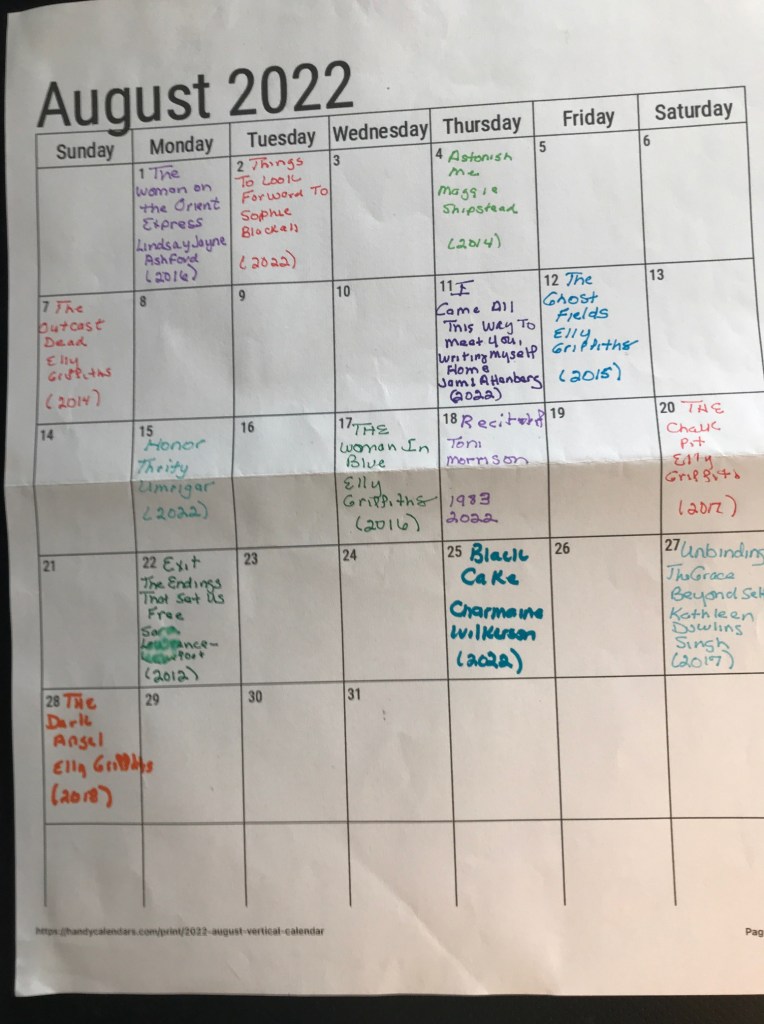
Along with continuing to read the Ruth Galloway Mystery series by Elly Griffiths (5 more this month), I read some stellar fiction, checking off several titles on my TBR list. I also read more nonfiction than in the last couple months–4 titles. So here’s the report.
Fiction
Astonish Me by Maggie Shipstead (2014). I have now completed Shipstead’s back list and I have enjoyed each one for their originality and freshness of plot and her development of characters. This novel, her second, is set in the world of ballet. The main character is a dancer in her young years, later becoming a ballet teacher whose son is a talented dancer. An important part of the story is her relationship with a Russian ballet dancer.
Honor by Thrity Umrigar (2022). I have enjoyed earlier books by the author, such as The Space Between Us and The Weight of Heaven, and was so pleased when this new novel was ready for me at the library. The main character, Smita, is an American journalist born in India. She is in India to cover a story about a Hindu woman who marries a Muslim man and suffers tragic consequences for that love. As Smita becomes involved with this woman, she is forced to confront her own background and to make life-changing decisions. At one point another character says to Smita, “You know what your problem is, Smita? You focus on the cat hair. Try focusing on the cat.” (p. 319)
Recitatif by Toni Morrison. (1983, but in a 2022 edition) This is the only short story Morrison wrote and the introduction by Zadie Smith is longer than the story itself. The story focuses on two women, one black and one white, but the reader does not know which is which. Clearly, the story is meant to highlight our own racism and adoption of stereotypes.
Black Cake by Charmaine Wilkerson (2022). I loved this book and so admire the deft way the author (This is her debut novel.) kept all the twists and turns and number of characters and the changes in their lives clear for the reader. The book is based first on an island, perhaps Jamaica, but also England and the U.S and the “black cake” of the title is a family tradition and also figures in the plot of the book, as does long-distance swimming and surfing. How’s that for an interesting combination? I don’t want to say more, at the risk of giving too much away. I repeat, I loved this book.
I also read The Woman on the Orient Express by Lindsay Jayne Ashford (2016), and it was a so-so read. Agatha Christie was the main character, so that was promising, but by the end I wondered what the point was. Can’t win them all.
Nonfiction
I wrote in two previous posts about two of the books I read in August. Things to Look Forward To, 52 Large and Small Joys for Today and Everyday by Sophie Blackall (2022) in the August 11 post and Exit, the Ending that Sets Us Free by Sara Lawrence-Lightfoot in the August 25th post. I read two other nonfiction titles.
I Came All This Way to Meet You, Writing Myself Home by Jamie Attenberg (2022). This was a plus-minus book for me. There was much in the book I didn’t enjoy and couldn’t relate to–drugs, drinking, uncommitted sex– and I am not sure I would like the author if I met her nor am I planning to read her novels. However, I copied two pages of quotes about books and writing in my book journal, and I appreciated much of what she says about solitude and about issues with her body. So plus-minus.
Unbinding, The Grace Beyond Self by Kathleen Dowling Singh (2017). I read this book over a long period of time, savoring and reflecting. Before this book I read and loved two others by Singh, The Grace in Aging, Awaken as You Grow Older (2014) and The Grace in Living, Recognize It, Trust It, Abide In It (2016). Unbinding, alas, was her last book before her death in 2017. I think I could read this book over and over again and not begin to receive all that is offered. Three chapters stand out for me, “Becoming,” “Aging and Death,” and “The Sacrament of Surrender.”
We are already into September and summer reading is behind us. Most of the books I read this summer were ones I got from the library, but in the meantime I acquired a number of books for my own library. I am planning to focus on those this month. We’ll see how that goes! Happy reading!
An Invitation
What do you recommend from your summer reading? Any reading plans for the fall? I would love to know.
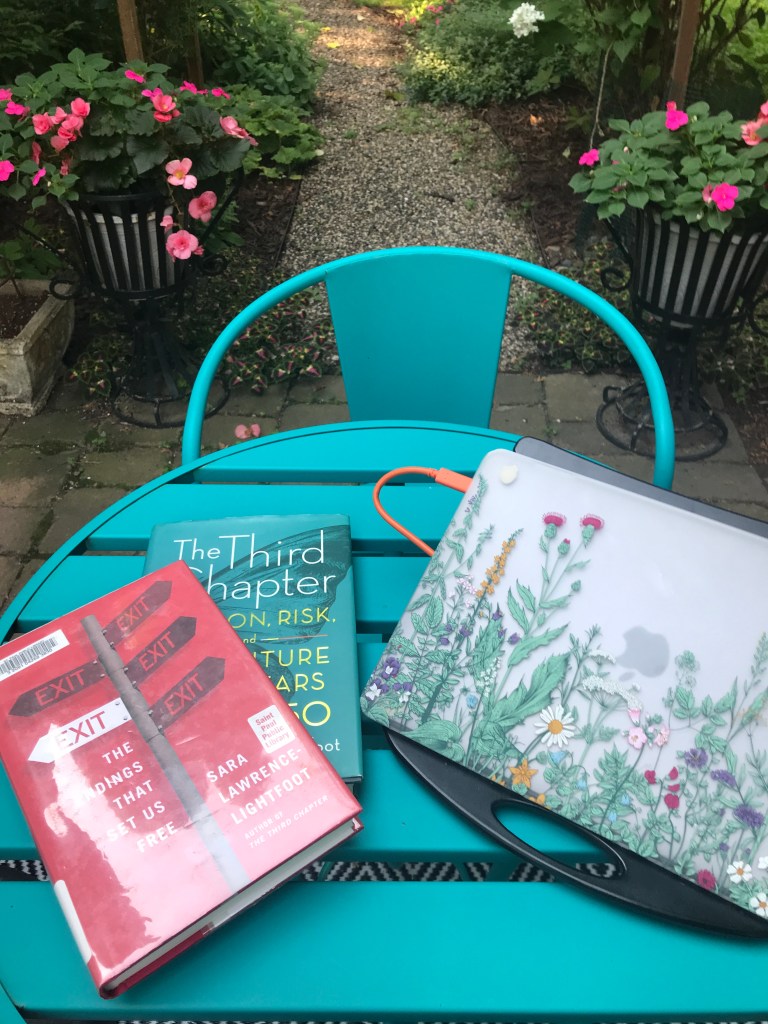
I was 61 when I read Sara Lawrence-Lightfoot’s book The Third Chapter, Passion, Risk and Adventure in the 25 Years After 50, published in 2009. I am now 74 and almost at the end of the time of life Lawrence-Lightfoot writes about in the book.
This book was pivotal in my aging evolution.
We were living in Madison, WI, at the time, and I had not found my place in that community. I had trained as a spiritual director when we lived in Ohio and had a private practice there. I had led spirituality groups in an organization for those touched by cancer and also facilitated retreats and taught T’ai Chi in a variety of places, but in my current life I simply had not found a foothold. That was for a variety of reasons, I realize now, but at the time I had no idea how to adjust to this unexpected loss of role, let alone what might be next.
The Third Chapter helped me acknowledge the sadness and grief I felt, but also opened me to imagine new possibilities; new ways of viewing myself and who I might become as I aged. When we moved back to St Paul, after almost 20 years away, I was thrilled to discover ways I could live with purpose and meaning. The time described in The Third Chapter has been and continues to be a time of thriving for me.
The book also gave me a name for this stage of life. “The Third Chapter.” The other day a writer friend, who was feeling certain life changes swirling around her, said she felt as if she was experiencing a midlife crisis again, but of course, we are well beyond our midlife years. How important it is, I think, to give voice to these elder years.
In the inside cover of the book I wrote two questions: What are the words you use to describe this stage of life? What words do you find yourself using frequently when you talk about yourself? I didn’t know when I wrote those words how those would not only be key questions for my own reflection, but they would become questions as I helped develop Third Chapter programs at my church.
So back to the book. By telling others’ stories, Lawrence-Lightfoot focuses on the creative and purposeful learning that goes on in this stage of life and explores the ways men and women at this stage
find ways of changing, adapting, exploring, mastering, and channeling their energies, skills, and passions into new domains of learning. I believe that successful aging requires that people continue–across their lifetime–to express a curiosity about their changing world, an ability to adapt to shifts in their developmental and physical capacities, and an eagerness to engage new perspectives, skills, and appetites. This requires the willingness to take risks, experience vulnerability and uncertainty, learn from experimentation and failure, seek guidance and counsel from younger generations, and develop new relationships of support and intimacy.
p. 7
No small task. That should keep us engaged!
This book was the first of what is now my extensive collection of books and aging and spirituality. I am still in my “third chapter,” but I would welcome a new book from Lawrence-Lightfoot about the years after 75. Hint, hint.
In the meantime I found another book by her, Exit, The Endings That Set Us Free (2012). Once again deftly telling others’ stories, she explores the variety of endings in our lives and how to navigate them. She notes that our culture values beginnings, launchings. We hold entrepreneurs in high regard. But exits are ignored and often viewed as failures.
We often slink our way out the door, becoming invisible as we do so. One of the women she interviews says, “I don’t want the exit to be about closed doors. Where is the open door! Where is the new life?” (p. 68)
How do we open a door when we end a relationship, a job or career, a role, a major project? And how do we purposefully and meaningful approach the final exit, our own death or the death of a loved one? This book, like The Third Chapter, tells illustrative stories so well, encouraging readers to reflect on our own lives and the endings we have experienced or will experience.
I thought about the acknowledged ending to a job I loved–how I felt celebrated and honored and how that helped me let go. But I also remember another time when my last day in a role I had also loved was totally ignored. No “Thank you.” No “We’ll miss you.” I am sorry I didn’t take it upon myself to create an exit ritual.
A note about Lawrence-Lightfoot: She is a MacArthur prize-winning sociologist, the author of ten books, and is the first African-American woman in Harvard’s history to have an endowed professorship named in her honor. She is someone worth reading, for sure.
An Invitation
Have any books been a guide for you in this aging evolution? I would love to know.
Note:
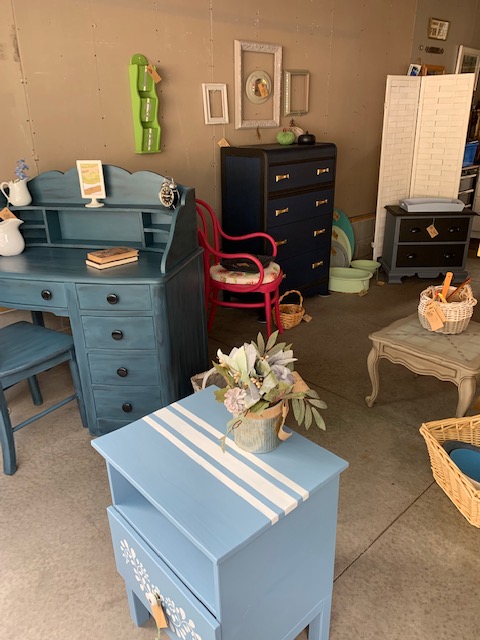
On another topic, for those of you in the St Paul, MN area, my husband Bruce is having his second garage sale of the season this weekend, Friday and Saturday, August 26-27, at our house, 2025 Wellesley Ave. As many of you know, he paints discarded furniture and accessories and the proceeds from his sales go to support the work of Lutheran Social Service’s Rezik House, a residence for homeless youth. Access to the sale is through the alley only.
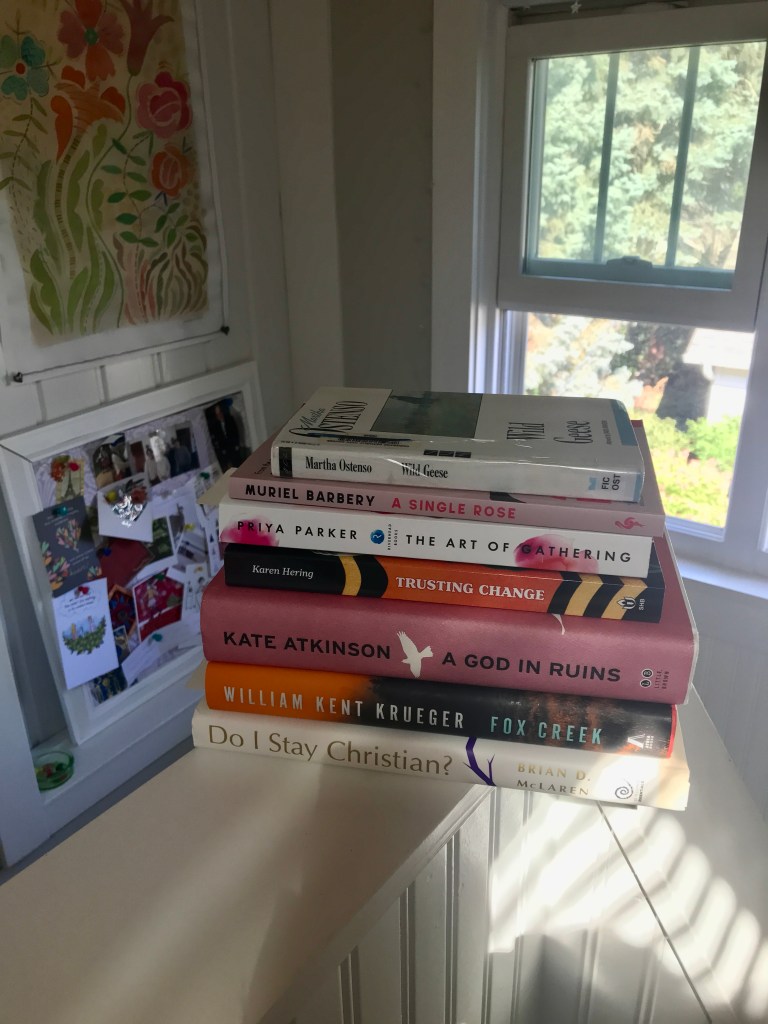
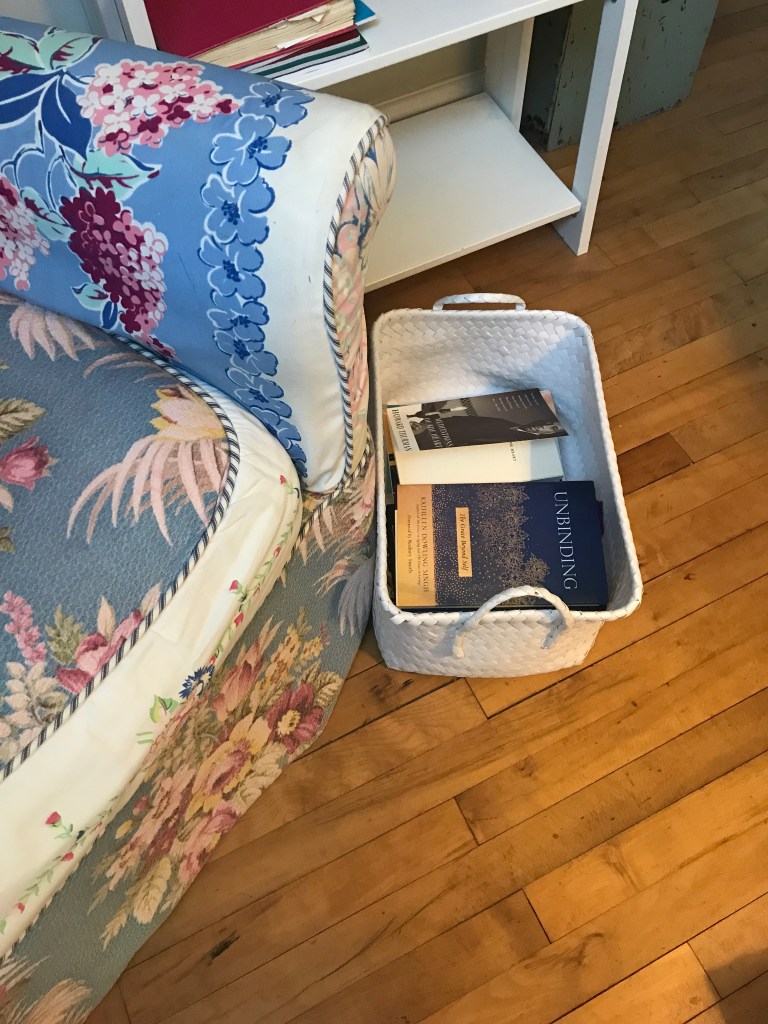
The basket where I keep the current books I read and refer to during my meditation time almost overflows. My Bible is a constant, of course, as is my current journal and my prayer cards (See my post on August 9, 2022), but the other books are a potpourri of what I want to study right now, or books by favorite or recommended authors, or daily devotions. The basket is also where I keep new books, browsing and welcoming them to my library, before I decide if I want to read them now or keep till later.
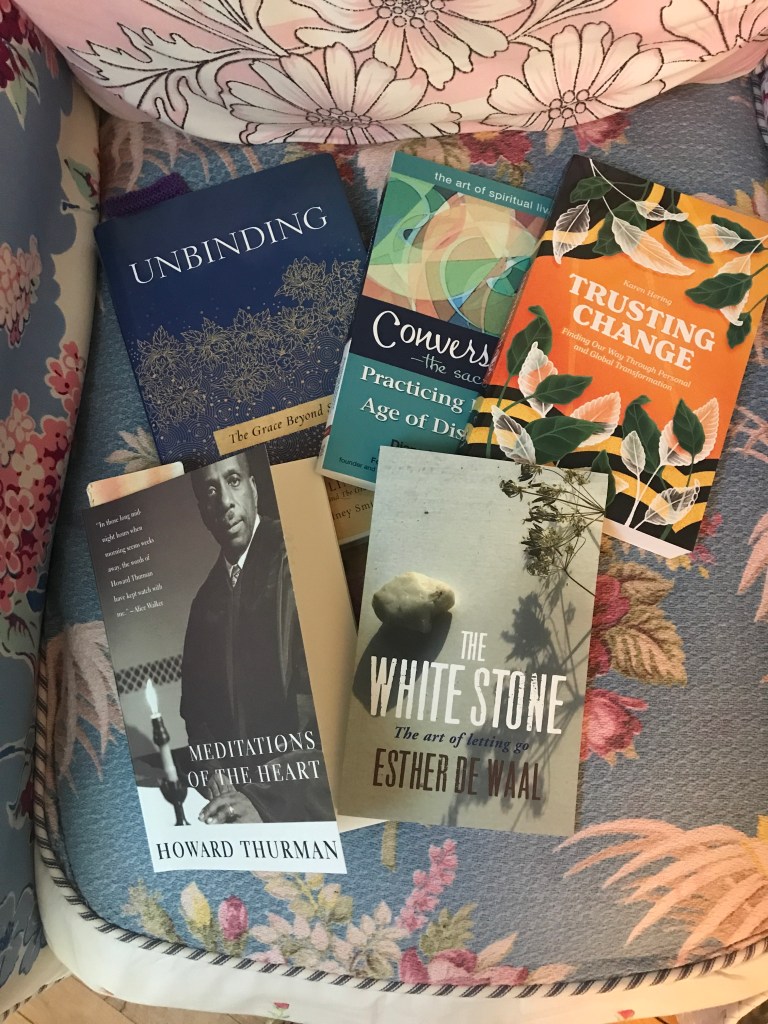
Here’s what is in the basket now.
Unbinding, The Grace Beyond Self by Kathleen Dowling Singh. I have been reading this book slowly and for quite some time. I don’t pretend to understand everything in this book about some of the foundational teachings in Buddhism, but the ongoing practice of awakening and all that means and involves challenges and inspires me. Singh, who died in 2017 was the author of other books that have had deep influence on my life, The Grace in Dying, The Grace in Living, The Grace in Aging.
Meditations of the Heart by Howard Thurman. How often I have read a powerful quotation by this spiritual leader (1899-1981), but I have never owned a book by him. It is about time. This book is a collection of meditations and prayers and as in the words of the first meditation is “an island of peace within one’s soul.” That is not to say, however, the book is without exhortation to action, for there is nothing about Thurman’s faith or life in faith that is passive.
The White Stone, The Art of Letting Go by Esther De Waal. I remember reading her book on Benedictine Spirituality, Seeking God, many years ago and am eager to sit with this slim book. According to the back cover, this book is about the houses she has loved and the process of letting them go and moving into new environments. I have done that many times and am sure De Waal’s experience will deepen my own. I discovered this book recently when we visited the Liturgical Press bookstore on the St John’s University campus in Collegeville, MN.
Trusting Change, Finding Our Way Through Personal and Global Transformation by Karen Hering. The dedication in this new release is “For all of us sharing this chrysalis time.” I loved Hering’s earlier book, Writing to Wake the Soul : Opening the Conversation Within, and have also enjoyed retreats and classes I’ve taken from her. She is a gifted teacher and writer, and I have no doubt this book will be a gift itself. I am especially intrigued by the chapter, “Practicing Equanimity.”
Conversation, The Sacred Art, Practicing Presence in an Age of Distraction by Diane M. Millis. I have read sections of this book, including the chapter “Listening to Your Life,” but as I begin preparation for two conversation groups I will offer beginning this fall at my church, now is a good time to read and study this book. As I have with Hering, I have benefited from Millis’ gifted teaching and writing and know this book will be helpful and inspirational. I recommend her Re-Creating A Life, Learning How To Tell Our Most Life-Giving Story.
The basket also holds one edition of Oneing from the Center of Action and Contemplation and at least one issue of Presence, An International Journal of Spiritual Direction and Companionship. I am always behind reading those journals. Sigh!
With this basket at my side, morning could extend into afternoons and evenings!
An Invitation
Does your devotion/meditation time include reading? I would love to know.
Yes, I know how important it is to live in the present moment.
Breathe in and tell yourself that a new day has been offered to you, and you have to be here to live it.
You Are Here, Discovering the Magic of the Present Moment by Thich Nhat Hand
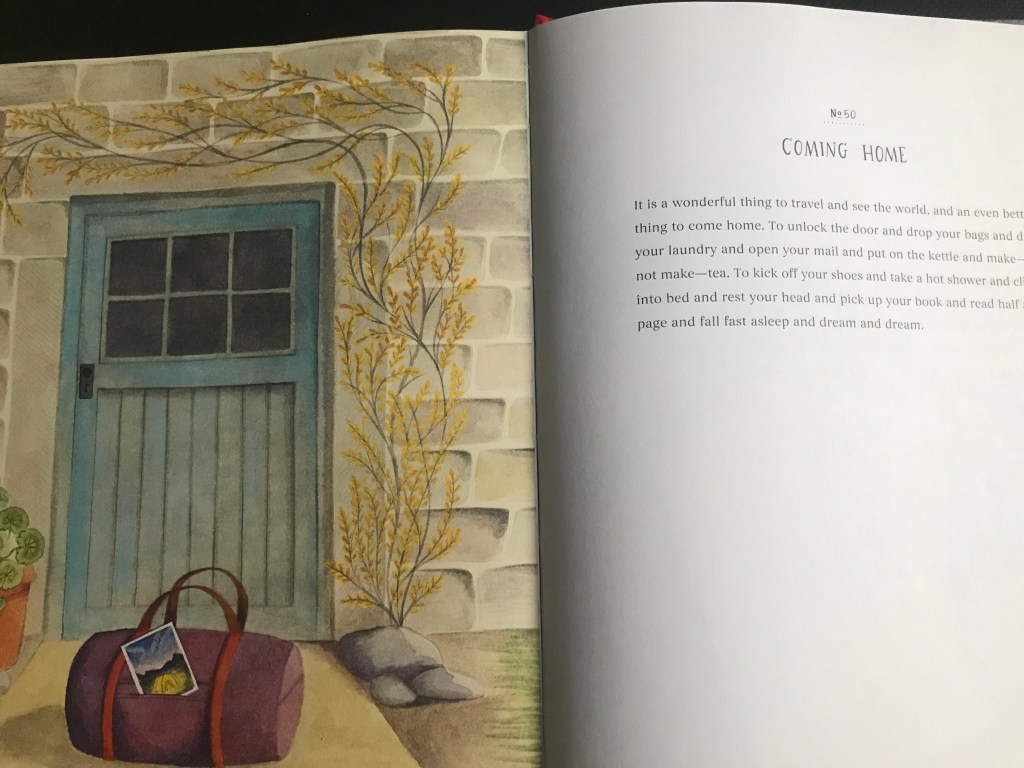
This gentle and charming book, Things To Look Forward Toby author and illustrator Sophie Blackall is a doorway into remembering what brings us joy and the pleasures that sustain and guide us, even when the present moment is fraught with angst. This book is a guidebook for being in the present moment, even as we look ahead.
Some of what Blackall looks forward to are on my list, like “making lists” and “returning home,” and other items, like “rain” and “visiting a museum,” open me to greater appreciation and gratitude. Maybe that’s what this book is–a gratitude book for a life being lived.
Here’s my list, a list that keeps growing, and that is a good thing, I think.
Sunday morning church.
Fall: weather, food, clothes, pumpkins
Being with our kids and grandkids. Anytime. Anyplace.
Having written the first sentence or paragraph of a new writing project. The first is always the hardest.
Meeting with my spiritual directees.
Anticipating the next book to read. I love adding titles to my TBR (To Be Read) list and then checking them off as I read them. And what is better than getting an email from the library saying a book I have requested is now available!
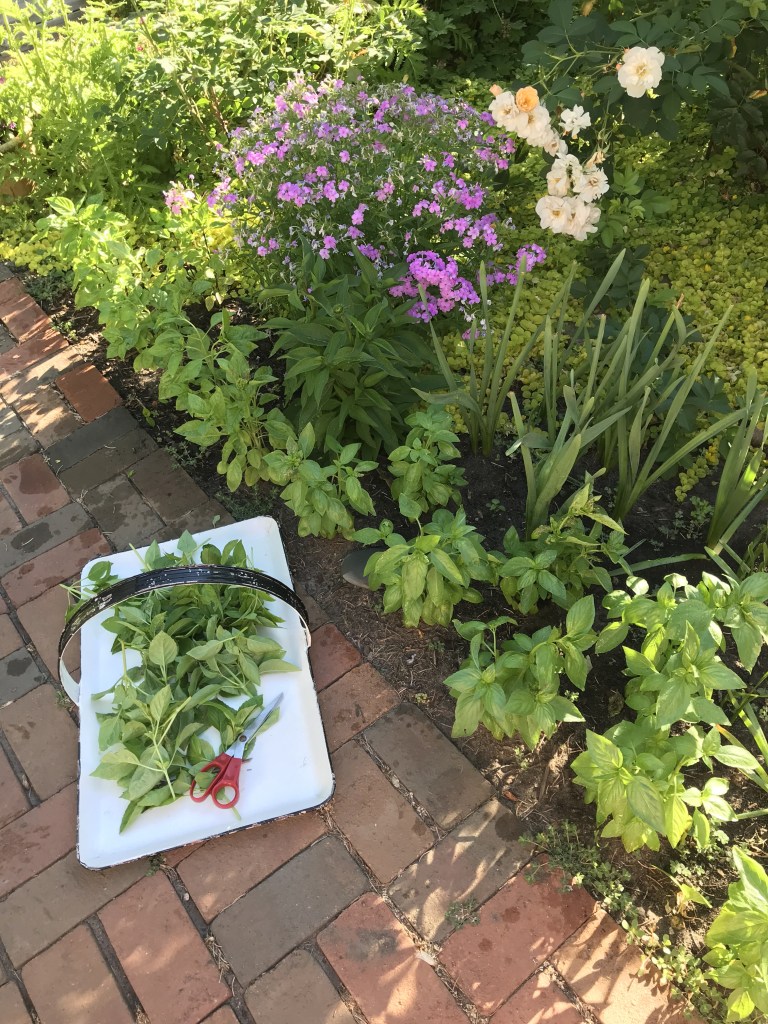
Making pesto with the basil from our garden.
A cold Diet Coke, especially from MacDonalds. (Remember, Blackall says the list contains both large and small joys)
One day road trips and counting eagles and hawks.
Cozy days in the snug.
The first trip in the morning to the garret.
Perfect weather to sit in the side garden, I call Paris.
Shopping the house as I clean to create new vignettes.
Ironing. Pressing out the wrinkles.
Seeing a friend cross the threshold.
Morning Meditation Time, whether it is walking in the neighborhood or sitting in my Girlfriend Chair
Setting the table for a gathering and thinking about the love that will be present.
My husband filling vases with flowers from his glorious garden.
Going to a play or concert.
A good night’s sleep.
Unpacking. I don’t enjoy packing, but unpacking always feels like a new beginning.
Normally we say that the future is not here yet, but we can touch it right now by getting deeply in touch with the present moment. Because it is of an interbeing nature, the present cannot exist by itself. It interexists with the past and the future. It’s like a flower that cannot exist by itself: it has to interexist with the sun and the earth. This is true for time, too. The present is made up of material called the past and the future, and the past and future are here in what we call the present.
You are Here, Discovering the Magic of the Present Moment by Thich Nhat Hanh
Blackall’s list and my list are the result of past times, which we look forward to living again in the present. Past, present, and future are all one.
An Invitation
What’s on your “looking forward to list”? I would love to know.
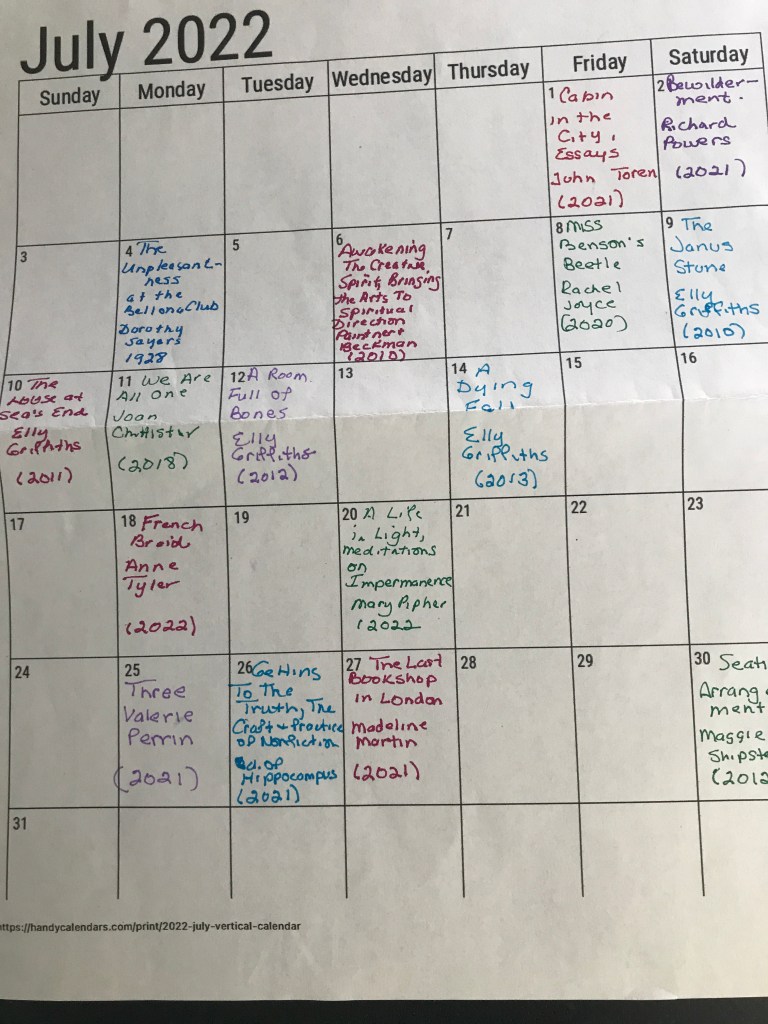
I read sixteen books in July–surprising even myself.
The first half of the month I immersed myself in mysteries. See my July 14 post. https://wordpress.com/post/livingonlifeslabyrinth.com/949 During the second half of July I read three novels from my TBR list, and I recommend with pleasure each one.
French Braid by Anne Tyler. I’ve read most of her long list of books, enjoying some more than others. This one is especially good. Few people write dialogue as well as Tyler does, for one thing, and few people create a window into family relationships as she does. True, the characters are often quirky, but still, recognizable. In this story the family members maintain distance from one another, not out of dislike or fear, but simply this is the way it is. The title is referenced towards the end of the book describing a French braid when it is undone, “ripples, little leftover squiggles…that’s how families work, too. You think you’re free of them, but you’re never really free; the ripples are crimped in forever.” (p. 234) Later, Tyler writes, “This is what families do for each other–hide a few uncomfortable truths, allow a few deceptions. Little kindnesses…and little cruelties. (p. 342) Classic Tyler
Three by Valerie Perrin. Her earlier novel, Fresh Water for Flowers, was the first book I read in 2021 and was one of my favorite books that year. It remains a favorite. I loved Three, as well. The title refers to Etienne, Adrien, and Nina who grew up together, forming their own kind of family. The story moves between their growing up years and years much later. Sometimes a scene is repeated, but the second time we, the readers, know much more than we did the first time we read it. Much of the story is told by Virginie, but we don’t know who she is till much later in the book. “Intriguing” is the word that occurred to me as I read this book. Flawed characters, for sure, but characters who want to live as their better selves. One line that stays with me, “How many people do we miss out on in a lifetime?” (p. 261)
Seating Arrangements by Maggie Shipstead. After reading her most recent novel Great Circle in June https://livingonlifeslabyrinth.com/2022/06/09/book-report-great-circle-by-maggie-shipstead/, I knew I wanted to read her backlist. Seating Arrangements is her first novel, published in 2012, and it is worth reading. The story takes place the weekend of a wedding–Winn and Biddy’s oldest daughter, Daphne is getting married to Greyson. Daphne is seven months pregnant, which doesn’t seem to be an issue for anyone. The wedding party gathers at the family’s island home, and the story could have focused on any one of the characters, but this is really the father’s story. “His wedding had been a wedding, not a family reunion and missile launch and state dinner all rolled into one.” (p. 93). Winn is attracted to one of the bridesmaids, and his younger daughter Livia is recovering from an abortion and being dumped by her boyfriend, and there is the matter of the beached whale. Shipstead not only tells a story well, but I love her rich descriptions and her often ironic tone. Now I am ready to read the next novel on her backlist, Astonish Me.
I feel I should mention another novel I read in July, Bewilderment by Richard Powers. I’m not sure I loved this book, but it felt like an honor to read it, and at times the story of a widowed father, Theo, and his unusual nine year-old son, Robin, moved me to tears. Theo doesn’t accept the encouragement from Robin’s teachers to start him on medication, but instead homeschools him and enrolls him in an experimental kind of therapy. Theo is an astrobiologist and often tells Robin stories of imagined planets. All this is in the context of a world that seems to be destroying itself and Trumpian anti-science politics. I’ve not yet read Powers’ The Overstory–I know I should. I know I will, but not yet.
As part of my morning meditation time, I am reading, slowly, very slowly, Unbinding, The Grace Beyond Self by Kathleen Dowling Singh, which has been on my shelf for several years, and it is worth the wait and the intentional slow pace. Other than that, I am not reading much nonfiction right now. I do recommend, however, a writing book, Getting to the Truth, The Craft and Practice of Nonfiction by the editors of Hippocampus Magazine. Excellent essays.
Reading Is…
it’s going somewhere without ever taking a train or a ship, an unveiling of new, incredible worlds. It’s living without having to face consequences of failures, and how best to succeed…I think within all of us, there is a void, a gap waiting to be filled by something. For me, that something is books and all their proffered experiences. p.73
The Last Bookshop in London by Madeline Martin
An Invitation
What did you read in July? Anything you recommend? I would love to know.
One of my favorite blogs about writing is Brevity. On Monday, August 8 you can read an essay I wrote called “Writing in a Garret.” I hope you will read it and would love to know your response. https://brevity.wordpress.com
Steve Laube is an agent in the Christian publishing marketplace and in a recent blog post (https://stevelaube.com/21-influential-books/) he listed books he called “punctuation marks” in his life. “Some books were a comma, some an exclamation point and some a period or full stop.” Books that have been influential in his life.
What a good idea, I thought, and besides I was struggling with an essay-in-progress. What a good distraction that would be. Limiting myself to my spirituality and theology books, all in the garret, I soon had a pile of over 50 books.
Could I limit myself to 21 books? And why did Steve Laube choose that number anyway, but I decided to discipline myself and see if I could choose the most important from the towering stacks. Here’s the list–in no particular order.
The Wisdom of the Enneagram, The Complete Guide to Psychological and Spiritual Growth for the Nine Personality Types by Don Richard Riso and Russ Hudson (1999)
In Wisdom’s Path. Discovering the Sacred in Every Season by Jan L. Richardson (2000)
Walking A Sacred Path, Rediscovering the Labyrinth as a Spiritual Tool by Dr. Lauren Artress (19950
The Universal Christ, How a Forgotten Reality Can Change Everything We See, Hope For, and Believe by Richard Rohr (2019)
The Circle of Life, The Heart’s Journey Through the Seasons by Joyce Rupp and Macrina Wiederkehr (2005)
Quiet, The Power of Introverts in a World That Can’t Stop Talking by Susan Cain (2012)
Transitions, Making Sense of Life’s Changes by William Bridges (1980)
The Gospel According to Woman, Christianity’s Creation of the Sex War in the West by Karen Armstrong (1987)
The Seven Whispers, Listening to the Voice of Spirit by Christina Baldwin (2002)
Composing a Life, Life as a Work in Progress–The Improvisations of Five Extraordinary Women by Mary Catherine Bateson (1989)
The Cloister Walk by Kathleen Norris (1996)
The Gift of Years, Growing Older Gracefully by Joan Chittister (2008)
The Dance of the Dissident Daughter, A Woman’s Journey From Christian Tradition to the Sacred Feminine by Sue Monk Kidd (1996)
Anam Cara, A Book of Celtic Wisdom by John O’Donohue (1997)
The Re-Enchantment of Everyday Life by Thomas Moore (1996)
An Altar in the World, A Geography of Church by Barbara Brown Taylor (2009)
Seven Spiritual Gifts of Waiting by Holly W. Whitcomb (2005)
A Hidden Wholeness, The Journey Toward An Undivided Life by Parker J. Palmer (2004)
The Grace in Aging, Awaken As You Grow Older by Kathleen Dowling Singh (2014)
The Inner Work of Age, Shifting from Role to Soul by Connie Zweig (2021)
Holy Listening, The Art of Spiritual Direction by Margaret Guenther (1992)
Traveling Mercies, Some Thoughts on Faith by Anne Lamott (1999)
Awakening the Energies of Love, Discovering Fire for the Second Time by Anne Hillman (2008)
Holiness and the Feminine Spirit, The Art of Janet McKenzie, edited by Susan Perry (2009)
Why did I choose these titles?
I don’t know. A top of the head, top of the heart reaction. Some of the titles are ones that radically changed my way of thinking. Some are titles that offered me deep insight into who I am and who I was created to be. Many are books I keep returning to. Sometimes re-reading them, but sometimes it is enough to simply hold one of these books and feel the wise energy rising from the pages.
In many cases I was choosing an author more than a specific title. It was not easy to choose only one Joyce Rupp or Joan Chittister, and how could I not add Barbara Brown Taylor’s Leaving Church to the list or Dakota by Katherine Norris or any of the other titles by John O’Donohue or Thomas Moore.
And you might notice authors who are not there; other authors important in my spiritual growth–Thomas Merton, Marcus Borg or John Shelby Spong or more recent writers, such as Brian McLaren or J. Philip Newell or Diana Butler Bass. And what about the ancients–my beloved Julian of Norwich, for example?
Choosing just 21 books was a tough assignment, for sure. And you will notice I cheated, and there are 24 titles on my list. Would the list be the same in a week or if I had created it a few months ago, in the midst of winter? No doubt, but what would remain the same is the power of other people’s thinking and creativity and expertise to deepen my awareness of the movement of God in my life.
Laube decided to gather all the books from his list in one place as a “visual reminder of those moments when God reached out through the pages of creative people…and touched me.” I like that idea, but I decided to keep each one in its current spot on my shelves. Each shelf is like a neighborhood, and I like the idea of all of Karen Armstrong books keeping each other company and sharing space with their neighbors.
Oh, and one more thought. The day will come, I imagine, when I will need to drastically pare down the number of books in my library, thanks to a move to a smaller space, (A friend calls this process, giving oneself a haircut.) and this recent exercise shows me I will be able to do that.
An Invitation
What 21 books are on your “most important” list? I would love to know.
Notes
I made a list of the other 25 or so books that didn’t make the “A” list. Maybe I’ll share that someday, too. That list includes devotionals and writing books.
Next Thursday, August 4, I will post my end of the month book summary.
Note: I’m taking a break next week. The next post will be Tuesday, July 26, 2022.
I’ve always loved reading mysteries, beginning with Nancy Drew, of course. Later, I worked my way through Agatha Christie and Dorothy Sayers and more recently, I’ve indulged my Louise Penny and Jacqueline Winspear addictions. (The next Louise Penny, by the way, won’t be released until November.)
I’ve always balanced reading mysteries with reading nonfiction and literary fiction, but this month? Not so much.
At the beginning of the month I read one of Dorothy Sayers’ Lord Peter Wimsey books, The Unpleasantness at the Bellona Club. My only regret was that I wasn’t on vacation at a lake resort where the only diversion was the occasional putt-putt of a motor boat or the haunting call of a loon. It is that kind of book –witty and subtle and oh, so upperclass English.
Then I got sucked into the Ruth Galloway series by Elly Griffiths. I recall reading at some point the first book in the series, The Crossing Places and enjoyed it, but I did not feel compelled to grab the next in the series–and there is a total of 14 of them with a new one planned for 2023. This month, however, that changed, and not only am I reading them, but so is my husband and our daughter.
I am currently reading #5, A Dying Fall, and will more than likely finish that today.
Ruth Galloway is an English forensic archaeologist who often helps the police, developing a close relationship with copper Harry Nelson. The unfolding of the plot is always interesting, but as is usually the case for me, the characters interest me more. I just discovered when I looked up the author website that she has also written other mystery series and stand-alone books as well. Oh no!!!
I know I don’t need to justify, nor should you, why I choose to read a particular book or series of books or genres, but I admit I am curious why I am so enamored of mysteries right now. I seem to need lighter reading, a quick read, or what is often called “summer reading,” or “beach reading.”
Yesterday I received the weekly online newsletter from one of my favorite bookstores, Arcadia Books in Spring Green, WI, and the opening column referenced a bumper sticker, “It’s brutal out here.” How true that is. Often, the crimes committed in the mysteries I read are brutal, too, but in 300 or so pages, the mystery is solved and good people have worked to make that so. The known is made known. The uncertainty is resolved. And life goes on.
if only the real world was that simple.
So…to balance watching the January 6 hearings and listening to the news on NPR and reading the NYTImes and Washington Post, as well as informed and thoughtful online newsletters, I am reading mysteries, and Elly Griffiths is a good choice.
An Invitation
Has your reading changed in recent months? I would love to know.
Joan Chittister, O.S.B., is a Benedictine nun, theologian, speaker, and prolific author. As a visionary voice in church and society, she has served in a variety of leadership roles, including co-chair of the UN sponsored Global Peace Initiative of Women.
Occasionally, actually more than occasionally, Chittister is the object of controversy and criticism–for her stances on contraception, abortion, women’s ordination as contradicting Roman Catholic teaching. Several years ago she was prohibited by the Catholic patriarchy from attending the first Women’s Ordination Worldwide Conference, and –no surprise–she not only attended, but gave the opening address.
Even though I have never met her I consider her one of my spiritual directors. I have heard her speak many times, most often at the Chautauqua Institution in New York, where she is a frequent and popular speaker at the afternoon theology forums, and, of course, I have read many of her books.
We Are All One, Reflections on Unity, Community, and Commitment to Each Other (2018)
This small book is my current “before I make the bed” book.
One of the chapters, “Holy Accountability” begins with this quote:
It is not God’s fault that things are as they are at present, but our own.
Etty Hillesum
Not the Republicans’ fault. Not the former President’s fault (or the current one). Not the superintendent of schools or the mayor or police department or the neighbor who doesn’t mow his lawn or the parent who doesn’t discipline his child or…..
No, the fault is our own. My own.
As if that weren’t enough, Chittister asks,
Here’s a quiz: What do the Adam and Eve story and the presidential election of 2016 in the United States have in common? Give up? It’s easy: free will, accountability–and oh, yes, a snake in the tree.
p. 41
Does that grab you? Chittister goes on to remind us that Adam and Eve lost “paradise” because they ignored their responsibilities. Ouch.
One of her attributes as a writer and a speaker is her ability to target the heart of a matter in a few words and to challenge the reader/listener to examine beliefs and perspectives and then to respond.
The great human task is to make life better for everyone. To be satisfied with anything less marks us as less than fully developed human beings.
p. 45
The Gift of Years, Growing Older Gracefully (2008)
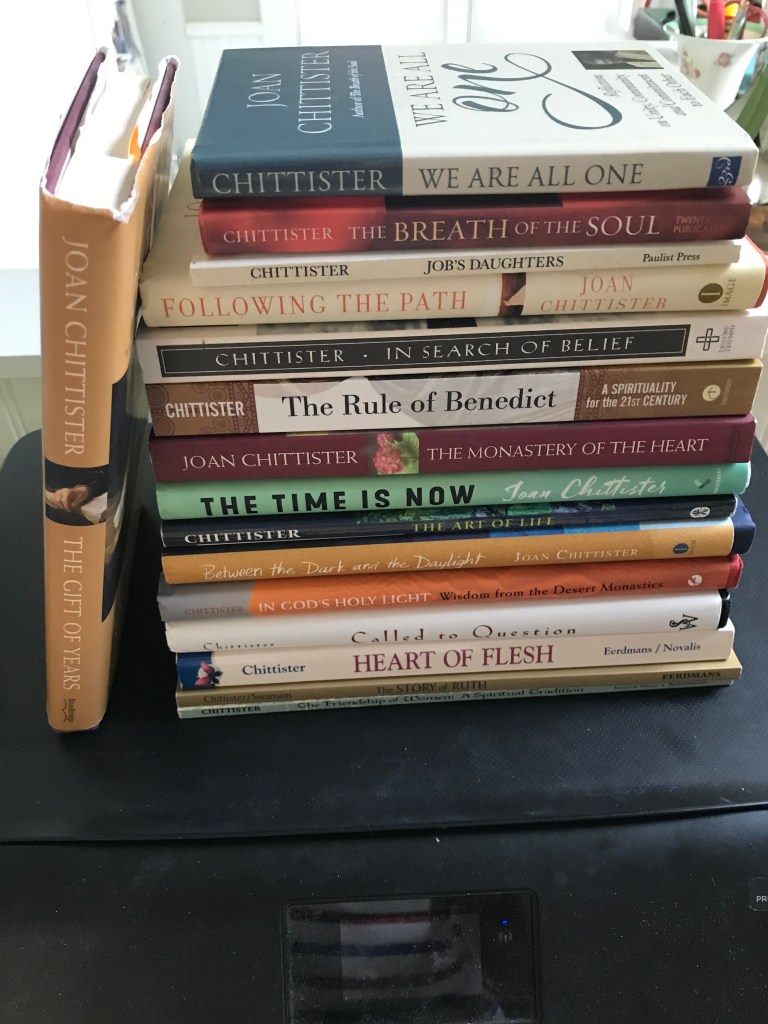
I own sixteen Joan Chittister books; many I have read more than once. The Gift of Years has become sacred text for me, and I consult it frequently, trusting its wisdom and its ability to challenge my fears and enlarge my vision.
Again, in a few words, Chittister tackles big topics, such as regret, letting go, loneliness, transformation, forgiveness, faith. With each topic she opens me to both burden and the blessing. For example:
The burden of regret is that, unless we come to understand the value of the choices we made in the past, we may fail to see the gifts they have brought us.
The blessing of regret is clear–it brings us, if we are willing to face it head on, to the point of being present to this new time of life in an entirely new way. It urges us on to continue becoming.
p. 5
Chittister does not have her head in the sand about the challenges of becoming older, of being old, (She wrote this at age 72 and is now 86 and still writing and speaking and influencing.) but, instead, she reminds us that even in this stage of life there is life to live. I am still becoming.
Other Chittister Books
I think it may be time to re-read The Time is Now, A Call to Uncommon Courage (2019) and Between the Dark and the Daylight, Embracing the Contradictions of Life (2015). I am also tempted to add The Monastic Heart: 50 Simple Practices for a Contemplative and Fulfilling Life to my library.
As I said, Joan Chittister is one of my spiritual guides, and I need more time with her.






 Living on Life's Labyrinth