Being A Vessel

November 15, 2022

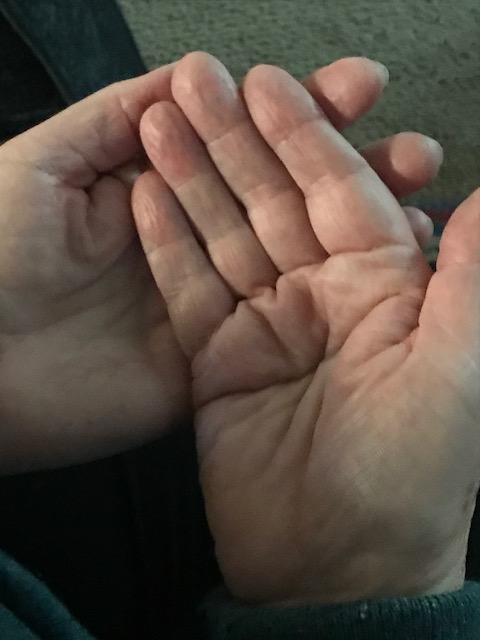
At a recent session with my spiritual director, she noticed how I cupped my hands as I spoke. That posture suggested a word to her. Vessel. The word resonated with me, and I wondered about the implications of that word in my life.

Soon after that session I read a prayer, “Blessing the Fragments,” by Jan Richardson in her book, The Cure for Sorrow, A Book of Blessings for Times of Grief. This is the first verse.

Cup your hands together,
and you will see the shape
this blessing wants to take.
Basket, bowl, vessel:
it cannot help but open
to welcome what comes.

Welcome what comes? I’m not so sure about that. Why, for example, would I welcome the sadness I feel about a friend’s dire cancer diagnosis. Then I read the last verse.

Look into the hollows
of your hands
and ask
what wants to be 
gathered there,
what abundance waits
among the scraps,
what feast
will offer itself 
from the pieces 
that remain.


“Oh, Nancy, ” I say to myself, “You do not yet know the gifts of this time. And you can’t know if you live with your hands clenched in a rigid fist.”

With my hands cupped I …

Receive and Release

Open and Offer

Honor and Hold

Isn’t this what we envision for ourselves when we walk with someone who experiences pain or confusion, doubt or fear?

At those times I want to receive what is shared, spoken or unspoken. Not only do I want to release my own fears, but also my need to control or correct or fix or solve.

I want to open my heart and listen with the ears of my heart. I open to the inner voice, the Divine that whispers to me.

I open to surprise, to possibility, to what feels new and perhaps not quite acceptable. I open to change, to transformation, to hope and salvation. I open to imperfection and a lack of answers. I open to the spaciousness of this time, whatever that means.

I offer what I can, what I am able. I offer myself, my heart and my intuition, too, along with my understanding, even when I don’t understand.

I offer my presence.

I honor for we are beloved. We are holy. I honor our fragility that lives within our wholeness. I honor vulnerability and the willingness to be seen, to be known.

I hold the space for all that is swirling or sometimes for all that feels static. I hold the fear and allow love to be borrowed, if love feels distant. I hold the in-between times. I hold myself accountable, even as I am gentle with myself.

I hold the present moment with my presence.

I hold open the door.
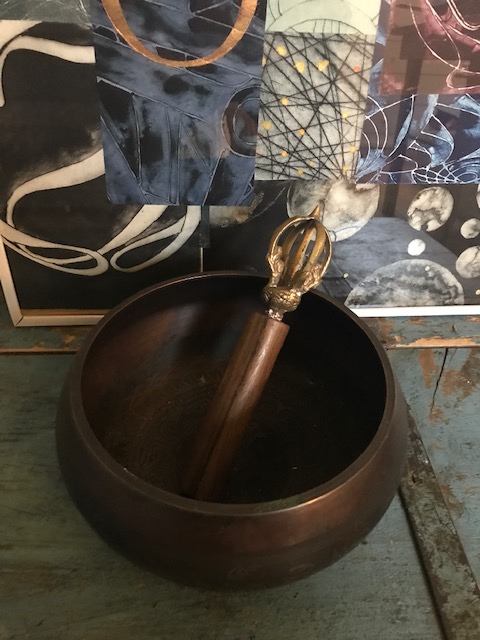
I remember my prayer bowl, a vessel that sings. When I strike the rim the tone is clear and strong and reverberates for a long time, fading gradually into the space around me. The energy and the memory remain.

May I be that vessel–a vessel that receives and releases, opens and offers, honors and holds. A vessel that sings even as she cries.

An Invitation

Cup your hands. What do you see? What kind of vessel are you carrying? I would love to know.

The Landscape’s Answer to My Spirit’s Need

November 8, 2022

What do you see here? How would you describe this scene?

I imagine some would call this bleak, cold, barren, dismal and wonder why I would even take this picture.

This landscape is exactly what I needed recently.

Last week I was cranky, easily irritated. Unsettled and touchy. When I feel that way, I know I need more time in morning meditation. I need to write in my journal, read sacred words and ponder them, sit in silence, and pray. But this past week, although it looked spacious enough on paper, somehow zoomed past without room for what I most needed. A correction: The time was there, but I failed to use it in the ways I knew would help.

A dear friend has received a dire diagnosis, and I am grieving for her and for her family. And I am grieving for myself, too. I wake up in the morning in the midst of thoughts for her, and a prayer for her is the last thing on my lips before I shut my eyes at night. I experience both grief for what is being lost right now, and I anticipate the grief that will come.

I am so sad.

At the same time I want to be present to my friend and whatever she needs right now. A helper. A doer. A responder. A receiver. A calm and quiet presence. Whatever is needed in the moment.

A Call to Roam

The past week was beautiful, warmer than normal temperatures. Sunny, and many leaves were holding on in a continuation of fall’s majestic show. But Friday was cooler and grey; a day signaling introspection and contemplation.

How grateful I was that my husband and I had set aside that day to roam. At his request we drove down along the Mississippi River on the Wisconsin side of the river–one of our favorite routes. The towns along the way. Maiden Rock, Stockholm, Pepin, are busy on summer weekend days, and I imagine not long ago the leaf-peepers were oohing and aahing at the color and the sparkling water.

Now every tree was bare. The skeletal branches revealed the essence of each tree, and the sky and the waters almost blending together as one whispered a message of connection, of wholeness.

How grateful I was to be able to rest my eyes. Instead of missing what was no longer there, I paused in what is. This is beauty, too. This is love, too.

I still felt sad, but I also felt a kind of peace. The spaciousness I glimpsed between the branches reminded me that we are each part of the ongoing cycle the seasons offer us.

We crossed the river back into Minnesota and found a quiet place for lunch, next to a railroad track and right on the river. How fun it will be to return there in another season when the days are warmer and the scene is livelier and more colorful, but this was just what I needed in that moment.

An Invitation:

What landscape nurtures your soul’s need? I would love to know.

Dilemmas in Downsizing #2

October 25, 2022

The love of variety is one of my challenges when I think about downsizing/decluttering.

I love decorating for the seasons, and the house never looks the same, one season after another. Not only is that because I have so much stuff, but because I enjoy rearranging and using what I have in new ways. I’m not very good with my hands–don’t sew, don’t do crafts, but I know I have a good eye and know how to put things together. And oh, how fun it is to discover something tucked away in a cupboard that is just the perfect touch on a tabletop or shelf.

My mother once commented on a neighbor, a dear friend of hers, who in all the years they knew each other never changed the centerpiece on their kitchen table. A wooden bowl of artificial fruit, if I recall. She couldn’t imagine living that way. At least I know where my comfort and desire for change comes from, but as I declutter, little by little, I wonder if there will be a time when I won’t feel the urge to change the dining room centerpiece or the living room coffee table? As I continue this process of simplifying what is tucked in cupboards and closets, will I simplify my interest in and need for variety?

Here are some positive signs:

One day last week when I sat with a client in the snug, I noticed cobwebs floating under a bookshelf. Ugh! It was time to do a more thorough cleaning, and as I did that, I gathered a few small pieces of silver sitting on top of piles of books. Just sweet little accessories collected over the years with no real purpose, but adding a touch of shine to the shelf. Each one needed to be polished, which I started doing, and then I asked myself, “How would it feel to add these to our garage sale pile? Will I miss them if I no longer own them?”

Much to my surprise, I was ready to release them. I know it doesn’t seem like much, but one thing leads to another. By the way, I did keep two pieces I particularly love–a small English chocolate or tea pot from a hotel and a creamer.

As I continued cleaning, I pulled a few books off the shelves and added them to the Little Free Library basket, and I also made another decision. Decades ago when I worked in an independent bookstore, I bought books signed by every author who visited the store, usually for a book signing event. Many of those books I have never read, and as I stood in front of the living room bookcase, I realized I probably never will read them. Obviously, I will confer with my husband about this, but I envision clearing much more space soon.

Bruce and I have been antique collectors all our married life. Going to antique shows and shops has been our hobby, a form of entertainment, and although that activity has decreased in recent years, it has not disappeared. This past weekend, however, we decided not to go to an annual fall show; one we have always enjoyed and where we have often found treasures. Making that decision wasn’t difficult. Not a sacrifice. We quite simply didn’t feel a pull to go. I recognize that doesn’t mean our interest in antiquing has retired, but it is more moderate. That feels like a good thing.

Decluttering is a process. Unless you have a team of people who swoop in, take over, and do it all, once and for all, decluttering can not be done in one big now or never moment. Decluttering is a one drawer at a time process. One closet at a time. Even one shelf at a time. And as a process, it is possible to integrate it into my daily life–to organize what is scattered and to choose what still gives joy and what just feels like stuff, and to clear space as I clean.

Stay tuned, for I have a feeling there will be more Dilemmas in Downsizing to share.

An Invitation

What are you learning in this process? I would love to know.

Dilemmas In Downsizing

October 18, 2022

“I don’t want my children to deal with this when I’m gone.”

I wonder how many times I’ve heard someone declare this as a reason for downsizing and decluttering.

On one level that is a noble idea, with which it is hard to disagree. Bravo, you! And yet at the same time, there is something inside me that isn’t 100% aboard that idea.

If you read my post on Thursday, October 13, 2022, https://livingonlifeslabyrinth.com/2022/10/13/book-report-downsizing-my-books/ you know that I am not ignoring the challenge of my own stuff. That post focused on books, but I could have written about my “Dish Problem.” I inherited the problem, along with actual dishes, from my mother, and my sister has the same problem. We love setting a beautiful table with dishes appropriate to the season or the occasion. Perhaps the problem would have been more under control, if my husband didn’t also love dishes and if we hadn’t been antique collectors all our married life.

Even though I still have enough dishes to serve the neighborhood, I want you to know that I no longer have as many sets as I once did. I have pared back significantly, and am proud to say, all our dishes, other than a set of Christmas dishes, are easily assessable in cupboards and not packed away in bins. I know I will continue to evaluate what I really want to keep and use for now, and it’s certainly possible there will be more than two place settings of the white dishes we use everyday when I die or move into a care center.

Our children will have to deal with our stuff.

Is that so bad?

First of all, let me say I believe in the principle of “like with like, ” which means staying organized, and I also believe in knowing what one has, which also means staying organized and not storing “maybe I’ll use this one day” items in difficult to reach storage items. I also don’t believe in keeping things like 25 year old tax returns, and clothes that haven’t fit for 5 years and if they ever were to fit again will be out of style anyway, and stacks of jigsaw puzzles that were fun to put together once, but twice? Not so much.

All that being said, I think there is some value for our children in dealing with the stuff that remains.

A story about my mother.

My mother loved jewelry, and she was blessed with my father who loved giving her beautiful jewelry. Before she died she designated her major pieces, but that still left boxes and drawers full of necklaces, bracelets, earrings, and rings.

One of the first days after she died, we opened up the dining room table as far as it could go and filled it with piles of her jewelry–the pearl pile, the turquoise pile, the silver pile, the costume jewelry pile. You get the idea. Then we all gathered and starting with the oldest, which was me, went around the table one by one selecting one item from one of the piles. We went round and round and round draping ourselves in the treasures until what was left was not wanted by anyone. My father in the meantime sat nearby beaming. He was so happy we were delighting in these bits and pieces of Betty Ann’s baubles.

I still fill with tears as I think about that day, which was almost 20 years ago. That day was part of our grieving process, and because my mother had not figured out what to do with all those boxes and drawers of jewelry, she gave that day to us. We told stories and laughed and honored her gypsy nature.

When my father died, there was less to do because he had moved into a senior living facility a few years before, but, trust me, there was still enough stuff. Strange as it may sound, I am grateful for the days my sister and brother and husband and brother-in-law spent together sorting and tossing and packing and moving. Because of COVID, the grands and greats were not able to be with us, and they missed our storytelling and the moments when each of us needed some comfort.

I hope when the time comes my family won’t resent the fact that somehow I never got around to creating beautiful family albums and instead left boxes of loose photos. I hope they will pass around pictures and tell stories and comfort each other. I hope when they pack up the dishes I only use in the fall they will remember how good my applesauce tasted and the baked spaghetti hot dish and the pork loin with wild rice and how I loved setting a pretty table even when dinner was only pizza.

I am not suggesting you avoid what must be done or use this post as a justification for holding on tightly to what is only cluttering your present life, but going through the stuff of our loved ones’ lives also can be a tool in the process of grieving. Just a thought.

An Invitation

What are your thoughts about stuff and grieving? I would love to know.

Book Report: Downsizing My Books

October 13, 2022

A frequent conversation among elders is what to do with our stuff. We all have it.

We know it’s only stuff. But it’s our stuff, and we don’t want anyone telling us what to do with our stuff.

I can feel my body become rigid, my throat constrict, and my eyes narrow if anyone dares tell me I have too many books. What is too many? I am not willing to have that conversation.

But, of course, the truth is I do have lots of books.

What to do?

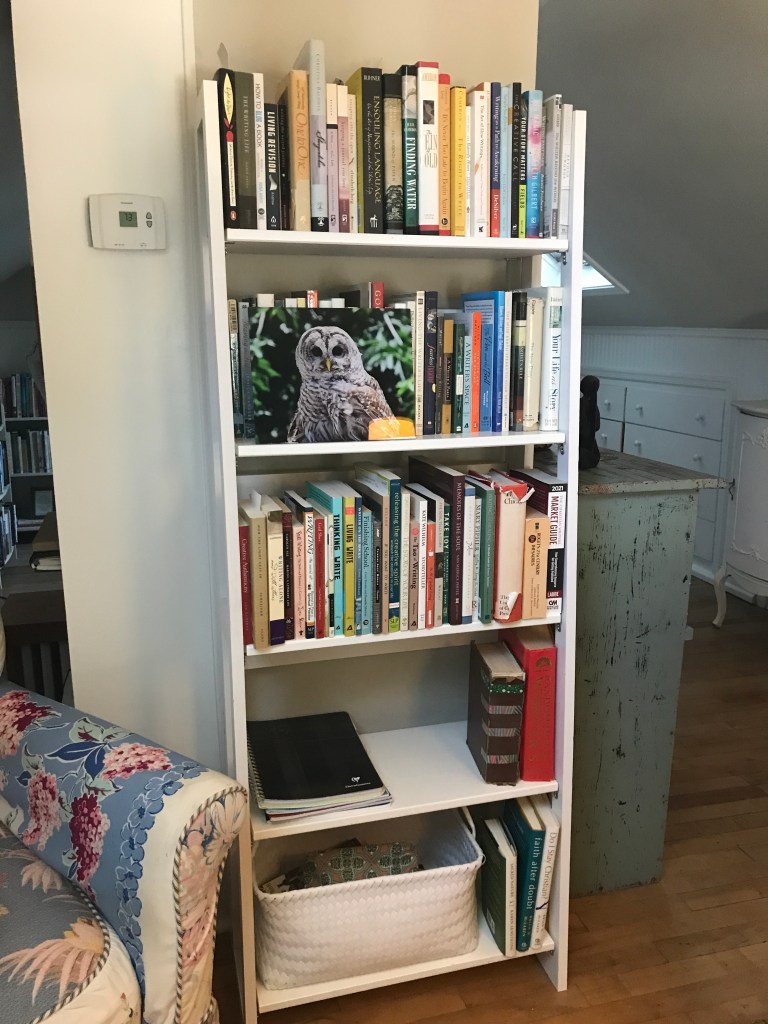
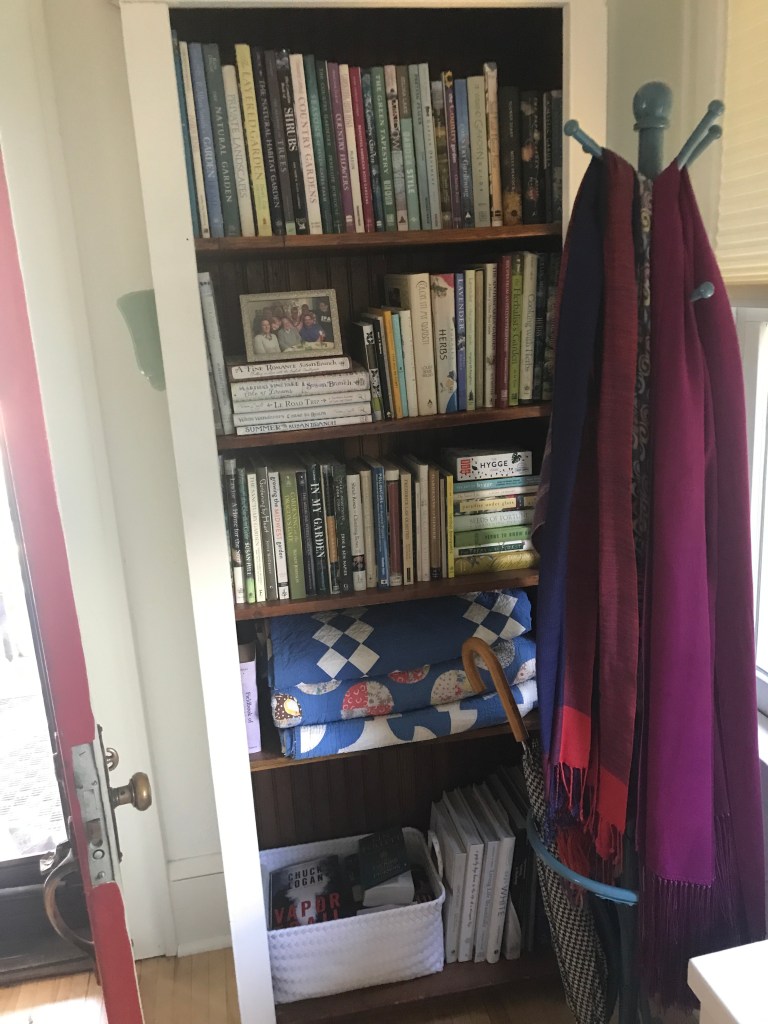
I know that the next move, if and when that happens, will be to a much smaller space; one in which there will be much less room for all our books. Does that mean I need to empty our bookshelves now and never purchase another book? Or do I just ignore the elephant –in this case hundreds of books–in the room(s)?ownsizing

Strategies and Process

My main strategy is to recognize and to practice the PROCESS of downsizing. Here’s what that means:

  1. Use the library more and buy fewer books. So far this year I have checked out almost 80 books from the library, and I have purchased a little more than half that amount.
  2. Every time I read a book I own I consider if it is one I might want to read again or refer to in my work as a spiritual director or small group facilitator. If I decide I don’t need or want to keep it, it is placed in a basket of books to take to a Little Free Library or set aside for our annual garage sale or pass on to someone else and say, “No need to return.” Occasionally, I want to re-read a book I no longer own. Well, there’s the library to save the day!
  3. The last two years my Lenten spiritual practice has been to eliminate at least one book from my spirituality/theology bookshelves each day. I intend to continue that practice this year, too.
  4. Each time I return a book to a shelf or find space for a new book, I spend time looking at the other books on those shelves and often I decide I don’t need to save one of the nearby books any longer.
  5. No books are allowed to gather in piles on the floor. Books do not become the base for a lamp or prop up a table leg.
  6. There are no boxes of books in storage areas. Seeing my books not only gives me pleasure, but that prevents the “out of sight, out of mind” issue that solves nothing.
  7. The books I have acquired, but not yet read are kept on two shelves. Nonfiction books are on a shelf in the garret and fiction in the snug. That means I am aware of them when I finish a book and wonder what to read next.

Practicing Awareness

Part of this downsizing process is to ask myself –not just once, but periodically–what is the meaning of this specific category of stuff? Why do I hold on to these books?

There is more than one answer. First of all, I am a passionate reader, and I prefer to read books in their paper form. You may prefer listening to books or reading on a Kindle. Good for you, and maybe, someday I will do that, too, but not now. Books are beautiful and are part of my decor and add to the warmth and personality of our home. I feel the presence of the writer and their words by having books physically present. Also, I am a writer and a teacher and browse my books for inspiration, for answers, for reinforcement and support and for ideas to broaden my perspective. I suppose I can do that on the internet, but it’s not the same. Finally, my books offer a glance into my history, a view into who I am. And my books remind me to continue the process of growth and evolution.

I know someday I will have to face (or my family will) the challenge of what to do with all these books, and I guess should apologize for that, but oh well… I continue to remind myself that downsizing is a process, and I am in the midst of that process. I am becoming aware that each book I let go of makes it easier to let go of another one.

One more thing: I’ve noticed it is much easier to prod someone else to do something about their stuff, than it is to tackle our own stuff. I’m guilty of that, and I am trying to reform and focus on my own stuff. Enough said!

An Invitation:

What stuff is plaguing you and what are you doing about it? I would love to know.

Pantry Envy: A Hometender’s Sin

October 11, 2022

This past weekend we visited family in Nebraska, including our niece and her husband. We had dinner in their lovely new home, and I have a confession. I had an extreme case of pantry envy. Kitchen envy, too.

Their pantry is the size of my kitchen. Need I say more?

And it was organized, spacious, and beautiful.

I was in love. Or should I say, IN ENVY.

Envy is not an unknown feeling for me. I am an enneagram FOUR and envy is the “sin” or “passion” of this personality type. In this case “sin” is not meant to be viewed as something bad or evil, but rather as the tendency to miss the mark in some way. When experiencing the sin or passion, we lose our center and are not our best selves.

Envy and the Enneagram

First a word about the enneagram.

The enneagram is an ancient system of self-understanding and self-discovery; a tool for personal transformation and development. Pronounced “ANY-a-gram,” the enneagram is a geometric figure that maps out nine fundamental personality types of human nature and their complex relationships.

My husband and I were introduced by a friend to the enneagram many years ago and studying it, returning to its subtleties and complexities over and over has been life-enhancing. The key step is to determine which of the nine personality types one is. After being introduced to the types, I knew almost immediately that I am a FOUR: an individualist or some times called the romantic or artist.

Envy is the sin or passion of the four.

Envy is based on the feeling that something is missing. Envy leads Fours to feel that others possess qualities that they lack. Fours long for what is absent but often fail to notice the many blessings in their lives.

The Wisdom of the Enneagram, The Complete Guide to Psychological and Spiritual Growth for the Nine Personality Types, by Don Richard Riso and Russ Hudson.

They see immediately who has more style, more class, more taste, more talent, more unusual ideas, more genius than they do. They see who is simpler, more natural, more normal, and ‘healthier’ than they are. There is nothing that a FOUR couldn’t be envious about.

The Enneagram, A Christian Perspective by Richard Rohr and Andreas Ebert

Noticing Envy

Envy has been an issue in my life, for sure. And while I am not able to say it has disappeared nor have I conquered the green-eyed monster, but I am more apt to recognize it quickly and ask, “What is this about and why am I feeling this now?” Plus, I am more able to turn the feeling into gratitude for my own blessings and to honor the gifts in someone else’s life.

So here’s how my pantry envy evolved.

What happened first was genuine delight for my niece. She and her husband had waited a long time for their dream house, and they had worked hard to make it happen. Bravo to them. In addition, how fun it was to see my niece’s hometending skills, her creativity, ingenuity, and her love of beauty, and I hope I expressed my appreciation for her gifts.

Then I sat with what I was experiencing within myself. Here’s what I uncovered:

I am living in what is sure to be my last house. I assume wherever I live next I will have a kitchen, but chances are it will be smaller and simpler, more basic than what I have now. This is because I am in my mid 70’s and closer to the end of my life than the beginning. I have had many kitchens –some bigger, some smaller–than my current kitchen and I have cooked and entertained no matter the size or the design, but I realize I no longer do that on the scale I once did. I feel some sadness about that. I know it is time to let go of some of that need. How grateful I am for all the times we have gathered family and friends around our table. How grateful I am for the ability to feed others and ourselves and to never lack for food in our home.

My envy opened me just a bit more to what I still store in my inner pantry, and that is a good thing.

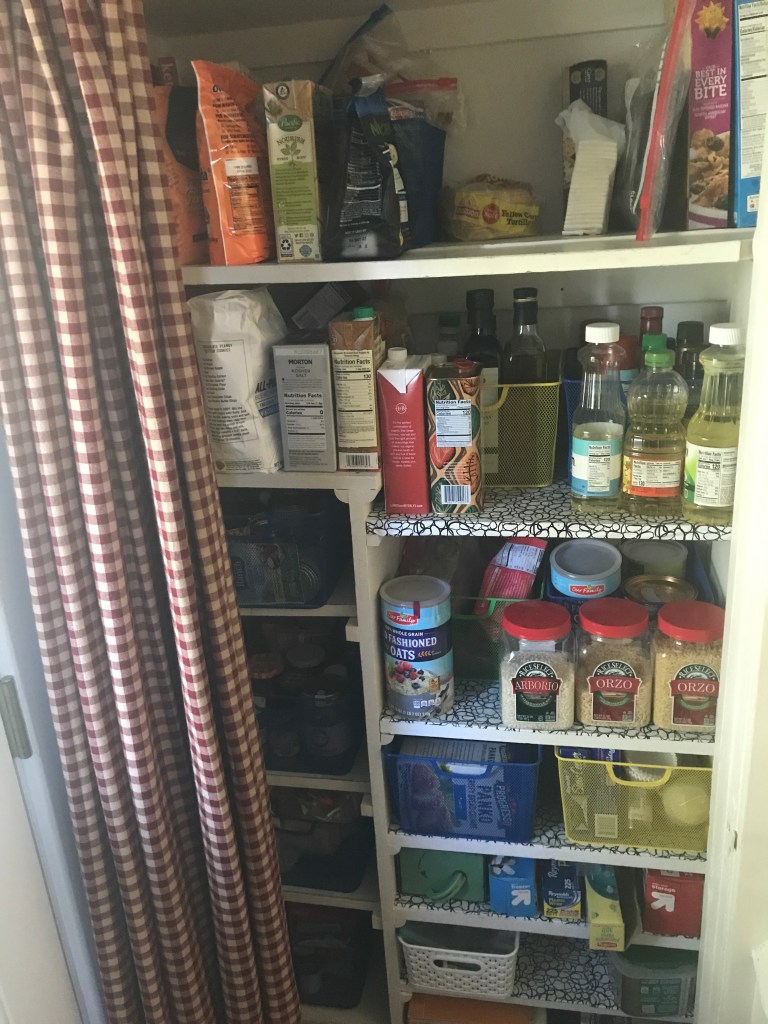
By the way, my current pantry, which is a closet a couple steps down from the kitchen, is adequate. More than adequate for my current needs, and I need to remember that. It could use a bit tidying, however. I will put that on my list.

An Invitation

What moments of envy do you experience and how can they be a teacher? I would love to know.

Note:

If you are interested in the enneagram, I highly recommend the Riso and Hudson book I quoted. Also, you can take a test at https://www.bestenneagramtest.com/enneagram-test-how-can-i-find-out-my-enneagram-type?gclid=Cj0KCQjwhY-aBhCUARIsALNIC07jjnNA_X_HrH9lNQdBDKXoPBsrWeDvITTlnE0DmY_Djx4qJ4_NBCEaAiFWEALw_wcB OR https://mypersonality.net/quiz?afid=gdnmps&gclid=Cj0KCQjwhY-aBhCUARIsALNIC06glsDnVpEU2cYZ57KvpeykthSx5vfm7ZF01bWCnk_u6VGSKENcuH4aAolZEALw_wcB

Going with the Flow

September 20, 2022

Since returning from our Labor Day weekend road trip to Cleveland, the days have been full. Notice I said “full,” not “busy.”

For me “full” indicates choice. What do I choose to do? What do I prefer to do? What brings meaning into my life and in what ways do my choices have potential meaning for others?

“Fullness” versus “busyness” reminds me to pay attention. When am I responding from my essence, from the person I hope to be, was created to be, instead of responding out of duty or obligation? Obviously, sometimes a task simply needs to be done, but the more I open to the life I think I am asked to live right now, the more those tasks fall into place.

All that being said, during these last two weeks I have needed to use my time and energy well, moving from task to task deliberately and intentionally and calmly. And that’s the way the next couple weeks will be, as well.

As I have moved through these days, I have thought about my word of the year, rhythm, and also the flow I hope to experience.

Word of the Year: Rhythm

As you listen closely for your deepest call, what are the greater rhythms to which you must accommodate yourself.

Christine Valters Paintner

You may recall that my word of the year is “rhythm.” I’ve been more aware in the last few months of how I need to respond to the rhythm of a day–what is planned and required in a day–but also I am more able to notice and create my own rhythm.

For example, I know my rhythm becomes raggedy and I begin to unravel when I don’t begin my day meditating, praying, reading sacred texts. Doing that faithfully, allows me to adjust my preferred rhythm to the needs of the day. At the same time immersing myself in slow silence also helps me adjust the needs of the day to my own rhythm. Much to my amazement when I ground myself in that spiritual practice, the needs of the day and my needs accommodate one another.

When that happens, I experience flow–when one thing streams into another naturally and easily.

A Reminder

Sometimes I need a physical reminder, an illustration of what flow looks and feels like.

We spent the weekend at the home of friends who live in northern Minnesota, and one afternoon we cruised their beautiful lake. We were the only ones on the water, except for a few loons, who have not yet migrated.

My favorite part was going through a narrow and shallow channel to enter another lake. Our friend turned the motor down and guided the boat under the low bridge, reminding us to keep our hands inside the boat and to lower our heads.

How appropriate was that–to bow our heads as we crossed a threshold.

Pause and bow your head.

Rest in the silence.

Experience the flow.

Discover the rhythm.

Often when I lead a guided meditation instructing participants to breathe deeply in and out, I include the phrase, “find your own rhythm.” I think I need to add, “Feel the flow. Notice the flow around and through you.”

This morning when I closed my eyes, lightly, not tightly, and breathed in and out, gently and deeply, finding my own rhythm, I imagined the shallow water in that channel, and I remembered the feeling of unrushed, undemanding, gentle and yet noticeable flow.

Are you tired? Worn out? Burned out on religion? Come to me. Get away with me and you’ll recover your life. I’ll show you how to take a real rest. Walk with me and work with me–watch how I do it. Learn the unforced rhythms of grace. I won’t lay anything heavy or ill-fitting on you. Keep company with me and you’ll learn to live freely and lightly.

The Message, Matthew 11: 28-30

May I live my life that way.

An Invitation

When have you experienced flow? I would love to know.

Note:

Here is my post on my Word of the Year: https://wordpress.com/post/livingonlifeslabyrinth.com/362

My New Spiritual Practice

August 30, 2022

I wake up in near darkness these days as summer brightness begins its surrender into fall shadows.

Inspired by a short video, “The Beauty of Living,” (See note below.) I decided to light a candle on the dresser as the first act of the day.

I light the candle as an expression of gratitude. Oh, let me count the ways.

I light the candle as an acknowledgement of seasonal changes, as well as the changes I experience as I age.

I light the candle to welcome the day and to offer myself to the rhythm of the day.

I light the candle to open to the gifts of the day. May I see them, know them, honor them.

I light the candle to accept the challenges of the day. May I be filled with grace.

I light the candle to soften the expectations for the day, for myself in the day. May I not be driven by lists, but instead bring my whole heart into the day.

I light the candle as a sign of my connection to the whole. I am one in the all.

I light the candle to enlarge the boundaries of my heart.

I light the candle to know the Presence and to guide me in ways I can be the Presence.

I light the candle as a reminder that in everything there is shadow and in everything there is light.

I light the candle as an act of contemplation, leading to action.

I light the candle as way to enter the day.

And then I make the bed, pausing at the window to drink in the view of the gardens still lush in their summer energy.

An Invitation:

Do you have a spiritual practice that starts your day. I would love to know.

Note #1:

Here’s the link for the video, “The Beauty of Living.” https://gratefulness.org/resource/beauty-of-living/?utm_source=A+Network+for+Grateful+Living&utm_campaign=64065a9096-newsletter_october_2020_COPY_01&utm_medium=email&utm_term=0_c606570b82-64065a9096-113849461&mc_cid=64065a9096&mc_eid=f8389d4b84

Note #2: Taking a Short Break

My next post will be Thursday, September 8, when I will share the summary of my August reading.

Note #3

As a reader of this blog, you know of my deep respect for Joan Chittister. She spoke once again at Chautauqua. Here’s a detailed report on her talk. I highly recommend you read it. https://chqdaily.com/2022/08/in-closing-week-sr-joan-chittister-details-how-to-live-courageous-prophetic-life/?mc_cid=f551a77842&mc_eid=a480c5ce14

Book Report: Two Nonfiction Books By Sara Lawrence-Lightfoot

August 25, 2022

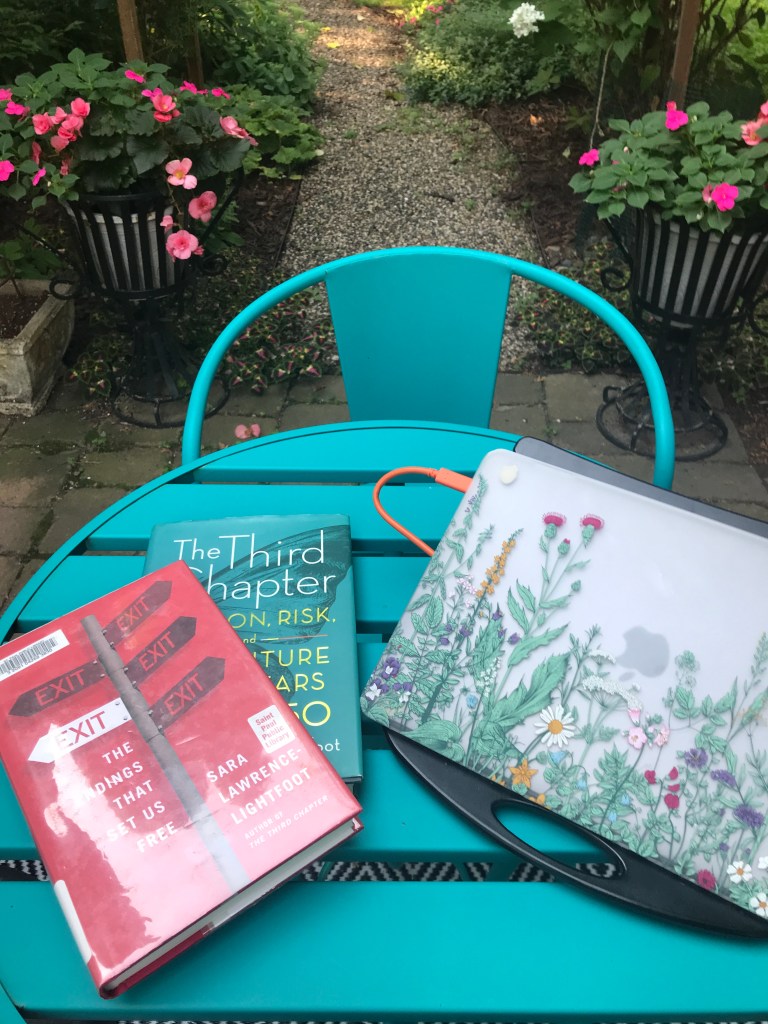
I was 61 when I read Sara Lawrence-Lightfoot’s book The Third Chapter, Passion, Risk and Adventure in the 25 Years After 50, published in 2009. I am now 74 and almost at the end of the time of life Lawrence-Lightfoot writes about in the book.

This book was pivotal in my aging evolution.

We were living in Madison, WI, at the time, and I had not found my place in that community. I had trained as a spiritual director when we lived in Ohio and had a private practice there. I had led spirituality groups in an organization for those touched by cancer and also facilitated retreats and taught T’ai Chi in a variety of places, but in my current life I simply had not found a foothold. That was for a variety of reasons, I realize now, but at the time I had no idea how to adjust to this unexpected loss of role, let alone what might be next.

The Third Chapter helped me acknowledge the sadness and grief I felt, but also opened me to imagine new possibilities; new ways of viewing myself and who I might become as I aged. When we moved back to St Paul, after almost 20 years away, I was thrilled to discover ways I could live with purpose and meaning. The time described in The Third Chapter has been and continues to be a time of thriving for me.

The book also gave me a name for this stage of life. “The Third Chapter.” The other day a writer friend, who was feeling certain life changes swirling around her, said she felt as if she was experiencing a midlife crisis again, but of course, we are well beyond our midlife years. How important it is, I think, to give voice to these elder years.

In the inside cover of the book I wrote two questions: What are the words you use to describe this stage of life? What words do you find yourself using frequently when you talk about yourself? I didn’t know when I wrote those words how those would not only be key questions for my own reflection, but they would become questions as I helped develop Third Chapter programs at my church.

So back to the book. By telling others’ stories, Lawrence-Lightfoot focuses on the creative and purposeful learning that goes on in this stage of life and explores the ways men and women at this stage

find ways of changing, adapting, exploring, mastering, and channeling their energies, skills, and passions into new domains of learning. I believe that successful aging requires that people continue–across their lifetime–to express a curiosity about their changing world, an ability to adapt to shifts in their developmental and physical capacities, and an eagerness to engage new perspectives, skills, and appetites. This requires the willingness to take risks, experience vulnerability and uncertainty, learn from experimentation and failure, seek guidance and counsel from younger generations, and develop new relationships of support and intimacy.

p. 7

No small task. That should keep us engaged!

This book was the first of what is now my extensive collection of books and aging and spirituality. I am still in my “third chapter,” but I would welcome a new book from Lawrence-Lightfoot about the years after 75. Hint, hint.

In the meantime I found another book by her, Exit, The Endings That Set Us Free (2012). Once again deftly telling others’ stories, she explores the variety of endings in our lives and how to navigate them. She notes that our culture values beginnings, launchings. We hold entrepreneurs in high regard. But exits are ignored and often viewed as failures.

We often slink our way out the door, becoming invisible as we do so. One of the women she interviews says, “I don’t want the exit to be about closed doors. Where is the open door! Where is the new life?” (p. 68)

How do we open a door when we end a relationship, a job or career, a role, a major project? And how do we purposefully and meaningful approach the final exit, our own death or the death of a loved one? This book, like The Third Chapter, tells illustrative stories so well, encouraging readers to reflect on our own lives and the endings we have experienced or will experience.

I thought about the acknowledged ending to a job I loved–how I felt celebrated and honored and how that helped me let go. But I also remember another time when my last day in a role I had also loved was totally ignored. No “Thank you.” No “We’ll miss you.” I am sorry I didn’t take it upon myself to create an exit ritual.

A note about Lawrence-Lightfoot: She is a MacArthur prize-winning sociologist, the author of ten books, and is the first African-American woman in Harvard’s history to have an endowed professorship named in her honor. She is someone worth reading, for sure.

An Invitation

Have any books been a guide for you in this aging evolution? I would love to know.

Note:

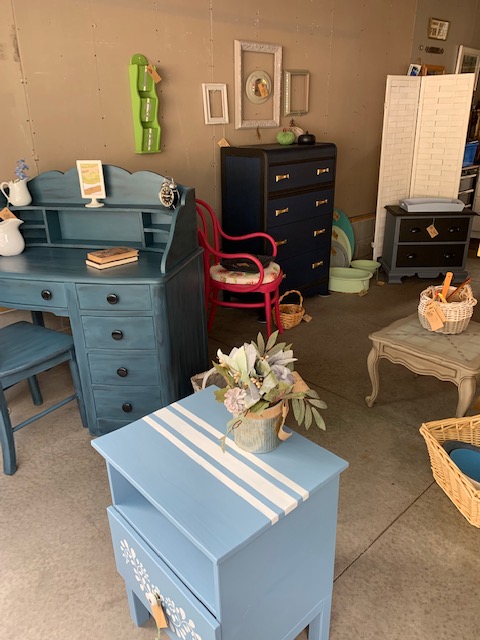
On another topic, for those of you in the St Paul, MN area, my husband Bruce is having his second garage sale of the season this weekend, Friday and Saturday, August 26-27, at our house, 2025 Wellesley Ave. As many of you know, he paints discarded furniture and accessories and the proceeds from his sales go to support the work of Lutheran Social Service’s Rezik House, a residence for homeless youth. Access to the sale is through the alley only.

Pesto Time: Past, Present, and Future

August 23, 2020

These days my morning meditation time is spent first in the garden and then in the kitchen. The basil hedge calls, “Nancy, it is time to make pesto.”

The Present

Before clipping enough basil for two batches of pesto, I run my palms through the leaves, filling the coolness of the morning air with the aroma that whispers, “green,” “fresh,” “delicious.” I smell my hands, telling myself to remember this day when the garden is bare and in hibernation.

I fill the gathering basket and promise I will harvest more the next day –and the day after that until both the basil and I, the harvester, are done.

On the way back into the house, my gathering basket on my arm, I pause and listen to the bees humming as they keep the allium company. I know this may sound silly, but they remind me of the llamas humming their own sweet songs when we lived at Sweetwater Farm. Stay in the present. You can write about the past in a minute, I tell myself.

Look closely to see the bees in their purple environment.

Now it is time to transform basil into pesto.

Sprinkled clean, the basil leaves air dry–two cups of basil for each batch of pesto. One of my tricks is to cover the leaves with a towel and roll a rolling pin over the top, releasing and exploding the basil flavor. My food processor awaits–the basil, nuts and garlic first, followed by a mix of olive and vegetable oil. Then grated Romano and Parmesan cheese with salt and pepper to taste.

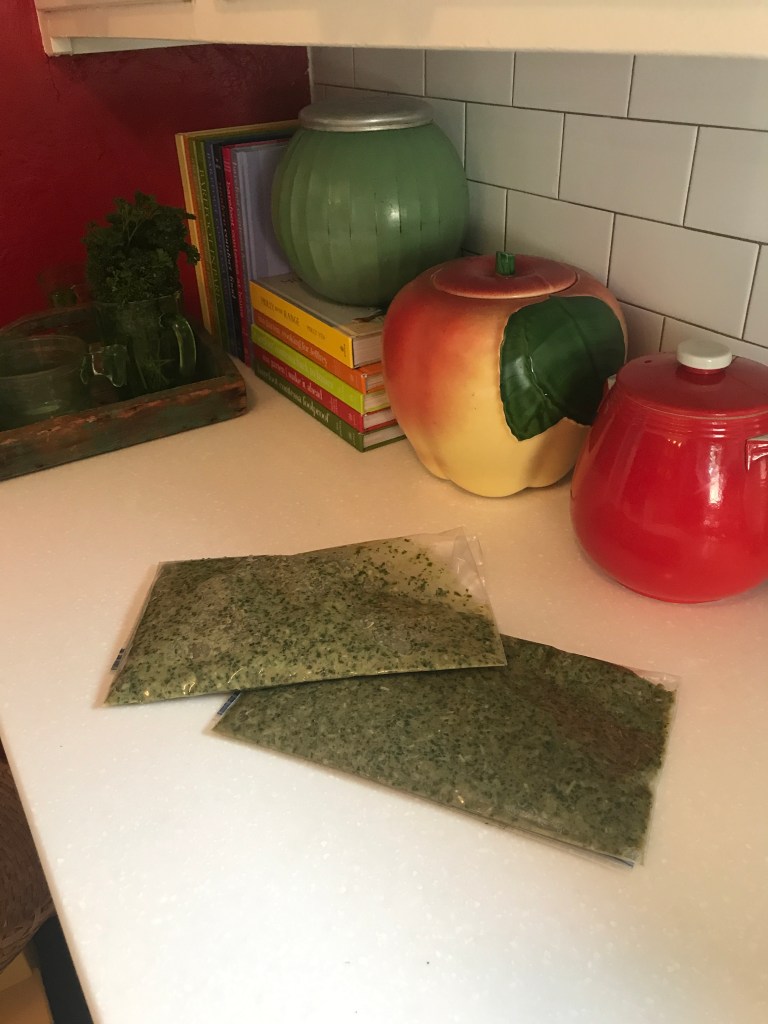
I spoon the, let’s be honest, messy mix into a freezer bag. Yes, I know the trick of storing the pesto in refrigerator trays and using it one cube at a time, and that is a good idea, but storing it in freezer bags means it lays flat, leaving more space.

Then on to batch number two.

And tomorrow batch three and four.

The Past

As I separate the leaves from the stems and later as I put away the needed ingredients and clean the kitchen, how easily I remember other pesto making days and even before that how I became enamored with using herbs in cooking and growing my own herbs.

One summer when our children were young, we took a family vacation in the Boston area. One of our stops was the Plymouth Plantation where I had a fascinating conversation with a woman who was tending an herb garden. She stayed in perfect character–a woman in early colonial days– as I asked her about the herbs she was growing. I wanted to know what her favorite herbs were for cooking and she was surprised by my question, for she used herbs for medicinal purposes. That brief encounter led me to a desire to know more–and, of course, I amassed a library of books about herbs.

That interest led to a small herb garden complete with a white picket fence in our small St Paul backyard, but later, when we lived at Sweetwater Farm in Ohio I had a chance –and the space–to more fully indulge my interest in herbs. Thyme, rosemary, sage, of course. Chives, cilantro, oregano, dill, tarragon, marjoram, a variety of mints. But I also loved lemon balm and lemon verbena for lemonade and other summer drinks. And lavender–perhaps my favorite. I grew lavender right outside the back door where I could enjoy the laundry fresh scent with each going out and coming in. I dried long stem bundles and later filled sachet bags to hang in closets and tuck in dresser drawers.

On pesto making days I moved from my tiny kitchen to the harvest table, spreading the bounty across the surface. I became a pesto making factory. Sometimes friends joined me for the process–each taking home a batch or two.

Oh, how I loved and am grateful for that time of my life.

I grew herbs mainly for food, but that doesn’t mean they weren’t healing. Walking in the Sweetwater Farm gardens the summer of my mother’s recurrence of colon cancer and my diagnosis of uterine cancer soothed me. I extended healing and loving blessings to spiritual direction clients when I offered a carefully tied bundle of lavender or fresh sprigs of rosemary and thyme. I gave thanks for the bounties of creation as I tended the earth. I thought about my grandmother, who loved to garden, and wished she had been able to visit us at Sweetwater Farm.

I am in a time of my life when memories rush like a waterfall. Everything seems to remind me of something. The present leads me gently into the past–not to be stuck there and not even to pretend those were the “good old days,” but more simply as a reminder of all the days I have been privileged to live. And to note growth where it has occurred, but also those darker, tighter spaces where more growth is needed.

The Future

Pesto over spaghetti is in the future. Cold winter nights when a reminder of summer is just what is needed. Meal times when I am tired of or bored with cooking. How jolly to open the freezer and pull out a bag of pesto. I make sure to never be without pasta in the pantry.

I know others who buy bushels of tomatoes or corn on the cob and spend hours in the kitchen preparing the bounty for later enjoyment. Or those who make strawberry or peach jam.

When we do this, we are not only preparing food for another day, but we are harvesting and storing memories.
And, taking in the smells and sights and tastes of the present moment, we are in the midst of spiritual practice.

An Invitation

What do you harvest from your garden–your internal or external garden? I would love to know.