Book Report: The 14th Book

September 29, 2022

Recently blogger Melanie (http://comfy house.blogspot.com) posted a series of fun book topics (“Best sequel,” “Currently Reading,” “Drink Choice While Reading,” etc.). The one that captured my attention was “Start at the top left of your shelf and pick the 27th book.”

I modified that somewhat and decided to pick the 14th book on several of my bookshelves housing fiction. Why the 14th? Well some of the shelves don’t hold 27, and I just chose #14 at random.

Here are the 14th books from seven different shelves–four shelves with only hardcovers and three with paperbacks.

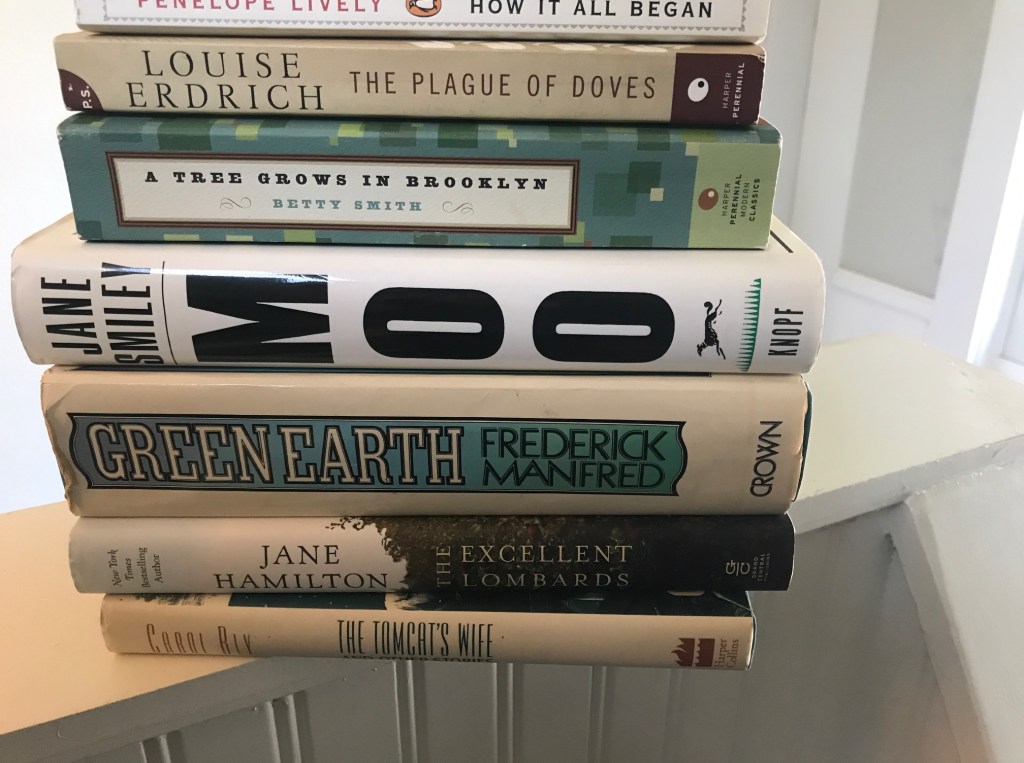
  • The Tomcat’s Wife and Other Stories by Carol Bly (1991). Carol Bly was a Minnesota writer who died in 2007. She was married to (and divorced) the writer Robert Bly, who is probably better known than Carol, but she was known and respected not only for her writing, but also her teaching and speaking gifts. I heard her speak on a number of occasions and always appreciated her wit and wisdom. My favorite book of hers was a collection of essays, Letters from the Country (1981), originally published in Minnesota Monthly. Do I still own that book? I will check. Anyway, the copy I have of The Tomcat’s Wife is autographed, but frankly, I am not sure I actually read it. Yet.
  • The Excellent Lombards by Jane Hamilton (2016).I loved her previous books, The Book of Ruth and A Map of the World. I only have a vague memory of this book, a coming-of-age story set on her family farm, an apple farm, the main character “Frankie” loves dearly and worries about its future.
  • Green Earth by Frederick Manfred (1977).Manfred was another Minnesota author (1912-1994) perhaps best known for his book Lord Grizzly, but he wrote many books, many in the “western” genre. Green Earth is a big book, over 700 pages, and Manfred was a big man with a big presence. I remember noticing his big hands when I met him at a book signing event at the independent bookstore where I worked many decades ago, Odegard Books. I don’t think I ever got around to reading this book, but I am attracted to it now because it is a family saga set in what he called Siouxland (northwest Iowa, southwest Minnesota, southeast South Dakota), an area that intrigues me for its prairie landscape. At one time he lived in a house that eventually became the interpretive center of Blue Mounds State Park in Rock County, Minnesota.
  • Moo by Jane Smiley (1995). Another autographed book, this book brings back memories. I won this book in a raffle at a library event in Cleveland, OH. This is not my favorite book by Smiley, but I love how she has written books in a variety of styles. My favorite book of hers is A Thousand Acres for which she won the Pulitzer Prize for Fiction in 1992. More recently, I throughly enjoyed the quirky novel Perestroika in Paris.
  • The Plague of Doves by Louise Erdrich (2008). Just holding this book makes me want to read/re-read all of Erdrich’s books, first to most current. I know there are book groups who are doing just that, and I admire their devotion, as she has written 28 books–fiction, non-fiction, poetry, and children’s books and has won the National Book Award for Fiction and the Pulitzer Prize for Fiction. A Plague of Doves, which is the story of the unsolved murder of a farm family that continues to haunt a community, was a finalist for the Pulitzer Prize for Fiction. And I would be remiss not to mention that Erdrich is the owner of one of my favorite bookstores, Birchbark Books, Minneapolis.
  • How It All Began by Penelope Lively (2011). Lively is a prolific and celebrated English writer, whose works often explore the power of memory, which perhaps is why I am attracted to her books. I loved The Photograph (2003) and Moon Tiger (1987), and I recall thoroughly enjoying the disparate cast of characters in How It All Began. I can imagine re-reading it.
  • A Tree Grows in Brooklyn by Betty Smith (1943). This is one of my all-time favorite books, and if you haven’t read it, do not delay. If you haven’t re-read it since your youth, re-read it now. If you decide to pick one book from this eclectic list of books, let it be this one. Enough said.

In plucking these books off some of my shelves, I thought I might discover some I could donate to a Little Free Library, but that is not the case. I was surprised by how many of the authors are Midwestern–Bly, Hamilton, Manfred, Smiley, Erdrich–and I wonder if that would be the case if I focused on a different number or other shelves. Also, I am pleased that I have only NOT read two of the five, and I am more inclined to read them soon. All in all, I am delighted to become reacquainted with these books.

Happy reading!

An Invitation

What are the the titles of your #14 books? I would love to know.

NOTE:

Next week’s Book Report Thursday will be a summary of what I read in September.

Breaking the Sabbath to Keep It Holy?

September 27, 2022

“Remember the Sabbath day and keep it holy.” Exodus 20:8

Sunday afternoon I cleaned the kitchen. All afternoon.

I emptied the refrigerator, throwing out what was no longer edible, and scrubbed the inside. I rearranged some of the cupboards, moving what is used most frequently onto the lower shelves and what is used less frequently onto higher shelves. I finally tackled the space under the kitchen sink where I keep cleaning supplies –a task that had been on my list for a long time. I sanitized the garbage can, scoured the microwave, re-organized the pots and their covers in the oven drawer. I moved methodically from one area to another, shining and cleansing and tidying and finished by washing the floor cloth first and then the floor.

I enjoyed every minute of the process.

In fact, when I stood in the dining room looking into my small kitchen, I felt refreshed.

This feeling of refreshment felt like my version of a “Sabbath exhale.”

Without the Sabbath exhale, the life-giving inhale is impossible.”

Sabbath, Finding Rest, Renewal, and Delight In Our Busy Lives by Wayne Muller

Sunday Routine

My Sabbath started more traditionally the night before–taking a shower, washing my hair, deciding what to wear to church the following morning, and getting a good night’s sleep. We had missed church the previous Sunday when we were staying with friends in their northern Minnesota lake home and that was its own kind of Sabbath, but I was eager to return to the Sunday morning ritual.

How good it was to sit in the sanctuary before the service started–to take a deep breath and release the busyness of the previous week. How good it was to close my eyes, to pause, to remind myself to be there, only there, to listen to the music and prepare myself for the gifts of that time. How good it was to be in community, to witness the baptism of a beloved baby and to receive the bread and the wine. I sent blessings to each person who came to the table.

How good it was to greet one another and to rejoice in this gathering, both during worship and during the education hour.

Sabbath time, and I felt refreshed.

Our tradition for many years, beginning when our children were young, was to go out for lunch after church. More than giving me a break from fixing a meal, although that was greatly appreciated, Sunday lunch in a casual restaurant was a time to relax with one another. To check-in. To remind ourselves of who we were as a family. To pause before moving forward into what was sure to be another busy week often of conflicting and complicated schedules and responsibilities. My husband and I have continued the tradition throughout our empty nest years. Now, I confess, we take the NYT with us, but it is a time of ease, an in-between time.

This past Sunday our grandson Peter joined us. He had been staying with us for a few days while his parents were out of town. He is a good conversationalist and oh how good it was to have him all to ourselves.

Sabbath time, and I felt refreshed.

Paying Attention

Once home I continued my Sabbath–by cleaning the kitchen. Yes, by cleaning the kitchen. Doing that felt like a kind of rest because I didn’t approach it as drudgery or something that needed to be done or something to cross off my too long and too dictatorial TO DO list. No, one of my spiritual practices is hometending, and cleaning the kitchen that afternoon was a Sacred Yes. I entered the time with joy and gratitude for the privilege of living in a lovely home, for the delight of sharing my life with my husband of 51 years and in remembrance of all those who have crossed our threshold and in hopes and expectation of future gatherings.

Sabbath time, and I felt refreshed.

Here’s a warning–mainly to myself. How easy it would have been for the pleasure to have turned into obsession. To clean out all the cupboards and drawers. To clean the inside of the oven, and yes, it needs it. To polish all the copper pots hanging in the window. And then to push myself to continue into a cleaning frenzy of the first floor.

The refreshment could easily have become exhaustion. And that would not have been Sabbath rest.

Dinner was easy–only leftovers. I spent the rest of the day reading in the snug.

The day had been “a piece of time that opens space for God.” (Dorothy C. Bass)

I realize my Sabbath rest may not have been a literal or traditional way of keeping and remembering the Sabbath, and many Sundays I attempt to be more intentional about resting, but this past Sunday I paid attention to my own rhythm, and I felt refreshed.

An Invitation

What does Sabbath rest look like for you? I would love to know.

NOTE:

Here are three resources about the Sabbath from my library:

  • Sabbath by Dan Allender (2009)
  • Sabbath Keeping, Finding Freedom in the Rhythms of Rest by Lynne M. Baab (2005)
  • “Keeping Sabbath” by Dorothy C. Bass in Practicing Our Faith, A Way of Life for a Searching People, Dorothy C. Bass (editor) (1997)
  • The Sabbath by Abraham Joshua Heschel (1951)
  • A Sabbath Life, One Woman’s Search for Wholeness by Kathleen Hirsch (2001)
  • Sabbath, Finding Rest, Renewal, and Delight in Our Busy Lives by Wayne Muller (1999)
  • The Sabbath World, Glimpses of a Different Order of Time by Judith Shulevitz (2011)

Book Report: Fall Wish List

September 22, 2022

Recently Acquired Books

Even though I have MANY books on my shelves I have not yet read, including those recently acquired, and even though my list of books I intend to request from the library is long, I still covet many new books–yet to be released this fall or recently released. Here’s my list:

Fiction

  • Lucy By The Sea by Elizabeth Strout
  • A World of Curiosities by Louise Penny (Nov 29)
  • Killers of a Certain Age by Deanna Rayburn
  • The Marriage Portrait by Maggie O’Farrell
  • The Bullet That Missed by Richard Osman
  • The Ski Jumpers by Peter Geye
  • The Evening Hero by Marie Myung-Ok Lee
  • Lessons by Ian McEwan

Oh, and I am attracted to the British Library Women Writers Series–forgotten works by mid-century women writers. I think there are 18 in the series.

Nonfiction

  • Sacred Nature: Restoring Our Ancient Bond with the Natural World by Karen Armstrong
  • A Place in the World, Finding the Meaning of Home by Frances Mayes
  • Hagitude, Reimagine the Second Half of Life by Sharon Blackie
  • How We Live Is How We Die by Pema Chodron

The scary thing is that I know I will be enticed by many other titles along the way–and every time I enter a bookstore. I guess as addictions go this problem isn’t too bad.

An Invitation

What new books are tempting you? I would love to know.

Going with the Flow

September 20, 2022

Since returning from our Labor Day weekend road trip to Cleveland, the days have been full. Notice I said “full,” not “busy.”

For me “full” indicates choice. What do I choose to do? What do I prefer to do? What brings meaning into my life and in what ways do my choices have potential meaning for others?

“Fullness” versus “busyness” reminds me to pay attention. When am I responding from my essence, from the person I hope to be, was created to be, instead of responding out of duty or obligation? Obviously, sometimes a task simply needs to be done, but the more I open to the life I think I am asked to live right now, the more those tasks fall into place.

All that being said, during these last two weeks I have needed to use my time and energy well, moving from task to task deliberately and intentionally and calmly. And that’s the way the next couple weeks will be, as well.

As I have moved through these days, I have thought about my word of the year, rhythm, and also the flow I hope to experience.

Word of the Year: Rhythm

As you listen closely for your deepest call, what are the greater rhythms to which you must accommodate yourself.

Christine Valters Paintner

You may recall that my word of the year is “rhythm.” I’ve been more aware in the last few months of how I need to respond to the rhythm of a day–what is planned and required in a day–but also I am more able to notice and create my own rhythm.

For example, I know my rhythm becomes raggedy and I begin to unravel when I don’t begin my day meditating, praying, reading sacred texts. Doing that faithfully, allows me to adjust my preferred rhythm to the needs of the day. At the same time immersing myself in slow silence also helps me adjust the needs of the day to my own rhythm. Much to my amazement when I ground myself in that spiritual practice, the needs of the day and my needs accommodate one another.

When that happens, I experience flow–when one thing streams into another naturally and easily.

A Reminder

Sometimes I need a physical reminder, an illustration of what flow looks and feels like.

We spent the weekend at the home of friends who live in northern Minnesota, and one afternoon we cruised their beautiful lake. We were the only ones on the water, except for a few loons, who have not yet migrated.

My favorite part was going through a narrow and shallow channel to enter another lake. Our friend turned the motor down and guided the boat under the low bridge, reminding us to keep our hands inside the boat and to lower our heads.

How appropriate was that–to bow our heads as we crossed a threshold.

Pause and bow your head.

Rest in the silence.

Experience the flow.

Discover the rhythm.

Often when I lead a guided meditation instructing participants to breathe deeply in and out, I include the phrase, “find your own rhythm.” I think I need to add, “Feel the flow. Notice the flow around and through you.”

This morning when I closed my eyes, lightly, not tightly, and breathed in and out, gently and deeply, finding my own rhythm, I imagined the shallow water in that channel, and I remembered the feeling of unrushed, undemanding, gentle and yet noticeable flow.

Are you tired? Worn out? Burned out on religion? Come to me. Get away with me and you’ll recover your life. I’ll show you how to take a real rest. Walk with me and work with me–watch how I do it. Learn the unforced rhythms of grace. I won’t lay anything heavy or ill-fitting on you. Keep company with me and you’ll learn to live freely and lightly.

The Message, Matthew 11: 28-30

May I live my life that way.

An Invitation

When have you experienced flow? I would love to know.

Note:

Here is my post on my Word of the Year: https://wordpress.com/post/livingonlifeslabyrinth.com/362

Book Report: Reflecting on Home

September 15, 2022

Sometimes a book does everything but jump into your hands. That was the case with two books I read recently.

I must have read a review of The Green Hour, A Natural History of Home by Alison Townsend (2021), for I added it to my TBR list, but when I saw it in Arcadia Books on our recent trip to Spring Green, WI, I knew I could not wait for it to come out in paperback or for the library to add it to their shelves.

First of all, look at that cover. So beautiful, and it is the kind of book that simply feels good to hold. But more than that is the topic, the themes. The author grew up in Pennsylvania and as a young adult lived in Oregon and California, but later in adulthood moved to the Madison, Wisconsin area. She writes beautifully, richly about each landscape–the kind of multi-layered, descriptive writing I love–but having lived in Madison, those are the sections I loved the most.

Her essay, “Strange Angels: Encounters with Sandhill Cranes,” is perhaps the best nature essay I’ve ever read.

Like a group of pilgrims or spiritual seekers collecting before their journey begins and uttering preliminary prayers, the cranes seem to be readying themselves, preparing for the long flight they must make, some of them for the first time.

p. 159

Like the author I love the sound of the cranes and always feel blessed hearing them. “Perhaps that is why their call is so evocative, why it seems to float across the millennia as it does, immutable and enduring.” p. 160. Cranes are not part of my life here in St Paul, and I miss them.

I also loved the essay “An Alphabet of Here, A Prairie Sampler” as well. C is for Canada Geese. G is for Great-Horned Owl. Q id for Queen Anne’s Lace and Queen of the Prairie.

Z is for zigzags, zaps, and zings of summer lightning, the zed-shaped folds of the aurora opening its luminescent green curtains on a winter’s night when it’s twenty degrees below zero, and the z-z-z-z-z-ing as we sleep–cat on the bed, collies on the floor beside us–the zodiac swirling around us like the well of life that is here, now, the only one we are given.

p. 187

Some books beg to be read aloud, and I am grateful my husband was willing to listen as I read select essays to him while driving through the countryside on our way to Cleveland recently. This books was our perfect companion.

I discovered The White Stone, The Art of Letting Go by Esther de Waal (2021) when we toured the gardens at St John’s University, Collegeville, MN this summer. Because I can never resist a bookstore, we browsed the Liturgical Press bookstore on campus, and I found this little treasure. Years ago I read her book Seeking God, her book on Benedictine spirituality, but it is no longer in my library–I may need to get another copy. This book was written during the pandemic and at a time when she is moving from one home to another, and she employs what has sustained her through the years–the Rule of St. Benedict, the gifts of Celtic spirituality, the teachings of Thomas Merton, and the Psalms–to guide her through a time of transition.

I hold on to stability but I must not be static. Here is the paradox…I must be prepared for the continual transformation in which God is bringing the new out of the old…It is just a matter of somehow keeping on keeping on, a continual bending one’s life back to God whatever happens.

p. 64

I was especially moved by the chapter titled “Diminishment,” in which she reflects on how time seems different as we age, but also that “Life now brings a greater opportunity to pay attention to look consciously at the ordinary minutiae of daily life in the things around…”

She also underscores the key question of Benedictine life: “Am I becoming a more loving person?” When we were driving through Indiana, I noticed a small sign on the edge of a cornfield, “Fear God,” it said, and I thought to myself, “How does fearing God make me a more loving person?” Instead, I suspect adhering to that idea would make me a more fearful person. I want to be a more loving person. Thanks for the reminder, Esther de Waal.

Ok, that’s it. I am so happy these two books will live on our bookshelves.

An Invitation

Have any books found their way into your hands, your heart recently? I would love to know.

Pictures I Didn’t Take

September 13, 2022

This is the only photograph I took while visiting our son and daughter-in-love in Cleveland.

I could have taken pictures of the backyard party at Geof and Cricket’s house the night of the first football game of the season (OSU 21, Notre Dame 10) or the delicious BBQ ribs prepared by Cricket.

Perhaps I should have taken pictures of the many friends who came to see the game projected on the inflatable outdoor screen or the array of dishes spread on the dining room table–as good as any church potluck. Why didn’t I take a picture of the many pots of flowers framing the backyard?

The view of Lake Erie from the restaurant where we enjoyed snacks and something to drink was certainly lovely enough to warrant a photograph and what about the cute cottage, soon to-be-an AirB&B where we stayed–just three houses away from Geof and Cricket’s house?

And why-oh-why didn’t I ask someone to take a picture of the four of us together? Silly me!

Here’s why: I was simply being present. Enjoying the conversations, the companionship, not only with our dear ones, but also with their friends. I was content to be in their presence, to feel the love and the delight in one another’s company.

And that was enough.

Don’t get me wrong. I am grateful for the ability to take pictures on my phone and I do that often. And sometimes I regret not taking pictures–like our grandson at his first football game this fall or this past Sunday at the potluck after church. I love documenting the change of seasons and oh, how I love scrolling through my visual library of past events.

There are also times, however, when what I most need to do is rest in the presence and allow my memory, the camera inside my head and heart, to take the pictures.

Sometimes I need to be part of the scene and not separate from it. Sometimes I need to let the moment flow, instead of attempting to freeze it into a particular time and place.

And let’s be honest, sometimes I simply get so caught up in the moment that I forget to take a picture. Oh well.

An Invitation

What pictures live in your memory alone? I would love to know.

Book Report: August Round-Up

September 8, 2022

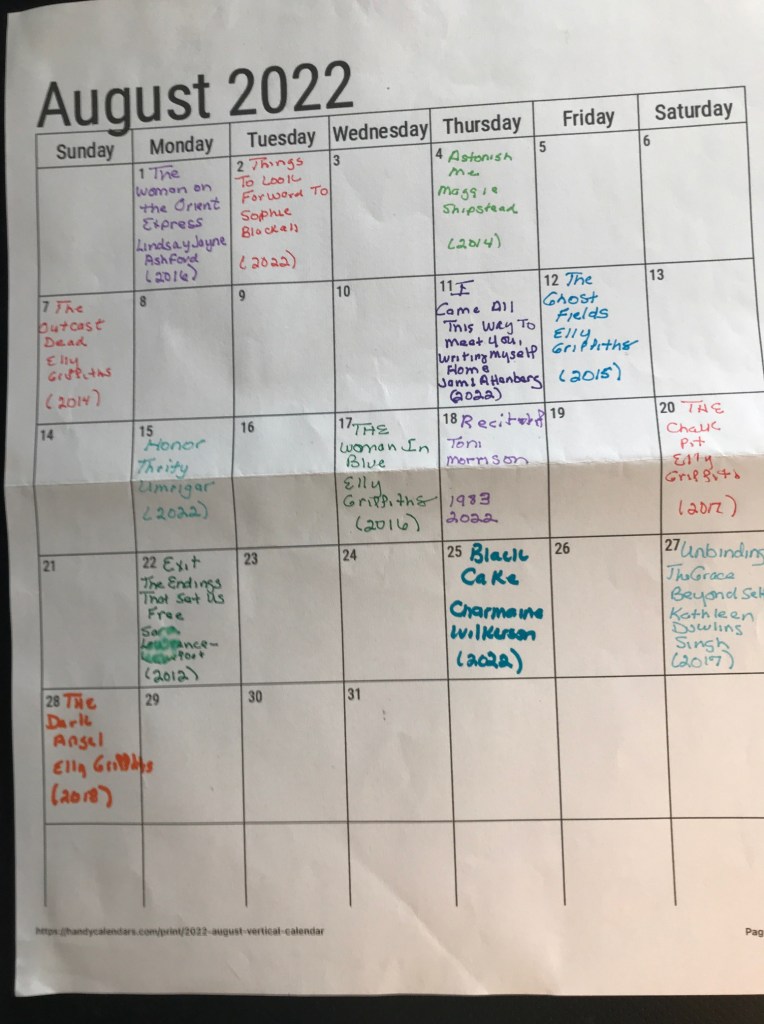
Along with continuing to read the Ruth Galloway Mystery series by Elly Griffiths (5 more this month), I read some stellar fiction, checking off several titles on my TBR list. I also read more nonfiction than in the last couple months–4 titles. So here’s the report.

Fiction

  • Astonish Me by Maggie Shipstead (2014). I have now completed Shipstead’s back list and I have enjoyed each one for their originality and freshness of plot and her development of characters. This novel, her second, is set in the world of ballet. The main character is a dancer in her young years, later becoming a ballet teacher whose son is a talented dancer. An important part of the story is her relationship with a Russian ballet dancer.
  • Honor by Thrity Umrigar (2022). I have enjoyed earlier books by the author, such as The Space Between Us and The Weight of Heaven, and was so pleased when this new novel was ready for me at the library. The main character, Smita, is an American journalist born in India. She is in India to cover a story about a Hindu woman who marries a Muslim man and suffers tragic consequences for that love. As Smita becomes involved with this woman, she is forced to confront her own background and to make life-changing decisions. At one point another character says to Smita, “You know what your problem is, Smita? You focus on the cat hair. Try focusing on the cat.” (p. 319)
  • Recitatif by Toni Morrison. (1983, but in a 2022 edition) This is the only short story Morrison wrote and the introduction by Zadie Smith is longer than the story itself. The story focuses on two women, one black and one white, but the reader does not know which is which. Clearly, the story is meant to highlight our own racism and adoption of stereotypes.
  • Black Cake by Charmaine Wilkerson (2022). I loved this book and so admire the deft way the author (This is her debut novel.) kept all the twists and turns and number of characters and the changes in their lives clear for the reader. The book is based first on an island, perhaps Jamaica, but also England and the U.S and the “black cake” of the title is a family tradition and also figures in the plot of the book, as does long-distance swimming and surfing. How’s that for an interesting combination? I don’t want to say more, at the risk of giving too much away. I repeat, I loved this book.
  • I also read The Woman on the Orient Express by Lindsay Jayne Ashford (2016), and it was a so-so read. Agatha Christie was the main character, so that was promising, but by the end I wondered what the point was. Can’t win them all.

Nonfiction

I wrote in two previous posts about two of the books I read in August. Things to Look Forward To, 52 Large and Small Joys for Today and Everyday by Sophie Blackall (2022) in the August 11 post and Exit, the Ending that Sets Us Free by Sara Lawrence-Lightfoot in the August 25th post. I read two other nonfiction titles.

  • I Came All This Way to Meet You, Writing Myself Home by Jamie Attenberg (2022). This was a plus-minus book for me. There was much in the book I didn’t enjoy and couldn’t relate to–drugs, drinking, uncommitted sex– and I am not sure I would like the author if I met her nor am I planning to read her novels. However, I copied two pages of quotes about books and writing in my book journal, and I appreciated much of what she says about solitude and about issues with her body. So plus-minus.
  • Unbinding, The Grace Beyond Self by Kathleen Dowling Singh (2017). I read this book over a long period of time, savoring and reflecting. Before this book I read and loved two others by Singh, The Grace in Aging, Awaken as You Grow Older (2014) and The Grace in Living, Recognize It, Trust It, Abide In It (2016). Unbinding, alas, was her last book before her death in 2017. I think I could read this book over and over again and not begin to receive all that is offered. Three chapters stand out for me, “Becoming,” “Aging and Death,” and “The Sacrament of Surrender.”

We are already into September and summer reading is behind us. Most of the books I read this summer were ones I got from the library, but in the meantime I acquired a number of books for my own library. I am planning to focus on those this month. We’ll see how that goes! Happy reading!

An Invitation

What do you recommend from your summer reading? Any reading plans for the fall? I would love to know.

My New Spiritual Practice

August 30, 2022

I wake up in near darkness these days as summer brightness begins its surrender into fall shadows.

Inspired by a short video, “The Beauty of Living,” (See note below.) I decided to light a candle on the dresser as the first act of the day.

I light the candle as an expression of gratitude. Oh, let me count the ways.

I light the candle as an acknowledgement of seasonal changes, as well as the changes I experience as I age.

I light the candle to welcome the day and to offer myself to the rhythm of the day.

I light the candle to open to the gifts of the day. May I see them, know them, honor them.

I light the candle to accept the challenges of the day. May I be filled with grace.

I light the candle to soften the expectations for the day, for myself in the day. May I not be driven by lists, but instead bring my whole heart into the day.

I light the candle as a sign of my connection to the whole. I am one in the all.

I light the candle to enlarge the boundaries of my heart.

I light the candle to know the Presence and to guide me in ways I can be the Presence.

I light the candle as a reminder that in everything there is shadow and in everything there is light.

I light the candle as an act of contemplation, leading to action.

I light the candle as way to enter the day.

And then I make the bed, pausing at the window to drink in the view of the gardens still lush in their summer energy.

An Invitation:

Do you have a spiritual practice that starts your day. I would love to know.

Note #1:

Here’s the link for the video, “The Beauty of Living.” https://gratefulness.org/resource/beauty-of-living/?utm_source=A+Network+for+Grateful+Living&utm_campaign=64065a9096-newsletter_october_2020_COPY_01&utm_medium=email&utm_term=0_c606570b82-64065a9096-113849461&mc_cid=64065a9096&mc_eid=f8389d4b84

Note #2: Taking a Short Break

My next post will be Thursday, September 8, when I will share the summary of my August reading.

Note #3

As a reader of this blog, you know of my deep respect for Joan Chittister. She spoke once again at Chautauqua. Here’s a detailed report on her talk. I highly recommend you read it. https://chqdaily.com/2022/08/in-closing-week-sr-joan-chittister-details-how-to-live-courageous-prophetic-life/?mc_cid=f551a77842&mc_eid=a480c5ce14

Book Report: Two Nonfiction Books By Sara Lawrence-Lightfoot

August 25, 2022

I was 61 when I read Sara Lawrence-Lightfoot’s book The Third Chapter, Passion, Risk and Adventure in the 25 Years After 50, published in 2009. I am now 74 and almost at the end of the time of life Lawrence-Lightfoot writes about in the book.

This book was pivotal in my aging evolution.

We were living in Madison, WI, at the time, and I had not found my place in that community. I had trained as a spiritual director when we lived in Ohio and had a private practice there. I had led spirituality groups in an organization for those touched by cancer and also facilitated retreats and taught T’ai Chi in a variety of places, but in my current life I simply had not found a foothold. That was for a variety of reasons, I realize now, but at the time I had no idea how to adjust to this unexpected loss of role, let alone what might be next.

The Third Chapter helped me acknowledge the sadness and grief I felt, but also opened me to imagine new possibilities; new ways of viewing myself and who I might become as I aged. When we moved back to St Paul, after almost 20 years away, I was thrilled to discover ways I could live with purpose and meaning. The time described in The Third Chapter has been and continues to be a time of thriving for me.

The book also gave me a name for this stage of life. “The Third Chapter.” The other day a writer friend, who was feeling certain life changes swirling around her, said she felt as if she was experiencing a midlife crisis again, but of course, we are well beyond our midlife years. How important it is, I think, to give voice to these elder years.

In the inside cover of the book I wrote two questions: What are the words you use to describe this stage of life? What words do you find yourself using frequently when you talk about yourself? I didn’t know when I wrote those words how those would not only be key questions for my own reflection, but they would become questions as I helped develop Third Chapter programs at my church.

So back to the book. By telling others’ stories, Lawrence-Lightfoot focuses on the creative and purposeful learning that goes on in this stage of life and explores the ways men and women at this stage

find ways of changing, adapting, exploring, mastering, and channeling their energies, skills, and passions into new domains of learning. I believe that successful aging requires that people continue–across their lifetime–to express a curiosity about their changing world, an ability to adapt to shifts in their developmental and physical capacities, and an eagerness to engage new perspectives, skills, and appetites. This requires the willingness to take risks, experience vulnerability and uncertainty, learn from experimentation and failure, seek guidance and counsel from younger generations, and develop new relationships of support and intimacy.

p. 7

No small task. That should keep us engaged!

This book was the first of what is now my extensive collection of books and aging and spirituality. I am still in my “third chapter,” but I would welcome a new book from Lawrence-Lightfoot about the years after 75. Hint, hint.

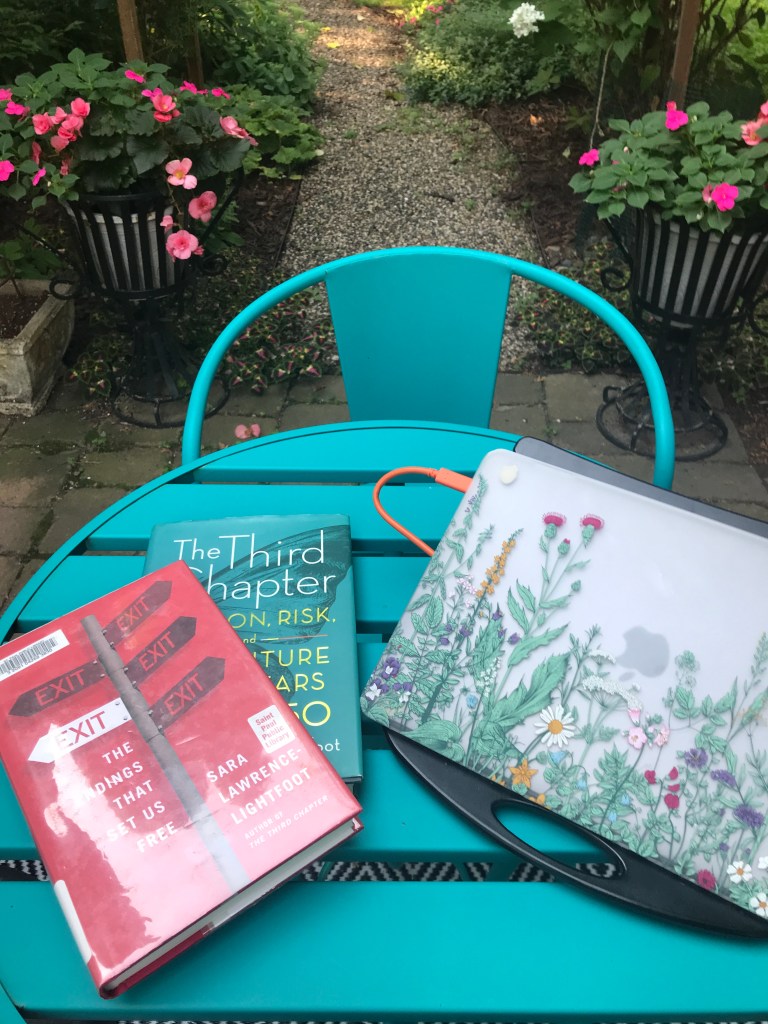
In the meantime I found another book by her, Exit, The Endings That Set Us Free (2012). Once again deftly telling others’ stories, she explores the variety of endings in our lives and how to navigate them. She notes that our culture values beginnings, launchings. We hold entrepreneurs in high regard. But exits are ignored and often viewed as failures.

We often slink our way out the door, becoming invisible as we do so. One of the women she interviews says, “I don’t want the exit to be about closed doors. Where is the open door! Where is the new life?” (p. 68)

How do we open a door when we end a relationship, a job or career, a role, a major project? And how do we purposefully and meaningful approach the final exit, our own death or the death of a loved one? This book, like The Third Chapter, tells illustrative stories so well, encouraging readers to reflect on our own lives and the endings we have experienced or will experience.

I thought about the acknowledged ending to a job I loved–how I felt celebrated and honored and how that helped me let go. But I also remember another time when my last day in a role I had also loved was totally ignored. No “Thank you.” No “We’ll miss you.” I am sorry I didn’t take it upon myself to create an exit ritual.

A note about Lawrence-Lightfoot: She is a MacArthur prize-winning sociologist, the author of ten books, and is the first African-American woman in Harvard’s history to have an endowed professorship named in her honor. She is someone worth reading, for sure.

An Invitation

Have any books been a guide for you in this aging evolution? I would love to know.

Note:

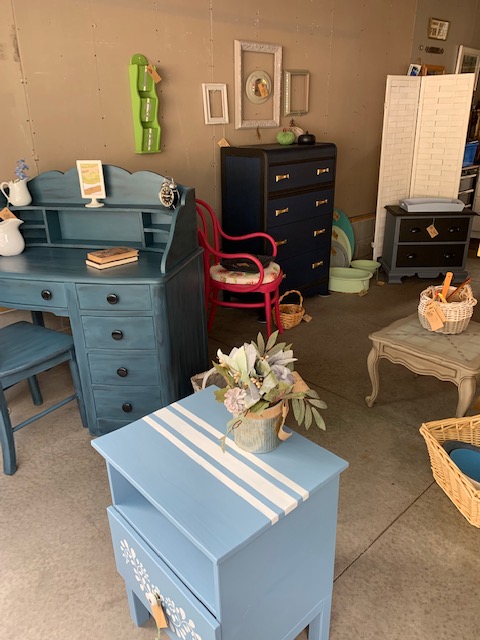
On another topic, for those of you in the St Paul, MN area, my husband Bruce is having his second garage sale of the season this weekend, Friday and Saturday, August 26-27, at our house, 2025 Wellesley Ave. As many of you know, he paints discarded furniture and accessories and the proceeds from his sales go to support the work of Lutheran Social Service’s Rezik House, a residence for homeless youth. Access to the sale is through the alley only.

Pesto Time: Past, Present, and Future

August 23, 2020

These days my morning meditation time is spent first in the garden and then in the kitchen. The basil hedge calls, “Nancy, it is time to make pesto.”

The Present

Before clipping enough basil for two batches of pesto, I run my palms through the leaves, filling the coolness of the morning air with the aroma that whispers, “green,” “fresh,” “delicious.” I smell my hands, telling myself to remember this day when the garden is bare and in hibernation.

I fill the gathering basket and promise I will harvest more the next day –and the day after that until both the basil and I, the harvester, are done.

On the way back into the house, my gathering basket on my arm, I pause and listen to the bees humming as they keep the allium company. I know this may sound silly, but they remind me of the llamas humming their own sweet songs when we lived at Sweetwater Farm. Stay in the present. You can write about the past in a minute, I tell myself.

Look closely to see the bees in their purple environment.

Now it is time to transform basil into pesto.

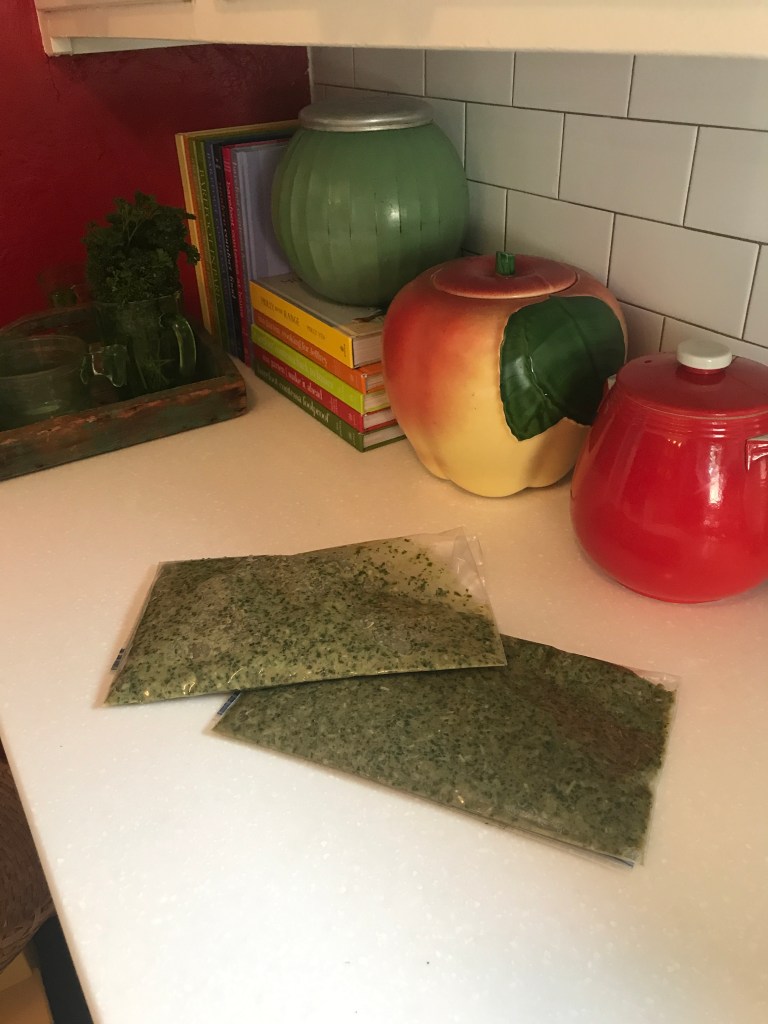
Sprinkled clean, the basil leaves air dry–two cups of basil for each batch of pesto. One of my tricks is to cover the leaves with a towel and roll a rolling pin over the top, releasing and exploding the basil flavor. My food processor awaits–the basil, nuts and garlic first, followed by a mix of olive and vegetable oil. Then grated Romano and Parmesan cheese with salt and pepper to taste.

I spoon the, let’s be honest, messy mix into a freezer bag. Yes, I know the trick of storing the pesto in refrigerator trays and using it one cube at a time, and that is a good idea, but storing it in freezer bags means it lays flat, leaving more space.

Then on to batch number two.

And tomorrow batch three and four.

The Past

As I separate the leaves from the stems and later as I put away the needed ingredients and clean the kitchen, how easily I remember other pesto making days and even before that how I became enamored with using herbs in cooking and growing my own herbs.

One summer when our children were young, we took a family vacation in the Boston area. One of our stops was the Plymouth Plantation where I had a fascinating conversation with a woman who was tending an herb garden. She stayed in perfect character–a woman in early colonial days– as I asked her about the herbs she was growing. I wanted to know what her favorite herbs were for cooking and she was surprised by my question, for she used herbs for medicinal purposes. That brief encounter led me to a desire to know more–and, of course, I amassed a library of books about herbs.

That interest led to a small herb garden complete with a white picket fence in our small St Paul backyard, but later, when we lived at Sweetwater Farm in Ohio I had a chance –and the space–to more fully indulge my interest in herbs. Thyme, rosemary, sage, of course. Chives, cilantro, oregano, dill, tarragon, marjoram, a variety of mints. But I also loved lemon balm and lemon verbena for lemonade and other summer drinks. And lavender–perhaps my favorite. I grew lavender right outside the back door where I could enjoy the laundry fresh scent with each going out and coming in. I dried long stem bundles and later filled sachet bags to hang in closets and tuck in dresser drawers.

On pesto making days I moved from my tiny kitchen to the harvest table, spreading the bounty across the surface. I became a pesto making factory. Sometimes friends joined me for the process–each taking home a batch or two.

Oh, how I loved and am grateful for that time of my life.

I grew herbs mainly for food, but that doesn’t mean they weren’t healing. Walking in the Sweetwater Farm gardens the summer of my mother’s recurrence of colon cancer and my diagnosis of uterine cancer soothed me. I extended healing and loving blessings to spiritual direction clients when I offered a carefully tied bundle of lavender or fresh sprigs of rosemary and thyme. I gave thanks for the bounties of creation as I tended the earth. I thought about my grandmother, who loved to garden, and wished she had been able to visit us at Sweetwater Farm.

I am in a time of my life when memories rush like a waterfall. Everything seems to remind me of something. The present leads me gently into the past–not to be stuck there and not even to pretend those were the “good old days,” but more simply as a reminder of all the days I have been privileged to live. And to note growth where it has occurred, but also those darker, tighter spaces where more growth is needed.

The Future

Pesto over spaghetti is in the future. Cold winter nights when a reminder of summer is just what is needed. Meal times when I am tired of or bored with cooking. How jolly to open the freezer and pull out a bag of pesto. I make sure to never be without pasta in the pantry.

I know others who buy bushels of tomatoes or corn on the cob and spend hours in the kitchen preparing the bounty for later enjoyment. Or those who make strawberry or peach jam.

When we do this, we are not only preparing food for another day, but we are harvesting and storing memories.
And, taking in the smells and sights and tastes of the present moment, we are in the midst of spiritual practice.

An Invitation

What do you harvest from your garden–your internal or external garden? I would love to know.