June 29. 2023
NOTE: I am going to take a blog break next week. I will resume posting on July 11.
What is reading? Reading is…
…an activity whose value, while broadly proclaimed, is hard to specify. Is any other common human undertaking so riddled with contradiction? Reading is supposed to teach us who we are and help us forget ourselves, to enchant and disenchant, to make us more worldly, more introspective, more empathic and more intelligent. It’s a private, even intimate act, swathed in silence and solitude, and at the same time a social undertaking. It’s democratic and elitist, soothing and challenging, something we do for its own sake and as a means to various cultural, material and moral ends.
A. O. Scott in “The Reading Crisis,” New York Times Book Review, June 25, 2023
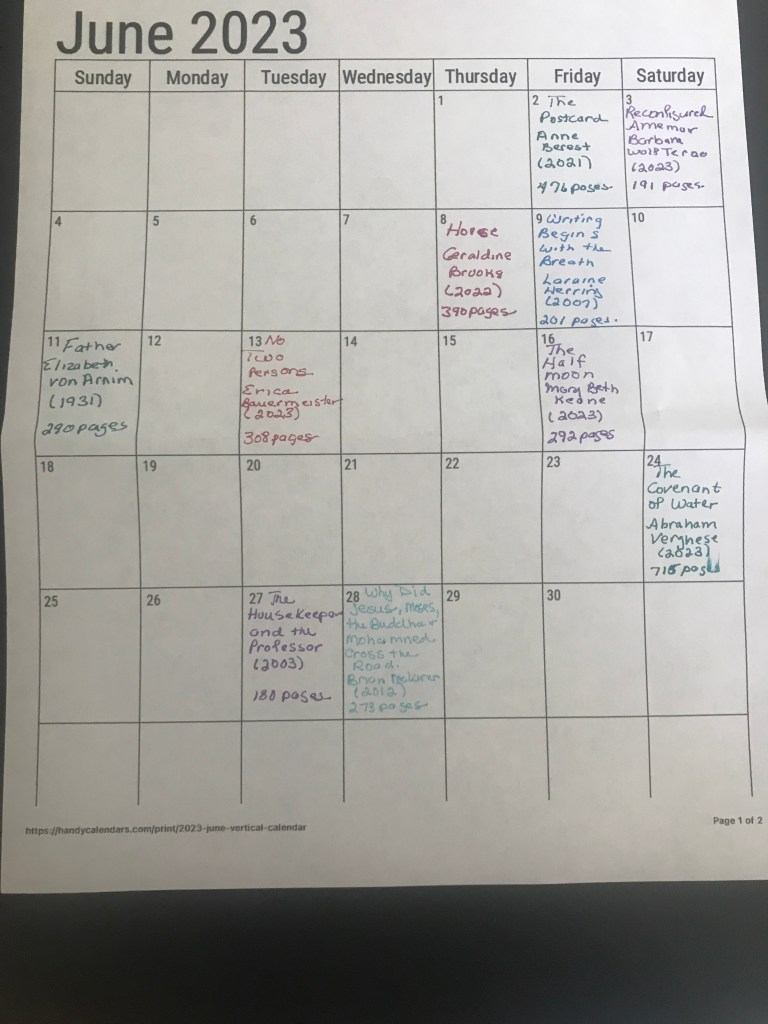
This month’s reading included many of the “shoulds” as listed in A. O. Scott’s essay, as well as the contradictions–reading as a private act, as well as a social undertaking. So here goes–a summary of June’s reading hours.
Fiction
Earlier this month I wrote about The Postcard by Anne Berest and Father by Elizabeth Von Arnim and my appreciation for both, although wildly different books. (Posts on June 8 and June 15)
- Horse by Geraldine Brooks. I always enjoy Brooks’ books, and this one was no exception, although the “horse world” doesn’t much interest me. However, with all her books, there is more than one layer. The book weaves the story about one particular horse, Lexington, a race horse at the end of the Civil War, with finding the skeleton of that horse over a hundred years later at the Smithsonian. On its own the story of the horse’s trainer/groom, a slave named Jarrett, was fascinating, but I also enjoyed the contemporary figures in the story–a graduate student in art history and a woman who works at the Smithsonian. The story is based in fact, and now the skeleton of the horse is on view at the horse museum in Kentucky.
- No Two Persons by Erica Bauermeister. The epigraph for this book is “No two persons ever read the same book or see the same picture.” The Writings of Madame Swetchine, 1860. At times I thought the book was a bit contrived, but still I enjoyed the concept of the book. Alice has written a novel called Theo, and the rest of the book is about certain readers and how they related to it. The readers include the woman at a literary agency who “discovered” the book and passed the manuscript on to the agency’s owner; a teenage girl who is homeless; a movie intimacy consultant; and others. Two quotes I like:
The story on Alice’s computer screen had been finding its way into words for more than five years, or maybe forever. Over that time, it had grown, changed, creaked, flown, gone silent, and then gained its voice again, its plot taking unexpected paths, its characters turning into people she hadn’t thought they would be, just as she had. This glowing screen, the one constant. p. 5
Because if that wasn’t what art was all about, in the end, mentally shoplifting your way through the world around, the thoughts inside you. p. 105
- The Half Moon by Mary Beth Keane. This is a portrait of a marriage in which each individual has a passion that threatens to destroy the marriage. Jess desperately wants a child and Malcolm wants to own the bar, The Half Moon, where he has worked for years. Their individual yearnings get in the way of being honest with each other. The ending was a bit too fantastic I thought, but I hurt for both of them and rooted for their marriage.
- The Covenant of Water by Abraham Verghese. A BIG book. 715 pages. Usually when I read a book of this size, I want to be swept away by it, but that was not the case for me with this book. There were times when that happened–quite a few actually, but I was not enamored of all the medical references and descriptions. Others will be intrigued by them, I am sure. Also, the frequent use of Indian words in italics distracted me, although usually I was able to figure out the meaning from the context. (I am embarrassed by how privileged I sound!) That being said, I liked each of the characters and their stories, beginning with a 12 year old girl in 1900 who enters an arranged marriage in southwestern India. (That marriage does turn out to be happy, however.) The book ends in 1977 and along the way we meet many characters, many of whom are affected by a medical “condition.” Yes, there is sadness and even tragedy along the way, but these are good people attempting to live a good life. Ultimately, I liked this book, but I didn’t love it.
- The Housekeeper and the Professor by Yoko Ogawa. Translated from the Japanese by Stephen Snyder. Who would have thought I would so enjoy a book that involves so much about mathematics and, as if that weren’t enough, baseball. The professor is a math genius who has a traumatic brain injury and only has 80 minutes of short term memory. That means his housekeeper and her 10 year old son, who spends time there each day after school, have to introduce themselves to him everyday. They form a family of sorts and each of them care and caretake in their own way.
The Professor loved prime numbers more than anything in the world. I’d been vaguely aware of their existence, but it never occurred to me that they could be the object of someone’s deepest affection. He was tender and attentive and respectful; by turns he would caress them or prostrate himself before them; he never strayed far from his prime numbers. Whether at his desk or at the dinner table, when he talked about numbers primes were most likely to make an appearance. At first, it was hard to see their appeal. They seemed so stubborn, resisting division by any number but one and themselves. Still, as we were swept up in the Professor’s enthusiasm, we gradually came to understand his devotion, and the primes began to seem more real, as though we could reach out and touch them. I’m sure they meant something different to each of us, but as soon as the Professor would mention prime numbers, we would look at each other with conspiratorial smiles. Just as the thought of a caramel can cause your mouth to water, the mere mention of prime numbers made us anxious to know more about their secrets.
pp. 60-61
Nonfiction
- Reconfigured, A Memoir by Barbara Wolf Terao. I was asked to read an advanced copy of this book, which will be released on July 18. The book is about the author’s breast cancer journey in the context of an unhappy marriage. How important it is to be able to tell our story about traumatic times in our lives, and I admire the author’s ability to honestly wrestle with both the physical and the emotional challenges. I have read a few cancer memoirs, since experiencing cancer in my own life–over 20 years ago–as well as the lives of friends and family, and I think what we look for in these memoirs is a deeper understanding of why we responded the way we did and how we cope and if we are lucky, how we grow and change in life-affirming ways. This book explores how to have the “strength to be a survivor.” The author respond to people’s perception of her bravery in this way.
I would come to hear that phrase from many people over the course of my treatments, and it was never a comfort to me because I knew I was not brave. I was doing what I had to do to stay alive. Inside, I was kicking and screaming about this turn of events–and what I was required to do to my body. I wondered if people lauded my bravery as a way of distancing themselves from cancer and the fears conjured up by that word, and if so, I really didn’t blame them.
pp. 81-82
- Writing Begins with the Breath, Embodying Your Authentic Voice by Laraine Herring. This book focuses on the writing of fiction, but there was lots applicable to the writing of nonfiction. I read a chapter each of my Writing Wednesdays and especially appreciated her chapters on a “deep writing process.” If I started including quotes in this post that resonated with me, I would have a very long post indeed. If you are a writer, add this title to your TBR list. She has also written The Writing Warrior, Discovering the Courage to Free Your True Voice. I have only read a few chapters in that book, but it is very good, too.
- Why Did Jesus, Moses, the Buddha, and Mohammed Cross the Road? Christian identity in a Multi-Faith World by Brian D. McLaren. I am a big McLaren fan. He always makes me think and often gives voice to issues I have, but didn’t necessarily know I had. In this book he asks two key questions: Can you be a committed Christian without having to condemn or convert people of other faiths? and Is it possible to affirm other religious traditions without watering down your own? In his usual fashion, he writes in an accessible way, but each page also includes helpful and clarifying footnotes.
SO that was June and now it is on to July. I am planning to use some of my non writing time in the coming days to read–I hope on the patio and in my secret garden, “Paris.”
An Invitation
What did you read this last month? Any recommendations? I would love to know.
 Living on Life's Labyrinth
Hi Nan, thanks for this post. I also read Horse, and, like her other books, I reveled in the writing. Loved the story, especially Jarrett’s journey. We made it through June! Now on to July……..
LikeLike
So glad you enjoyed Horse, too. Yes, on to July. (I have a great pile of books waiting for more spacious time.)
LikeLike
Thanks for the book report Nancy. It’s always interesting to see what you’re reading. I read Horse a few months ago. It was ok but I enjoyed other of her books more. I do admire how much research she does. Two of my favorites was People of the Book and The Weight of Ink.
I got Laraine Herrings book Writing Begins with the Breath from the library. I ordered The Housekeeper and the Professor. Both sound very interesting. Thanks again.
LikeLike
You are so welcome. I liked both People of the Book (perhaps my favorite of hers) and The Weight of Ink, too. Brooks is always worth reading.
LikeLike
Always look forward to your posts! Here’s a stand-out from my June reads:
The Gift of the Deer by Helen Hoover
What a wonderful find from a thrift store in St. Germain, WI! In the early 1960s, the author and her husband help a starving deer and then observe the impact it makes all the while gently reminding the reader of nature’s wonders and that “nothing can be lost, for nothing exists alone”.
LikeLike
I remember reading that wonderful book years and years ago. In fact, I wonder if we still have a copy. Oh, and thanks for your kind words.
LikeLike
I also read The Covenant of Water in June. I really enjoyed it (including all the medical talk!), but the book itself was too drawn out. The only two other books I read this month were two books of poetry (Good Bones and How to Love the World). I’m in the middle of reading a non-fiction book called Outlive: The Science and Art of Longevity by Dr Peter Attia. Enjoy your break! You have a secret garden??
LikeLike
I am intrigued by the nonfiction title you mention and will look into that. Our side garden, which I call “Paris,” is a secret garden in that no one notices it (or me when I sit there) from the sidewalk when they walk by our house.
LikeLike