NOTE: I am going to take a brief break and won’t publish posts on Tuesday, May 7 or Thursday, May 9. I will post my April Book Report Summary, however, on Thursday, May 2.
As always, the weekly writing group I facilitate, In Your Own Words, Contemplative Writing as Spiritual Practice, includes time for silent meditation. “Close your eyes lightly, not tightly. Take a deep cleansing breath. Breathe gently in and out, finding your own rhythm.” After six or seven minutes of sitting in silence with one another, I read the guiding words for the day. For example:
The word “orientation,” like “Orient,” comes from the Latin, orient, which refers to the “sunrise,” the “east.” If we know the point where the sun rises, we can determine all other points of the compass and find the direction we want to take. Some words can help us in a similar way. Words full of light, they beam, as it were, like the floodlights of a lighthouse and build a bridge over troubled water. Such luminous words can also become keywords that unlock new insights for us. We can learn “to think along language,” the way we walk along a path through meadows enjoying flower by flower, ever new discoveries as we go. You Are Here, Keywords for Life Explorers by David Steindl-Rast, p. 3
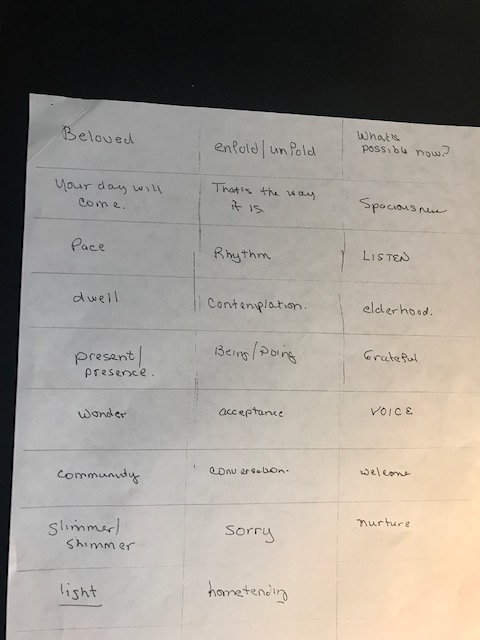
I then read the writing prompts for the day, which recently included the following:
“Begin by listing words on the accompanying table that have had meaning for you or seem to be occurring or appearing in your life right now….List the words (or brief phrases) without judgment.”
I end by saying, “The time is yours,” and we write for 20 minutes.
My Father’s Guiding Words
I filled in the first three blanks on the sheet divided into small sections easily. “Beloved,” my 2023 word of the year. My current words of the year, “enfold/unfold.” And a question I often ask myself and my spiritual direction clients, “What is possible now?” I was surprised, however, when on the next line I wrote, “Your day will come.”
I began to write.
My father said those four words often. “Your day will come.”
I confess I sometimes resented those words–and that he said them with such a knowing smile on his face. I heard judgment and privilege. I felt admonishment–that I wasn’t old enough or hadn’t paid my dues or didn’t deserve something. I can’t recall specific instances when his response was “Your day will come,” but I remember my impatience and my irritation. Why should I remain patient when I wanted something, to do something, to be something, but apparently MY DAY had not yet come.
But I also wondered if the day for __________ would actually ever come or would life pass me by? Would the day truly come when I would know a lasting and fulfilling love? Would the day come when I would know my purpose in life? And would the day come when I would know how to fulfill that purpose? How would I actually know my day had come?
Dad didn’t offer any answers, instead he repeated his pat answer without becoming engaged. His wisdom rolled over me, only lightly touching my skin. I vowed not to use that phrase with my own kids, if I was lucky enough to have any. I don’t think I’ve broken that intention, but you’ll have to ask them.
Now, of course, at this third chapter stage of my life, I realize my day has come–as so many days have gone, have left. So many days have been lived. Some more fully than others. Some days have passed me by. Some days have drifted away unnoticed by me.
And now this day has come.
My day here and now.
My day of becoming more of the person I was created to be.
Often when Dad was in his 80’s and even into his 90’s, he announced he was ready to die, “just not today.” Eventually, his day came. Our creator God announced to him, “Your day is here. The day of your death, your full transformation is here.”
I don’t know when that day will come for me, but now when I think of those words, “Your day will come,” I hear an invitation to use these days wisely, to live these days fully. Doing that, I prepare for the day of my own death, the day my day comes.
Thanks be to God.
An Invitation
What words or phrases have special meaning for you right now? I would love to know.
NOTE:
The writing group I facilitate meets Thursday mornings from 10:30 to noon at Gloria Dei Lutheran Church, St Paul, MN. There is no charge and all are welcome. If you have interest in participating in the group, let me know. If you are not able to participate in person, but would like to receive the guiding words and prompts, send me your email, and I will add you to the list.
One of my favorite projects each week is preparing for the writing group I facilitate at my church. Along with creating a writing prompt, I offer short quotations to support the subject of the prompt. Finding appropriate quotes becomes a rabbit hole of pleasure and memory. Sometimes, I confess, browsing my bookshelves becomes a diversion, a distraction from the task in front of me. Oh well.
An example: My morning meditation these days includes reading the prayers for Lent in Jan Richardson’s Circle of Grace, A Book of Blessings for the Seasons. (2015). One of those blessings led me to this week’s writing prompt –a prompt about telling our own stories. Great–I had both the content for the prompt and one illustrative quote.
Let the browsing begin.
I remembered a workshop on storytelling as a spiritual practice that I took from Diane Millis a couple years ago, so found her book, Re-Creating a Life, Learning How to Tell Our Most Life-Giving Story (2019) on one of my shelves. As I paged through the book, I remembered an exercise Millis led at the workshop and wrote a note to myself to consider adapting that for a future writing group. I also noticed a reference to one of my favorite books, Composing A Life (1990) by Mary Catherine Bateson.
Here’s where the rabbit hole gets deeper. I pulled that book, autographed by Bateson, off my shelf, and as I noted what I had underlined and where I had written comments, I remember the evening I heard Bateson speak at a private girls’ school in Cleveland. Her book, Peripheral Visions, Learning Along the Way (1994), had recently been published, and, of course, I bought that book, too, and had her sign it.
We had moved to Cleveland from Minnesota just months before, and I still felt quite lost and unsure of what my next steps in composing my own life would be. I remember having a lovely conversation with Bateson and being surprised by the time she took to share her wisdom and perspective with me. I don’t remember her words, but am sure I wrote about it in my journal. I resist digging out that journal, for I might never climb out of that rabbit hole! An aside: Many years later I learned that a woman who became a friend had also attended that lecture.
Also on my shelf is Composing A Further Life, The Age of Active Wisdom (2010), and I am so tempted to begin re-reading this book right this very minute. The chapter titles, “Thinking About Longevity,” “A Time for Wholeness,” and “Knowledge Old and New” beckon me and I suspect are even more relevant for me now, but I set it aside. For the moment. And then I remember another of her books that I found at a Little Free Library, Willing to Learn, Passages of Personal Discovery (2004), but have yet to read. It awaits on a different shelf, where I keep TBR nonfiction books.
I slap my hands, reshelve the Bateson books, and turn to the shelves with my writing books. There are lots of temptations on those shelves. I start with two books: The Story of Your Life, Writing a Spiritual Autobiography (1990) by Dan Wakefield and Your Life as Story, Writing the New Autobiography (1997) by Tristine Tainer. The Wakefield book introduced me to the term and the idea of “spiritual autobiography,” which is now more commonly thought of as “spiritual memoir,” and the Rainer book reminds me of her earlier book The New Diary, How to Use A Journal for Self-Guidance and Expanded Creativity (1978), which I used as a text when I taught a series of journal writing classes way back when! All three books are full of notes to myself.
I have found what I need for the writing group and force myself to re-shelve the pile of books on my desk, but that leads to another round of browsing.
The Diane Millis book is right next to a collection of Thomas Merton books and close by are Thomas Moore books. The Bateson books are near books by a current favorite, Diana Butler Bass, including her latest Freeing Jesus, Rediscovering Jesus as Friend, Teacher, Savior, Lord, Way, and Presence (2021). I notice I have starred the last two chapters, “Way” and “Presence,” and I am tempted to re-read those chapter right now. Plus, I notice a Dan Wakefield book I have not yet read, Releasing the Creative Spirit, Unleash the Creativity in Your Life (2001), and I am certain just what I need could be found on those pages.
Behave yourself, Nancy, and focus. Finish the task at hand.
An Invitation:
What books are waiting for you on your bookshelves? I would love to know.
Welcome to the new year! As with any year, all years, we have no idea what will happen in this new year. We never know. It is always unknown. We certainly had no idea on January 1, 2021 what we would face in the coming months, but one thing we know for sure is that the old year has turned.
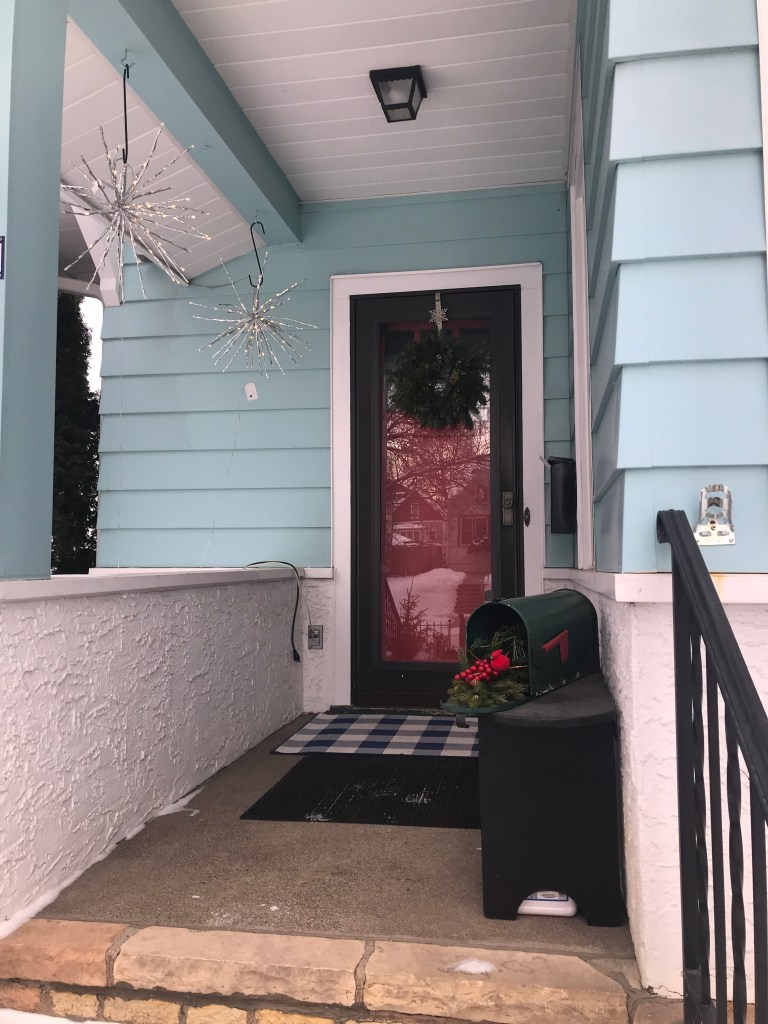
Here we are on the threshold of the new year.
What a good time to pull up your chair to silence.
I invite you to close your eyes lightly, not tightly and take a deep cleansing breath. Breathe in and out gently, finding your own rhythm.
Stay in the silent space as long as you wish, and when you are ready open your eyes, glance around you, as if seeing your space for the first time, and read these words:
Divine Gate-Keeper, ever present to my soul,
I approach the threshold of the new year
Aware of my vulnerability and mortality,
Recognizing my dependence on your vigilance.
Your wisdom will direct my inner footsteps
As I face the future’s unmarked terrain.
Your rapt attentiveness assures me
That you will guide my comings and goings.
This day I join my heart with all living beings
As we walk together toward what lies ahead.
Joyce Rupp
Before opening the gate and crossing the threshold fully into the new year, I invite you to pause on the threshold and reflect on the lessons and gifts of the past year. We have an opportunity before we become used to living in 2022, to reflect on the ways 2021 was sacred text for us.
Let your heart speak.
When I think about the new year, I….
As I let go of 2021, I feel…
As I move into 2022, I…
This is a good place to start, but perhaps you want or need to go deeper.
Imagine that you are preparing to walk a labyrinth. You stand on the threshold and see a long winding path in front of you. What do you imagine as you begin the journey. I think about the Wise Men–and I choose to believe there were Wise Women, too, who are still on the journey to the Christ Child. They are bringing gifts, but they will receive gifts, too. They just don’t know what they will be.
Here are some threshold crossing questions to consider as you reflect on the past year?
What do I treasure about 2021?
What have I hidden away?
What griefs and losses, regrets and changes do I need to process?
What have I made visible?
How have I become more of the person God created me to be?
And now as you envision 2022, here are other questions to consider:
What are your yearnings for the new year?
What can I do for God in the coming year?
What can God do for me?
How might the new year offer you space in which to dream, create, act, be?
What is the heart of your new year’s prayer?
Allow the questions to live within you. Sit with one that seems to resonate or one you wish I had not asked. The journey is more than one step, but begins with one step.
You’ll notice I did not mention “resolutions.” I prefer the word “intention,” for intention implies to me a gradual and ongoing unfolding. And that unfolding grows out of reflection and contemplation.
May this be a time of loving presence.
An Invitation:What are you feeling, experiencing, learning as you cross the threshold? I would love to know.



 Living on Life's Labyrinth