NOTE: I am going to take a brief break and won’t publish posts on Tuesday, May 7 or Thursday, May 9. I will post my April Book Report Summary, however, on Thursday, May 2.
As always, the weekly writing group I facilitate, In Your Own Words, Contemplative Writing as Spiritual Practice, includes time for silent meditation. “Close your eyes lightly, not tightly. Take a deep cleansing breath. Breathe gently in and out, finding your own rhythm.” After six or seven minutes of sitting in silence with one another, I read the guiding words for the day. For example:
The word “orientation,” like “Orient,” comes from the Latin, orient, which refers to the “sunrise,” the “east.” If we know the point where the sun rises, we can determine all other points of the compass and find the direction we want to take. Some words can help us in a similar way. Words full of light, they beam, as it were, like the floodlights of a lighthouse and build a bridge over troubled water. Such luminous words can also become keywords that unlock new insights for us. We can learn “to think along language,” the way we walk along a path through meadows enjoying flower by flower, ever new discoveries as we go. You Are Here, Keywords for Life Explorers by David Steindl-Rast, p. 3
I then read the writing prompts for the day, which recently included the following:
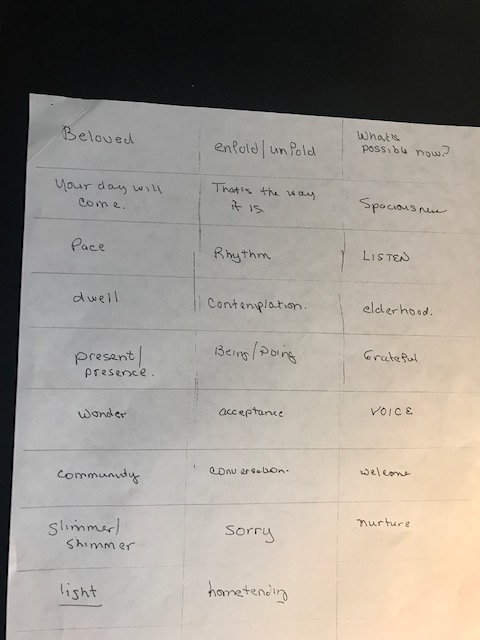
“Begin by listing words on the accompanying table that have had meaning for you or seem to be occurring or appearing in your life right now….List the words (or brief phrases) without judgment.”
I end by saying, “The time is yours,” and we write for 20 minutes.
My Father’s Guiding Words
I filled in the first three blanks on the sheet divided into small sections easily. “Beloved,” my 2023 word of the year. My current words of the year, “enfold/unfold.” And a question I often ask myself and my spiritual direction clients, “What is possible now?” I was surprised, however, when on the next line I wrote, “Your day will come.”
I began to write.
My father said those four words often. “Your day will come.”
I confess I sometimes resented those words–and that he said them with such a knowing smile on his face. I heard judgment and privilege. I felt admonishment–that I wasn’t old enough or hadn’t paid my dues or didn’t deserve something. I can’t recall specific instances when his response was “Your day will come,” but I remember my impatience and my irritation. Why should I remain patient when I wanted something, to do something, to be something, but apparently MY DAY had not yet come.
But I also wondered if the day for __________ would actually ever come or would life pass me by? Would the day truly come when I would know a lasting and fulfilling love? Would the day come when I would know my purpose in life? And would the day come when I would know how to fulfill that purpose? How would I actually know my day had come?
Dad didn’t offer any answers, instead he repeated his pat answer without becoming engaged. His wisdom rolled over me, only lightly touching my skin. I vowed not to use that phrase with my own kids, if I was lucky enough to have any. I don’t think I’ve broken that intention, but you’ll have to ask them.
Now, of course, at this third chapter stage of my life, I realize my day has come–as so many days have gone, have left. So many days have been lived. Some more fully than others. Some days have passed me by. Some days have drifted away unnoticed by me.
And now this day has come.
My day here and now.
My day of becoming more of the person I was created to be.
Often when Dad was in his 80’s and even into his 90’s, he announced he was ready to die, “just not today.” Eventually, his day came. Our creator God announced to him, “Your day is here. The day of your death, your full transformation is here.”
I don’t know when that day will come for me, but now when I think of those words, “Your day will come,” I hear an invitation to use these days wisely, to live these days fully. Doing that, I prepare for the day of my own death, the day my day comes.
Thanks be to God.
An Invitation
What words or phrases have special meaning for you right now? I would love to know.
NOTE:
The writing group I facilitate meets Thursday mornings from 10:30 to noon at Gloria Dei Lutheran Church, St Paul, MN. There is no charge and all are welcome. If you have interest in participating in the group, let me know. If you are not able to participate in person, but would like to receive the guiding words and prompts, send me your email, and I will add you to the list.
Once a week I facilitate a group of writers at my church. We meditate and then I present a writing prompt and we write for twenty minutes. The weekly sessions are not just a set apart time for writing, but have become a kind of spiritual direction group. Contemplatively, reflectively, respectfully, even lovingly, the group listens each other into deeper understanding of their own spiritual journeys.
Preparing for and then being with this group is always a highlight of my week.
Sometimes (often!) I am the one who needs the deeper learnings possible in this kind of sanctuary.
Last week I led them through a process of lectio divina–holy reading or feasting on the word. I gave each participant two pages from one of the editions of the publication Bella Grace. https://bellagracemagazine.com If you are familiar with Bella Grace, you know the sumptuousness of the photography, along with the inspiring essays and quotations. Each of the pages I selected had a single quote, and I passed them out to the writers randomly with no attempt to match writer and quotes. I invited them to focus on one or both of the quotes. Their choice.
Two of the remaining pages were for me. I didn’t self-select a quote for myself either.
When I read the quote on one of my pages, I gasped.
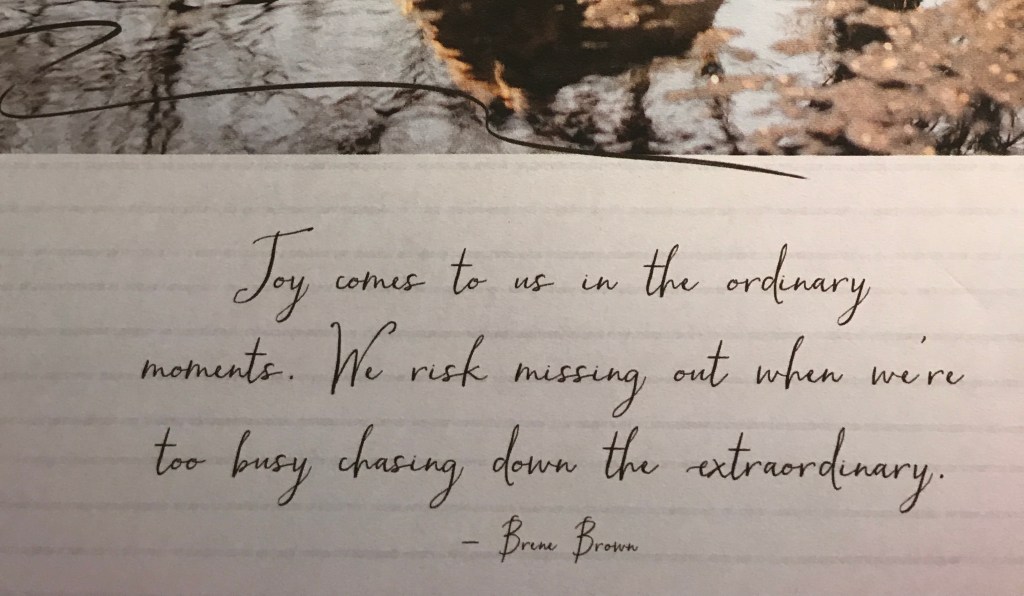
Joy comes to us in the ordinary moments. We risk missing out when we’re too busy chasing down the extraordinary.
Bene Brown
Nice, huh? Well, here’s what you need to know.
I am currently preparing to present an adult forum during our church’s education hour, and the topic is–you got it–JOY!!!!!
Even though I suggested the topic and volunteered to lead the session, I have not been overjoyed about doing this. In fact, I have been a bit of a drama queen about the whole process. For those of you who know anything about the enneagram, I am a 4 and 4s have a tendency to become dramatic when they are anxious about something. I have presented many adult forums in the past and feel so privileged to be able to do that, but there are new challenges this time. Mainly, technology issues–how to present effectively to in-person and at home audiences at the same time. The hybrid model.
Normally, I would create a setting, an atmosphere to experience the topic, to engage with a spiritual practice and to interact with each other. But this new and necessary way of being together limits my usual way of teaching and responding. And Power Point? What’s that? (Yes, I am behind the times.)
When I read the quote in front of me, I had no recollection of reading it before and deciding to include it in the selections for the group. Surprise! Receiving this quote was just what I needed; a reminder to slow down and breathe and to reclaim joy for myself.
In the quiet of the room and in the company of the other writers, I entered the lectio divina process.
Lectio (reading, taking a bite). Get acquainted with the quote. Write down the word or phrase that stands out for you.
Joy comes.
2. Meditatio (reflecting, chewing on it). Read the same passage again. What touches your heart? Allow it to resonate within you. Close your eyes, take those words into your heart and reflect on them. Try to feel them in your body. Write down your reflection.
I feel the first prickling sensation of tears as I sit with this phrase. “Joy comes.” And I notice there is not an “I” in the phrase. Without my asking or seeking or trying to make something happen, joy comes on its own, unbidden. I am reminded that I am a beloved child of God. No matter what. From the very beginning–even before the beginning. What a glorious affirmation, “Nancy, you are a beloved child of God, and joy comes.”
3. Oratio (being active, savoring the essence). Reading the word(s) again, you may feel “so what?” What am I going to do about what I am learning and feeling? Is there a call here? Is this a place for surrender or new level of commitment to deepen your spirituality? Write about your new awareness, thought, feeling or desire.
Be joy and open to joy. Remember all the learning you do when you prepare a new presentation and how that learning deepens because of the interaction with others. Be joy. Open to joy. The most important thing to remember is that joy is an affirmation of God’s presence, God’s love. Not only does God come, but God remains. Ever and always.
In a recent sermon Diana Butler Bass commented that if there was ever a time we need joy, it is now.
Yes. Grief and loss and confusion and uncertainty and fear surrounds us, but still joy comes. In the ordinary. My task is to receive it and reflect it.
4. Contemplatio (resting, digesting and integrating). Once again read the quote. Be aware of presence. This is the time for the prayer of silence, the prayer of the heart. Rest in God, the sacred, the holy.
I feel the drama disappear, at least for the moment, and I relax. I breathe. Make room for joy, I tell myself. Joy comes and needs space in which to shine, to grow, to be.
I expect there will still be technological challenges, but oh, the joy when joy is allowed to flourish.
Joy comes.
An Invitation: Are there words, such as a scripture passage or a lines from a novel or something read in Facebook or even an expression you or someone else uses frequently that beckon you into reflection? I would love to know.
NOTE: Stay tuned for my “Favorite Books of 2021” posts, which I will publish the next two Thursdays–Thanksgiving Day and December 2.
Thank you for reading my blog and sharing my thoughts with others.

 Living on Life's Labyrinth