Dear Subscriber…

September 18, 2024

For several years my Monday routine has included writing my Tuesday post and often the one for Thursday as well, but this summer I discovered technical issues. You, as a subscriber or someone on my email lists, received my posts as usual, but the posts did not appear on the blog website. That meant others, who were not subscribers, did not have access to a new post.

After initially trying to figure out the problem myself, contacting WordPress and also researching YouTube for possible solutions, I decided it was time for a Summer Sabbatical. I adopted Scarlet O’Hara’s philosophy of “I’ll think about it tomorrow.”

Eventually, however, I got serious and hired professional help, but, even with the best efforts, the problem remained.

Now what?

I moved into a time of discernment, and I discovered a number of things about myself and this stage of my life.

  • I enjoyed the new spaciousness of my days. Writing the posts takes a good chunk of time. I have enjoyed over the years using my time in this way, but now I was aware of how much space the blog has been taking in my head and at the keyboard. I realized how I was always on the alert: what to write about; what images could accompany my words; and even as I took my morning walk I rehearsed how to write about an idea.
  • I missed being visible. One of the things that happens as one ages in our culture is that we tend to become invisible to others. The blog at least gave me the illusion that I had not disappeared, and my ego loved that (loves that!). I wonder what the invitation is here.
  • I have become aware of the need to pace myself more. Quite simply, I am not able to do as much in a day as I once did and that means paying more attention to my energy and my priorities. What exactly are those priorities? I asked myself.
  • I realized my reading life had become an obsession. My Thursday posts were devoted to books –my recommendations and news about books. Was I reading in order to write an interesting post? Well, not entirely, but maybe, just a bit. And being known as someone who reads A LOT and is in the know fed that ego of mine!

Someone asked me recently “What are you up to these days?” and I sort of stumbled an answer, just like I am vague when someone asks me if I have any travel plans. With further reflection, however, I realized that what I am up to these days is aging, being an elder, inhabiting this stage of my life.

And what does that look like? What do I hope that looks like? What does it include? And how do I live that, practice that?

I think it involves a certain degree of surrender. Real surrender, it seems to me, involves letting go before one is really prepared to do so, before one is ready. And the issues with my blog seems to be one of those times. Would I choose to stop writing a blog if I didn’t have these technical problems? Probably not, but perhaps, just perhaps, this is one of those God moments. Renita Weems in her book Listening for God calls it “Gotta be God,” as in this must be God whispering in my ear.

My life is deliciously full, and I am so grateful for the ways I am able to use what I think are my gifts. Planning and facilitating the weekly writing group at church brings me such joy. Sitting with my directees in spiritual direction is an ongoing privilege. Being able to respond to other invitations, including writing opportunities, introduces surprise into my life and often challenges me to stretch and to deepen.

At the same time I want and need to be more available to friends and family, especially as many are facing the challenges of aging.

I apologize. I have taken too long to say that it is time for me to let go of my blog, Living on Life’s Labyrinth. The site will stay available for past posts and who knows maybe someday a solution to the technical issue will magically be solved or perhaps I will decide to start a new blog. But this is my decision for right now. This is what feels right and possible at this moment.

I am so grateful to all of you have read me faithfully, have made comments along the way, offered kind words, and shared my posts with others. Thank you, thank you, thank you.

Much of my summer reading has been for an article I am writing for BookWomen, A Readers Community for Those Who Love Women’s Words www.bookwomen.net about spiritual memoirs written by women, but, of course, I read some wonderful fiction, too. Here’s my list of favorites from June, July, and August.

  • Long Island by Colm Toibin (2024)
  • The Cemetery of Untold Stories by Julia Alvarez (2024)
  • Family, Family by Laurie Frankel (2024)
  • Lucky by Jane Smiley (2024)
  • The Hazelbourne Ladies Motorcycle and Flying Club by Helen Simonson (2024)
  • The Lost Art of Mixing by Erica Bauermeister (2013)
  • Forgotten on Sunday by Valerie Perrin (2015 in France, translated, 2023)
  • We Are the Brennans by Tracey Lange (2021)
  • Sandwich by Catherine Newman (2024)
  • How to Read a Book by Monica Wood (2024)
  • You Are Here by David Nicholls (2024)
  • Found in a Bookshop by Stephanie Butland (2023)
  • In My Father’s House by Joseph O’Connor (2023)
  • The First Ladies by Marie Benedict and Victoria Christopher Murray (2023)
  • Loved and Missed by Susan Boyt (2021)
  • Family Happiness by Laurie Colwin (1982)
  • The Wife by Meg Wolitzer (2003)
  • The Measure by Nikki Erlick (2022)

This is normally the spot where I pose a question for your reflection and invite your comments. Today I invite you to consider how you might adopt the spiritual practice of aging. I can still read any comments, if you care to send them, but the question–a big one–is more for your own contemplation.

Again, thank you for reading. I have loved having you along on this adventure. May your days living on life’s labyrinth be blessed.

Following Foolproof Directions

July 9, 2024

Monday morning. “Really?” I moaned when I looked at the clock. 5:30. I wasn’t ready to fully enter the day, but on the other hand, I knew if I went back to sleep, I would sleep later than I wanted to. After all the Monday list was long.

What did I do? I closed my eyes and went back to sleep. For another hour and 15 minutes. I’m usually getting ready for my morning walk by then. Oh well.

I made the bed. At least I had accomplished one thing, I reassured myself. Little by little I did what needed to be done in order to go for a walk. I admit I don’t’ head out on a walk eagerly. I really prefer sitting in the snug, reading my current book. But going for a morning walk is on the list, and it is good for me. Some writers say they love having written, more than actually writing. Well, I am happier when I’ve completed my walk more than when I am actually walking. I must say, however, that right now what a pleasure it is to see the exuberant gardens in so many homes.

Once home, dripping in sweat, because that’s what my body does, even when it is only warm and not hot, the next step was to take a shower. The bathroom with the shower is on the lower level of the house, which is not where my clothes closet and dresser are located. Normally, that is not an issue, but yesterday I needed to return to the first floor not once, but twice to get what I needed to be fully clothed.

Ok, I was finally ready to enter the day.

On my list was to make egg salad, and I was proud of myself for cutting the chives before taking my shower and washing off the insect repellant needed when I walk. You see getting to the chives, once visible, but now hidden among other fully grown plants, is no small task, and I had jungled my way to them. (Yes, I know “jungle” is not a verb.)

I have foolproof directions for hard boiled eggs.

  • Place eggs in large pot and cover with cool tap water.
  • Bring water to boil, lower heat and simmer for five minutes.
  • Turn off heat and let eggs sit in water for five minutes.
  • Drain. Fill pot with cold water.
  • To peel, tap each end on a board, roll egg between hand and board to crackle the shell.
  • Peel under running tap water and let cool to room temperature.

The directions are only foolproof, however, when they are followed.

First mistake: when the water boiled, I set the timer on my phone to five minutes, but I forgot to press “start.”

Second mistake: After wondering how long the eggs had been simmering, I set the timer again for five minutes and AGAIN–I kid you not–forgot to press “start.”

I have no idea if I estimated the time as too long or not enough, but when I tried peeling the eggs…well, let’s just say, I needed to start all over. And I did, and this time, I focused on the directions, and guess what? They worked, and I made delicious egg salad for sandwiches.

By this time it was already midmorning, and normally, I would have written my Tuesday post and would be ready to work on Thursday’s post or another item on my list–a list this week that is longer than any previous week this summer. Yesterday, however, I had no idea what to write.

Here’s where the day shifted.

What I most needed was to follow my own foolproof directions.

  • Close my eyes, lightly, not tightly, and take a deep cleansing breath
  • Continue breathing gently, in and out, finding my own rhythm.
  • As thoughts and ideas, worries and concerns enter my head, invite them to step aside. They will be there later, if I need them.
  • Remain in the stillness, the silence, the spaciousness and allow the presence of God to enfold me.
  • When it is time, and I will know when it is time, I take another deep cleansing breath and open my eyes.

I know these directions are foolproof, so why is it I forget to follow them? Why do I resist? Why do I forget that in order to be the movement of God, I must welcome and notice the movement of God.

I am not suggesting that the rest of the day proceeded smoothly and that I accomplished everything on my too long list, but I did write this post. I enjoyed an egg salad sandwich for lunch. I met with a client whom I love, and I was able to be present to her. I checked off a few small items on my list. I had time to read in the snug. And most of all, I moved through the day in a more grace-filled way.

Sometimes it just takes following directions.

What are your “foolproof directions”? I would love to know.

Signs of Resurrection

April 2, 2024

Easter Sunday, 2016, Granddaughter Maren, age 14, participating in procession

I am not a theologian. I have no degrees in religion. I am not ordained. I have no revolutionary insights into what happened on what we Christians now think of as Easter Sunday. I hold few, if any certainties in my personal creed. Some days, maybe most days, I move from one task to another without giving much thought to the great “truths” of life and death. In fact, more and more I consider the implications of “multiple truths,” a term Rabbi Adam Spilker of Mt Zion Temple used during a recent adult forum at my church.

Ok, given all I say I’m not, who do I say I am?

Well, on this day, two days after Easter Sunday, 2024, I say I am someone who believes in resurrection. As Joan Chittister says in her book, In Search of Belief, I am not specifically referring to the “revivification of an old life…It’s about experiencing a new kind of life entirely.”

I must admit I get hung-up on the word “entirely,” for I seem to experience resurrection in moments, in hints, in glimpses, in efforts, in unexpected gifts, in trial and error, in suggestions, in shimmers and glimmers.

In forgiveness. Or at least the desire to forgive. The movement toward forgiveness.

In grace, even when I don’t recognize it or acknowledge its presence.

Yes, I see resurrection in the loan daffodil that is almost ready to blossom in our backyard and in the song of a bird we can’t identify. And yes, I see resurrection in the pounds of rice and the cash collected for the local food shelf. I see resurrection in the overflowing crowds at all three of our Easter Sunday services –that pull towards hope and light. I hear it in the hymns and the inspiring sermon, and I receive it in the sharing of peace and the taste of the bread and wine.

I see it in the ways many are working for justice and peace and health and safety throughout the world. All the ways we are given to open our eyes and to respond to untruths and injustice and trauma and loss. All the ways we are invited to care.

I often think and write about discovering the person God created me to be. The movement towards wholeness. The unfolding and enfolding of my own essence. Lately, another word has entered my reflection time: alignment. When is what I do, how I live my life, what I choose, and how I respond most in alignment with God? Those moments of alignment, however brief or intangible, nearly invisible, are moments of resurrection.

Most often I don’t perceive those moments as they are occurring. Rather, I perceive them as a kind of retrospective resurrection moment, but I am seeking to be more and more aware of Presence in the moment. Right now as I write these words to you.

My moments of resurrection are different from yours, but they share certain characteristics, I think. They lift.

They open.

They touch.

They grow.

They lead.

They transform.

Over the years I have developed a purpose or, if you prefer, a mission statement for myself.

My purpose is to deepen awareness of the movement and presence of God in my own life and the lives of others:

By writing.

By facilitating groups.

By listening and asking questions.

By living a contemplative life.

More and more I realize that my purpose/mission statement is a reminder to myself to practice resurrection, to notice resurrection, and to seek resurrection for myself and for others.

What we believe by resurrection is that life has a purpose and a quality that does not end at the grave. We believe that the God who created us does not create us to abandon us but brings us finally, somehow, home to the fullness of life. Resurrection is simply another part of the process of growing into God. “Life” as we know it, “time” as we chart it, are simply temporary points to an eternal journey in a universe of unlimited mystery, endless possibility.

In Search of Belief by Joan Chittister, p. 195.

We have now entered the season of Easter. May these days open you, no matter your belief system, to moments of resurrection.

Where and when have you noticed resurrection? I would love to know.

Book Report: November Summary

November 30, 2023

One can read more when not fixing Thanksgiving dinner. (My husband and I enjoyed our Thanksgiving dinner at a favorite restaurant while our St Paul family was traveling. We even had some leftovers to bring home.) I must be honest, however, about the number of books I read this last month.

Several books I read this month were less than 200 pages. I didn’t set out to read short books, but several rose to the top of the pile.

  • Andy Catlett, Early Travels by Wendell Berry (fiction) 141 pages. See my review in my November 16th post.
  • Diary of a Tuscan Bookshop by Alba Donati (nonfiction) 193 pages. Also in my November 16 post.
  • The English Understand Wool by Helen DeWitt (fiction) 69 pages. Ann Patchett is wildly enthusiastic about this book, so how could I resist, and I did love it–and even read it twice. This book is part of New Directions publishers’ Storybook ND series, which publishes books that offer “the pleasure of reading a great book from cover to cover in an afternoon.” Love that! The book (story?) is described as a “modern morality drama” about a seventeen year old girl raised in Marrakech by a French mother and English father. The predominant theme in her life, as emphasized by the woman she knows as her mother, is to avoid mauvais ton or “bad taste.” The truth of her life is revealed, and she is confronted by the “publishing sharks of New York city.” Read it!
  • So Late in the Day by Claire Keegan (fiction) 118 pages. I love each book I have read by Irish writer Keegan (Foster and Small Things Like These). She writes with such clarity that one is almost fooled, thinking each story is simple. But oh there is so much going on below the surface, in the internal lives of her characters. So Late in the Day is the title story in this book of three short stories. The other two are The Long and Painful Death and Antartica. The book is small and would fit easily in a favorite reader’s Christmas stocking.
  • The English Teacher by Lily King. I wasn’t sure how I would feel about this book by the end or what I wanted the ending to be. The English teacher is Vida Avery, who is a stellar teacher–until she isn’t. She teaches at a private school and has a quiet, private life with her teenage son, Peter. Unexpectedly, she marries, a recent widower with three children, and this new status opens her to an earlier trauma in her life.
  • Two books in the Lane Winslow mystery series by Iona Whishaw. #3, An Old, Cold Grave and #4, It Begins in Betrayal. Set in Canada, post WWII, Winslow is happy to be away from her life as a British spy, but at the same time she becomes involved as an unofficial detective when murder occurs in her small village. The 4th in the series takes place mainly in London, however, when her romantic interest, Canadian Inspector Darling, is accused of a war crime. I will definitely continue reading this series.
  • The Door-to-Door Bookshop by Carsten Henn. See my review in my November 23 post.
  • Day by Michael Cunningham. I loved Cunningham’s earlier book, The Hours–loved the movie, too–but I must say I liked this book, but didn’t love it. I did like the structure of the book. One family, the same day of the year in three different years –2019, 2020, 2021–and how their lives change during the pandemic. There is no question that Cunningham writes beautifully, and I often stopped to re-read a sentence or paragraph, simply to enjoy the flow of the words, but I tired of the characters: Isabel, married to Dan, who is an old wannabe rock star hoping for a comeback, and Isabel’s gay brother Robbie, who lives with them, until they need the room for the two growing children in the family.
  • A Likely Story by Leigh McMillan Abramson. A good read. Ward Manning is a famous novelist, but seems to be losing his touch. Claire his wife dies suddenly and their daughter Isabelle discovers a novel written by her mother. Isabelle edits and finishes the novel, presenting it as her own, and the novel Underpainting, becomes a bestseller. Dysfunctional family!

Ward Manning has given his daughter the legacy of being his. Having him as a father was a biographical sparkler bright enough to light up the rest of her life. Even if she did nothing.

p. 76.
  • The Wind Knows My Name by Isabel Allende. In many ways this reads like a nonfiction book–about immigration into this country, but Allende’s narration kept me going. There were two main threads in this book that eventually were woven together. Samuel, an Austrian Jew, is separated from his family in 1938 and sent to England where he lived in a series of homes. He becomes a famous violinist who settles in California. The other strain involves a child, Anita, who is separated from her El Salvadoran mother. Serena, a social worker, and Frank, a lawyer take on her case –and you will have to read it to discover how it all comes together.

I just noticed the theme of Isabel (Isabelle) in this month’s reading!

Except for The Diary of a Tuscan Bookseller, the other three nonfiction books I read this month are all books I have read before.

  • The Summer of the Great-Grandmother by Madeleine L’Engle. This book is #2 in L’Engle’s Crosswicks Journal series, which includes #1, A Circle of Quiet and #3, The Irrational Season. I read #2 again because it deals with dementia, which at the point of history in which this book was written is referred to as senility, a term we no longer use. A number of people in our lives are suffering from forms of dementia, and I knew L’Engle would write honestly and compassionately about this disease. She refers to the Greek word, ousia, which means the “essence of being” — a helpful reminder as dementia is a disease of so much loss. After the death of the great-grandmother dies, L’Engle writes,

My memory of my mother, which is the fullest memory of anybody living, is only fragmentary. I would like to believe that the creator I call God still remembers all of my mother, knows and cares for the ousia of her, and is still teaching her and helping her to grow into the self he created her to be, her integrated, whole, redeemed self.

  • Wintering, The Power of Rest and Retreat in Difficult Times by Kathering May. I underlined more than the first time i read it, but that is often the case when re-reading a book. A couple quotes reveal what is true for me and my wintering times.

Everybody winters at one time or another; some winter over and over again.

p. 10

We may never choose to winter, but we can choose how. Some winters are big, some small.”

p. 13
  • Wayfaring, A Gospel Journey into Life by Margaret Silf. I read this book slowly throughout the whole month, usually only half a chapter during each of my morning meditation times. Silf invites the reader to use the imagination to meet the truths in the Gospel, but from the world of one’s daily life; to join Jesus in the Gospel stories and become part of those stories. She calls this “imaginative prayer.” One of the Gospel stories I continue to explore is the story of Martha and Mary when they invite Jesus to their home for a meal. I have seen myself as both Martha and Mary at different times, but this time as I read this story I was led to explore Jesus’s need for a “bolt hole,” from the world’s demands on him. Enlightening –and opened me to yet more dimensions. I expect I will use much of this material in the coming months in the contemplative writing group I facilitate.

My intention in the coming month is to re-read old favorites, but that can change depending on which of the library books I have requested become available. Another issue is deciding which of my favorites I choose to read. Stay tuned.

What books did you give thanks for in the last month? I would love to know.

What Are You Doing These Days? And Other Difficult Questions

August 29, 2023

“What are you doing these days?”

“How’s your summer been?”

“Doing anything exciting? Traveling anywhere?”

At recent gatherings my husband and I have been asked these or similar questions. Twice I answered,
“We’re just boring old people.” That may be true, but we are not without interests and activities, and it is rare that I feel bored.

Why then is it so hard to answer the question? It is easier for me to share Bruce’s gardening at home and at church and his painting and then selling discarded furniture with proceeds going to Lutheran Social Services programs for homeless youth. And it is easier to share the activities of our grands–Maren’s semester in Greece this fall after working at Northern Lights Family Camp all summer and Peter’s recent hiking trip in the Rockies and now starting his sophomore year of high school and playing football.

Why is it so hard for me to share what I am doing? After all, I love what I am privileged to do.

Most of my days feel rich and full, so why am I uncomfortable sharing the ways I experience this time of my life?

I don’t have an easy answer, but I wonder if at least part of the answer is that what I do, I do most days. I read. I pray. I hometend. I pay bills. I go to Target. I watch yet another series on BritBox. I answer emails and go for walks. I spend time with friends and family and roam backroads with my husband. I go to church.

The stuff of life. The normal stuff of life. The movement from day to day.

I also meet with my spiritual direction clients and plan sessions for the weekly contemplative writing group at church and organize occasional events for Third Chapter, Spirituality As We Age, also at church. I write two posts every week for this blog and am always working on an essay to submit to various publications.

These activities are also the stuff of my life. The normal stuff of my life. The movement from day to day.

In that ongoing movement I try to pay attention and notice the movement of God.

That’s what I do with my days.

Perhaps I need to practice answering the question. I need to have an answer I can pull out of my back pocket–an answer that is simple and accurate, but in some way expresses the constellation of my life.

“Thanks for asking. Life is rich and full. How privileged I feel being able to do what matters to me. Yesterday, for example, I ….”

I love the familiar Annie Dillard quote, “How we spend our days is, of course, how we spend our lives. What we do with this hour, and that one, is what we are doing.”

Exciting days? Not so much. Big travel plans. Not really, except for our weekend rambles and our road trip to see our Cleveland kids in the fall. No, we are not going to Greece to visit Maren. This is her time, her adventure, and we will rejoice in what she shares.

Instead, we are living fully and deeply and joyfully in the stuff of each day.

How do you answer the “what are you doing?” questions? I would love to know.

One of the women in my personal writing group has just had an important article about the perils of wetlands published. I encourage you to read it. https://minnesotareformer.com/2023/08/25/u-s-supreme-court-has-put-precious-wetlands-in-peril/

A Week in Review

May 23, 2023

Have you noticed how some weeks just glow? The days flow with a kind of ease. Perhaps there are more than your usual share of special moments or perhaps the ordinary becomes extraordinary. This past week was one of those weeks, beginning with Mother’s Day and rich family time and ending on Saturday with a top-down drive in my husband’s Miata to a favorite nursery and an outdoor lunch in small town on the St Croix River.

In between I enjoyed productive writing time–writing my posts for the week, as well as working on an essay to submit to a publication. Oh how good it was to write in “Paris.”

I met with my spiritual director and we explored the ways I am lightening my life as I age, including a shorter haircut –silly or trivial as that may sound. I met with spiritual direction clients and the writing group I facilitate. The moments of silence, of sitting with one another open my heart and clear the space for what most needs tending. Such a privilege those times are.

The grandkids delivered homemade cookies one evening (delicious) and another evening we had dinner at one of our favorite restaurants, Sea Salt overlooking Minnehaha Falls. I walked every morning and read on the patio. Finished a book and started another.

We attended a gala for Theater Latte Da, a local theater that specializes in musicals, often new and never before produced, and enjoyed time with friends but also the wonderful musical entertainment. Once I figured out what I was going to wear, all was well!

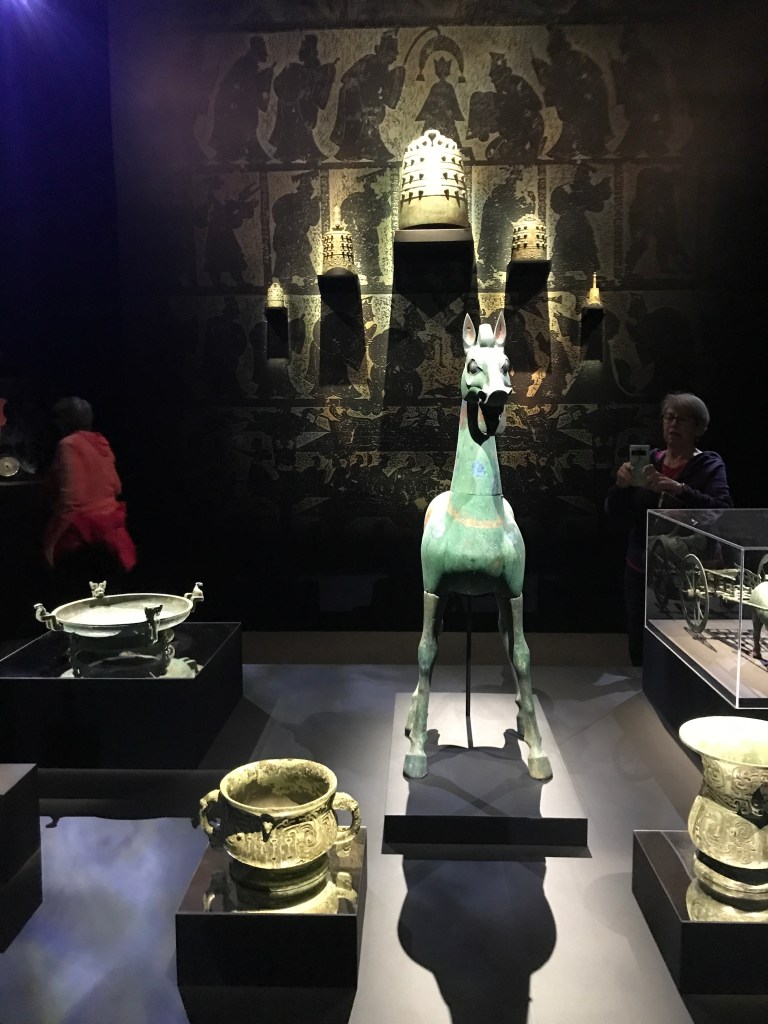
One morning I went to the Minneapolis Institute of Arts (MIA) to see an exhibit called “Eternal Offerings, Chinese Ritual Bronzes.” Yes, the objects created to honor ancestors or to communicate with the spiritual world were beautiful, but the atmosphere created —sound, murals on the walls, lighting— all added to the appreciation of the objects. I took my time moving through the rooms–allowed myself to relax into the beauty and the history, as well as the spiritual life of a culture not my own. I had not been to MIA for a long time and made a mental note to return soon.

The Foundation of Each Day

I began each day reading a meditation from You are the Beloved, Daily Meditations for Spiritual Living by Henri J. M. Nouwen, compiled and edited by Gabrielle Earnshaw. Perhaps this past week shimmered for me because each of those readings so resonated with me, beginning on Sunday, May 14 when Nouwen writes about prayer as a “careful attentiveness to the Presence of Love personified inviting us to an encounter.”

I felt as if I encountered God each day, wherever I was, whatever I was doing, and whomever I was with.

Contemplative prayer can be described as an imagining of God’s Son, Jesus, letting him enter fully into our consciousness so that he becomes the icon always present in the inner room of our heart.

May 15

…many words from the Scriptures can reshape the inner self. When I take the words that strike me during a service into the day and slowly repeat them while reading or working, more or less chewing on them, they create new life.

May 16

But when we believe that we are created in the image of God himself and come to realize that Christ came to let us reimagine this, then meditation and prayer can lead us to our true identity.

May 17

Listen to your heart…Praying is first and foremost listening to Jesus who dwells in the very depths of your heart.

May 18

Prayer allows us to lead into the center of our hearts not only those who love us but also those who hate us. This is possible only when we are willing to make our enemies part of ourselves and thus convert them first of all in our own hearts.

May 19

Just because prayer is the most precious expression of being human, it needs the constant support and protection of the community to grow and flower.

May 20

Here it is day three of the current week, and my days continue to flow, to glow, to shimmer, to open me to the movement and presence of God. Ah, how grateful I am.

An Invitation

What do you notice as you review your days? I would love to know.

Finding Purpose as We Age

April 4, 2023

“I have time now to try new things, but also the need to use this time well.”

” I feel called to do something, to create community.”

“How important it is to be intentional.”

“This time keeps evolving and one thing seems to lead to another.”

“How can I best use my energy?”

“I sometimes say to myself, ‘I get to do this,’ and that brings me joy.”

Last week I facilitated a Third Chapter conversation called “What Now? An Informal Conversation about Purpose and Meaning in the Elder Years.” Third Chapter activities and opportunities are designed for those 55+ and focus on ways to grow spiritually and to explore both the gifts and the challenges of these years. In recent months many have gathered to share insights and thoughts, as well as questions and concerns about a variety of topics, including downsizing and decluttering, choosing the next place to live, making plans about funerals and memorials, and nurturing intergenerational relationships. In preparation for this conversation, I realized I needed to create a purpose statement for myself; some guiding words as a way to sort and focus how I choose to use my energy and time and gifts. First, I browsed a number of books in my personal library about aging to see what resonated with me:

  • Pay attention to your inner compass.
  • What is asking for more attention?
  • This is a time to come home to the self, the person I was created to be.
  • Know yourself. Know your boundaries. Know your gifts. And then be generous.
  • Aging is the gift of continuing on.
  • Cultivate your power to inspire. Be a muse and a guiding spirit.

My next step was to think about what I love to do, what I am currently doing, and what I feel I do well. And I thought about how those things relate to my spirituality, my relationship to the Divine, and to my ongoing quest to understand who I am created to be. And then I thought about what is possible, given my age, my energy, my relationships and my community.

David Steindl-Rast’s words, “When you can’t go far, go deep,” have become a guiding mantra for me in recent years. In my case, what I choose is to go deep. And, to help others go deep as well. Ah, I could feel myself growing closer to defining my purpose, or if you prefer, “call,” or even “vocation,” although that word sounds more applicable to an earlier time of life.

No surprise, I then sat with my journal and tried on some words and phrases to see how they fit. I realized, as the words came together quickly and easily, that thoughts about this stage of my life have been percolating and evolving and emerging.

My purpose is to deepen awareness of the movement and presence of God in my own life and the lives of others.

I took a deep breath after writing those words, letting them flow through me, inviting them to float around me. Do they sound pompous? Pious? “Holier-that-Thou?” I thought about questions I ask my spiritual direction clients frequently. How are you noticing the movement of God in your life now? When have you experienced the presence of God? I ask myself these questions, too, all the time, whispering to myself, “May I feel the presence and be the presence.”

Yes, this is my purpose statement, I told myself, but how is it I intend to live this statement right now, right here.

  • By writing.
  • By facilitating groups.
  • By listening and asking questions.
  • By living a contemplative life.

Over time these specific ways to live my purpose may change, may evolve, and I imagine if I live many more years, my focus will be on the gifts of a contemplative life, but my overriding purpose statement feels as if it can live within me for the rest of my days.

I wrote my purpose statement and intentions on a small card that sits in front of me on my desk, and I practice saying it aloud, sharing it with others. My hope is to fully integrate the words into both actions and contemplation.

How grateful I am for the wisdom and insights shared during our Third Chapter conversations, and for the opportunity those times offer to learn from and to support one another during this time of our lives, for as Joan Chittister says, “The gift of these years is not merely being alive–it is the gift of becoming more fully alive than ever.”

An Invitation

What is the purpose and meaning of your life at this stage of life? Have you written a purpose statement? I would love to know.

NOTE:

An essay I wrote, “Actually, Your Children May Want (Some of) Your Stuff” recently appeared in Next Avenue, a digital publication produced by Twin Cities PBS(TPT), which is dedicated to covering issues that matter most as we age. Here’s the link: https://www.nextavenue.org/your-children-may-want-your-stuff/ I hope you will read and share with others.

Some Days Need More Than One Spiritual Practice

March 7, 2023

Some days feel like this.

And perhaps like this:

Even the Buddha can have an off day.

What I first need to remember is that it is March in Minnesota, and even those of us who love winter become weary of yet another forecast of more snow.

The next thing I need to remember is what helps when I feel a bit blue or antsy and itchy or bored (that happens rarely for me) or worried or disappointed or overwhelmed or….

I admit my first response often is chocolate. Or a grilled cheese sandwich is good, too.

Or if I have been working at my desk, especially if the writing is not going well or if I feel overwhelmed by the TO DO List, which seems to have too many DO NOW items than can physically be done NOW, I try to remember to close the laptop, walk down the garret stairs, and move into the snug to read my current library book. If I could, I would go for a walk, but oh yeah, there’s the snow and ice and a memory of falling and breaking an ankle. The snug will have to do.

Eventually, I remember what helps –even more than chocolate.

I take a deep cleansing breath. More than one. I close my eyes lightly, not tightly. That may seem like an unnecessary reminder, but notice how you feel when you close your eyes tightly. Your whole face squinches up, ogre-like, and instead of breathing, you hold your breath. So close your eyes lightly, not tightly. And then breathe in and out gently, finding your own rhythm.

Often that is enough. I breathe my way to relaxing into the next step or the loving outlook. Or feeling beloved myself.

But sometimes that isn’t enough, and I need to move to the next step in my spiritual practice repertoire: Sitting in silence.

For me that means moving to my Girlfriend Chair in the garret and allowing myself to be enfolded in silence. The majority of my garret time is quiet. I don’t work with music playing, and especially in the winter with the windows closed and the kids next door off to school, all is calm, all is still. I sit with my feet firmly planted on the floor, and I feel the silence enfold me. Sometimes it is so quiet, I can hear my inner voice, the voice I hope echoes the Divine. I listen. I really listen.

Often it is surprising what I hear.

“I love you. Now and forever.”

“Send your love to someone else.”

“Enough. You have enough. You are enough. Enough”

“Trust yourself. You are doing good work. Just stay on the path.”

“Really? You are willing to spend your precious time whining.”

Or if I’m really lucky, “Have another piece of chocolate.”

Sometimes I write in my journal during that silent time or read some sacred words. And prayer of one kind or another is sure to follow.

Whatever has caused my restlessness or anxiety hasn’t disappeared because I have turned to one (or two or three) of my spiritual practices, but I am more centered. I am more present.


We realize that we are in the center, and that from there all that is and all that takes place can be seen and understood as part of the mystery of God’s life with us…’All these other things,’ which so occupied and preoccupied us, now come as gifts or challenges that strengthen and deepen the new life that we have discovered.

Henri Nouwen

I am my silence. I am not the busyness of my thoughts or the daily rhythm of my actions. I am not the stuff that constitutes my world. I am not my talk. I am not my actions. I am my silence. I am the consciousness that perceives all these things. When I go to my consciousness, to that great pool of silence that observes the intricacies of my life, I am aware that I am me. I take a little time each day to sit in silence so that I can move outward in balance into the great clamour of living.

Richard Wagamese, Embers, One Ojibway’s Meditations

An Invitation

What spiritual practices help you return to the center? I would love to know.

Book Report: February Round-Up

March 2, 2023

My reading month started well and ended well, and in between the books were uneven.

Fiction

In an earlier post I wrote about Our Missing Hearts by Celeste Ng. https://wordpress.com/post/livingonlifeslabyrinth.com/1721 A glowing report of a book exquisitely written and a story powerfully told. While visiting a small new bookstore, I heard another customer say she had just finished a book that she loved and was so well-written. She was talking about Our Missing Hearts, and I joined in the conversation, agreeing completely. I have yet to meet anyone who has read the book who did not love it.

The last fiction book I read this month was Gone Like Yesterday, a debut novel by Janelle Williams, and I think this writer has the potential in future novels to attain Celeste Ng’s status. Of course, that is impossible to know, but I hope nothing gets in the way of Williams’ writing and growing and perfecting her skills. Her writing is lyrical and the plot, while involved, is interesting, as are her characters. Zahra is a young black woman who helps privileged high school students write their college admissions essays. She is introduced to Sammie, a another young woman, black, bright, nurtured by her uncle and grandmother, and also applying to colleges. When Zahra learns her brother is missing, Sammie and her uncle pose driving Zahra to Atlanta to look for him. Here’s the tricky part–the presence and sound of moths. Surrounding the car, floating above their heads. hovering in their ears. Are they real? What do they mean? A touch of magical realism. Sometimes it works, but sometimes it doesn’t. I think Williams tries to do too much in this book, but still I am glad I read it.

Three of the other books are mysteries: # 2 and #3 in the series by Ausma Neharat Khan about Canadian police detective Esa Khattak and his colleague Rachel Getty. Although I like, but don’t love these books, at some point I will read more in the series. The third mystery I read is part of the British Library Crime Series, Crossed Skis, An Alpine Mystery by Carol Carnac, which was published in 1952. A well-known trope in British mysteries is the house party concept and this one is similar–a group of young people who don’t all know each other go on a skiing vacation and…. well, read it to find out.

I read two books I truly did not like, and I wonder why I finished them. I usually make quick decisions about whether to finish reading a book or not. Oh well. The first is O Caledonia by Elspeth Barker and even after reading my summary of the book in my book journal, I have little memory of the book. The other book is historical fiction by the popular writer, Marie Benedict. Perhaps I finished this because she is a writer often recommended by others, and I kept hoping I would find something redeeming in the book. The book is The Mitford Affair about the English Mitford sisters, especially Nancy, Unity, and Diana. Set on the brink of WWII, Unity and Diana are big supporters of Hitler, and they manage to become part of his inner circle. Nancy eventually and hesitantly shares with Winston Churchill — the Mitfords are distant relations — some of her sisters’ plans and efforts. I need to like at least one of the main characters in any book I read, and I didn’t like anyone in this book.

Nonfiction

I can recommend all four nonfiction titles without hesitation–depending on your own personal interests.

  1. Memoir as Medicine, The Healing Power of Wiring Your Messy, Imperfect, Unruly (but Gorgeously Yours) Life Story by Nancy Slonim Aronie. I try to read books about the craft of writing frequently, and a writing friend recommended this. Wonderful prompts. Great examples from her own memoir. This book inspired me to establish Writing Wednesdays for myself. Yesterday was my my fifth one, and I plan to continue that schedule.
  2. A Friend Sails in on a Poem by Molly Peacock. I am not a poet, but I loved this memoir of the friendship between two women who are poets, Peacock and Phillis Levin. Peacock is the author of two of my all-time favorite books, both biographies, The Paper Garden: An Artist Begins Her Life’s Work at 72 and Flower Diary: in Which Mary Hiester Red Paints, Travels, Marries and Opens a Door.
  3. Prayer in the Night, For Those Who Work or Watch or Weep by Tish Harrison Warren. Using the words of the compline prayer (Several months ago I wrote this prayer on a small card that sits on my nightstand. Even on mights I don’t pray the words, the intention of those words lives in my heart.) Warren’s writing is simple and clear and at the same time profound, “We need practices that don’t simply palliate our fears or pain, but that teach us to walk with God in the crucible of our own fragility.” Warren shares her fragilities and encourages us to open to our own and to share them with God.
  4. Do I Stay Christian? A Guide for the Doubters, the Disappointed, and the Disillusioned by Brian McLaren. I actually owned this book before I bought McLaren’s previous book, Faith After Doubt, Why Your Beliefs Stopped Working and What to do About It, but I quickly realized it was important to read Faith After Doubt first. I did that in January. Do I Stay Christian? builds on Faith After Doubt, and wow, there is much to process. Part I answers the question, “No.” Part II, “Yes,” and Part III, “How.” Part I is the most upsetting, and Part III is the most challenging. Chapters in Part II include “Because….Where Else Would I go?” “Because I’m Human,” and “Because of Our Legendary Founder.” McLaren is such a good writer (and speaker–I often listen to his podcast, “Learning to See.” ) In the Appendix to the book he writes

We are all friends around this table. All equals. All unique. All welcome. Who we are is who we are. There is no need to pretend. Some of us have a lot of beliefs and very few doubts. Some of us have a lot of doubts and very few beliefs. Some of us love God, but we’re not sure about Jesus, and some of us love Jesus, but we’re not so sure about God. Some of us aren’t sure about anything, and others feel very sure about almost everything. Some of us gladly call ourselves Christians. Some of us barely call ourselves Christians. Some of us once were Christians, but not anymore. Some of us aren’t sure we were ever Christians, or aren’t sure what that means, or whether it matters. But this we share: we welcome one another to this circle just as we are, for we all are part of one web of life on this precious planet in this amazing universe.

p. 229

See my post on books by Brian McLaren here: https://wordpress.com/post/livingonlifeslabyrinth.com/1658

One last note: My husband and I visited a new bookstore in town recently and if you live in the Minneapolis/St Paul area I encourage you to stop by. The name is Comma, and it is the Linden Hills area of Minneapolis.

An Invitation

Anything to recommend from your February reading? I would love to know.

The Presence

January 24, 2023

The Presence by A.E. Borthwick

Recently, I moved this print from underneath the guest bed to the garret where I can see it from my desk. In previous homes it hung above a fireplace, but I never found the right spot for it in this house. I’ve missed it, however, and finally, with minor rearranging, “The Presence” is now a presence once again.

This print by Scottish artist, A.E. Borthwick, has been a presence in my family since I was four or five years old.

My father, who had a lovely singing voice, was the liturgist in our church in Albert Lea, Minnesota, and when we moved away, the church gave him this framed print. At one time there was a letter for my father taped to the back of the print and oh, how I wish I still had that. However, I am grateful the print has survived the many moves.

My parents were master of resettlement and within a couple days of each move to a new location, boxes were unpacked and our home was organized and comfortable. That included hanging pictures, and “The Presence” always had a prominent location, usually in the living room.

Many years later when I was grown and had children, my parents asked my sister, brother, and me which of their possessions we would want someday, and I said the only thing I really wanted was that print. It symbolized home for me. Soon after that conversation, my parents gave me the print, instead of waiting until they downsized.

History of “The Presence”

A. E. Borthwick (1871-1955) was a painter, stained glass artist, and printmaker born in Scarborough, Yorkshire. He studied at the Edinborough College of Art and also in Antwerp and Paris.

He painted “The Presence,” which is set in St Mary’s Scottish Episcopal Cathedral in Edinburgh, in 1910. Before WWI began he sent the painting to Munich where prints were going to be made. When war broke out the painting was sold to an American company and “lost.” It was rediscovered when it emerged to illustrate a newspaper article answering the question, “Is Religion Dead?” The answer given was “No, because of Christ’s abiding presence in his Church.”

At the end of the war an Act of Congress was passed that meant the painting would be returned to Scotland and during WWII it was preserved in the vaults of the Royal Scottish Academy. It had been presented to St Mary’s Cathedral in 1944, and there it remains.

https://www.youtube.com/watch?v=rm5G351clFk

The Changing Meaning of the Painting in My Life

The painting depicts a scene in the cathedral. Communion is being administered at the High Altar, and at the back of the cathedral Christ extends his hand toward a kneeling penitent. Christ is shown in radiant light. The light is so bright in the shadows of the cathedral that one needs to look closely to see the figure.

For most of my life I didn’t think much about the meaning of the painting, and I certainly didn’t relate to the setting. The churches my family attended were far more simple and humble than this massive cathedral. Nor did I think about what would make a person hide in a corner in grief or pain or in need of acceptance or forgiveness.

No, the presence of the painting in our homes meant we were home once more.

When I was training as a spiritual director, however, the word “presence” became more significant for me. During that two-year training, I was exposed to a variety of spiritual practices, including centering prayer. Part of that practice is to use a centering word that in the words of Thomas Keating, “expresses your intention of opening and surrendering to God…Gently place it in your awareness each time you recognize you are thinking about some other thought.” (Open Mind, Open Heart, The Contemplative Dimension of the Gospel by Thomas Keating, p. 36). I tested a number of words, such as “light,” “open,” “heart,” and finally, much like receiving a word for the year, I received “presence.” I knew without a doubt that was the word.

Over time the word itself transformed in my mind into the painting itself. I felt the image, the meaning of the painting itself.

My Mantra as a Spiritual Practice

Eventually, the one word, “presence,” expanded into a mantra: “May I feel the Presence and may I be the Presence.”

I whisper these words to myself, for example,

  • When I begin or end my morning meditation time,
  • Before I meet with spiritual direction client,
  • As I begin to write a post for this blog or work on another piece of writing,
  • When I plan a new session for the church writing group I facilitate.

I find myself saying these words to myself as I move through my day, for I never know when I will need the guidance and comfort of the Presence nor do I know when I will have the opportunity to be the Presence for someone else. That can happen as easily at the grocery store or library as it does in one on one conversations at church.

The mantra is a form of prayer.

And now once again I have the physical presence of “The Presence” to support and remind me that I am beloved and I am to reflect that belovedness in the world.

An Invitation

Is there a word or phrase, an image or object that reminds you of the presence of God in your life? I would love to know.