July 2, 2024
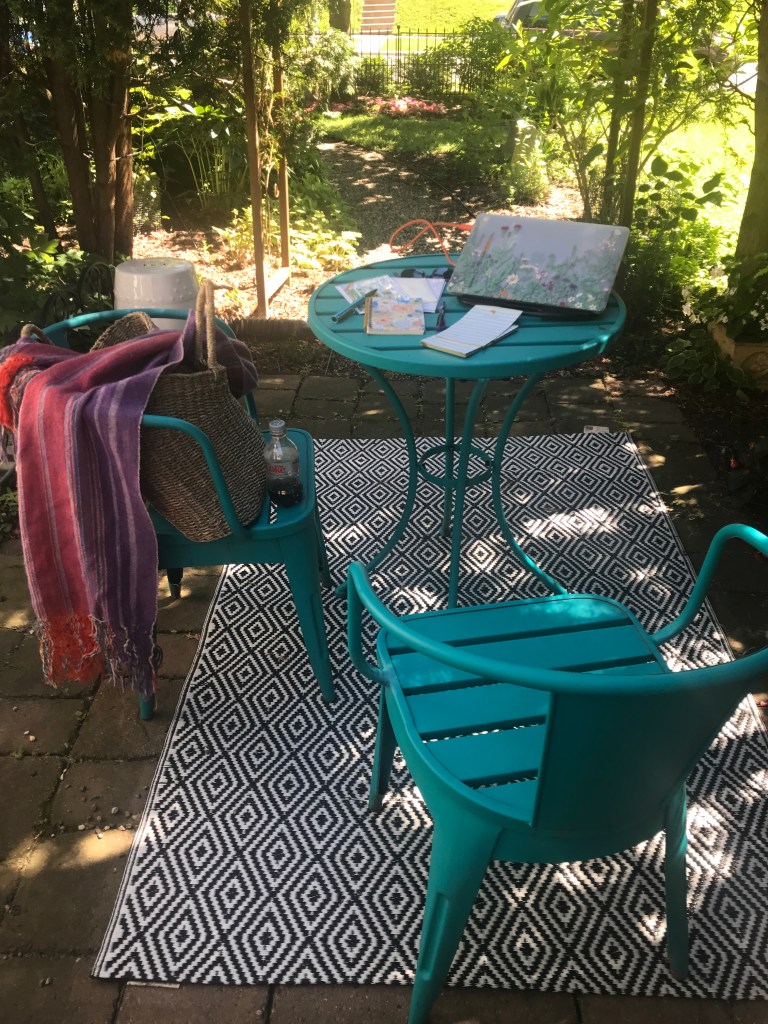
Come join me in “Paris.” On gorgeous summer days this is where you might find me–writing letters and emails, dipping into my basket of miscellaneous meditation books and saved articles, jotting notes to myself, adding to my To DO and TBR lists, and often taking a deep cleansing breath, as I open my journal for more reflection time.
These are rich, but quiet days. Days I need right now.
I am reading for the second time How To Walk into a Room, The Art of Knowing When to Stay and When to Walk Away by Emily P. Freeman. Freeman uses the metaphor of a “room,” to reflect on decision-making and changes in our lives. Freeman emphasizes the importance of naming the room we inhabit now, and I am more and more aware that my current room is a room of elderhood, of old age.
This room is spacious with several corners and areas designated for different aspects of my life: my work as a spiritual director, as the facilitator of a writing group, as writer of this blog, along with my identities including wife, mother, grandmother, friend, sister, and active church member. The room has a number of doors often open to welcome others and windows, reminding me to pay attention to the diverse movement around me. There are places to sit for solitary reflection and for attentive conversations.
In my 60’s I often said I hoped my elder years would be a time of expansiveness–a time to grow bigger–and I needed a BIG room. Now, however, in my 70’s I have revised that thought. Instead, this is a time of deepening. And I think my room encourages that intention to deepen, to grow deeper into who I was created to be. That fits right now, but at some point, perhaps my room will be smaller, and I won’t need as many designated areas. My room will modify into a room of contentment. Not passiveness, but a contemplative contentment.
My father seemed to live in that room in his last years–his 80’s into his 90’s. He spent much of his day in prayer and meditation without realizing that he was living as a contemplative in his last room. That was not a word familiar to him, but when I offered it to him, I could see that it resonated, and he accepted, even welcomed it.
This summer, however, I think I am in a hallway. Wandering beyond my room, but not far from it. I am just a bit antsy, for I have had more open time than what has been normal for me. Most of the time that feels good, for it means I have more time to read and more time to respond to whims, and more awareness of how I want to use my energy and the pacing needed along the way.
Freeman describes hallways in this way:
A hallway is a place of permission. It's a space where you're allowed, compelled even, to ask your questions, perhaps the kinds of questions that your rooms haven't allowed. It's a space to try on possibilities and to reimagine what could be.

The hallway may be the space between two rooms,...but it could also be a pause, a space where you enter just for a time, to clear your head, to take a beat, to weigh your options, to remember who you are...it's a waiting room, a bridge, and a deep breath. pp. 94-95.
In this hallway I have encountered some words to ponder.
- Job died, an old man and full of days. (Job 42:16) Margaret Silf in her Daily Readings says, “To die an old man is one thing; but to have lived a life in which every day was really lived, that is quite another. ” p.201
- From a laugh-out loud novel I am currently reading, Sandwich by Catherine Newman: “(‘Dad and I defrosted the chest freezer’ is an actual text I once sent in response to a question about our weekend and how it was going.)” p. 45
- Sara B. Franklin describes Judith Jones in her new book The Editor, How Publishing Legend Judith Jones Shaped Culture in America in this way, “she wore her age like a fact.” (quoted in the NYT Book Review by Alexandra Jacobs, Sunday, June 30, 2024)
- “I’m making space for the unknown future to fill up my life with yet to come surprises.” Elizabeth Gilbert
Each of these quotations feels true to me, to whom I am now and the person I am becoming and the person I was created to be. The trick is finding the rhythm, the space in my room, for each of these truths. And that’s where the hallway comes in –or in my case “Paris.”
You are welcome to join me there.
An Invitation
How would you describe the room you are inhabiting now? I would love to know.
Notes for Democracy:
What will you do today to save democracy? I plan to write more “get out the vote” postcards. Check out my recent post, “A Postcard Primer” https://wordpress.com/post/livingonlifeslabyrinth.com/3619 for links to participate in postcard campaigns. And I highly recommend reading today’s newsletters by Robert Hubbell and Heather Cox Richardson about the Supreme Court’s attack on democracy. https://heathercoxrichardson.substack.com https://roberthubbell.substack.com


 Living on Life's Labyrinth