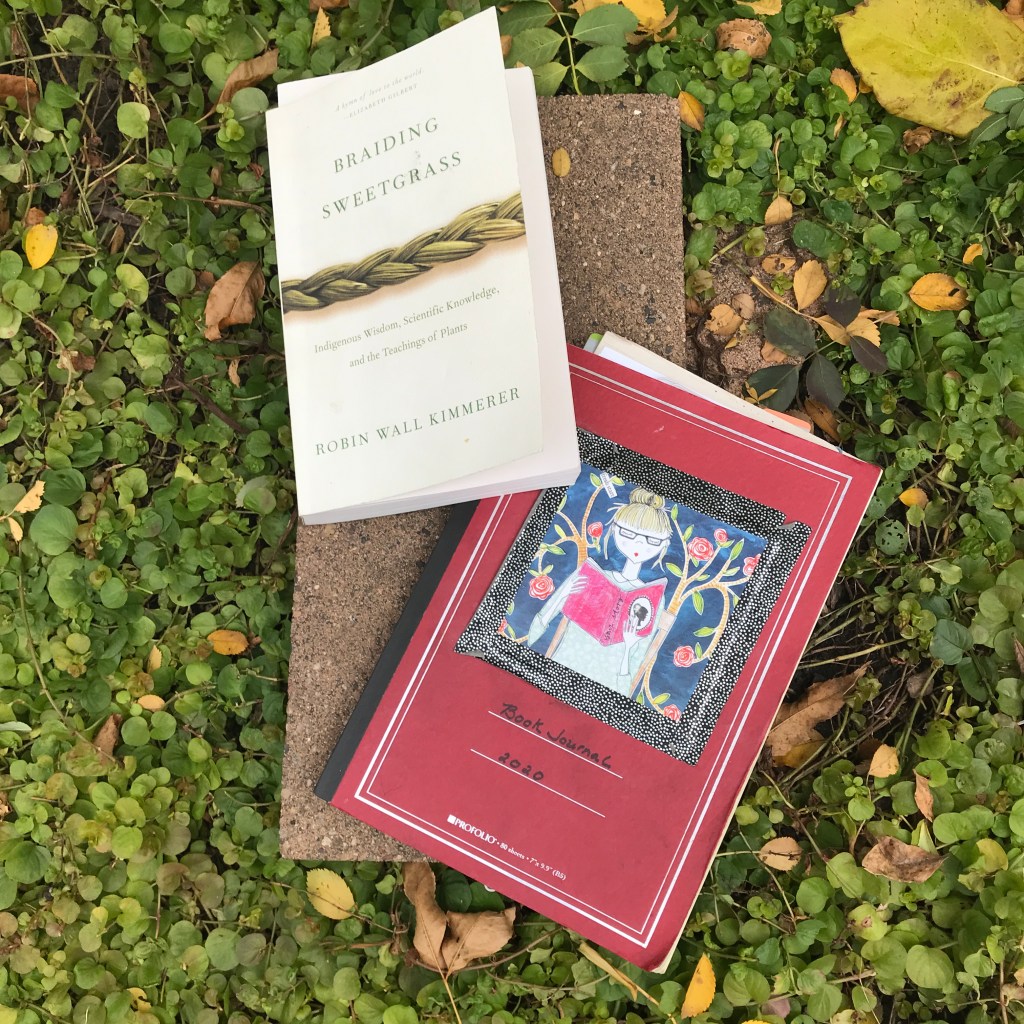
Braiding Sweetgrass, Indigenous Wisdom, Scientific Knowledge, and the Teachings of Plants by Robin Wall Kimmerer (Milkweed Editions, 2013) has been on my “To Be Read” (TBR) list for a long time. Robin Wall Kimmerer is an enrolled member of the Citizen Potawatomi Nation, and she is a distinguished scientist and professor. She is also storyteller, a writer of lyrical prose. She is a truthteller.
I not sure why I finally took the plunge; why this was the right time for me to read this book, but perhaps it was because my husband has been reading David Treuer’s monumental The Heartbeat of Wounded Knee: Native America from 1890 to the Present (Riverhead Books, 2019).
I am also aware of how one book leads to another. Another book by the same author or another book set in the same place or time period. Or another book on the same topic. In October I read Poet Warrior, A Memoir by Poet Laureate Joy Harjo, (Norton, 2021) and I felt immersed in the stories and poetry of native peoples and the need to unearth the truth and move towards healing.
What I know for sure is that I need to continue my education. I need to reframe and reform what I thought I knew—the incorrect and the missing.
I loved this book. I savored this book. I felt drawn into the depths of this book, but I need to be honest about my experience of the book. I did not read every word. At times I got lost in the biology, the botany of her descriptions.
Perhaps a story from my own background would be helpful here. When I was a freshman in college, I took an intro biology class in order to fulfill a distribution requirement. I was quite certain Biology 101 would be easier for me than any math course that would meet the requirement. Well, one day during lab time, we were all diligently dissecting and probing some poor specimen. Truth be told, I was poking more than probing. The professor, a kindly, grandfatherly-looking man, peered over my shoulder and then he said, “Ms. Jensen, what is your major?” “English,” I replied, and he said, “Good.” I got the message!
Frankly, I was proud of myself for delving into material out of my comfort zone, but Kimmerer’s writing about nature and our connection to the earth and the depth of her wisdom is what carried me along. In the Preface, she says the book is an “intertwining of science, spirit, and story.” So true.
She begins by telling the creation story of Skywoman. At the beginning there was only Skyworld, and much of the book explores the constellation of teachings called “Original Instructions.”
These are not “instructions” like commandments, though, or rules; rather, they are like a compass: they provide an orientation but not a map. The work of living is creating that map for yourself. How to follow the Original Instructions will be different for each us and different for every era. p. 7
The book explores how she has done that in her own life–as a mother, a teacher, a scientist, a resident of this earth.
One of the original instructions she refers to frequently is the notion of reciprocity. We give and we are given. We receive and we return. How important that is to remember as privileged white people who often feel good about our giving to less fortunate. We forget we are in relationship, and in relationship we receive, as well. She writes, “Doing science with awe and humility is a powerful act of reciprocity with the more-than-human world.” (p. 252)
I was also very moved by the ways she asked a tree or a plant for permission to harvest, to use and to receive as a gift, rather than feeling entitled to the corn, the sweetgrass, or herbs. She never assumes she is owed something or owns something. When approaching a plant for her own purpose, she leaves a gift of tobacco, a traditional native gift. I confess I have not done that when I have cut basil to make pesto or in years past, lavender to bundle into sachets.
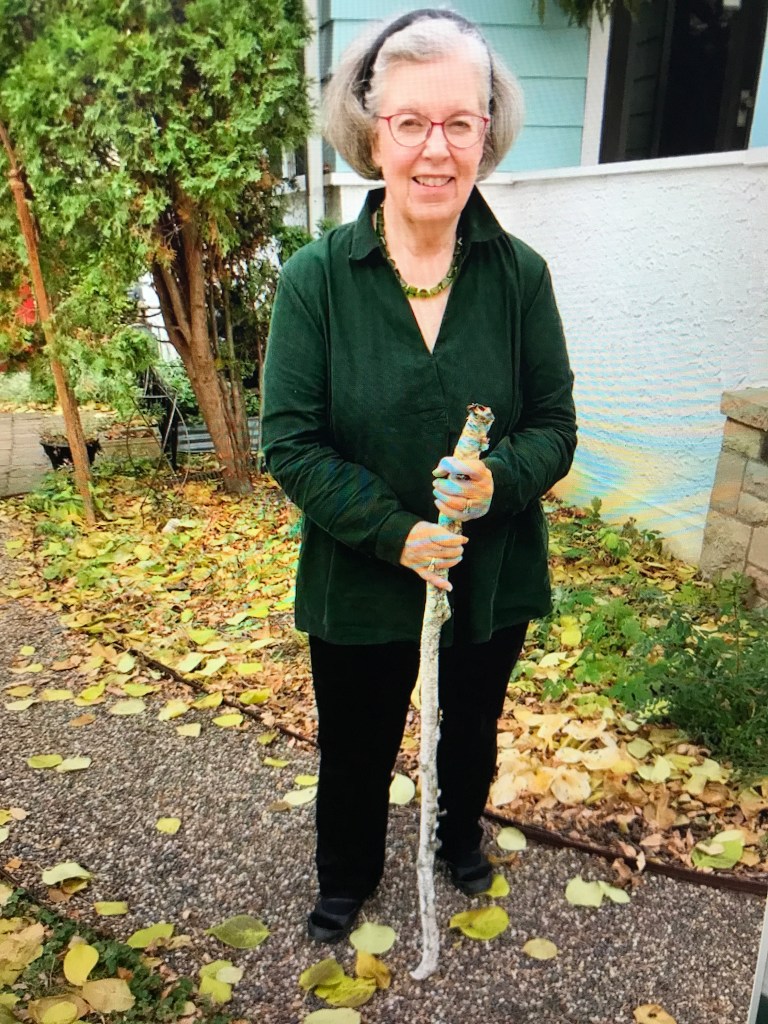
Recently, when we were in Door County I found a birch bark limb the perfect length and size for a walking stick. I have always loved birch trees–the startling white trunks in contrast to the darkness of oaks, maples, elms, and others. My eyes are drawn to the white birch in the winter when branches are bare and the landscape lacks obvious color. I have learned that birch represent the qualities of gentleness and sweetness, reminding us that life is not only struggle and suffering, but gifts are everywhere. Seeing that fallen branch on the side of the path where I was walking felt like a gift. However, I didn’t ask the branch or the trees around me or the earth where I paused, if the gift was for me. I apologize.
In return for that gift I have written this book report not only to attract new readers, but also to honor the earth and all its gifts.
An Invitation: What have you read that opens you to what you did not know? I would love to know.
 Living on Life's Labyrinth