A Decade In This Place

November 21, 2023

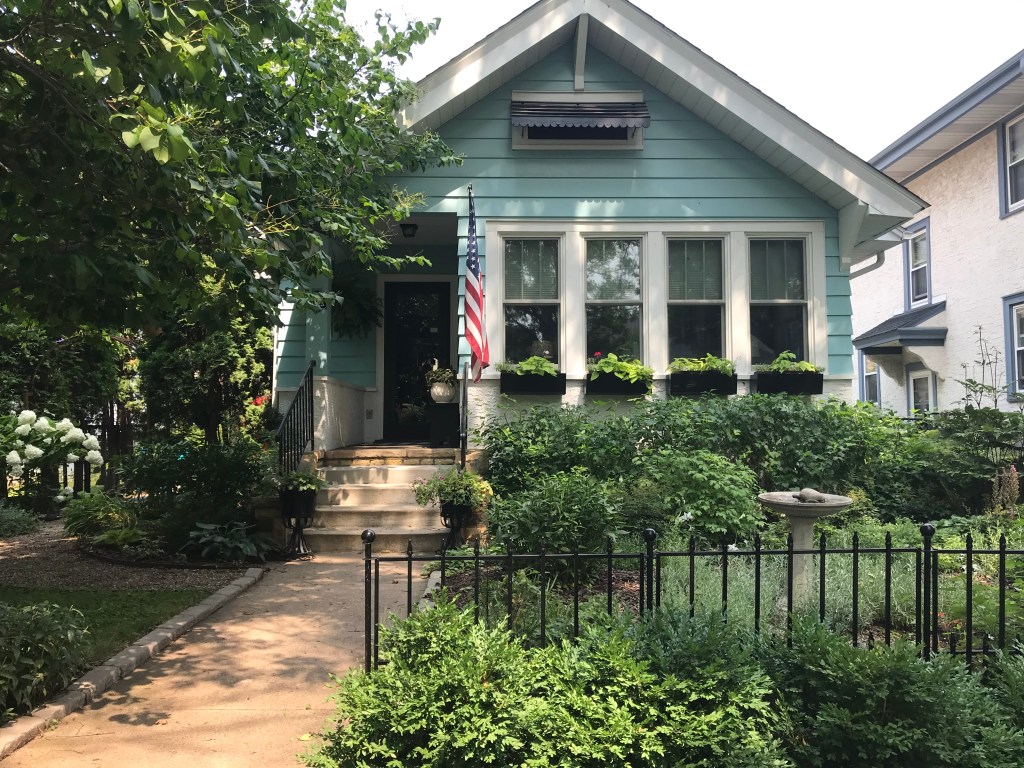
Thanksgiving weekend, 2013, we moved back to St Paul, the same neighborhood where we bought our first house in 1974, when Bruce graduated from medical school and started his family practice residency, and I was pregnant with our daughter Kate. Now we have two grandchildren, Peter, almost 16 and Maren, 21.

The decision to return to where our family life had begun was not difficult. We yearned to be with our grandchildren more, as well as my aging father. Our life in Madison, WI, was good, very good, but it was time to return home.

“I can’t do this,” I thought as I stood in the dull and dingy-looking and oh, so small kitchen. “Where’s the refrigerator?” I asked our realtor. Between the two of us we took up all the floor space in this teeny, tiny mini-kitchen. With a big smile she pointed out two refrigerator drawers underneath a counter.

“Isn’t this a clever idea?” She beamed, obviously hoping for a positive reaction from me. “Not having a full-sized refrigerator gives you more counter space,” she added.

I was not enamored.

The cabinets were painted a sickroom white, not the shiny white of nurses’s uniforms of the past, and the countertops were mottled grey and tan, like age spots on ancient hands.

Bruce pointed out the pluses. Excellent condition, good storage, and the price was right, to say nothing of the perfect location–five blocks from where our daughter and her family live, and three blocks from the kids’ elementary school. Yes, location, location, location.

I pointed out what it didn’t have: a fireplace or front porch or central air. All things on our wish list. And that garage, a cramped one-car garage, so small I wondered if I could master the necessary parking maneuvers for my Jeep.

Our offer on the house was accepted, and my head agreed with the decision, but my heart was not in agreement. I knew I needed some time with the house. Without my husband. That opportunity came during the house inspection.

Sitting in my car before entering the house, I scanned the block of well-tended homes sheltered by mature trees. My eyes rested on our future home. Not too small, not too big. A pleasant-looking house. I liked the window boxes on the four front windows of the sunroom and the mums on the steps with one small pumpkin obviously placed there by little kid hands. I did not care for the yellow-gold exterior and wondered what color would bring it more to life.

Once inside, I wandered room by room, “reading” the house, gazing with soft eyes, as if encountering a piece of scripture for the first time. Lectio or “reading” is the first step in lectio divina, a spiritual practice that opens the reader to a more intimate relationship with the Word and often leads to clarification, even transformation.

I stood in the narrow, window-lined front room only big enough for a couple comfortable chairs and thought how lovely it would be to sit there and read. I noted the two windows in the kitchen, a gift in such a small space. I paused on the landing going up to the second floor, a refinished attic space and looked out the windows to the backyard. “I could have my office up here and call it ‘the garret.'”

I returned to the front door and took a deep breath, moving into deeper meditation, meditatio, the second step of lectio divina. Could I begin to let go of my space requirements, my vision of what I thought I needed? Could I imagine myself in this space?

There was no room for our large formal couch in the loving room, but how about forming a circle with four comfortable chairs? I began to picture certain loved pieces of furniture in this space. What about placing my lady’s writing desk next to the front door? What a pleasant place to sit and write a letter. My heart softened.

A fountain of ideas began to flow, overflow about ways to modify the house to our taste and lifestyle. A new palette. White wood work and white living room walls. Light beach aqua in the front room, which eventually I called “the snug,” and turquoise in the dining room. Clearly I had engaged with lectio divina’s third step, oratio, or “being active, but it was in the kitchen where I fully embraced that step.

During our first years of marriage, I cooked and baked and prepared dinner parties in a tiny windowless kitchen where initially I had waged combat with cockroaches. That’s where my Christmas tradition of baking loaf after loaf of cherry walnut bread began. Our kitchen at Sweetwater Farm was small, too, with almost no counter space, but oh, the Thanksgiving feasts created there.

Instead of seeing the space as limited, I reframed it in my mind as efficient. What it needs, I told myself, was crisp marshmallow white cupboards, a white subway tile backsplash and white solid surface countertop. And how about red walls? Santa Claus suit red.

No, I wouldn’t have everything I wanted. A friend suggested we build a front porch. Of course, with enough money and patience and vision, one can do almost anything, but just because we once had something doesn’t means we must have it again. Instead, I rested in contemplation, assured I would discover a new gift.

One day on my morning walk soon after moving in, I noticed a neighbor’s inviting side courtyard, and then I saw other gardens and patios located in narrow side yards, creating private space. Could we do that? We had skinny space on one side of the house leading to the gate into the back yard. Tall arborvitaes lined the boundary between our house and the neighbor’s, leaving space just big enough for a couple chairs and a small table. My husband the gardener enthusiastically approved the plan.

As I settled into our new home, I continued practicing, although unconsciously, lectio divina, opening to its invitation for transformation. Our new secret garden space, which I call “Paris,” symbolized my willingness to let go and discover something new, vibrant, and pleasing; to be transformed.

We were 65 when we moved into this house, and now we are 75. Our hope and intention is to spend the next decade here as well, but, who knows. Bruce has said he would like to stay in the house on his own, if I died first, but If I were a widow, I would move into an apartment, not wanting to take care of the gardens. In the meantime we live fully, happily, gratefully in this space.

Is there some aspect of your life in which the spiritual practice of lectio divina could be helpful? Something calling for transformation or reframing? I would love to know.
My News Strategy

May 17. 2022

How many times in recent months or, let’s face it, these past few years, have you said, “I just can’t watch (or listen) to the news anymore”? Or perhaps you have been addicted to the news, watching and listening more hours of the day than you know is healthy for you. Perhaps the radio or a cable news station accompanies your every move, wherever you are, whatever you are doing.

No surprise, for the news –local, national, and global–is upsetting, and that is stating it mildly.

Approaching the News as a Spiritual Practice

Jane Vennard in her book, Fully Awake and Truly Alive, Spiritual Practices to Nurture Your Soul (2013) says all spiritual practices can be divided into three categories. (page 87)

  • Contemplative: caring for my body, resting, being silent, practicing solitude, praying, writing in my journal, walking mindfully,
  • Communal: participating in the life of a faith community or other communities in which you gather with others to pay attention to the holy in your life,
  • Missional: hospitality and service.

While the lines dividing the three types of spiritual practice are not always clear and well-defined, as Vennard points out, these categories of spiritual practice can help us become more intentional about our approach to the news.

Part of my morning meditation time, my intentional contemplative time sitting quietly in the garret or walking alone in the neighborhood, often is devoted to praying the news. I may simply name the issues or the people that worry me or touch my heart. I don’t pretend to have answers, but I lean my heart in the direction of those in need, those in pain or in the midst of sorrow and loss, and those who are trying to make a positive difference. Plus, I acknowledge and give thanks for the many gifts in my life; a life lived with ease and privilege and prosperity. I must never take that for granted.

Do my prayers matter? Well, that is a big question, but what I’ve noticed is that when I pray regularly I am more aware of the life around me. Near and far. When I watch or listen to or read the news, I pay attention to my responses. In a way I test my empathy level. Have I become hardened to the news? Do I sigh in disgust (“How could things possibly be worse?”) or descend into hopelessness (“That’s the way things are and what can we do about it anyway?”) Or do I approach the news looking for connection, for our common humanity, for reminders that God is counting on us to live into his love for us?

What I’ve discovered is that the more I pray, the more I find to pray about and the more I find to pray about the more I pray. And the more I pray, I don’t just pray the hurts, the losses, the fears, the unending challenges, but I also pray the love shown, the paths created, the courage, the care, and the revealed movement of God.

Along with this contemplative approach to the news, I have a communal practice. I am an active member of a faith community with a strong commitment to social justice issues. I value our gathering times when we lift not just our individual concerns, but our concerns for the world. Being part of a community gives me a base from which to move in the world, to respond to the news, and provides opportunities for the missional type of spiritual practice. Ways to serve.

Receiving the news is not only a way to stay informed, as important as that is, but it is also a way to strengthen my way of being in the world–as a contemplative who lives and serves with purpose in community. At least that is my aspiration.

My Choices: My News Sources

Even though I try to view my approach to news as a spiritual practice, the choices are overwhelming. Here’s my current buffet of choices:

  • I listen to Minnesota Public Radio/National Public Radio when I get dressed in the morning and when I prepare meals or clean.
  • I receive daily emails from The Washington Post and The New York Times.
  • I read two online newsletters that I highly recommend: Robert Hubbell’s Today’s Edition Newsletter https://roberthubbell.substack.com and Heather Cox Richardson’s Letters from an American https://heathercoxrichardson.substack.com
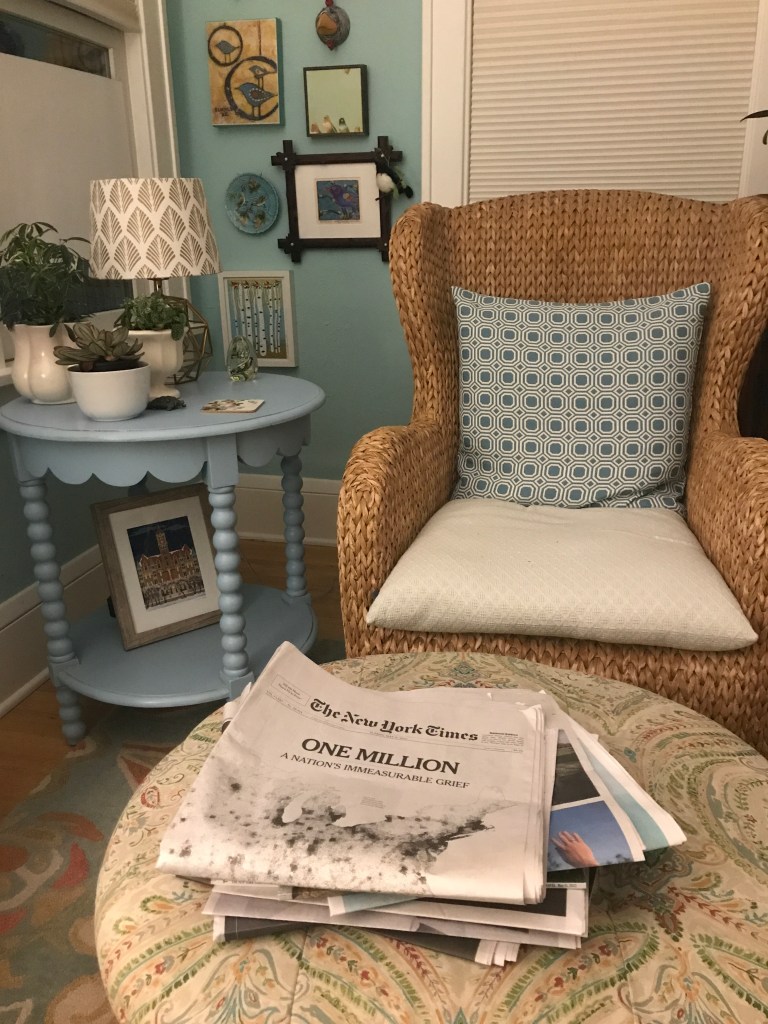
  • I read the Sunday New York Times–not always on Sunday, however. I admit I start with the Book Review and some Sundays I don’t get much further than that, but even reading the rest of the paper on Tuesday or Wednesday is valuable.
  • We watch the nightly PBS News Hour. Lately, we have fasted from watching any television news, but when we do, this is our choice.

A Thought

it isn’t more light we need, it’s putting into practice what light we already have. When we do that, wonderful things will happen within our lives and within our world.

Peace Pilgrim

An Invitation

What is your relationship to the news? What is your news strategy? I would love to know.

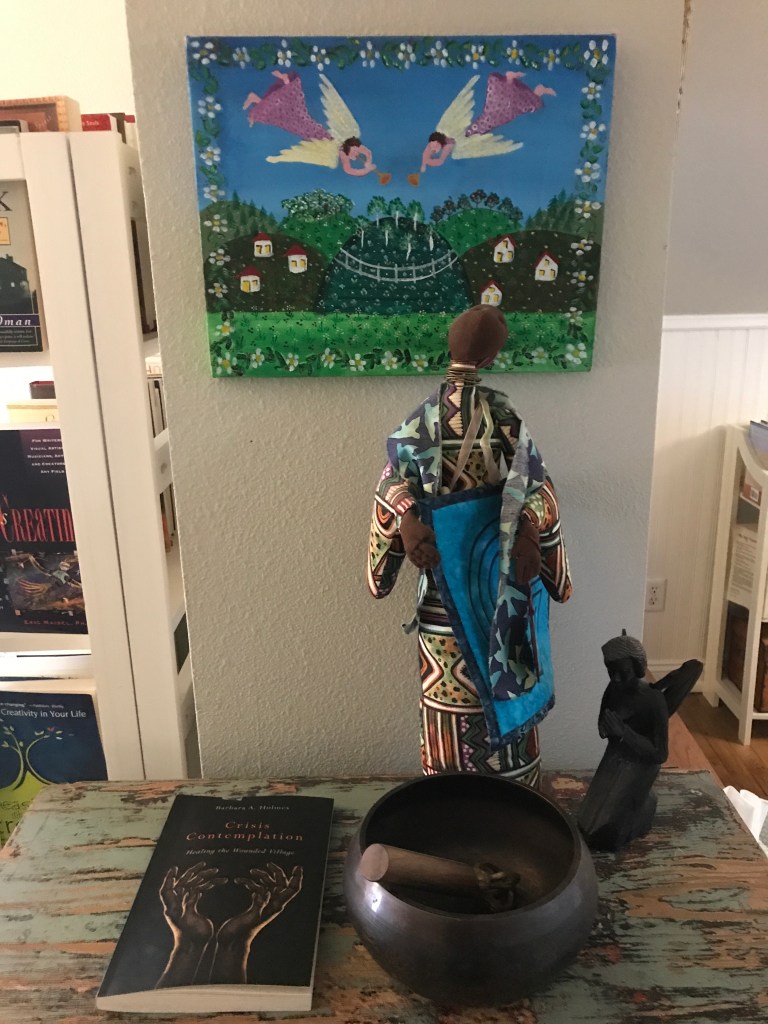
Book Report: Crisis Contemplation, Healing the Wounded Village by Barbara A. Holmes (2021)

We can identify three common elements in every crisis: The event is usually unexpected, the person or community is unprepared, and there is nothing anyone could do to stop it from happening…Bereft of words, all of us hold the same question: How could this be happening? Crisis Contemplation, p. 21

We don’t need to think very hard or very deep to identify crises in the last couple years. You may have experienced a personal crisis, alongside the communal ones our society has been enduring.

I don’t imagine many of us respond by moving into contemplation when a crisis strikes. Our more immediate response is action. This book does not negate that response, but at the same time Holmes encourages us to “allow for the possibility of contemplative refuge, respite, and renewal. To slow down and be still is to allow both the source of our troubles and options for recovery to emerge.” (42)

This is hard work and as Holmes points out this work does not mean retreating to our meditation pillows. She points out that “Contemplative porch practices are no longer required of me; they are part of me.” (42). Yes! I often urge my spiritual direction clients and my readers to develop spiritual practices now, before the unexpected, which will come, for sure. Ground yourself in your contemplative practice and they will be with you.

As I read this book, I felt as if I was sitting in the back of a room where Holmes was exploring and reflecting with BIPOC peoples. I had the privilege and pain of listening, opening my heart (I hope) to the trauma, the wounds across the generations and so present now. I attempted to read this book as a contemplative practice.

Rev. Dr. Barbara Holmes, author and scholar of African-American spirituality and mysticism, is on the faculty of Center for Action and Contemplation (CAC) under the leadership of Fr. Richard Rohr, https://cac.org and it was in one of CAC’s daily meditations where I was introduced to her wisdom. I know I will eventually read one of her earlier books, Joy Unspeakable: Contemplative Practices of the Black Church (2017). And I am drawn back to books by Richard Rohr.

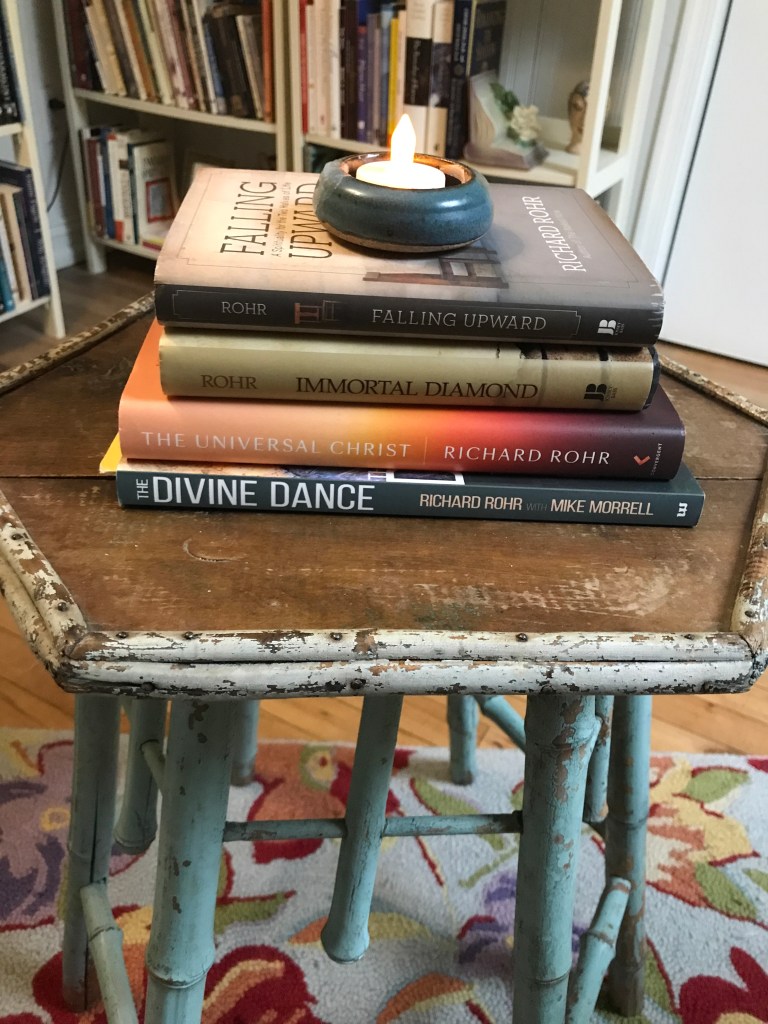
The Universal Christ, How a Forgotten Reality Can Change Everything We See, Hope For, and Believe (2019) has become a touchstone book for me.

As I was writing this post, I remembered another book on my shelf, one I have recommended when personal crisis hits, The Ten Things to Do When Your Life Falls Apart, An Emotional and Spiritual Handbook by Daphne Rose Kingma (2010). This book focuses more on individual issues, but still, there is much to contemplate here. The ten things, by the way are:

  • Cry your heart out
  • Face your defaults
  • Do something different
  • Let go
  • Remember who you’ve always been
  • Persist
  • integrate your loss
  • Live simply
  • Go where the love is
  • Live in the light of the Spirit.

As always, one book leads to another and another.

An Invitation: When you have been in the midst of a crisis, has there been a book that has been helpful or meaningful? I would love to know.