Book Report: Downsizing My Books

October 13, 2022

A frequent conversation among elders is what to do with our stuff. We all have it.

We know it’s only stuff. But it’s our stuff, and we don’t want anyone telling us what to do with our stuff.

I can feel my body become rigid, my throat constrict, and my eyes narrow if anyone dares tell me I have too many books. What is too many? I am not willing to have that conversation.

But, of course, the truth is I do have lots of books.

What to do?

I know that the next move, if and when that happens, will be to a much smaller space; one in which there will be much less room for all our books. Does that mean I need to empty our bookshelves now and never purchase another book? Or do I just ignore the elephant –in this case hundreds of books–in the room(s)?ownsizing

Strategies and Process

My main strategy is to recognize and to practice the PROCESS of downsizing. Here’s what that means:

  1. Use the library more and buy fewer books. So far this year I have checked out almost 80 books from the library, and I have purchased a little more than half that amount.
  2. Every time I read a book I own I consider if it is one I might want to read again or refer to in my work as a spiritual director or small group facilitator. If I decide I don’t need or want to keep it, it is placed in a basket of books to take to a Little Free Library or set aside for our annual garage sale or pass on to someone else and say, “No need to return.” Occasionally, I want to re-read a book I no longer own. Well, there’s the library to save the day!
  3. The last two years my Lenten spiritual practice has been to eliminate at least one book from my spirituality/theology bookshelves each day. I intend to continue that practice this year, too.
  4. Each time I return a book to a shelf or find space for a new book, I spend time looking at the other books on those shelves and often I decide I don’t need to save one of the nearby books any longer.
  5. No books are allowed to gather in piles on the floor. Books do not become the base for a lamp or prop up a table leg.
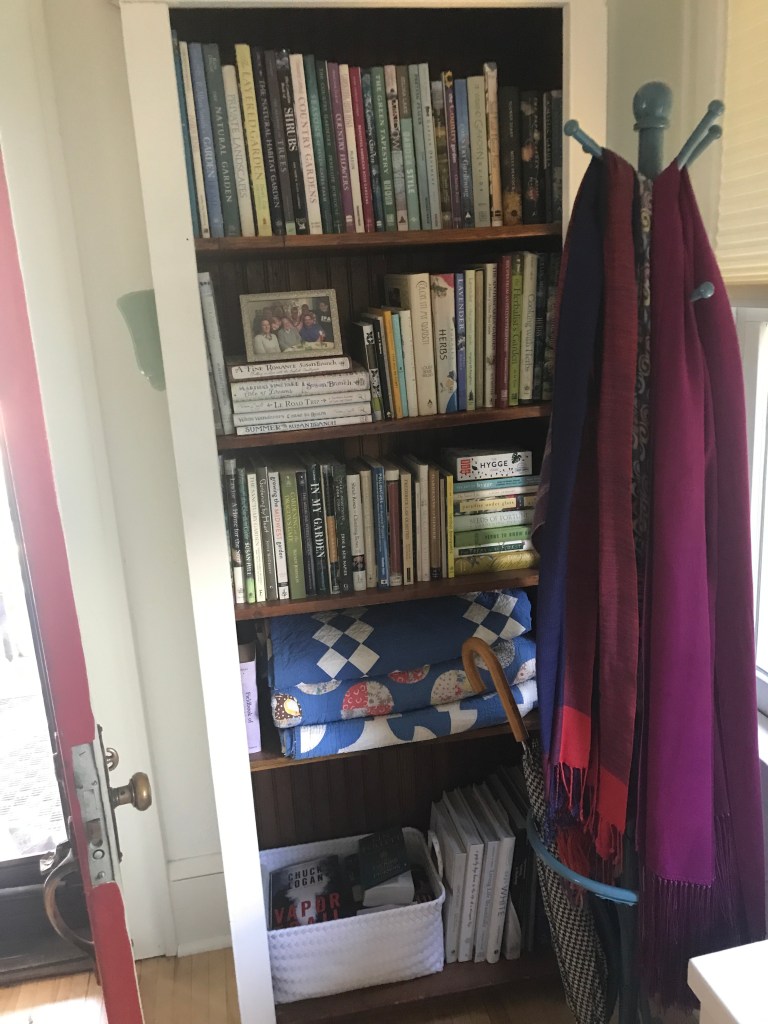
  6. There are no boxes of books in storage areas. Seeing my books not only gives me pleasure, but that prevents the “out of sight, out of mind” issue that solves nothing.
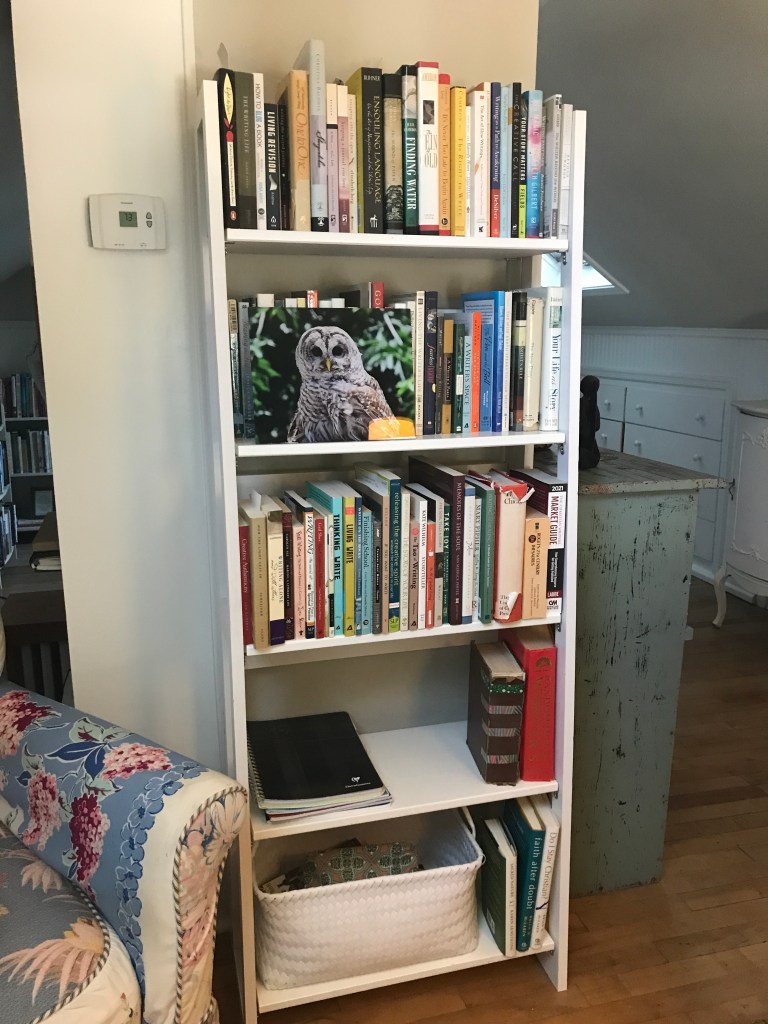
  7. The books I have acquired, but not yet read are kept on two shelves. Nonfiction books are on a shelf in the garret and fiction in the snug. That means I am aware of them when I finish a book and wonder what to read next.

Practicing Awareness

Part of this downsizing process is to ask myself –not just once, but periodically–what is the meaning of this specific category of stuff? Why do I hold on to these books?

There is more than one answer. First of all, I am a passionate reader, and I prefer to read books in their paper form. You may prefer listening to books or reading on a Kindle. Good for you, and maybe, someday I will do that, too, but not now. Books are beautiful and are part of my decor and add to the warmth and personality of our home. I feel the presence of the writer and their words by having books physically present. Also, I am a writer and a teacher and browse my books for inspiration, for answers, for reinforcement and support and for ideas to broaden my perspective. I suppose I can do that on the internet, but it’s not the same. Finally, my books offer a glance into my history, a view into who I am. And my books remind me to continue the process of growth and evolution.

I know someday I will have to face (or my family will) the challenge of what to do with all these books, and I guess should apologize for that, but oh well… I continue to remind myself that downsizing is a process, and I am in the midst of that process. I am becoming aware that each book I let go of makes it easier to let go of another one.

One more thing: I’ve noticed it is much easier to prod someone else to do something about their stuff, than it is to tackle our own stuff. I’m guilty of that, and I am trying to reform and focus on my own stuff. Enough said!
An Invitation:

What stuff is plaguing you and what are you doing about it? I would love to know.

Book Report: Browsing My Bookshelves

One book leads to another. And another.

One of my favorite projects each week is preparing for the writing group I facilitate at my church. Along with creating a writing prompt, I offer short quotations to support the subject of the prompt. Finding appropriate quotes becomes a rabbit hole of pleasure and memory. Sometimes, I confess, browsing my bookshelves becomes a diversion, a distraction from the task in front of me. Oh well.

An example: My morning meditation these days includes reading the prayers for Lent in Jan Richardson’s Circle of Grace, A Book of Blessings for the Seasons. (2015). One of those blessings led me to this week’s writing prompt –a prompt about telling our own stories. Great–I had both the content for the prompt and one illustrative quote.

Let the browsing begin.

I remembered a workshop on storytelling as a spiritual practice that I took from Diane Millis a couple years ago, so found her book, Re-Creating a Life, Learning How to Tell Our Most Life-Giving Story (2019) on one of my shelves. As I paged through the book, I remembered an exercise Millis led at the workshop and wrote a note to myself to consider adapting that for a future writing group. I also noticed a reference to one of my favorite books, Composing A Life (1990) by Mary Catherine Bateson.

Here’s where the rabbit hole gets deeper. I pulled that book, autographed by Bateson, off my shelf, and as I noted what I had underlined and where I had written comments, I remember the evening I heard Bateson speak at a private girls’ school in Cleveland. Her book, Peripheral Visions, Learning Along the Way (1994), had recently been published, and, of course, I bought that book, too, and had her sign it.

We had moved to Cleveland from Minnesota just months before, and I still felt quite lost and unsure of what my next steps in composing my own life would be. I remember having a lovely conversation with Bateson and being surprised by the time she took to share her wisdom and perspective with me. I don’t remember her words, but am sure I wrote about it in my journal. I resist digging out that journal, for I might never climb out of that rabbit hole! An aside: Many years later I learned that a woman who became a friend had also attended that lecture.

Also on my shelf is Composing A Further Life, The Age of Active Wisdom (2010), and I am so tempted to begin re-reading this book right this very minute. The chapter titles, “Thinking About Longevity,” “A Time for Wholeness,” and “Knowledge Old and New” beckon me and I suspect are even more relevant for me now, but I set it aside. For the moment. And then I remember another of her books that I found at a Little Free Library, Willing to Learn, Passages of Personal Discovery (2004), but have yet to read. It awaits on a different shelf, where I keep TBR nonfiction books.

I slap my hands, reshelve the Bateson books, and turn to the shelves with my writing books. There are lots of temptations on those shelves. I start with two books: The Story of Your Life, Writing a Spiritual Autobiography (1990) by Dan Wakefield and Your Life as Story, Writing the New Autobiography (1997) by Tristine Tainer. The Wakefield book introduced me to the term and the idea of “spiritual autobiography,” which is now more commonly thought of as “spiritual memoir,” and the Rainer book reminds me of her earlier book The New Diary, How to Use A Journal for Self-Guidance and Expanded Creativity (1978), which I used as a text when I taught a series of journal writing classes way back when! All three books are full of notes to myself.

I have found what I need for the writing group and force myself to re-shelve the pile of books on my desk, but that leads to another round of browsing.

The Diane Millis book is right next to a collection of Thomas Merton books and close by are Thomas Moore books. The Bateson books are near books by a current favorite, Diana Butler Bass, including her latest Freeing Jesus, Rediscovering Jesus as Friend, Teacher, Savior, Lord, Way, and Presence (2021). I notice I have starred the last two chapters, “Way” and “Presence,” and I am tempted to re-read those chapter right now. Plus, I notice a Dan Wakefield book I have not yet read, Releasing the Creative Spirit, Unleash the Creativity in Your Life (2001), and I am certain just what I need could be found on those pages.

Behave yourself, Nancy, and focus. Finish the task at hand.

An Invitation:

What books are waiting for you on your bookshelves? I would love to know.