Book Report: February Summary

February 29, 2024

How is it possible to read eight novels in one month and not be disappointed by any of them? Well, that’s my story this month. I am willing to say, however, that my absolute favorite of the month was Apeirogon (2020) by Colum McCann, which I reviewed in my post on February 22nd. https://wordpress.com/view/livingonlifeslabyrinth.com This is an important book, but you know how sometimes “important books” can feel like a slog. This one DID NOT!

Coming in with a close, photo finish second was The Bell in the Lake (2022) by Norwegian author, Lars Mytting. This book was not on my radar at all, and I am grateful for a friend’s recommendation. Set in a remote area of Norway in the 1880’s, the new pastor, Kai Schweigaard, decides a new, larger and more modern church is needed. The current medieval stave style church — wooden, timber framed– is in bad repair and besides the carvings referencing pagan legends seem inappropriate on a Christian church. The church is sold to historians in Dresden, where the church will be reconstructed, in order to preserve the stave style.

A complicating factor are the bells in the church, which are said to ring on their own at the sign of danger. And danger is on the horizon, including a love triangle: the pastor, Astrid Hekne whose ancestors had the bells cast and donated to the church–and such a story that is– and Gerhard, the artist and architect sent from Dresden to oversee the dismantling of the church. Wonderful book, and I am eager to read The Reindeer Hunters, also by Mytting.

I ended the month on a reading high. More than once while reading The Berry Pickers (2023) by Amanda Peters I felt tears forming. During the annual work trip to Maine from Nova Scotia to pick blueberries, four-year-old Ruthie goes missing. Instead of being taken seriously, clearly because the family is Indian, they are ignored and eventually must return home. The rest of the book is about what happens to Ruthie and also the stories of her family of origin. Heart-wrenching and well-written.

Along with these three I read:

  • We All Want Impossible Things (2022) by Catherine Newman. A hospice novel with hospice humor, along with an exploration of grief and loss. Well-done and not depressing.
  • The Department of Rare Books and Special Collections (2022) by Eva Jurczyk. Even though at times this book felt like some additional editing would be helpful, I thoroughly enjoyed the premise of a missing rare manuscript and the academic setting, and I hope there will be more by this author in the future.
  • Lillian Boxfish Takes a Walk (2016) by Kathleen Rooney. I read this book years ago and so enjoyed reading it again. The walk in New York City on New Year’s Eve (1984) is really a life review for Lillian now in her 80’s and such a life she has had–much more than what is on the surface.
  • Wench (2010) by Dolan Perkins-Valdez. You may have read her more recent book, Take My Hand (2022) and I liked that book, although I thought there were some some gaps, some undeveloped pieces. I think Wench, which is the author’s first book, is the better book of the two. Set in pre-Civil War, the slave owners in this story take their slave mistresses to a summer resort in Ohio. The story focuses on these women –what they endure, how they develop, and their attempts to achieve freedom.
  • Banyan Moon (2023) by Thai Thai. A totally absorbing book. Banyan House in Florida is owned by Minh, a Vietnamese woman who immigrated to the Unites States with her daughter. We learn the story of their life in Vietnam, but the main plot line is set in the U.S. When Minh dies, her granddaughter Ann returns to Florida from Michigan where she is engaged to a wealthy white man and professor who says she is “exotic.” Secrets are discovered, and relationships must be healed. Stunning writing, especially for a debut novel.

First, the fun one, but there was wisdom there, too: Unraveling, What I Learned about Life While Shearing Sheep, Dyeing Wool, and Making the World’s Ugliest Sweater (2023) by Peggy Orenstein. I reviewed this in an earlier post, in which I also told my own sheep story.

I read three books by Esther de Waal.

  • The White Stone The Art of Letting Go (2021). I had read this before, but a spiritual direction client mentioned reading it, and I decided to read it again. A chapter about “diminishment” was especially helpful as I think about these elder years. “I hope that God is going to work within my limitations.” p. 89.
  • To Pause at the Threshold, Reflections on Living on the Border (2001). I read this right before the beginning of Lent, which is one of those border times, and I especially appreciated the chapters, “Connecting Inner and Outer” and “The Time Between Times.”
  • Lost in Wonder, Rediscovering the Spiritual Art of Attentiveness (2003). The book is written as a preparation for going on a retreat, but is applicable to our everyday lives as well. At times I got lost in all the quotes from other spiritual writers and would have preferred more Esther. That is true in each of her books. However, I loved what she says about creating and living in our own cloister space. “But it is vital to see the cloister space in my own self as the pivot around which daily life revolves, the rock or anchor which holds it firmly grounded. This is what Christ meant when he said ‘Go into your room'”. p. 14

Finally, Cacophony of Bones The Circle of a Year (2023) by Kerri ni Dochartaigh. This book is a sequel to Thin Places, A Natural History of Healing and Home (2021), which I read in January. She is pregnant and it is the pandemic. “I am telling you here of a year that was like no other. I am telling you here of a year that was just the same as every other that had gone before.” p.ix. She feels deeply, struggles with depression, doubts herself, but she is a keen observer and creates links missed by most of us, I imagine.

I have a stack of books from the library:

  • The Other Mothers by Katherine Faulkner
  • Graceland by Margaret Renkl
  • The View from Penthouse B by Elinor Lipman
  • The Hero of the Book by Elizabeth McCracken
  • Commitment by Mona Simpson

And I have a stack of recently acquired books:

  • The Women by Kristin Hannah
  • The Distance Between Us by Maggie O’Farrell
  • As It Is In Heaven by Niall Williams
  • A Deceptive Devotion by Iona Whishaw (#6 in her mystery series)
  • An Irish Country Girl by Patrick Taylor
  • An Irish Country Courtship by Patrick Taylor

And I continue to read during my morning meditation time:

  • Jesus, Guide of My Life by Joyce Rupp
  • A Different Kind of Fast by Christine Valters Paintner

Happy reading!

On one of our recent roaming days we discovered a wonderful bookstore new to us–in Buffalo, Minnesota. I was especially impressed with their backlist of books. We helped the Buffalo economy! https://buffalo-books.com

If you are new to my blog, you may be interested to know that every Thursday I write about books and every Tuesday I write on spiritual topics–the ordinary and the extraordinary. Thanks for reading and I hope you will decide to subscribe and/or share my posts with others.

What did you read in February? Any gems? I would love to know.

Book Report: Apeirogon by Calum McCann

February 22, 2024

Excuse me if I sound a bit breathless, but I just finished reading Apeirogon by Colum McCann, and it is stunning, superb. I had not heard of this book, which was published in 2020, but then in the last couple months a good friend, who is one of my most reliable book sources, and another someone, whom I can’t recall, mentioned this book. I added it to my TBR list and then during a recent bookstore indulgence, there it was.

First order of business: What is an “apeirogon”? Is it a person, place, or thing? A made-up word?

Apeirogon: a shape with a countably infinite number of sides.

Countably infinite being the simplest form of infinity. Beginning from zero, one can use natural numbers to count on and on, and even though the counting will take forever one can still get to any point in the universe in a finite amount of time.

p. 82

Make sense? No, I don’t really understand it either, except that this book challenged me to open to more possibilities, more sides, more understandings than I could imagine.

Set that aside for the moment.

The story, based on a true story: Bassam Aramin is Palestinian. Rami Elhanan is Israeli. They each lose a daughter to violence. Abir is killed in 2007 by a rubber bullet when she is ten, and Smadar is 13 when she becomes the victim of suicide bombers in 1997. These bereft fathers meet and decide to share their stories, which they do over and over again and all over the world. Their core message, which is repeated multiple times, is “It will not be over until we talk.”

The story is moving, as is the wisdom because of the story.

Rami says:

The first choice is obvious: revenge. When someone kills your daughter, you want to get even. You want to go out and kill an Arab, any Arab, all Arabs, and then you want to try and kill his family and anyone else around him, it’s expected, it’s demanded. Every Arab you see, you want him dead. Of course you don’t always do this in a real sense, but you do this by asking other people to kill this Arab for you, your politicians, your so-called leaders. You ask them to slam a missile into his house, to poison him, to take his land, to steal his water, to arrest his son, to beat him up at the checkpoints. If you kill one of mine, I will kill ten of yours. And the dead one, naturally, has an uncle or a brother or a cousin or a wife who wants to kill you back and then you want to kill them back again, another ten times over. Revenge. It’s the simplest way. And then you get monuments to that revenge, with mourners’ tents, songs, placards on the walls, another riot, another checkpoint, another piece of land stolen. A stone leads to a bullet. And another suicide bomber leads to another air strike. And it goes on and on. And on.

p. 220

Bassam says:

You see the Occupation exists in every aspect of your life, an exhaustion and a bitterness that nobody outside it really understands. It deprives you of tomorrow. It stops you from going to the market, to the hospital, to the beach, to the sea. You can’t walk, you can’t drive, you can’t pick up an olive from your own tree which is on the other side of the barbed wire. You can’t even look up in the sky. They have their planes up there. They own the air above and the ground below. You need a permit to sow your land. Your door is kicked in, your house is taken over, they put their feet on your chairs. Your seven-year-old is picked up and interrogated…Most Israelis don’t even know this happens. It’s not that they’re blind. They just don’t know what is being done in their name…They can’t travel in the West Bank. They have no idea how we are living. But it happens every day. Every single day…

It’s a tragedy that we need to continually prove that we are human beings. Not only to the Israelis, but also for other Arabs, our brothers and sisters, to the Americans, to the Chinese, the Europeans. Why is that? Do I not look human? Do I not bleed man? We are not special. We are a people, just like any other.

pp. 236-237

The structure in the book is almost a character itself. The whole of the book is made up of small numbered sections. Some are only a line long and others a page or two. The content of these sections is not only the basic story, but also references to nature and art and philosophy and history and literature and other peoples’ stories–all suggesting the interconnection of everything and everyone. And not once did I feel bored. Not once did I wonder when the “real” story would continue. Did I understand every reference? No, but I was always intrigued.

But here’s how the plot is even more unique. In the first half the book the sections build from #1 to #500. Then there is a section #1001. Only much later does the reader understand the significance of that number. Then the section numbers decrease from #500 to #1. And sometimes a section in one half of the book is related to the same number in the other half of the book. I kept wondering if the author had a huge dry erase board where he kept track of the content. This method did not feel contrived or created for its own sake. Instead, it added to the interconnection of everything and everyone.

This is a novel for our time and one that contributes in a deep and powerful way as a way to understand, if that is possible, the current chaos.

I feel a need to fast before opening another book. I probably won’t do that, for my reading addiction is always present, but I do know this book will preoccupy and even haunt me.

What books have haunted you long after you’ve read them? I would love to know.

Book Report: Lillian Boxfish Takes A Walk by Kathleen Rooney

February 8, 2024

I’m not sure what inspired me to re-read this 2016 book, Lillian Boxfish Takes a Walk by Kathleen Rooney, but there it was on my TBR list, and when, during a recent visit to a favorite bookstore, Excelsior Bay Books, Excelsior, MN, I spotted it on the shelves, I couldn’t resist the stunning cover. True, 85 years-old Lillian is described as wearing a mink coat on her New Year’s Eve walk in New York, but still, the artist captured Lillian’s essence.

What didn’t capture the essence of the book, at least for me, were some of the back cover snippets of reviews written when the book was first published. I thought it was amusing, rather than “hilarious” or even “funny.” That is not a bad thing, however. Nor did I resonate with the focus and emphasis in some reviews on New York City presented over time. The view is of Lillian Boxfish’s life with the city as a backdrop. In some books place is clearly one of the main characters, but that didn’t feel true for me in this book, except perhaps for the ongoing reference to her work as an advertising writer for R.H. Macy’s.

I do agree, however, with the reviews describing the book as “elegantly written,” and “touching.” And “witty.”

It is 1984 and Lillian has reservations for herself on New Year’s Eve at a favorite restaurant not far from her apartment. That walk turns into over 10 miles of walking and not always in the best parts of the city. Along the way she meets a variety of people, including Skip who drives a limo and is concerned for her safety (In fact, everyone she meets is worried about an elderly woman walking alone at night.) She dismisses their concern and continues on her way, charming everyone she encounters, including a family who invites her to join them for dinner and three young thugs whose intention is to rob her.

Her story unfolds as she walks–her stellar career, which began in the 1930s, in advertising, eventually becoming the highest paid advertising woman in the country, a published and popular poet, but also the darker sides of her life. I remember the first time I read this book not being prepared for that aspect of her life, but this time I picked up on the clues along the way. And while I am not yet 85, I am more aware as I continue to age that there are dark sides in each of our lives.

The reviews also, rightly so, honor the book for its illumination of the power of human connections.

There is always a danger in re-reading a book that you have enjoyed the first time. Will it live up to those earlier impressions? This one did, and I am glad I spent more time with Lillian.

What have you re-read recently? How did the second time around measure up for you? I would love to know.

I enjoyed this article on reading lists. https://www.washingtonpost.com/books/2024/01/26/keeping-yearly-reading-lists/?utm_campaign=wp_book_club&utm_medium=email&utm_source=newsletter&wpisrc=nl_books

BooK Report: January Summary

February 1, 2024

15 Books: 11 Fiction and 4 Nonfiction

  • Absolution by Alice McDermott. (See January 11th post) I keep thinking about this book–the story, the characters, the exquisite writing.
  • The Heaven and Earth Grocery Store by James McBride. Another memorable book. The time is the 1950s and is mainly set in small town Pennsylvania where immigrant Jews and African Americans live side-by-side, but often not easily or comfortably. So many strong characters and making them come alive on the page is one of McBride’s strong suits. He describes one of the characters this way, “Chona had never been one to play by the rules of American society. She did not experience the world as most people did. To her the world was not a china closet where you admire this and don’t touch that. Rather, she saw it as a place where every act of living was a chance for tikkun olam, to improve the world.” p, 275.

I was surprised I enjoyed both of these books so much because in both cases the language was often off-putting and the amount of references to sex could have become tiresome, but in both cases the characters interested me, sometimes intrigued me, and I entered cultures not familiar to me.

  • Olga Dies Dreaming by Xachitl Gonzalez. Olga is a successful wedding planner and her brother is a progressive New York Congressman. Their mother left them at an early age to return to Puerto Rica where she led a revolutionary movement. The brother and sister both pursue the American dream in their own ways and are distracted from their values and ideals along the way. I learned so much about Puerto Rican history and economics, especially since much of the book is set at the time of Hurricane Maria.
  • Girl, Woman, Other by Bernardine Evaristo. One of the things that intrigued me about this 2019 Booker Prize novel was its style. Each chapter, which focused on one woman at a time, was written almost as a poem. Sometimes I found myself reading sections aloud, for the rhythm and the flow seemed to demand that. I wonder what the audio version is like. And in each chapter there was only one period–at the end of the last sentence. I know some reviewers found that technique to be too much, but I loved it. I felt as if I was in an unending conversation, especially as connections between the women were developed. Not one woman was perfect, not even close, but I appreciated their complexity, as they somehow surmounted deep loss, sexism, and racism in their lives. And the insights into gender and language were revealing as well. A favorite line comes at the end of the book, “White people are only required to represent themselves, not an entire race.”
  • Murder Most Royal by S. J. Bennett. I gave this book to my husband for Christmas, knowing full well I wanted to read it myself. I had enjoyed other books in the series, The Windsor Knot and All the Queen’s Men. Who can resist a mystery where Queen Elizabeth II is one of the main characters? It is not necessary to read these books in order, by the way, and the next one, A Death in Diamonds, will be published soon.
  • A Sorrowful Sanctuary, #5 in the Lane Winslow Series by Iona Whishaw. This series is set in Canada soon after the end of WWII. Lane is a young woman who immigrates to Canada from the UK after her service in the war. She seems to always be on the scene after a murder and therefore, develops a relationship with police detective, Inspector Darling. Easy and charming, and each one seems to get better and better. I do recommend reading these in order. The first one is A Killer in King’s Cove.
  • The Caretaker by Ron Rash. This author has written many books, but he was new to me. I don’t have his other titles on my TBR, but I don’t discount the idea of reading more. Jacob returns from the Korean War badly injured. His controlling parents have told him that his wife and baby have died in childbirth, and they have told her that he died in the war. Suffering ahead! The caretaker is Blackburn Gant, Jacob’s close friend, and his story of love and loss is just as important in the book.
  • The English Experience by Julie Schumacher. (See my January 25 post) How grateful I am to have read a book with humor this month. At the same time there was warmth and insight. This is Schumacher’s third book with an academic setting, but you don’t need to be an academic to enjoy them. The other titles are Dear Committee Members and The Shakespeare Requirement.
  • My Lover’s Lover by Maggie O’Farrell. You may have read Hamnet and/or The Marriage Portrait, more recent books by O’Farrell –each of them so good. Well, she has quite the backlist, and I have been reading and enjoying them. My Lover’s Lover was her second novel, published in 2002. One review says this book “brilliantly describes how old relationships can haunt new ones.” A Key word: haunt. Lily feels haunted by her boyfriend’s former lover Sinead and is determined to learn the truth about their relationship. While this book is not as good as O’Farrell’s more recent books, one can see the powerful writer she is becoming. I only have one more of O’Farrell’s books to read, The Distance Between Us.
  • A Song Over Miskwaa Rapids by Linda LeGarde Grover. I wish I had listened to this book, for I would love to hear the Ojibwe words. The story wasn’t always easy to follow, for the ancestry, so important to the story, was sometimes confusing to my white context. It was worth the effort, however, and I loved the chorus of spirit women who observed and commented as the story progressed. A body is found buried in a state park 50 years after the fact. How and why that happens has many threads–all beautifully and sensitively written.
  • The Wildest Sun by Asha Lenmie. I never grew to care for the main character Delphine because she was whiney to the end. I grew weary of her saying “I am sorry” and feeling sorry for herself because she had a terrible childhood. Her mother always told her that Ernest Hemingway was her father and she goes to Cuba to meet him. Enough said.
  • The Comfort of Crows, A Backyard Year by Margaret Renkl. I LOVED this book, not only for its wondrous,lovely prose, but it is beautifully illustrated with collages by her brother Billy, also. Gorgeous! Renkl, who lives in Nashville is a journalist and an amateur biologist, passionate about the natural world and what we are doing to it. She weaves glimpses into her backyard with other places she knows, and we also meet her family and her life as a writer. Unlike me, she does not love winter, but I forgive her for that. I noted so many quotations in my book journal. Here’s just one: “Turn your face up to the sky. Listen. The world is trembling into possibility. The world is reminding us that this is what the world does best. New life. Rebirth. The greenness that rises out of ashes.” p. 57. And another, which truly endears her to me: “Rain was in the forecast for the weekend away, so I packed ten or twelve books to give myself options. I like to see books spread out on a table like a banquet. Every time I pass by I’m tempted to sit down and begin something delicious or to pick up where I left off the last time I played hooky from work…” p. 233.
  • Haphazard by Starlight, A Poem a Day from Advent to Epiphany by Janet Morley and Lighted Windows, An Advent Calendar for a World in Waiting by Margaret Silf. I started both of these books during Advent in December, and they carried me into the new year. Such good companions.
  • Thin Places, A Natural History of Healing and Home by Kerri ni Dochartaigh. This book can be appreciated on so many levels. Set in Ireland, the nature writing is stunning, especially about birds, but also because the author grew up in Derry, a major site of “the troubles.” I learned so much about that traumatic time. She writes beautifully about trauma and loss and the inability to face history, the clashes between religions and cultures and even the loss of language. At the same time she is honest about her personal struggles, including alcoholism, and all the work she has done, continues to do, to heal.

A good reading month indeed!

What books started your year of reading? I would love to know.

Book Report: The English Experience by Julie Schumacher

January 25, 2024

We deserve some lightness, some humor. Right?

I finished reading each of the books I received for Christmas.

  • The Comfort of Crows, A Backyard Year by Margaret Renkl
  • Absolution by Alice McDermott
  • The Heaven and Earth Grocery Store by James McBride
  • A Song Over Miskwaa Rapids by Linda Legarde Grover
  • The Wildest Sun, A Novel by Asha Lemmie

I read the last Maggie O’Farrell book, one of her first, I had on my shelves, My Lover’s Lover, and I even read one of the books I gave my husband, Murder Most Royal by S. J. Bennett. It was time to head to the library.

Anticipating the need to restock my shelves, I had requested a number of books and three of them were waiting for me.

  • Olga Dies Dreaming by Yacht Gonzales
  • Fault Lines by Emily Itami
  • Girl, Woman, Other by Bernadine Evisto

Plus, I noticed that one of the books I planned to request, Apeirogan by Colum McCann was on the shelves of my preferred library. I would nab that one, too, but first a stop at the Lucky Day shelf. Does your library have one of those?

Lucky Day books are new releases often with lots of holds on them. You never know what will be on that shelf, and you may just get lucky. I did, for The English Experience by Julie Schumacher (2023) was on my TBR list. Hurrah! The only catch with Lucky Day Books is that they can’t be renewed and one can only check out two Lucky Day items at a time.

No problem.

Schumacher is a faculty member in the Creative Writing Program and the Department of English at the University of Minnesota, and her novels are written with humor and warmth about life in academia. I thoroughly enjoyed two of her previous novels, Dear Committee Members (Winner of the Thurber Prize), 2014 and The Shakespeare Requirement, 2018.

This most recent book is set in England during a month-long study abroad program. Professor Fitger, who was strong-armed into leading the group at the last minute, accompanies eleven undergraduate students. One thinks he is actually going on a program in the Caribbean; another has never been away from her cat, and another disappears from the group immediately, heading to Paris. They all complain about Fitger’s requirement for weekly papers about their experiences, and we, the readers, can shake our heads at their meanderings and loose attempts to fulfill the homework. Fitger has his own problems to contend with, including his ex-wife who intends to move away, taking the dog they share. He is counting the days till he can return to his midwestern life.

A lovely change of pace book. Humorous, light-hearted, but also warm and insightful.

Has a book made you laugh outloud recently? I would love to know.

Book Report: Banned Books

January 28, 2024

BANNED! One of my favorite books is on the banned book list in Orange County, Florida, along with another favorite Ann Patchett book, Patron Saint of Liars. You can see Ann Patchett’s response here. https://www.instagram.com/reel/C1ryx_DLK7C/?utm_campaign=wp_book_club&utm_medium=email&utm_source=ig_web_button_share_sheet&wpisrc=nl_books

Escombia County, Florida, went even further. Their new list of BANNED books includes:

  • Wuthering Heights by Emily Bronte. BANNED!
  • Death on the Nile by Agatha Christie. BANNED!
  • A Tale of Two Cities by Charles Dickens. BANNED!
  • For Whom the Bell Tolls by Ernest Hemingway. BANNED!
  • The Adventures of Tom Sawyer by Mark Twain. BANNED!
  • Dr. Zhivago by Boris Pasternak. BANNED!

You might as well ban English teachers and classes.

Oh, also on the BANNED list is Middlesex by Jeffrey Eugenides, but that’s obvious, isn’t it? With SEX in the title. And there are the usual suspects, books by Toni Morrison, May Angelou, and Margaret Atwood. But the list also includes National Geographic Society’s Human Body Systems. Heaven forbid that young people learn about their own bodies. And five dictionaries and The Guiness Book of World Records. Huh?

These campaigns, of course, are not about books. They are about control and fear. What to do? Well, one thing is to encourage the young people in your life to read, to be curious and explore the wonders of books, and to talk with them about what they are learning and discovering. And to share your thoughts about banning books.

The New York Times Book Review, Sunday, January 14, published an essay about a new phenomenon called “Reading Rhythms.” Not a book club, but “a reading party.” People gather to read –whatever they are reading at the moment–and then after an hour or so they talk about what they are reading.

I’ve long believed that gathering in groups to meditate together or to write together opens a different kind of energy from doing those activities alone. But I had not considered the power of reading in groups, although I love the calm and pleasure of sitting in the same room with loved ones when we are each reading, but what an interesting idea to do that intentionally with a group of strangers or to invite friends over to read and then talk. A cozy winter activity, but I also imagine doing this outside in the summer sitting on the shore of a favorite lake.

Stay tuned–an invitation may be forthcoming.

What’s your favorite BANNED book? I would love to know.

Read the full article about this new list of BANNED books in the Washington Post Book Club newsletter by Ron Charles. https://s2.washingtonpost.com/camp-rw/?trackId=596b1081ade4e24119acf1e6&s=65a1547e22c7b80f14d01ca7&linknum=2&linktot=90&linknum=2&linktot=90

Book Report: Absolution by Alice McDermott

January 11, 2024

   There were so many cocktail parties in those days. And when they were held in the afternoon we called them garden parties, but they were cocktail parties nonetheless.

   You have no idea what it was like. For us. The women I mean. The wives.

p. 3

Alice McDermott‘s exquisitely, delicately written novel Absolution opens with those two spare paragraphs. It is 1963 in Vietnam, a time in history when women were apt to think of themselves as “helpmeets.” (As I type this I wonder why the word “helpmate” is not the preferred term.) It is also a time and place in history when the men are advisors, consultants to what becomes an untenable war.

But this novel is not about the men. When I was describing this novel to a group of women my age, the discussion immediately turned to the role of men, American men, in Vietnam. Interesting. When I think about novels about Vietnam, I immediately reference The Things They Carried by Tim O’Brien, who, by the way, gives a glowing endorsement on the back cover of Absolution. I don’t recall one woman in that stellar and memorable novel.

Yes, there were women in Saigon, American women, and there are stories to be told.

In this case the main characters are Charlene and Patricia, whom Charlene immediately re-christens Tricia, which is an early clue into her character. Charlene is on one hand a bully, but on the other a woman who desires to “do good.” At another time in history Charlene might have become the founder of a world-class corporation, but instead she devises a scheme to raise money to distribute baskets of treats to children in hospitals and orphanages by selling “Saigon Barbies.” She enlists Tricia to help her, and newlywed Tricia, new to life in Saigon, blends passively into Charlene’s realm.

The story is told retrospectively by a much older Tricia in correspondence with Charlene’s daughter Rainey. Absolution is the act of forgiving someone for having done something wrong or sinful, and one feels that in the telling of the story so many years later. McDermott reminds us in this story that we are each more than one thing. We are a collection of complexities. Even our urges to “do good,” on wartime or personal scales, are knotty and often grow out of lack of understanding a culture or context.

Over the years I’ve enjoyed other books by McDermott, such as Charming Billy, At Weddings and Wakes, and A Bigamist’s Daughter, but this book demanded more from me. More attention. More honor. More presence. More reflection. I loved this book.

Can you think of a book that enlarged your perspective? I would love to know.

Book Report: Christmas Gift Books and Last Books of 2023

January 4, 2024

Between Christmas and New Year’s I moved into my 2024 Book Journal, and I am ready to record each book I read in the coming year plus begin new TBR lists. Actually, in the last couple days I have recorded the first two books read this year (to be shared later this month) and have added four TBR titles: The Department of Rare Books and Special Collections by Eva Jurezyk, suggested by a friend; and three titles recommended by Ann Patchett, Girl Woman, Other by Bernardine Evaristo, Her First American by Lore Segal, and The Wife by Meg Wolitzer. The titles recommended by Ann Patchett were all published several years ago–part of her weekly “new to me” initiative.

On the first pages of my new book journal I list all the books I read in 2023: 107 novels and 38 nonfiction books. In 2022 I read 150 books, so this year’s 145 falls a bit short of that, but who’s counting. Truly, it was another year of great reading.

I also included in my new book journal the compiled list of books I have not yet read from my 2023 TBR. I hope to read them this year. There are 32 fiction and nine nonfiction books on that list. And finally, I included a list of books I acquired during the past year and have not yet read. (Nine books) I am not going to tell you how many books I acquired during the year. Some of those books were gifts and others I found in Little Free Libraries, but let’s say I helped the financial status of a number of independent bookstores.

Friends and family are often reluctant to give me a book, because I read so much and may have already read what they give me. This Christmas my husband asked for a list of books I would like to read, and off he went to Next Chapter Books where he bought me A Song Over Miskwaa Rapids by Linda LeGarde Grover, The Wildest Sun by Asha Lemmie, The Heaven and Earth Grocery Store by James McBride, and The Comfort of Crows by Margaret Renkl. Plus, a friend took a risk and sent me Absolution by Alice McDermott, which I am reading and loving now. Stay tuned in the coming weeks for my reviews.

Early in December I lamented that I had only read three books so far, but my pace did pick up. I ended up reading four more books in December, plus finishing my year-long devotional reading. You Are the Beloved by Henri Bowen, compiled and edited by Gabrielle Earnshaw. That book was a gift from a friend and has been a treasured companion this past year.

I also read two mysteries by Anthony Horowitz, which I thoroughly enjoyed, The Sentence is Death and Moonflower Murders. Perhaps you’ve read Magpie Murders or watched the tv series on PBS. Finally, I read two earlier books by Maggie O’Farrell–her debut novel published in 2000, After You’d Gone and The Vanishing Act of Esme Lennox, published in 2006. At first the debut novel felt overwritten, but I am glad I continued reading it and actually liked it better than the later book, which, although the story was compelling, there were missing pieces, I thought. Still O’Farrell is an amazing writer, whose Hamnet and The Marriage Portrait I hope to re-read. She has written ten books (one of the 10 is nonfiction, I Am, I Am, I Am) and I have now read eight of them. I own one of the remaining, My Lover’s Lover and will also read The Distance Between Us–soon, I hope.

I certainly don’t have an intentions about number of books to read or about spending more time reading, but I would like to hold my TBR lists a bit more lightly–to think of them as suggestions, rather than To Do lists. Also, I would like to balance my reading more between new releases (I am attracted to the glittering new books!) and older books, including the backlists of favorite or new to me authors.

My last year’s intentions, which I plan to continue, include:

  • Read more carefully.
  • Continue to use the library.
  • Re-read favorite books. Out of the 145 books read in 2023, only 12 of those were ones I had read before.
  • Keep closer track of where and from whom I get recommendations.
  • Continue the process of letting go of books.

Any book and reading intentions for 2024? I would love to know.

Book Report: December Reading? Not So Much

December 21, 2023

Last December I read at my usual rate of 10+ books. In fact, I read 13 books, including Demon Copperhead by Barbara Kingsolver and Lucy By The Sea by Elizabeth Strout, and a memoir by Frances Mayes, A Place in the World, The Meaning of Home.

This year I have read 3 books. THREE BOOKS! Granted those three, which are each books I have read and loved before, are hefty tomes, but THREE!!!! I intended to re-read another favorite, but after 100 pages I put it back on the shelf.

Before I reflect on possible reasons for this change in my reading, here are the three I did read –re-read.

  • Pride and Prejudice by Jane Austen. I am not sure how many times I have read this book, but what I do know is that I will read it again and again. Maybe it will be my new Advent tradition and treat for myself.
  • Fresh Water for Flowers by Valerie Perrin. This is one of my favorite books, too. The main character, Violette, is a cemetery keeper in France. Love and death. Misguided love. Misunderstood love. Beautifully written.
  • Great Expectations by Charles Dickens. I remember reading this in 8th grade, and I think it influenced me to become an English teacher. I have not read this book since that time and now realize what I read must have been an abridgment, for at almost 500 pages this book was at times quite the slog. (Saying that feels so sacrilegious.) At other times I reveled in the language and the descriptions. I cheered Pip, the main character, but also pointed my finger at him in frustration. Dickens didn’t miss a human emotion in this book! One of the movies I have re-watched this month–while wrapping presents–was The Man Who Invented Christmas about Dickens writing A Christmas Carol. Delightful.

I started, but did not finish re-reading Possession by A. S. Byatt. I will at some point, but it felt too dense, too slow, and it demands more focus that I am able to give it at the moment. Instead, I am reading one of the mysteries by Anthony Horowitz, The Sentence Is Death, and that seems to be just what I need.

So what’s the deal with my reading this month? The usual Christmas activities and tasks have taken up the space of my usual reading time this year, I think. As I age I have less energy and in December I needed that energy in ways not normally necessary. When I haven’t been engaged with my Christmas list, I have been more inclined to watch a movie or stream a series than read a book.

Also, instead of devoting or immersing myself to a book, I am grazing.

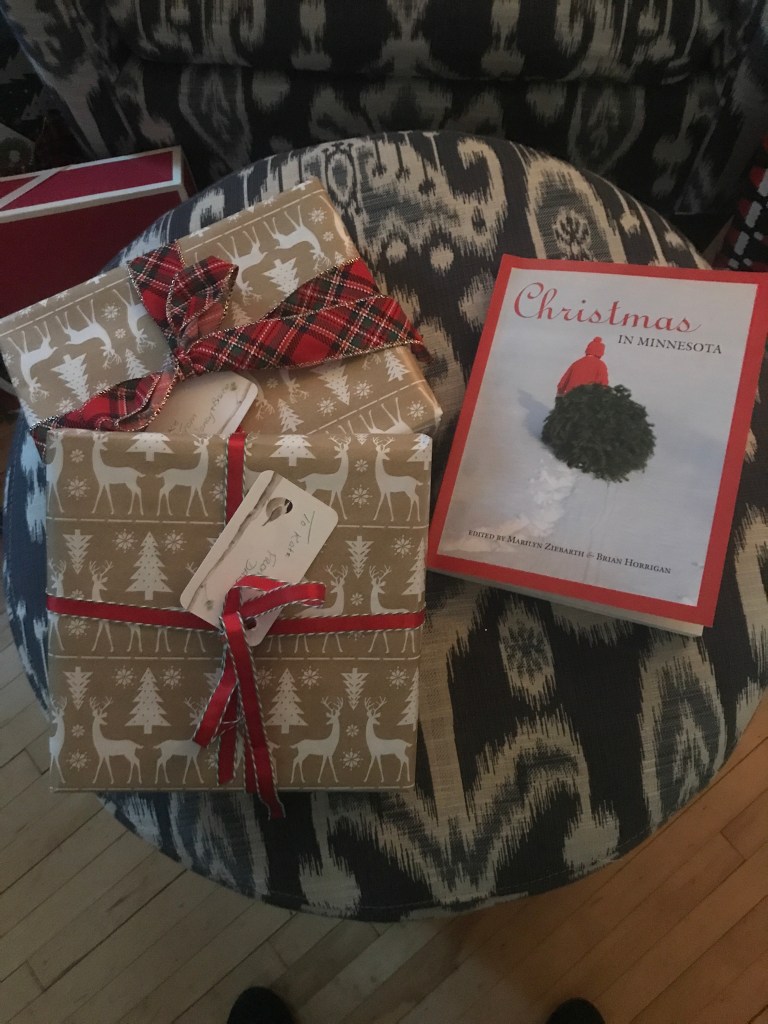
A friend sent me a wonderful anthology, Christmas In Minnesota, edited by Marilyn Ziebarth and Brian Horrigan, and it is a seasonal treasure. Stories and essays and memoir, along with nostalgic drawings and photographs. I can dip into Christmas moments, as shared by Minnesota writers–Garrison Keillor, Susan Allen Toth, F. Scott Fitzgerald, Sinclair Lewis, Jon Hassler, Faith Sullivan and so many more. Sometimes I read an offering from beginning to end, but other times I just open the book and read a paragraph or two wherever I land. I have no intention of reading this book from cover to cover, at least not this year, but instead this book is like an unexpected encounter with a friend in the grocery store or receiving a Christmas card from someone who has not been present in my life for quite some time.

Am I concerned that the number of books read this month has plummeted from my usual number? No, not at all. I can already feel myself looking forward to wintry days devoted just to reading. But I can also feel myself loosening my grip on the number of books I read and how much time I devote to reading. At this stage of my life, I have more freedom to make those decisions in the moment.

Have you taken time to read this month? Is there a book you are eager to read in the new year? I would love to know.

I am going to take a brief holiday break, but will begin posting again on January 2.

Book Report: Favorite Nonfiction Books Read in 2023

I am always more inclined to read fiction, rather than nonfiction, but oh my, there are memorable books on this list of favorites. I am aware that most of the books I list have not shown up on various media “Best of 2023” lists, and, in fact, many, if not most, of the books were not published in 2023, but this list reflects my personal taste plus the direction of my heart and my interests. I imagine your list is as individual as mine.

I have listed books in the order in which I read them–within the created categories. Browse at your leisure!

Part of my meditation time each morning is to read a book classified as spirituality or theology. All of these books, by the way, are housed in my garret where I write and meet with spiritual directees.

  • Liturgy of the Ordinary, Sacred Practices in Everyday Life by Tish Harrison Warren
  • Faith After Doubt, Why Your Beliefs Stopped Working and What To Do About It by Brian D. McLaren
  • Do I Stay Christian, A Guide for the Doubters, the Disappointed, and the Disillusioned by Brian D. McLaren
  • A Prayer in the Night, For Those Who Work or Watch or Weep by Tish Harrison Warren
  • Embers, One Ojibway’s Meditations by Richard Wagamese
  • Alive Until You’re Dead, Notes on the Home Stretch by Susan Moon
  • Enchantment, Awakening Wonder in an Anxious Age by Katherine May
  • Sacred Nature, Restoring our Ancient Bond with the Natural World by Karen Armstrong
  • Lost and Found, Reflections on Grief, Gratitude and Happiness by Kathryn Schulz
  • Why Did Jesus , Moses, The Buddha and Mohammed Cross the Road? Christian Identity in a Multi-Faith World by Brian D. McLaren
  • Things Seen and Unseen, A Year Lived in Faith by Nora Gallagher (Re-read)
  • Practicing Resurrection, A Memoir of Work, Doubt, Discernment, and Moments of Grace by Nora Gallagher. (Re-read)
  • Winter Grace, Spirituality and Aging by Kathleen Fischer (Re-read)
  • The Summer of the Great-Grandmother by Madeleine L’Engle (Re-read)
  • Wintering, The Power of Rest and Retreat in Difficult Times by Katherine May (Re-read)
  • Memoir as Medicine, The Healing Power of Writing Your Messy, Imperfect, Unruly (but Gorgeously Yours) Life Story by Nancy Slonin Aronie
  • Writing Begins with the Breath, Embodying Your Authentic Voice by Laraine Herring
  • The Hawk’s Way, Encounters with Fierce Beauty by Sy Montgomery (nature)
  • A Friend Sails in on a Poem by Molly Peacock
  • Bomb Shelter, Love, Time, and Other Explosives by Mary Laura Philpott (essays)
  • Leaving the Pink House by Ladette Randolph (memoir)
  • The Heartbeat of Wounded Knee, Native America From 1890 to the Present By David Treuer
  • South to America, A Journey Below the Mason-Dixon to Understand the Soul of a Nation by Imani Perry
  • One Hundred Saturdays, Stella Levi and the Search for a Lost World by Michael Frank
  • Catching the Light by Joy Harjo (memoir, poetry)
  • Fox and I, An Uncommon Friendship by Catherine Raven (memoir, nature)
  • You Could Make This Place Beautiful, A Memoir by Maggie Smith

What nonfiction books read in 2023 do you recommend? I would love to know.