Book Report: January Round-Up

January has been a cold month here in Minnesota, but I have been content to stay inside and read.

Such good books. My intention was to select one or two favorite fiction titles and one or two nonfiction titles, but I could not decide which books not to mention.

Fiction

  • The Sentence by Louise Erdrich. I love books set in a bookstore, and any book written by Erdrich calls to me, so this was a winning combination. Erdrich’s actual bookstore in Minneapolis, Birchbark Books, is one of my favorites and the fictional representation of the store is just as appealing. The basic plot is that one of the employees is haunted by a customer who has died, but that is far too simplistic a description. The book is set during the pandemic and also refers to the murder of George Floyd and the days following that. I am so grateful for Erdrich’s ongoing elucidation of indigenous history, culture, and current realities.
  • Celine by Peter Heller. I read his more recent book The River and liked it, but didn’t love it. However, a favorite bookseller recommended this book to me, and the main character, a 68 year-old woman who is a private investigator, is intriguing. At first I was confused by lots of names and places and wasn’t sure where the focus was going to be, but Celine, who comes from an “old” family, wears Armani scarves when she tracks her prey, uses guns comfortably, and is married to Peter, a “Mainer” who doesn’t drive, kept me turning the pages. I hope Heller writes another book about these two. The story itself–searching for a young woman’s father who supposedly was killed by a bear in Yellowstone–is well done, too.
  • Songbirds by Christy Lefteri. Set in current times in Cyprus, where a maid, originally from Sri Lanka disappears. She has fallen in love with a man who poaches song birds and sells them to restaurants as forbidden and exotic treats. That’s disturbing enough, as it is, but even more so is the indentured servant conditions of the maids and that the main character, Nisha, is not the only one.
  • Oh William! by Elizabeth Strout. I loved this book. William and Lucy Barton were once married and had two daughters, now grown. Lucy’s second husband has died and William’s current wife leaves him. William asks Lucy to help him confront a missing piece of his life story. Lucy, by the way, is a successful writer, but feels invisible and inadequate. Ah, the mysteries of marriage and relationships and as Strout (Lucy) says, “how we lived our lives on top of this.” After reading this book, I re-read the earlier one My Name is Lucy Barton and discovered I liked it much more the second time around.
  • The School for Good Mothers by Jessamine Chan. Think The Handmaid’s Tale by Margaret Atwood. Not as chilling, perhaps, at least not on the surface, but…. Frida, a divorced mom with a young child, has a “bad day” and makes a mistake for which she is sentenced to a training school for mothers. There is a right way and a wrong way. One way. In the school she is assigned to a robotic doll to practice the right way. Ripe for a movie, I am guessing.
  • The Thursday Murder Club by Richard Osman. Set in a retirement community in the UK, a “gang” of residents meet to solve unsolved murders and, of course, get involved in a real murder (or more than one). Interesting characters with interesting backgrounds (Elizabeth was former secret service), and I am eager to read the next book in the series. I assume there will be more after #2.
  • The Phone Booth at the Edge of the World by Laura Imai Messina. This is my “wild card” of the month–a book I just happened upon. I knew nothing about it, but the summary sounded intriguing, and it was one of those books that just felt right. The plot is based on the true story of a tsunami in Japan in 2011. People who have lost loved ones come to talk to them in a disconnected phone booth at the site of the tsunami. Two of those are Yui, whose daughter and mother died, and Takeshi whose wife died. Such a beautiful story of the rhythms of grief and re-entry into life and love.
  • Mrs March by Virginian Feito. This is the least favorite novel I read this month, but I finished it. (I discarded a few others along the way.) Mrs March is married to a successful novelist, and she has many emotional problems. I got tired of the grinding perspective of her paranoia, but still there was some nice writing.

Nonfiction

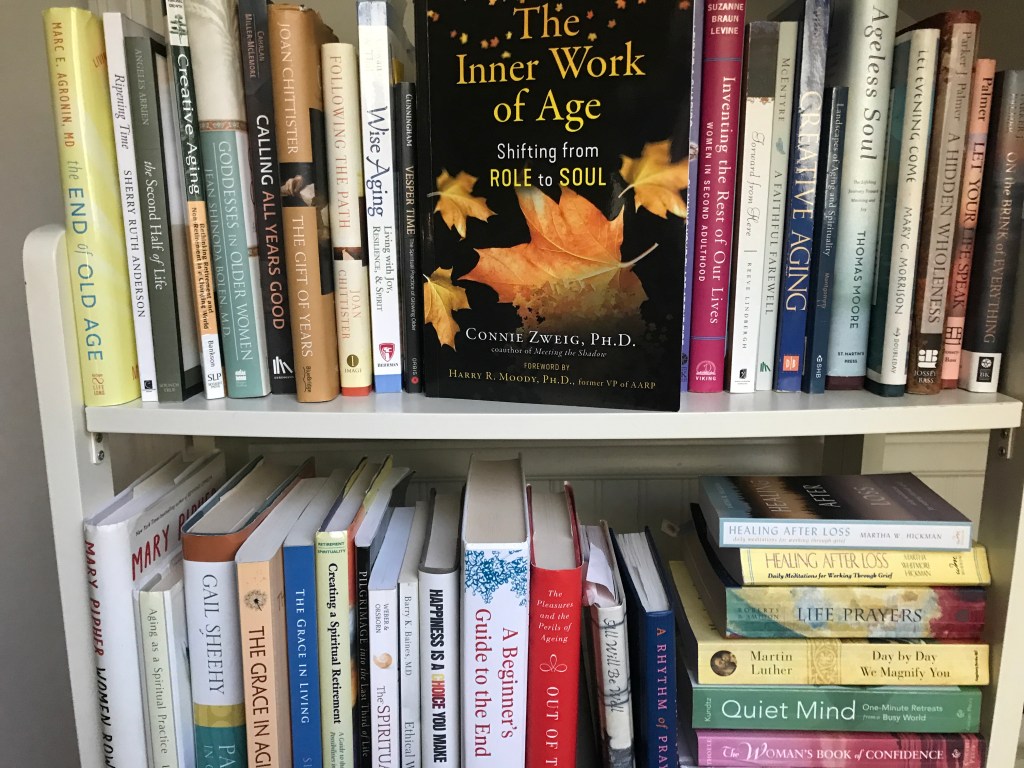
  • The Inner Work of Age, Shifting from Role to Soul by Connie Zweig. I read this book slowly during my morning meditation time. Zweig’s main message is to become an Elder, which means doing the necessary inner soul work, becoming who we were created to be and embracing the hidden spiritual gifts of age. She doesn’t ignore the challenges; for example, life-changing illness, but instead urges each of us to become aware of our own shadow–the obstacle(s) that prevent our own authenticity. So much here. I added many quotes in my journal and used many of the reflection questions at the end of each chapter. This is a book to move us beyond being elderly and instead, to live our elderhood with awareness.
  • Wife/Daughter/Self, A Memoir in Essays by Beth Kephart. I have loved Kephart’s books on writing and this book gave me insight into who she is as writer and teacher, but much more beyond that. Each section was divided into snatches, short pieces, but the book didn’t feel disconnected. I did think, however, that the section on “wife” was the strongest. The book made me think about how roles change or even end, but the self remains.
  • In the Country of Women by Susan Straight. Straight is a white woman who was married to a black man from the neighborhood where she grew up. They had three daughters and even after they divorced they remained connected in healthy ways. Plus, she was very connected to his large and complicated family. I couldn’t always keep every one straight and how they were related to one another, but the weaving of the stories, the texture of the connections, like the braiding of hair, which she mentioned often, were memorable. This was an unexpected gift.
  • 16 Ways to Create Devotional Writing to Renew the Spirit and Refresh the Soul by David J. Sluka. A book to keep on my shelf for the day, if that comes, when I decide to write devotions for women elders.

It is already February 3, and I have read….sorry, you have to wait till my February Round-Up.

An Invitation: What were your favorite January reads? I would love to know.

Book Report: Browsing A Bookshelf

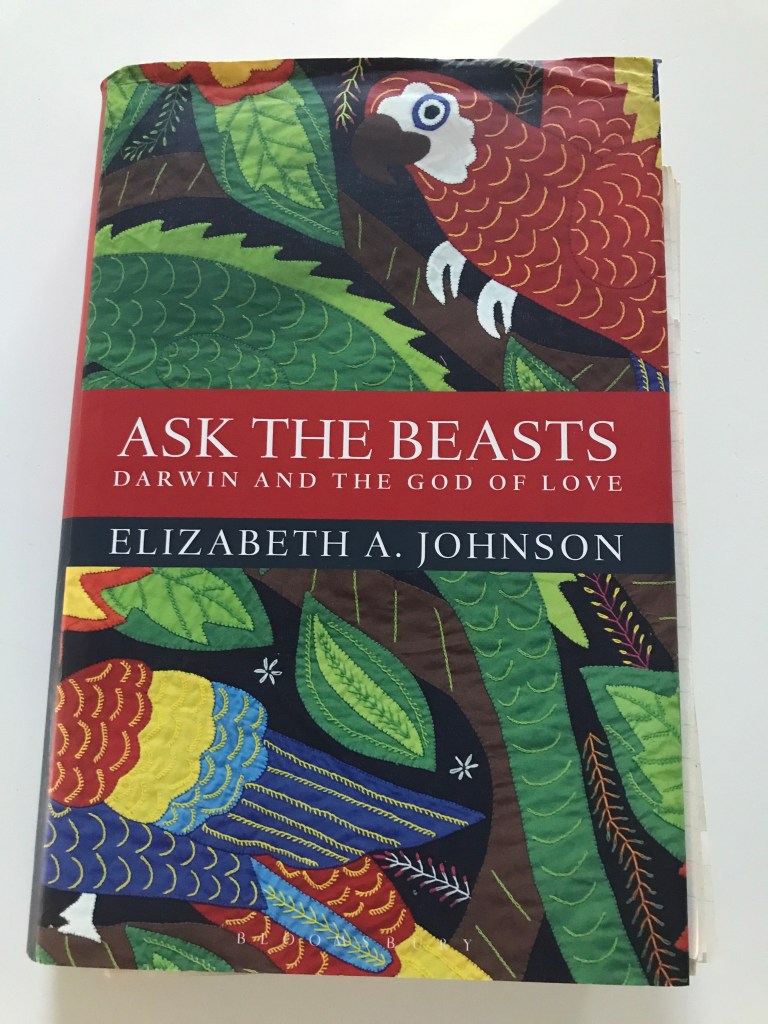
Join me in my garret, where I keep my books on spirituality and theology. Pick a shelf, any shelf. How about the one that begins with books by Elizabeth A. Johnson and ends with a little book about contemplation by Martin Laird, Into the Silent Land?

And in-between are treasures of learning and wisdom and journeys into spiritual practice and reflection.

The Prettiest Cover: Ask the Beasts, Darwin and the God of Love by Elizabeth A. Johnson. (2014) Inside are several pages of notes I wrote when this book was the focus of a class I took at Wisdom Ways in 2014. https://www.wisdomwayscenter.org Johnson asks the question “What is the theological meaning of the natural world of life?” and “Why hasn’t theology taken the natural world seriously?” This is a dense book and as a non theologian, I was grateful to be studying this book with a group of wise and educated women. Johnson, by the way, was being “investigated” by the Catholic Church as she was writing this book.

Right next to this book is another Elizabeth Johnson book, Friends of Gods and Prophets, A Feminist Theological Reading of the Communion of Saints (1998); a book I have yet to read. Some day.

Moving Along: A commentary on the Gospel of Mark by Donald Juel, who was a professor at Luther Seminary when I was associate director of public relations there, and I always enjoyed the brief conversations with him when he stopped in my office or during lunch. Next to Juel’s book is Julian of Norwich’s Showings. I wonder what Mark and Julian of Norwich would have to say to each other.

Other Saints–Among My Personal Saints: Thomas Keating and Sue Monk Kidd. Father Keating was the founder of the Centering Prayer Movement and two of his books have been important in my spiritual development–Open Mind, Open Heart, The Contemplative Dimension of the Gospel (1986) and The Better Part, Stages of Contemplative Living (2000). Centering prayer is a practice of turning within and resting in God’s presence. Not far away from the Fr. Keating books are two books by Sue Monk Kidd, When the Heart Waits, Spiritual Direction for LIfe’s Sacred Questions (1990) and The Dance of the Dissident Daughter (1996). You may recognize this author for her more recent fiction, including The Secret Life of Bees (2002) and The Book of Longings (2020), but it is “Dissident Daughter” that holds the most meaning for me. Kidd unfolds her awakening to feminine spirituality, and I went on that journey with her. I read this book more than once and underlined more each time and added my own questions and reflections and commentaries.

Next to Kidd on the shelf is Ursula King’s The Search for Spirituality, Our Global Quest for a Spiritual Life, (2008) and I see I have marked Chapter Five, ‘Spirituality Within Life’s Dance” as my favorite in the book and within that chapter, the section on “Spirituality and Aging.” I need to reread that section.

Buddhist Wisdom: Two books by Jack Kornfield. First, perhaps his most famous work A Path With Heart, A Guide Through the Perils and Promises of Spiritual Life (1993) and a collection of sayings, The Art of Forgiveness, Lovingkindness, and Peace (2002), which was given to me by a dear friend who died many years ago. She lives in my heart and on my bookshelf. In A Path With Heart Kornfield includes a number of meditations, such as “Who am I?” and “Transforming Sorrow into Compassion.” The techniques may be different. The definitions may be different, but I think these mindfulness meditations are compatible with the practice of centering prayer, and I think Jon Kabat Zinn, whose book Wherever You Go There You Are, Mindulness Meditation in Everyday Life (1994) is also on this shelf, would agree.

Jewish Wisdom–Books by Three Rabbis: Yearnings, Embracing the Sacred Messiness of Life (2006) by Rabbi Irwin Kula, The Lord Is My Shepherd, Healing Wisdom of the Twenty-Third Psalm (2003) by Rabbi Harold S Kushner of When Bad Things Happen to Good People fame, and Jewish Spirituality, A Brief Introduction for Christians (2001) by Rabbi Lawrence Kushner. A post-it note dangling from the edge of Yearnings directed me to this sentence, “The more we allow ourselves to unfold, the less likely we are to unravel.” p. 37

Interfaith Wisdom: The Jews, Christians and Buddhists all meet in Beside Still Waters, Jews, Christians and the Way of the Buddha (2003) edited by Harold Kasimow, John P. Keenan, and Linda Klepinger Keenan. Another book unread. So far.

Life’s Journey: 1. A Woman’s Guide to Spiritual Renewal (1994) by Nelly Kaufer and Carol Osmer Newhouse. 2. The Ten Things To Do When Your Life Falls Apart, An Emotional and Spiritual Handbook (2010) by Daphne Rose King. (#1 on the To Do list is to “cry your heart out.) 3. Grieving Mindfully, A Compassionate and Spiritual Guide to Coping with Loss (2005) by Sameet M. Kumar. At one time or another I have consulted all of these books, both for myself and for my spiritual directees.

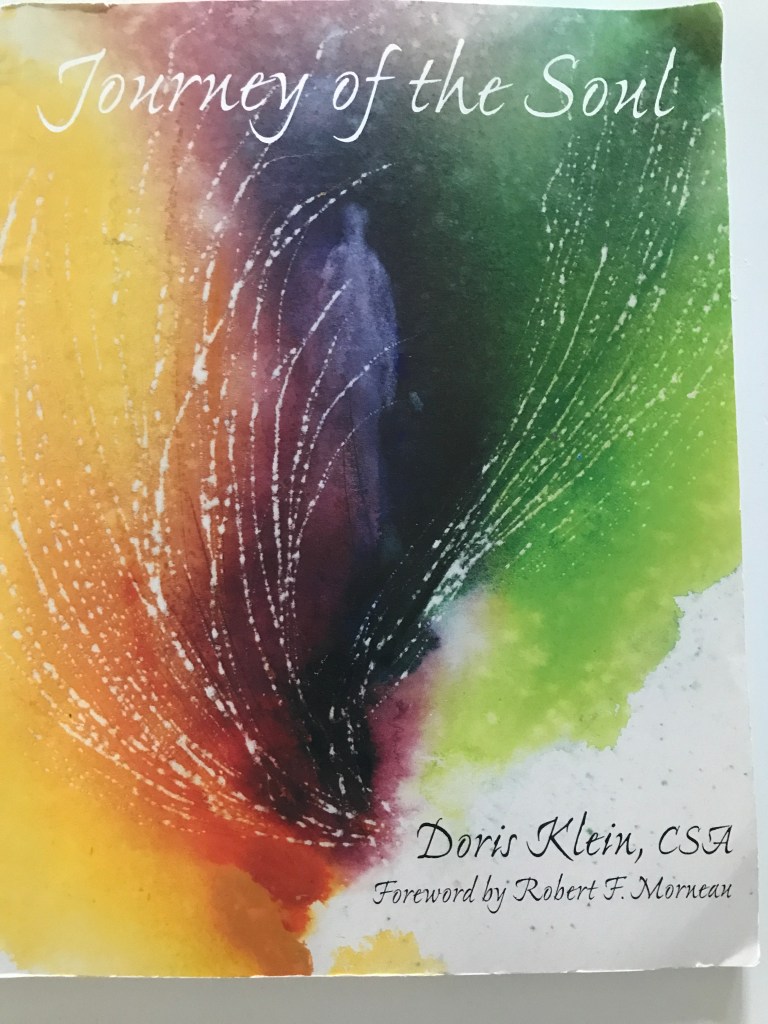
And More: a book on the sacred art of pilgrimages, one on dreams, a classic of spiritual literature (The Imitation of Christ) and still more. I close with a book that is a feast for the eyes, as well as the mind and the heart, Journey of the Soul (2000) by Doris Klein, CSA. It has been a long time since I sat with the words and the images in this book–perhaps now is the time to return to this book.

The soul journey is the process of spiraling into the Heart of the Holy where in reality we always are. We simply learn to see more clearly. p.3

I know I’ve just flung a lot of titles your way, but what strikes me is how one single bookshelf can open the door to new reflection and at the same time rewind a path of memory. By the way, I removed four titles from this shelf and added them to the Little Free Library pile. May they be exactly what someone else needs.

Thanks for shopping my Johnson to Laird bookshelf with me.

Book Report: Book Conversations

Some of the best conversations include talk about books.

Recently, my husband and I had dinner with our granddaughter Maren and along with talk about her first semester at college, the reunion she had during winter break with the women from her wilderness canoe trip in Alaska this summer, and her plans for the 2022 summer, we talked books. Maren is not only a voracious reader, like everyone else in the family, but she is a careful and insightful reader. I trust her recommendations and value her appraisals and judgment. She is also an excellent writer herself–perhaps someday I will be able to recommend a book written by her.

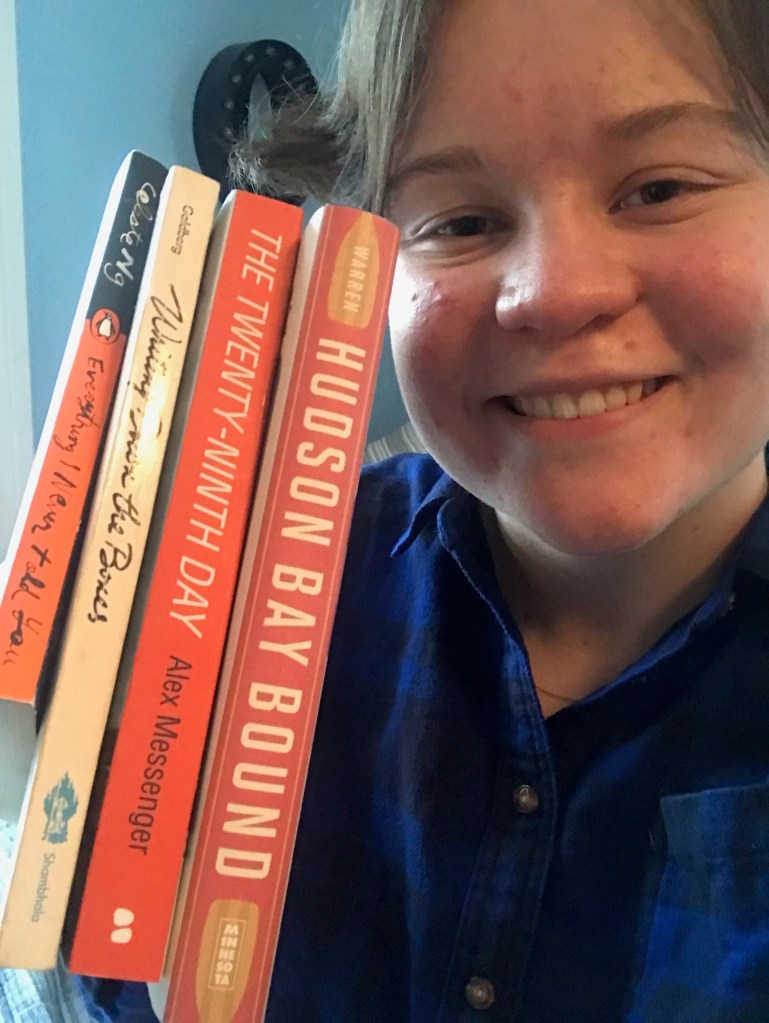
Over pasta, we shared titles. She had recently read The River by Peter Heller, and I had just finished and really enjoyed his earlier book Celine. I have added The River to my own TBR list now. She had read Celeste Ng’s Everything I Never Told You, and I urged her to read Little Fires Everywhere. She and her Dad are watching Station Eleven, and I mentioned how excellent the book by Emily St James Mandel is and later gave her my copy of the book.

When she was a baby, we sent her at least one book every month, building her library from babyhood through the toddler and childhood years and on into middle school. The regularity of the book-giving routine eased as she got older, but there were still occasional book-buying sprees with her and always the gift of a book or two is part of birthdays and Christmas. For Christmas this year we gave her two books related to her own wilderness experiences, The Twenty-Ninth Day, Surviving a Grizzly Attack in the Canadian Tundra by Alex Messenger and Hudson Bay Bound: Two Women, One Dog, Two Thousand Miles to the Arctic by Natalie Warren. As she shared her impressions of these books, we learned more about her own 30-day plus canoeing and hiking trip above the Arctic Circle this past summer with five other women.

Earlier this year I gave her a stack of books about writing as part of her high school graduation present. Some were new copies of books I have loved and valued, but others were ones I plucked from my own shelves and passed on to her, including Natalie Goldberg’s Writing Down the Bones, Freeing the Writer Within. A true classic for all writers. My copy included a note written to me by Natalie after I helped publicize a writing workshop decades ago. How gratified I was to hear Maren say how reading that book has given her a new and renewed outlook on writing practice.

Talking books, sharing titles with other readers is always a delight, a way to connect and enrich our understandings of each other–and what a treat to do that with our granddaughter.

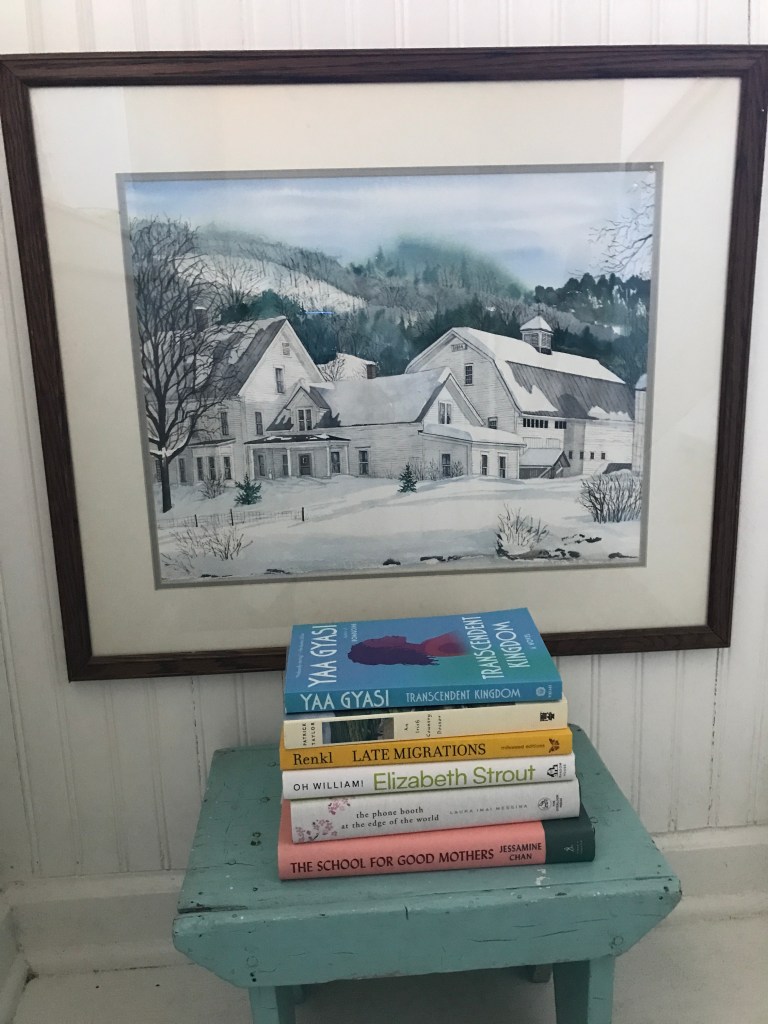
On another note, my book piles continue to grow. Over the weekend my husband and conducted a Book Raid at one our favorite bookstore, Content Bookstore in Northfield, MN. https://www.contentbookstore.com Here’s my stack–stay tuned for more book reports!

An Invitation: Have any recent conversations included book talk? I would love to know.

Book Report: A Book For My Age

A growing area of my garret bookshelves is books about aging, about living as an elder.

The book I return to over and over is Joan Chittister’s The Gift of Years, Growing Older Gracefully, and another ongoing favorite is The Grace in Aging, Awaken As You Grow Older by Kathleen Dowling Singh. Both are rich and, in fact, offer even more riches as I grow further into elderhood, but lately I have been immersed in a 2021 book, The Inner Work of Age, Shifting from Role to Soul by Connie Zweig.

Here’s what is written on the back cover:

With extended longevity comes the opportunity for extended personal growth and spiritual development. You now have the chance to become an Elder, to leave behind past roles, shift from work in the outer world to inner work with the soul, ad become authentically who you are. This book is a guide to help get past the inner obstacles and embrace the hidden spiritual gifts of age.

The author, Connie Zweig, PH.D, is a retired psychotherapist who is known as the “Shadow Expert.” Many years ago I read her now classic work, Romancing the Shadow, Illuminating the Dark Side of the Soul (1997).

I am reading this new book slowly, taking time to respond to questions she offers for reflection, along with the guided meditations and other spiritual practices presented at the end of each chapter. The chapter that has resonated with me the most so far is “Retirement as a Divine Messenger,” but this morning I finished reading “Life-Changing Illness as a Divine Messenger,” a rich preparation for when illness enters my own life.

I am hesitant to say much more about this book, except that it feels momentous to me. The right book at the right time–both opening me to new thoughts and information, too, as well as reinforcing what seems to be unfolding in my own aging process. I am certain this will not be the last time you will find references to this book in my posts. Stay tuned.

An Invitation: If you are an elder or approaching that time of your life, what books do you recommend to support and enhance this Third Chapter state. I would love to know.

Book Report: The Sentence by Louise Erdrich

How happy I am that the first book I read in the new year was so good. So very good. A book the calibre of The Sentence by Louise Erdrich sets a tone of excellence for the rest of the year.

The basic story, -as if it were possible to confine the plot to the word “basic”- is that a bookstore employee who had been in prison, convicted for stealing a body, is haunted by the ghost of a former customer. The bookstore is modeled after Birchbark Books (one of my favorite independent bookstores) owned by the author, and the setting for the book is mainly Minneapolis from 2019-2020, which means the murder of George Floyd and the pandemic are part of the book’s context and action.

The sentence refers to the prison sentence of the main character, Tookie, a Native American woman, but also sentences in books and beyond that, one’s life sentence. The book’s epigraph gives a hint of the complexity to follow: “From the time of birth to the time of death, every word you utter is part of one long sentence.” Sun Young Shin, Unbearable Splendor. I kept returning to that quotation as I moved further into the book.

I apologize to anyone who reads my copy of the book, for I underlined so much and many little post-it notes are flapping on the book’s edges.

…this dimming season sharpens one. The trees are bare. Spirits stir in the stripped branches. November supposedly renders thin the veil. p. 41

Think how white people believe their houses or yards or scenic overlooks are haunted by Indians, when it’s really the opposite. We’re haunted by settlers and their descendants. We’re haunted by the Army Medical Museum and countless natural history museums and small town museums who still have unclaimed bones in their collections…p. 81

When everything big is out of control, you start taking charge of small things. p. 202

I keep thinking about this perspective about forgiveness–forgiving one’s self and forgiving others.

You can’t get over things you do to other people as easily as you get over things they do to you. p.358

I could go on, but I prefer that you buy your own copy and mark your own favorite lines and passages. One more thing: I hope I never again use the phrase “the calvary’s coming,” for one of the characters says that phrase is really a reference to genocide. Think about it.

And yet one more thing: I know I am an old lady who has not kept up with all the abbreviations used in texts, but I was not familiar with DWW–Disturbed While Writing. Now that is one I will remember and probably use!

I promise this is the last thing. Several reviews have described this book as “wickedly funny,” and it is, but it is also deeply disquieting and seriously absorbing.

An Invitation: What is your first book of 2022? I would love to know.

Book Report: Christmas Books

Snow is lightly falling, making this open afternoon perfect for browsing the collection of Christmas books stacked on the living room coffee table. Just as photographs tease us into memories, so do books, especially Christmas books.

I begin with A Child’s Christmas In Wales by Dylan Thomas, which begins

One Christmas was so much like another, in those years around the sea-town corner now and out of all sound except the distant speaking of the voices I sometimes hear a moment before sleep, that I can never remember whether it snowed for six days and six nights when I was twelve or whether it snowed for twelve days and twelve nights when I was six.

I am tempted to quote the whole book. The lushness of the language, the warmth and the humor and Dylan’s ability to create scenes almost convinces me I once lived that life myself. I resist the temptation, however, but hope you will add this book–and read aloud to anyone who will listen–of this classic. My husband, by the way, once acted in a reader’s theatre production of the book and one of his first presents to me oh so long ago was a copy of the book. I remember reading the book aloud to each of my classes the day before Christmas vacation when I taught high school English.

Perhaps my favorite version of the Christmas story and one we have loved sharing with our children and grandchildren, nieces and nephews, is Julie Vivas’s version of The Nativity with its earthy and charmingly humorous illustrations. Did you ever consider how difficult it would have been for Mary to mount the back of a donkey or how exhausted she was after the birth, handing off the new baby to Joseph? It’s all here—the scrawny angels, the crowds of people looking for an inn, the sheep who didn’t want to be left behind and the wonder, the joy, the awe.

No stack of Christmas books is complete without books by Tomie de Paola. I love his illustrations of Miracle on 34th Street, but even more special is The Clown of God, an old story he told and illustrated. Our copy was signed by dePaola in 1980 when I was working at a wonderful independent book store. The story, in case you don’t know is a French legend about a young juggler who offers his gifts, and a miracle occurs. Many years ago when I was on our church council I read this book for devotions at the start of the meeting. After reading each page I turned the book around to show the pictures–just like our kindergarten teacher did when we were young.

Next I browse Susan Branch’s Christmas from the Heart of The Home which is basically a cookbook, but each recipe is done in calligraphy and accompanied by charming illustrations. Branch also includes anecdotes and pieces of advice about celebrating the season.

Recipe for a Happy Christmas

Fill a house with equal parts of Love, Hope, and Peace. Add the Joy of children, the Strength of older people, and the Spirit of Christ. Spread over all the Blessings of Contentment. Season with the music of Laughter, and some Mistletoe Kisses warm before a crackling fire. Serve with Great Welcome, Much Cheer, and All the food in this book!

And there is lots of food in this homey book, but maybe this is the year to fix Orange French Toast or Chocolate Poached Pears, and then I’ll read once again A Cup of Christmas Tea by Tom Hegg.

When I open the Everyman’s Pocket Classics edition of Christmas Stories I see I have checked off several of the titles in the table of contents–stories by Arthur Conan Doyle, Willa Cather, Elizabeth Bowen and others, but, honestly, I can’t tell you the plot of any of them. I suspect I will enjoy re-reading them. Perhaps I should set aside the current novel I am reading and sink into this book, story after story.

Finally, I am intrigued by a little book I found recently in an antique shop, Readings and Recitations for Winter Evenings compiled by B. J. Fernie and published by The Christian Herald in 1895. I imagine a gathering of elegantly dressed men and women passing the book from person to person and each one reading aloud for everyone’s entertainment one of the selections by Dickens or Bret Harte or Mark Twain or Longfellow. What a civilized pre-Netflix idea!

At one time our collection of Christmas books was larger, but over the years we have passed many, like The Night Before Christmas, also illustrated by dePaola, on to our kids and grandkids. The pile on the coffee table is just enough to add to the blessings of the season.

Hot cider and a story are calling me! Happy reading!

An Invitation: What are your favorite Christmas books? I would love to know.