Book Report: Reflecting on Home

September 15, 2022

Sometimes a book does everything but jump into your hands. That was the case with two books I read recently.

I must have read a review of The Green Hour, A Natural History of Home by Alison Townsend (2021), for I added it to my TBR list, but when I saw it in Arcadia Books on our recent trip to Spring Green, WI, I knew I could not wait for it to come out in paperback or for the library to add it to their shelves.

First of all, look at that cover. So beautiful, and it is the kind of book that simply feels good to hold. But more than that is the topic, the themes. The author grew up in Pennsylvania and as a young adult lived in Oregon and California, but later in adulthood moved to the Madison, Wisconsin area. She writes beautifully, richly about each landscape–the kind of multi-layered, descriptive writing I love–but having lived in Madison, those are the sections I loved the most.

Her essay, “Strange Angels: Encounters with Sandhill Cranes,” is perhaps the best nature essay I’ve ever read.

Like a group of pilgrims or spiritual seekers collecting before their journey begins and uttering preliminary prayers, the cranes seem to be readying themselves, preparing for the long flight they must make, some of them for the first time.

p. 159

Like the author I love the sound of the cranes and always feel blessed hearing them. “Perhaps that is why their call is so evocative, why it seems to float across the millennia as it does, immutable and enduring.” p. 160. Cranes are not part of my life here in St Paul, and I miss them.

I also loved the essay “An Alphabet of Here, A Prairie Sampler” as well. C is for Canada Geese. G is for Great-Horned Owl. Q id for Queen Anne’s Lace and Queen of the Prairie.

Z is for zigzags, zaps, and zings of summer lightning, the zed-shaped folds of the aurora opening its luminescent green curtains on a winter’s night when it’s twenty degrees below zero, and the z-z-z-z-z-ing as we sleep–cat on the bed, collies on the floor beside us–the zodiac swirling around us like the well of life that is here, now, the only one we are given.

p. 187

Some books beg to be read aloud, and I am grateful my husband was willing to listen as I read select essays to him while driving through the countryside on our way to Cleveland recently. This books was our perfect companion.

I discovered The White Stone, The Art of Letting Go by Esther de Waal (2021) when we toured the gardens at St John’s University, Collegeville, MN this summer. Because I can never resist a bookstore, we browsed the Liturgical Press bookstore on campus, and I found this little treasure. Years ago I read her book Seeking God, her book on Benedictine spirituality, but it is no longer in my library–I may need to get another copy. This book was written during the pandemic and at a time when she is moving from one home to another, and she employs what has sustained her through the years–the Rule of St. Benedict, the gifts of Celtic spirituality, the teachings of Thomas Merton, and the Psalms–to guide her through a time of transition.

I hold on to stability but I must not be static. Here is the paradox…I must be prepared for the continual transformation in which God is bringing the new out of the old…It is just a matter of somehow keeping on keeping on, a continual bending one’s life back to God whatever happens.

p. 64

I was especially moved by the chapter titled “Diminishment,” in which she reflects on how time seems different as we age, but also that “Life now brings a greater opportunity to pay attention to look consciously at the ordinary minutiae of daily life in the things around…”

She also underscores the key question of Benedictine life: “Am I becoming a more loving person?” When we were driving through Indiana, I noticed a small sign on the edge of a cornfield, “Fear God,” it said, and I thought to myself, “How does fearing God make me a more loving person?” Instead, I suspect adhering to that idea would make me a more fearful person. I want to be a more loving person. Thanks for the reminder, Esther de Waal.

Ok, that’s it. I am so happy these two books will live on our bookshelves.

An Invitation

Have any books found their way into your hands, your heart recently? I would love to know.
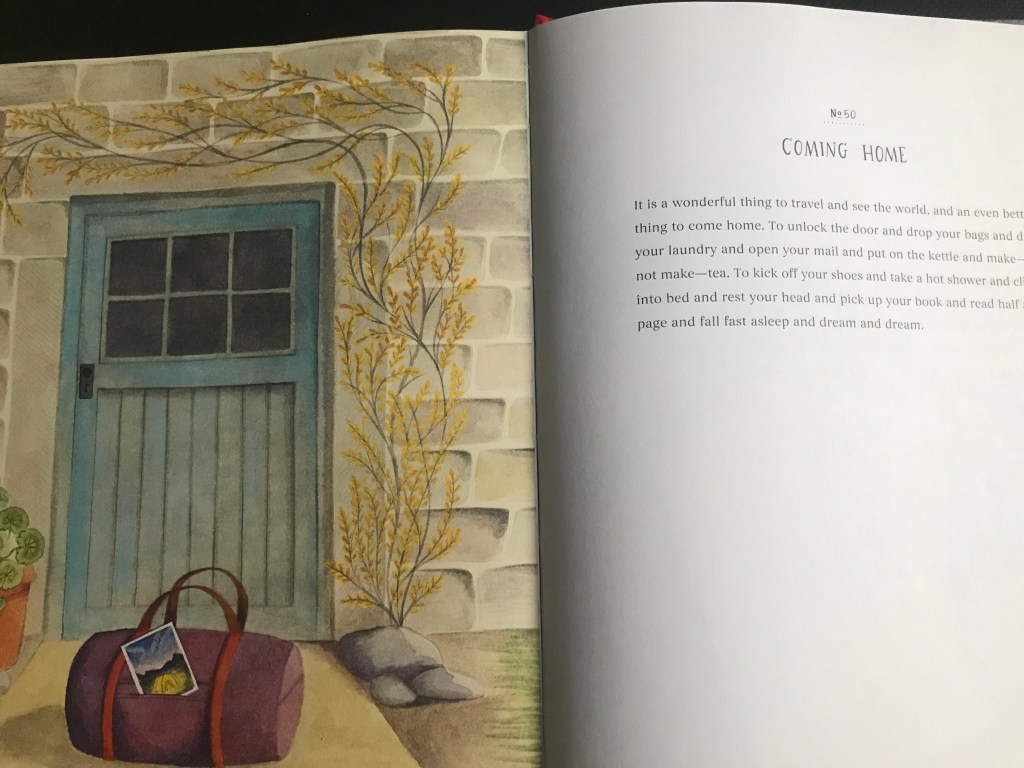
Book Report: Things to Look Forward To, 52 Large and Small Joys for Today and Everyday by Sophie Blackall (2022)

August 11, 2022

Yes, I know how important it is to live in the present moment.

Breathe in and tell yourself that a new day has been offered to you, and you have to be here to live it.

You Are Here, Discovering the Magic of the Present Moment by Thich Nhat Hand

This gentle and charming book, Things To Look Forward To by author and illustrator Sophie Blackall is a doorway into remembering what brings us joy and the pleasures that sustain and guide us, even when the present moment is fraught with angst. This book is a guidebook for being in the present moment, even as we look ahead.

Some of what Blackall looks forward to are on my list, like “making lists” and “returning home,” and other items, like “rain” and “visiting a museum,” open me to greater appreciation and gratitude. Maybe that’s what this book is–a gratitude book for a life being lived.

Here’s my list, a list that keeps growing, and that is a good thing, I think.

  • Sunday morning church.
  • Fall: weather, food, clothes, pumpkins
  • Being with our kids and grandkids. Anytime. Anyplace.
  • Having written the first sentence or paragraph of a new writing project. The first is always the hardest.
  • Meeting with my spiritual directees.
  • Anticipating the next book to read. I love adding titles to my TBR (To Be Read) list and then checking them off as I read them. And what is better than getting an email from the library saying a book I have requested is now available!
  • Making pesto with the basil from our garden.
  • A cold Diet Coke, especially from MacDonalds. (Remember, Blackall says the list contains both large and small joys)
  • One day road trips and counting eagles and hawks.
  • Cozy days in the snug.
  • The first trip in the morning to the garret.
  • Perfect weather to sit in the side garden, I call Paris.
  • Shopping the house as I clean to create new vignettes.
  • Ironing. Pressing out the wrinkles.
  • Seeing a friend cross the threshold.
  • Morning Meditation Time, whether it is walking in the neighborhood or sitting in my Girlfriend Chair
  • Setting the table for a gathering and thinking about the love that will be present.
  • My husband filling vases with flowers from his glorious garden.
  • Going to a play or concert.
  • A good night’s sleep.
  • Unpacking. I don’t enjoy packing, but unpacking always feels like a new beginning.

Normally we say that the future is not here yet, but we can touch it right now by getting deeply in touch with the present moment. Because it is of an interbeing nature, the present cannot exist by itself. It interexists with the past and the future. It’s like a flower that cannot exist by itself: it has to interexist with the sun and the earth. This is true for time, too. The present is made up of material called the past and the future, and the past and future are here in what we call the present.

You are Here, Discovering the Magic of the Present Moment by Thich Nhat Hanh

Blackall’s list and my list are the result of past times, which we look forward to living again in the present. Past, present, and future are all one.

An Invitation

What’s on your “looking forward to list”? I would love to know.

Book Report: July Round-Up

August 4, 2022

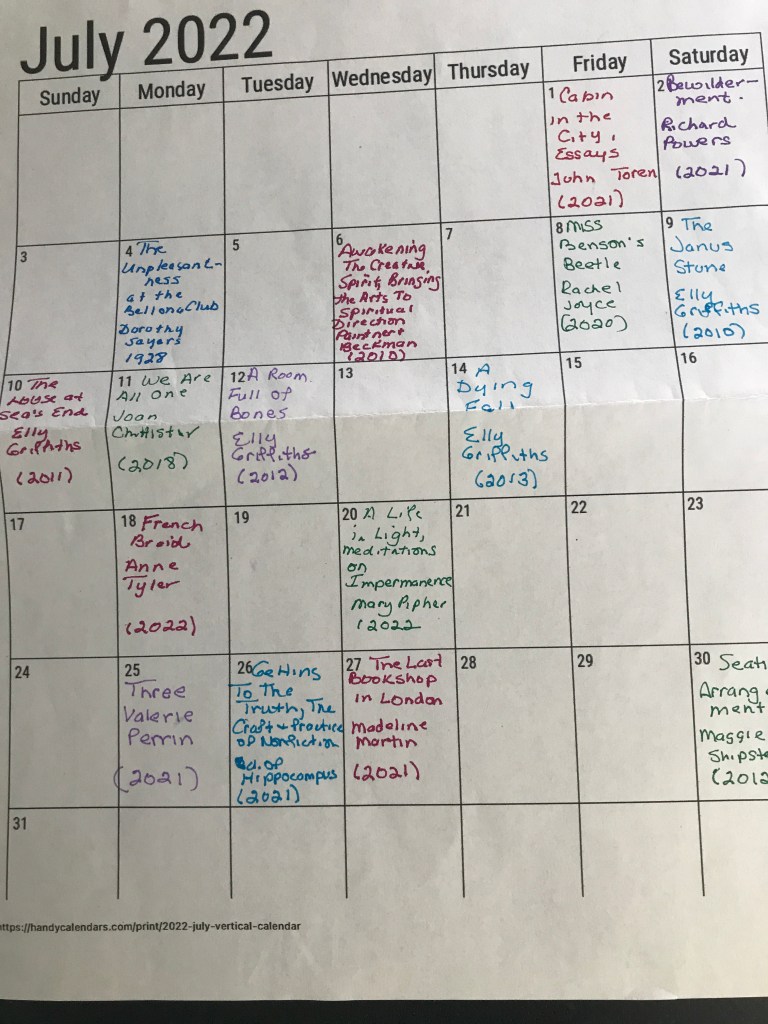
I read sixteen books in July–surprising even myself.

The first half of the month I immersed myself in mysteries. See my July 14 post. https://wordpress.com/post/livingonlifeslabyrinth.com/949 During the second half of July I read three novels from my TBR list, and I recommend with pleasure each one.

  • French Braid by Anne Tyler. I’ve read most of her long list of books, enjoying some more than others. This one is especially good. Few people write dialogue as well as Tyler does, for one thing, and few people create a window into family relationships as she does. True, the characters are often quirky, but still, recognizable. In this story the family members maintain distance from one another, not out of dislike or fear, but simply this is the way it is. The title is referenced towards the end of the book describing a French braid when it is undone, “ripples, little leftover squiggles…that’s how families work, too. You think you’re free of them, but you’re never really free; the ripples are crimped in forever.” (p. 234) Later, Tyler writes, “This is what families do for each other–hide a few uncomfortable truths, allow a few deceptions. Little kindnesses…and little cruelties. (p. 342) Classic Tyler
  • Three by Valerie Perrin. Her earlier novel, Fresh Water for Flowers, was the first book I read in 2021 and was one of my favorite books that year. It remains a favorite. I loved Three, as well. The title refers to Etienne, Adrien, and Nina who grew up together, forming their own kind of family. The story moves between their growing up years and years much later. Sometimes a scene is repeated, but the second time we, the readers, know much more than we did the first time we read it. Much of the story is told by Virginie, but we don’t know who she is till much later in the book. “Intriguing” is the word that occurred to me as I read this book. Flawed characters, for sure, but characters who want to live as their better selves. One line that stays with me, “How many people do we miss out on in a lifetime?” (p. 261)
  • Seating Arrangements by Maggie Shipstead. After reading her most recent novel Great Circle in June https://livingonlifeslabyrinth.com/2022/06/09/book-report-great-circle-by-maggie-shipstead/, I knew I wanted to read her backlist. Seating Arrangements is her first novel, published in 2012, and it is worth reading. The story takes place the weekend of a wedding–Winn and Biddy’s oldest daughter, Daphne is getting married to Greyson. Daphne is seven months pregnant, which doesn’t seem to be an issue for anyone. The wedding party gathers at the family’s island home, and the story could have focused on any one of the characters, but this is really the father’s story. “His wedding had been a wedding, not a family reunion and missile launch and state dinner all rolled into one.” (p. 93). Winn is attracted to one of the bridesmaids, and his younger daughter Livia is recovering from an abortion and being dumped by her boyfriend, and there is the matter of the beached whale. Shipstead not only tells a story well, but I love her rich descriptions and her often ironic tone. Now I am ready to read the next novel on her backlist, Astonish Me.

I feel I should mention another novel I read in July, Bewilderment by Richard Powers. I’m not sure I loved this book, but it felt like an honor to read it, and at times the story of a widowed father, Theo, and his unusual nine year-old son, Robin, moved me to tears. Theo doesn’t accept the encouragement from Robin’s teachers to start him on medication, but instead homeschools him and enrolls him in an experimental kind of therapy. Theo is an astrobiologist and often tells Robin stories of imagined planets. All this is in the context of a world that seems to be destroying itself and Trumpian anti-science politics. I’ve not yet read Powers’ The Overstory–I know I should. I know I will, but not yet.

As part of my morning meditation time, I am reading, slowly, very slowly, Unbinding, The Grace Beyond Self by Kathleen Dowling Singh, which has been on my shelf for several years, and it is worth the wait and the intentional slow pace. Other than that, I am not reading much nonfiction right now. I do recommend, however, a writing book, Getting to the Truth, The Craft and Practice of Nonfiction by the editors of Hippocampus Magazine. Excellent essays.

Reading Is…

it’s going somewhere without ever taking a train or a ship, an unveiling of new, incredible worlds. It’s living without having to face consequences of failures, and how best to succeed…I think within all of us, there is a void, a gap waiting to be filled by something. For me, that something is books and all their proffered experiences. p.73

The Last Bookshop in London by Madeline Martin

An Invitation

What did you read in July? Anything you recommend? I would love to know.

Note #1:

One of my favorite online sites for books and reading is Modern Mrs Darcy. Yesterday her post was a list of mystery series to read while waiting for the new Louise Penny! https://modernmrsdarcy.com/what-to-read-next-louise-penny-readalikes/

Note #2:

One of my favorite blogs about writing is Brevity. On Monday, August 8 you can read an essay I wrote called “Writing in a Garret.” I hope you will read it and would love to know your response. https://brevity.wordpress.com

Book Report: Favorite Reading Places

June 16, 2022

I can read and am happy to read in any location, but on these June days I most enjoy sitting on our patio with a full view of the garden; a garden developed and tended by my husband. I receive its beauty every day.

The only setting better for my reading pleasure is a view of water, preferably big water. Water where I can hear the sound of waves, gentle or with more energy. The first COVID summer my husband and I packed up outdoor chairs, cold drinks and snacks and our books and headed to nearby lakes where we could sit at a distance from anyone else and enjoy a “vacation day.”

When we lived at Sweetwater Farm, I stretched out on the sectional in the area at the front of the house we called “the nest.” When the windows were open, I often heard the clop-clop of Amish buggies passing by or I might hear our donkey, Festus, signaling that it was dinner time NOW.

As a child, I remember reading on a blanket spread out on the beach of the resort where my family spent one or two weeks each summer. It was one of those old-fashioned kind of resorts with individual cabins and not much, if any, in the way of amenities, but we loved it there. At night or if it rained, my book and I moved onto the screen porch, and I was just as content.

In one house we lived in for only a short time when I was in the 7th grade, there was a window seat in the closet of my room. Guess where I read? When our kids were young, we sat on the front porch swing, and I read aloud the next chapters in the current family book. Our house in Madison, WI, had one of those large, livable porches, too, and I often spent the whole day there reading or writing, only stopping to make dinner, which we would eat on the porch and then read there until bugs interfered with our comfort.

One of my favorite reading memories is reading in the adult pool at a country club. We lived in Dallas, TX, for two years when I was in junior high school, and we often spent hot summers weekend days at the club. My father and brother sometimes played golf, and my mother sat near the kiddie pool, watching my younger sister. Nobody, and I mean nobody, used the pool designated as the adult pool. That pool had wide steps leading into the water, and I sat on the top step, the water lapping against my legs and waist.

Once a lifeguard told me to get out of the pool because it was just for adults, and a man I didn’t know told him to leave me alone. “She’s not bothering anyone.” I suppose I thanked him and just kept reading.

More important, of course, than place, however, is the book. Right now I am reading a long and absorbing novel, The Love Songs of W.E.B. Du Bois by Honoree Fannonne Jeffers, and I will need many more hours of reading in favorite locations before I write about this book.

Looking Back: Favorite Books of June, 2021

I will list my favorite June books in a couple weeks, but in the meantime here are a few of the books I read a year ago.

  • I re-read two favorites and loved them even more the second time around. Their Eyes Were Watching God by Zora Neale Hurston and Prodigal Summer by Barbara Kingsolver.
  • The Other Black Girl by Zakiyu Davila Harris, a debut novel, was a summer sensation. OBG stands for “other black girl,” and is used when there is more than one black woman in an office. Now think about that! In this case the office is a publishing house. I can imagine this book being the basis for a television series.
  • What Could Be Saved by Liese O’Halloran Schwartz is set in Bangkok in 1972. That interested me since I spent a semester in Thailand the fall of 1968, and I recognized many of the place names. The dysfunction of the American family whose son disappears reminded me of Ann Patchett’s themes at times. An engrossing read.
  • I only read two nonfiction books last June. (I think that will be true this June, too.) One was The Seeker and the Monk by Sophfronia Scott, in which the author explored her own spirituality by studying Thomas Merton. The other nonfiction title was Morningstar, Growing Up With Books by Ann Hood. I am a sucker for books about books, and this was a good one.

An Invitation

Where do you like to read? I would love to know.

Book Report: Great Circle by Maggie Shipstead

June 9, 2022

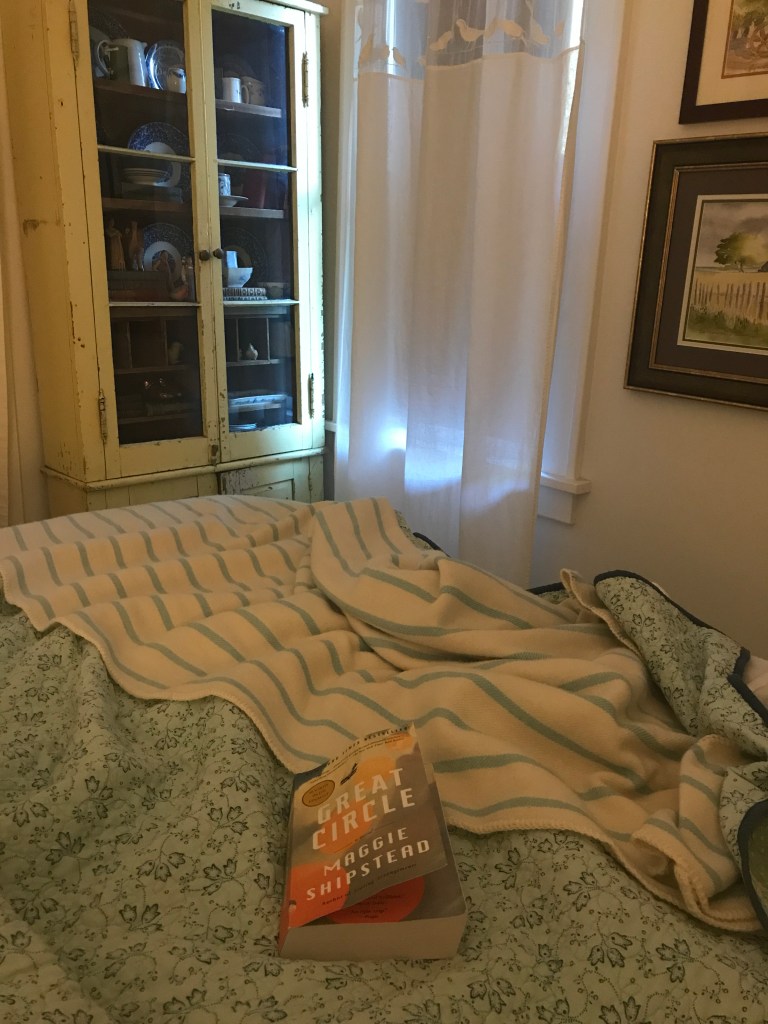
I always read in bed before turning out the light, but only occasionally do I begin the day reading in bed. Last Friday, however, I woke up a bit earlier than usual and decided to treat myself to what I call “Edith Wharton Time.”

Now I have no idea if the American writer Edith Wharton actually started her day by reading in bed, but when I toured her gorgeous home, The Mount, in Massachusetts and saw her spacious bedroom looking out over the gardens she had carefully planned, I imagined her enjoying the morning reading or writing in bed before attending to her agenda for the day. She had servants, of course, and perhaps even was served breakfast in bed. That was not the case for me, but I don’t usually eat breakfast anyway.

I only had 50 pages left to read in Great Circle (2021) by Maggie Shipstead, and reading them in the early hours when I felt refreshed from a good night’s sleep seemed like a perfect way to start the day.

I loved this book.

The plot summary on the back of the book is accurate and enticing:

After being rescued from a sinking ocean liner in 1914, Marian and Jamie Graves are raised by their dissolute uncle in Montana. There–after encountering a pair of barnstorming pilots passing through in beat-up biplanes–Marian commences a lifelong love affair with flight. At fourteen, she drops out of school and finds an unexpected patron in a wealthy bootlegger, an arrangement that will haunt her for the rest of her life, even as it allows her to fulfill her destiny: circumnavigating the globe by flying over the North and South Poles.

A century later, movie star Hadley Baxter is cast to play Marian in a film centered on her disappearance in Antartica. Scandal-plagued and trapped in her role as a Hollywood wild child, Hadley is eager to redefine herself after getting fired from a romantic film franchise. Her immersion into the character of Marian unfolds alongside Marian’s own story, as the two women’s destinies–and their hunger for self-determination in vastly different places and times–collide.

Does this tempt you?

At 651 pages, reading this book is a commitment, but I enjoy sinking into a book with rich descriptions of place and engaging with complicated characters and twists of plots and staying with a story that spans lifetimes. And the circle theme–circles as endless and wondrous, but as Marian points out in the book she writes about undertaking the North-South Pole journey, “Endlessness is torture, too.”

I now have added Shipstead’s two previous novels to my TBR list: Astonish Me (2014) and Seating Arrangements (2012). My library hold list continues to grow!

Starting my day by finishing the book must have been a good omen, for the delights of the day continued. My husband, who was busy with his garage sale selling the discarded furniture he has painted, pointed out it was National Donut Day. That required a trip to a favorite bakery, The Baker’s Wife. And later I enjoyed time with a friend sitting in the sunshine on her patio. A good day, indeed.

An Invitation

Do you enjoy reading in bed? I would love to know.
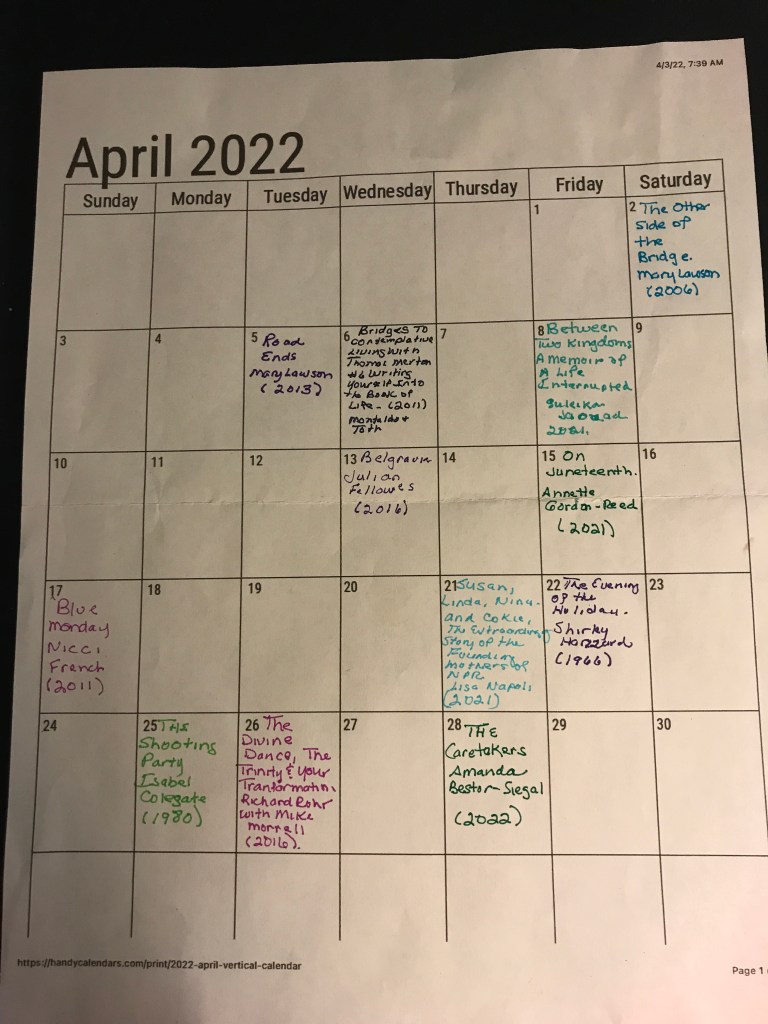
Book Report: May Round-Up

June 2, 2022

Fiction Dominated!

Out of the twelve books I read in May, only two were nonfiction, and both of those were memoir: The Pleasure of Their Company (2006) by Doris Grumbach, written as she contemplated her 80th birthday celebration, and A Ghost in the Throat (2020) by Irish poet Doireann Ni Ghriofa. I heard an interview with Ghriofa on NPR and was intrigued, but wasn’t sure if it was a novel or a memoir or a piece of literary criticism about an 18th century Irish poet Eibhin Dubh Ni Chonaill. I conclude it is all three. (The bookseller who sold me the book was quite sure it is a novel, by the way.) Did I love it? No, but I am not sorry I read it, and I appreciate the author’s reflection on the text of women’s lives.

Out of the ten fiction books I read, five were books in the mystery series by Nicci French (a pseudonym for a husband-wife team) featuring the psychoanalyst Frieda Klein as the main character. We also listened to the audio book of one of the titles on our road trip to Montana. I have finished the series and am glad I read them one after another for there is an ongoing thread in each of the books that might be hard to follow if read out of order or one without the rest. I won’t say more.

I read five other novels in May. The most memorable is Beneficence by Meredith Hall. You can read my review in an earlier post. livingonlifeslabyrinth.com/2022/05/19/book-report-beneficence-by-meredith-hall-2020/ This is a stunning book, and I keep thinking about its gifts.

The other four novels read in May are:

  • Take My Hand by Dolan Perkins-Valdez, a new novel (2022), which is getting quite a bit of attention. The topic, which is sterilization of black women/girls without informed consent, is an important one, and the story told is chilling and appalling. The main character is a young Black woman, a nurse from a well-to-do family. Set in the 1970’s in Montgomery, Alabama, She works at a family planning clinic and becomes involved with a family in which two young girls are sterilized. That eventually leads to a major law case. One of the themes especially well-developed was the assumptions made about how, when, and what kinds of care and involvement to give.
  • Matrix by Lauren Groff (2021). What a good book group selection this would be, but don’t judge it by the book flap summary, which says nothing!!!! The book has been reviewed widely because of the author’s previous successes, including Fates and Furies (2015) and Florida (2018), or I would have had no idea what to expect. Also, a male friend informed me there are no men in the book. NO MEN! I didn’t miss them. The book is set in the 1100s in what became England and is based on a real person. Marie was sent to an abbey where she has visions of the Virgin Mary and transforms the abbey from poverty to riches and power.
  • The Gown by Jennifer Robson (2019). A good vacation read. The story is based on the designing and creating of Queen Elizabeth’s wedding dress, and the main characters are two of the gown’s embroiderers. One of them is a Jewish refugee from France. Part of the story is set later in Canada when a granddaughter wants to learn more about her family history.
  • Jubilee by Margaret Walker (1966). Based on her great-grandmother’s life, the novel, written over 30 years, was in response to “Nostalgia” fiction about antebellum and Reconstruction South. The main character, Vygry, who looks and is often mistaken as white, works in the Big House of her father, the master of the plantation. The plot moves from preCivil War through the war and to the years after the war. At times the book reads like a well-written text book, and I learned a great deal, but mainly the rich writing and the wrenching story of the characters’ desire for freedom kept me reading.

An Invitation

As always, I am interested in what you have been reading. What do you recommend? I would love to know.

BONUS NOTE:

My husband has been painting and decorating discarded furniture all winter, and the garage is full to the brim. Come view and buy examples of creative talents at his garage sale, Thursday through Saturday, June 2-4 from 8:00 am – 4:00 pm. 2025 Wellesley Ave, St Paul. Access the garage through the alley ONLY. Proceeds support Lutheran Social Services for homeless youth. Wear a mask, please.

Book Report: Beneficence by Meredith Hall (2020)

May 19, 2022

Goodness. The state of goodness. That’s what “beneficence” means, and this is what this book explores. “Love and all its costs.” (p. 251)

Doris, the mother of the family, opens the story, which is set on a farm in 1947, with these words:

Every morning, early, when Tup and I get up to start our chores, the whole house still quiet and the children asleep I turn and pull the bed together, tugging at the sheets to make them tight and smooth. They are warm with our heat. I slide my hand across the place my husband slept, drawing the blankets up and closing in the warmth, like a memory of us, until night comes when we will lie down together again.

p. 5

A simple scene, but so evocative and so full. Of love and promise and commitment. Making the bed is a spiritual practice for Doris and also an expression of the dailiness and the goodness of her life.

Only a couple paragraphs later, however, Doris says, “You cannot know what will come.” She alerts the reader that this is no simple pastoral account of life on a farm, but this is a tale of what any family encounters one way or another. The love and the loss and the complicated responses to that loss.

It has been a long time since I have read a book that made me cry. This one did. More than once, and more than once I re-read paragraphs and even entire chapters, relishing the writing, but I also wanted to stay with these good, but imperfect people and to support them and honor them. They became real to me. In part that happens because the narration of the story changes in each chapter. Sometimes the father, Tup, is the narrator and sometimes the daughter, Dodie. There are two sons in the family, also, Sonny and Beston.

Almost at the end of the book, now 1965, Doris’s words echo the book’s beginnings.

The cows slept with their calves in the safety of the barn. The night offered all its promise. Tup and I moved to each other, our heat and our weight and our devotion. We slept without guard. There is never a going back. What we say and what we do stays, always. The great price of love and attachment is loss, with us every day. But here, too, each day, are their great easings.

p. 257

I do hope Meredith Hall has another novel in progress. In the meantime I plan to read her memoir, Without a Map. And, I suspect, I will re-read Beneficence again for this book is good. Very good.

An Invitation

Have you read anything recently that made you cry? Or what about a book that you know you will want to read again? I would love to know.

Book Report: April Round-Up and Powell’s Book Store Purchases

May 12, 2022

I have now read all four of Mary Lawson’s wonderful novels, and I hope she is writing, writing, writing! The Other Side of the Bridge (2006) is her second novel (Crow Lake is her first) and is set in a small Canadian town, shifting between two time periods, WWII and the 1960’s. The main character Ian, the son of the town’s physician, is often called upon to help his father, but as a teenager he prefers working on the farm owned by Arthur and his wife Laura. The story of Arthur and his brother Jake is a major part of the story, as is the story of Pete, a Native American friend of Ian’s. Many subplots, but they weave together beautifully.

Lawson’s 3rd book is Road Ends (2013). Warning: Dysfunctional family alert! The mother just wants to have babies and then ignores them when they have grown out of babyhood. Tom is the oldest of seven boys and Megan is the only daughter. She escapes to London and the father, who is a banker, escapes to his study. A heart-breaking story, but oh, Lawson can write. I reviewed her most recent book, A Town Called Solace in my March Round-Up. https://wordpress.com/post/livingonlifeslabyrinth.com/650

I am now fully immersed in a mystery series by a husband-wife duo whose pseudonym is Nicci French. I read the first in the series, Blue Monday (2011) in April, and we listened to the second, Tuesday’s Gone (2012) on our road trip to Portland, OR, and this week I read the third, Waiting for Wednesday. I guarantee I will complete the remaining days of the week this month. Set in London, the main character is the highly intuitive psychotherapist, Frieda Klein, who could use some therapy herself. She develops an informal, but key relationship with the police department. A small boy is kidnapped and this re-opens a case from years before. Get ready for a major twist at the end. I recommend reading these books in order, by the way, for some of the characters and plots continue from book to book.

I have already reviewed two favorite nonfiction books read in April, Between Two Kingdoms by Suleika Jauoud https://wordpress.com/post/livingonlifeslabyrinth.com/673 and On Juneteenth by Annette Gordon-Reed, https://wordpress.com/post/livingonlifeslabyrinth.com/695 but I will mention two others. First, Susan, Linda, Nina and Cokie, The Extraordinary Story of the Founding Mothers of NPR by Lisa Napoli. (2021) As an NPR junkie, I throughly enjoyed reading about their key roles in the early years of NPR, and as I write this, I can hear each of their distinctive voices. My only complaint about the book is that it lacks pictures, but it is radio after all!

I have not yet moved the other book, The Divine Dance, The Trinity and Your Transformation (2016) by Richard Rohr and Mike Morrell from my basket of morning meditation materials to my bookshelf, for I keep re-reading sections, in order to reflect and absorb the words even more. Despite the deep topic, the writing style is conversational, and invites inner conversation. The words “flow and “relationship” are key to the discussion. No doubt I will refer to this book again in future blog posts.

The Powell’s Report

First, I should mention that one night of our road trip to Portland, OR, we stayed in Missoula, MT, which has a charming downtown and a good independent bookstore, Fact and Fiction. Even though I knew I would make a big haul at Powell’s, I can’t pass up supporting independent bookstores wherever I find them. I bought two novels on my TBR list: Beneficence (2020) by Meredith Hall, which I read on the trip and loved and will write about in more detail in a later post, and A Ghost in the Throat (2020) by Doireann Ni Ghriofa. I listened to an interview with the Irish author on NPR recently and am intrigued.

I also bought a book at the Crazy Horse Memorial; a book I have been meaning to read for a long time, and I am so happy to have bought it at the memorial location: Black Elk Speaks, The Complete Edition by John G. Neihardt.

Then Powell’s. Armed with my TBR list on my phone and a store map, which is definitely needed, I took a deep breath and realized I needed a plan. I decided to focus on two sections–mystery and literature, both on the same floor and close to the coffee shop. At Powell’s used and new books are shelved together, and I decided to only buy books that had not been published recently, instead of current books easy to find in most bookstores. I made one exception, Great Circle (2021) by Maggie Shipstead. By the time I made the decision to narrow my purchases, I already had this in my basket and couldn’t force myself to eliminate it.

These are the used books I found that are on my TBR list:

  • Solar Storms by Linda Hogan (1995)
  • The Gown by Jennifer Robson (2019)
  • Jubilee by Margaret Walker (1966)
  • The Expats (2012) and The Paris Diversion (2019) by Chris Pavone

I also decided to get a couple books I loved and want to re-read: The Stone Diaries (1994) by Carol Shields and The Shell Seekers (1987) by Rosamunde Pilcher.

Finally, a surprise find, a book I had not heard about, The Pleasure of Their Company (2000) by Doris Grumbach. This slim hardcover memoir written near her 80th birthday was on the shelf next to her novels. It caught my eye and for $6.95 used I could not resist.

I’m thrilled with my pile and the whole Powell’s experience. Now I know what our granddaughter meant when she said we would need to set a timer for ourselves or we would still be wandering the aisles when the store closed for the day.

An Invitation

What were your favorite April books and what is waiting on your shelves for the right time? I would love to know.

Book Report: On Juneteenth by Annette Gordon-Reed and My Thoughts About Retirement Reading

NOTE: I am going to take a brief break from the blog. My plan is to begin posting again the week of May 9.

First, the weekly book report: On Juneteenth by Annette Gordon-Reed.

Part memoir, part history, part psychoanalysis of Texas, this slim volume enlightens the movement to make June 19, Juneteenth, a national holiday. On June 19th, 1865, in Galveston, Texas, the end of legalized slavery was announced–two years after The Emancipation Proclamation and two months after Robert E. Lee surrendered to Ulysses S. Grant.

Gordon-Reed grew up in Texas and in fact, she was the first Black child to attend an all- white school in her hometown, Conroe, Texas. Her story is compelling and offered me several new perspectives. For example, the Black high school near her home was Booker T. Washington High School, usually referred to in the community as “Booker T,” but when people outside the community called it Washington High School and assumed it was named for “George”

Another new thought: Gordon-Reed writes about the effect of integration on Black teachers. “The children were to be integrated, not the teaching staff…People who had been figures of authority were put in charge of dispensing books and doing other administrative tasks that took them away from contact with Black students, depriving those students of daily role models.” p. 51. Think of the longterm effects of that practice.

My family lived in Texas for two years, when I was in junior high school. My father was transferred there from New York and then transferred back to New York. During our brief time there I acquired a Texas accent and learned to address my teachers as “Sir” and “Ma’am”–both habits I lost quickly when we returned to Long Island. What I didn’t acquire was much real knowledge about Texas. I learned about the six flags that flew over Texas and about the Alamo and all the reasons Texas was great. I didn’t learn anything about the history of slavery in Texas.

When slavery in Texas was mentioned, it was presented as an unfortunate event that was to be acknowledged but quickly passed over. There was no sense of the institution’s centrality. Slavery was done. There was no point in dwelling on the past. Texas was all about the future, about what came next–the next cattle drive, the next oil well. the next space flight directed by NASA’s Mission Control in Houston.

pp. 27-28

In steps the historian. And we continue to learn and to gain insight about the implications of the past and what needs to happen now.

Now for Thoughts about Reading and Retirement.

After reading On Juneteenth, which I got at the library, I realized I have yet to read Gordon-Reed’s Pulitzer Prize and National Book Award winning book The Hemingses of Monticello, An American Family (2008). Don’t scold me. Periodically, I take the book from the shelf of other miscellaneous, yet to be read nonfiction books and ask myself if this is the time. It’s a BIG BOOK, and I know when I read it, I will want to focus and fully immerse myself in it.

It’s the kind of book I think I will want to read when I retire, but I’m not planning to retire anytime soon.

Now here’s a confession. Sometimes when many around me tell me I must read a certain book OR when I hear or read too many reviews about a book, I lose interest in reading the book myself. Because of that, I know I have missed reading many books I would have loved. But it is not too late. There is always retirement whenever that happens or whenever the time is right for that specific book.

In the meantime I daydream about other books on my shelves I want to re-read or read for the first time.

An Invitation:

What books do you daydream about reading? What books did you miss when they were first published but interest you now? I would love to know.

Book Report: The Sentence by Louise Erdrich

How happy I am that the first book I read in the new year was so good. So very good. A book the calibre of The Sentence by Louise Erdrich sets a tone of excellence for the rest of the year.

The basic story, -as if it were possible to confine the plot to the word “basic”- is that a bookstore employee who had been in prison, convicted for stealing a body, is haunted by the ghost of a former customer. The bookstore is modeled after Birchbark Books (one of my favorite independent bookstores) owned by the author, and the setting for the book is mainly Minneapolis from 2019-2020, which means the murder of George Floyd and the pandemic are part of the book’s context and action.

The sentence refers to the prison sentence of the main character, Tookie, a Native American woman, but also sentences in books and beyond that, one’s life sentence. The book’s epigraph gives a hint of the complexity to follow: “From the time of birth to the time of death, every word you utter is part of one long sentence.” Sun Young Shin, Unbearable Splendor. I kept returning to that quotation as I moved further into the book.

I apologize to anyone who reads my copy of the book, for I underlined so much and many little post-it notes are flapping on the book’s edges.

…this dimming season sharpens one. The trees are bare. Spirits stir in the stripped branches. November supposedly renders thin the veil. p. 41

Think how white people believe their houses or yards or scenic overlooks are haunted by Indians, when it’s really the opposite. We’re haunted by settlers and their descendants. We’re haunted by the Army Medical Museum and countless natural history museums and small town museums who still have unclaimed bones in their collections…p. 81

When everything big is out of control, you start taking charge of small things. p. 202

I keep thinking about this perspective about forgiveness–forgiving one’s self and forgiving others.

You can’t get over things you do to other people as easily as you get over things they do to you. p.358

I could go on, but I prefer that you buy your own copy and mark your own favorite lines and passages. One more thing: I hope I never again use the phrase “the calvary’s coming,” for one of the characters says that phrase is really a reference to genocide. Think about it.

And yet one more thing: I know I am an old lady who has not kept up with all the abbreviations used in texts, but I was not familiar with DWW–Disturbed While Writing. Now that is one I will remember and probably use!

I promise this is the last thing. Several reviews have described this book as “wickedly funny,” and it is, but it is also deeply disquieting and seriously absorbing.

An Invitation: What is your first book of 2022? I would love to know.