Book Report: The One Hundred Years of Lenni and Margot by Marianne Cronin

September 14, 2023

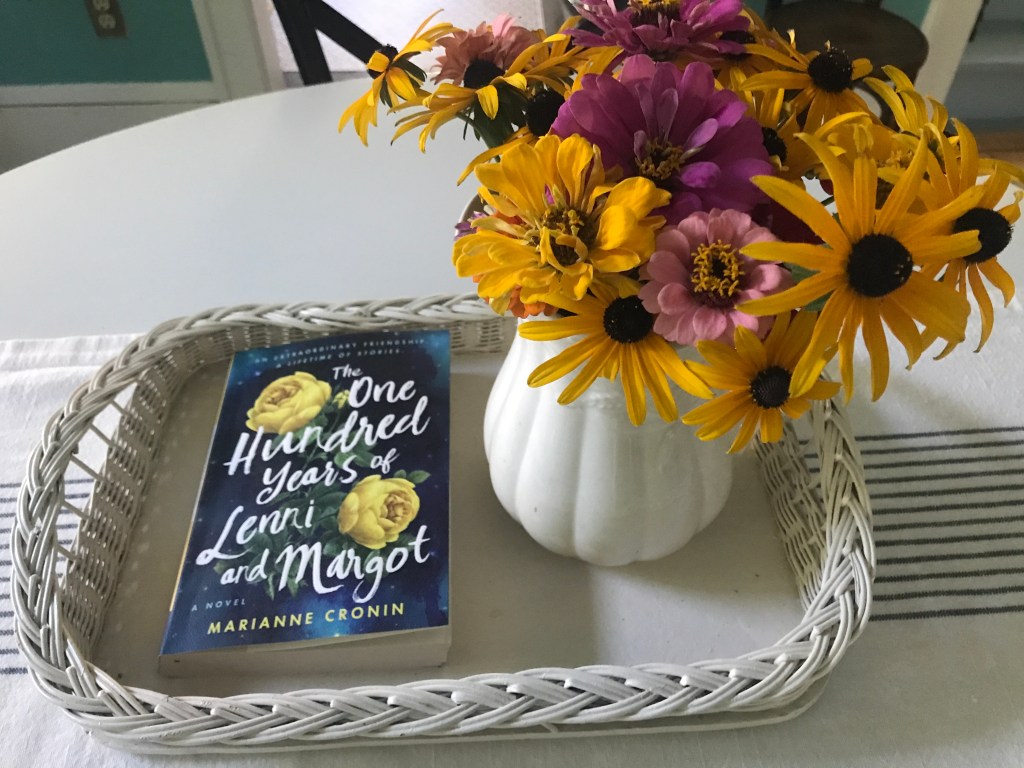
Some books simply feel like good companions, and The One Hundred Years of Lenni and Margot by Marianne Cronin is one of those books.

I’m not aware that “Good Companions” is an actual genre, but perhaps it should be. A good companion book, according to me is one that

  • Is easily put down and picked up.
  • Has likable, but not perfect characters.
  • Can be read on public transportation or a long plane trip.
  • Fills a lazy weekend or unplanned time.
  • Balances plot with character development, but is not overly descriptive.
  • Ends the way you thought it probably would, but still elicits an emotional connection.
  • Offers meaning or a slightly new perspective without being heavy-handed.

I think of good companion books as a kind of “palate cleanser.” A book to read after or before embarking on a bigger, more involved, maybe more serious book. Good companion books are not controversial and don’t include topics with the “ugh” factor, but instead are charming, endearing.

Now you may call that a “beach book” or a “summer read,” but I don’t think of a books having an appropriate season. Good companion books fit anytime of the year. And when you read the last page, you can honestly, say, “I’m so glad I read that.”

The setting of The One Hundred Years of Lenni and Margot is the Glasgow Princess Royal Hospital where seventeen-year-old Lenni lives on the Terminal Ward. Margot is eighty-three and has serious heart problems. When they meet in an arts and crafts class, they realize that between the two of them they have lived one hundred years and they decide to create one hundred paintings about their lives. They share their stories and along the way touch the lives of others, including the hospital chaplain, Father Arthur and New Nurse, who is never named, and even Paul the Porter. We learn of their pasts and we see them both grow into forgiveness and acceptance.

On the first couple pages Lenni describes herself as terminal and she compares that to airport terminals. She also thinks God is like ” a cosmic wishing well.” (p. 5)

I love this insight into the Lord’s Prayer:

There are some words in the Lord’s Prayer that I don’t know. But I do know the word art. It’s a necessary infusion, I think. We should all be artists. Especially if God is doing art in heaven; we should follow his example.

p. 248

This quote may sound as if the book is religious in nature. It’s not, but more spiritual perhaps. With a light touch. Who among us couldn’t benefit from a book that leans into forgiveness and acceptance.

  • Astrid and Veronica by Linda Olson
  • No Two Persons by Erica Bauermeister
  • Love and Saffron, A Novel of Friendship and Love by Kim Fay
  • Zorrie by Laird Hunt
  • Miss Benson’s Beetle by Rachel Joyce
  • A Single Rose by Muriel Barbery
  • The Reading List by Sara Nisha Adams
  • The Girl Who Reads on the Metro by Christine Feret
  • Meet Me at the Museum by Anne Youngson
  • Lessons from Yellowstone by Diane Smith
  • Three Things about Elsie by Joanna Cannon
  • My Mrs Brown by William Norwich
  • The Garden of Small Beginnings by Abbie Waxman
  • Like a Mule Bringing Ice Cream to the Sun by Sarah Lidipomanyika
  • One Night Two Souls Went Walking by Ellen Cooney
  • Perestroika in Paris by Jane Smiley
  • A Guide to the Birds of East Africa by Nicholas Drayson

Have you read any good companion books lately? I would love to know.

Book Report: August Round-Up

August 31, 2023

Susan Hill and I have been best buddies this August. Or should I say the characters in her Simon Serrailer mystery series? I read #4 through #8 this month, and 9, 10, and 11 are waiting for me on my TBR shelf. The next book in the series, #12, will be released in October, and I suspect I won’t be able to wait till it comes out in paperback a year later to read it.

What I find so intriguing about these Susan Hill books is that often the crime to be solved by police detective Simon Serrailer is not the most important plot thread in the book. The more important story may involve Simon’s sister Cat, a physician whose professional love is hospice work, and her family or may involve her stepmother and father or other characters we come to know throughout the series. The truth is that Simon can be quite infuriating, but each book reveals more about him, why he is the way he is. Hill is an excellent writer, and since a new Louise Penny does not appear to be imminent, I am thrilled I have more Hill books to read.

That reminds me I remember reading years ago a nonfiction book by Hill, Howard’s End is on the Landing, A Year of Reading from Home, which is about reading what she already owns, instead of making new purchases. She reads books she has never read but owned for years, as well as re-reads favorites. I remember being intrigued, but not enough to try it myself. Could I ever accept that challenge?

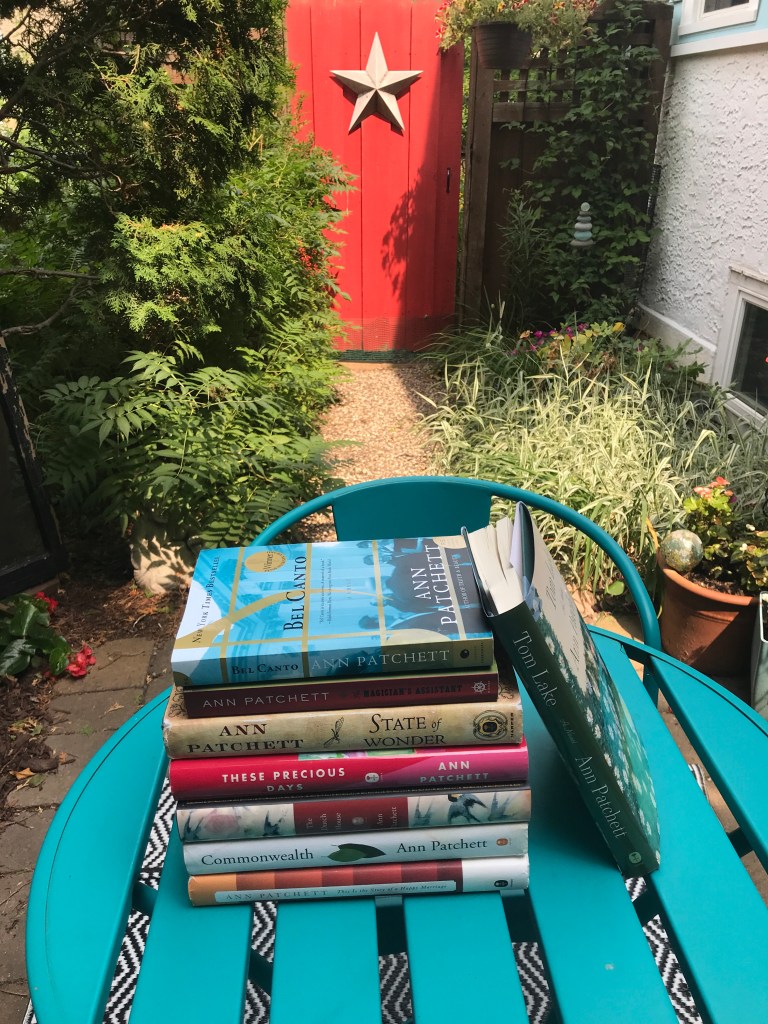
  • Tom Lake by Ann Patchett. I reviewed this book in my August 24th post. I loved this book. Sometimes I am surprised when not everyone loves a book I loved, but oh well. To each his own, right? I felt the same way when I declared undying love for Dutch House and others didn’t like it at all. I have not loved equally each of her books, but I am in awe of her writing skills and her ability to tell a story and create memorable characters. That is no small thing, and I will read anything she writes.
  • The Bookbinder by Pip Williams. Some of the characters in this book, which is set in the Oxford University Press in the early 1900s, were also in The Dictionary of Lost Words, a favorite book read in July. In this book Peggy and her twin sister work in the press’s bindery. Their mother had also worked there. Peggy yearns to go to university, but she’s “town, not gown,” and is responsible for the care of her mentally challenged sister. WWI refugees from Belgium figure in the story, too; a story that has lots of layers–class, war, women’s issues, plus insight into the physical making of books. A good read, indeed.
  • The Glass Hotel by Emily St James Mandel. No, this is not just about a Ponzi scheme or about an older man and his much younger “wife,” Vincent, who is named after Edna St Vincent Millay. Each character in this book, which reads easily and compellingly, is complex. These are people who are capable of being more than one persona. Are any of them likable? Not really, and yet I read on. Vincent says she lives in the “kingdom of money”–until she doesn’t. Another character comments towards the end, “We move through the world so lightly,” and yet the actions of Jonathan, the mastermind of the scheme and his minions certainly do not have light effects on others. Another line –“it’s possible to both know and not know something”–illustrates the power of denial and of not wanting to know. I have read both Station Eleven and Sea of Tranquility and was amazed by both of them–the depth and the quality of writing and the ability to engage–but in each case, as with The Glass Hotel, I have resisted reading them. Now why is that? I have not read Mandel’s earlier novels, Last Night in Montreal, The Singer’s Gun or The Lola Quartet, and I think I probably should. The Glass Hotel, by the way, was one of Barak Obama’s favorite books of 2020.
  • The Lost Journals of Sacajawea by Debra Magpie Earling. This was not an easy book to read because of the content, the language, and the culture of which I lack knowledge. Sacajawea is taken into slavery as a child by a white man. Eventually she has a baby, learns English, and while much is made of that in summaries of the book, it really doesn’t play much of a part in the book nor does the connection to Lewis and Clark. Rather, what is significant is the ongoing rape of Native women. The language is poetic and enthralling, but there is much I don’t understand. Is “Weta” God? Is “agai” the sun? I would have loved a glossary, but perhaps the reason for not providing one is to make me aware of what it is like to be forced into another culture.
  • Love and Saffron, A Novel of Friendship and Love by Kim Fay. I have always enjoyed epistolary books. The most notable is 84 Charing Cross Road by Helene Hanff but The Guernsey Literary and Potato Peel Pie Society by Mary Ann Shaffer and Annie Barrows is another favorite. Love and Saffron consists mainly of letters between Joan and her older friend Immy. Immy writes a column called “Letters from an Island,” and they begin corresponding because of their mutual love of food. Over time they develop a deep and meaningful friendship.
  • West with Giraffes by Lynda Rutledge. In 1938 two giraffes are driven across the United States to the San Diego Zoo, which at that time was headed by Belle Benchley, a historical figure–the first woman in that role. This was not an easy trip for many reasons, given the times, the end of the Depression, the overlap of the Dust Bowl, the limited views of women, and the undeveloped highway system. The main character, outside of the giraffes themselves, is Woody Nickel who is fleeing his own demons. A good story, but it could have been even better, I thought, with some additional editing.

I have made a dent on my TBR shelf, but danger lurks, for I recently learned about another new book store in our area, and it is important to support local independent bookstores. Plus, at the end of September we are going on a road trip that will take us to Nashville specifically to visit Ann Patchett’s bookstore. Stay tuned.

Anything stand out from your end of summer reading? I would love to know.

Book Report: Tom Lake by Ann Patchett

August 24, 2023

Sunday afternoon, a cool and pleasant day before the cover of heat returned once again, I sat outside and finished reading Tom Lake by Ann Patchett. I wanted to finish it, but that doesn’t mean I wanted it to end. The NYT review by Alexandra Jacobs felt understated and even at times a bit snarky calling Patchett, “Aunt Patchett,” “as always slyly needlepointing her own pillowcase mottos,” but I LOVED THIS BOOK.

I waited to read Tom Lake until I had conquered a couple major deadlines. In fact, I didn’t dare have it in the house until the retreat I facilitated was completed, and the article I had been asked to write was sent off to the editor. My weekend was spacious, and the time belonged to Patchett.

Have I said how much I LOVED THIS BOOK?

Tom Lake, by the way, is not a person, but the name of a lake in Michigan.

The story has two narratives. One narrative begins when the main character, high school student Lara, is cast as Emily in Thornton Wilder’s Our Town and then follows her acting career, which includes a movie in Hollywood. More importantly, Lara plays Emily again in a summer stock production of Our Town. During that summer she has an affair with another actor, Peter Duke.

The other narrative is set during the pandemic. Lara is married with three grown daughters, Emily, Maisie, and Nell, who return to their parents’ cherry farm in Michigan, and as they pick cherries, the women ask Lara to share the stories of her earlier life. She has much to tell, but chooses not to tell everything.

Sometimes following two time periods is confusing, but anyone who has read Patchett knows how expert she is at bringing the reader along with her, wherever she decides to go.

In an interview on PBS News Hour (Thursday, August 17) Patchett said the idea for the book grew from the play, Our Town, not with a character, and in the opening pages she refers to the feelings people in New Hampshire, which is where Our Town is set, have about the play.

We felt about the play the way other Americans felt about the Constitution or the “Star-Spangled Banner.”

p. 1

Rumor had it certain women wanted to play Emily forever. They criss-crossed New Hampshire town to town, year after year, trying to land the part.

p. 11

Many have said that Our Town is America’s most important play ever written, and it is always being performed somewhere. This spring our granddaughter Maren was in a senior thesis abbreviated production of the play at Lewis and Clark College in Portland, OR.

And this summer Bruce and I saw a production at the American Players Theater, Spring Green, WI.

Is there something about Our Town that we need right now? Wait a minute, am I reviewing Our Town or Tom Lake? Perhaps the two will always be linked in my heart and mind from now on.

Back to the book. Each character is so clear, so well-defined, but with their own obscurities. Each one of the daughters could become a book on their own, and yet they belong together–something the pandemic gave them another chance to experience.

They stack their dishes in the sink and head out the door together, Maisie holding the end of Emily’s braid the way one elephant will use its trunk to hold another elephant’s tail. Nell slips her finger through Maisie’s belt loop. Joe and I used to say that if lightning struck one of these girls all three would go up in flames.”

p. 91

This book would have been good, very good, without the context of the pandemic. No doubt Patchett would have found a way for her daughters to return to the farm for a chunk of time and no doubt there would have been reasons for such ongoing storytelling, but the pandemic becomes the open hands of the story.

I stay behind to make the lunch, which I should have been working on while I was talking all this time. The past need not be so all-encompassing that it renders us incapable of making egg salad. The past, were I to type it up, would look like a disaster, but regardless of how it ended we all had many good days. In that sense the past is much like the present because the present–this unparalleled disaster–is the happiest time of my life: Joe and I here on this farm, our three girls grown and gone and then returned, all of us working together to take the cherries off the trees. Ask that girl who left Tom Lake what she wanted out of life and she would never in a million years have said the Nelson farm in Traverse City, Michigan, but as it turned out, it was all she wanted.

p. 253.

The story continues to unfold to the last page, but it doesn’t feel like a great reveal–only the way life happens. Day by day. Year by year.

There is no explaining this simple truth about life: you will forget much of it. The painful things you were certain you’d never be able to let go. Now you’re not entirely sure when they happened, while the thrilling parts, the heart-stopping joys, splintered and scattered and became something else. Memories are then replaced by different joys and larger sorrows, and unbelievable, those things get knocked aside as well, until one morning you’re picking cherries with your three grown daughters and your husband goes by on the Gator and you are positive that this is all you’ve ever wanted in the world.

p. 116

One more thing: I made a crucial decision as I started reading the book. I decided not to underline sentences and paragraphs I loved, for I knew immediately, there would be so many. Instead I marked passages with a subtle light blue x in the margin, keeping the book a bit more pristine and fresh, like the daisies on the cover. (I didn’t understand the cover design choice, by the way until almost the end. Why weren’t there cherry trees on the cover I wondered. Trust me, there is a reason.)

May these days, as we move from late summer into fall, find you engrossed in just the right book.

Are you an Ann Patchett reader? What’s your favorite?

I enjoyed reading this interview with Patchett. https://www.shondaland.com/inspire/books/a44654107/tom-lake-is-a-meditation-on-a-love-that-could-never-be-family-and-the-quiet-beauty-of-our-town/

Women Who Dared to Write

August 17, 2023

I was an English major in college, graduated in 1970. For the most part the classes offered were well-taught and prepared me to for my life as a reader and as a high school English teacher. However, there was a major hole in the curriculum. No female writers.

Oh, maybe we read a few poems by Emily Dickinson or Elizabeth Barrett Browning, but in the American Novel class, during which we read and wrote a paper about a different book every week. We read Henry James and Nathaniel Hawthorne and even Philip Roth’s Goodbye Columbus, but no Willa Cather or Edith Wharton. In none of my classes was I introduced to George Eliot or Virginia Woolf. I do remember reading Jane Austen’s Sense and Sensibility in high school, but if I recall, it was not assigned. I chose to read it for an independent study.

After that steady diet of male authors, I decided during my years of young motherhood to read books mainly by women. I wish I still had my book lists from those years, but they are long gone. I do remember feeling I had been deprived of women’s voices for far too long, and I gobbled up book after book, broadening my own perspective and education.

As I started reading A Life of One’s Own, Nine Women Writers Begin Again by Joanna Biggs, I felt myself drawn into the world of women writers again; women who paved the way for women writers today.

Each chapter of A Life of One’s Own, which is a play on Virginia Woolf’s treatise, A Room of One’s Own, focuses on an important female writer: Mary Wollstonecraft, George Eliot, Zora Neale Hurston, Virginia Woolf, Simone de Beauvoir, Sylvia Plath, Toni Morrison, and Elena Ferrante. Joanna Biggs, newly divorced, turns to these writers, these women, and their books, for clues about how to live fully a life of freedom and intellectual fulfillment as a woman. The resulting book is a combination of memoir, literary criticism, and biography.

True confessions: I have not read Wollstonecraft’s A Vindication of the Rights of Women nor have I read deBeauvoir’s The Second Sex nor do I intend to do so at this stage of my life. I do feel more of a gap, knowing I have not read Eliot’s Middlemarch, and perhaps the next time I am allowed to take only one book with me for a week of confinement in a remote cabin, this will be the book. I do want to read it, but that means not reading a pile of other books. Another confession: I have only read the first book, My Brilliant Friend, in Elena Ferrante’s quartet, and it just didn’t grab me. Women friends who know me have expressed surprise that I didn’t love it, so what did I miss? This past weekend my husband and I stopped in a sweet little used bookstore when we were roaming, and I practically tripped over My Brilliant Friend. I took it as a sign, bought it, and added it to my TBR pile for another go. I will let you know.

I have read books by the other authors: The Bell Jar by Plath and some of her poetry; Their Eyes Were Watching God by Hurston, which I re-read in 2021; several books, The Bluest Eye, Sula, and Beloved by Morrison; and a number of Virginia Woolf books. In fact, I just read Monday or Tuesday, a slim volume of short stories or are they essays? The genre is not always clear and doesn’t need to be. My favorite in this book is “A Society,” about a group of women who created a “society for asking questions.”

One of us was to visit a man-of-war, another was to hide herself in a scholar’s study, another was to attend a meeting of business men; while all were to read books, look at pictures, go to concerts, keep our eyes open in the street, and ask questions perpetually. We were very young. You can judge of our simplicity when I tell you that before parting that night we agreed that the objects of life were to produce good people and good books. Our questions were to be directed to finding out how far these objects were now attained by men. We vowed solemnly that we would not bear a single child until we were satisfied.

p. 39-40

Decades ago I worked in an independent bookstore and I remember when three volumes of Woolf’s arrived —Mrs. Dalloway, A Room of One’s Own, and To The Lighthouse. By then I had read each of these books, but I had to own these lavender hardcover editions, each in their own slipcase. They never made it to the store’s bookshelves and remain treasures today in my personal library.

I was particularly taken by the chapter on Toni Morrison. Biggs says Morrison started writing “because she wanted something to read. What she wanted to read didn’t exist yet, so she wrote it.” I wonder if that isn’t true for each of the women writers profiled in Biggs’ book.

I also love this Morrison quote.

A grown-up–which I think is a good thing to be–is a person who does what she has to do without complaining, without pretending that it’s some enormous, heroic enterprise.”

p. 213

All in all, this was a pleasant read, a reminder of the gifts and legacy of women writers. I wish Biggs had written a final chapter focusing more on what she learned and discovered about herself as a woman, as a woman who writes. In addition, the subtitle of the book, Nine Women Writers Begin Again, doesn’t seem accurate. These women found ways to write, no matter what. They continued to write, rather than stopping and then beginning once again. And I am always intrigued by cover art. While this is a lovely painting called 2nd Street View by Lois Dodd, it didn’t feel evocative of the book’s theme and topics. I know–picky, picky, picky!

An Invitation

Are there any female writers who wrote in the past who you are just now discovering? I would love to know.

Book Report: July Round-Up

August 3, 2023

Before I share the highlights of my July books, I have a request. I am writing an article for BookWomen about keeping a book journal and TBR (To Be Read) lists. I would love to hear from you about the ways you keep track of what you read or want to read. OR if you don’t record your reading life, why not? Do you use Good Reads or another online method? Do you have a physical book dedicated to book lists? What else do you keep track of in your reading life? Number of pages read? A summary of each book read? Do you give books stars to evaluate what you’ve read? I would love to learn it all. Send me an email at nagneberg48@gmail.com and do it soon, please. I have an August 20th deadline, so I am working on this now. Thanks–and I hope to hear from you.

The shortest summary is to say –Lots of hot days created lots of reading time!

As noted in my post on July 13, I entered the month taking a time -out from other activities to read, read, read. The reading pace slowed down a bit the rest of the month, but I can easily report another good book month.

Beyond the books mentioned previously in my July posts, can I pick a favorite book of the month? Tough one. Here are two in contention:

  • The Female Persuasion by Meg Wolitzer. I was surprised I had not read this book in the past, for it is just my kind of book–strong female characters coming into their own. Faith Frank is an influential feminist and Greer hears her speak when she is in college, eventually going to work for Frank’s foundation. The side stories–Greer’s high school/college boyfriend Cory and her best friend, Lee–are all engrossing as well. A favorite line, although there were many.

You know, I sometimes think the most effective people in the world are introverts who taught themselves how to be extroverts.

p. 45
  • The Dictionary of Lost Words by Pip Williams. This intriguing novel is based on the true story about the creation of the Oxford English Dictionary in the early 20th century against the background of women’s suffrage in the UK and also WWI. The main character is Esme, whose father is a lexicographer, and she is present with him in the scriptorium from a very early age. She falls in love with words, especially the words discarded by the dictionary men. Those are the words used by women and by other classes. Esme goes on to create a dictionary of those lost words. I loved her personal story, too–how she surmounts a sad chapter in her life and is supported by women, including the servant Lizzy.

We can’t always make the choices we’d like, but we can try to make the best of what we must settle for. Take care not to dwell.

p. 200

By the time you read this, I will have finished a new book by Pip Williams, The Bookbinder. Set in the same time period and at the Oxford Press, it includes some of the characters from The Dictionary of Lost Words. I love this book, too.

I also loved Red at the Bone by Jacqueline Woodson, which I think pairs well with Maud Martha (See the July 27 post.). Each chapter is short with short, almost stand-alone paragraphs. One character is the focus of each chapter and is written in third person, but in such a way that it felt like first person. The story evolves from the birth of a child to a 16 year old couple, Iris and Aubrey. The three live with Iris’s parents until Iris leaves Brooklyn and goes to Oberlin College in Ohio. Set in contemporary times, but there is also reference to the Tulsa Massacre in 1921. I almost started re-reading this book when I finished the last page, for it was so beautifully written, and I would take more care reading it a second time with the readers’ guide questions in mind.

One of my purchases at Once Upon A Crime bookstore was the first book in the Vera Stanhope series by Ann Cleeves, The Crow Trap. (I like the Vera tv series.) I enjoyed the book, despite the fact that Vera doesn’t even appear until page 125, but the story is interesting and the ending, surprising. I may read more in the series eventually, but right now I am more intrigued with the Simon Serailler series by Susan Hill. I read #2, The Pure in Heart and #3, The Rock of Darkness and #4 and #5 are waiting for me on my TBR shelf.

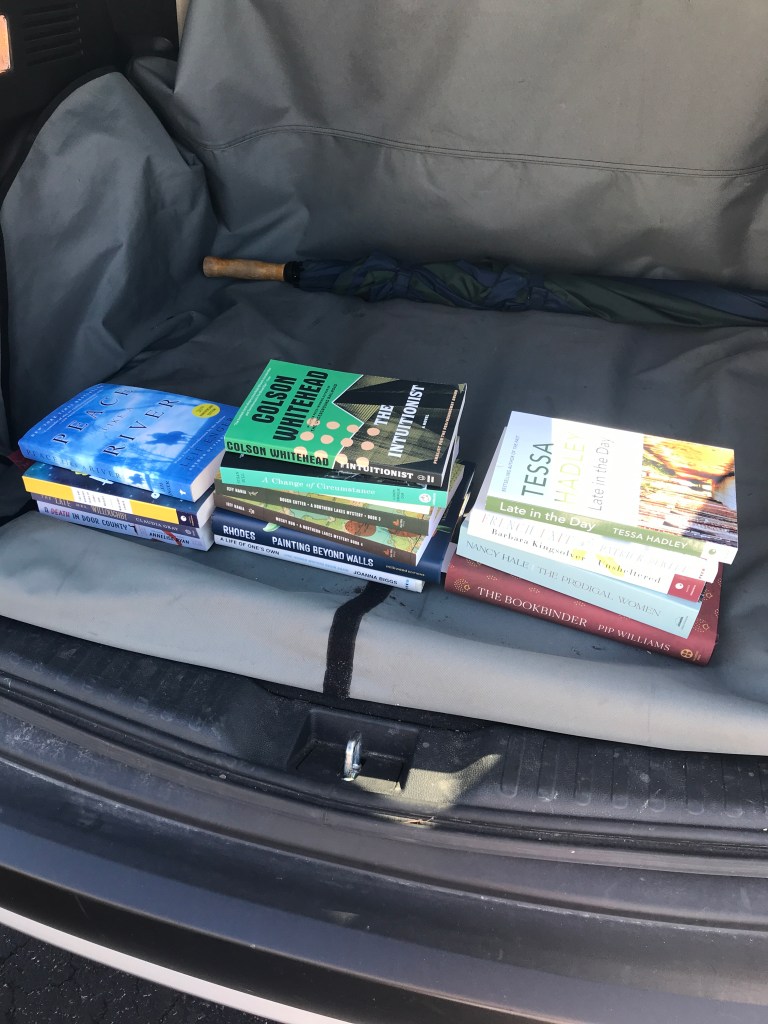
Our car could be labelled a “bookmobile.” This past weekend we visited two favorite bookstore: Arcadia Books in Spring Green, WI, and Mystery to Me in Madison, WI. I found several books on my TBR list:

  • A Change of Circumstance by Susan Hill
  • The Bookbinder by Pip WIlliams
  • The Prodigal Women by Nancy Hale (Arcadia recently did a review of the re-issue of this book published in the 40’s)
  • Unsheltered by Barbara Kingsolver (A book I have been wanting to re-read.)
  • French Exit by Patrick DeWitt
  • The One Hundred Years of Lenin and Margot by Marianne Cronin
  • A Life of One’s Own, 9 Women Writers Begin Again by Joanna Biggs

When I visit a destination bookstore, I also like to buy something not on my TBR list–a wild card. This time I bought Flatlands by Sue Hubbard and Late in the Day by Tessa Hadley.

Bruce did well, too, as you can see from the pile in the trunk.

Any wild cards in your reading life? I would love to know.

Book Report: Maud Martha by Gwendolyn Brooks

July 27, 2023

In 1972 or ’73 I taught an English class at Webster Groves High School called “The Outnumbered.” I assume I was assigned that class because I was the youngest, least experienced member of the English department, and the chairs of the department thought I might relate to the “nontraditional” content more than some of the other teachers. In reality I was a white privileged woman who had received a classical English education, but I dug in and was determined to teach “relevant” material to my integrated classes in that St Louis suburb.

I remember introducing this poem by Gwendolyn Brooks.

We real cool. We
Left school. We

Lurk late. We
Strike straight. We

Sing sin. We
Thin gin. We

Jazz June. We
Die soon. 


I wish I could remember if there was any discussion about the poem, but I imagine that some of my students who had escaped inner city life knew much more about the meaning of this poem than I did. Over the years I read other poems by Gwendolyn Brooks and her famous counterparts like Langston Hughes and later one of her students, Nikki Giovanni, and I remember reading her children’s book, Bronzeville Boys and Girls, but I remember the illustrations by Faith Ringgold more than the words. I knew she was famous and celebrated. In fact, she was the first Black woman to be given the Pulitzer Prize for Poetry (Annie Allen in 1950) and in 1985 she was the first Black woman to be named as the consultant in poetry to the Library of Congress (a role now known as poet laureate), and she was given the National Medal of the Arts in 1995. The list goes on….

Until recently, I had not read any of her novels, but a friend sent me Maud Martha (1953), a short book of only 180 pages, and I read it almost in one sitting–not just because it is short, but because the language, the rhythm of her sentences and the insights into the life of an African American woman in the ’50s was vivid, moving, and revealing.

But dandelions are what she chiefly saw. Yellow jewels for everyday, studding the patched green dress of her back yard. She liked their demure prettiness second to their everydayness; for in that latter quality she thought she saw a picture of herself, and it was comforting to find that what was common could also be a flower.

p. 2

My favorite chapter, perhaps, was”Kitchenette Folks,” which included descriptions of the people who lived in the building where Maud Martha, her husband Paul, and daughter Paulette lived. Marie “wore flimsy black nightgowns and bathed always once and sometimes twice a day in water generously treated with bath crystals…” or Clement Levy, a little boy. “Lewy life was not terrifically tossed. Saltless, rather. Or like an unmixed batter. Lumpy.”

There were also insights into black-white interactions.

Mrs Teenie Thompson. Fifty-three; and pepper whenever she talked of the North Shore people who had employed her as housemaid for ten years. ‘She went to hugging’ and kissin’ of me –course I got to receive it–I got to work for ’em. But they think they got me thinkin’ they love me. Then I’m supposed to kill my silly self slavin’ for ’em. To be worthy of their love. These old whi’ folks. They jive you, honey. Well, I jive ’em just like they jive me. They can’t beat me jivin’. They’ll have to jive much, to come anywhere near my mark in jivin’.’

p. 119

I know there is so much good contemporary fiction to read by persons of color, but consider spending time with a classic.

An Invitation

Have you read any “classics” recently? I would love to know.

A Request:

I am writing an article for one of my favorite publications about books and readers, BookWomen. http://www.bookwomen.net The topic is keeping a book journal and TBR lists. I would love to hear from any of you who keep lists of what you want to read and/or what you have read and any details about that process. Email me at nagneberg48@gmail.com

Book Report: Louise Penny and Susan Hill

July 20, 2023

For many years August was marked by the release of a new Louise Penny mystery. More recently, however, her new book was been published in the fall. This year? Does anyone know if a new Inspector Gamache will join the ranks of the previous 18 books? I have not seen or heard anything, and I started to panic that I may need to re-read them all again –for the third time.

Fortunately, I have a new plan. I will read all twelve of Susan Hill’s Simon Serraillier mysteries. Years ago I read The Various Haunts of Men, the first in the series probably about the time it was published in 2005 and before the second one was released. I remember enjoying it very much and am delighted to have rediscovered this series. And now there are twelve of them!

Last week I read #2, The Pure in Heart. I suspect I will want to re-read the first one, but this book does a good job of refreshing my memory about #1.

Simon Serraillier is a police detective in the English village of Lafferton. There is a charming map at the beginning of the book–that’s always a plus for me. Simon is on a vacation in Venice, however, at the beginning of this book. He has gone to relax and recover from the death of a colleague. Along with being a detective he is an artist and is preparing for an exhibition, which apparently happens in a future book.

He returns home when he learns that his younger sister, who has been severely handicapped since birth and resides in a care home, seems to be be dying. Soon after returning home a young boy in the village is kidnapped, and that serves as the main plot line.

The plot is important, of course, but I am intrigued by the characters, many of whom I assume will be continued presences in the next books. Simon has another sister, Cat, who is a physician and is pregnant with her third child, and a brother who lives in Australia. They are triplets. One of the side stories involves what Simon considers to be a casual relationship with an older woman, Diana, who wants the relationship to be more serious. And there is also his “sidekick” Nathan Coates–how important those sidekicks are in police procedurals.

I have been adding so many titles to my TBR lists in recent weeks, but they may each take a back seat to this series. The third one is called The Risk of Darkness. Excuse me while I make a trip to Half-Price Books in hopes of acquiring that one and any others in the series. Oh, and by the way, Susan Hill is more properly known as Dame Susan Elizabeth Hill. Lady Wells.

An Invitation

Do you enjoy reading series? Which ones have you loved? Are you waiting for the “next one” in a series? I would love to know.

Reading Days

July 13, 2023

Actually, to be accurate, one reading day became several reading DAYS.

Since we had no plans for the 4th of July or the weekend leading up to it and because it was so hot, I declared a time-out, and for me that always means reading time. My husband, who loves to read, too, posed no arguments, but he did suggest a field trip to mark the beginning of our reading days.

One year when our children were young and we couldn’t afford to go away on a vacation, we had a staycation. One of the days that week was B Day, which stood for “Bookstores, Bakeries and Batman.” (The first Batman movie had just been released.) We went to more than one bakery and more than one bookstore, where we each could choose a book –or was it two–and then we ended the day by going to the movie. A day we all remember fondly.

We decided to honor the last day of June and the entrance to July with a B Day with a slight modification. One bakery. One bookstore. And no Batman.

First Stop: A Bakery

We had a hard time choosing what to eat right then and what to bring home from this new french Vietnamese bakery. I guess we’ll have to go back.

Second Stop: A Bookstore.

A small, but oh so deliciously packed bookstore dedicated to mysteries and thrillers and true crime books. A little overwhelming, but I had my list, and Bruce was looking for more books by C. J. Box. We both left with a nice stack. I especially appreciated a section dedicated to books that are first in a series. I bought the first in the Vera Stanhope series and the first in the Shetland series, both by Ann Sleeves because we have enjoyed watching the BBC TV series over the years.

Along with the Ann Cleeves books, The Crow Trap and Raven Black, I bought:

  • Death at Darkening Mist by Iona Whishaw. This is #2 in the Lance Winslow series. I am willing to give this a try, even though I have not read #1. Lance Winslow is a former British Intelligence officer who yearns for a nice, quiet life, but alas, the body of a Russian man is found in the local hot springs and…
  • The Pure in Heart by Susan Hill, #2 in the Simon Serrailer series. Serrailer by the way, is described as a “dashing detective,” and that’s good enough for me. Years ago I read the first in the series, The Various Haunts of Man, and I remember so liking it, but nothing else about it. Perhaps I will need to re-read #1 before reading #2.
  • Murder Flies the Coop by Jessica Ellicott. a Beryl and Edwina Mystery–most certainly in the English cozy category. This was the wild card of the day, and I admit the pleasing cover influenced me, but doesn’t this description sounds fun: “One would hardly call them birds of a feather, but thrill-seeking American adventuress Beryl Helliwell and quietly reserved Brit Edwina Davenport do one thing very well together–solve murders…”

Third Stop: Back Home and My Favorite Reading Chairs

For the next few days–right through the 4th of July, I read and read and read. I didn’t read any of the recently purchased books from Once Upon a Crime, but instead selected from other books waiting for me on my TBR shelf.

  • Our Woman in Moscow by Beatriz Williams. First, I finished reading this book, which was my wild card selection from an earlier bookstore field trip, and I thoroughly enjoyed it. Williams writes historical fiction, and this book, set mainly during the Cold War, is inspired by the spy ring, known as the Cambridge Five. However, the main characters and the story that unfolds is fiction. In 1948 Iris Digby vanishes from her London home with her American diplomat husband and their two children. Several years later her twin sister receives a postcard from Iris expressing the need for help. And the plot thickens…
  • The Midnight Library by Matt Haig. This book has been on the bestseller list for such a long time and is now finally in paperback. A fantasy in which the main character, Nora seeks to end her life, but instead is given a chance to explore paths she could have taken. Each book in “the midnight library” offers the opportunity to undo regrets. This is a book to read in one sitting on a hot day, such as we just experienced, or on a cold blizzard day. Oh, my favorite chapter title is “If Something Happens to Me, I Want to Be There,” and I also like the term used throughout the book, one’s “root life.” Not a great book, but a pleasant diversion from whatever demands diversion.
  • The Stationery Shop by Marjan Kamala. This book showed me how timing is everything. I had checked this book out of the library when it was first released and quickly discarded it. I have no idea why, but I recently heard some reviews of this book and decided to give it a second chance. I am so glad I did, for I Ioved it. Set mainly in Tehran in 1953, a time of revolution, two young people meet in a stationery shop. Of course, they fall in love. And then there is a coup, and I don’t want to reveal anything more about the story, except that I cried two different times while reading it.
  • Sea of Tranquility by Emily St John Mandel. This woman can write! I loved Station Eleven, but for whatever reason put off reading this 2022 title. Yes, this is time travel, which normally doesn’t appeal to me, but this treatment is subtle and compelling. Set in four different time periods, early 1900s, 2020, 2203, and 2401, one of the characters is on a mission to uncover an event that crosses all of those years—without changing what happens in the future. A favorite quote:

“—and my point is, there’s always something. I think, as a species, we have a desire to believe that we’re living at the climax of the story. It’s a kind of narcissism. We want to believe that we’re uniquely important, that we’re living at the end of history, that now, after all these millennia of false alarms, now is finally the worst that it’s ever been, that finally we have reached the end of the world.”

  • Writing the Sacred Art, Beyond the Page to Spiritual Practice by Rami Shapiro and Adam Shapiro. I like to read a few pages in a book about writing before I work on an essay. I finished this book during the days of reading and noted material to adapt for the writing group I facilitate. The chapter, “Writing to Open the Mind,” was especially compelling.

So…five books in five days. My idea of heaven. Why not try a B Day or Days for yourself?

An Invitation

Have you ever given yourself a reading day or days? I would love to know.

Book Report: June Round-Up

June 29. 2023

NOTE: I am going to take a blog break next week. I will resume posting on July 11.

What is reading? Reading is…

…an activity whose value, while broadly proclaimed, is hard to specify. Is any other common human undertaking so riddled with contradiction? Reading is supposed to teach us who we are and help us forget ourselves, to enchant and disenchant, to make us more worldly, more introspective, more empathic and more intelligent. It’s a private, even intimate act, swathed in silence and solitude, and at the same time a social undertaking. It’s democratic and elitist, soothing and challenging, something we do for its own sake and as a means to various cultural, material and moral ends.

A. O. Scott in “The Reading Crisis,” New York Times Book Review, June 25, 2023

This month’s reading included many of the “shoulds” as listed in A. O. Scott’s essay, as well as the contradictions–reading as a private act, as well as a social undertaking. So here goes–a summary of June’s reading hours.

Fiction

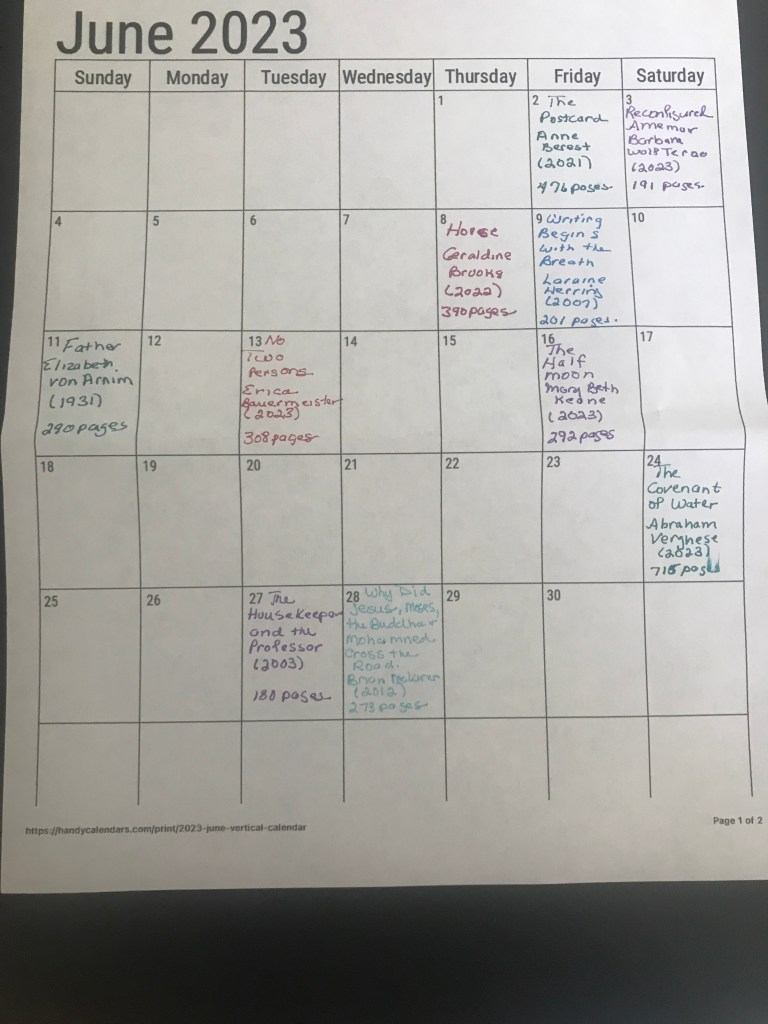
Earlier this month I wrote about The Postcard by Anne Berest and Father by Elizabeth Von Arnim and my appreciation for both, although wildly different books. (Posts on June 8 and June 15)

  • Horse by Geraldine Brooks. I always enjoy Brooks’ books, and this one was no exception, although the “horse world” doesn’t much interest me. However, with all her books, there is more than one layer. The book weaves the story about one particular horse, Lexington, a race horse at the end of the Civil War, with finding the skeleton of that horse over a hundred years later at the Smithsonian. On its own the story of the horse’s trainer/groom, a slave named Jarrett, was fascinating, but I also enjoyed the contemporary figures in the story–a graduate student in art history and a woman who works at the Smithsonian. The story is based in fact, and now the skeleton of the horse is on view at the horse museum in Kentucky.
  • No Two Persons by Erica Bauermeister. The epigraph for this book is “No two persons ever read the same book or see the same picture.” The Writings of Madame Swetchine, 1860. At times I thought the book was a bit contrived, but still I enjoyed the concept of the book. Alice has written a novel called Theo, and the rest of the book is about certain readers and how they related to it. The readers include the woman at a literary agency who “discovered” the book and passed the manuscript on to the agency’s owner; a teenage girl who is homeless; a movie intimacy consultant; and others. Two quotes I like:

The story on Alice’s computer screen had been finding its way into words for more than five years, or maybe forever. Over that time, it had grown, changed, creaked, flown, gone silent, and then gained its voice again, its plot taking unexpected paths, its characters turning into people she hadn’t thought they would be, just as she had. This glowing screen, the one constant. p. 5

Because if that wasn’t what art was all about, in the end, mentally shoplifting your way through the world around, the thoughts inside you. p. 105

  • The Half Moon by Mary Beth Keane. This is a portrait of a marriage in which each individual has a passion that threatens to destroy the marriage. Jess desperately wants a child and Malcolm wants to own the bar, The Half Moon, where he has worked for years. Their individual yearnings get in the way of being honest with each other. The ending was a bit too fantastic I thought, but I hurt for both of them and rooted for their marriage.
  • The Covenant of Water by Abraham Verghese. A BIG book. 715 pages. Usually when I read a book of this size, I want to be swept away by it, but that was not the case for me with this book. There were times when that happened–quite a few actually, but I was not enamored of all the medical references and descriptions. Others will be intrigued by them, I am sure. Also, the frequent use of Indian words in italics distracted me, although usually I was able to figure out the meaning from the context. (I am embarrassed by how privileged I sound!) That being said, I liked each of the characters and their stories, beginning with a 12 year old girl in 1900 who enters an arranged marriage in southwestern India. (That marriage does turn out to be happy, however.) The book ends in 1977 and along the way we meet many characters, many of whom are affected by a medical “condition.” Yes, there is sadness and even tragedy along the way, but these are good people attempting to live a good life. Ultimately, I liked this book, but I didn’t love it.
  • The Housekeeper and the Professor by Yoko Ogawa. Translated from the Japanese by Stephen Snyder. Who would have thought I would so enjoy a book that involves so much about mathematics and, as if that weren’t enough, baseball. The professor is a math genius who has a traumatic brain injury and only has 80 minutes of short term memory. That means his housekeeper and her 10 year old son, who spends time there each day after school, have to introduce themselves to him everyday. They form a family of sorts and each of them care and caretake in their own way.

The Professor loved prime numbers more than anything in the world. I’d been vaguely aware of their existence, but it never occurred to me that they could be the object of someone’s deepest affection. He was tender and attentive and respectful; by turns he would caress them or prostrate himself before them; he never strayed far from his prime numbers. Whether at his desk or at the dinner table, when he talked about numbers primes were most likely to make an appearance. At first, it was hard to see their appeal. They seemed so stubborn, resisting division by any number but one and themselves. Still, as we were swept up in the Professor’s enthusiasm, we gradually came to understand his devotion, and the primes began to seem more real, as though we could reach out and touch them. I’m sure they meant something different to each of us, but as soon as the Professor would mention prime numbers, we would look at each other with conspiratorial smiles. Just as the thought of a caramel can cause your mouth to water, the mere mention of prime numbers made us anxious to know more about their secrets.

pp. 60-61

Nonfiction

  • Reconfigured, A Memoir by Barbara Wolf Terao. I was asked to read an advanced copy of this book, which will be released on July 18. The book is about the author’s breast cancer journey in the context of an unhappy marriage. How important it is to be able to tell our story about traumatic times in our lives, and I admire the author’s ability to honestly wrestle with both the physical and the emotional challenges. I have read a few cancer memoirs, since experiencing cancer in my own life–over 20 years ago–as well as the lives of friends and family, and I think what we look for in these memoirs is a deeper understanding of why we responded the way we did and how we cope and if we are lucky, how we grow and change in life-affirming ways. This book explores how to have the “strength to be a survivor.” The author respond to people’s perception of her bravery in this way.

I would come to hear that phrase from many people over the course of my treatments, and it was never a comfort to me because I knew I was not brave. I was doing what I had to do to stay alive. Inside, I was kicking and screaming about this turn of events–and what I was required to do to my body. I wondered if people lauded my bravery as a way of distancing themselves from cancer and the fears conjured up by that word, and if so, I really didn’t blame them.

pp. 81-82
  • Writing Begins with the Breath, Embodying Your Authentic Voice by Laraine Herring. This book focuses on the writing of fiction, but there was lots applicable to the writing of nonfiction. I read a chapter each of my Writing Wednesdays and especially appreciated her chapters on a “deep writing process.” If I started including quotes in this post that resonated with me, I would have a very long post indeed. If you are a writer, add this title to your TBR list. She has also written The Writing Warrior, Discovering the Courage to Free Your True Voice. I have only read a few chapters in that book, but it is very good, too.
  • Why Did Jesus, Moses, the Buddha, and Mohammed Cross the Road? Christian identity in a Multi-Faith World by Brian D. McLaren. I am a big McLaren fan. He always makes me think and often gives voice to issues I have, but didn’t necessarily know I had. In this book he asks two key questions: Can you be a committed Christian without having to condemn or convert people of other faiths? and Is it possible to affirm other religious traditions without watering down your own? In his usual fashion, he writes in an accessible way, but each page also includes helpful and clarifying footnotes.

SO that was June and now it is on to July. I am planning to use some of my non writing time in the coming days to read–I hope on the patio and in my secret garden, “Paris.”

An Invitation

What did you read this last month? Any recommendations? I would love to know.

Book Report: Books and More

June 22 2023

Last week my husband and I roamed, and you know what that means–checking out bookstores and libraries. Our destination was Spooner and Hayward in Wisconsin’s lake country. For many years my parents owned a lake home on Teal Lake outside of Hayward, so when our children were young we made that trip many, many times–most every weekend in the summer. Lots of wonderful memories.

Going to the lake always included packing books. What might we want to read on the deck or the beach or the pontoon or in front of the fireplace? There was no time for reading on this recent day trip, but we did buy books to take back home with us.

Our first stop was Northwind Book and Fiber, and it almost could have been our last stop, for I kept finding books I just had to have. Only my husband tempting me with a donut from the bakery a couple doors away speeded up my selection process. This store carries a terrific selection of backlist titles, and I quickly decided not to buy any brand-new titles, but to look for some older ones on my TBR list. I did well! This bookstore is now one of my personal favorites.

I was especially pleased to find The Housekeeper and the Professor by Yoko Ogawa. I have had this on my “hold” list at the library for a LONG time, but someone keeps renewing or not returning the two copies. This book, by the way, is the last one I have left to read on my fiction 2022 TBR list. A bonus: the store owner said it is one of her all-time favorite books, and she always has a copy on the shelf. I suspect she has already placed an order for a replacement copy.

My WILD CARD selection is West With Giraffes by Lynda Rutledge. I know this has been recommended to me, but I had not added it to my TBR list–who knows why. Well, seeing it, reading the first couple pages, I knew I needed to add this to my stack.

I am embarrassed to say I have not read Emily St John Mandel’s acclaimed Sea of Tranquility. Not sure why, especially since I loved Station Eleven. My granddaughter is a big fan of Mandel’s and that’s reason enough to read more of Mandel’s work.

I’m a little concerned I have already read The Female Persuasion by Meg Wolitzer, for I have enjoyed other books by her. I don’t own it, however, and it is just one of those books that feels good to hold–chunky and inviting. It has occurred to me to read not only all of her books, but those by her mother, Hilma Wolitzer. Another enticing book project.

The other three books, Red at the Bone by Jacqueline Woodson, The Stationery Shop by Marjan Kamali, and The Dictionary of Lost Words by Pip Williams have all been recommended to me by more than one source. Yum!

And what did my husband buy?

  • Open Season by C.J. Box
  • A Double Death on the Block and A Small Death in the Great Glenn both by A.D. Scott
  • The Language of Trees, A Rewinding of Literature and Landscape by Katie Holton.

From Spooner we continued to Hayward, which was so packed with tourists, we decided not to linger, but instead drove further to a small little town called Cable. We remembered taking our kids to the charming little library there, and I was thrilled to see it was still there. Jammed with books–such a cozy place to browse and read.

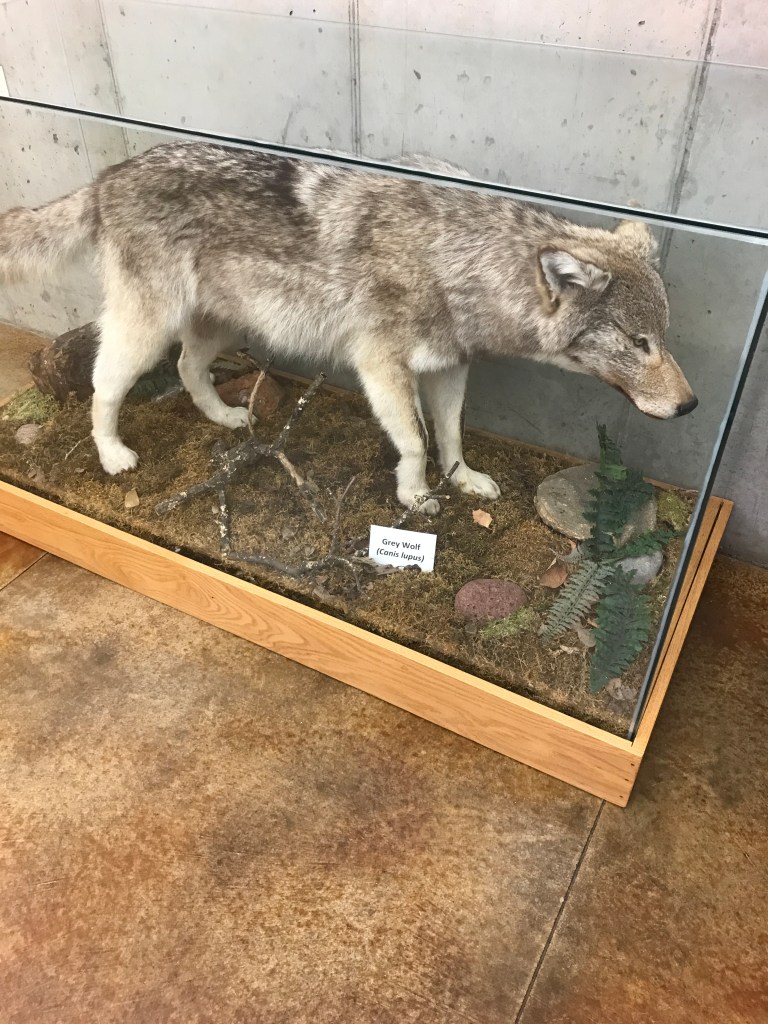
Part of the library at one time was a small natural history museum with scenes of flora and fauna. Now there is a big new natural history museum where I chatted briefly with my totem animal, canis lupus.

Cable also has a small independent bookstore, Redbery Books. Bruce bought Spider Lake, A Northern Lakes Mystery by a Wisconsin writer, Jeff Nania, but I was more restrained. For once.

Outside the library, by the way, is this sweet carving. The book the bear is reading is Where the Wild Things Are.

Not only do we use our plat map books when we roam, preferring back roads to the main ones suggested by Google maps, but we also consult the Midwest Indie BookStore Road Map. We wouldn’t want to miss any independent bookstore on our route!

Oh, and one more fun book treat. A friend who is a retired University of Minnesota librarian sent me this new version of Monopoly. How fun is this. I have printed the image for my book journal, and we’ll see how well I play in the coming months.

One last thing–I promise. What am I reading now? I have finally started reading The Covenant of Water by Abraham Verghese. I am surprised to say it is taking me some time to get into it, but maybe that is good or otherwise I wouldn’t be doing anything else. I will keep you informed about my progress.

An Invitation

Do you have any book related treats to report? I would love to know.

LINKS: https://www.northwindbook.com https://www.redberybooks.com