Two Novels by Indigenous Authors: The Council of Dolls by Mona Susan Power and Wandering Stars by Tommy Orange.

April 18, 2024

Both books are powerful.

Both books are beautifully written.

Both books are stories of generational trauma and intergenerational healing.

Both books offer windows into a culture that is being rediscovered and treasured.

Both books reveal injustice and yes, evil.

Both books reference the Carlisle Indian Boarding School.

Both books follow the lives of multiple generations.

Both books are about institutional violence and oppression.

A Council of Dolls by Mona Susan Power

Mona Susan Power is an enrolled member of the Standing Rock Sioux Tribe and currently lives in St Paul. Perhaps someday I’ll see her in one of our coffee shops or the grocery store, and if I do I will tell her how important her book is, and how I hope she continues to tell the stories. Following the great success of her first novel, The Grass Dancer, Power experienced deep depression and learned she was suffering from P. T. S. D., as well. How grateful I am that she has found resilient reserves within herself to continue her writing

I’m sorry I didn’t buy this book, rather than read a library copy. Maybe I will buy it now, so I can read it again and underline favorite passages. Power says she is an “intuitive writer,” meaning the story and the characters come to her. Maybe that’s why the human and the doll characters seems so real.

The story follows the lives of three generations of Dakota girls/women: Sissy (b. 1961), Lillian (b. 1925) and Cora (b. 1880s) and their dolls. It is up to the reader to decide if the dolls are real, spirits with powers to heal and save the girls from further tragedy or are the products of the girls’ imaginations. I must admit, although my growing up couldn’t be more different from these women, I thought about the dolls in my life as a young girl and how they often brought me comfort and gave me a sense of purpose even.

Favorite Passages

Cora telling about her father says,

My father says that we should welcome all stories to see if they are worth remembering. “You can put ideas on and off just like moccasins. You can wear them and set them aside, hold onto those you find meaningful. Don’t be afraid of learning something beyond what we’re able to teach you. Even the wisest person doesn’t know everything, But it’s also important to preserve the ideas that make sense to you, even in the face of resistance–someone telling you that you’re wrong and only they know the truth. Such boasting is evidence of a fool, perhaps a dangerous one.”

p. 141

A last word from the dolls:

We’ve learned that healing the present doesn’t only clear waters flowing into the future, recovery also flows backward and alleviates the suffering of ancestors. So they can set down their tears and dark memories, their guilt and shame, their vengeance. And because Time is our relative, a flexible being that moves through every thought and memory, branching into a million rivers of possibility, healing even one of its streams will eventually heal the world.

p. 286

Wandering Stars by Tommy Orange

I admit it took me longer to read this book than Council of Dolls, and I’m sorry I didn’t wait longer after finishing “Dolls” to read it. By the end I just wanted the painful stories of addiction and loss to end, but perhaps that is the point.

Tommy Orange is an enrolled member of the Cheyenne and Arapaho Tribes of Oklahoma who was born and raised in Oakland, California, and this book often references the challenges of finding and knowing other Indian people in that part of the country. Wandering Stars is both prequel and sequel to his earlier much acclaimed novel There There. I suggest reading There There first, but it isn’t necessary. I am grateful for the family tree at the beginning of the book and referred to it often.

The book follows the descendants of the 1864 Sand Creek Massacre, moving through the generations to the present day. The references to Richard Henry Pratt, who became the founder of the Carlisle Indian Boarding School, both the cause and the result of so much evil, are harrowing.

“Stars” refers both to the family descendants in the Bear Shield and Red Feather families, but also to one of the characters who is shot at a Pow Wow.

One of the doctors, who wore a faded-ass baseball cap with a fish on it he didn’t think the guy should have been wearing on the job, told him the bullet shard in him was shaped like a star, like that was some cool shit. Then the doctor told him he should be grateful that it stopped moving, that an exit wound could be what kills you. The doctor said they would keep an eye on it, the star shard, because, he warned, they’ve been known to wander, parts of them getting into your bloodstream and poisoning you. And then the doctor, still apparently trying to comfort him about the bullet staying in, said it wasn’t bullets that killed but the path they took, This seemed to him like some dumb-ass bumper-sticker wisdom, like: Guns don’t kill people, people kill people, or, The journey is the destination.

p. 119

There were so many times in the book I wanted to shout, “Don’t do it.” An indication of how well-drawn these characters are. And so many times I cheered for these characters, as they rose above addictions.

I felt good talking to my son and eating the bread I made there in our kitchen, on our land, in our home. I had a family now and the drinking was behind me. I’d lived enough life, almost died enough times to know when a good thing came along, a thing you didn’t know could fill you right up, which only when it filled you let you know there’s been a hole in you before.

p. 34-35

I initially went to using as a way to feel the world, when I’d learned somewhere along the way to numb it. But I wanted to feel the world without having to use, and not simply become obedient to the cold demands of a cruel world, or to an equally cruel addiction.

p. 304

Such good books. Heavy and meaningful. And now I’m ready for something lighter, but still well-written. Stay tuned.

What emotionally hard to read books have you read? I would love to know.

Book Report: One Hundred Saturdays, Stella Levi and the Search for a Lost World by Michael Frank

May 18, 2023

I waited for this book for a long time. The library only had two copies and the people who checked it out must have renewed it more than once and then not returned it on its final due date. Finally, I received the notice that it was my turn. I must admit I wondered if the wait would be worth it. It was.

Stella Levi grew up in the Jewish area called Juderia on the Aegean Island, Rhodes. That Jewish community had existed there for half a millennium until the Germans seized control of the island in September, 1943. The following July all 1650 residents were deported to Auschwitz. It was a mystery why, when Germany was so close to being defeated and the end of the war so near, they went to all this expense and effort, but that is the nature of war, I guess.

Stella survived and eventually immigrated to the U.S. As an elder she met Michael Frank who was interested in her story, and this book is the result of 100 Saturday visits over a period of six years. Frank listened, asked respectful questions, and over time she trusted him, and they developed a rich friendship.

I’ve read many books about WWII and the Holocaust, but in each one I learn something new and come just a bit closer to imagining the horror of that time, but there are also moments of rejoicing when people somehow live beyond the terror and the evil. Stella is one of those people.

“You have to remember that the first time I ever left Rhodes was when they took us to Athens and from Athens through Europe by train. I looked out the window, I watched the stations flash by: here was the continent I’d dreamt about for so long. And afterward…afterward in the camps themselves, we met the French women and Madame Katz and Paula, who were from Belgium. They spoke about Paris, Lyon, Brussels. They had actually seen and experienced, or were connected to, the places I had longed to know and to visit. They’d lived there. They were from there, of there…”

Under the unlikeliest of circumstances, the wider world came closer.

p. 68

“Very early on, almost from the beginning, something curious happened. I detached myself from the Stella who was in Auschwitz. It was if everything that was happening to her was happening to a different Stella. not the Stella I was, not the Stella from Rhodes, the Stella I knew. I watched this person, this other Stella, as she walked through this desert, but I was not this person.”

After a moment she adds, “There was no other way.”

p. 140

About Stella’s relationship with Frank:

“And then you came along and were curious. And patient with me, even though I wasn’t always so…so easy. And in speaking to you I have learned a good deal about myself. As I tell you my stories, I learn. One thing I learn is that there is no single truth; there is a changing truth…and you understand a good deal from going back, returning, and more than once, to what you thought you knew, and felt, and believed.”

p. 208

A bonus in this book is that it is illustrated by Maira Kalman who is the author and illustrator of over 30 books for adults and children, and her work is exhibited in museums around the world.

This is her portrait of Stella.

One of my favorite books she illustrated is the classic The Elements of Style by William Strunk, Jr and E. B. White. Her illustrations make grammar palatable.

Here are Strunk and White:

And here is Maira Kalman.

An Invitation

What books have you waited for? Have they fulfilled your expectations or been a disappointment? I would love to know.
Book Report: Things to Look Forward To, 52 Large and Small Joys for Today and Everyday by Sophie Blackall (2022)

August 11, 2022

Yes, I know how important it is to live in the present moment.

Breathe in and tell yourself that a new day has been offered to you, and you have to be here to live it.

You Are Here, Discovering the Magic of the Present Moment by Thich Nhat Hand

This gentle and charming book, Things To Look Forward To by author and illustrator Sophie Blackall is a doorway into remembering what brings us joy and the pleasures that sustain and guide us, even when the present moment is fraught with angst. This book is a guidebook for being in the present moment, even as we look ahead.

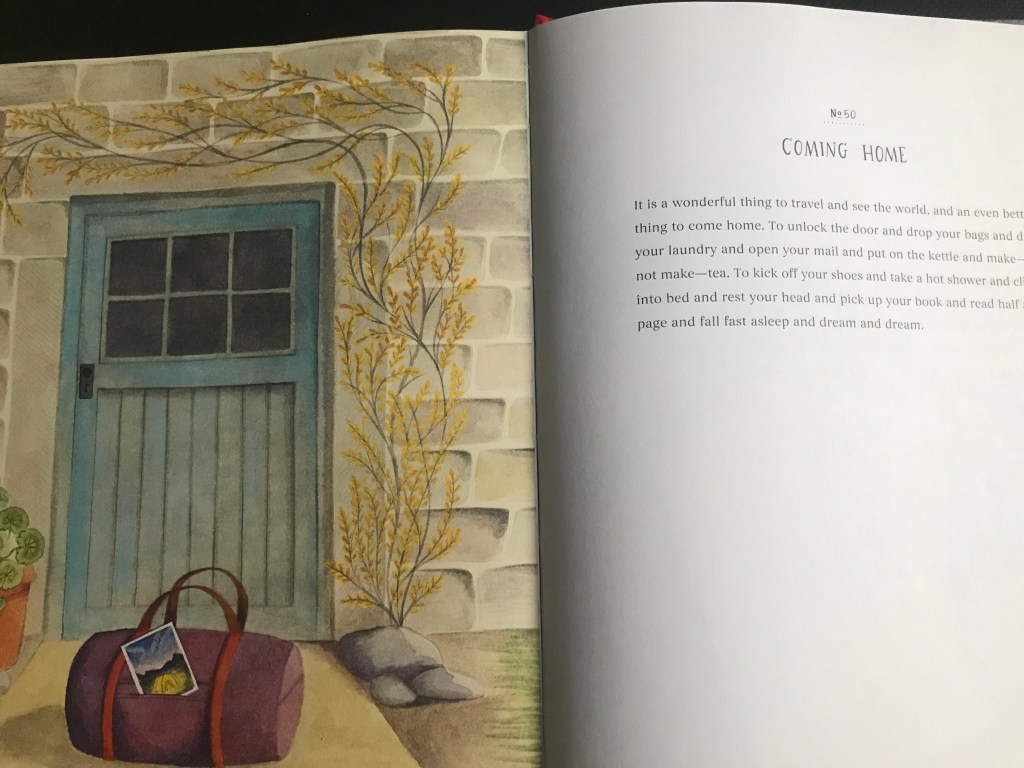
Some of what Blackall looks forward to are on my list, like “making lists” and “returning home,” and other items, like “rain” and “visiting a museum,” open me to greater appreciation and gratitude. Maybe that’s what this book is–a gratitude book for a life being lived.

Here’s my list, a list that keeps growing, and that is a good thing, I think.

  • Sunday morning church.
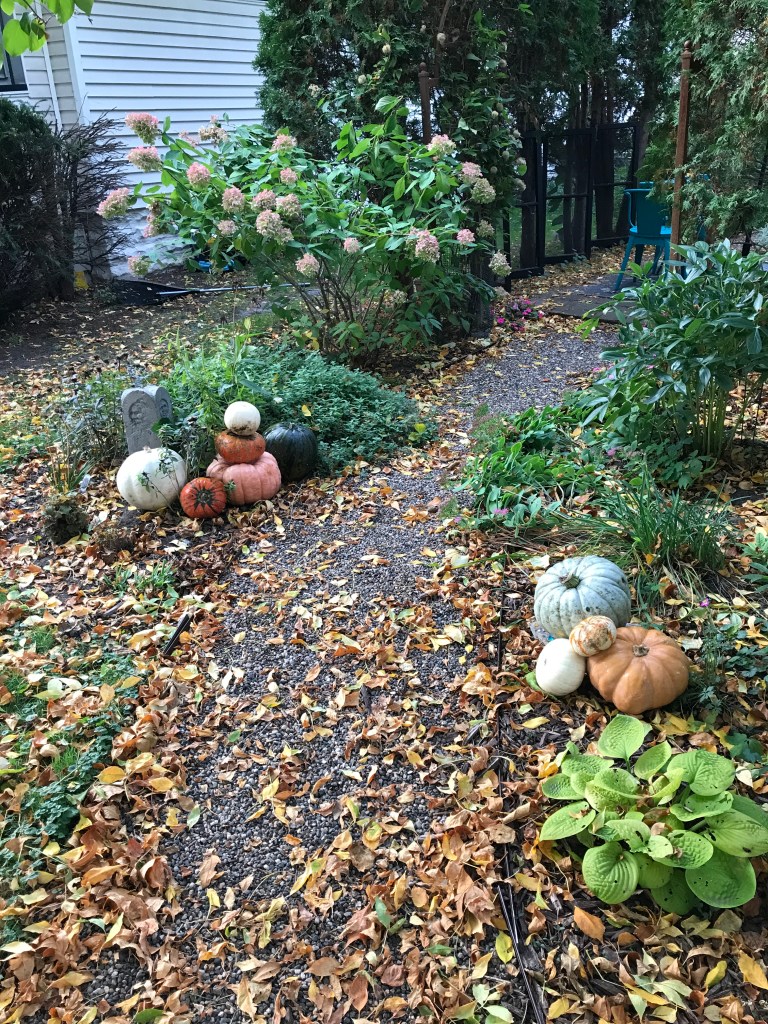
  • Fall: weather, food, clothes, pumpkins
  • Being with our kids and grandkids. Anytime. Anyplace.
  • Having written the first sentence or paragraph of a new writing project. The first is always the hardest.
  • Meeting with my spiritual directees.
  • Anticipating the next book to read. I love adding titles to my TBR (To Be Read) list and then checking them off as I read them. And what is better than getting an email from the library saying a book I have requested is now available!
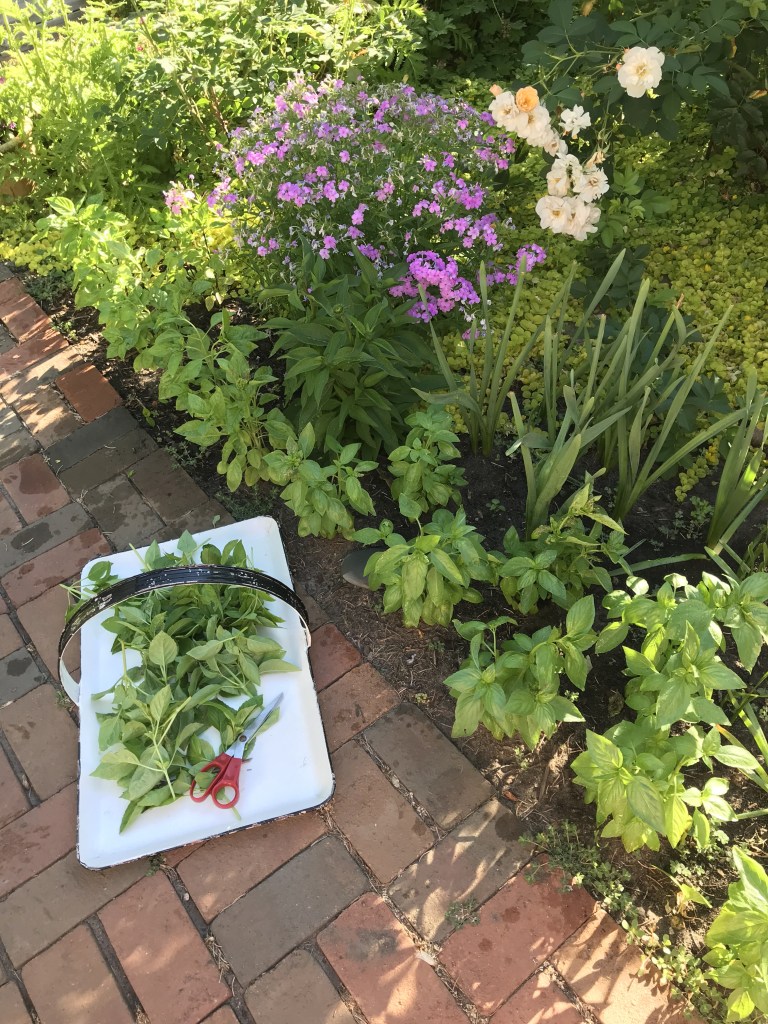
  • Making pesto with the basil from our garden.
  • A cold Diet Coke, especially from MacDonalds. (Remember, Blackall says the list contains both large and small joys)
  • One day road trips and counting eagles and hawks.
  • Cozy days in the snug.
  • The first trip in the morning to the garret.
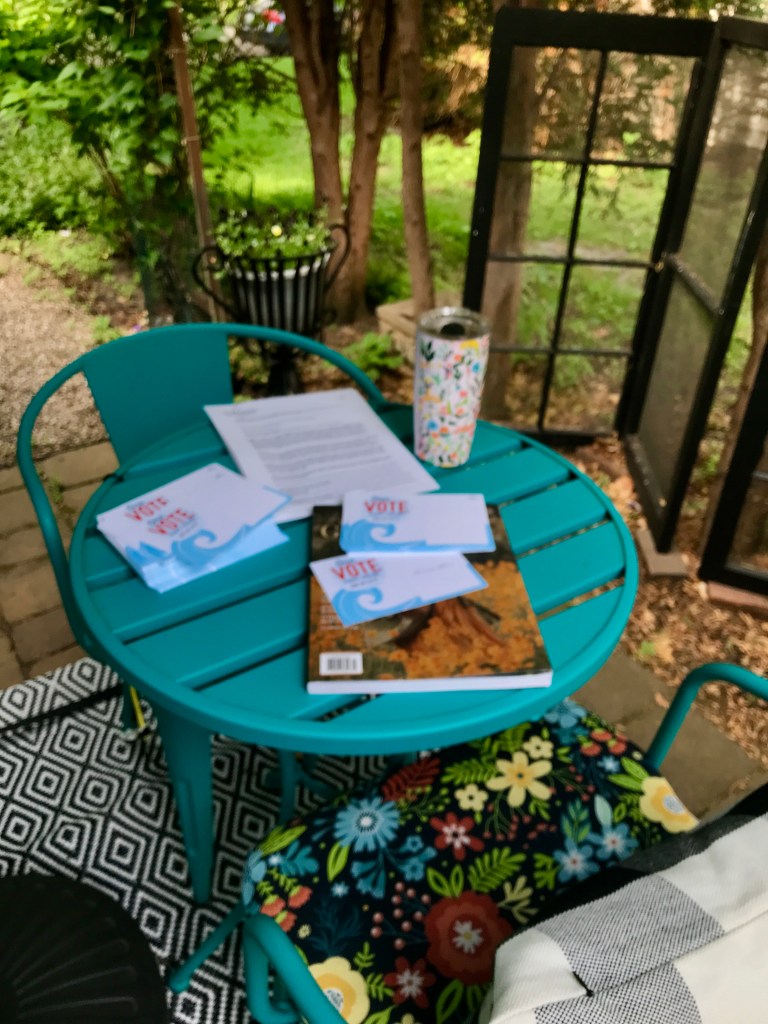
  • Perfect weather to sit in the side garden, I call Paris.
  • Shopping the house as I clean to create new vignettes.
  • Ironing. Pressing out the wrinkles.
  • Seeing a friend cross the threshold.
  • Morning Meditation Time, whether it is walking in the neighborhood or sitting in my Girlfriend Chair
  • Setting the table for a gathering and thinking about the love that will be present.
  • My husband filling vases with flowers from his glorious garden.
  • Going to a play or concert.
  • A good night’s sleep.
  • Unpacking. I don’t enjoy packing, but unpacking always feels like a new beginning.

Normally we say that the future is not here yet, but we can touch it right now by getting deeply in touch with the present moment. Because it is of an interbeing nature, the present cannot exist by itself. It interexists with the past and the future. It’s like a flower that cannot exist by itself: it has to interexist with the sun and the earth. This is true for time, too. The present is made up of material called the past and the future, and the past and future are here in what we call the present.

You are Here, Discovering the Magic of the Present Moment by Thich Nhat Hanh

Blackall’s list and my list are the result of past times, which we look forward to living again in the present. Past, present, and future are all one.

An Invitation

What’s on your “looking forward to list”? I would love to know.

Book Report: Beneficence by Meredith Hall (2020)

May 19, 2022

Goodness. The state of goodness. That’s what “beneficence” means, and this is what this book explores. “Love and all its costs.” (p. 251)

Doris, the mother of the family, opens the story, which is set on a farm in 1947, with these words:

Every morning, early, when Tup and I get up to start our chores, the whole house still quiet and the children asleep I turn and pull the bed together, tugging at the sheets to make them tight and smooth. They are warm with our heat. I slide my hand across the place my husband slept, drawing the blankets up and closing in the warmth, like a memory of us, until night comes when we will lie down together again.

p. 5

A simple scene, but so evocative and so full. Of love and promise and commitment. Making the bed is a spiritual practice for Doris and also an expression of the dailiness and the goodness of her life.

Only a couple paragraphs later, however, Doris says, “You cannot know what will come.” She alerts the reader that this is no simple pastoral account of life on a farm, but this is a tale of what any family encounters one way or another. The love and the loss and the complicated responses to that loss.

It has been a long time since I have read a book that made me cry. This one did. More than once, and more than once I re-read paragraphs and even entire chapters, relishing the writing, but I also wanted to stay with these good, but imperfect people and to support them and honor them. They became real to me. In part that happens because the narration of the story changes in each chapter. Sometimes the father, Tup, is the narrator and sometimes the daughter, Dodie. There are two sons in the family, also, Sonny and Beston.

Almost at the end of the book, now 1965, Doris’s words echo the book’s beginnings.

The cows slept with their calves in the safety of the barn. The night offered all its promise. Tup and I moved to each other, our heat and our weight and our devotion. We slept without guard. There is never a going back. What we say and what we do stays, always. The great price of love and attachment is loss, with us every day. But here, too, each day, are their great easings.

p. 257

I do hope Meredith Hall has another novel in progress. In the meantime I plan to read her memoir, Without a Map. And, I suspect, I will re-read Beneficence again for this book is good. Very good.

An Invitation

Have you read anything recently that made you cry? Or what about a book that you know you will want to read again? I would love to know.

Book Report: On Juneteenth by Annette Gordon-Reed and My Thoughts About Retirement Reading

NOTE: I am going to take a brief break from the blog. My plan is to begin posting again the week of May 9.

First, the weekly book report: On Juneteenth by Annette Gordon-Reed.

Part memoir, part history, part psychoanalysis of Texas, this slim volume enlightens the movement to make June 19, Juneteenth, a national holiday. On June 19th, 1865, in Galveston, Texas, the end of legalized slavery was announced–two years after The Emancipation Proclamation and two months after Robert E. Lee surrendered to Ulysses S. Grant.

Gordon-Reed grew up in Texas and in fact, she was the first Black child to attend an all- white school in her hometown, Conroe, Texas. Her story is compelling and offered me several new perspectives. For example, the Black high school near her home was Booker T. Washington High School, usually referred to in the community as “Booker T,” but when people outside the community called it Washington High School and assumed it was named for “George”

Another new thought: Gordon-Reed writes about the effect of integration on Black teachers. “The children were to be integrated, not the teaching staff…People who had been figures of authority were put in charge of dispensing books and doing other administrative tasks that took them away from contact with Black students, depriving those students of daily role models.” p. 51. Think of the longterm effects of that practice.

My family lived in Texas for two years, when I was in junior high school. My father was transferred there from New York and then transferred back to New York. During our brief time there I acquired a Texas accent and learned to address my teachers as “Sir” and “Ma’am”–both habits I lost quickly when we returned to Long Island. What I didn’t acquire was much real knowledge about Texas. I learned about the six flags that flew over Texas and about the Alamo and all the reasons Texas was great. I didn’t learn anything about the history of slavery in Texas.

When slavery in Texas was mentioned, it was presented as an unfortunate event that was to be acknowledged but quickly passed over. There was no sense of the institution’s centrality. Slavery was done. There was no point in dwelling on the past. Texas was all about the future, about what came next–the next cattle drive, the next oil well. the next space flight directed by NASA’s Mission Control in Houston.

pp. 27-28

In steps the historian. And we continue to learn and to gain insight about the implications of the past and what needs to happen now.

Now for Thoughts about Reading and Retirement.

After reading On Juneteenth, which I got at the library, I realized I have yet to read Gordon-Reed’s Pulitzer Prize and National Book Award winning book The Hemingses of Monticello, An American Family (2008). Don’t scold me. Periodically, I take the book from the shelf of other miscellaneous, yet to be read nonfiction books and ask myself if this is the time. It’s a BIG BOOK, and I know when I read it, I will want to focus and fully immerse myself in it.

It’s the kind of book I think I will want to read when I retire, but I’m not planning to retire anytime soon.

Now here’s a confession. Sometimes when many around me tell me I must read a certain book OR when I hear or read too many reviews about a book, I lose interest in reading the book myself. Because of that, I know I have missed reading many books I would have loved. But it is not too late. There is always retirement whenever that happens or whenever the time is right for that specific book.

In the meantime I daydream about other books on my shelves I want to re-read or read for the first time.

An Invitation:

What books do you daydream about reading? What books did you miss when they were first published but interest you now? I would love to know.

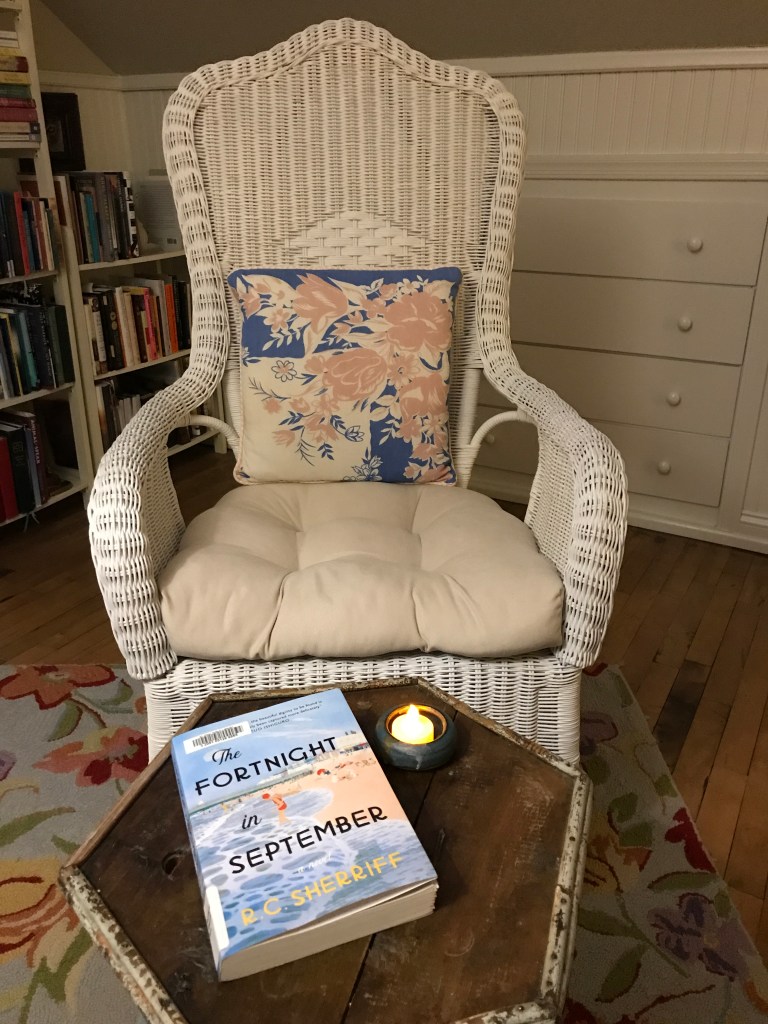
Book Report: The Fortnight in September by R.C. Sherriff

I love books in which nothing much happens. I know I am not the only one or otherwise Virginia Woolf’s Mrs Dalloway and To The Lighthouse, originally published in the 1920’s, would not be loved and absorbed to this day. In fact, I am tempted, after reading The Fortnight in September by R. C. Sherriff to re-read Woolf’s classics.

Back to today’s book.

The Fortnight in September, originally published in 1931 and recently re-issued, is the story of a London family, the Stevens, and the two weeks of their annual holiday in the seaside resort town, Bagnor Regis. We experience them as they prepare for the trip; embark on the journey via trains, of course; their stay at Seaview which over the years has become quite shabby, but they are loyal to the owner, Mrs Huggett; and then as they head back home to the routine of the rest of the year.

Nothing much happens, but in a way that is the point. The family consists of Mr and Mrs Stevens (we never learn their first names) and their children, Dick, age 17 who is somewhat unsatisfied with his work; Mary, age 21 who has a first glimpse of romance while on holiday; and Ernie, still a schoolboy who happily sails his toy yacht, which he almost forgot to bring with him. We experience their days–cricket on the beach, walks on the promenade in the evening, tea time, and it is all quite magical, an escape from the everyday, a satisfaction with another kind of routine.

In fact, the family is quite unsure of itself when unexpectedly they meet a man who is an important customer where Mr. Stevens works. This man invites them to his home for tea and while it is a bit of an adventure, something different, in some ways they would have preferred to have their usual kind of day.

Does that sound dull? I was never bored and in part that speaks to the quality of the writing. Often the writing style of books that rely on creating a certain atmosphere is lush and overdone, but the writing here is delicate, even though the descriptions are clear and complete. I can turn to most any page and find a passage that immerses me in the time and place.

For Mr. Stevens always put down the train journey as a doubtful quantity in the sum of happiness. Even under the worst conditions you might conjure up a faint sense of exhilaration in racing through the country toward the sea, but when anything happened like this: when suddenly your limbs are freed from the aching pressure of other people’s hips and elbows: when luxurious spaces of empty seat lie around you for the spreading of your magazines and papers, and arms and legs—only then can you triumphantly sweep the doubt aside. (p. 86)

The Stevenses settled themselves with half-closed eyes: the sea was lapping drowsily against the wall, and the soft breeze turned its gentle murmur into the rustling of distant elms. They could hear the evening train puffing out from the station, the murmur of voices on the promenade, and the padding of feet–but the music of the band seemed to gather these other sounds and weave them into its symphony. p. 173

The Stevens create routine away from routine, and they rest and quietly rejoice in it. The holiday feels less like escape from what might be unpleasant in their lives, although we readers don’t have much of a sense about that, and more about how the two weeks are part of the routine of their lives. This is what they do every year and this is what is part of who they are and how they live.

I think about my family when I was growing up and how we would go to the same family-run resort in northern Minnesota. How exciting it was when we extended our vacation from one week to two weeks, indicating a growth of income.

We definitely had routines. The Stevens had a trunk. We had a Lake Box with beach towels and the blanket to spread on the grass by the lake and a pin-up lamp to hang on the screen porch and–I wish I could remember what else was in the box. Year after year we did the same thing. I walked to town in the morning for the newspaper for my parents and for rolls or doughnuts for breakfast. We spent the afternoon on the beach most days, but also one day went to Bambiland to feed the deer. One evening we had dinner at Lumbertown, a real treat. I read book after book, only breaking the pace to go for an occasional swim.

Nothing much happened and we loved it and were grateful for it.

At some point life will more than likely change for the Stevens, as it did for my family. Mary will marry and form her own family routine. Mrs Stevens, perhaps, will become ill and not be able to make the journey. Mrs Huggett may die and the Seaview will be sold or torn down. But for the moment this is life as they desire it to be, and while they don’t take it for granted, they don’t hold it too tightly either.

In this Advent season of lists and preparations, this book was a gentle time-out, and I loved it.

An Invitation: What is most important to you in a book? Plot? Character? Setting? Theme? I would love to know.