Book Report: Banned Books

January 28, 2024

BANNED! One of my favorite books is on the banned book list in Orange County, Florida, along with another favorite Ann Patchett book, Patron Saint of Liars. You can see Ann Patchett’s response here. https://www.instagram.com/reel/C1ryx_DLK7C/?utm_campaign=wp_book_club&utm_medium=email&utm_source=ig_web_button_share_sheet&wpisrc=nl_books

Escombia County, Florida, went even further. Their new list of BANNED books includes:

  • Wuthering Heights by Emily Bronte. BANNED!
  • Death on the Nile by Agatha Christie. BANNED!
  • A Tale of Two Cities by Charles Dickens. BANNED!
  • For Whom the Bell Tolls by Ernest Hemingway. BANNED!
  • The Adventures of Tom Sawyer by Mark Twain. BANNED!
  • Dr. Zhivago by Boris Pasternak. BANNED!

You might as well ban English teachers and classes.

Oh, also on the BANNED list is Middlesex by Jeffrey Eugenides, but that’s obvious, isn’t it? With SEX in the title. And there are the usual suspects, books by Toni Morrison, May Angelou, and Margaret Atwood. But the list also includes National Geographic Society’s Human Body Systems. Heaven forbid that young people learn about their own bodies. And five dictionaries and The Guiness Book of World Records. Huh?

These campaigns, of course, are not about books. They are about control and fear. What to do? Well, one thing is to encourage the young people in your life to read, to be curious and explore the wonders of books, and to talk with them about what they are learning and discovering. And to share your thoughts about banning books.

The New York Times Book Review, Sunday, January 14, published an essay about a new phenomenon called “Reading Rhythms.” Not a book club, but “a reading party.” People gather to read –whatever they are reading at the moment–and then after an hour or so they talk about what they are reading.

I’ve long believed that gathering in groups to meditate together or to write together opens a different kind of energy from doing those activities alone. But I had not considered the power of reading in groups, although I love the calm and pleasure of sitting in the same room with loved ones when we are each reading, but what an interesting idea to do that intentionally with a group of strangers or to invite friends over to read and then talk. A cozy winter activity, but I also imagine doing this outside in the summer sitting on the shore of a favorite lake.

Stay tuned–an invitation may be forthcoming.

What’s your favorite BANNED book? I would love to know.

Read the full article about this new list of BANNED books in the Washington Post Book Club newsletter by Ron Charles. https://s2.washingtonpost.com/camp-rw/?trackId=596b1081ade4e24119acf1e6&s=65a1547e22c7b80f14d01ca7&linknum=2&linktot=90&linknum=2&linktot=90
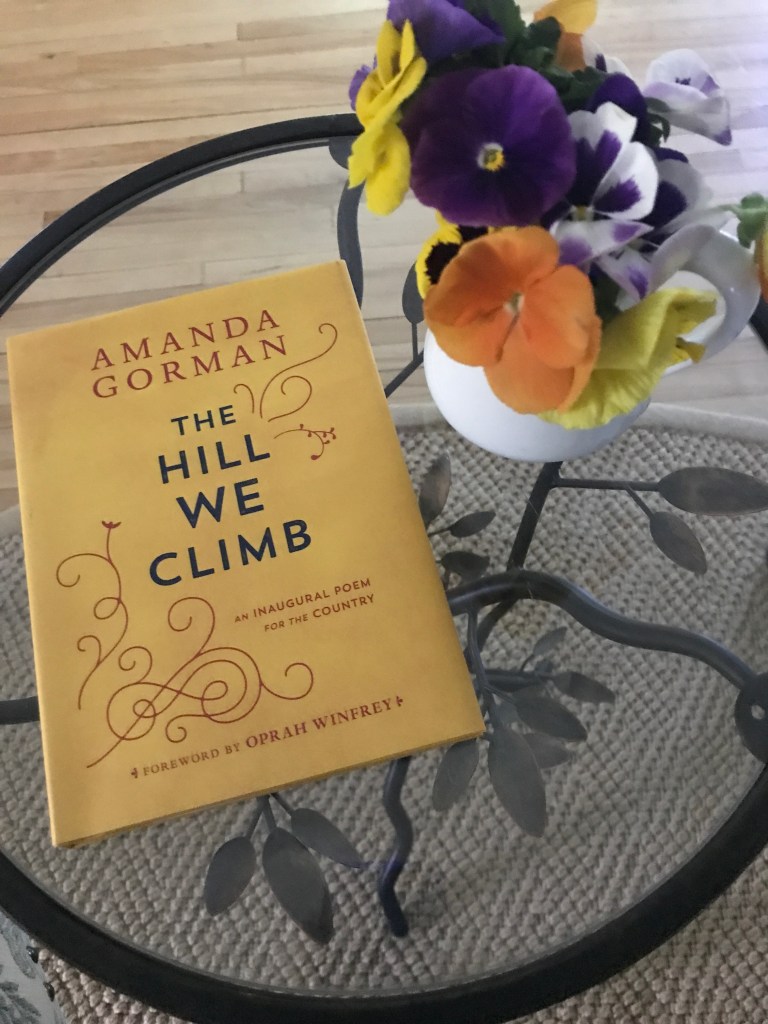
Re-reading Amanda Gorman’s “The Hill We Climb”

May 30, 2023

My mouth dropped open when I heard the reports about Amanda Gorman’s poem, “The Hill We Climb,” being removed from shelves in the elementary school section of the library in a K-8 Florida school. One parent said the poem included “hate messages” that served to “cause confusion and indoctrinate students.” The objection to the book did not include examples from the poem to support the parent’s argument.

I always wonder when I hear about yet another book being banned (or in this case, the school argues, it was not banned, but rather, “moved.”) if those who are so concerned about a specific book have actually read the book. In this case I also wondered if they had seen Amanda Gorman read her poem at President Biden’s inauguration–days after the January 6 attack on the Capitol.

When I heard the reports about the attack on her poem, I remembered how striking this young woman appeared in her tailored yellow coat, a column of gold, standing and speaking confidently as our country’s leaders sat behind her listening intently. I remember the beauty of her hands –motioning not in accusation, but beckoning all of us to climb the hill of justice, the people we have always said we want to be. I’m afraid I don’t remember what Biden said in his speech, although I remember thinking, “Good job. This is a good start.” But I do remember, however, Gorman’s play on words: “‘just is’ isn’t always justice.”

I don’t remember words of hate.

I don’t remember thinking “Oh dear, this could be really confusing for young children to read or hear.”

But then again I am an old woman and I forget where I put my phone and just this morning I misplaced a favorite pen, so perhaps I needed to read “The Hill We Climb” again. I had purchased a copy of the poem, with its Forward by Oprah Winfrey –the complainant said Winfrey was the author–as soon as the book was published.

I read the whole poem aloud. And then I read it again, pausing often, asking myself, “Is this phrase full of hate?”

Somehow, we've weathered and witnessed
A nation that isn't broken, but simply 
    unfinished
...
To compose a country committed
To all cultures, colors, characters,
And conditions of man.
And so we lift our gazes not
To what stands between us,
But what stands before us.
We close the divide,
Because we know to put
Our future first, we must first
Put our differences aside.
...
We seek harm to none, and harmony for all.
...
We will rebuild, reconcile, and recover,
In every known nook of our nation,
In every corner called our country,
Our people, diverse and dutiful.
We'll emerge, battered, but beautiful.
...

I found no hate. I found hope wound in an out of the hard work required of us all.

In a way I am glad this decision by a Florida school has come to our attention, for it highlights the gift of Gorman’s words. Jo Harjo, the twenty-third Poet Laureate of the United States, in her book Catching the Light refers to poets when she writes, “As scribes of our generation, we are called to remember what matters.” (p. 39) She also says every poem is a prayer, and Gorman led us in prayer.

I found no hate.

One more note. I believe children generally know what they can handle, what they are ready to read–and it is usually more than what we give them credit for. People who want material removed from libraries or classrooms often do that, they claim, in order to protect their children from things they aren’t old enough to understand, from what might be confusing or might influence them in an unhealthy way. I am more inclined to believe that those parents are protecting themselves from the need to explore hard questions with their children and from confronting their own contradictions and fears. I wonder if they aren’t afraid they might not really believe what they say they believe if they open themselves to a different vision.

The new dawn blooms as we free it,
For there is always light,
If only we're brave enough to see it,
If only we're brave enough to be it.

An Invitation

Can you recall a time when a book led to a serious or deep conversation with a child? I would love to know.

Amnda Gorman reciting her poem at Biden Inauguration: https://www.youtube.com/watch?v=LZ055ilIiN4