Book Report: Two New Novels For Your Summer Reading

July 11, 2024

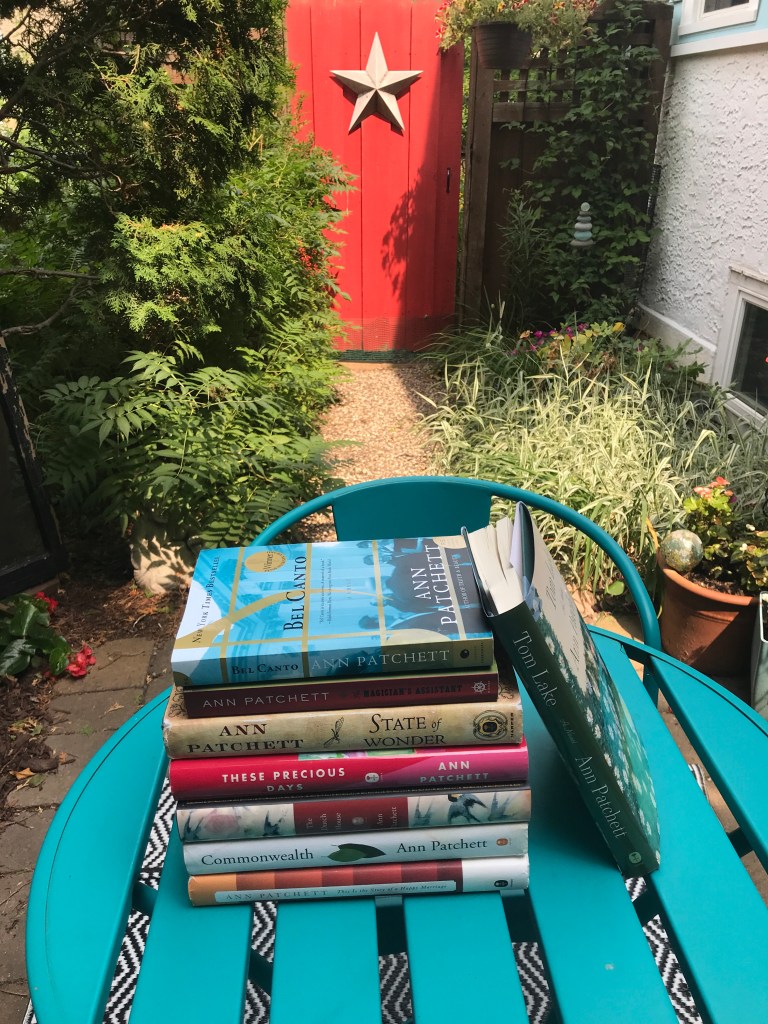
The 4th of July holiday week was quiet at our house, and you can guess what I did! I enjoyed the spaciousness of the days with a book on my lap. I moved from the snug to the patio to the comfortable chair with an ottoman in the entryway to the side garden we call “Paris,” and I read. My kind of holiday.

I LOVED this book, and so did Ann Patchett. I will read almost anything she recommends.

Sandwich is joy in book form. I laughed continuously, except for the parts that made me cry. Catherine Newman does a miraculous job reminding us of all the wonder there is to be found in life.

Every year for the past two decades Rocky and her family spend a week at a modest beach rental in Cape Cod. This year is no exception, but this year Rocky’s husband Nick and their two adult children, Willa and Jamie are joined by Jamie’s girlfriend Maya and also for a couple days by her aging parents. (Why is it parents of middle aged children are always referred to as “aging parents.” Aren’t we all aging? Sigh.)

At one point when both my husband and I were reading on the patio, he actually had to go inside the house because I was laughing out loud so frequently while reading this funny, yet poignant book of family life, past and present.

p. 24. Forty minutes later, we are walking back to the cottage with two lattes, four chocolate croissants, one scone, three baguettes, and a receipt for sixty-five dollars.

p. 45. ("Dad and I defrosted the chest freezer" is an actual text I once sent in response to a question about our weekend and how it was going.)

p. 97. Menopause feels like a slow leak: thoughts leaking out of your head; flesh leaking out of your skin; fluid leaking out of your joints. You need a lube job, is how you feel. Body work. Whatever you need, it sounds like a mechanic might be required, since something is seriously amiss with your head gasket.
You finally understand the word crepey as it applies to skin--although you could actually apply this word to to your ass as well, less in the crepe-paper sense than the flat-pancake one. Activities that might injure you include ping-pong, napping, and opening a tub of yogurt...


So many novels I read about family life, domestic fiction, focus on the dysfunction, but I loved this one for it focuses on the love. This family is not perfect, nor are any of these characters perfect, but they love one another, and they love that they are a family. And yes, there are secrets held from one another–some of which are revealed during this week at the Cape, but once again you sense as a reader that the bond with one another is soul-deep.

p. 121.         Rocky's father says, "It is a privilege to grow old. We are lucky to be here."
"We really are," my mother says. I cry a little then, because of the conversation and the wine and this absolute devastation and blessedness, rolled up into a lump in my own throat that I have been trying to swallow for my whole life.
Life is a seesaw, and I am standing dead center, still and balanced: living kids on one side, living parents on the other. Nicky here with me at the fulcrum. Don't move a muscle, I think. But I will, of course. You have to.

I repeat: I loved this book and so did Ann Patchett.

One more thing: I think Catherine Newman and I share the same taste in clothes. I am quite sure in her photo on the back flap that she is wearing the same blouse I am wearing right now.

Sorry–one more thing: I also really liked her earlier novel, We All Want Impossible Things. She has written memoirs, too, Waiting for Birdy, and Catastrophic Happiness and you can bet they are now on my TBR.

So often the blurb on the inside cover of a book is overblown, but this time the book lives up to the description.

In immersive, moving prose, Rachel Chong weaves a profound tale of class and striving, race and visibility, and family and inheritance, a story of trust, forgiveness, and finally coming home. Exuberant and explosive grand and entertaining, Real Americans is an inquiry into the forces that roil our new century: Are we destined or made? And, if the latter, who gets to do the making?"

This novel is divided into three parts. In part one Lily Chen is an unpaid intern for a large media company and she meets wealthy Matthew, heir to a pharmaceutical company. Lily’s parents are scientists who fled Mao’s China. Matthew and Lily fall in love and marry. Their son Nick is the focus of part two. Lily and Matthew have divorced and teenager Nick knows nothing about his father–until he takes a DNA test. In part three we learn about Lily’s mother May, beginning with her life in China, eventually fleeing to Hong Kong and then the US. Lily and May are estranged from one another.

The story certainly kept me engaged, although at times, especially in part two when I got tired of the college angst and behavior, I hoped for more answers to unanswered questions. I felt there were gaps along the way, such as why is it that Lily and Matthew got divorced anyway? However, that being said, this book would be an excellent book group selection–lots to talk about.

A favorite quote:

p. 363. Once she had believed that connection meant sameness, consensus, harmony. having everything in common. And now she understood that the opposite was true: that connection was more valuable--more remarkable--for the fact of differences. Friendship didn't require blunting the richness of yourself to find common ground. Sometimes it was that, but it was also appreciating another person, in all their particularity.

My daughter has read this book (actually, she read Sandwich, too, and loved it, as did Ann Patchett), and enjoyed it, too, and also highly recommends the author’s earlier novel, Goodbye, Vitamin.

Did your 4th of July week include any reading time? I would love to know.
Book Report: Two New Novels For Your Summer Reading

July 11, 2024

The 4th of July holiday week was quiet at our house, and you can guess what I did! I enjoyed the spaciousness of the days with a book on my lap. I moved from the snug to the patio to the comfortable chair with an ottoman in the entryway to the side garden we call “Paris,” and I read. My kind of holiday.

I LOVED this book, and so did Ann Patchett. I will read almost anything she recommends.

Sandwich is joy in book form. I laughed continuously, except for the parts that made me cry. Catherine Newman does a miraculous job reminding us of all the wonder there is to be found in life.

Every year for the past two decades Rocky and her family spend a week at a modest beach rental in Cape Cod. This year is no exception, but this year Rocky’s husband Nick and their two adult children, Willa and Jamie are joined by Jamie’s girlfriend Maya and also for a couple days by her aging parents. (Why is it parents of middle aged children are always referred to as “aging parents.” Aren’t we all aging? Sigh.)

At one point when both my husband and I were reading on the patio, he actually had to go inside the house because I was laughing out loud so frequently while reading this funny, yet poignant book of family life, past and present.

p. 24. Forty minutes later, we are walking back to the cottage with two lattes, four chocolate croissants, one scone, three baguettes, and a receipt for sixty-five dollars.

p. 45. ("Dad and I defrosted the chest freezer" is an actual text I once sent in response to a question about our weekend and how it was going.)

p. 97. Menopause feels like a slow leak: thoughts leaking out of your head; flesh leaking out of your skin; fluid leaking out of your joints. You need a lube job, is how you feel. Body work. Whatever you need, it sounds like a mechanic might be required, since something is seriously amiss with your head gasket.
You finally understand the word crepey as it applies to skin--although you could actually apply this word to to your ass as well, less in the crepe-paper sense than the flat-pancake one. Activities that might injure you include ping-pong, napping, and opening a tub of yogurt...


So many novels I read about family life, domestic fiction, focus on the dysfunction, but I loved this one for it focuses on the love. This family is not perfect, nor are any of these characters perfect, but they love one another, and they love that they are a family. And yes, there are secrets held from one another–some of which are revealed during this week at the Cape, but once again you sense as a reader that the bond with one another is soul-deep.

p. 121.         Rocky's father says, "It is a privilege to grow old. We are lucky to be here."
"We really are," my mother says. I cry a little then, because of the conversation and the wine and this absolute devastation and blessedness, rolled up into a lump in my own throat that I have been trying to swallow for my whole life.
Life is a seesaw, and I am standing dead center, still and balanced: living kids on one side, living parents on the other. Nicky here with me at the fulcrum. Don't move a muscle, I think. But I will, of course. You have to.

I repeat: I loved this book and so did Ann Patchett.

One more thing: I think Catherine Newman and I share the same taste in clothes. I am quite sure in her photo on the back flap that she is wearing the same blouse I am wearing right now.

Sorry–one more thing: I also really liked her earlier novel, We All Want Impossible Things. She has written memoirs, too, Waiting for Birdy, and Catastrophic Happiness and you can bet they are now on my TBR.

So often the blurb on the inside cover of a book is overblown, but this time the book lives up to the description.

In immersive, moving prose, Rachel Chong weaves a profound tale of class and striving, race and visibility, and family and inheritance, a story of trust, forgiveness, and finally coming home. Exuberant and explosive grand and entertaining, Real Americans is an inquiry into the forces that roil our new century: Are we destined or made? And, if the latter, who gets to do the making?"

This novel is divided into three parts. In part one Lily Chen is an unpaid intern for a large media company and she meets wealthy Matthew, heir to a pharmaceutical company. Lily’s parents are scientists who fled Mao’s China. Matthew and Lily fall in love and marry. Their son Nick is the focus of part two. Lily and Matthew have divorced and teenager Nick knows nothing about his father–until he takes a DNA test. In part three we learn about Lily’s mother May, beginning with her life in China, eventually fleeing to Hong Kong and then the US. Lily and May are estranged from one another.

The story certainly kept me engaged, although at times, especially in part two when I got tired of the college angst and behavior, I hoped for more answers to unanswered questions. I felt there were gaps along the way, such as why is it that Lily and Matthew got divorced anyway? However, that being said, this book would be an excellent book group selection–lots to talk about.

A favorite quote:

p. 363. Once she had believed that connection meant sameness, consensus, harmony. having everything in common. And now she understood that the opposite was true: that connection was more valuable--more remarkable--for the fact of differences. Friendship didn't require blunting the richness of yourself to find common ground. Sometimes it was that, but it was also appreciating another person, in all their particularity.

My daughter has read this book (actually, she read Sandwich, too, and loved it, as did Ann Patchett), and enjoyed it, too, and also highly recommends the author’s earlier novel, Goodbye, Vitamin.

Did your 4th of July week include any reading time? I would love to know.
Book Report: Two New Novels For Your Summer Reading

July 11, 2024

The 4th of July holiday week was quiet at our house, and you can guess what I did! I enjoyed the spaciousness of the days with a book on my lap. I moved from the snug to the patio to the comfortable chair with an ottoman in the entryway to the side garden we call “Paris,” and I read. My kind of holiday.

I LOVED this book, and so did Ann Patchett. I will read almost anything she recommends.

Sandwich is joy in book form. I laughed continuously, except for the parts that made me cry. Catherine Newman does a miraculous job reminding us of all the wonder there is to be found in life.

Every year for the past two decades Rocky and her family spend a week at a modest beach rental in Cape Cod. This year is no exception, but this year Rocky’s husband Nick and their two adult children, Willa and Jamie are joined by Jamie’s girlfriend Maya and also for a couple days by her aging parents. (Why is it parents of middle aged children are always referred to as “aging parents.” Aren’t we all aging? Sigh.)

At one point when both my husband and I were reading on the patio, he actually had to go inside the house because I was laughing out loud so frequently while reading this funny, yet poignant book of family life, past and present.

p. 24. Forty minutes later, we are walking back to the cottage with two lattes, four chocolate croissants, one scone, three baguettes, and a receipt for sixty-five dollars.

p. 45. ("Dad and I defrosted the chest freezer" is an actual text I once sent in response to a question about our weekend and how it was going.)

p. 97. Menopause feels like a slow leak: thoughts leaking out of your head; flesh leaking out of your skin; fluid leaking out of your joints. You need a lube job, is how you feel. Body work. Whatever you need, it sounds like a mechanic might be required, since something is seriously amiss with your head gasket.
You finally understand the word crepey as it applies to skin--although you could actually apply this word to to your ass as well, less in the crepe-paper sense than the flat-pancake one. Activities that might injure you include ping-pong, napping, and opening a tub of yogurt...


So many novels I read about family life, domestic fiction, focus on the dysfunction, but I loved this one for it focuses on the love. This family is not perfect, nor are any of these characters perfect, but they love one another, and they love that they are a family. And yes, there are secrets held from one another–some of which are revealed during this week at the Cape, but once again you sense as a reader that the bond with one another is soul-deep.

p. 121.         Rocky's father says, "It is a privilege to grow old. We are lucky to be here."
"We really are," my mother says. I cry a little then, because of the conversation and the wine and this absolute devastation and blessedness, rolled up into a lump in my own throat that I have been trying to swallow for my whole life.
Life is a seesaw, and I am standing dead center, still and balanced: living kids on one side, living parents on the other. Nicky here with me at the fulcrum. Don't move a muscle, I think. But I will, of course. You have to.

I repeat: I loved this book and so did Ann Patchett.

One more thing: I think Catherine Newman and I share the same taste in clothes. I am quite sure in her photo on the back flap that she is wearing the same blouse I am wearing right now.

Sorry–one more thing: I also really liked her earlier novel, We All Want Impossible Things. She has written memoirs, too, Waiting for Birdy, and Catastrophic Happiness and you can bet they are now on my TBR.

So often the blurb on the inside cover of a book is overblown, but this time the book lives up to the description.

In immersive, moving prose, Rachel Chong weaves a profound tale of class and striving, race and visibility, and family and inheritance, a story of trust, forgiveness, and finally coming home. Exuberant and explosive grand and entertaining, Real Americans is an inquiry into the forces that roil our new century: Are we destined or made? And, if the latter, who gets to do the making?"

This novel is divided into three parts. In part one Lily Chen is an unpaid intern for a large media company and she meets wealthy Matthew, heir to a pharmaceutical company. Lily’s parents are scientists who fled Mao’s China. Matthew and Lily fall in love and marry. Their son Nick is the focus of part two. Lily and Matthew have divorced and teenager Nick knows nothing about his father–until he takes a DNA test. In part three we learn about Lily’s mother May, beginning with her life in China, eventually fleeing to Hong Kong and then the US. Lily and May are estranged from one another.

The story certainly kept me engaged, although at times, especially in part two when I got tired of the college angst and behavior, I hoped for more answers to unanswered questions. I felt there were gaps along the way, such as why is it that Lily and Matthew got divorced anyway? However, that being said, this book would be an excellent book group selection–lots to talk about.

A favorite quote:

p. 363. Once she had believed that connection meant sameness, consensus, harmony. having everything in common. And now she understood that the opposite was true: that connection was more valuable--more remarkable--for the fact of differences. Friendship didn't require blunting the richness of yourself to find common ground. Sometimes it was that, but it was also appreciating another person, in all their particularity.

My daughter has read this book (actually, she read Sandwich, too, and loved it, as did Ann Patchett), and enjoyed it, too, and also highly recommends the author’s earlier novel, Goodbye, Vitamin.

Did your 4th of July week include any reading time? I would love to know.
Reflections on a Road Trip: Nashville, Cincinnati, and Cleveland

October 10, 2023

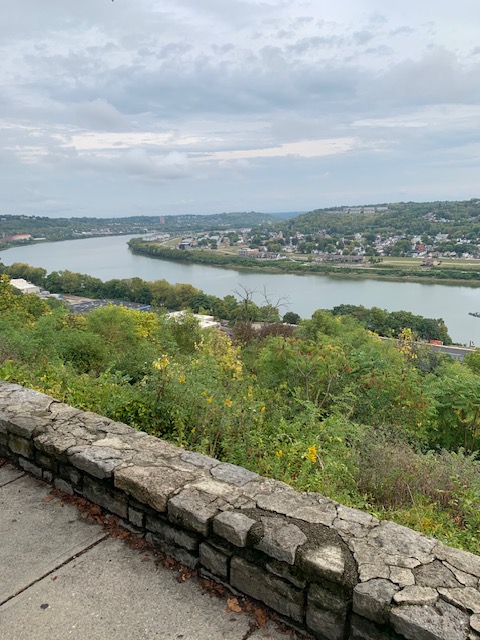
The Ohio River.

Our granddaughter is spending first semester of her junior year of college in Greece. Many people have asked us if we are planning to visit her, and I have responded by saying, “This is Maren’s adventure, and we will be her most interested, enthusiastic, and avid listeners when she returns home.” Some people seem puzzled by my answer, but others nod in understanding. One person said to me, “How wise. This is her time.” Now I should add that her parents and brother will be visiting her, but that is a different dynamic, and we are thrilled they have that opportunity.

Our days of international travel are done. We had some amazing trips to Bucket List places, but our sights have turned more inward–as in within the borders of this country. More manageable, but no less interesting or valuable, I think. This recent road trip is an example.

In the fall we enjoy driving to Cleveland to visit our beloved son and daughter-in-love. This year we decided to meander a bit before landing in Cleveland. On my Bookstore Bucket List was Ann Patchett’s bookstore, Parnassus Books in Nashville. (See my Thursday, October 5 post.) Also, a friend had recently visited and recommended the National Underground Railroad Museum in Cincinnati. The itinerary became clear.

  • Take enough pictures.
  • Clean/cook/do laundry.
  • Check email. Well, that isn’t exactly true, but rather I didn’t respond to email or read what wasn’t absolutely necessary.
  • Meditate, except to gaze out the car windows.
  • Write in my journal or do any writing at all. I didn’t do any planning of future classes either.
  • Watch any tv, YouTube videos, or even listen to much on the radio.
  • Sleep very well, but I slept well enough. Why is it I wonder why so many hotels have such high beds, which are not easy for those of us who are old and short?
  • Buy any souvenirs.
  • Worry about the week after vacation.
  • Relaxed
  • Enjoyed the drive, except for the traffic in Nashville.
  • Read during our quiet evenings.
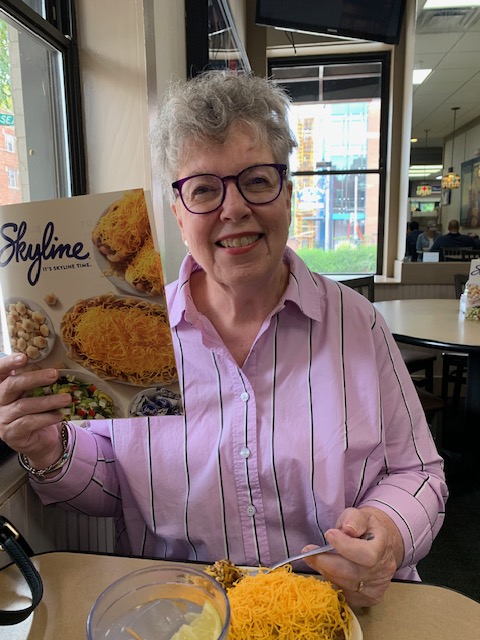
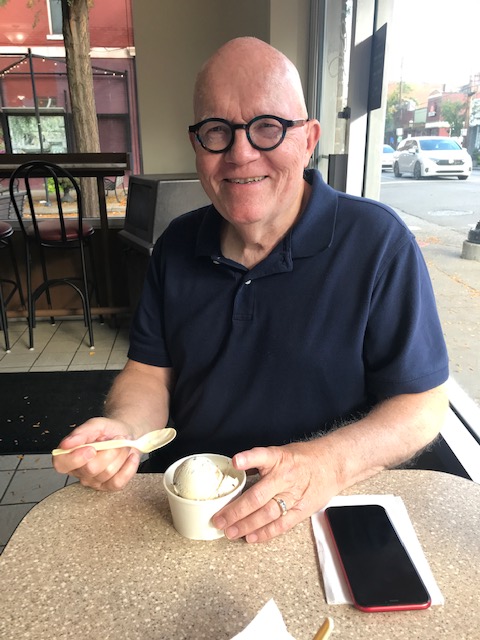
  • Appreciated good food fixed by other people: True Food in Nashville; Eagle Food and Beer, Skyline Chili and Graetner’s Ice Cream in Cincinnati; and Mama Catana’s and Brew Dog in Cleveland.
  • Did my part to support independent bookstores.
  • Loved our spacious and leisurely time with our son and daughter-in-love. Catching up and moving forward in one another’s lives. The best.
  • Wandered in and out of interesting shops, including City Farmhouse in Franklin, TN and Patina Home and Garden in Leipers Fork, TN. In both cases I have home decor books written by the owners and enjoyed meeting them in person. I am always inspired by well-curated shops, but realize more and more how my needs and desires have become more spare.
How fun to see “my” vintage turkey plates for sale and so beautifully displayed.
  • Reminisced about our years in Cleveland. Returning there is always bittersweet–we loved our years at Sweetwater Farm, but the decision to return “home” was a good one. However, we miss our Cleveland kids.
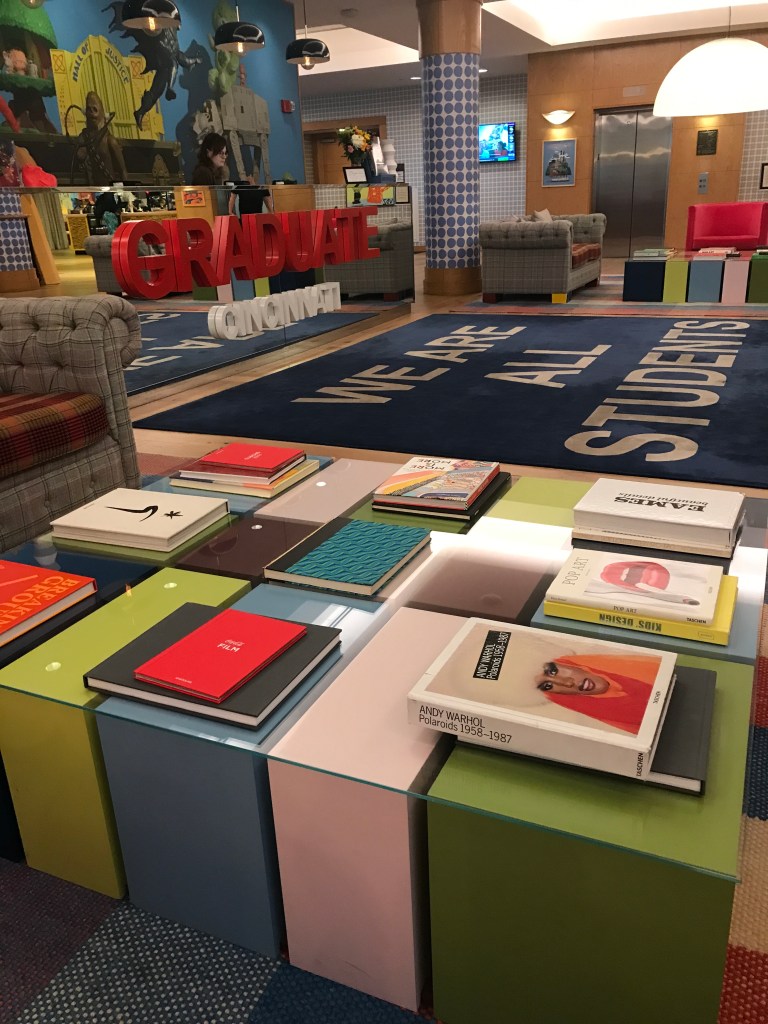
  • Wondered why more hotels can’t have personality like Graduate in Cincinnati.
  • Entertained new thoughts and just let them flow. Who knows where they will take me.
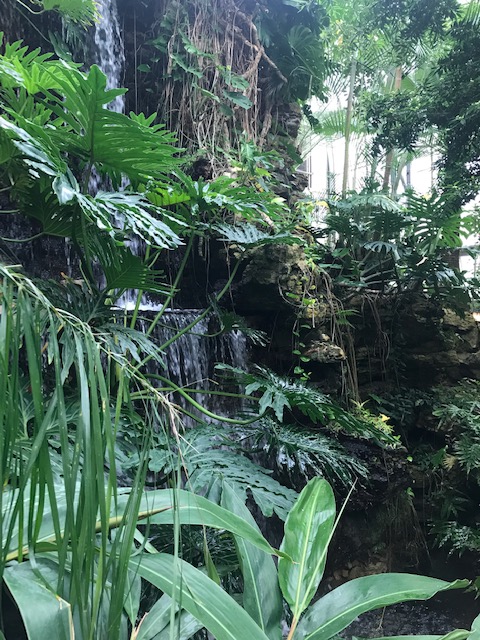
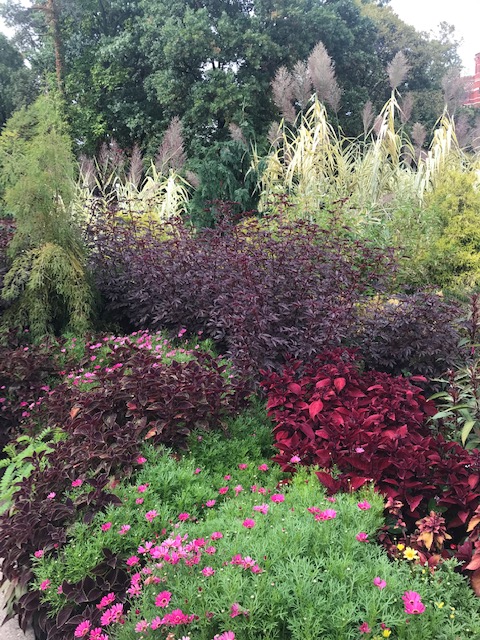
  • Appreciated the variety of colors and textures at the Cincinnati Conservatory.
  • Made a new friend.

The mission of this museum, which opened in 2004, is “to pursue inclusive freedom by promoting social justice for all, building on the principles of the Underground Railroad.” We spent over three hours in the museum and could have stayed even longer, but our hearts and minds overflowed and ached with all we learned about the history of enslavement and the resulting urge for freedom.

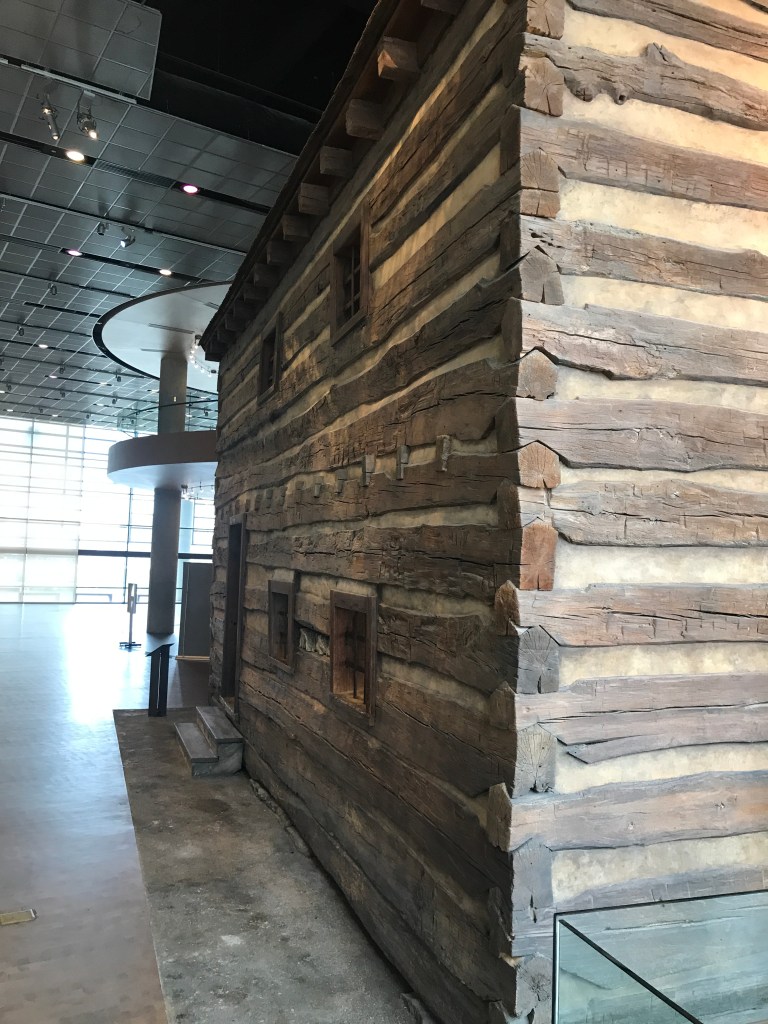
Perhaps I was most moved by the Slave Pen, built in the 1800s by Kentucky slave trader, Capt. John W. Anderson to temporarily warehouse enslaved people, as many as 300 at a time in a space no larger than our garage, until they were sold further south. The structure, which was discovered in Mason, KY, less than 60 miles from the museum, was moved piece by piece and rebuilt inside the museum. A sacred place.

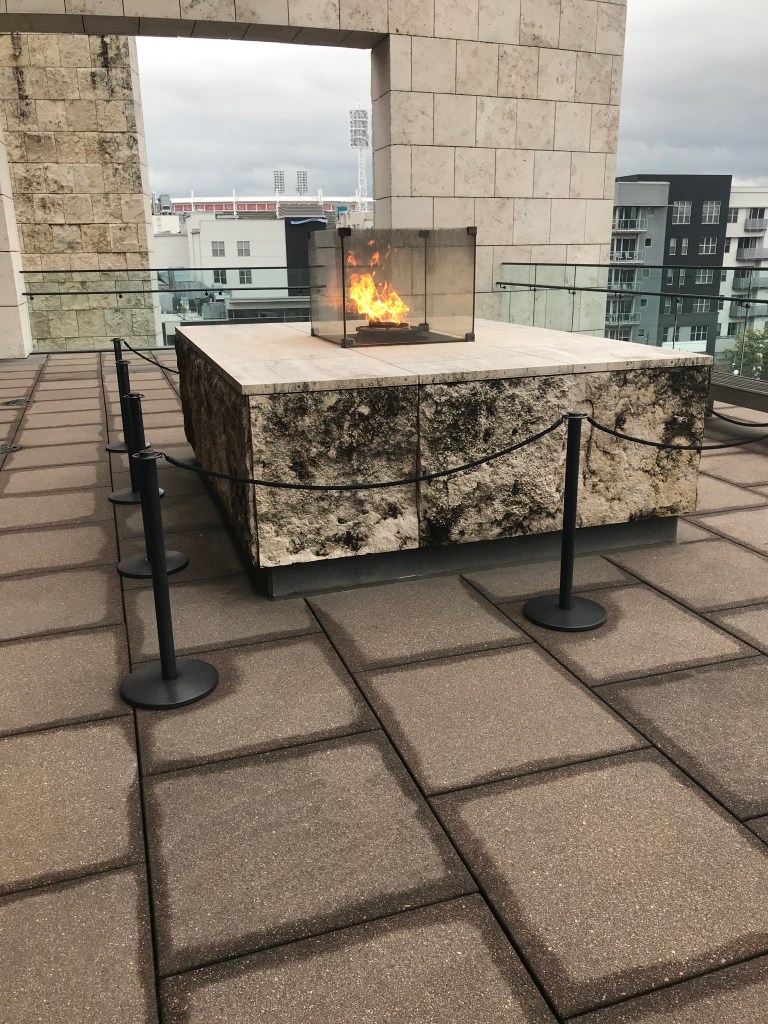
At one point we sat and waited for one of the recommended films to begin and I overheard a conversation among two groups of visitors. It turns out they were all from Wisconsin. We could easily have joined in the conversation, but no, they weren’t talking about this experience. Rather, they were talking about the Green Bay Packers. Really? I thought later, as I stood on the terrace where there is a flame, which will stay lit until there is justice for all, how important it is to learn about our history, for only then can we create a new history for those who come after us.

Gazing at the Ohio River, once the border between a free state and the slave state of Kentucky, I thought about all the ways there are still barriers between those who are free and those who are not.

Of course, it is always good to get home–otherwise, it wouldn’t be home, but the value of travel, whether near or far, is not what you’ve seen or done, not what items on the bucket list you’ve checked off. Rather, how have you changed? How have you grown? And what does that mean in the way you live your life? I sort through that as I continue to reflect.

What role has travel played in your life? I would love to know.
Book Report: September Summary and Visit to Ann Patchett’s Bookstore

October 5, 2023

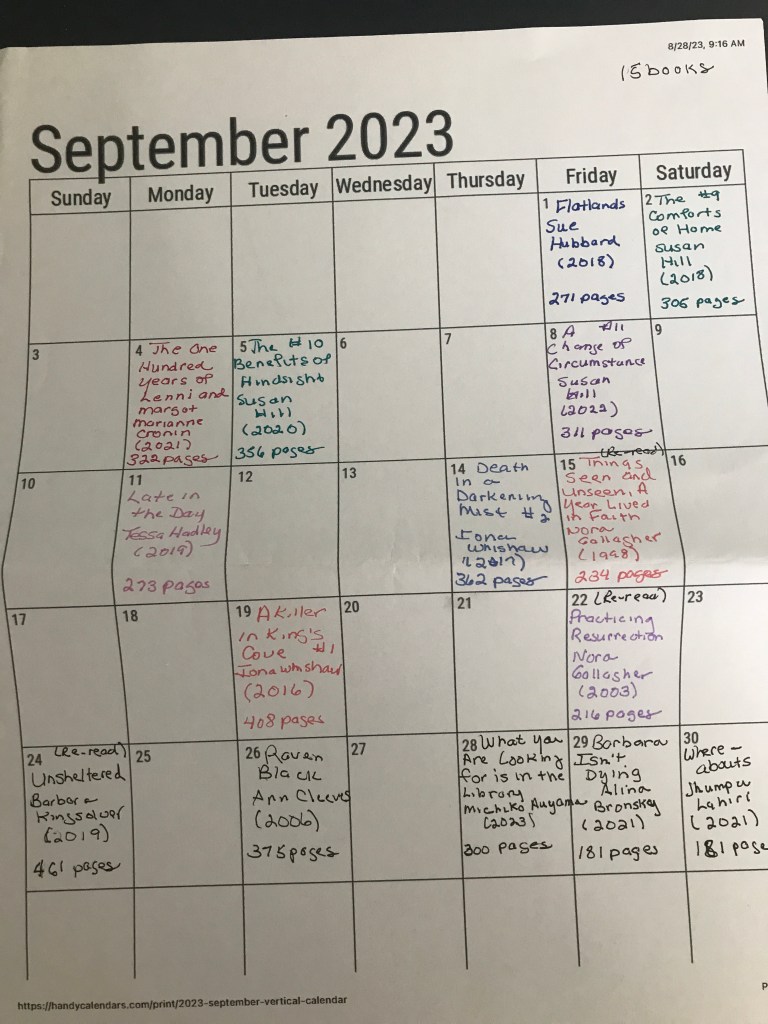
From the looks of my book calendar, I could be accused of not doing much else other than reading during September. I assure you that is not the case, but I don’t deny this was a good reading month.

Here’s what I read while on our road trip:

  • Raven Black by Ann Cleeves. This is the first book in the Shetland series. Perhaps you have watched the BBC series, Shetland. Cleeves also wrote the Vera series. Although I enjoyed this book, I probably won’t continue reading the series, but rather continue reading the Lane Winslow series by Iona Whishaw, which I mentioned in the September 21st post. (I read the first two titles in this series this month: A Killer in King’s Cove and Death in a Darkening Mist.)However, I do love books set in the Shetland Islands, and Cleeves knows how to tell a tale.
  • What You Are Looking For Is In the Library by Michiko Aoyama, translated from the Japanese by Alison Watts. This book got me at the title. A sweet, gentle book in which each chapter features one character who is dissatisfied with his or her life–a man who has recently retired, a new mother whose job has been downsized, a young man who loves to draw but has never found the right job match, and others. They each are directed to the library in the neighborhood community center where the reference librarian instinctively seems to know what books –books that on the surface make no sense–will change their lives and give them confidence or a new perspective. No violence. No sex. No objectionable words. Instead, an uplifting and encouraging book.
  • Barbara Isn’t Dying by Alina Brodsky, translated from the German by Tim Mohr. I chuckled as I read the first few pages, but although the sarcastic and ironic tone continues, it becomes more serious. Barbara, who clearly has run her home efficiently and without assistance from husband Walter says she is tired and retires to her bed, leaving a puzzled Walter in charge. He has no idea how to make coffee, let alone anything else, and grocery shopping is a whole new world, but he does his best and develops new skills. In the meantime their children take Barbara to their doctor, and the news, which is never shared and which Walter ignores, is not good. An exercise in classic denial. The book is well-written, insightful, and often tender.
  • Whereabouts by Jhumpa Lahiri. This book got lots of attention when it was released in 2021 because Indian-American writer Lahiri wrote it in Italian, not her native language, and then she translated it into English. The book is a series of vignettes told in first person by a woman, an academic, who lives in Italy. However, no names or people or places are ever given. We know few facts about the the narrator, but we learn much about her inner life, and we receive the gift of her observations. Lovely writing in short chapters.
  • Unsheltered by Barbara Kingsolver. I finished reading–actually, re-reading–this book at the beginning of the vacation. It was neither short (461 pages) nor was it a fast read, but never mind, for Kingsolver’s books are a reminder of what it means to read such good writing, and her books are always engrossing and interesting and out-of the ordinary. Reading a Kingsolver book means immersing oneself in the best. There are two story lines in this book, but both are set in the same place–a crumbling, tumbledown mansion in New Jersey, and the stories relate and overlap. One story line is set in contemporary times: Willa is a writer/editor whose magazine position has ended and her husband Iano is a college professor who keeps moving in search of tenure. Money problems and family dysfunction dominate. The other story focuses on Thatcher Greenwood, a science teacher, and his family who live in the same house, although much earlier. Mary Beech, a botanist, who corresponds with Darwin, lives next door. She is based on a real historical figure, by the way. So much more could be said, but better to read Kingsolver’s book than my review. After reading and loving Demon Copperhead, I feel compelled to re-read her earlier books.

Before leaving on our road trip I read two nonfiction books. In the September 21 post I wrote about re-reading Things Seen and Unseen, A Year Lived in Faith by Nora Gallagher, and I decided to re-read the sequel Practicing Resurrection, A Memoir of Work, Doubt, Discernment, and Moments of Grace. In this book she writes about her discernment process about becoming an Episcopalian priest. She examines writing as a call, as well, and there are lovely passages about sandhill cranes, spiritual direction, and marriage. A favorite line: “Perhaps God doesn’t know all the parts either, but cranes her neck toward us listening.” p. 163. Both of these books are leading me to re-read some favorites from my own extensive library of books about spirituality and theology.

What else haven’t I mentioned?

  • The One Hundred Years of Lenni and Margot by Marianne Cronin. See the September 14 post.
  • Three more books in the Simon Serailler mystery series by Susan Hill: The Comforts of Home (#9), The Benefits of Hindsight (#10), and A Change of Circumstance (#11). The next one in the series, #12, will be released this month.
  • Flatlands by Sue Hubbard. This book was one of my “wild cards” from a trip to a mystery bookstore in Madison, WI, but it isn’t a mystery. Rather it is a tale of unlikely friendship between a young girl who is an evacuee from London and an artist and conscientious objector during WWII. The landscape of the wild wetlands of the English fens is almost another character.
  • Late in the Day by Tessa Hadley. Another excellent “wild card” book. Two married couples are the main characters and when one of the husbands dies, the dynamics change. I appreciated the careful “not too much” writing–deep and yet not navel gazing.

Most people go to Nashville for the music, but not me. Parnassus Books, owned by brilliant bestselling author, Ann Patchett was on my Bookstore Bucket List, and it didn’t disappoint.

Fortified by a delicious lunch at True Food and armed with a list of titles on my TBR list, I took a deep breath and opened the door. My husband who also loves to read, but is more casual, I would say, about what he reads, assured me I could take all the time I wanted.

My strategy was to first check the shelves for all the books on my list and then to take another deep breath and open myself to other possibilities–books I call my Wild Cards. Bruce periodically checked in with me, asking if he had read this book or that or if we owned it. I often replied that I had read the book in question, but couldn’t remember if we still owned it or if we had passed it on to a Little Free Library. That’s one reason I keep a list of what I want to read– remembering all the titles in my reading life is impossible!

One of the pleasures of browsing in a bookstore is encountering so many good books from my reading past. A kind of life review. As I moved slowly along the fiction shelves, I kept saying to myself, “Oh, I loved that book” or “What a good book that is” or “I want to re-read that book.

In my mind a good bookstore is one that doesn’t only have the latest and greatest or maybe latest, but not so greatest, but also is intentional about stocking good books from the past, earlier books written by a current author. Parnassus passed that test.

Another mark of a good bookstore is knowledgeable and engaged staff. Another star for Parnassus Books. As I browsed I could hear conversations between staff and customers. Not only did the staff KNOW books, but when a customer asked about a book unfamiliar to them, they were eager to know more. When it came time for me to purchase my pile, the bookseller clearly was selling books and not socks or computer paper or laundry detergent. She looked at each book, sometimes commenting on a title, and as I handed her my credit card, she said, “You’ve got a great pile here.” She seemed totally sincere.

I always feel a sense of camaraderie in a good bookstore–chatting with other customers seems possible, and, in fact, often happens. In this case, two young women were wondering about reading Emily St James Mandel’s book, Sea of Tranquility, which I read this summer. I interjected myself into the conversation, asking if they had read Station Eleven. They didn’t seem bothered by this old lady reader eavesdropping, and I noticed they bought the most recent Mandel book. Somehow I don’t think I would have asserted myself in that way if I had been in Barnes and Noble.

The only way Parnassus Books failed me is that they were out of their bookmarks. Darn! Oh, and I have a wish list for bookstores in general: better religion and spirituality sections. More and more I have to order a title I am interested in sight unseen. Lately, I have been looking for You Are Here: Keywords for Life’s Explorers by David Stenidl-Rast and The Eloquence of Silence by Thomas Moore, but no such luck yet.

From My TBR List: (All Fiction);

  • The Stranger Diaries by Elly Griffiths
  • Whereabouts by Jhumpa Lahiri
  • Barbara Isn’t Dying by Alina Bronsky
  • What You Are Looking for Is In the Library by Michiko Aoyama
  • Maureen by Rachel Joyce

Wild Card Selections:

  • The English Teacher by Lily King
  • The Golden Hour by Beatriz Williams
  • Andy Catlett by Wendell Berry
  • Fox and I, An Uncommon Friendship by Catherine Raven (memoir)

Oh, and I bought two Ann Patchett books bags. How could I resist! What a good day!

What defines in your mind a good bookstore? I would love to know.

Book Report: Tom Lake by Ann Patchett

August 24, 2023

Sunday afternoon, a cool and pleasant day before the cover of heat returned once again, I sat outside and finished reading Tom Lake by Ann Patchett. I wanted to finish it, but that doesn’t mean I wanted it to end. The NYT review by Alexandra Jacobs felt understated and even at times a bit snarky calling Patchett, “Aunt Patchett,” “as always slyly needlepointing her own pillowcase mottos,” but I LOVED THIS BOOK.

I waited to read Tom Lake until I had conquered a couple major deadlines. In fact, I didn’t dare have it in the house until the retreat I facilitated was completed, and the article I had been asked to write was sent off to the editor. My weekend was spacious, and the time belonged to Patchett.

Have I said how much I LOVED THIS BOOK?

Tom Lake, by the way, is not a person, but the name of a lake in Michigan.

The story has two narratives. One narrative begins when the main character, high school student Lara, is cast as Emily in Thornton Wilder’s Our Town and then follows her acting career, which includes a movie in Hollywood. More importantly, Lara plays Emily again in a summer stock production of Our Town. During that summer she has an affair with another actor, Peter Duke.

The other narrative is set during the pandemic. Lara is married with three grown daughters, Emily, Maisie, and Nell, who return to their parents’ cherry farm in Michigan, and as they pick cherries, the women ask Lara to share the stories of her earlier life. She has much to tell, but chooses not to tell everything.

Sometimes following two time periods is confusing, but anyone who has read Patchett knows how expert she is at bringing the reader along with her, wherever she decides to go.

In an interview on PBS News Hour (Thursday, August 17) Patchett said the idea for the book grew from the play, Our Town, not with a character, and in the opening pages she refers to the feelings people in New Hampshire, which is where Our Town is set, have about the play.

We felt about the play the way other Americans felt about the Constitution or the “Star-Spangled Banner.”

p. 1

Rumor had it certain women wanted to play Emily forever. They criss-crossed New Hampshire town to town, year after year, trying to land the part.

p. 11

Many have said that Our Town is America’s most important play ever written, and it is always being performed somewhere. This spring our granddaughter Maren was in a senior thesis abbreviated production of the play at Lewis and Clark College in Portland, OR.

And this summer Bruce and I saw a production at the American Players Theater, Spring Green, WI.

Is there something about Our Town that we need right now? Wait a minute, am I reviewing Our Town or Tom Lake? Perhaps the two will always be linked in my heart and mind from now on.

Back to the book. Each character is so clear, so well-defined, but with their own obscurities. Each one of the daughters could become a book on their own, and yet they belong together–something the pandemic gave them another chance to experience.

They stack their dishes in the sink and head out the door together, Maisie holding the end of Emily’s braid the way one elephant will use its trunk to hold another elephant’s tail. Nell slips her finger through Maisie’s belt loop. Joe and I used to say that if lightning struck one of these girls all three would go up in flames.”

p. 91

This book would have been good, very good, without the context of the pandemic. No doubt Patchett would have found a way for her daughters to return to the farm for a chunk of time and no doubt there would have been reasons for such ongoing storytelling, but the pandemic becomes the open hands of the story.

I stay behind to make the lunch, which I should have been working on while I was talking all this time. The past need not be so all-encompassing that it renders us incapable of making egg salad. The past, were I to type it up, would look like a disaster, but regardless of how it ended we all had many good days. In that sense the past is much like the present because the present–this unparalleled disaster–is the happiest time of my life: Joe and I here on this farm, our three girls grown and gone and then returned, all of us working together to take the cherries off the trees. Ask that girl who left Tom Lake what she wanted out of life and she would never in a million years have said the Nelson farm in Traverse City, Michigan, but as it turned out, it was all she wanted.

p. 253.

The story continues to unfold to the last page, but it doesn’t feel like a great reveal–only the way life happens. Day by day. Year by year.

There is no explaining this simple truth about life: you will forget much of it. The painful things you were certain you’d never be able to let go. Now you’re not entirely sure when they happened, while the thrilling parts, the heart-stopping joys, splintered and scattered and became something else. Memories are then replaced by different joys and larger sorrows, and unbelievable, those things get knocked aside as well, until one morning you’re picking cherries with your three grown daughters and your husband goes by on the Gator and you are positive that this is all you’ve ever wanted in the world.

p. 116

One more thing: I made a crucial decision as I started reading the book. I decided not to underline sentences and paragraphs I loved, for I knew immediately, there would be so many. Instead I marked passages with a subtle light blue x in the margin, keeping the book a bit more pristine and fresh, like the daisies on the cover. (I didn’t understand the cover design choice, by the way until almost the end. Why weren’t there cherry trees on the cover I wondered. Trust me, there is a reason.)

May these days, as we move from late summer into fall, find you engrossed in just the right book.

Are you an Ann Patchett reader? What’s your favorite?

I enjoyed reading this interview with Patchett. https://www.shondaland.com/inspire/books/a44654107/tom-lake-is-a-meditation-on-a-love-that-could-never-be-family-and-the-quiet-beauty-of-our-town/