NOTE: I am going to take a brief break and won’t publish posts on Tuesday, May 7 or Thursday, May 9. I will post my April Book Report Summary, however, on Thursday, May 2.
As always, the weekly writing group I facilitate, In Your Own Words, Contemplative Writing as Spiritual Practice, includes time for silent meditation. “Close your eyes lightly, not tightly. Take a deep cleansing breath. Breathe gently in and out, finding your own rhythm.” After six or seven minutes of sitting in silence with one another, I read the guiding words for the day. For example:
The word “orientation,” like “Orient,” comes from the Latin, orient, which refers to the “sunrise,” the “east.” If we know the point where the sun rises, we can determine all other points of the compass and find the direction we want to take. Some words can help us in a similar way. Words full of light, they beam, as it were, like the floodlights of a lighthouse and build a bridge over troubled water. Such luminous words can also become keywords that unlock new insights for us. We can learn “to think along language,” the way we walk along a path through meadows enjoying flower by flower, ever new discoveries as we go. You Are Here, Keywords for Life Explorers by David Steindl-Rast, p. 3
I then read the writing prompts for the day, which recently included the following:
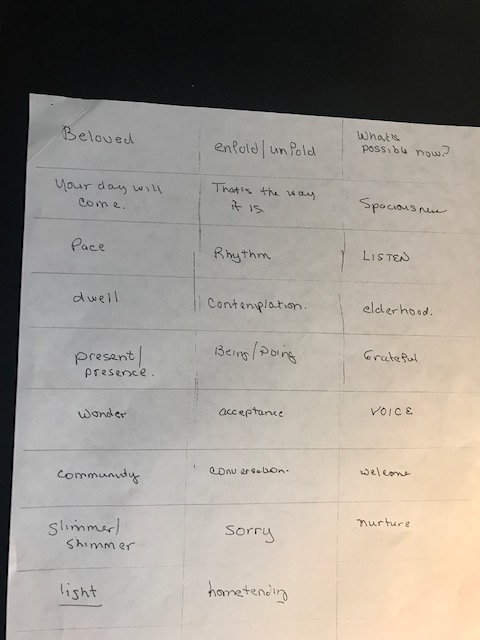
“Begin by listing words on the accompanying table that have had meaning for you or seem to be occurring or appearing in your life right now….List the words (or brief phrases) without judgment.”
I end by saying, “The time is yours,” and we write for 20 minutes.
My Father’s Guiding Words
I filled in the first three blanks on the sheet divided into small sections easily. “Beloved,” my 2023 word of the year. My current words of the year, “enfold/unfold.” And a question I often ask myself and my spiritual direction clients, “What is possible now?” I was surprised, however, when on the next line I wrote, “Your day will come.”
I began to write.
My father said those four words often. “Your day will come.”
I confess I sometimes resented those words–and that he said them with such a knowing smile on his face. I heard judgment and privilege. I felt admonishment–that I wasn’t old enough or hadn’t paid my dues or didn’t deserve something. I can’t recall specific instances when his response was “Your day will come,” but I remember my impatience and my irritation. Why should I remain patient when I wanted something, to do something, to be something, but apparently MY DAY had not yet come.
But I also wondered if the day for __________ would actually ever come or would life pass me by? Would the day truly come when I would know a lasting and fulfilling love? Would the day come when I would know my purpose in life? And would the day come when I would know how to fulfill that purpose? How would I actually know my day had come?
Dad didn’t offer any answers, instead he repeated his pat answer without becoming engaged. His wisdom rolled over me, only lightly touching my skin. I vowed not to use that phrase with my own kids, if I was lucky enough to have any. I don’t think I’ve broken that intention, but you’ll have to ask them.
Now, of course, at this third chapter stage of my life, I realize my day has come–as so many days have gone, have left. So many days have been lived. Some more fully than others. Some days have passed me by. Some days have drifted away unnoticed by me.
And now this day has come.
My day here and now.
My day of becoming more of the person I was created to be.
Often when Dad was in his 80’s and even into his 90’s, he announced he was ready to die, “just not today.” Eventually, his day came. Our creator God announced to him, “Your day is here. The day of your death, your full transformation is here.”
I don’t know when that day will come for me, but now when I think of those words, “Your day will come,” I hear an invitation to use these days wisely, to live these days fully. Doing that, I prepare for the day of my own death, the day my day comes.
Thanks be to God.
An Invitation
What words or phrases have special meaning for you right now? I would love to know.
NOTE:
The writing group I facilitate meets Thursday mornings from 10:30 to noon at Gloria Dei Lutheran Church, St Paul, MN. There is no charge and all are welcome. If you have interest in participating in the group, let me know. If you are not able to participate in person, but would like to receive the guiding words and prompts, send me your email, and I will add you to the list.
Paris and the Cotswolds may not be part of current plans.
We no longer live at our beloved Sweetwater Farm.
Living in Minnesota , instead of Ohio, means I can no longer decide on a whim to spend a day at Chautauqua.
Dear and as meaningful to me as those places are, however, they are not my only happy places.
I am happy most of the time wherever I am, but oh, how happy I was this last weekend to be in one of my happiest of happy places: Door County, WI, which is only 5 1/2 hours away from our St Paul home.
Over the years we have spent many happy times there, sometimes with family, sometimes with friends, sometimes just the two of us, which was the case this time–my birthday present planned by my husband. It is a place we gravitate to over and over again.
Do we gravitate there over and over again because being there makes us happy or because we are happy there do we want to go there again and again? Chicken and egg?
A Childhood Happy Place
When I was growing up my family moved many times. My Dad worked for a large corporation and was transferred frequently as he climbed the company ladder. At the end of the school year, the moving van would appear at our house, but before we moved into our new home, we returned to the same summer vacation spot in northern Minnesota. Year after year. Summer after summer. That was a place of both grounding and transition. Of memories and memory-making. Of ease and taking a breath before the work of resettlement. Of surety and stability. Of time to process the loss of friends and to hope for the presence of new ones. Of comfort. We knew what to expect and how we would spend our days.
That place was our past, our present, and a path to the future.
The Touch of Past, Present, and Future
Because we vacationed in Door County with our children when they were young and later, in their adult years with our grandchildren part of the scene, we have a history there. We reminisce about our son sketching on the sandy beach and about taking the ferry to Washington Island specifically to go to the book store there, and about playing miniature golf when the club was taller than our grandson and eating cherry coffee cake at the White Gull Inn. And more. So much more.
Going there now reminds us of some of the building blocks of our lives. The conversations we had while savoring the sunset or fruity daiquiris before a leisurely dinner. The dreams fulfilled and those that drifted away. When we laughed and what we treasured. Who we have been and how we lived.
And now in the present in this happy place, the past sits lightly, and we feel a simple, but rich gratitude for being here. For having this time to be together. The weather doesn’t dictate the gift of this time. We eat good meals. We browse in favorite shops, and we roam back roads, delighting when we spot sandhill cranes in an open field and a deer loping across a gravel road. We gaze at the water as the sky turns into evening pink. We read and doze in our room, no longer pulled to do something, go somewhere. Being here now is enough.
And the future? Well, who knows much about what the future holds, beyond our eventual deaths. But we envision more time in this happy place because we feel welcomed and at home there. But more than that it is a place that seems to support the people we are becoming, for that becoming continues until it doesn’t.
Past Door County Moments
An Invitation
Where are the places that represent past, present, and future for you? I would love to know.
Late in the afternoon, since it was the Day of Preparation (that is, Sabbath eve,) Joseph of Arimathea, a highly respected member of the Jewish Council, came. He was one who lived expectantly, on the lookout for the kingdom of God. Working up his courage, he went to Pilate and asked for Jesus’ body. Pilate questioned whether he could be dead that soon and called for the captain to verify that he was really dead. Assured by the captain, he gave Joseph the corpse.
Having already purchased a linen shroud, Joseph took him down, wrapped him in the shroud, placed him in a tomb that had been cut into the rock, and rolled a large stone across the opening. Mary Magdalene and Mary, mother of Joses, watched the burial.
Mark 15: 42-47 (paraphrased by Eugene Peterson in The Message: The Bible in Contemporary Language)
Many years ago the Cleveland Museum of Art hosted a traveling show of treasures from the Vatican. Entombment, a large painting by Caravaggio, was one of those treasures. We were living in Cleveland at the time and were among the crowds of people who attended this exhibit. Our son Geof, who is a graduate of the Milwaukee Institute of Art and Design, became our unofficial guide as we moved through the galleries. In his quiet voice, he pointed out aspects of the paintings I would surely have missed otherwise. Many people listened to an audio tour prepared by the museum, but even so I noticed a number of people paying attention to what Geof was saying and watching where he was pointing.
How true that was when we entered a room where the only painting was Entombment.
After spending time gazing at the painting, trying to take in the lifeless body of Jesus, the grief of those in attendance, and the strength and struggle of the men as they placed the body in the tomb, Geof suggested we move to the left side of the painting and kneel–not as an act of adoration and devotion, although I remember feeling that, but in order to experience the painting from a different perspective.
Joseph of Arimathea seemed to be looking right at me, asking for my help. I was in that tomb, too, positioned to receive and to ease the body onto that hard slab of rock. When we eventually left that room, that tomb, I noticed others taking the same posture as Geof had shown me.
The Passion Story
During our Sunday morning worship service, Palm Sunday, the Passion Story according to the Gospel of Mark was read. How many times have I read the story in the quiet of my own space, heard the story, seen the story performed, even read aloud for others the story? I know this story, and yet, I am always stunned by the story. Sometimes I imagine myself as Peter, denying three times his relationship with Jesus. Or might I have been one of the Chief Priest’s servant girls who questioned Peter, “You were with the Nazarene, Jesus.” Sometimes I am the woman pouring the expensive perfume over Jesus’ head. Sometimes I am one of the disciples in the room preparing the Passover meal. Sometimes I wonder what it would have been like to carry the cross as Simon of Cyrene, did.
This story has room for each part of me. Each aspect of ourselves.
This time as Joseph of Arimathea’s actions were described, I remembered that Caravaggio painting and how my son had invited me to be in that scene, that moment.
I wondered about my openness, my willingness to receive.
When have I held someone else’s loss? How have I held my own losses?
How have I prepared the tomb for my own death?
Christine Valters Paintner in her new book, A Different Kind of Fast, Feeding Our True Hungers in Lent, invites us to enter the scene. “Help carry the weight of his body.” I see Joseph and his companion strain to hold that deadweight. How am I asked to lighten that load? To share that burden?
I don’t recall thinking much about the others depicted in the painting, but Paintner suggests:
Stand by the tomb as the mourners lay Jesus’s body to rest. Rest in the silence with them for a while. When the time feels right, consider engaging in conversation with one or more people there. Ask them what they have seen, how they feel, what they are going to do now. Have a dialogue with the garden, the plantlife, the tomb itself, Jesus’s body.
Sit inside the tomb for a period of time. Rest into the waiting. Recognize those places in your own life where you await new life.
p. 214.
This is what these Holy Week days are about–to see and to know ourselves in the story. To discover a new perspective and to lean into the new life awaiting us.
May these coming days deepen your awareness of the movement of God in your life.
An Invitation
When have you heard or experienced something familiar in a new way and gained a new perspective? I would love to know.
In my February 19, 2024 post, “Lenten Overload,” (https://wordpress.com/post/livingonlifeslabyrinth.com/3153), I noted my Lenten practices of recent years, when I focused on “letting go” and “decluttering.” I thinned out my shelves of spirituality and theology books–even though it doesn’t look that way–and incorporated that practice into my life as an ongoing project. I tossed multiple copies of published essays I have written and notebooks with writing ideas, plans, and the beginnings of other essays. How good that has felt and how necessary that is, especially at this stage of my life.
In that post I shared my decision to finally (FINALLY) deal with the bins of unorganized photos. A lifetime of photos. I had intended to also begin re-reading my journals, and I did read the first two (1977-1978), but quickly realized I could not adequately address both projects at the same time. I decided to focus on the photos and to enter into it with contemplation and reflection.
With my heart and soul. To pay attention to the movement of God in my life, as reflected in my inner voice. To approach these projects as more than physical decluttering and clearing of space. Instead, I hope to let go of what clutters my heart and mind.
The Beginning
No surprise, I am learning as I am doing.
I had vague ideas about how to approach the magnitude of organizing all our photos. Chronological seemed the most logical idea, but then I thought about certain themes. Maybe instead of organizing photos in albums, I should create some photo books a’ la Shutterfly. Our homes have been so important to us, and I have taken many photos to show the changes we made inside and outside over the years. Maybe I should select the best of those and do other photo books and should I integrate photos of family and friends into the settings? And what about trip photos? Do we really need the many photos of buildings and lakes and other scenery? And what about all the photos family and friends sent to us in Christmas cards? We have loved receiving them, but should I keep them all now?
I dug in–sorting into various categories. The grandkids. Our kids. Friends and other family. Homes. Trips. I subdivided big categories into smaller ones. I cursed myself for never writing helpful information on the back of each photo. Sometimes a date was stamped on the back and that helped, as did clothing and backgrounds, but what a mess.
I consider myself an organized person, so how did I let it get this way? And why do we have all these duplicates? How will I ever make sense of this all? Well, like Anne Lamott’s famous quote about writing, “Bird by Bird.” Photo by photo. One photo at a time.
My Made-Up Guidelines
Focus on one category or subject at a time. I decided to begin with all the photos of our first grandchild, Maren, who is now 21. Group all the pictures of her and of my husband and me with her. A sizable pile, to be sure, but it is a start, and it’s almost like getting to know her all over again.
Eliminate too similar or duplicate photos. Edit, edit, edit.
Set aside pictures to give to others. For instance, I now have a fun pile of photos to send to Maren.
Work in short spurts and work only as long as it is pleasurable and productive.
Print photos on my phone I intend to keep. Delete others.
Don’t even consider filling photo albums or other storage options until all photos have been sorted and categorized and organized.
Be flexible. Maybe I will decide to do things differently as I go along. Maybe other ideas or methods will present themselves.
Be patient. Remember to stretch, to breathe. Always a good thing.
A Practice, Not A Project
How easy it is to think about this process as a project–as something that needs to be done because of all the space these bins are taking or because I can never find a picture I want or because I don’t want to leave this mess for my kids to handle. Or because this is the time of life to intentionally declutter and deal with the stuff of our lives. If not now, when?
Those are worthwhile reasons, but I have committed to this as a Lenten practice. What does that mean?
Once again Joan Chittister comes to the rescue:
The wonder of being able to see life as whole, at any time and all times, is the great gift of memory. It makes all of life a piece in progress. With one part of the soul in the past and another in the present, we are able to go on stitching together a life that has integrity and wholeness. Because of memory life is not simply one isolated act after another. It all fits into the image of the self and the goals of the heart. It makes them real. It makes them whole.
The Gift of Years, Growing Older Gracefully, p. 155.
This practice is about gratitude for the many gifts in my life.
This practice is about remembering how the years have formed me and my loved ones.
This practice is about finding the whole in the parts.
This practice is about noticing the gaps and what they mean.
This practice is about sharing stories.
This practice is about making connections.
This practice is about being present as I recall the past.
This practice is about transforming burden into gift.
This practice is about being more aware of God’s presence in my life. My whole life.
Post-Lent
Today is day 24 in the 40 days of Lent, (Sundays are not counted in the 40 days.) and I am no where close to completing this project, but since it is a spiritual practice, that is ok. More than ok. This spiritual practice will companion me in the Easter season and into ordinary time and more than likely right up to and through Advent. And because I keep taking more photographs this project/practice will continue teaching and guiding me.
An Invitation
If you decided on a specific spiritual practice for this season of Lent, how is it going? I would love to know.
My morning meditation time includes not only reflecting on a selection from a spiritual text, writing in my journal, and lifting the prayers of my heart, but I also read Heather Cox Richardson’s daily newsletter, Letters from an American, which has over 1.4m subscribers. https://heathercoxrichardson.substack.com Richardson is a Professor of History at Boston College and an expert on American political and economic history, and each day she manages to bring clarity to the chaos of the day’s news, adding the perspective of history into what swirls around us.
Heather Cox Richardson is a valuable and insightful and hopeful voice, and Sunday she spoke to an overflow crowd at House of Hope Presbyterian Church in St Paul, MN. Such a privilege to see and hear her.
I urge you, if you have not already done so, to subscribe to her newsletter. She also has a new book, New York Times bestseller Democracy Awakening: Notes on the State of America. Nope, I haven’t read it yet, but I own it, and I will read it, for sure.
In Person Energy
Sitting in her presence with all the others who made the decision to spend their Sunday afternoon in this way, I thought about the gifts of physically sharing space with others and how different that is from sitting in the snug reading a book or at my desk reading newsletters on my phone or laptop. How different sharing the same space with a speaker is from listening to a podcast or radio interview while I fix dinner. Now don’t get me wrong–I am so grateful for all those ways I can access news, ideas, and events, but being there strengthens commitment, builds energy, and reinforces beliefs and intentions.
Even though I know, as I listen to, watch, or read something meaningful or interesting in the comfort of my home, I am expanding my awareness, sharing that experience with others is a different, more personal, more dynamic experience. How good it is to be with others who are eager to hear more, learn more, and who may support a certain perspective.
An example: I am a big Barbara Brown Taylor fan. I own and have read most of her books, and whenever a new one is published by her I rush to buy it. That is true about Anne Lamott and Elizabeth Gilbert, for example, as well. But after attending in person events in which these women were the speakers, even though I was one of hundreds in attendance, I have a kind of relationship with each of them. I saw them pause and smile and take a sip of water and adjust their glasses or the hair that fell into their eyes and shift the papers of their prepared talk. I sensed them listen, really listen, as an audience member asked a question. They are now no longer only words on a page or a voice in a studio. They are individuals. They are women who decided what to wear that morning and have long “to do” lists, which may include grocery shopping or taking the car in for an oil change. And yes, they are brilliant and wise and often funny and charming, but they are also real. Real.
I realize that as I age I am not as likely to make the effort to attend these kinds of events. I think more about the logistics and the energy such attendance takes. Instead of going to a book signing or talk by someone who interests me at a local independent bookstore, I am more apt to decide in favor of staying home and reading. I am not going to beat myself up here, for sometimes that is the right choice. But sometimes I am drawn to be present.
Choosing to be Present
I also think about other ways and time we can be present and the benefits of doing that. I choose to attend Sunday worship. I choose to sit at tables with others during our adult forums between services. I choose to lead a weekly writing group, which includes time to meditate and write together, even though I write and meditate by myself at home.
Something different happens when we are sharing each other’s energy. Something different is felt when we share a space. Something different is created when we intentionally gather.
Now I realize that the day may come, more than likely will come, that my ability to physically be present will be limited, but that time is not yet.
For now I benefit from the coming together, and my sense is that each of us present benefit from the collective presence.
An Invitation
When have you experienced recently the value of being present? I would love to know.
Sunday morning as we approached our church we spotted an eagle perched on top of our steeple. Perched doesn’t seem like the right word for a creature as large and as impressive as an eagle. In fact, “perched” sounds precarious, but, actually, the eagle looked quite comfortable. Balanced. Settled.
According to Medicine Cards, The Discovery of Power Through the Ways of Animals by Jamie Sams and David Carson:
Eagle medicine is the power of the Great Spirit, the connection to the Divine. It is the ability to live in the realm of spirit, and yet remain connected and balanced within the realm of Earth. Eagle soars, and is quick to observe expansiveness within the overall pattern of life. From the heights of the clouds, Eagle is close to the Heavens where the Great Spirit dwells.
p. 41
Seeing the eagle who appeared so at home against the backdrop of the clear blue sky, I thought about the importance of the eagle to Native American tribes. Again, Sams and Carson:
Eagle represents a state of grace achieved through hard work, understanding, and a completion of the tests of initiation which result in the taking of one’s personal power.
p. 41
Seeing eagle, I felt my heart lift. I felt beckoned by eagle to soar. I’m not sure what that means in my life right now, and more than likely, there are spiritual tests ahead as I live these elder days, but eagle reminds me to take heart and gather my courage.
So often I write about being grounded–in my faith, in my community, in the ongoing unfolding of my relationship with the Divine–but I also need to stretch, to soar, to expand. To open to the spaciousness of the skies. Again, I am not sure what that means in these elder years. How might I be called to become even more than how I currently think of my being? In what ways does eagle challenge me to become the person I was created to be?
Eagle teaches you to look higher and to touch Grandfather Sun with your heart, to love the shadow as well as the light. See the beauty in both, and you will take flight like the eagle.
Eagle medicine is the gift we give ourselves to remind us of the freedom of the skies.
p. 41
How grateful I am Eagle welcomed us to church Sunday morning.
An Eagle Story or is it a Peter Story?
Several years ago when our grandson Peter was only eight years old (He is now sixteen.) he joined us on a field trip to the National Eagle Center in Wabasha, MN. https://www.nationaleaglecenter.org Now here’s something you need to know about Peter: at a very young age he became a wolf expert. He became a member of the International Wolf Center in Ely, MN. https://wolf.org He read books about wolves, and we visited a wolf sanctuary where he asked knowledgeable questions. He knows all about wolves.
But he also knew a thing or two about eagles.
As we drove from St Paul to Wabasha, Papa started quizzing Peter about eagles. How many kinds of eagles are there? What’s the difference between a bald eagle and a golden eagle? What is the life expectancy of an eagle? What happened to make them almost extinct and now they are everywhere?
Peter tolerated the questions, answering with authority (and accuracy), but all of a sudden he had had it. “Papa, raptors are not my specialty.”
So there.
Oh, and by the way, once at the eagle center he stumped one of the docents with one of his questions. She responded, “I don’t know, but I will find out and let you know.” And she did.
I think Peter has both wolf and eagle spirit.
An Invitation
How do the birds of the air, the creatures of the earth inspire and teach you? I would love to know.
Biographical Notes about Jamie Sams and David Carson
Jamie Sams is a Native American medicine teacher and a member of the Wolf Clan teaching lodge. She is of Iroquois and Cherokee descent and has been trained in Seneca, Mayan, Aztec, and Choctaw medicine. She is the author of Sacred Path Cards, The 13 Original Clan Mothers, and Earth Medicine.
David Carson is of Choctaw descent, grew up in Oklahoma and has lived on Cheyenne, Crow, and Sioux reservations in Montana and Manitoba. He is the author of Lament.
I felt prepared for Lent this year. I really did. After all, I had consulted my list of Lenten meditation books in my personal library and gathered some key ones. In addition I ordered two new books (of course)–Jesus, Guide of My Life, Reflections for the Lenten Journey by Joyce Rupp and A Different Kind of Fast, Feeding Our True Hungers in Lent by Christine Valters Paintner.
I even thought about a specific Lenten practice to note daily in my journal people, places, and things as a way to increase my awareness and become more present. Have I done that yet? Nope. Not really.
Instead, I feel overwhelmed.
My email inbox is full of beautiful and meaningful Lenten reflections –Joan Chittister, Richard Rohr, Nadia Bolz Weber, Diana Butler Bass, Steve Garnaas, Rosemary McMahon, Oasis Ministries, and others. And I am tempted by other new books: Field Notes for the Wilderness by Sarah Bessey,You Are Here: Keywords for Life’s Explorers by David Steindl-Rast, The Eloquence of Silence by Thomas Moore, Beguiled By Beauty, Cultivating a Life of Contemplation and Compassion by Wendy Farley, and Being Here: Prayers for Curiosity, Justice and Love by Padraig O’Tuoma.
Even the New York Times’ Sunday opinion section had an essay about Lent, “What We Give Up Makes Us Who We Are by Molly Worthen.
So many thoughts. So many suggestions.
So much to read.
What to give up? What to add on? So many ways to think about this time of the church year and about this season of my life. So many more items for my To Do list.
Time to back up.
First, I thought about the meaningful Lenten practices of recent years — lightening my physical load. For two years I challenged myself to let go of books in my spirituality and theology library–at least one book each of the 40 days of Lent. How good that felt and how that has become part of my ongoing practice. I no longer need to keep every book that enters the house.
Last year I extended that ‘letting go” to a big stack of magazines I have kept. I paged through each issue, saving some articles or images to perhaps use with the writing group I facilitate. The only complete issues I kept were the ones in which an essay I had written had been published. Do I miss them –not at all?
So is there any other THING that needs decluttering? Ah yes. At the beginning of this year I decided to begin two projects.
To finally go through all our photos–sort, organize, order and even compile some of them into thematic Shutterfly books.
To reread all my journals, beginning with my first one from 1976, and decide what to do with them.
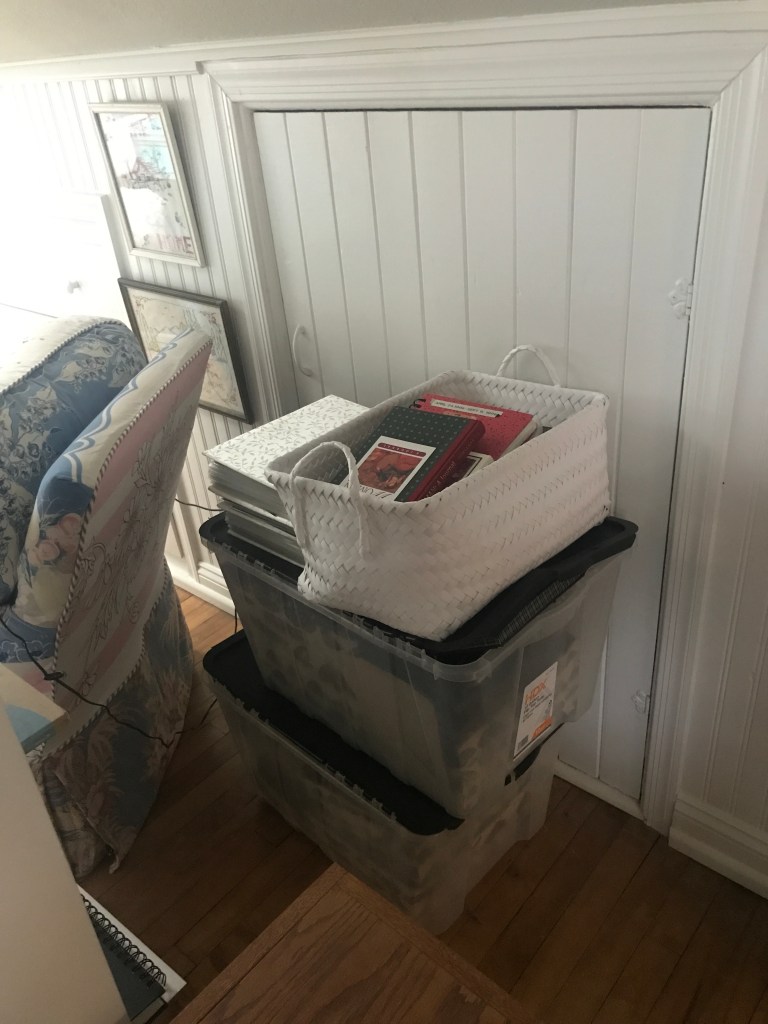
What have I done on those two projects? Well, the above picture is the extent of my work so far. I have gathered the bins of photographs and some of the earliest journals. They are partially hidden behind my comfortable chair in the garret where I can see them from my desk.
They are calling me, beckoning me.
I hunger to respond to them.
I yearn to let go of what is no longer needed.
Ah, my Lenten practice. To enter into these projects with contemplation and reflection. With my heart and soul. To pay attention to the movement of God in my life, as reflected in my inner voice. To approach these projects as more than physical decluttering and clearing of space. Instead, I hope to let go of what clutters my heart and mind.
I recognize these projects will take much longer than the 40 days of Lent, but this is a set-aside time to begin that journey.
To do that, however, I do need to let go of the need to read everything that comes into my inbox or to order all the titles that entice me or even to respond to all the worthy ideas and suggestions about approaches to Lent that come my way. I need to leave my meditation space a little sooner and take that contemplative attitude back into the garret where my projects await.
Finally, I need to be gentle with myself. I am aware that moving into the new year now takes a bit longer, and movement from winter to spring is always challenging for me. Perhaps this slower pace is my new normal.
And I need to remember that my word for the year is enfold/unfold. Lent will enfold me and Lent will unfold.
Stay tuned.
An Invitation
What spiritual practice is calling you? What yearning is beckoning you? I would love to know.
Several times in the past week I have quoted Christina Baldwin‘s simple, but oh so wise words:
Ask for what you need and offer what you can.
from The Seven Whispers, Listening to the Voice of Spirit.
I don’t recall the specific circumstances when I shared those words, but I know when a piece of wisdom is on my lips that it is meant not only for the person receiving it, but it is for me, too! Probably most strikingly for me.
Offer What You Can
Recently, I received two emails about ways I have volunteered in the past at my church. One was fixing and bringing a meal to individuals and families during times of stress or need, and the other was about being part of the hospitality team, serving at receptions etc. Did I want to continue participating in those ways?
I didn’t respond immediately, but instead I considered both of those ongoing opportunities during the next couple morning meditation times. In the meantime a request addressed to the whole congregation came, asking for helpers during the potluck before the annual meeting. Also, the weekly newsletter, as always, listed a wide variety of ways volunteers are needed in the church and in the larger community.
Oh, how tempting it is to spontaneously say, “I can do that.” And sometimes that is exactly the right thing to do. Sometimes that is the most genuine of responses. An expression of being in the present moment.
But as I age I am more aware of what makes most sense for who I am now. What are the ways I am called to use my energy, my time, my gifts? How does saying “yes,” affect other “yeses” in my life? The answer isn’t always clear, but what I am learning is that I need to honor the main ways I have committed to serve; the ways I feel I can best serve right now. Writing posts for this blog twice a week is one way, but also meeting with my spiritual direction clients and preparing for and facilitating the writing group I lead at church.
I don’t list these activities in a “look at me” way, but rather to remind myself of the importance of knowing what I can offer, how I can live my essence and in what ways I continue to discover the person God created me to be. These ways may change, probably will change, as I grow older, which reminds me of what Esther De Waal says in the chapter, “Diminishment” in her book The White Stone, The Art of Letting Go, “I hope that God is going to work within my limitations.” p. 89.
How did I respond to the various requests? I decided to step away from the two specific queries, thanking the people who lead those efforts. I didn’t I step up to help with the potluck either, but perhaps my “not this time,” left space open for someone else to say, “Yes I can do that.” Just a thought.
My plan and hope is to continue to exercise “sacred yes, sacred no;” to practice discernment as opportunities arise.
And finally, this must be said. I am aware more and more every day of the need to create spaciousness for time with family and friends.
Ask for What You Need
Well, I don’t know about you, but this is harder for me. Asking for what I need feels riskier. The notion of asking for what I need feels like I am declaring my inadequacy and vulnerability. EEEK! Baldwin says that asking for what we need is as much a spiritual practice as offering what you can. Asking for what we need is a way to pay attention, to be aware of the changes in our lives, and, in fact, it is part of becoming the person we were created to be. I often ask myself, “What is possible right now?” and sometimes the answer means asking for someone else and their gifts and time and energy to enter my life.
Baldwin says asking for what we need and offering what we can is a form of “spiritual trading” and that spiritual trading “creates flow.”
As long as the energy is flowing and cyclical, there is enough to go around. If any one of us stops asking or stops offering, the flow is disrupted and the balance destroyed.
p. 71
Be brave enough to ask fir help when you need it. There is no merit badge for Doing All the Hard Things Alone. Reach out.
Maggie Smith
An Invitation
How are Christina Baldwin’s words, “ask for what you need and offer what you can” showing up in your life right now? I would love to know.
People my age often use the words “senior moments” to describe a lapse of memory or moment of confusion. Who hasn’t walked into a room and then wondered about the intention? Sometimes the most familiar of names escape me. More and more my husband and I supply missing pieces for one another. I know the first name of someone in our history, and he remembers the last name. He can describe a movie or a book, but I know the title. Senior Moments! We laugh and are grateful once again for each other’s presence.
It’s important to acknowledge and be aware of those moments, for sometimes these moments are a sign of something more serious. Knowing the difference is not always easy, and we need to stay alert. When I make a mistake, substituting an incorrect name or word or phrase, it seems important to say, “Whoops, I should have said…,” or at the very least “Where did that come from?” or “I’ll call you at 2 in the morning when the word comes to me.” Some people have a hard time, however, saying, “I’m sorry.” Period. Some people have not practiced that skill or nicety over the years, but that is a whole other topic. And some people are not even aware that they have used words incorrectly or aren’t making sense. I digress. Another senior moment?
Allow me to suggest other kinds of senior moments. The gift of senior moments.
Pausing to notice another new blossom on the mini-daffodil plant on the dining room table.
Focusing on doing one thing at a time, instead of trying to multi-task.
Letting go of past hurts and past expectations.
Honoring my being as much as and maybe even more than my doing.
Giving thanks for the many gifts in my life. And oh, there are so many!
Asking myself “What is possible now?” and “How do I want and need to use my energy and time right now?
Choosing to read another chapter in the mystery I’m currently reading, instead of cleaning the bathroom. (I hasten to add I did clean the bathroom later that morning.)
Allowing a memory to nurture my day. I just had this flash of seeing our grandkids walking down the block towards our house at the end of the school day when they were in elementary school. Pete is now a sophomore in high school and Maren is a junior in college. How glad I am we moved here when we did!
Diverting myself from my “plan for the day” and responding to a pleasing invitation.
Opening my heart to the losses I feel, instead of denying them.
Nurturing my contemplative side, spending more time in reflection and prayer.
Appreciating this time of my life for the growth it offers me.
How sad I am when I hear someone say, “I hate getting old.” First of all, I try to be very careful about using the word “hate.” and don’t use it nonchalantly. I realize that so far my aging has been easy, compared to many others in my life. I have a privileged life. I repeat, I have a privileged life.
I know there will be harder days ahead, but hating old age negates all the gifts of the previous days and years. Isn’t there a difference between accepting and hating? Between honoring what has led me to this time and hating? Between holding tenderly these present days and the days to come and hating? Between feeling and saying something is hard and hating it?
I appreciate what Maggie Smith says in her book, Keep Moving: Notes on Loss, Creativity and Change.
I thought that what I was living was the whole story, but it was only a chapter.
p. 2
I’m in my senior moment chapter, and I intend to live it in the best way possible. May it be so.
An Invitation
What “senior moments” are you noticing? I would love to know.
I begin most days in the area of the house I call the snug. An enclosed front porch is how it would be described in a real estate listing, I suppose. Not very big, but spacious enough for two comfortable reading chairs and two sets of bookshelves against the inside wall. A few months ago I rearranged the space to make room for a small desk.
Cozy. Full of light on sunny days. A welcoming space for beginning the day.
Before making the bed and getting dressed, I settle into the snug for my morning meditation and devotion time. Most days I am there an hour or so before moving forward into the rest of the day.
That was not the case this past Saturday.
My time in the snug began in its usual way by reading the day’s reflections in the two books I have selected to accompany me through the year. Joyce Rupp’s Fragments of Your Ancient Name, 365 Glimpses of the Divine for Daily Meditation and Margaret Silf’s Daily Readings with Margaret Silf. I have used the Rupp book before, and It is interesting to me to see what I underlined before and what resonates with me now. The Silf book is new to me, but I have loved other books by her and in 2023 I re-read one of her other books, Wayfaring, A Gospel Journey into Life.
Each reflection in the Rupp book is a “name” for God, a way to describe God, and on January 20 the name of God is “Joyful Journeyer.”
...
When love accepts both ease and struggle,
When prayer includes a heart of acceptance,
...
When silence serves as a source of listening,
When dying no longer frightens or dismays,
...
Then we know how it is to engage with you
As the Joyful Journeyer on our road of life.
Each line moved me deeper into stillness, pondering those hopes within me, but also how I yearn for the hope to become truthful reality in my life.
Silf quoted Mark 3:20-21. “Jesus went home, and such a crowd collected that they could not even have a meal. When his relatives heard of this they set out to take charge of him, convinced he was out of his mind.” Silf reflected on how “the ordinary cannot tolerate for long the presence of the extraordinary,” but that isn’t what struck me about these verses. Not this time.
Instead, I focused on “Jesus went home.” First of all, how glad I was that Jesus had a home and could return there. I thought about him being welcomed. I imagined him finding comfort; the kind of comfort that comes from knowing where everything is and not having to introduce yourself or even be on your best behavior, because you know you are loved.
I thought about all the times I returned home –my parents’ home and my own homes. When we lived in our country home in Ohio, I often drove or flew home to be with my parents or our daughter and her family. How fortunate I felt to be able to do that and to know they waited for me and wanted, even needed my presence. At the same time, oh, how my heart lifted as I approached once again the driveway to our beloved Sweetwater Farm. Home.
(I arrived home, but in my case the crowd that collected were all our animals always eager to be fed!)
I opened my Bible to see if I had ever underlined these verses, and I had not, but I noticed a difference in the word choice and translation. In the version Silf quotes, the word “relatives” is used, but in the New Revised Standard Version, which I read, the word is “family.” That feels so different to me. A change in intimacy and even acceptance. A difference perhaps in the way we know and see one another. I will think about that more.
I spent some time musing on these thoughts in my journal, and by that time the streetlight was off and dawn had become day. The young mom across the street had headed off to her exercise class–at least that is my guess–and several dog walkers had strolled past our house. Most days I would blow out the candle, my first companion of the day, and move into the rest of the day.
Instead, feeling chilled, I wrapped my shawl around me and read the last chapter of another book in my meditation basket, Thin Places, A Natural History of Healing and Home by Kerri ni´Dochartaigh, a memoir by an Irish woman born in Derry, on the border of North and South of Ireland at the height of the Troubles. One parent was Catholic and the other Protestant, and terror reigned around her. Not only did I learn about how it was to live during those harrowing (a word she uses frequently) times, but I thought how what she experienced is an aspect of what I imagine those in Gaza are experiencing now.
Much of the book, however, is about place and time — all places and all times.
There is a time for everything–for sowing, planting, harvesting. A time for holding on, and a time to let go. A time for sorrow, and a time for healing. More so, there is, simply, time. There is time for it all. We still have time to step in or out –of places, of relationships, of thought processes, or our own selves. Sometimes the snow will still be here on St Brigid’s Day, and sometimes we will have a year without it coming at all. There will be years when the autumn trees seem more vibrant, more sublime, than we ever remember them being before. There will be years when we have suffered so much that we can’t pick out one season from the other, never mind one day. Days when we cannot imagine ever feeling okay again, thinking that we have taken enough of it all, enough already, enough. Then, a change in the wind, the first bluebell, the smell of snow in the sky, the moment courses on, and everything has shape-shifted–everything is okay again, more than okay, maybe, even.
p. 247
Today was my time to move slowly, deliberately. Today was my time to soak myself in stillness.
My only goal was to make the bed and get dressed by noon.
I just barely accomplished that.
An Invitation
What does your Sabbath time look like? I would love to know.







 Living on Life's Labyrinth