Book Report: Browsing My Bookshelves

One book leads to another. And another.

One of my favorite projects each week is preparing for the writing group I facilitate at my church. Along with creating a writing prompt, I offer short quotations to support the subject of the prompt. Finding appropriate quotes becomes a rabbit hole of pleasure and memory. Sometimes, I confess, browsing my bookshelves becomes a diversion, a distraction from the task in front of me. Oh well.

An example: My morning meditation these days includes reading the prayers for Lent in Jan Richardson’s Circle of Grace, A Book of Blessings for the Seasons. (2015). One of those blessings led me to this week’s writing prompt –a prompt about telling our own stories. Great–I had both the content for the prompt and one illustrative quote.

Let the browsing begin.

I remembered a workshop on storytelling as a spiritual practice that I took from Diane Millis a couple years ago, so found her book, Re-Creating a Life, Learning How to Tell Our Most Life-Giving Story (2019) on one of my shelves. As I paged through the book, I remembered an exercise Millis led at the workshop and wrote a note to myself to consider adapting that for a future writing group. I also noticed a reference to one of my favorite books, Composing A Life (1990) by Mary Catherine Bateson.

Here’s where the rabbit hole gets deeper. I pulled that book, autographed by Bateson, off my shelf, and as I noted what I had underlined and where I had written comments, I remember the evening I heard Bateson speak at a private girls’ school in Cleveland. Her book, Peripheral Visions, Learning Along the Way (1994), had recently been published, and, of course, I bought that book, too, and had her sign it.

We had moved to Cleveland from Minnesota just months before, and I still felt quite lost and unsure of what my next steps in composing my own life would be. I remember having a lovely conversation with Bateson and being surprised by the time she took to share her wisdom and perspective with me. I don’t remember her words, but am sure I wrote about it in my journal. I resist digging out that journal, for I might never climb out of that rabbit hole! An aside: Many years later I learned that a woman who became a friend had also attended that lecture.

Also on my shelf is Composing A Further Life, The Age of Active Wisdom (2010), and I am so tempted to begin re-reading this book right this very minute. The chapter titles, “Thinking About Longevity,” “A Time for Wholeness,” and “Knowledge Old and New” beckon me and I suspect are even more relevant for me now, but I set it aside. For the moment. And then I remember another of her books that I found at a Little Free Library, Willing to Learn, Passages of Personal Discovery (2004), but have yet to read. It awaits on a different shelf, where I keep TBR nonfiction books.

I slap my hands, reshelve the Bateson books, and turn to the shelves with my writing books. There are lots of temptations on those shelves. I start with two books: The Story of Your Life, Writing a Spiritual Autobiography (1990) by Dan Wakefield and Your Life as Story, Writing the New Autobiography (1997) by Tristine Tainer. The Wakefield book introduced me to the term and the idea of “spiritual autobiography,” which is now more commonly thought of as “spiritual memoir,” and the Rainer book reminds me of her earlier book The New Diary, How to Use A Journal for Self-Guidance and Expanded Creativity (1978), which I used as a text when I taught a series of journal writing classes way back when! All three books are full of notes to myself.

I have found what I need for the writing group and force myself to re-shelve the pile of books on my desk, but that leads to another round of browsing.

The Diane Millis book is right next to a collection of Thomas Merton books and close by are Thomas Moore books. The Bateson books are near books by a current favorite, Diana Butler Bass, including her latest Freeing Jesus, Rediscovering Jesus as Friend, Teacher, Savior, Lord, Way, and Presence (2021). I notice I have starred the last two chapters, “Way” and “Presence,” and I am tempted to re-read those chapter right now. Plus, I notice a Dan Wakefield book I have not yet read, Releasing the Creative Spirit, Unleash the Creativity in Your Life (2001), and I am certain just what I need could be found on those pages.

Behave yourself, Nancy, and focus. Finish the task at hand.

An Invitation:

What books are waiting for you on your bookshelves? I would love to know.

Prayers Around the Cross

On Wednesday evenings during Lent our congregation extends an invitation to gather at the cross, to pray and light candles. Solemn, quiet moments. Moments when I not only hear my own heartbeat, but the yearning heartbeats of all those around me.

Each of us brings our own cares and concerns. Each of us brings hopes for safety and peace and life and love. We light a candle and lift the distress we feel.

And then we go home. Some of us may feel lighter. Some of us may experience clarity. Some of us may continue to feel the burdens we brought with us, but are at least grateful for the silence and beauty of those moments.

Feeling the warmth of the gathering, some of us feel even more grateful for the warmth of the homes to which we return.

A writer friend recently wrote these words in a new poem, “Doing Something,” about the war in Ukraine:

              I lit a candle
              I scrubbed the kitchen floor
              I scoured the bathtub
              I carried out the garbage
              I wiped out the refrigerator.
                                                                   
              Not because I loved the doing.
              I still have my home.
              I can do the ordinary. 
                                   Linda Schaeffer


"I can do the ordinary."

As I age, I am learning not only to appreciate the ability to do the ordinary stuff of life, but I am learning to do those tasks, those day-to-day routines, with prayerful intention. As I carry bags of groceries from the car to the house, I can carry prayers for all those who wonder where they will get their next meal. As I place clean clothes in my dresser drawers, I can pray that all those who have left all their belongings behind will be offered what they most need. As I retrieve the daily mail, I can send into the world prayers for protection and well-being. 

I know "ordinary" isn't enough, but I also know that extraordinary responses and efforts and solutions and changes are built on the ordinary. My prayerful ordinary moments along with your prayerful ordinary moments create room for the extraordinary to grow and thrive and make a difference. 

I believe that with all my heart. 

Wednesday evening I will return to the cross. Once again I will lift the yearnings of my heart and light a candle, but in the meantime, I will move through my ordinary days, praying for the extraordinary. 

An Invitation:

What are your prayers as you move through the ordinary moments of your days? I would love to know.
Note:

You may find this link interesting–the poet Matthew Guite reflects on what C.S. Lewis has to say about living in the midst of war. https://www.youtube.com/watch?v=ngGozM0ZMG8

Age and My Relationship to Time

Tuesday, March 8, 2022

My relationship with time is changing.

For most of my life I’ve plotted how much I can accomplish in a day. I’ve been determined not to waste time, but instead, making lists for each day, I have carefully planned my time. I have been ever conscious of how to use my time efficiently and thereby, gain more time or so I thought. Often I have treated time like an enemy. “I don’t have enough time.” “Where has the time gone?” I will ________ when I have enough time.

I’ve been a time vigilante. Watching time. Timing my time. Seeking ways to improve my use of time. Congratulating myself when I use my time well–according to my self-imposed standards, of course.

How is my relationship with time changing?

The watch I wore for years died. The watch was a gift from my husband–dressy, but simple. A good watch, and I loved it and wore it every day, all day. After having it repaired once, twice, it was clear the life of the watch was over, and my husband offered to get me a new watch. I picked one out, brought it home, but didn’t wear it and finally returned it. I no longer felt a need for time to be wrapped around my wrist.

True, my iPhone is a constant companion, and the current time is visible on my laptop, but somehow that feels different to me. I like seeing my naked wrist, free from the constant reminder of time.

Not only do I not wear a watch, but I also don’t set an alarm when I go to bed. I wake up when the sun’s brightness alerts me to the day or the rumbling of the garbage truck in the alley can’t be ignored. I wake up when I wake up. This winter I have slept later in the morning than I used to and in the past I would have chastised myself for the “loss” of a half hour when I could have been writing in my journal or going on a walk. Now I am more open to saying to myself, “Well, you must have needed the extra rest.”

I still make a list for the day, but my lists are shorter. I am more gentle with myself, more realistic, perhaps, about what I can accomplish in a day. Even what I want to accomplish in a day. And I am more open to disregarding the agenda I’ve created for myself, in favor of whatever appears or opens. Instead of restricting myself to an hour of meditation/devotion time in the morning, I sit in the Girlfriend Chair as long as my heart tells me that’s where I need to be.

I pay more attention to my energy. I know I need some time between working at my desk and fixing our evening meal. I know I need more open and unscheduled time, more time for refreshment. In the recent past the ratio of work days to play days was 6:1 and then it became 5:2, but more and more the rhythm seems to be 4:3. Not that long ago I spent part of Sunday writing my Tuesday posts and also preparing the material for the Thursday writing group I facilitate. Even before going to 8:15 a.m. Sunday church I looked ahead to the coming week, noting my appointments and making my To Do lists. Lately, however, I delay the planning till later in the day. I may answer some emails, as well, but leave everything else till Monday.

Some of the change, no doubt, is due to the pandemic and the necessity to be home, but much of the change is because of my age. Joan Chittister in The Gift of Years, Growing Older Gracefully points out both the blessings and the burdens of time in this stage of life. “Time ages things…Time deepens things…Time ripens things…Time is a wondrous thing.” (120-121)

I realize more and more what a privilege it is to have this time of my life; to have the kinds of choices I have; to still feel a sense of purpose. I am in ongoing discernment about how to live with purpose and do that in a way that “opens to the divine timing which best serves my soul,” as Julia Cameron says. (Blessings, Prayers and Declarations for a Heartfelt Life, 59) And when I am aware of how to best serve my soul, I am more aware of how to serve.

An affirmation:

It is my choice to use time festively and expansively. I have plenty of time, more than enough time. I fill my time with love, expansion, enthusiasm, exuberance, and commitment. I both act and rest at perfect intervals. Proper use of time comes easily to me. I set the rhythm of my days and years, alert to inner and outer cues which keep me in gentle harmony. Time is my friend and my partner. I let it work for me. I breathe out anxiety and breathe in renewal. I neither fight time nor surrender to time. We are allies as I move through life.

Heart Steps, Prayers and Declarations for a Creative LIfe by Julia Cameron, pp. 70-71

I love the steady, strong sound of the clock in the garret. Like a steady, strong heartbeat, a reminder to live my time.

An Invitation:

What is your relationship to time? I would love to know.
Snowball Discernment

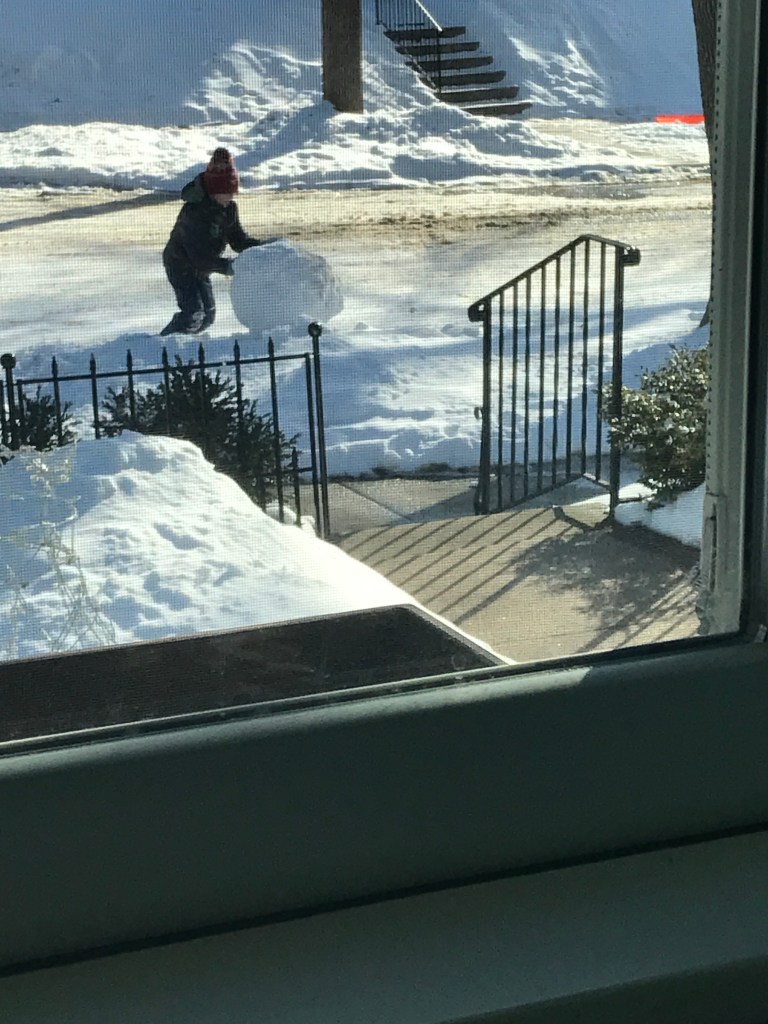
I glanced out the window of the snug and saw a struggle: boy vs snow. I noticed a path that must have started at the boy’s house a few doors away from us, and now the snowball had grown to heavy and unwieldy proportions. I have no idea what the boy’s goal or intention was, but now he faced a problem-how to roll the ball to wherever it was he wanted it to be.

He patted the snow around the big ball. He paused and looked around, hoping, I imagine, to find some of his buddies who might help. He rested, sometimes on the ball itself, but then he was right at it again, determined, it seemed, to accomplish his goal, whatever that was.

Soon he had some success and got the ball rolling, but then he was done, just plain done. At least for the moment.

Had he met his goal? Was the snowball where he wanted it to be? Did he decide to take a time-out and perhaps return the next day when he felt fresher and had a different perspective on the project? Had he changed his mind and decided whatever he had accomplished was enough? How did he feel about his efforts? Had he learned anything in the process?

Will he someday in the future remember the Sunday afternoon in February when he had a plan to roll a snowball from one end of the block to the other or to build a snowman in his friend’s front yard. Or maybe he didn’t have a plan at all. He just started rolling the ball one inch at a time. What story will he tell himself about that effort?

This simple drama outside our house seems like a window into discernment. Sometimes we start something with only a vague plan or maybe we know the outcomes we want, but we have no idea how hard getting to the finish line will be. Or maybe the goal changes as we go along, or maybe we discover we have gained valuable lessons or awareness along the way and it is time to move onto something else. Maybe the situation has changed, and it is time to evaluate the initial goal.

My thoughts return to the boy.

Maybe the boy’s inner voice whispered, “Enough, boy. I have other plans for you.”

Maybe the boy’s energy needs to be directed in other ways.

Currently, I have a big, heavy snowball in my front yard, a major project, and I don’t know what steps to take next. This is discernment time, and I am doing my best to find the balance between pushing and resting. Between looking at options and stepping away to gain perspective. Between consulting with others and listening deeply to myself and the voice of Spirit.

Tomorrow, March 2, is Ash Wednesday. The 40 days of Lent are a time to open to the yearnings God has for me, as well as the ways I yearn for God. I may or may not discern an answer to my current question by the time we sing “Alleluia!” on Easter Sunday, but I know the willingness, the attentiveness I give to the movement of God in my life will somehow grow me closer to the person I was created to be.

An Invitation: Is there something in your life now that calls you into discernment? I would love to know.

NOTE: Decision Making and Spiritual Discernment, The Sacred Art of Finding Your Way by Nancy L. Bieber (2010) is an excellent resource for the discernment process.

Book Report: Morning Meditation Basket

As promised in my recent post (Tuesday, February 21, 2022, “Morning Meditation”), today’s Book Report shares my current morning meditation and devotion materials.

My collection of materials change as I finish reading a specific book, but also as the seasons in the church year change and as my personal needs change. However, two books always remain: the Bible and a journal. I only have a few pages left in my current journal and need to choose a replacement soon. That is on this week’s list.

Here are the other books in the basket:

  • Celtic Treasure, Daily Scriptures and Prayer by J. Philip Newell. (2005). This may be the third time I have returned to daily use of this book. Right now I am focusing on chapter five, “Songs of the Soul,” but other chapters include “Stories of Creation,” “Power and Justice,” and “Letters of Love.” Each day in the seven week cycle, begins with the same words, “We light a light in the name of the God who creates life, in the name of the Saviour who loves life, and in the name of the Spirit who is the fire of life.” After encouragement to “Be still and aware of God’s presence within and all around,” Newell retells a piece of scripture and offers a prayer. The brief and simple, but oh, so lovely daily meditation always ends in the same way.

The blessings of heaven,

the blessings of earth,

the blessings of sea and of sky.

On those we love this day

and on every human family

the gifts of heaven,

the gifts of earth,

the gifts of sea and of sky.

The illustrations from the Book of Kells plus children’s drawings are lovely, too.

This book provides a framework for my meditation practice right now. I begin with the opening prayer and readings and end with the closing words.

  • The Wild Land Within, Cultivating Wholeness through Spiritual Practice by Lisa Colon Delay (2021). I first learned about this book on Christine Valters Paintner’s website, Abbey of the Arts. https://abbeyofthearts.com The author describes the book as

an invitation to explore your own flyover country. This book serves as a companion to search the inner and unseen but very real territory of yourself. As we attend to this land within, our journey will involve some issues you may know little or nothing about. There are places of rough and even terrifying terrain. We will learn what makes spiritual growth unnecessarily difficult or extra confusing. To explore this land within means encountering climate and storms, negotiating treacherous topography, and finding creatures both wounded and wild. p. 2

Delay, who is a writer, teacher, and spiritual director and originally from Puerto Rico, broadens my white cultural context with references to Native American, Black, Latinx, and others and asks me to define what have been my main influences and how those influences have affected my spiritual growth.

In an early section Delay spends time reflecting on the four soils parable recorded in Matthew 13:1-23, Mark 4:1-20, and Luke 8:4-15. I have been re-reading those pieces of scripture now myself, and using the practice of lectio divina, I ask what meaning they have for me after walking on the earth for almost 74 years. Ongoing exploration.

I am moving slowly, deliberately through this book. My plan is to read a chapter every day, but I keep returning to what I read previous days, finding more openings for learning and reflection. Chapter Five, by the way, is called “Weather Fronts,” and that seems perfect for the winter storm watch we experienced as I wrote this.

One more thing: Delay has a podcast, Spark My Muse. I have not yet listened to it, but I will.

  • The Divine Dance, The Trinity and Your Transformation by Richard Rohr with Mike Morrell (2016) It seems I always have a Richard Rohr book in my meditation basket. If I think I am reading Delay’s book slowly, I am reading this one at an slower pace. I dip into this book, reading two or three pages, when I am willing to set aside the next task.

I was first attracted to this particular book because of the cover art, the famous icon of The Trinity created by Russian iconographer Andrei Rublev in the fifteenth century. I love that icon and the mystery it draws me towards. I was also attracted to the title of the book itself.

Whatever is going on in God is a flow, a radical relatedness, a perfect communion between Three–a circle dance of love.

And God is not just a dancer; God is the dance itself. p. 27

This book will be in my basket for a long time. Oh, I also have a publication from Richard Rohr’s Center for Action and Contemplation: Oneing, An Alternative Orthodoxy. Volume 9, No. 2 focuses on The Cosmic Egg.

  • Soul Therapy, The Art and Craft of Caring Conversations by Thomas Moore (2021) This is another book I dip into when the spirit moves me. Moore’s books, especially Care of the Soul, have been important landmarks in my spiritual growth. Directed towards “helpers,” including psychologists, social workers, ministers, spiritual directors and others, the book reminds me to continue my own soul work as I sit with others doing their own soul work.
  • The Making of an Old Soul, Aging as the Fulfillment of Life’s Promise by Carol Orsborn, Ph. D (2021) I have not yet cracked open the cover of this book, but I enjoy Orsborn’s blog https://carolorsborn.com and I really liked her earlier book The Spirituality of Age. More than likely, I will report on this book later.

My basket runneth over!!

An Invitation: What books or other materials do you turn to for reflection and soul work? I would love to know.

Winter Gifts

Ice formations on top of an artesian aquifer near Maiden Rock, WI. https://www.atlasobscura.com/places/nelsons-on-rush-river

At a retreat I helped facilitate for women with breast cancer the opening activity was to declare our favorite season. The floor had been divided into four quadrants–winter, spring, summer, fall–and the women gathered in the segments. The winter space was almost as bare as tree branches in January with only 3 of the 50 participants asserting love of winter.

I was one of those three, and we three actually held hands and huddled together–and vowed to meet for hot chocolate on the coldest of winter days. Each person shared what they loved about their favorite season, and we winter people had similar feelings–the love of burrowing in, of being cozy and having more time to read and write, feeling there are fewer distractions. We expressed love for the quiet that darkness brings.

None of us talked abut loving outdoor sports, although I have such wonderful childhood memories about ice skating Friday nights and Sunday afternoons at the neighborhood rink. As as an adult I enjoyed cross-country skiing with our children and later, at Sweetwater Farm, snowshoeing on our land, noting where deer had bedded down for the night. But those activities are not the core of my love of winter.

The season allows and encourages me to access not only the deepest parts of myself, but also the barest, like those skeleton bare branches.

Winter is a time of clarification for me. I see across the landscape of my soul, unhindered by intense and varied colors and textures. Instead, there is the sweep of white, the unhidden contours of the land, the places where the earth meets the sky. I note the eagles soaring above the few places of open water, and my heart soars, too, and feels the bigness of possibility, of hope. I seek that open water, not because I yearn for the flow of water in spring and summer, but because of its uniqueness during this frozen time. It illuminates the edges, the hard places, and invites me into the deep.

I wonder sometimes if the winter season was not positioned at the end and the beginning of the year, would I feel differently about winter? How much of this intentional time to go deeper, to challenge myself is related to the reflection and evaluation as we end one year and move into another? How much is about turning the page of a new calendar, clearing the space, starting again? Hard to know, but I think I am glad the season and the new year are related.

Recently, my husband and I headed out of St Paul and drove down the Wisconsin side of the Mississippi; a drive we love no matter the time of day or year; no matter the weather. We followed the easy directions to see the ice formations we had heard about and were stunned by their magnificence and their fairy tale beauty. As we continued along our favorite route, able to see Lake Pepin’s shoreline through the bare trees and also homes on top of the bluffs normally hidden by thick foliage, but now revealed against the grey sky, we counted hawks and eagles. Six hawks and at least two dozen eagles, including four in the same tree. And swans, too, holding a convention in open water. Who would not love this, I thought.

Returning home, I felt renewed, restored, and ready for the ongoing work of this winter age of my life.

An Invitation: Sit with winter, the season, the stage of life, and allow it to speak to you. What does it say to you? I would love to know.

Book Report: The Story of Ruth by Joan Chittister

I’m always happy to spend time with Benedictine nun and theologian, Joan Chittister. I have heard her speak many times, often at the Chuautauqua Institution in New York, but other places as well, and, of course, I own and have read many of her books. I return to her The Gift of Years, Growing Older Gracefully (2008) frequently, but value many of her other titles, also, including Following the Path, The Search for a Life of Passion, Purpose, and Joy (2012); The Time is Now, A Call to Uncommon Courage (2019); The Art of Life, Monastic Wisdom for Every Day (2012); and Between the Dark and the Daylight, Embracing the Contradictions of Life (2015). Many years ago when I was preparing lectures for a weeklong retreat on spiritual friendship her book The Friendship of Women, A Spiritual Tradition (2000) was a guiding star.

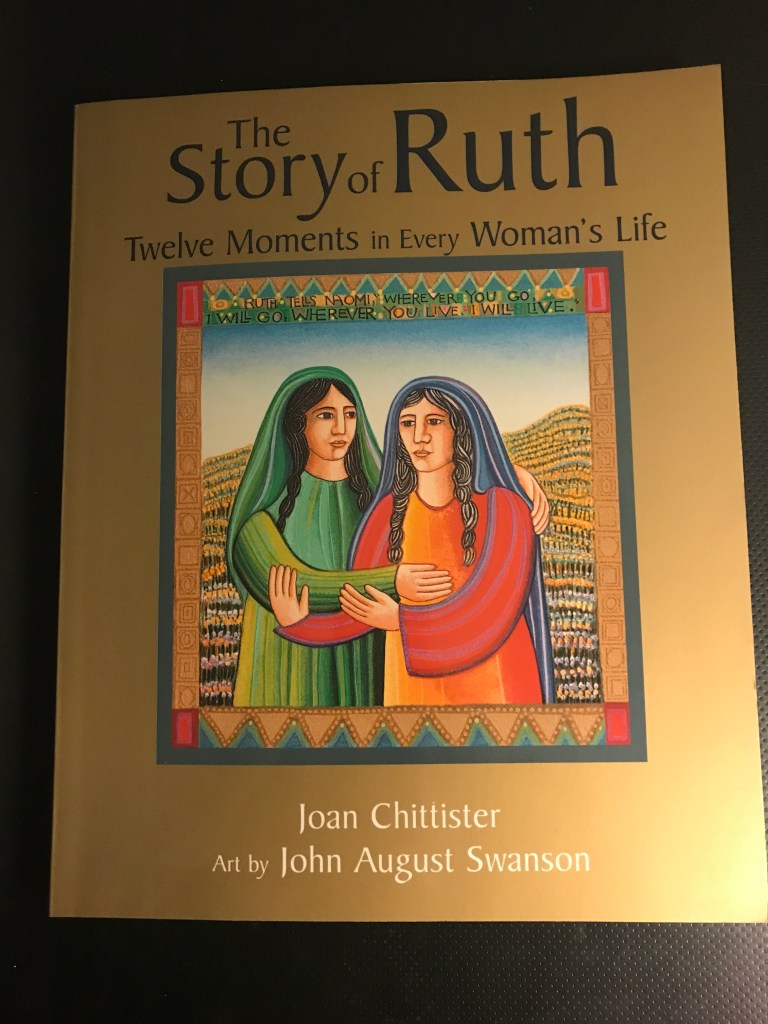
The Story of Ruth, Twelve Moments in Every Woman’s Life is a gentle and wise, but compelling reflection of the Biblical story of Ruth and Naomi. Who isn’t familiar with the verses:

Where you go, I will go; where you lodge, I will lodge; your people will be my people, and your God my God. Where you die, I will die–there will I be buried. (Ruth 1: 16-17)

I’m not sure what drew me to this book at this stage of my life. I probably read some reference to it in someone’s blog, but what a welcome companion it has been recently. How good it is to be in the company of women as they meet the challenges, or as Chittister calls them, “moments” of their lives and how God calls us to become who we were created to be.

The book leads us through the Biblical story, highlighting the ways Naomi and Ruth, mother-in-law and daughter-in-law, meet the challenges following the deaths of their husbands. Chittister relates those challenges to the challenges all women face, especially as women continue to struggle with inequality and stereotypical limitations. Each chapter examines one of those challenges, including respect, recognition, invisibility, and empowerment.

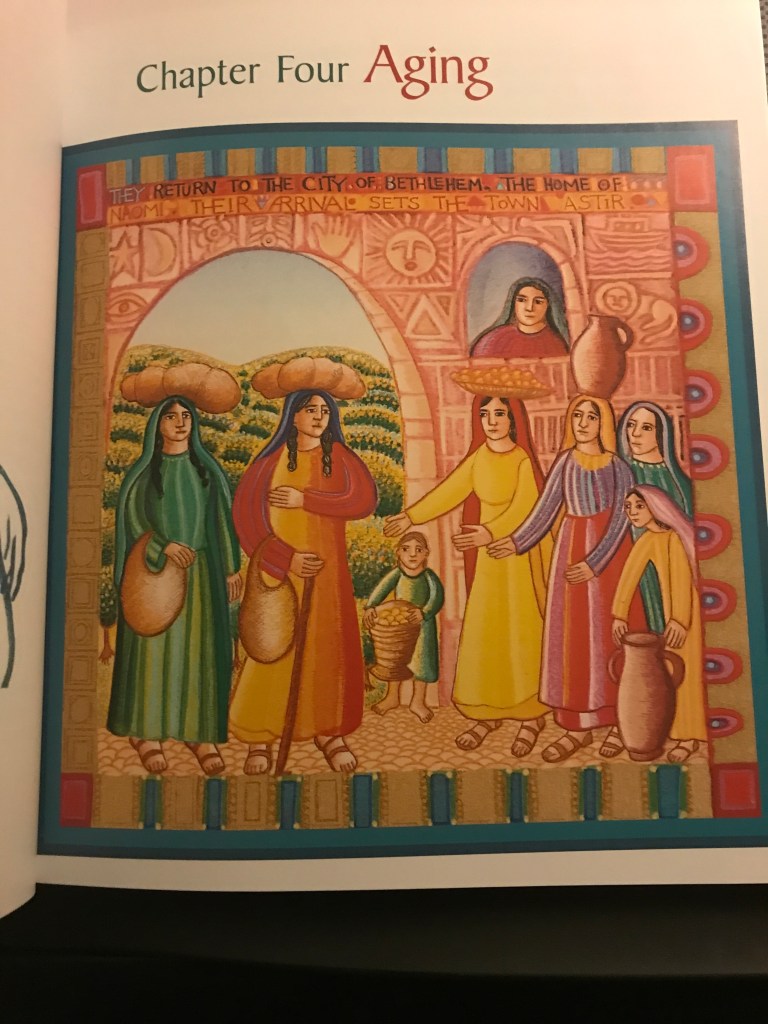
I suspect if I had read this book earlier in my life I would have been drawn to different chapters, but as a woman in her 70’s, I was most drawn to the chapters on loss, aging, and the last chapter, fulfillment. In the chapter on aging, Chittister writes:

There are lessons that come with age that come no other way. Age is a mirror of the knowledge of God. Age teaches that time is precious, that companionship is better than wealth, that sitting can be as much a spiritual discipline as running marathons, that thinking is superior doing, that learning is eternal, the things go to dust, that adult toys wear thin with time, that only what is within us–good music, fine reading, great art, thoughtful conversation, faith, and God–remains. When our mountain climbing days are over, the elderly know, these are the things that will chart the setting of our suns and walk us to our graves. All the doings will wash away; all the being will emerge. (p. 33)

And in the chapter on fulfillment:

What we do as women to bring ourselves to fullness makes the world around us a fuller place as well. (p. 87)

A wonderful bonus in the book is the art by John August Swanson.

An Invitation: What Biblical stories have new meaning for you as you age? I would love to know.

Books Added This Week to My TBR (To Be Read) List

  • The Heartbeat of Wounded Knee by David Treuer (2019). This actually is already on my list, but needs to move higher. Nonfiction
  • The Love Songs of W.E.B. DuBois by Honoree Fannone Jeffers (2021) Fiction
  • Cabin by the Lake Mystery Series by Linda Norlander: Death of an Editor; Death of a Starling; and Death of a Snow Ghost (May, 2022)

The Rhythm of Rest

I could not do one more thing. Well, of course, I could, but I would have done the next thing without focus or interest, inspiration, or energy.

The week had been full . Full of good interactions and scattered with productive writing time, but I was done, even cranky. Perhaps it was the unrelenting cold or the unrelenting pandemic, but I sagged and slumped.

Enter my Word of the Year: Rhythm.

Most of my weeks have a defined, steady rhythm. We begin the week attending church and adult forum, followed by going out for lunch where we read the New York Times. Early in the week I write both Tuesday and Thursday posts for this blog, and I prepare for the writing group I facilitate Thursday mornings at church. I tend to do the week’s grocery shopping that morning, too. Usually, on Friday or Saturday, my husband and I plan an outing–get in the car and roam.

The weeks vary depending on appointments with my spiritual direction clients and if one of the writing groups in which I am a participant is scheduled, and, now and then, there is time with friends or family. And, of course, there are the usual tasks–the laundry, the emails, the bills, the meal preparation, the home-tending. Oh, and writing time. This past week I worked on a piece to submit to a publication that has published my work in the past.

I begin my day meditating, praying, and writing in my journal, and later, I try to leave my desk by 4:00, giving myself some space to read before fixing dinner. In the evening we binge watch something on Netflix or Amazon Prime (Right now we are watching season 11 of “Vera” on BrittBox.) and read before going to bed.

By and large, these are good rhythms, but my word of the year invites me to pay attention. What rhythm calls me right now? What is the rhythm my body needs? My soul needs? Rhythm summons me to listen to my own heartbeat.

Instead of pressing on determined to check more off a list that seems to grow when my head is turned, I took a deep breath and asked, “What rhythm wants to be heard right now?”

REST. REST.

I turned off my computer, left my desk and the garret, even though it was hours before my normal 4:00 leave the office time, and I nestled in the snug with book, blanket, and a mug of hot cider. I read and I dozed. I listened to the rhythm pulsing gently around and through me, and I restored. And I gave thanks for being at a stage of life when it is possible to respond to rhythm’s invitation.

I know, appreciate, and allow my own rhythm. Each day I take some time to be in my personal rhythm.

Sue Patton Thoele

An Invitation: Do you have a word of the year? If so, how is it present in your life? I would love to know.

Book Report: January Round-Up

January has been a cold month here in Minnesota, but I have been content to stay inside and read.

Such good books. My intention was to select one or two favorite fiction titles and one or two nonfiction titles, but I could not decide which books not to mention.

Fiction

  • The Sentence by Louise Erdrich. I love books set in a bookstore, and any book written by Erdrich calls to me, so this was a winning combination. Erdrich’s actual bookstore in Minneapolis, Birchbark Books, is one of my favorites and the fictional representation of the store is just as appealing. The basic plot is that one of the employees is haunted by a customer who has died, but that is far too simplistic a description. The book is set during the pandemic and also refers to the murder of George Floyd and the days following that. I am so grateful for Erdrich’s ongoing elucidation of indigenous history, culture, and current realities.
  • Celine by Peter Heller. I read his more recent book The River and liked it, but didn’t love it. However, a favorite bookseller recommended this book to me, and the main character, a 68 year-old woman who is a private investigator, is intriguing. At first I was confused by lots of names and places and wasn’t sure where the focus was going to be, but Celine, who comes from an “old” family, wears Armani scarves when she tracks her prey, uses guns comfortably, and is married to Peter, a “Mainer” who doesn’t drive, kept me turning the pages. I hope Heller writes another book about these two. The story itself–searching for a young woman’s father who supposedly was killed by a bear in Yellowstone–is well done, too.
  • Songbirds by Christy Lefteri. Set in current times in Cyprus, where a maid, originally from Sri Lanka disappears. She has fallen in love with a man who poaches song birds and sells them to restaurants as forbidden and exotic treats. That’s disturbing enough, as it is, but even more so is the indentured servant conditions of the maids and that the main character, Nisha, is not the only one.
  • Oh William! by Elizabeth Strout. I loved this book. William and Lucy Barton were once married and had two daughters, now grown. Lucy’s second husband has died and William’s current wife leaves him. William asks Lucy to help him confront a missing piece of his life story. Lucy, by the way, is a successful writer, but feels invisible and inadequate. Ah, the mysteries of marriage and relationships and as Strout (Lucy) says, “how we lived our lives on top of this.” After reading this book, I re-read the earlier one My Name is Lucy Barton and discovered I liked it much more the second time around.
  • The School for Good Mothers by Jessamine Chan. Think The Handmaid’s Tale by Margaret Atwood. Not as chilling, perhaps, at least not on the surface, but…. Frida, a divorced mom with a young child, has a “bad day” and makes a mistake for which she is sentenced to a training school for mothers. There is a right way and a wrong way. One way. In the school she is assigned to a robotic doll to practice the right way. Ripe for a movie, I am guessing.
  • The Thursday Murder Club by Richard Osman. Set in a retirement community in the UK, a “gang” of residents meet to solve unsolved murders and, of course, get involved in a real murder (or more than one). Interesting characters with interesting backgrounds (Elizabeth was former secret service), and I am eager to read the next book in the series. I assume there will be more after #2.
  • The Phone Booth at the Edge of the World by Laura Imai Messina. This is my “wild card” of the month–a book I just happened upon. I knew nothing about it, but the summary sounded intriguing, and it was one of those books that just felt right. The plot is based on the true story of a tsunami in Japan in 2011. People who have lost loved ones come to talk to them in a disconnected phone booth at the site of the tsunami. Two of those are Yui, whose daughter and mother died, and Takeshi whose wife died. Such a beautiful story of the rhythms of grief and re-entry into life and love.
  • Mrs March by Virginian Feito. This is the least favorite novel I read this month, but I finished it. (I discarded a few others along the way.) Mrs March is married to a successful novelist, and she has many emotional problems. I got tired of the grinding perspective of her paranoia, but still there was some nice writing.

Nonfiction

  • The Inner Work of Age, Shifting from Role to Soul by Connie Zweig. I read this book slowly during my morning meditation time. Zweig’s main message is to become an Elder, which means doing the necessary inner soul work, becoming who we were created to be and embracing the hidden spiritual gifts of age. She doesn’t ignore the challenges; for example, life-changing illness, but instead urges each of us to become aware of our own shadow–the obstacle(s) that prevent our own authenticity. So much here. I added many quotes in my journal and used many of the reflection questions at the end of each chapter. This is a book to move us beyond being elderly and instead, to live our elderhood with awareness.
  • Wife/Daughter/Self, A Memoir in Essays by Beth Kephart. I have loved Kephart’s books on writing and this book gave me insight into who she is as writer and teacher, but much more beyond that. Each section was divided into snatches, short pieces, but the book didn’t feel disconnected. I did think, however, that the section on “wife” was the strongest. The book made me think about how roles change or even end, but the self remains.
  • In the Country of Women by Susan Straight. Straight is a white woman who was married to a black man from the neighborhood where she grew up. They had three daughters and even after they divorced they remained connected in healthy ways. Plus, she was very connected to his large and complicated family. I couldn’t always keep every one straight and how they were related to one another, but the weaving of the stories, the texture of the connections, like the braiding of hair, which she mentioned often, were memorable. This was an unexpected gift.
  • 16 Ways to Create Devotional Writing to Renew the Spirit and Refresh the Soul by David J. Sluka. A book to keep on my shelf for the day, if that comes, when I decide to write devotions for women elders.

It is already February 3, and I have read….sorry, you have to wait till my February Round-Up.

An Invitation: What were your favorite January reads? I would love to know.

Morning Gratitude, Morning Presence

As I make the bed first thing every morning, I pause and look out the window towards the backyard and the garage. This time of the year I know what I will see: mounds of unmelted snow, tracks from the squirrel gang that frequents the base of the bird feeder, and the bare branch remnants of my husband’s glorious garden. Maybe there will be a cardinal at the feeder, but probably not till a bit later.

I don’t stand at the window hoping to see something different. No, I stand at the window to welcome a new day, to give thanks for the light of a new day, and to remind myself to be present to this day, the new and holy day.

Soon after making the bed, but still in my robe and pajamas, I climb the stairs to the garret and settle in for meditation time. Lately, my quiet time has included listening to Cat Stevens sing one of my favorite hymns, “Morning Has Broken.” You can listen here: https://www.youtube.com/watch?v=e0TInLOJuUM

Morning has broken like the first morning;

black-bird has spoken like the first bird.

Praise for the singing!

Praise for the morning!

Praise for them, springing fresh from the Word!

Text: Eleanor Farjeon and Music: Gaelic Tune

What more could I ask for than to remember that each morning is like the first morning. Oh, if I could only live present to that gift, that morning gift, the whole day, every day.

That prayer would be enough. That prayer holds all those I love and all those unknown to me, but in need of a new day.

The words in verse three lift me even higher.

Mine is the sunlight!

Mine is the morning,

born of the one light Eden saw play!

Praise with elation, praise every morning,

God’s re-creation of the new day!

Each day is a chance to re-create the sun in my own heart, my own being. This is enough. More than enough.

I invite you to sing with me. I will stand at the window and listen for your voice.

An Invitation: What is your first view of the day? How does it help you move into the day?I would love to know.