Book Report: February Summary

February 29, 2024

How is it possible to read eight novels in one month and not be disappointed by any of them? Well, that’s my story this month. I am willing to say, however, that my absolute favorite of the month was Apeirogon (2020) by Colum McCann, which I reviewed in my post on February 22nd. https://wordpress.com/view/livingonlifeslabyrinth.com This is an important book, but you know how sometimes “important books” can feel like a slog. This one DID NOT!

Coming in with a close, photo finish second was The Bell in the Lake (2022) by Norwegian author, Lars Mytting. This book was not on my radar at all, and I am grateful for a friend’s recommendation. Set in a remote area of Norway in the 1880’s, the new pastor, Kai Schweigaard, decides a new, larger and more modern church is needed. The current medieval stave style church — wooden, timber framed– is in bad repair and besides the carvings referencing pagan legends seem inappropriate on a Christian church. The church is sold to historians in Dresden, where the church will be reconstructed, in order to preserve the stave style.

A complicating factor are the bells in the church, which are said to ring on their own at the sign of danger. And danger is on the horizon, including a love triangle: the pastor, Astrid Hekne whose ancestors had the bells cast and donated to the church–and such a story that is– and Gerhard, the artist and architect sent from Dresden to oversee the dismantling of the church. Wonderful book, and I am eager to read The Reindeer Hunters, also by Mytting.

I ended the month on a reading high. More than once while reading The Berry Pickers (2023) by Amanda Peters I felt tears forming. During the annual work trip to Maine from Nova Scotia to pick blueberries, four-year-old Ruthie goes missing. Instead of being taken seriously, clearly because the family is Indian, they are ignored and eventually must return home. The rest of the book is about what happens to Ruthie and also the stories of her family of origin. Heart-wrenching and well-written.

Along with these three I read:

  • We All Want Impossible Things (2022) by Catherine Newman. A hospice novel with hospice humor, along with an exploration of grief and loss. Well-done and not depressing.
  • The Department of Rare Books and Special Collections (2022) by Eva Jurczyk. Even though at times this book felt like some additional editing would be helpful, I thoroughly enjoyed the premise of a missing rare manuscript and the academic setting, and I hope there will be more by this author in the future.
  • Lillian Boxfish Takes a Walk (2016) by Kathleen Rooney. I read this book years ago and so enjoyed reading it again. The walk in New York City on New Year’s Eve (1984) is really a life review for Lillian now in her 80’s and such a life she has had–much more than what is on the surface.
  • Wench (2010) by Dolan Perkins-Valdez. You may have read her more recent book, Take My Hand (2022) and I liked that book, although I thought there were some some gaps, some undeveloped pieces. I think Wench, which is the author’s first book, is the better book of the two. Set in pre-Civil War, the slave owners in this story take their slave mistresses to a summer resort in Ohio. The story focuses on these women –what they endure, how they develop, and their attempts to achieve freedom.
  • Banyan Moon (2023) by Thai Thai. A totally absorbing book. Banyan House in Florida is owned by Minh, a Vietnamese woman who immigrated to the Unites States with her daughter. We learn the story of their life in Vietnam, but the main plot line is set in the U.S. When Minh dies, her granddaughter Ann returns to Florida from Michigan where she is engaged to a wealthy white man and professor who says she is “exotic.” Secrets are discovered, and relationships must be healed. Stunning writing, especially for a debut novel.

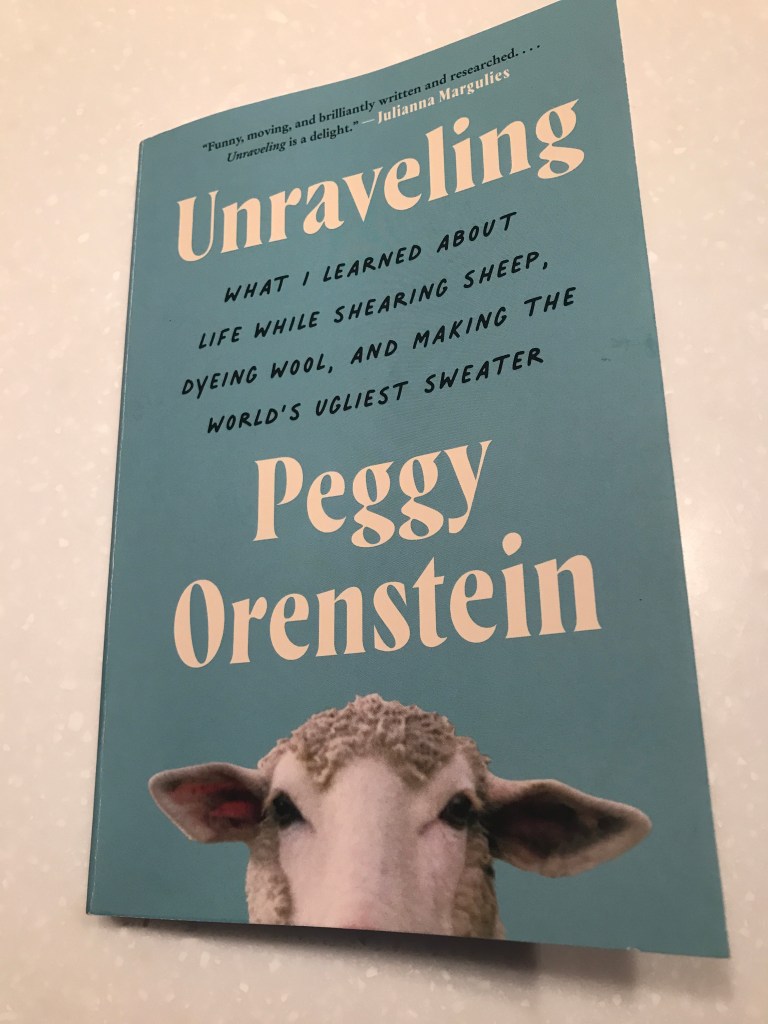
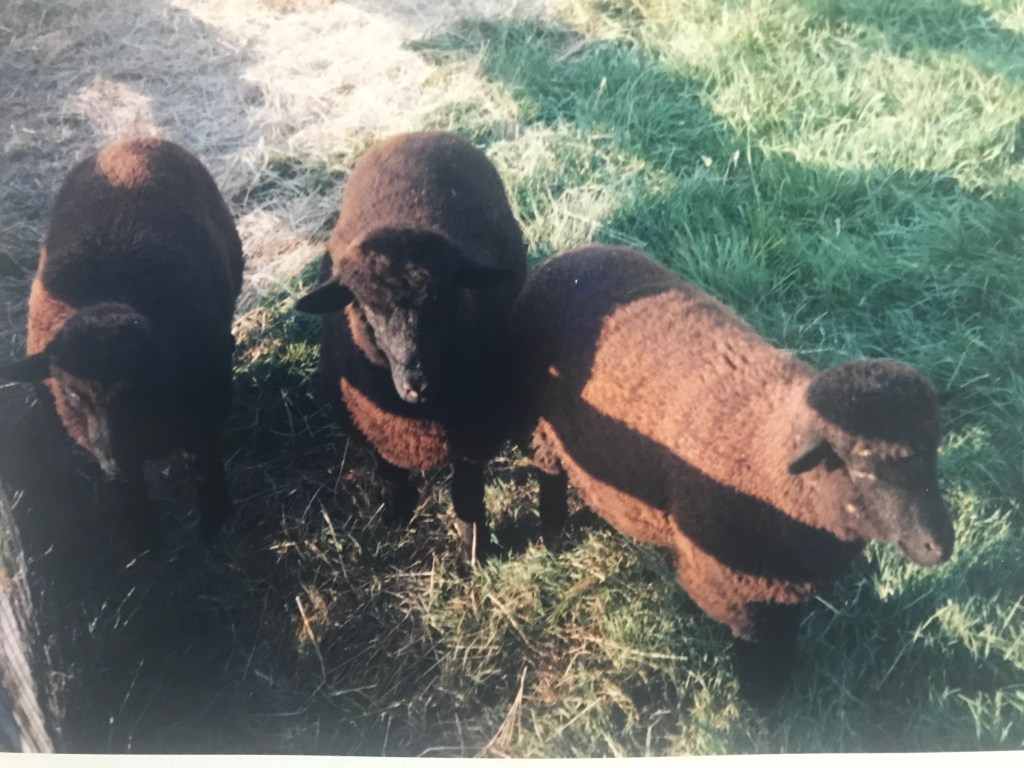
First, the fun one, but there was wisdom there, too: Unraveling, What I Learned about Life While Shearing Sheep, Dyeing Wool, and Making the World’s Ugliest Sweater (2023) by Peggy Orenstein. I reviewed this in an earlier post, in which I also told my own sheep story.

I read three books by Esther de Waal.

  • The White Stone The Art of Letting Go (2021). I had read this before, but a spiritual direction client mentioned reading it, and I decided to read it again. A chapter about “diminishment” was especially helpful as I think about these elder years. “I hope that God is going to work within my limitations.” p. 89.
  • To Pause at the Threshold, Reflections on Living on the Border (2001). I read this right before the beginning of Lent, which is one of those border times, and I especially appreciated the chapters, “Connecting Inner and Outer” and “The Time Between Times.”
  • Lost in Wonder, Rediscovering the Spiritual Art of Attentiveness (2003). The book is written as a preparation for going on a retreat, but is applicable to our everyday lives as well. At times I got lost in all the quotes from other spiritual writers and would have preferred more Esther. That is true in each of her books. However, I loved what she says about creating and living in our own cloister space. “But it is vital to see the cloister space in my own self as the pivot around which daily life revolves, the rock or anchor which holds it firmly grounded. This is what Christ meant when he said ‘Go into your room'”. p. 14

Finally, Cacophony of Bones The Circle of a Year (2023) by Kerri ni Dochartaigh. This book is a sequel to Thin Places, A Natural History of Healing and Home (2021), which I read in January. She is pregnant and it is the pandemic. “I am telling you here of a year that was like no other. I am telling you here of a year that was just the same as every other that had gone before.” p.ix. She feels deeply, struggles with depression, doubts herself, but she is a keen observer and creates links missed by most of us, I imagine.

I have a stack of books from the library:

  • The Other Mothers by Katherine Faulkner
  • Graceland by Margaret Renkl
  • The View from Penthouse B by Elinor Lipman
  • The Hero of the Book by Elizabeth McCracken
  • Commitment by Mona Simpson

And I have a stack of recently acquired books:

  • The Women by Kristin Hannah
  • The Distance Between Us by Maggie O’Farrell
  • As It Is In Heaven by Niall Williams
  • A Deceptive Devotion by Iona Whishaw (#6 in her mystery series)
  • An Irish Country Girl by Patrick Taylor
  • An Irish Country Courtship by Patrick Taylor

And I continue to read during my morning meditation time:

  • Jesus, Guide of My Life by Joyce Rupp
  • A Different Kind of Fast by Christine Valters Paintner

Happy reading!

On one of our recent roaming days we discovered a wonderful bookstore new to us–in Buffalo, Minnesota. I was especially impressed with their backlist of books. We helped the Buffalo economy! https://buffalo-books.com

If you are new to my blog, you may be interested to know that every Thursday I write about books and every Tuesday I write on spiritual topics–the ordinary and the extraordinary. Thanks for reading and I hope you will decide to subscribe and/or share my posts with others.

What did you read in February? Any gems? I would love to know.

Guiding Words for My Spiritual Practice of Hometending

February 27, 2024

Driving along the Wisconsin side of the Mississippi River this past weekend we were entertained by eagles tumbling in the sky as part of their mating ritual. We lost count of the number of hawks perched on bare branches, enjoying the view of open water and dwindling patches of ice. A glorious day for roaming, and this is one of our favorite drives.

One of our favorite stops is Cultural Cloth, a shop that represents the work of artisans from around the world. We don’t always stop there because we know how dangerous and tempting it can be, but the landscape has been so brown and grey this winter, a shot of color would be welcome. (See what I did there!)

We laughed and wished each other “Happy Anniversary” (Our anniversary is in August!) as we carried our latest purchase, a gorgeous rug made in Guatemala, to the car.

We fell in love with the colors of this kilim style rug woven in the Mazir-Sharif regions of Afghanistan. Their rugs are woven from scraps of yarn left over from the production of their pile-woven rugs. And I knew exactly where it would go–in our entryway.

Once home I folded the rug already in the entryway, which we had purchased from Cultural Cloth the last time we were there, and I placed the new rug in front of the door. Lovely. Welcoming and happy.

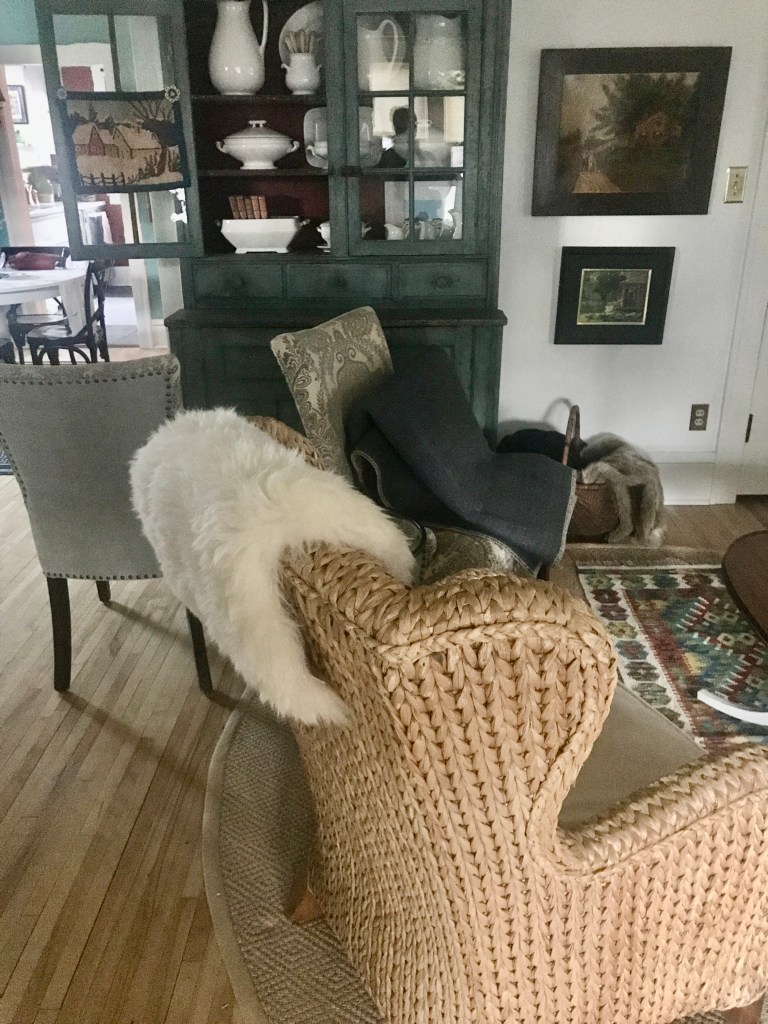
But then I wondered what it would look like in the living room area on top of the sisal rug–a shot of color. Why not try that?

Perfect! I liked it there even better.

And that’s when my delight in change took over. My impulse to rearrange. And one thing led to another.

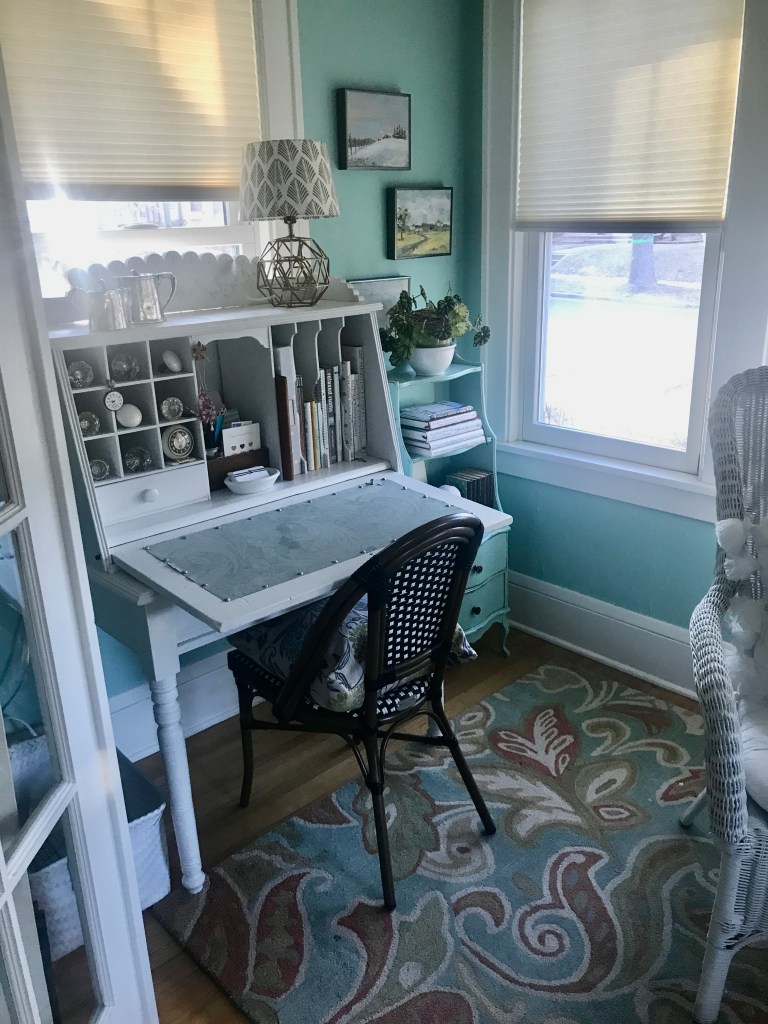
How would the more informal looking rattan chairs in the snug look in the living room? But then what would I do with the existing chairs, for they didn’t seem right for the snug? Ah, how about moving the chairs from the garret to the snug? Well, you get the idea. One thing leads to another.

The spiritual practice of hometending reminds me that nothing is static. Nothing stays the same, and being in the present moment leads to the next present moment. I allow myself to imagine how the present moment can look a bit different with just a bit of imagination and an openness to try something else.

One thing leads to another.

Fulfilling the vision takes work, and in this case it was moving around three sets of chairs and two tables and lamps and pillows and a desk and more. And as long as everything was in turmoil why not clean the ceiling fan in both the snug and the kitchen. Yes, why not? (Thanks, honey!)

That doesn’t happen in one fell swoop, and before the picture could be complete, things definitely looked worse before they got better. I had a vision, true, but I really didn’t know if it would all work in a pleasing way. The unknown remained unknown until most everything was in place.

Spiritual hometending reminds me that we may want to and, in fact, decide to cross a threshold, and we may know why we are doing that and have some idea of what is ahead, but not completely. We can’t see it all. There will be twists and turns on the path ahead, sometimes requiring trust and courage. When facing a decision, my husband and I often pose as part of the discernment process the question, “What’s the worst that can happen?” In this case, if we didn’t like how it turned out, we could move everything back the way it was. A loss of a day and some energy, yes, but nothing life threatening. We decided it was worth the effort.

I raided the pillow closet and opened up cupboards. I piled up books on tables and moved this here and that there. I thought I might need to buy new lamps, but then remembered the lamps in the guest bedroom, and sure enough, they added just the needed touch of color.

Spiritual hometending reminds me that so often, most often, I have what I need, if I am willing to open my eyes and my heart. At the same time I could not have accomplished the new look without the help and the support of my husband. Hometending–and all of life, often means knowing when to ask for help.

And, of course, what I most need to remember is that my inner house is grounded in the love of God, knowing, no matter what, I am beloved by God.

As I thought about words I often say, I remembered some of my parents’ guiding words. My father often said, “Your day will come.” How frustrating that was to hear sometimes, when whatever I wanted to do or have was denied, but I now hear the hope in that and even the joy in that.

My mother often said–just when conversation was becoming interesting–“Now we are just going to have happy talk.” She did not like disagreements or conflict, but now I also hear something else in her statement. Gratitude for what we have, including the love we have for one another. A desire to lift our lives with optimism.

Guiding Words are meant to lead, to open our hearts to possibilities, to offer direction without locking us into only one way of thinking or being. May it be so.

What words guide you? I would love to know.

NOTE: Cultural Cloth is in Maiden Rock, WI. https://culturalcloth.com

Book Report: Apeirogon by Calum McCann

February 22, 2024

Excuse me if I sound a bit breathless, but I just finished reading Apeirogon by Colum McCann, and it is stunning, superb. I had not heard of this book, which was published in 2020, but then in the last couple months a good friend, who is one of my most reliable book sources, and another someone, whom I can’t recall, mentioned this book. I added it to my TBR list and then during a recent bookstore indulgence, there it was.

First order of business: What is an “apeirogon”? Is it a person, place, or thing? A made-up word?

Apeirogon: a shape with a countably infinite number of sides.

Countably infinite being the simplest form of infinity. Beginning from zero, one can use natural numbers to count on and on, and even though the counting will take forever one can still get to any point in the universe in a finite amount of time.

p. 82

Make sense? No, I don’t really understand it either, except that this book challenged me to open to more possibilities, more sides, more understandings than I could imagine.

Set that aside for the moment.

The story, based on a true story: Bassam Aramin is Palestinian. Rami Elhanan is Israeli. They each lose a daughter to violence. Abir is killed in 2007 by a rubber bullet when she is ten, and Smadar is 13 when she becomes the victim of suicide bombers in 1997. These bereft fathers meet and decide to share their stories, which they do over and over again and all over the world. Their core message, which is repeated multiple times, is “It will not be over until we talk.”

The story is moving, as is the wisdom because of the story.

Rami says:

The first choice is obvious: revenge. When someone kills your daughter, you want to get even. You want to go out and kill an Arab, any Arab, all Arabs, and then you want to try and kill his family and anyone else around him, it’s expected, it’s demanded. Every Arab you see, you want him dead. Of course you don’t always do this in a real sense, but you do this by asking other people to kill this Arab for you, your politicians, your so-called leaders. You ask them to slam a missile into his house, to poison him, to take his land, to steal his water, to arrest his son, to beat him up at the checkpoints. If you kill one of mine, I will kill ten of yours. And the dead one, naturally, has an uncle or a brother or a cousin or a wife who wants to kill you back and then you want to kill them back again, another ten times over. Revenge. It’s the simplest way. And then you get monuments to that revenge, with mourners’ tents, songs, placards on the walls, another riot, another checkpoint, another piece of land stolen. A stone leads to a bullet. And another suicide bomber leads to another air strike. And it goes on and on. And on.

p. 220

Bassam says:

You see the Occupation exists in every aspect of your life, an exhaustion and a bitterness that nobody outside it really understands. It deprives you of tomorrow. It stops you from going to the market, to the hospital, to the beach, to the sea. You can’t walk, you can’t drive, you can’t pick up an olive from your own tree which is on the other side of the barbed wire. You can’t even look up in the sky. They have their planes up there. They own the air above and the ground below. You need a permit to sow your land. Your door is kicked in, your house is taken over, they put their feet on your chairs. Your seven-year-old is picked up and interrogated…Most Israelis don’t even know this happens. It’s not that they’re blind. They just don’t know what is being done in their name…They can’t travel in the West Bank. They have no idea how we are living. But it happens every day. Every single day…

It’s a tragedy that we need to continually prove that we are human beings. Not only to the Israelis, but also for other Arabs, our brothers and sisters, to the Americans, to the Chinese, the Europeans. Why is that? Do I not look human? Do I not bleed man? We are not special. We are a people, just like any other.

pp. 236-237

The structure in the book is almost a character itself. The whole of the book is made up of small numbered sections. Some are only a line long and others a page or two. The content of these sections is not only the basic story, but also references to nature and art and philosophy and history and literature and other peoples’ stories–all suggesting the interconnection of everything and everyone. And not once did I feel bored. Not once did I wonder when the “real” story would continue. Did I understand every reference? No, but I was always intrigued.

But here’s how the plot is even more unique. In the first half the book the sections build from #1 to #500. Then there is a section #1001. Only much later does the reader understand the significance of that number. Then the section numbers decrease from #500 to #1. And sometimes a section in one half of the book is related to the same number in the other half of the book. I kept wondering if the author had a huge dry erase board where he kept track of the content. This method did not feel contrived or created for its own sake. Instead, it added to the interconnection of everything and everyone.

This is a novel for our time and one that contributes in a deep and powerful way as a way to understand, if that is possible, the current chaos.

I feel a need to fast before opening another book. I probably won’t do that, for my reading addiction is always present, but I do know this book will preoccupy and even haunt me.

What books have haunted you long after you’ve read them? I would love to know.

Lenten Overload

February 19, 2024

“Ash Wednesday was almost a week ago and yet, I still don’t feel settled into Lent.”

That’s how my February 28, 2023 post began, and the sentiment expressed there fits me this year, too. https://wordpress.com/post/livingonlifeslabyrinth.com/1780,

I felt prepared for Lent this year. I really did. After all, I had consulted my list of Lenten meditation books in my personal library and gathered some key ones. In addition I ordered two new books (of course)–Jesus, Guide of My Life, Reflections for the Lenten Journey by Joyce Rupp and A Different Kind of Fast, Feeding Our True Hungers in Lent by Christine Valters Paintner.

I even thought about a specific Lenten practice to note daily in my journal people, places, and things as a way to increase my awareness and become more present. Have I done that yet? Nope. Not really.

Instead, I feel overwhelmed.

My email inbox is full of beautiful and meaningful Lenten reflections –Joan Chittister, Richard Rohr, Nadia Bolz Weber, Diana Butler Bass, Steve Garnaas, Rosemary McMahon, Oasis Ministries, and others. And I am tempted by other new books: Field Notes for the Wilderness by Sarah Bessey, You Are Here: Keywords for Life’s Explorers by David Steindl-Rast, The Eloquence of Silence by Thomas Moore, Beguiled By Beauty, Cultivating a Life of Contemplation and Compassion by Wendy Farley, and Being Here: Prayers for Curiosity, Justice and Love by Padraig O’Tuoma.

Even the New York Times’ Sunday opinion section had an essay about Lent, “What We Give Up Makes Us Who We Are by Molly Worthen.

So many thoughts. So many suggestions.

So much to read.

What to give up? What to add on? So many ways to think about this time of the church year and about this season of my life. So many more items for my To Do list.

Time to back up.

First, I thought about the meaningful Lenten practices of recent years — lightening my physical load. For two years I challenged myself to let go of books in my spirituality and theology library–at least one book each of the 40 days of Lent. How good that felt and how that has become part of my ongoing practice. I no longer need to keep every book that enters the house.

Last year I extended that ‘letting go” to a big stack of magazines I have kept. I paged through each issue, saving some articles or images to perhaps use with the writing group I facilitate. The only complete issues I kept were the ones in which an essay I had written had been published. Do I miss them –not at all?

So is there any other THING that needs decluttering? Ah yes. At the beginning of this year I decided to begin two projects.

  1. To finally go through all our photos–sort, organize, order and even compile some of them into thematic Shutterfly books.
  2. To reread all my journals, beginning with my first one from 1976, and decide what to do with them.

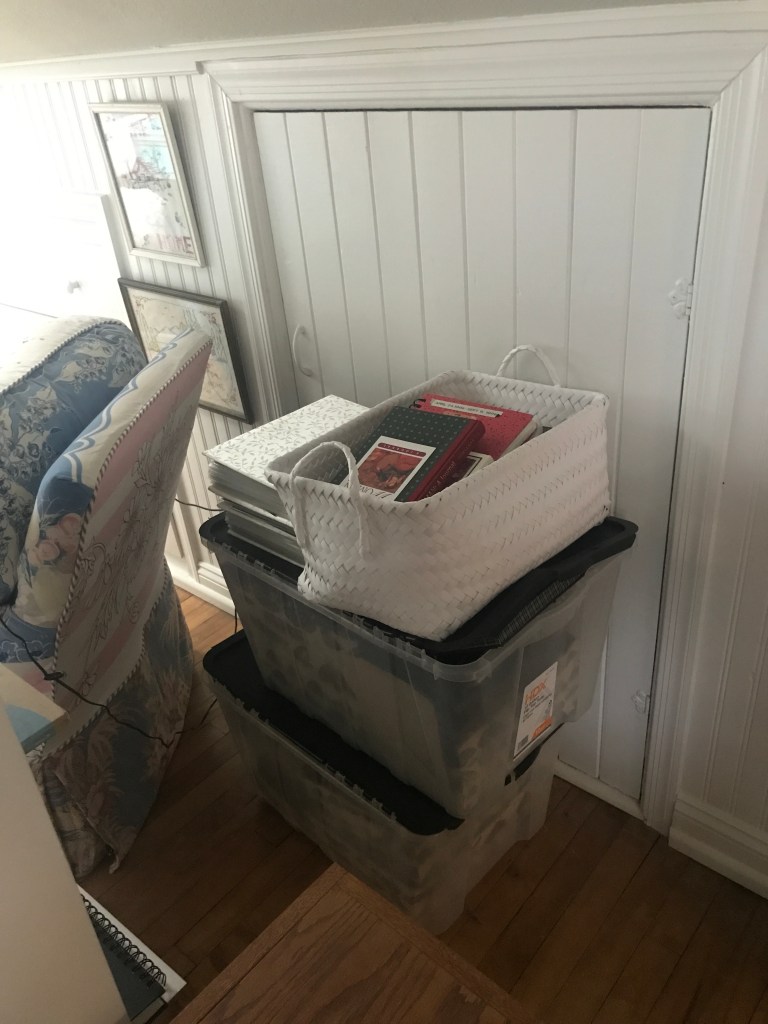
What have I done on those two projects? Well, the above picture is the extent of my work so far. I have gathered the bins of photographs and some of the earliest journals. They are partially hidden behind my comfortable chair in the garret where I can see them from my desk.

They are calling me, beckoning me.

I hunger to respond to them.

I yearn to let go of what is no longer needed.

Ah, my Lenten practice. To enter into these projects with contemplation and reflection. With my heart and soul. To pay attention to the movement of God in my life, as reflected in my inner voice. To approach these projects as more than physical decluttering and clearing of space. Instead, I hope to let go of what clutters my heart and mind.

I recognize these projects will take much longer than the 40 days of Lent, but this is a set-aside time to begin that journey.

To do that, however, I do need to let go of the need to read everything that comes into my inbox or to order all the titles that entice me or even to respond to all the worthy ideas and suggestions about approaches to Lent that come my way. I need to leave my meditation space a little sooner and take that contemplative attitude back into the garret where my projects await.

Finally, I need to be gentle with myself. I am aware that moving into the new year now takes a bit longer, and movement from winter to spring is always challenging for me. Perhaps this slower pace is my new normal.

And I need to remember that my word for the year is enfold/unfold. Lent will enfold me and Lent will unfold.

Stay tuned.

What spiritual practice is calling you? What yearning is beckoning you? I would love to know.

Book Report: Unraveling, What I Learned about Life While Shearing Sheep, Dyeing Wool, and Making the World’s Ugliest Sweater by Peggy Orenstein

February 15, 2024

Some in my family may argue that I read this book only to have an excuse to share my story about wrestling a sheep. (Do I have your attention?) Well, that may be at least partially true, but I also recognized the author who has written important books about young people in today’s culture, such as Girls & Sex, Boys & Sex, and Don’t Call Me Princess, and I knew I would learn something new and more than likely would appreciate the ride.

We are beginning to see books appear about the pandemic and/or written during the pandemic, and Unraveling by Peggy Orenstein is one of these books. Orenstein is a SLFHM (She learned from her mom.) knitter and during the pandemic she decided to experience the whole process from sheep to sweater. While there were too many details along the way for me, I did enjoy her reactions to each phase of the process. In addition, Orenstein shares her own life with the reader–feelings about a daughter ready to head to college, the ongoing grieving of her mother’s death, and the decline of her father. “I realize I am beginning a shift in my perspective from thinking about old age as a daughter…to reckoning with it for myself.”

As I said, at times all the details, especially since I am not a knitter and in fact, am not a craft kind of person at all, led me to skimming the text, rather than reading carefully. However, I will share one detail. About the color blue. Over the years both Republicans and Democrats tried to claim the color blue probably because “red” seemed related to communism, but in 2000 both USA Today and the New York Times used red for the Republicans (both words–red and Republican start with “r”) and blue for Democrats on the election coverage maps. Voila!

Ok, I promised you my story about wrestling a sheep.

Meet Wynken, Blynken, and Nod.

Once upon a time my husband and I lived at quite a magical place in the countryside outside of Cleveland. The original owner, Asa, was given the land for his service in the Revolutionary War, and in 1997 we became stewards of Sweetwater Farm, following a long line of previous owners. My husband, who worked full-time as a hospice physician and medical director decided having a hobby farm was just what he needed as an antidote to his days of death and dying.

I had always been a city girl, but I admit I fell prey to the charms of our country life. However, as Bruce added animals to the menagerie (llamas, goats, chickens, dog, cats, potbellied pig, donkey, geese named Cyd, Charise, and the sister Clarise, and of course, sheep) I was clear that the care and feeding of such animals was HIS responsibility.

Why was it then that the animals always seemed to escape when he wasn’t around?

One morning, as was my usual routine, I was sitting in my office in the front of the house, which faced the road, reading my devotions and meditating. I was disturbed by cars honking. Unusual. I looked out the window and saw a sheep on the road. One of our sheep.

I knew it had to be Blynken, for she had been sick, and Bruce had isolated her, confining her to the barn where he had piled up bales of hay to create her own healing space. Well, she apparently had recovered, and Bruce apparently had not closed the barn door all the way after feeding her before leaving for work. “Freedom,” thought Blynken.

Fortunately, I was dressed and not still in my pajamas, and I charged out the front door. By that time Blynken was running in the ditch. I headed after her. Now what you need to know about me is that I am not a runner, a sprinter, a pole vaulter. In fact, exercise is never my first or even second choice. I am a reader. But I booked after Blynken and somehow managed to catch up to her. Perhaps I was channeling our son who had played football in high school, but my adrenalin racing, I tackled that bundle of chocolate.

Now what? There I was — in the ditch flat on top of a bleating sheep.

Here’s the God-thing: A woman driving home after working the night shift at the hospital not far from us saw my plight. Blynken and I were hard to miss. She stopped and amazingly, she was driving a stationwagon and even more amazingly, she didn’t just laugh at me, but she jumped into action. She opened up the back of her car and between the two of us we managed to lift that blankety, blank sheep into the car.

I have no memory of our conversation–we were probably too out of breath — as we drove the short distance to our garage where there was an indoor dog pen. A new home for Blynken!

I know I thanked her profusely (and later found out from the hospital who she was–and sent her flowers), but she acted as if the Sheep Olympics were an every day occurrence in her life. I think we won a Gold Medal.

Oh, and best not to repeat the words I had with my beloved husband when he got home.

What have you read lately that reminded you of something that happened in your life? I would love to know.

Approaching Lent With Our Hearts

February 13, 2024

Tomorrow is Valentine’s Day.

Tomorrow is Ash Wednesday, the beginning of Lent.

As a friend pointed out, Lent is integrated into VaLENTine’s Day. Don’t you love it when someone gifts you with a new realization?

On Valentine’s Day we honor the love we have for one another. The special ones in our lives, for sure, but the day can also remind us of the loved ones no longer physically present in our lives. And the legacy of love we can leave beyond our own deaths.

And that brings us to Ash Wednesday when, using ashes, the sign of the cross is made on our foreheads. Ashes to ashes. Dust to dust. One of my pastors teasingly suggested, instead of a cross, how about a heart? I chuckled, but the connection between the cross and love felt real.

Think about all the scripture passages that include the word “love.” For example, how many weddings have you attended in which the following passage is quoted?

Love is patient; love is kind; love is not envious or boastful or arrogant or rude. It does not insist on its own way; it is not irritable or resentful; it does not rejoice in wrongdoing, but rejoices in the truth. It bears all things, believes all things, hopes all things, endures all things.

Love never ends.

I Corinthians 13: 4-8

The cross of ashes on my forehead can be a reminder of all those characteristics. Lent can be a time to become even more aware of the role of love in my life and how I might live that life every day. Lent as a time of contemplation invites me to become more aware of the presence of love, God’s love, and when I can be an instrument of love.

No surprise–I have chosen a book to companion me during Lent. This year Joyce Rupp’s Jesus , Guide of My Life, Reflections for the Lenten Journey is on the top of my devotional basket. I selected this book, because, well, because the author is Joyce Rupp whom I can trust to stretch me, but always with a sense of lovingkindness. I will also dip into a new book–so new it hasn’t arrived yet–by Christine Valters Paintner, A Different Kind of Fast, Feeding Our True Hungers in Lent.

And I have been preparing for Lent by reading Lost in Wonder, Rediscovering the Spiritual Art of Attentiveness by Esther de Waal. This book reinforces my thoughts about a Lenten daily practice I’ve been considering in which I will note in my journal People, Places, Things as a way of increasing my awareness and becoming more present. De Waal states the purpose of the book is to “awaken us from drift and drowsiness into a fuller and deeper sense of attentiveness to the world around and to the presence of God in that world.” (p. 1) I need that right now. She also stresses the need to balance looking inward and “looking outward beyond the self to the world around.” (p. 2)

One tool she suggests is a magnifying glass as a way to “take time and notice what you see.” I happen to have two small magnifying glasses–where they came from and why I have them, I have no idea–but I think I will carry one in my coat pocket to use when I go for walks. And the other one I will keep at home, not only to examine more closely familiar objects in my everyday life, but also as a tangible reminder to focus, to pay attention, to live with gratitude for the many gifts in my life. Not just what I see, but what enters each of my senses.

I feel ready to begin this Lenten journey, but first I will eat some Valentine chocolate.

Lent, of course, is a season in the Christian life, but a practice of paying attention is an invitation for all. What are you noticing these days? I would love to know.

Book Report: Lillian Boxfish Takes A Walk by Kathleen Rooney

February 8, 2024

I’m not sure what inspired me to re-read this 2016 book, Lillian Boxfish Takes a Walk by Kathleen Rooney, but there it was on my TBR list, and when, during a recent visit to a favorite bookstore, Excelsior Bay Books, Excelsior, MN, I spotted it on the shelves, I couldn’t resist the stunning cover. True, 85 years-old Lillian is described as wearing a mink coat on her New Year’s Eve walk in New York, but still, the artist captured Lillian’s essence.

What didn’t capture the essence of the book, at least for me, were some of the back cover snippets of reviews written when the book was first published. I thought it was amusing, rather than “hilarious” or even “funny.” That is not a bad thing, however. Nor did I resonate with the focus and emphasis in some reviews on New York City presented over time. The view is of Lillian Boxfish’s life with the city as a backdrop. In some books place is clearly one of the main characters, but that didn’t feel true for me in this book, except perhaps for the ongoing reference to her work as an advertising writer for R.H. Macy’s.

I do agree, however, with the reviews describing the book as “elegantly written,” and “touching.” And “witty.”

It is 1984 and Lillian has reservations for herself on New Year’s Eve at a favorite restaurant not far from her apartment. That walk turns into over 10 miles of walking and not always in the best parts of the city. Along the way she meets a variety of people, including Skip who drives a limo and is concerned for her safety (In fact, everyone she meets is worried about an elderly woman walking alone at night.) She dismisses their concern and continues on her way, charming everyone she encounters, including a family who invites her to join them for dinner and three young thugs whose intention is to rob her.

Her story unfolds as she walks–her stellar career, which began in the 1930s, in advertising, eventually becoming the highest paid advertising woman in the country, a published and popular poet, but also the darker sides of her life. I remember the first time I read this book not being prepared for that aspect of her life, but this time I picked up on the clues along the way. And while I am not yet 85, I am more aware as I continue to age that there are dark sides in each of our lives.

The reviews also, rightly so, honor the book for its illumination of the power of human connections.

There is always a danger in re-reading a book that you have enjoyed the first time. Will it live up to those earlier impressions? This one did, and I am glad I spent more time with Lillian.

What have you re-read recently? How did the second time around measure up for you? I would love to know.

I enjoyed this article on reading lists. https://www.washingtonpost.com/books/2024/01/26/keeping-yearly-reading-lists/?utm_campaign=wp_book_club&utm_medium=email&utm_source=newsletter&wpisrc=nl_books

Ask for What You Need and Offer What You Can

February 6, 2024

Several times in the past week I have quoted Christina Baldwin‘s simple, but oh so wise words:

Ask for what you need and offer what you can.

from The Seven Whispers, Listening to the Voice of Spirit.

I don’t recall the specific circumstances when I shared those words, but I know when a piece of wisdom is on my lips that it is meant not only for the person receiving it, but it is for me, too! Probably most strikingly for me.

Recently, I received two emails about ways I have volunteered in the past at my church. One was fixing and bringing a meal to individuals and families during times of stress or need, and the other was about being part of the hospitality team, serving at receptions etc. Did I want to continue participating in those ways?

I didn’t respond immediately, but instead I considered both of those ongoing opportunities during the next couple morning meditation times. In the meantime a request addressed to the whole congregation came, asking for helpers during the potluck before the annual meeting. Also, the weekly newsletter, as always, listed a wide variety of ways volunteers are needed in the church and in the larger community.

Oh, how tempting it is to spontaneously say, “I can do that.” And sometimes that is exactly the right thing to do. Sometimes that is the most genuine of responses. An expression of being in the present moment.

But as I age I am more aware of what makes most sense for who I am now. What are the ways I am called to use my energy, my time, my gifts? How does saying “yes,” affect other “yeses” in my life? The answer isn’t always clear, but what I am learning is that I need to honor the main ways I have committed to serve; the ways I feel I can best serve right now. Writing posts for this blog twice a week is one way, but also meeting with my spiritual direction clients and preparing for and facilitating the writing group I lead at church.

I don’t list these activities in a “look at me” way, but rather to remind myself of the importance of knowing what I can offer, how I can live my essence and in what ways I continue to discover the person God created me to be. These ways may change, probably will change, as I grow older, which reminds me of what Esther De Waal says in the chapter, “Diminishment” in her book The White Stone, The Art of Letting Go, “I hope that God is going to work within my limitations.” p. 89.

How did I respond to the various requests? I decided to step away from the two specific queries, thanking the people who lead those efforts. I didn’t I step up to help with the potluck either, but perhaps my “not this time,” left space open for someone else to say, “Yes I can do that.” Just a thought. 

My plan and hope is to continue to exercise “sacred yes, sacred no;” to practice discernment as opportunities arise.

And finally, this must be said. I am aware more and more every day of the need to create spaciousness for time with family and friends.

Well, I don’t know about you, but this is harder for me. Asking for what I need feels riskier. The notion of asking for what I need feels like I am declaring my inadequacy and vulnerability. EEEK! Baldwin says that asking for what we need is as much a spiritual practice as offering what you can. Asking for what we need is a way to pay attention, to be aware of the changes in our lives, and, in fact, it is part of becoming the person we were created to be. I often ask myself, “What is possible right now?” and sometimes the answer means asking for someone else and their gifts and time and energy to enter my life.

Baldwin says asking for what we need and offering what we can is a form of “spiritual trading” and that spiritual trading “creates flow.”

As long as the energy is flowing and cyclical, there is enough to go around. If any one of us stops asking or stops offering, the flow is disrupted and the balance destroyed.

p. 71

Be brave enough to ask fir help when you need it. There is no merit badge for Doing All the Hard Things Alone. Reach out.

Maggie Smith

How are Christina Baldwin’s words, “ask for what you need and offer what you can” showing up in your life right now? I would love to know.

Thanks for all your kind words about my recent guest essay, “Living with a Sacred Object, The Humble Harvest Table,” in Christine Valters Paintner’s Abbey of the Arts. If you haven’t yet read it or would like to share it, here is the link. https://abbeyofthearts.com/blog/2024/01/24/monk-in-the-world-guest-post-nancy-l-agneberg-4/

BooK Report: January Summary

February 1, 2024

15 Books: 11 Fiction and 4 Nonfiction

  • Absolution by Alice McDermott. (See January 11th post) I keep thinking about this book–the story, the characters, the exquisite writing.
  • The Heaven and Earth Grocery Store by James McBride. Another memorable book. The time is the 1950s and is mainly set in small town Pennsylvania where immigrant Jews and African Americans live side-by-side, but often not easily or comfortably. So many strong characters and making them come alive on the page is one of McBride’s strong suits. He describes one of the characters this way, “Chona had never been one to play by the rules of American society. She did not experience the world as most people did. To her the world was not a china closet where you admire this and don’t touch that. Rather, she saw it as a place where every act of living was a chance for tikkun olam, to improve the world.” p, 275.

I was surprised I enjoyed both of these books so much because in both cases the language was often off-putting and the amount of references to sex could have become tiresome, but in both cases the characters interested me, sometimes intrigued me, and I entered cultures not familiar to me.

  • Olga Dies Dreaming by Xachitl Gonzalez. Olga is a successful wedding planner and her brother is a progressive New York Congressman. Their mother left them at an early age to return to Puerto Rica where she led a revolutionary movement. The brother and sister both pursue the American dream in their own ways and are distracted from their values and ideals along the way. I learned so much about Puerto Rican history and economics, especially since much of the book is set at the time of Hurricane Maria.
  • Girl, Woman, Other by Bernardine Evaristo. One of the things that intrigued me about this 2019 Booker Prize novel was its style. Each chapter, which focused on one woman at a time, was written almost as a poem. Sometimes I found myself reading sections aloud, for the rhythm and the flow seemed to demand that. I wonder what the audio version is like. And in each chapter there was only one period–at the end of the last sentence. I know some reviewers found that technique to be too much, but I loved it. I felt as if I was in an unending conversation, especially as connections between the women were developed. Not one woman was perfect, not even close, but I appreciated their complexity, as they somehow surmounted deep loss, sexism, and racism in their lives. And the insights into gender and language were revealing as well. A favorite line comes at the end of the book, “White people are only required to represent themselves, not an entire race.”
  • Murder Most Royal by S. J. Bennett. I gave this book to my husband for Christmas, knowing full well I wanted to read it myself. I had enjoyed other books in the series, The Windsor Knot and All the Queen’s Men. Who can resist a mystery where Queen Elizabeth II is one of the main characters? It is not necessary to read these books in order, by the way, and the next one, A Death in Diamonds, will be published soon.
  • A Sorrowful Sanctuary, #5 in the Lane Winslow Series by Iona Whishaw. This series is set in Canada soon after the end of WWII. Lane is a young woman who immigrates to Canada from the UK after her service in the war. She seems to always be on the scene after a murder and therefore, develops a relationship with police detective, Inspector Darling. Easy and charming, and each one seems to get better and better. I do recommend reading these in order. The first one is A Killer in King’s Cove.
  • The Caretaker by Ron Rash. This author has written many books, but he was new to me. I don’t have his other titles on my TBR, but I don’t discount the idea of reading more. Jacob returns from the Korean War badly injured. His controlling parents have told him that his wife and baby have died in childbirth, and they have told her that he died in the war. Suffering ahead! The caretaker is Blackburn Gant, Jacob’s close friend, and his story of love and loss is just as important in the book.
  • The English Experience by Julie Schumacher. (See my January 25 post) How grateful I am to have read a book with humor this month. At the same time there was warmth and insight. This is Schumacher’s third book with an academic setting, but you don’t need to be an academic to enjoy them. The other titles are Dear Committee Members and The Shakespeare Requirement.
  • My Lover’s Lover by Maggie O’Farrell. You may have read Hamnet and/or The Marriage Portrait, more recent books by O’Farrell –each of them so good. Well, she has quite the backlist, and I have been reading and enjoying them. My Lover’s Lover was her second novel, published in 2002. One review says this book “brilliantly describes how old relationships can haunt new ones.” A Key word: haunt. Lily feels haunted by her boyfriend’s former lover Sinead and is determined to learn the truth about their relationship. While this book is not as good as O’Farrell’s more recent books, one can see the powerful writer she is becoming. I only have one more of O’Farrell’s books to read, The Distance Between Us.
  • A Song Over Miskwaa Rapids by Linda LeGarde Grover. I wish I had listened to this book, for I would love to hear the Ojibwe words. The story wasn’t always easy to follow, for the ancestry, so important to the story, was sometimes confusing to my white context. It was worth the effort, however, and I loved the chorus of spirit women who observed and commented as the story progressed. A body is found buried in a state park 50 years after the fact. How and why that happens has many threads–all beautifully and sensitively written.
  • The Wildest Sun by Asha Lenmie. I never grew to care for the main character Delphine because she was whiney to the end. I grew weary of her saying “I am sorry” and feeling sorry for herself because she had a terrible childhood. Her mother always told her that Ernest Hemingway was her father and she goes to Cuba to meet him. Enough said.
  • The Comfort of Crows, A Backyard Year by Margaret Renkl. I LOVED this book, not only for its wondrous,lovely prose, but it is beautifully illustrated with collages by her brother Billy, also. Gorgeous! Renkl, who lives in Nashville is a journalist and an amateur biologist, passionate about the natural world and what we are doing to it. She weaves glimpses into her backyard with other places she knows, and we also meet her family and her life as a writer. Unlike me, she does not love winter, but I forgive her for that. I noted so many quotations in my book journal. Here’s just one: “Turn your face up to the sky. Listen. The world is trembling into possibility. The world is reminding us that this is what the world does best. New life. Rebirth. The greenness that rises out of ashes.” p. 57. And another, which truly endears her to me: “Rain was in the forecast for the weekend away, so I packed ten or twelve books to give myself options. I like to see books spread out on a table like a banquet. Every time I pass by I’m tempted to sit down and begin something delicious or to pick up where I left off the last time I played hooky from work…” p. 233.
  • Haphazard by Starlight, A Poem a Day from Advent to Epiphany by Janet Morley and Lighted Windows, An Advent Calendar for a World in Waiting by Margaret Silf. I started both of these books during Advent in December, and they carried me into the new year. Such good companions.
  • Thin Places, A Natural History of Healing and Home by Kerri ni Dochartaigh. This book can be appreciated on so many levels. Set in Ireland, the nature writing is stunning, especially about birds, but also because the author grew up in Derry, a major site of “the troubles.” I learned so much about that traumatic time. She writes beautifully about trauma and loss and the inability to face history, the clashes between religions and cultures and even the loss of language. At the same time she is honest about her personal struggles, including alcoholism, and all the work she has done, continues to do, to heal.

A good reading month indeed!

What books started your year of reading? I would love to know.

Senior Moments

January 30, 2024

People my age often use the words “senior moments” to describe a lapse of memory or moment of confusion. Who hasn’t walked into a room and then wondered about the intention? Sometimes the most familiar of names escape me. More and more my husband and I supply missing pieces for one another. I know the first name of someone in our history, and he remembers the last name. He can describe a movie or a book, but I know the title. Senior Moments! We laugh and are grateful once again for each other’s presence.

It’s important to acknowledge and be aware of those moments, for sometimes these moments are a sign of something more serious. Knowing the difference is not always easy, and we need to stay alert. When I make a mistake, substituting an incorrect name or word or phrase, it seems important to say, “Whoops, I should have said…,” or at the very least “Where did that come from?” or “I’ll call you at 2 in the morning when the word comes to me.” Some people have a hard time, however, saying, “I’m sorry.” Period. Some people have not practiced that skill or nicety over the years, but that is a whole other topic. And some people are not even aware that they have used words incorrectly or aren’t making sense. I digress. Another senior moment?

Allow me to suggest other kinds of senior moments. The gift of senior moments.

  • Pausing to notice another new blossom on the mini-daffodil plant on the dining room table.
  • Focusing on doing one thing at a time, instead of trying to multi-task.
  • Letting go of past hurts and past expectations.
  • Honoring my being as much as and maybe even more than my doing.
  • Giving thanks for the many gifts in my life. And oh, there are so many!
  • Asking myself “What is possible now?” and “How do I want and need to use my energy and time right now?
  • Choosing to read another chapter in the mystery I’m currently reading, instead of cleaning the bathroom. (I hasten to add I did clean the bathroom later that morning.)
  • Allowing a memory to nurture my day. I just had this flash of seeing our grandkids walking down the block towards our house at the end of the school day when they were in elementary school. Pete is now a sophomore in high school and Maren is a junior in college. How glad I am we moved here when we did!
  • Diverting myself from my “plan for the day” and responding to a pleasing invitation.
  • Opening my heart to the losses I feel, instead of denying them.
  • Nurturing my contemplative side, spending more time in reflection and prayer.
  • Appreciating this time of my life for the growth it offers me.

How sad I am when I hear someone say, “I hate getting old.” First of all, I try to be very careful about using the word “hate.” and don’t use it nonchalantly. I realize that so far my aging has been easy, compared to many others in my life. I have a privileged life. I repeat, I have a privileged life.

I know there will be harder days ahead, but hating old age negates all the gifts of the previous days and years. Isn’t there a difference between accepting and hating? Between honoring what has led me to this time and hating? Between holding tenderly these present days and the days to come and hating? Between feeling and saying something is hard and hating it?

I appreciate what Maggie Smith says in her book, Keep Moving: Notes on Loss, Creativity and Change.

I thought that what I was living was the whole story, but it was only a chapter.

p. 2

I’m in my senior moment chapter, and I intend to live it in the best way possible. May it be so.

What “senior moments” are you noticing? I would love to know.

On Sunday, January 24, an essay I wrote, “Living with a Sacred Object, The Humble Harvest Table,” was published in Christine Valters Paintner’s Abbey of the Arts. I hope you will read it and let me know what you think. Here’s the link: https://abbeyofthearts.com/blog/2024/01/24/monk-in-the-world-guest-post-nancy-l-agneberg-4/