Book Report: So Many Choices

May, 16, 2024

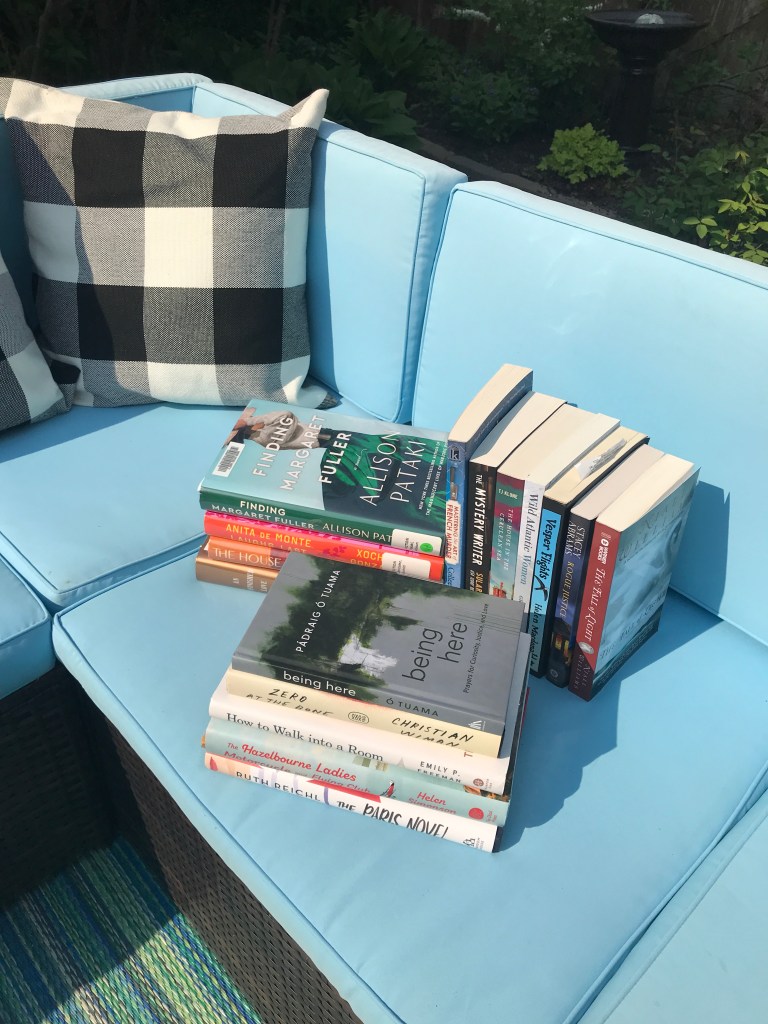
EEEK! My bookshelf of current to be read books overfloweth. My challenge is to accept that as a good problem to have –and not a time-limited contest or a requirement for completion. However, the piles of seductive choices are hard to ignore, and I am greedy. Perhaps it is time to declare some cabin time for myself–stay here at home but pretend I have gone off grid for a few days with books as my only companion. I’ll let you know how that goes!

Here are the books that are currently enticing me.

  • The House of Doors by Tan Tan Eng. Set in 1921 in Penang, Malaysia with the writer Somerset Maugham as one of the main characters.
  • Finding Margaret Fuller by Allison Partake. A historical novel featuring not only Fuller, who becomes a role model to Louisa May Alcott, but Ralph Waldo Emerson, Nathaniel Hawthorne, Edgar Allan Poe, Frederick Douglas, Elizabeth Cady Stanton and so many more.
  • Anita De Monte Laughs Last by Xochitl Gonzalez. I so enjoyed Olga Dies Dreaming by this author and am eager for her second novel, which is the story of an artist who died in 1985, but in the late 1990s is rediscovered by a young art student.
  • Like Happiness by Ursula Villarreal-Maura. Waiting for me at the library. The author says, “I wanted to write the story of a woman who sometimes wasn’t even the main character of her own life.”
  • An Unfinished Love Story, A Personal History of the 1960s by Doris Kearns Goodwin. I am almost done reading this excellent book that documents Goodwin and her husband Richard Goodwin sorting through his archives. He was a speech writer and more for John F. Kennedy, Lyndon Johnson, Eugene McCarthy, and Robert Kennedy. Fascinating.

For Mother’s Day I received The Paris Novel by Ruth Reichl and The Hazelbourne Ladies Motorcycle and Flying Club by Helen Simonson. Both are so tempting I can hardly finish writing this sentence. In the Reichl book, Stella receives an unusual inheritance–a one-way plane ticket and a note saying, “Go to Paris.” Helen Simonson wrote Major Pettigrew’s Last Stand, which I remember loving. Did I miss her The Summer Before the War? I need to look up that book. This new novel focuses on the changes for women at the end of WWI in England–the freedoms women gained are being revoked as men return home.

I also received a bookstore gift card–that’s like gold in my hands, but I am restraining myself at the moment.

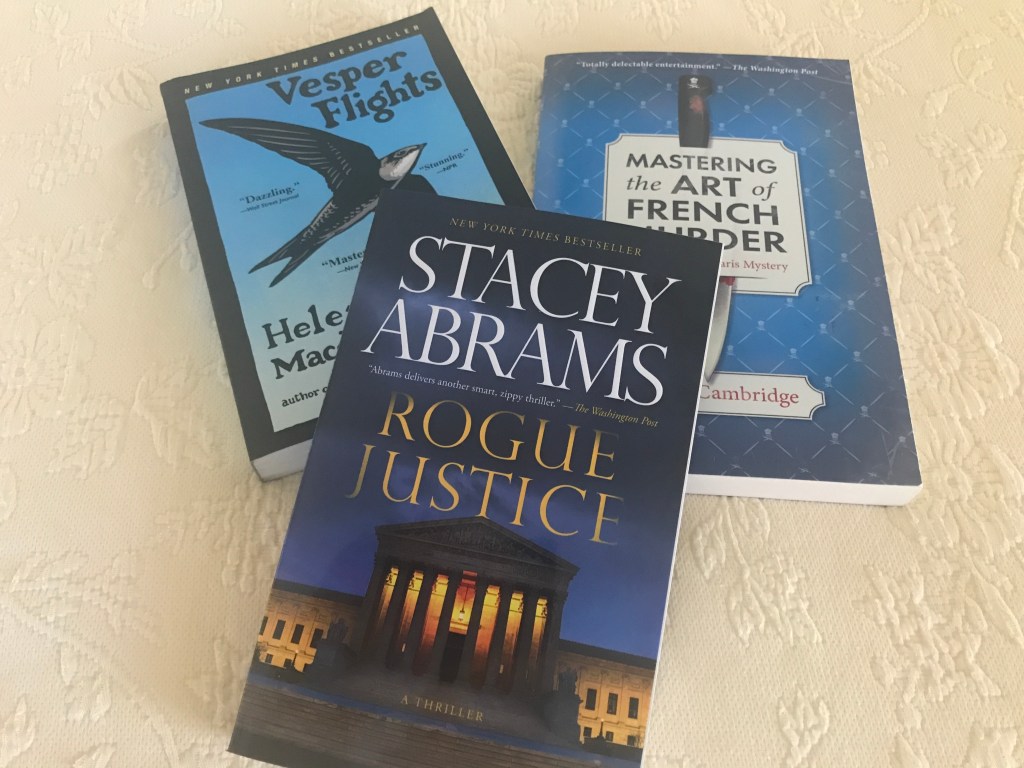
Also on the shelf are the books I received for my birthday, which I mentioned in an earlier post. but have yet to read: Vesper Flights by Helen MacDonald, Mastering the Art of French Murder by Colleen Cambridge, and Rogue Justice by Stacy Abrams. Perfect for cabin days!

  • Zero At the Bone, Fifty Entries Again Despair by Christian Wiman. I am not a person who often, if ever, feels despair, but I so respect Wiman’s insights and reflective voice, so I will read this, but maybe wait till winter.
  • How To Walk into a Room, The Art of Knowing When To Stay and When to Walk Away by Emily P. Freeman. Freeman is a podcaster and spiritual director who offers guidance during times of uncertainty. I have encountered this title in a variety of places—a sign!
  • Being Here, Prayers for Curiosity, Justice, and Love by Padraig O’ Team. Poet. Theologian. Host of Poetry Unbound. Obviously, I couldn’t resist.
  • Somehow, Thoughts on Love by Anne Lamott. I am almost done with Lamott’s latest book and am enjoying it more that her last couple books. Those felt repetitive to me–same books with different titles, but I love this one. I will write more about it in an upcoming post.
  • Books #8 and #9 in the Lane Winslow Mystery series by Iona Whishaw, Lethal Lesson and Framed in Fire are waiting for me. How restrained I am that I have not ordered #10, To Track a Traitor and #11, Lightning Strikes the Silence.
  • A Little Free Library find: Four mysteries by Marcia Muller. Has anyone read these? The copyright for the first in the Sharon McCone Mystery Series is 1977, Edwin of the Iron Shoes. McCone is a private eye In San Francisco. Oh for a rainy day!
  • Still awaiting my attention are four other bookstore finds: Wild Atlantic Women, Walking Ireland’s West Coast by Grain Lyons. The Fall of Light by Niall Williams. I am slowly reading all of his books. The House in the Cerulean Sea by T.J. Klune, which has often been recommended to me, but somehow I have not yet read. It is time. The Mystery Writer by Solari Gentill because I enjoyed her earlier book, The Woman in the Library. These are stand-alone mysteries, but alas, I recently discovered she has written a series, The Rowland Sinclair Series set in Australia in the 1930s and there are ten of them.

And guess what? Anne Bogel of “Modern Mrs Darcy” and her podcast “What Should I Read Next?” is releasing her summer reading recommendations list this week, which is sure to add to my TBR and my bookshelf. Sigh!

I can’t close without paying homage to short story writer Alice Munro, who died this week. I remember at some point in my life immersing myself in her books of short stories. Such a fine writer.

A story is not like a road to follow…it’s more like a house. You go inside and stay there for awhile, wandering back and forth and settling where you like and discovering how the room and corridors relate to each other, how the world outside is altered by being viewed from those windows. Alice Munro, 1931-2024

Happy reading everyone!

What’s waiting on your shelf? I would love to know.

Homecoming

May 14, 2024

Wednesday evening we returned from a road trip visiting our son and daughter-in-love in Cleveland and then a few days roaming in Michigan. A good trip, for sure, but oh, how wonderful to open the front door of our home and proclaim to the House Gods, “We’re back.” That was at 6:00 pm and by 7:00 we had unpacked, bags put away and washing machine chugging with our dirty laundry.

We are good returnees. You see, for us being home is even better than returning home.

My husband and I are homebodies. No doubt about it.

My husband hometends–or should I say garden tends–and he has been communing in the garden most daylight hours since our return. He also hometends for others when he paints discarded furniture, giving each piece a new and even more creative life. In June he will have his annual garage sale, the fruits of his winter labors, and all proceeds go to support Lutheran Social Services programs for youth experiencing homelessness.

I’m the interior hometender —hometending as a kind of spiritual practice, which I have written about before in this blog. How glad I am that before we left on this recent road trip I pushed myself to leave the house “return ready.” I’m not quite the perfectionist, however, as a friend who vacuums herself out the backdoor into the garage when she leaves on a trip, but I do like knowing that a clean and welcoming home waits for me when I cross the threshold. Besides, there is always enough to do upon returning without needing to clean the bathroom.

I have also realized over the years that my work as a spiritual director is a kind of hometending, too. I help others know the home within; the home always available. That’s a subject for another post.

Being away from home opens space for new thoughts and clarifying realizations, which sometimes crystallize once the bags are unpacked. For example, on this trip we discovered that we enjoy roaming on the way to a destination–in this case, our kids’ home–but as we head back towards home we just want to get home. Be home. We will remember this the next trip.

I also realized that even though we lived In Cleveland for 14 years ourselves, going there now is no longer about returning to where we once lived, but visiting where our kids live. This is their home, and we are their guests, enjoying Cleveland through their eyes and hearts. That feels like a shift.

The morning after our return my husband worked in the garden, and I grocery shopped and did a variety of other errands. Our normal routine is for each of us to do our own thing during the day, sharing the day’s events and thoughts with one another at suppertime. That works for us, and we eased right back into that pattern.

At the same time we are not quite the same people we were before we left on this road trip. Road trips change us, even if those changes are not immediately recognizable. We now hold new memories. We are now more aware of who we are now and what we most need to live fully right now. We bring deeper gratitude to these days, whether they are ones on the road or ones at home.

It is good to be home.

What are your routines when you return home? I would love to know.

Book Report: April Summary

May 2, 2024

James by Percival Everett.

I didn’t think I wanted to read this novel, which is a re-telling of Mark Twain’s The Adventures of Huckleberry Finn, but a copy was on the Lucky Day shelf at the library, and I decided to say “yes.” Everett’s version turned out to be my favorite novel read during April.

Told from the perspective of Jim/James we meet the Jim white people expect him to be and James, the person he really is. We know this, but this novel is a striking reminder of how speech and language is a tool to clarify and reinforce who we are and/or to hide and reinforce the person someone else wants us to be or thinks we are.

At one point James shares with enslaved children the basic rules for interacting with white people.

Don’t make eye contact. Never speak first. Never address any subject directly. Mumble sometimes so they can have the satisfaction of telling you not to mumble. p. 22.

  • The Little Village of Book Lovers by Nina George. There is so much to love in this novel about love–the transforming power of love and how books can be an aid, a vehicle, a tool in the discovery of love. One of the characters, Marie-Jeanne can see the mark of love, a glowing, shimmering light, and she becomes a matchmaker, even as a young girl. She awaits that shimmer for herself. I loved all the wonderful words about the power and glory of books, as well. If you loved one of my favorite books, Fresh Water for Flowers by Valerie Perrin, you will love this.
  • Ana Turns by Lisa Gornick. As Ana turns 60, she reflects on her life now. A physician husband who medicates to cope with back pain; a lover who demands little from her; a child who has realized they are trans; a mother who can only criticize her, a rich brother who is the one favored by her mother, and two nieces she adores. Lots of side stories, all beautifully told.
  • The Underground Library by Jennifer Ryan. This book is based on a true story about the establishment of a library in the London underground during WWII and is a good example of “Blitz spirit.” Juliet, the deputy librarian of a library, starts a book club and nightly readings in the underground after the library is bombed. Along the way she is supported by a wonderful array of women, and, of course, there is a love story, too.
  • Lessons in Chemistry by Bonnie Garmus. Am I the last person to read this book that has been on bestseller lists since its publication in 2022? The book focuses on the treatment of women and women’s views of themselves in the 1960s. When her husband dies in an accident, chemist Elizabeth is left to raise their daughter Madeleine (MAD), the most unusual and precocious kindergartner ever, for her reading skills alone. Work at a research lab is intolerable, and she gets a job on TV, a show called Supper at Six, in which she explains the chemistry of cooking and food. Such interesting characters plus a spirit of resilience, courage and love, and I laughed outloud often. I did tire, however, of the total separation of religion and science, but I thought even that softened towards the end.

I read only three nonfiction books in April, but each one was so worthwhile. I mentioned House Lessons in my April 25th post. The other two are:

  • The Eloquence of Silence, Surprising Wisdom in Tales of Emptiness by Thomas Moore. I think a stronger and clearer title would have been The Eloquence of Emptiness, for the book focuses more on the gifts of emptiness. The tendency is to think of emptiness as something negative or to be feared, but Moore explores how when we are too full, too busy, nothing unexpected can happen. “You can’t make fresh discoveries, and you will have few surprises and revelations.” p. 66. I underlined so much in this book and copied many passages into my journal. I have loved several books by Moore, including Care of the Soul, The Soul’s Religion, The Re-Enchantment of Everyday Life, and Dark Nights of the Soul. His book just prior to this one, Ageless Soul, was not one of my favorites, but this one truly resonated with me.
  • Birding While Indian, A Mixed-Blood Memoir by Thomas Gannon. Gannon is a professor of Native American literature at University of Nebraska Lincoln and a birder, who says birding is a kind of addiction for him. As he encounters birds, he also explores his heritage and his life as a Native person. Often the book was too detailed for me, a casual enjoyer of birds, but I was moved by the ways he connected his passion with his own struggles and background. Plus, I learned so much about how white colonialism has attempted and often succeeded in destroying the lives and culture of Native peoples. I made copies of several passages in this book, like the section on the Crazy Horse monument in South Dakota, in which he writes “that gigantic carving up of our sacred mountain is just another form of racism.” p.115. My husband and I spent time at the monument a couple years ago, and I would never have interpreted it that way, but I am now grateful for this perspective. He also reflects on one of my favorite books and authors, My Antonia by Willa Cather in which the narrator Jim views the Plains “as if he were face-to-face with a geographical nothing.” Burden sees no road, no fences, no creeks or trees or hills or fields. Gannon reminds the reader that “the land was teeming with the ‘countries’ of other species–and the tribes of other humans…”p. 37. Oh, how much I have left to learn and understand.

April 11: Float Up Sing Down by Laird Hunt https://wordpress.com/post/livingonlifeslabyrinth.com/3372

April 18: A Council of Dolls by Mona Susan Power; Wandering Stars by Tommy Orange. https://wordpress.com/post/livingonlifeslabyrinth.com/3365

April 25: An Irish Country Courtship by Patrick Taylor; A Match Made for Murder by Iona Whishaw; One Woman Show by Christine Coulson; and the memoir House Lessons, Renovating a Life by Erica Bauermeister. https://wordpress.com/post/livingonlifeslabyrinth.com/3425

I’m currently reading The Hunter by Tana French, and I am sure I will report on it in May.

What was memorable in your April reading life? I would love to know.

Guiding Words

April 30, 2024

As always, the weekly writing group I facilitate, In Your Own Words, Contemplative Writing as Spiritual Practice, includes time for silent meditation. “Close your eyes lightly, not tightly. Take a deep cleansing breath. Breathe gently in and out, finding your own rhythm.” After six or seven minutes of sitting in silence with one another, I read the guiding words for the day. For example:

The word “orientation,” like “Orient,” comes from the Latin, orient, which refers to the “sunrise,” the “east.” If we know the point where the sun rises, we can determine all other points of the compass and find the direction we want to take. Some words can help us in a similar way. Words full of light, they beam, as it were, like the floodlights of a lighthouse and build a bridge over troubled water. Such luminous words can also become keywords that unlock new insights for us. We can learn “to think along language,” the way we walk along a path through meadows enjoying flower by flower, ever new discoveries as we go. You Are Here, Keywords for Life Explorers by David Steindl-Rast, p. 3

I then read the writing prompts for the day, which recently included the following:

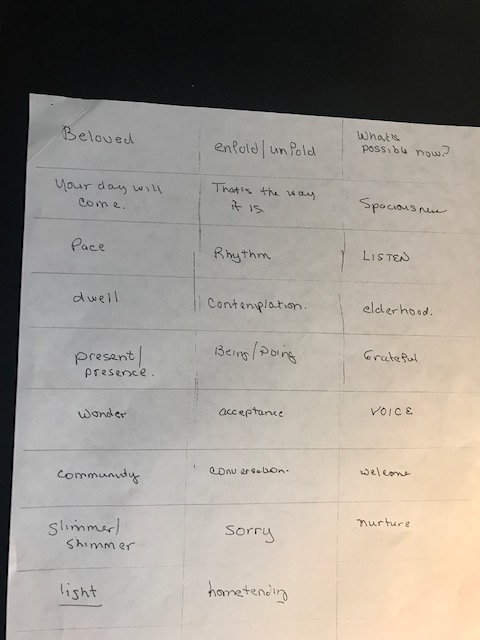
“Begin by listing words on the accompanying table that have had meaning for you or seem to be occurring or appearing in your life right now….List the words (or brief phrases) without judgment.”

I end by saying, “The time is yours,” and we write for 20 minutes.

I filled in the first three blanks on the sheet divided into small sections easily. “Beloved,” my 2023 word of the year. My current words of the year, “enfold/unfold.” And a question I often ask myself and my spiritual direction clients, “What is possible now?” I was surprised, however, when on the next line I wrote, “Your day will come.”

I began to write.

My father said those four words often. “Your day will come.”

I confess I sometimes resented those words–and that he said them with such a knowing smile on his face. I heard judgment and privilege. I felt admonishment–that I wasn’t old enough or hadn’t paid my dues or didn’t deserve something. I can’t recall specific instances when his response was “Your day will come,” but I remember my impatience and my irritation. Why should I remain patient when I wanted something, to do something, to be something, but apparently MY DAY had not yet come.

But I also wondered if the day for __________ would actually ever come or would life pass me by? Would the day truly come when I would know a lasting and fulfilling love? Would the day come when I would know my purpose in life? And would the day come when I would know how to fulfill that purpose? How would I actually know my day had come?

Dad didn’t offer any answers, instead he repeated his pat answer without becoming engaged. His wisdom rolled over me, only lightly touching my skin. I vowed not to use that phrase with my own kids, if I was lucky enough to have any. I don’t think I’ve broken that intention, but you’ll have to ask them.

Now, of course, at this third chapter stage of my life, I realize my day has come–as so many days have gone, have left. So many days have been lived. Some more fully than others. Some days have passed me by. Some days have drifted away unnoticed by me.

And now this day has come.

My day here and now.

My day of becoming more of the person I was created to be.

Often when Dad was in his 80’s and even into his 90’s, he announced he was ready to die, “just not today.” Eventually, his day came. Our creator God announced to him, “Your day is here. The day of your death, your full transformation is here.”

I don’t know when that day will come for me, but now when I think of those words, “Your day will come,” I hear an invitation to use these days wisely, to live these days fully. Doing that, I prepare for the day of my own death, the day my day comes.

Thanks be to God.

What words or phrases have special meaning for you right now? I would love to know.

The writing group I facilitate meets Thursday mornings from 10:30 to noon at Gloria Dei Lutheran Church, St Paul, MN. There is no charge and all are welcome. If you have interest in participating in the group, let me know. If you are not able to participate in person, but would like to receive the guiding words and prompts, send me your email, and I will add you to the list.

Fear of Not Having Enough To Read (FONHETR)

April 25, 2024

Packing for a trip, even one that just means being away from home a couple days, is never easy for me. Deciding on what clothes to bring is only half the problem. The other half is deciding what books to bring.

What if I don’t like a book I have packed? Then what will I read?

What if I finish a book faster than anticipated? What will I read then?

What if I have more time to read than anticipated? (A good problem to have, as far as I’m concerned.) Will I have enough to read?

For me, these are bigger questions than deciding how many changes of clothes to bring with me. The good news is that generally we travel in our car, so I have room for a stockpile of reading material.

My most recent book decision dilemma was our weekend in Door County.

After hemming and hawing, I selected 4 books for this three day vacation (Two of the three days were mainly in the car.) I had just read two serious literary fiction books, Wandering Stars by Tommy Orange and A Council of Dolls by Mona Susan Power (see April 18 post.) and I knew I needed something lighter.

  • An Irish Country Courtship by Patrick Taylor. I have read others in this charming series and know I will read others in the future. This one focuses on the “love life” of physician Fingel O”Reilly, as he courts Kitty. He has mourned the death of his wife for a long time, and Kitty is sensitive to his hesitancy about a new relationship in his life. In the meantime his associate has been fluffed off by a woman he thought was “the one,” and now he wonders if life as a village GP is enough for him. He ponders a decision.

In these short months he’d certainly had a fair sampling of the medical side of general practice, but he hasn’t been prepared for the village. Gradually, he’s come to learn it wasn’t simply a collection of houses, shops, a pub, and a couple of churches. It was an entity, and as an animal was the whole of its parts, so too was the village a many faceted, living organism. p. 287.

I’m grateful the author includes a glossary of Irish words and terms in the book. This time my favorite word is “harpled,” walking awkwardly, favoring a sore leg or back.

  • A Match Made for Heaven #7 in the Lane Winslow series by Iona Whishaw. Much of this book is set in Tucson, AZ, rather than Canada and for a very good reason. I don’t want to say why for those you of you who have not gotten this far in the series yet. This was perfect vacation reading. I will soon start reading #8.
  • One Woman Show by Christine Coulson. This was my “just in case” book. Just in case I finished both of the other books. This is a short, new novel, meant to be read in one sitting. The book documents much of the life of Kitty (1911-1998), but it is the structure that is most interesting. Her life is described as a series of art works, with an entry on each page.
BRIDE, AGED 19, 1926
Mrs. William Wallingford III (known as Kitty)
Collection of William Wallingford III (known as Bucky)
Ex-Collection of Martha and Harrison Whitaker

Considered the apex of early twentieth-century production.
Kitty is thoroughly polished, bound in white silk, and decorated with a clutch of pristine lily of the valley. The rest of her garniture joins her, but with deliberately less polish and packaging. The great and the good gather to see the exhibition and rave about the elegant lines and immaculate condition. Kitty glistens in the light of her new pedestal and foolishly considers herself now unbreakable.

Clever and thought-provoking.

  • The Eloquence of Silence, Surprising Wisdom in Tales of Emptiness by Thomas Moore. This books is one of my current devotion companions. Good food for reflection.

I selected my vacation book companions well–finished the Patrick Taylor, which I had started at home, and read in its entirety the Iona Whishaw mystery and read a couple chapters each day in Thomas Moore’s book. I saved One Woman Show and read it when we got home.

So well-done, Nancy. But then we discovered a bookstore new to us in Sturgeon Bay, which is at the entrance of the main part of the Door County Peninsula, and the book bag bulged. What a lovely and well-curated bookstore with a knowledgeable storeowner/bookseller, and you can bet we will stop there each trip we make to Door County.

Here are my selections:

  • The Mystery Writer by Solari Gentil. I read and enjoyed her earlier book, The Woman in the Library and so am eager to read this one. I also discovered that she has written a mystery series set in WWII, the Rowland Sinclair series. When I have completed all 11 of the Iona Whishaw books, I am sure I will investigate these.
  • An Irish Country Welcome by Patrick Taylor. This follows the one I just read, An Irish Country Courtship. The covers of these books, by the way, are so lovely.
  • Wild Atlantic Women, Walking Ireland’s West Coast by Grainne Lyons. To continue the Irish theme!
  • House Lessons, Renovating a Life by Erica Bauermeister. Bauermeister is the author of several novels as well, which I have not yet read, but this memoir is so beautifully written that I may add her other titles to my TBR. When I go to an independent bookstore I like to buy a WILD CARD book, meaning a book I have not heard of before, but for whatever reason it appeals. This was true for this book and the Wild Atlantic Women book, as well. Both my husband and I have now read House Lessons and loved it. Bauermeister and her husband live in Seattle, but decide to buy a ramshackle house in Port Townsend, WA. This is the story of that renovation, but also the life lessons learned along the way–the ways one’s life is a kind of ongoing renovation.

This weekend away was to celebrate my birthday and, no surprise, my favorite present is a new book. My husband is always nervous about buying me a book, anticipating I may have already read what he selects, but he did well. Now on my TBR bookshelf are these three–two mysteries and a nonfiction title.

  • Rogue Justice by Stacey Abrams
  • Mastering the Art of French Murder by Colleen Cambridge (Notice a similarity in title and cover to Julia Child’s masterpiece?)
  • Vesper Flights by Helen MacDonald. I loved H is For Hawk, but have not yet read this one.

Soon we will go on a road trip to visit our son and daughter-in-love in Cleveland and then spend a few days in Michigan, so the dilemma of what books to bring will resurface once again. Such a problem!

Do you take books on vacation? How do you decide what to bring with you? I would love to know.

I will post my April Book Report Summary on May 2.

A Celebration of Faith

April 23, 2024

Laying on of Hands at Our Grandson’s Confirmation Service

I often receive email confirmations.

“Your reservation for dinner at 7:00 for 4 people is confirmed.”

This is to confirm your order for… “

Hotel reservations, tickets for a play or concert–all are confirmed.

Verified

Acknowledged.

Validated

I appreciate those emails–knowing for sure that what I ordered or planned is now a step closer to reality. In a way that is what happens in a religious rite of confirmation.

On Sunday our 16 year old grandson Peter was confirmed at Gloria Dei Lutheran Church, St Paul, MN, where my husband and I and our daughter and family belong. Our granddaughter Maren was confirmed there several years ago.

Trust me, it was a two-hanky day for this GrandNan.

Each of the 16 young people were asked individually to affirm their faith, responding “I ask God to help and guide me.” The congregation was asked to promise our support for these young people and to pray for them in their life in Christ. We responded “We do, and we ask God to help and guide us.

Each confirmand and their loved ones then came forward for laying on of hands and a blessing.

God of Love, for Jesus’ sake, stir up in Peter Agneberg Ostrem the gift of your Holy Sprit; confirm his faith, guide his life, empower him in his serving, give him patience in suffering, and bring him to everlasting life. Amen.

In this moment in time his faith was confirmed, affirmed.

Verified.

Acknowledged.

Validated.

And celebrated, too.

Here’s the deal, the reality. Participating in the rite of confirmation, like those email confirmations, is not enough. I have to show up at the restaurant or the hotel. Or when my online order arrives, I have to open the package and use it or gift it to someone or in my case, read it because what I most often order are books. Sometimes what I ordered isn’t the right thing or doesn’t fit or is no longer appropriate. Or perhaps the restaurant or hotel was fine, but next time, I’ll look further for a choice that fits better.

The metaphor is not perfect, but confirmation is not the end. True, it is the end of a period of formal study, but it is also a launching into the possibility of a deeper faith. It is an invitation to grow, to participate in an evolution of faith.

No one knows what that will mean for each of these young people–what will challenge their faith; what will reinforce it. No one knows how it will change. More than likely they will each experience times when their faith feels secondary to everything else in their lives; when their awareness of the presence of God is not foremost in their everyday lives. But, my prayer for Peter and the other young people confirmed on Sunday, is that the groundwork offered during the years beginning with their baptism and leading them to this day of celebration, this rite of passage, will sustain them and lead them to live as the people they were created to be.

Has there been a time in your life when you were asked to affirm your faith or a belief in front of a group of people? I would love to know.

Two Novels by Indigenous Authors: The Council of Dolls by Mona Susan Power and Wandering Stars by Tommy Orange.

April 18, 2024

Both books are powerful.

Both books are beautifully written.

Both books are stories of generational trauma and intergenerational healing.

Both books offer windows into a culture that is being rediscovered and treasured.

Both books reveal injustice and yes, evil.

Both books reference the Carlisle Indian Boarding School.

Both books follow the lives of multiple generations.

Both books are about institutional violence and oppression.

A Council of Dolls by Mona Susan Power

Mona Susan Power is an enrolled member of the Standing Rock Sioux Tribe and currently lives in St Paul. Perhaps someday I’ll see her in one of our coffee shops or the grocery store, and if I do I will tell her how important her book is, and how I hope she continues to tell the stories. Following the great success of her first novel, The Grass Dancer, Power experienced deep depression and learned she was suffering from P. T. S. D., as well. How grateful I am that she has found resilient reserves within herself to continue her writing

I’m sorry I didn’t buy this book, rather than read a library copy. Maybe I will buy it now, so I can read it again and underline favorite passages. Power says she is an “intuitive writer,” meaning the story and the characters come to her. Maybe that’s why the human and the doll characters seems so real.

The story follows the lives of three generations of Dakota girls/women: Sissy (b. 1961), Lillian (b. 1925) and Cora (b. 1880s) and their dolls. It is up to the reader to decide if the dolls are real, spirits with powers to heal and save the girls from further tragedy or are the products of the girls’ imaginations. I must admit, although my growing up couldn’t be more different from these women, I thought about the dolls in my life as a young girl and how they often brought me comfort and gave me a sense of purpose even.

Favorite Passages

Cora telling about her father says,

My father says that we should welcome all stories to see if they are worth remembering. “You can put ideas on and off just like moccasins. You can wear them and set them aside, hold onto those you find meaningful. Don’t be afraid of learning something beyond what we’re able to teach you. Even the wisest person doesn’t know everything, But it’s also important to preserve the ideas that make sense to you, even in the face of resistance–someone telling you that you’re wrong and only they know the truth. Such boasting is evidence of a fool, perhaps a dangerous one.”

p. 141

A last word from the dolls:

We’ve learned that healing the present doesn’t only clear waters flowing into the future, recovery also flows backward and alleviates the suffering of ancestors. So they can set down their tears and dark memories, their guilt and shame, their vengeance. And because Time is our relative, a flexible being that moves through every thought and memory, branching into a million rivers of possibility, healing even one of its streams will eventually heal the world.

p. 286

Wandering Stars by Tommy Orange

I admit it took me longer to read this book than Council of Dolls, and I’m sorry I didn’t wait longer after finishing “Dolls” to read it. By the end I just wanted the painful stories of addiction and loss to end, but perhaps that is the point.

Tommy Orange is an enrolled member of the Cheyenne and Arapaho Tribes of Oklahoma who was born and raised in Oakland, California, and this book often references the challenges of finding and knowing other Indian people in that part of the country. Wandering Stars is both prequel and sequel to his earlier much acclaimed novel There There. I suggest reading There There first, but it isn’t necessary. I am grateful for the family tree at the beginning of the book and referred to it often.

The book follows the descendants of the 1864 Sand Creek Massacre, moving through the generations to the present day. The references to Richard Henry Pratt, who became the founder of the Carlisle Indian Boarding School, both the cause and the result of so much evil, are harrowing.

“Stars” refers both to the family descendants in the Bear Shield and Red Feather families, but also to one of the characters who is shot at a Pow Wow.

One of the doctors, who wore a faded-ass baseball cap with a fish on it he didn’t think the guy should have been wearing on the job, told him the bullet shard in him was shaped like a star, like that was some cool shit. Then the doctor told him he should be grateful that it stopped moving, that an exit wound could be what kills you. The doctor said they would keep an eye on it, the star shard, because, he warned, they’ve been known to wander, parts of them getting into your bloodstream and poisoning you. And then the doctor, still apparently trying to comfort him about the bullet staying in, said it wasn’t bullets that killed but the path they took, This seemed to him like some dumb-ass bumper-sticker wisdom, like: Guns don’t kill people, people kill people, or, The journey is the destination.

p. 119

There were so many times in the book I wanted to shout, “Don’t do it.” An indication of how well-drawn these characters are. And so many times I cheered for these characters, as they rose above addictions.

I felt good talking to my son and eating the bread I made there in our kitchen, on our land, in our home. I had a family now and the drinking was behind me. I’d lived enough life, almost died enough times to know when a good thing came along, a thing you didn’t know could fill you right up, which only when it filled you let you know there’s been a hole in you before.

p. 34-35

I initially went to using as a way to feel the world, when I’d learned somewhere along the way to numb it. But I wanted to feel the world without having to use, and not simply become obedient to the cold demands of a cruel world, or to an equally cruel addiction.

p. 304

Such good books. Heavy and meaningful. And now I’m ready for something lighter, but still well-written. Stay tuned.

What emotionally hard to read books have you read? I would love to know.
The Gifts of A Happy Place

April 16, 2024

Paris and the Cotswolds may not be part of current plans.

We no longer live at our beloved Sweetwater Farm.

Living in Minnesota , instead of Ohio, means I can no longer decide on a whim to spend a day at Chautauqua.

Dear and as meaningful to me as those places are, however, they are not my only happy places.

I am happy most of the time wherever I am, but oh, how happy I was this last weekend to be in one of my happiest of happy places: Door County, WI, which is only 5 1/2 hours away from our St Paul home.

Over the years we have spent many happy times there, sometimes with family, sometimes with friends, sometimes just the two of us, which was the case this time–my birthday present planned by my husband. It is a place we gravitate to over and over again.

Do we gravitate there over and over again because being there makes us happy or because we are happy there do we want to go there again and again? Chicken and egg?

When I was growing up my family moved many times. My Dad worked for a large corporation and was transferred frequently as he climbed the company ladder. At the end of the school year, the moving van would appear at our house, but before we moved into our new home, we returned to the same summer vacation spot in northern Minnesota. Year after year. Summer after summer. That was a place of both grounding and transition. Of memories and memory-making. Of ease and taking a breath before the work of resettlement. Of surety and stability. Of time to process the loss of friends and to hope for the presence of new ones. Of comfort. We knew what to expect and how we would spend our days.

That place was our past, our present, and a path to the future.

Because we vacationed in Door County with our children when they were young and later, in their adult years with our grandchildren part of the scene, we have a history there. We reminisce about our son sketching on the sandy beach and about taking the ferry to Washington Island specifically to go to the book store there, and about playing miniature golf when the club was taller than our grandson and eating cherry coffee cake at the White Gull Inn. And more. So much more.

Going there now reminds us of some of the building blocks of our lives. The conversations we had while savoring the sunset or fruity daiquiris before a leisurely dinner. The dreams fulfilled and those that drifted away. When we laughed and what we treasured. Who we have been and how we lived.

And now in the present in this happy place, the past sits lightly, and we feel a simple, but rich gratitude for being here. For having this time to be together. The weather doesn’t dictate the gift of this time. We eat good meals. We browse in favorite shops, and we roam back roads, delighting when we spot sandhill cranes in an open field and a deer loping across a gravel road. We gaze at the water as the sky turns into evening pink. We read and doze in our room, no longer pulled to do something, go somewhere. Being here now is enough.

And the future? Well, who knows much about what the future holds, beyond our eventual deaths. But we envision more time in this happy place because we feel welcomed and at home there. But more than that it is a place that seems to support the people we are becoming, for that becoming continues until it doesn’t.

An Invitation

Where are the places that represent past, present, and future for you? I would love to know.

Book Report: Float Up, Sing Down by Laird Hunt

April 11, 2024

This is not the book I intended to review today.

A visit to the library earlier this month yielded two surprise books on the Lucky Day shelf–both on my hold list and both with a large number ahead of me on that list. Needless to say, I grabbed both books, hoping there was nobody standing behind me ready to intimidate me into sharing at least one of them.

The two books were A Council of Dolls by Mona Susan Power and Wandering Stars by Tommy Orange. Both books are by contemporary indigenous authors. After reading (and loving) A Council of Dolls, I started reading Wandering Stars and realized I needed to read another book between those two books. In part, so I wouldn’t mix up the content–one in the other–but more to let each of those books breathe fully and for me to receive their breath. I promise you I will write more about each of these books in my April 18th post.

Sometimes after finishing a book that has fed me so completely, I need a palate cleanser kind of book–a cozy mystery, often. A book with a lighter touch. I wasn’t sure if Float Up, Sing Down, a book of linked short stories by Laird Hunt would fulfill that need, but I loved the cover, and it was in my pile of library books.

I don’t often read collections of short stories, but linked short stories are more appealing to me. Besides I so enjoyed Zorrie, Hunt’s 2021 novel, set in the same farming community in Indiana. Well….such good choice.

As I’ve written before, “quiet” novels, character-driven novels are my favorite kind of books, and that is true of Float Up, Sing Down. Each of the 14 chapters focuses on a single day in the life of each of the town’s residents. I can’t do better than the inside cover’s summary:

Candy Wilson has forgotten to buy the paprika. Turner Davis needs to get his zinnias in. Della told her mother she was going to the Galaxy Swirl, but that’s not where she’s really headed on her new Schwinn five-speed.

The residents of this rural town have their routines, their preferences, their joys, grudges, and regrets. Gossip is paramount. Lives are entwined. Retired sheriffs climb corn bins and muse on lost love. French teachers throw firecrackers out of barn windows, and teenagers borrow motorcycles to ride black roads..

Zorrie makes an occasional appearance, too.

Meet Horace, who “liked to know what the day had in store.” (p. 49) Horace had fought on D-Day, not that he liked to think about that time in his life, except for his encounter in Crete with Rose-Alice, whose Scottish archaeologist father had overseen excavations in Crete before the war. Now even in land-locked Indiana he can smell the sea. On this day, however, he needed to mow the lawn.

There had been quite a few in the community over the years who had been soft on him. Horace had always gone easy on the eyes, and old as he was getting, this was still true. Time wasn’t in any great hurry with him was the way Myrtle had put it. He wasn’t especially tall, but he was naturally lean, didn’t sweat too much, and looked good in a pressed cotton shirt. Like Gary Cooper but shorter, Alma Dunn had once said. He had taken her on three dates. She had gotten pretty worked up about things. He hadn’t married her or anyone else though. For a while there had been whispers of the nasty variety, but they hadn’t stuck. There hadn’t been anything for them to stick to.

p. 50

My favorite line is in the Myrtle chapter: “She was a good egg. It wasn’t just any old chicken that had laid her.” p. 158

Think Willa Cather, Wendell Berry, Elizabeth Strout. Think Our Town.

Do you need to read a “palate cleanser” after reading a particularly engrossing or “important” book? I would love to know.

Action VS Indifference

April 9, 2024

We do not have the luxury of indifference.

Robert Hubbell

Since the beginning of this year I have participated in several postcard campaigns to encourage people to register to vote and to actually vote in a primary. I have sent postcards to support specific candidates, including Ohio’s Sherrod Brown, Ruben Gallego in Arizona, and Tom Suozzi in New York. My total postcards: 300. So far.

I say this not to elicit praise or to pat myself on the back. Instead, I urge you to do what you can to save democracy. Fundraisers often say, “No gift is too small,” and I hasten to add “No action is too small.”

I am a terrible phone person. I don’t enjoy talking on the phone. I even dislike making phone calls and am so grateful for the ability to do much of what I need to do via email or text. I am grateful for all the people who participate in phone-calling events in support of candidates and campaigns, but that is not something I will be doing in the next seven months. (EEEK–only seven months before election day in November.)

I also won’t be walking door to door, passing out leaflets, engaging people in conversations. I did that decades ago, but that method no longer fits who I am now and what I am able to do.

What I can do, however, is participate in postcard campaigns. I can order postcards with a voting theme from Etsy. I can buy rolls of postcard stamps. In fact, the last time I did so, the mail clerk subtly asked me why I needed so many postcard stamps. Our conversation was brief and careful, but I could tell he was intrigued and you never know…

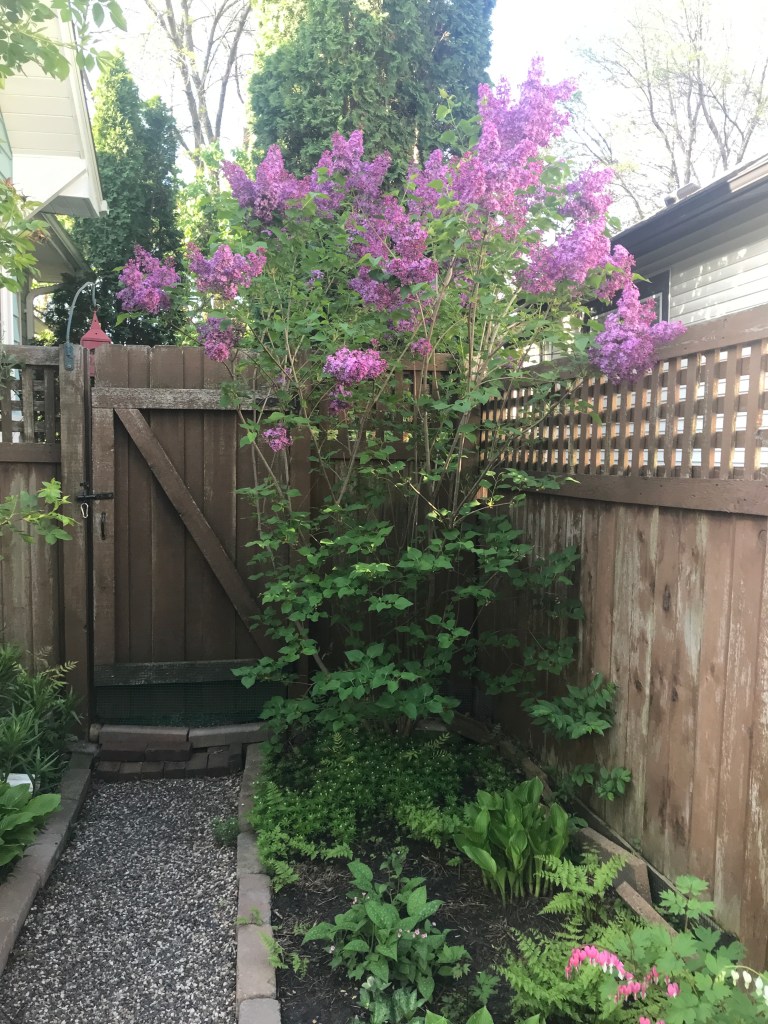
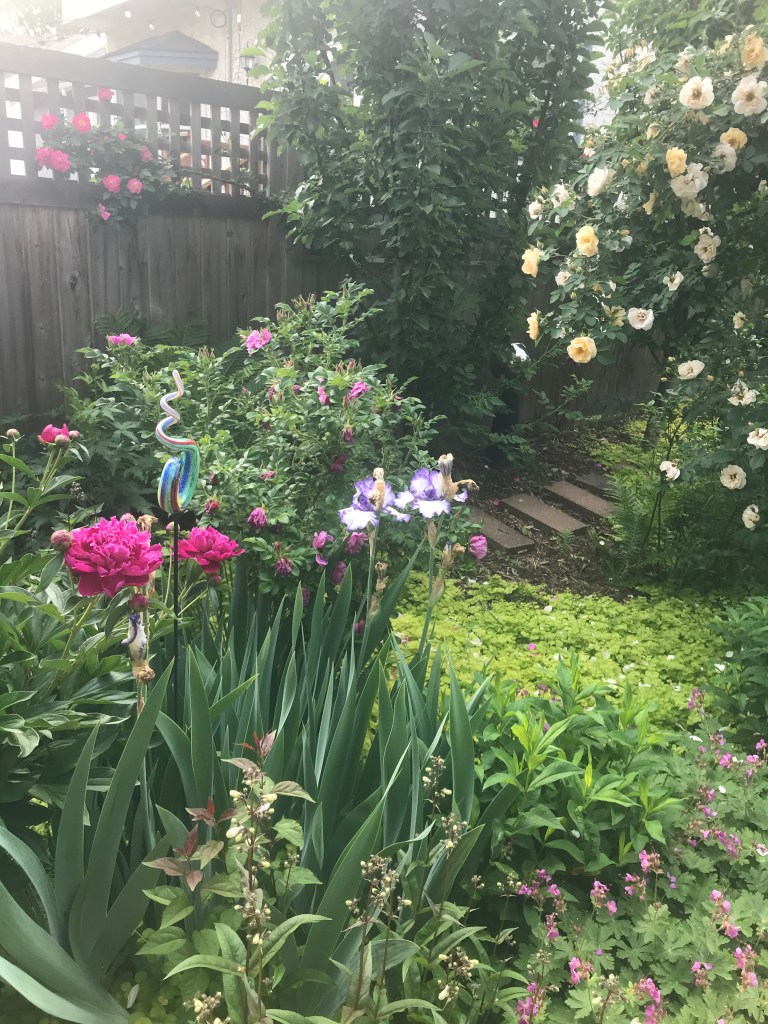
I can watch a movie on Netflix as I address and handprint the message provided by the sponsoring organization or I can sit at the dining room table and work on a few more postcards while dinner is baking in the oven. Soon I will be able sit at the bistro table in my secret “Paris” garden or on the patio and write postcards while I enjoy fresh air and birdsong and the glories of my husband’s gardening efforts.

I can drop the postcards in the mailbox a couple blocks away when I go on an afternoon walk.

I must do something because this is not a time for indifference.

I receive several daily or weekly newsletters that keep me informed and motivated and help me focus. If I feel myself holding my breath as I read them, I know it is time to sign-up for another postcard campaign.

#1 From Robert Hubbell’s Today’s Edition Newsletter, April 2, 2024 https://roberthubbell.substack.com/p/we-dont-have-the-luxury-of-indifference

We live in a world where the only US president ever to attempt a coup has a too-close-for-comfort chance of being re-elected on a platform of overt fascism. That changes everything. We do not have the luxury of indifference.

We do not have the luxury of being “just” journalists, lawyers, elected officials, educators, students, co-workers, entertainers, parents, family members, or citizens. At this moment, we must be defenders of democracy in everything we do. If not, we betray and abandon the Constitution. There is no in-between. The question has been called.

Indifference is a choice. Cynicism is a choice. “Just doing my job” is a choice.

Democracy is a choice.

Defending democracy is a duty that appears unbidden when Americans least expect it. Every generation before ours has discharged that duty honorably. Ours cannot be the one to falter.

#2 From Diana Butler’s Newsletter, The Cottage, April 3, 2024. https://dianabutlerbass.substack.com/p/donald-trumps-political-idolatry

The media is not misrepresenting evangelical views. It comes from evangelicals themselves — they embrace the theology of Trump the Savior, a new political Jesus. They believe it. They believe that Trump is being sacrificed for them.

The most telling part in this video is the opening interview with two evangelical voters. They clearly understand the Bible and evangelical views of salvation — you could hear these verses quoted and this theology expressed on any given Sunday (or Wednesday night Bible study) in any evangelical church in the United States. They don’t get the theology wrong. 

And then they apply it to Trump:

Man: “THE BIBLE SAYS HE WAS WOUNDED FOR OUR TRANSGRESSIONS. HE DID IT FOR US. WHEN TRUMP IS FACING ALL THESE THINGS IS HE DOING IT FOR US IN OUR PLACE.”

Woman: “JESUS DIED FOR MY SINS. JESUS DIED FOR ME AND SO I — IT CONNECTS IN MY BRAIN THAT WAY. LIKE, HE IS DOING THIS FOR US AS A COUNTRY TO MAKE THE CHANGES WE NEED TO MAKE AND HE IS THE TARGET WHERE WE DON’T HAVE TO BE.”

I choose the amount of time I spend listening to, watching, or reading about current events and the resulting commentary. I choose to spend part of my morning devotion time praying for the existence and renewal of democracy in this country and all those who are attempting to save it. However, I still feel overwhelmed and discouraged at times.

Yup, that’s when it’s time to sign-up for another postcard campaign.

Karen Hering in her remarkable book, Trusting Change, Finding Our Way Through Personal and Global Transformation advises:

Describe a practice you use to calm or settle yourself when experiencing strong reflexive responses of fear or anger. What do you experience when you do this?

p. 155

Writing in my journal always calms me and clarifies what I am feeling and often reveals a next step. I’ve discovered writing postcards also calms me and is a step I can take.

Name one global threshold you are concerned about, whether or not you have been actively engaged in addressing it. Share some of your skills or knowledge that might be helpful in that issue…

p. 155

I have the time. I print legibly. I can afford to buy postcards and stamps.

Simple.

The human heart is the first home of democracy. It is where we embrace our questions. Can we be equitable? Can we be generous? Can we listen with our whole beings, not just our minds, and offer our attention rather than our opinions? And do we have enough resolve in our hearts to act courageously, relentlessly, without giving up–ever–trusting our fellow citizens to join with us in our determined pursuit of a living democracy?

One of the voices of wisdom who sits on my shelf is Parker J. Palmer. Right now I think I need to re-read his 2011 book, Healing the Heart of Democracy, The Courage to Create a Politics Worthy of the Human Spirit.

What is it you can do to resist indifference? I would love to know.

Americans of Conscience https://americansofconscience.com

Activate America https://www.activateamerica.vote

Postcards to Voters https://postcardstovoters.org

Chop Woods, Carry Water https://chopwoodcarrywaterdailyactions.substack.com

I buy postcards from various artists on Etsy. https://www.etsy.com