Book Report: How Do I Learn About Specific Books?

May 26, 2022

A friend asked me recently how I learn about books I might want to read.

I was surprised by the question, for being aware of books I might want to read has never been an issue for me. Actually, the opposite is true, for I often feel overwhelmed by the sheer volume of titles that interest me.

My ears have always perked up when I have been in the vicinity of “book talk,” but working in a fabulous independent bookstore, Odegard Books, decades ago certainly reinforced that tendency. I always enjoyed directing a customer to a book that would meet their interests and reading styles, and that meant not only reading widely myself, but being aware of old and new titles on the shelves. And, of course, there was the too often plea, “I don’t know the title, but it has a red cover and I think the author was a man.” Playing that guessing game was challenging, but fun and honed my book knowledge and awareness.

Back to the question at hand. How do I learn about specific books? Here are some of the ways I develop book literacy:

  • Podcasts and Online Newsletters. A favorite newsletter is Modern Mrs Darcy and the accompanying podcast, What Should I Read Next? Anne Bogel, the host, just released this week her summer reading guide and I am drooling at some of her suggestions. Each week on her podcast she interviews a guest, asking them to name three favorite books and one that wasn’t for them and what they are looking for in their reading life. Then she does some “literary match-making.” I appreciate that the titles are not just new releases, but are often backlist titles. Lots of podcasts focus on books, but sometimes podcasts like On Being with Christa Tippett or newsletters like Abbey of the Arts also introduce me to book titles. A personal requirement for me in podcasts, by the way, is a voice I can listen to –too chirpy or too fast–doesn’t work for me.
  • Newsletters from Favorite Bookstores. One of my favorites is Arcadia Books in Spring Green, WI, and their newsletter is excellent. The reviews are thoughtful and clear without giving away too much. I trust what they recommend and appreciate that they don’t just list new titles or mention what an employee recommends, but give insights to the books. The Independent Booksellers Association, by the way, publishes a monthly round-up of new titles with recommendations from booksellers across the country. You can get a copy at your local independent bookstore–another good reason to hangout in a bookstore.
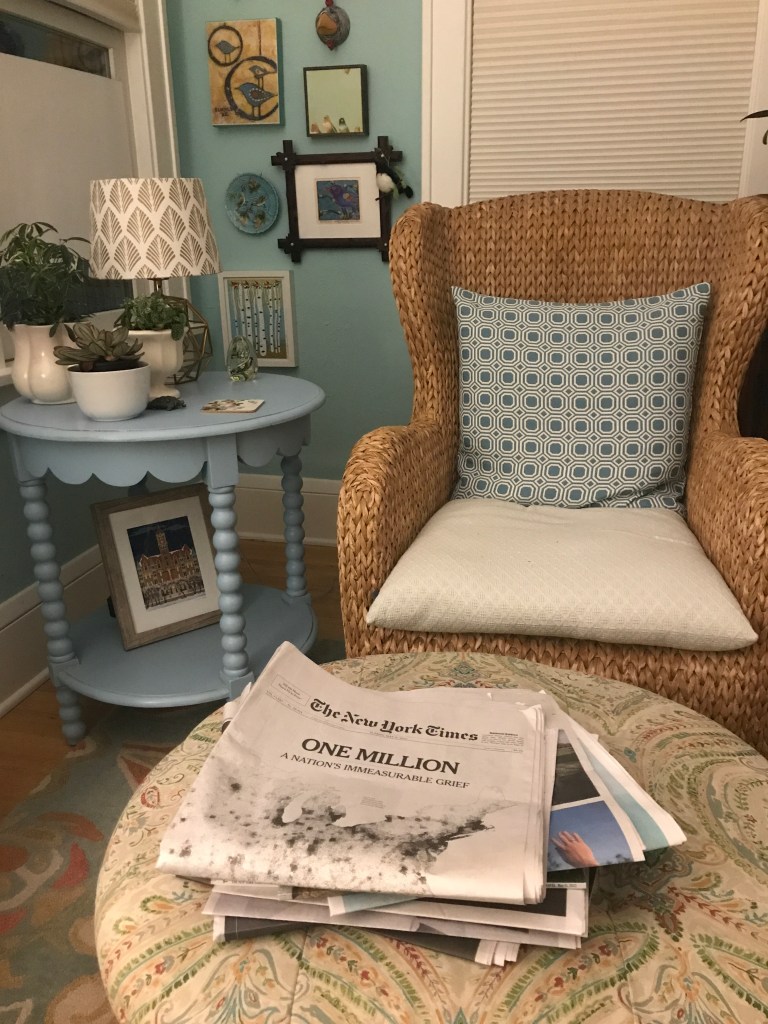
  • The New York Times Sunday Book Review. Of course. I used to pay close attention to what was on the bestseller list–a hangover from bookselling days, I guess, but these days that is not in my radar. I don’t read every review, but I at least glance at titles that have been granted review space, and I always enjoy reading the interview with an author in the “By the Book” column. Questions usually include, “What books are on your nightstand?” and What’s the best book you ever received as a gift?”
  • The Washington Post Book Club Newsletter. (online) Not only do I enjoy the casual style and commentary of the editor, Ron Charles, but there are always good links to other articles, and he ends each week with a poem.
  • BookWomen. This bi-monthly publication celebrates women’s words and explores the place of reading and books in women’s lives. Over the years I have written articles for them, which has always been a privilege, but more than that, I love reading about what others are reading.
  • Other Readers in My Life. I love book talk and relish conversations with others about what they are reading. I appreciate you readers of this blog who recommend books to me, as well.

This is definitely not an exhaustive list, for I roam through other websites and I consult other venues. One thing I don’t do, however, is spend any time reading recommendations that come from Amazon or Barnes and Noble. And I am not a Goodreads subscriber. Just personal choice.

Learning about books that interest me, of course, is important, almost an avocation, but the next question is what do I do with those reading possibilities? That’s where my book journal enters the picture. I keep my TBR (To Be Read) lists in my book journal, (I try to enter the source of the recommendation, but don’t always remember to do that.) ready to be consulted when it is time to request books from the library or for my next bookstore adventure.

Sources

Modern Mrs Darcy: https://modernmrsdarcy.com

Arcadia Books: https://readinutopia.com

Washington Post Book Club:https://www.washingtonpost.com/newsletters/book-club/

BookWomen: http://www.bookwomen.net

An Invitation

What’s your favorite way to learn about books? I would love to know.

If my Thursday, Book Report post is one of the ways you learn about books, I hope you will recommend it to others and suggest they subscribe to my blog. Thanks!

Thistle Talk on Difficult Days: Dealing with Grief and Loss

May 24, 2022

First thing Monday morning my husband headed to church to confront the nasty thistles invading the gardens. This has been and continues to be an ongoing battle, and one that will not be won today or tomorrow, but I admire his determination and commitment.

Thistles appear in our lives in many ways, and lately, thistles seem to be conducting on assault.

Daily, it seems, I hear news of family and friends challenged by serious health or economic concerns or the death of a loved one. Sunday morning, even before I was dressed, my husband showed me a post on Facebook about someone in our extended family who is experiencing hard times. We discussed ways to respond, but at the same time we can not make the basic problem disappear.

That’s a big thistle.

Thistles are prickly. They sting and their roots are deep. They don’t give up easily the places they’ve claimed in the garden. They tend to take over everything that has been loving and intentionally planted, and sometimes it is hard to see the growth, other than the unwanted thistle.

No one chooses a thistle. No one says, “Do we have room in the garden for a thistle?” Nope, they assert themselves without our consent or design.

So what do we do with these thistles?

Here’s what I am learning as a woman in her mid seventies: I have to leave room in my day for grieving, for feeling loss and sadness and sometimes shock. That means being even more intentional about my morning meditation time, which more and more means holding those in my heart who need tender care.

But I also have to leave room in my day for responding to those with tangible needs. Sometimes that means an in-person response –a meal, a visit, an offer to….–or it may mean a more distanced response, writing a note, sending a check, making sure others who need to know do, in fact, know.

Dealing with thistles takes energy, and I sometimes feel the toll encountering so many thistles takes on my spirit. I know that being present to the pain of others means I must be aware of my own feelings and what I am able to do at this stage of my life.

Doris Grumbach in her memoir The Pleasure of Their Company (2000,) which she wrote as she approached her 80th birthday, used the term, “lessening.”

I prefer lessening as both instruction and slogan for my old age.

page 50.

What that suggests to me in my life is choosing carefully, thinking wisely about how I use my energy, for one thing I know for sure: There will be more thistles.

Now is a good and necessary time to ask myself how many commitments are reasonable? What is the call in my life now and how can I respond? How do I best live my essence in this third chapter of my life? How do I create spaciousness in my life to be with the expected unexpected?

Two Thoughts for Reflection

The times are urgent; let us slow down.

African Saying

May you embrace this day, not just as any old day, but as this day. Your day. Held in trust by you, in a singular place, called now.

Carrie Newcomer

May your thistles not overwhelm your garden.

An Invitation

How do you respond to your thistles? I would love to know?

Book Report: Beneficence by Meredith Hall (2020)

May 19, 2022

Goodness. The state of goodness. That’s what “beneficence” means, and this is what this book explores. “Love and all its costs.” (p. 251)

Doris, the mother of the family, opens the story, which is set on a farm in 1947, with these words:

Every morning, early, when Tup and I get up to start our chores, the whole house still quiet and the children asleep I turn and pull the bed together, tugging at the sheets to make them tight and smooth. They are warm with our heat. I slide my hand across the place my husband slept, drawing the blankets up and closing in the warmth, like a memory of us, until night comes when we will lie down together again.

p. 5

A simple scene, but so evocative and so full. Of love and promise and commitment. Making the bed is a spiritual practice for Doris and also an expression of the dailiness and the goodness of her life.

Only a couple paragraphs later, however, Doris says, “You cannot know what will come.” She alerts the reader that this is no simple pastoral account of life on a farm, but this is a tale of what any family encounters one way or another. The love and the loss and the complicated responses to that loss.

It has been a long time since I have read a book that made me cry. This one did. More than once, and more than once I re-read paragraphs and even entire chapters, relishing the writing, but I also wanted to stay with these good, but imperfect people and to support them and honor them. They became real to me. In part that happens because the narration of the story changes in each chapter. Sometimes the father, Tup, is the narrator and sometimes the daughter, Dodie. There are two sons in the family, also, Sonny and Beston.

Almost at the end of the book, now 1965, Doris’s words echo the book’s beginnings.

The cows slept with their calves in the safety of the barn. The night offered all its promise. Tup and I moved to each other, our heat and our weight and our devotion. We slept without guard. There is never a going back. What we say and what we do stays, always. The great price of love and attachment is loss, with us every day. But here, too, each day, are their great easings.

p. 257

I do hope Meredith Hall has another novel in progress. In the meantime I plan to read her memoir, Without a Map. And, I suspect, I will re-read Beneficence again for this book is good. Very good.

An Invitation

Have you read anything recently that made you cry? Or what about a book that you know you will want to read again? I would love to know.

My News Strategy

May 17. 2022

How many times in recent months or, let’s face it, these past few years, have you said, “I just can’t watch (or listen) to the news anymore”? Or perhaps you have been addicted to the news, watching and listening more hours of the day than you know is healthy for you. Perhaps the radio or a cable news station accompanies your every move, wherever you are, whatever you are doing.

No surprise, for the news –local, national, and global–is upsetting, and that is stating it mildly.

Approaching the News as a Spiritual Practice

Jane Vennard in her book, Fully Awake and Truly Alive, Spiritual Practices to Nurture Your Soul (2013) says all spiritual practices can be divided into three categories. (page 87)

  • Contemplative: caring for my body, resting, being silent, practicing solitude, praying, writing in my journal, walking mindfully,
  • Communal: participating in the life of a faith community or other communities in which you gather with others to pay attention to the holy in your life,
  • Missional: hospitality and service.

While the lines dividing the three types of spiritual practice are not always clear and well-defined, as Vennard points out, these categories of spiritual practice can help us become more intentional about our approach to the news.

Part of my morning meditation time, my intentional contemplative time sitting quietly in the garret or walking alone in the neighborhood, often is devoted to praying the news. I may simply name the issues or the people that worry me or touch my heart. I don’t pretend to have answers, but I lean my heart in the direction of those in need, those in pain or in the midst of sorrow and loss, and those who are trying to make a positive difference. Plus, I acknowledge and give thanks for the many gifts in my life; a life lived with ease and privilege and prosperity. I must never take that for granted.

Do my prayers matter? Well, that is a big question, but what I’ve noticed is that when I pray regularly I am more aware of the life around me. Near and far. When I watch or listen to or read the news, I pay attention to my responses. In a way I test my empathy level. Have I become hardened to the news? Do I sigh in disgust (“How could things possibly be worse?”) or descend into hopelessness (“That’s the way things are and what can we do about it anyway?”) Or do I approach the news looking for connection, for our common humanity, for reminders that God is counting on us to live into his love for us?

What I’ve discovered is that the more I pray, the more I find to pray about and the more I find to pray about the more I pray. And the more I pray, I don’t just pray the hurts, the losses, the fears, the unending challenges, but I also pray the love shown, the paths created, the courage, the care, and the revealed movement of God.

Along with this contemplative approach to the news, I have a communal practice. I am an active member of a faith community with a strong commitment to social justice issues. I value our gathering times when we lift not just our individual concerns, but our concerns for the world. Being part of a community gives me a base from which to move in the world, to respond to the news, and provides opportunities for the missional type of spiritual practice. Ways to serve.

Receiving the news is not only a way to stay informed, as important as that is, but it is also a way to strengthen my way of being in the world–as a contemplative who lives and serves with purpose in community. At least that is my aspiration.

My Choices: My News Sources

Even though I try to view my approach to news as a spiritual practice, the choices are overwhelming. Here’s my current buffet of choices:

  • I listen to Minnesota Public Radio/National Public Radio when I get dressed in the morning and when I prepare meals or clean.
  • I receive daily emails from The Washington Post and The New York Times.
  • I read two online newsletters that I highly recommend: Robert Hubbell’s Today’s Edition Newsletter https://roberthubbell.substack.com and Heather Cox Richardson’s Letters from an American https://heathercoxrichardson.substack.com
  • I read the Sunday New York Times–not always on Sunday, however. I admit I start with the Book Review and some Sundays I don’t get much further than that, but even reading the rest of the paper on Tuesday or Wednesday is valuable.
  • We watch the nightly PBS News Hour. Lately, we have fasted from watching any television news, but when we do, this is our choice.

A Thought

it isn’t more light we need, it’s putting into practice what light we already have. When we do that, wonderful things will happen within our lives and within our world.

Peace Pilgrim

An Invitation

What is your relationship to the news? What is your news strategy? I would love to know.

Book Report: April Round-Up and Powell’s Book Store Purchases

May 12, 2022

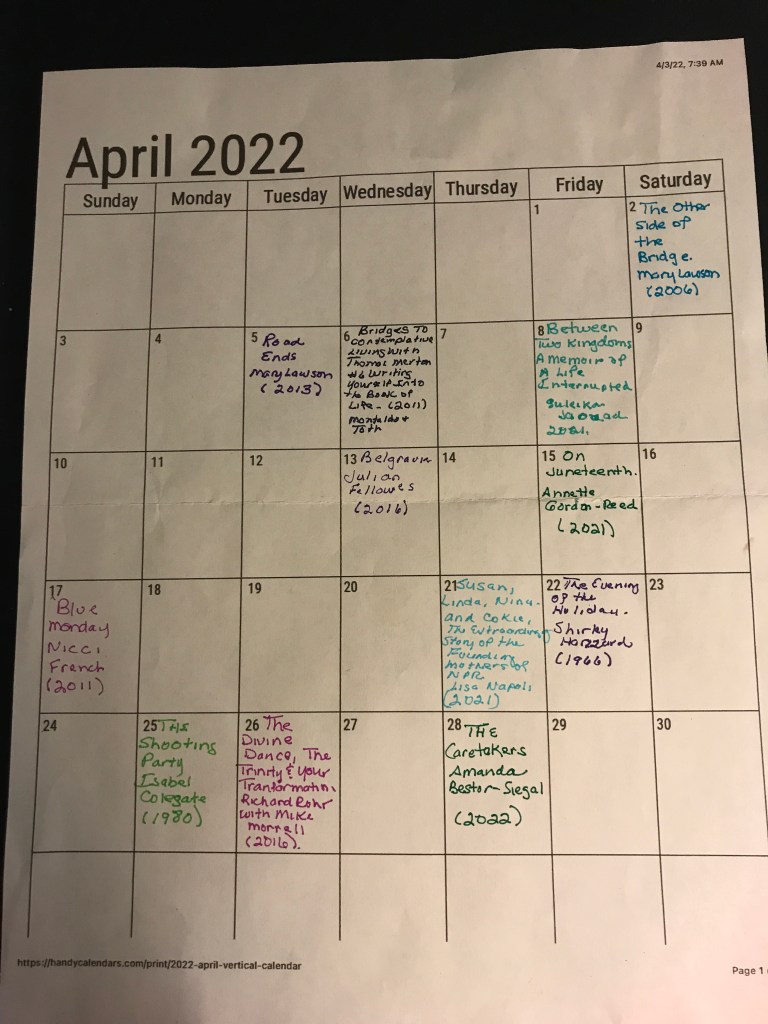
I have now read all four of Mary Lawson’s wonderful novels, and I hope she is writing, writing, writing! The Other Side of the Bridge (2006) is her second novel (Crow Lake is her first) and is set in a small Canadian town, shifting between two time periods, WWII and the 1960’s. The main character Ian, the son of the town’s physician, is often called upon to help his father, but as a teenager he prefers working on the farm owned by Arthur and his wife Laura. The story of Arthur and his brother Jake is a major part of the story, as is the story of Pete, a Native American friend of Ian’s. Many subplots, but they weave together beautifully.

Lawson’s 3rd book is Road Ends (2013). Warning: Dysfunctional family alert! The mother just wants to have babies and then ignores them when they have grown out of babyhood. Tom is the oldest of seven boys and Megan is the only daughter. She escapes to London and the father, who is a banker, escapes to his study. A heart-breaking story, but oh, Lawson can write. I reviewed her most recent book, A Town Called Solace in my March Round-Up. https://wordpress.com/post/livingonlifeslabyrinth.com/650

I am now fully immersed in a mystery series by a husband-wife duo whose pseudonym is Nicci French. I read the first in the series, Blue Monday (2011) in April, and we listened to the second, Tuesday’s Gone (2012) on our road trip to Portland, OR, and this week I read the third, Waiting for Wednesday. I guarantee I will complete the remaining days of the week this month. Set in London, the main character is the highly intuitive psychotherapist, Frieda Klein, who could use some therapy herself. She develops an informal, but key relationship with the police department. A small boy is kidnapped and this re-opens a case from years before. Get ready for a major twist at the end. I recommend reading these books in order, by the way, for some of the characters and plots continue from book to book.

I have already reviewed two favorite nonfiction books read in April, Between Two Kingdoms by Suleika Jauoud https://wordpress.com/post/livingonlifeslabyrinth.com/673 and On Juneteenth by Annette Gordon-Reed, https://wordpress.com/post/livingonlifeslabyrinth.com/695 but I will mention two others. First, Susan, Linda, Nina and Cokie, The Extraordinary Story of the Founding Mothers of NPR by Lisa Napoli. (2021) As an NPR junkie, I throughly enjoyed reading about their key roles in the early years of NPR, and as I write this, I can hear each of their distinctive voices. My only complaint about the book is that it lacks pictures, but it is radio after all!

I have not yet moved the other book, The Divine Dance, The Trinity and Your Transformation (2016) by Richard Rohr and Mike Morrell from my basket of morning meditation materials to my bookshelf, for I keep re-reading sections, in order to reflect and absorb the words even more. Despite the deep topic, the writing style is conversational, and invites inner conversation. The words “flow and “relationship” are key to the discussion. No doubt I will refer to this book again in future blog posts.

The Powell’s Report

First, I should mention that one night of our road trip to Portland, OR, we stayed in Missoula, MT, which has a charming downtown and a good independent bookstore, Fact and Fiction. Even though I knew I would make a big haul at Powell’s, I can’t pass up supporting independent bookstores wherever I find them. I bought two novels on my TBR list: Beneficence (2020) by Meredith Hall, which I read on the trip and loved and will write about in more detail in a later post, and A Ghost in the Throat (2020) by Doireann Ni Ghriofa. I listened to an interview with the Irish author on NPR recently and am intrigued.

I also bought a book at the Crazy Horse Memorial; a book I have been meaning to read for a long time, and I am so happy to have bought it at the memorial location: Black Elk Speaks, The Complete Edition by John G. Neihardt.

Then Powell’s. Armed with my TBR list on my phone and a store map, which is definitely needed, I took a deep breath and realized I needed a plan. I decided to focus on two sections–mystery and literature, both on the same floor and close to the coffee shop. At Powell’s used and new books are shelved together, and I decided to only buy books that had not been published recently, instead of current books easy to find in most bookstores. I made one exception, Great Circle (2021) by Maggie Shipstead. By the time I made the decision to narrow my purchases, I already had this in my basket and couldn’t force myself to eliminate it.

These are the used books I found that are on my TBR list:

  • Solar Storms by Linda Hogan (1995)
  • The Gown by Jennifer Robson (2019)
  • Jubilee by Margaret Walker (1966)
  • The Expats (2012) and The Paris Diversion (2019) by Chris Pavone

I also decided to get a couple books I loved and want to re-read: The Stone Diaries (1994) by Carol Shields and The Shell Seekers (1987) by Rosamunde Pilcher.

Finally, a surprise find, a book I had not heard about, The Pleasure of Their Company (2000) by Doris Grumbach. This slim hardcover memoir written near her 80th birthday was on the shelf next to her novels. It caught my eye and for $6.95 used I could not resist.

I’m thrilled with my pile and the whole Powell’s experience. Now I know what our granddaughter meant when she said we would need to set a timer for ourselves or we would still be wandering the aisles when the store closed for the day.

An Invitation

What were your favorite April books and what is waiting on your shelves for the right time? I would love to know.

Re-entry: Thoughts Post Road Trip

The road is never long when the goal is time with a grandchild.

My husband and I volunteered to bring our granddaughter Maren home from her first year at Lewis and Clark College in Portland, Oregon. We were eager for a road trip–a change of pace and scenery–and the lure of having Maren all to ourselves between Portland and St Paul was just the incentive we needed.

What a treat to see her in her new habitat, meet some of her friends, and hear about her classes and activities, as well as plans for the next school year. Plus, we thrilled with the diversity of landscape between Minnesota and Oregon, and how fun to see bison and antelope and prairie dogs and Bighorn sheep in their natural settings. Oh, and the coyote that dashed across the road right in front of us!

Each of our families made the trek through the Badlands and to Mt Rushmore when we were in sixth grade, but this was the first time we had been to the Crazy Horse Monument with its amazing museum of Native American art. The creation of the monument, whose origin is a fascinating tale, will continue for decades to come. Put this on your “must visit” list.

We oohed and aahed our way through Portland neighborhoods, including the Japanese Garden, realizing how color starved we were, thanks to our reluctant spring in Minnesota.

A great trip, but oh how good it is to be home.

Travel As I Age

  • I enjoy traveling, but I admit I am not passionate about traveling. I loved the big trips we had in the past–Paris, London, Rome and Florence, Tanzania, along with the semester I spent in Thailand when I was a junior in college. How amazing it was to experience other cultures and to see so much of what I had read about –or knew nothing about, but I don’t yearn for big trips. I view those trips as a kind of bonus in my life.
  • I don’t like to pack, but I enjoy unpacking. Deciding what to take –how much, for what kind of occasions and weather and possibilities–flusters me. But emptying the suitcases, doing the laundry, finding places for any new treasures does not feel like a chore to me. I love the feeling of settling back in and becoming reacquainted with the routines of my everyday life.
  • I am just as content and interested in the close by, as the far away. And then after roaming for only a day, I can sleep in my own bed. (Would someone explain to me why hotel beds seem to be so high–I need a running jump or a stool to get myself up into bed and when I do the bedding is so heavy I can hardly move. And what about the lack of good lighting? Don’t other people read before they go to sleep? I’ll stop whining now!)
  • I repeat: I am just as content with the close by as the far away. I like being a tourist in my own town, my own state, and I’ve started making this summer’s list of places we can visit in a day or maybe two.
  • I prefer immersing myself in a place. When we went to France several years ago, we stayed in Paris for the whole two weeks and took day trips, returning to our apartment each evening. We wandered neighborhoods, as well as seeing the most important sights. I like getting a taste of what it might be like to live in that location. That can also mean returning to a location over and over again. For example, we never tire of returning to Door County, WI. We relish the familiar, as well as the new discoveries.
  • I appreciate the spaciousness of travel. How good it is to learn and experience new things, but travel also opens my eyes and my heart to myself. I return home with new insights, new ideas for teaching or writing or even how to rearrange the furniture. Travel is a not only a time to wander physically, but it is also a time that encourages day dreaming and imagining what it would be like to live someplace else. Travel is a time to visit the “what ifs” of the mind.

Let me be clear: We had a great trip, especially the time we had to be with Maren. No regrets, but I am just as happy to once again be home.

Travel as Pilgrimage

As I prepare for or begin a trip, I consider my intention. In this case, it was obvious; spend time with Maren and gain a clearer vision of her college life. The agenda was simple and loose, leaving room for flexibility and possibility.

Just as important, however, at the beginning of a trip is to consider what to leave behind, in order to open myself to something new or unknown. For me that meant taking a time out from writing posts for this blog and spending a minimum of time emailing or doing other online tasks. I left behind my “to do” lists, and that, dear friends, is not easy for me.

As I travel, I ask myself how can I be receptive to what is in front of me and offered to me? What do I give of myself? Are my eyes open? My heart? On this trip we saw so much poverty and homelessness, for example. At the same time we saw so much beauty.

Now that I have returned, I need time to integrate what I’ve learned and experienced. What questions do I have about what I have seen? What else do I want to learn? How will this trip enhance my life and the way I live? I am in that stage now.

Note:

My next post, Thursday, May 12, I will share the list of books I bought at the bookstore mecca, Powells.

An Invitation

What kind of a traveler are you? What makes travel pleasurable for you? What role does travel play in who you are? I would love to know.

Words of the Season

NOTE: After my Book Report post on Thursday, April 21, I’m going to take a brief break. My plan is to begin posting again the week of May 9.

One of my Lenten practices in recent years has been to describe each day in a word or short phrase or to listen for a word that invites reflection. (I use a template from Praying in Color https://prayingincolor.com to record those words.)

The last word, the only word, the word at the center is Easter. How grateful I am to arrive there, to know this word, but at the same time It is good to reflect on the journey.

One of Jan Richardson’s Easter reflections in her book In Wisdom’s Path, Discovering the Sacred in Every Season is about words that have been meaningful in her life. She finds a list she made years ago: courage, comfort, dwell, and many others and decides to make a new list. She notes that many of the words on the old list reappear, but there are also new ones: threshold, voice, longing, labyrinth, shadow, passion and others. (p. 96)

What similarities are there between my 2022 and 2021 Lenten words? What can I learn by reviewing the words from these two years?

The first thing I notice is how much more restrained 2021 is than 2022. I enjoyed the coloring and doodling process this year, and I wonder if it isn’t time to resurrect some coloring books; an activity that has been relaxing in recent years.

My word for the year in 2021 was WORD, and my word for 2022 is RHYTHM. The focus for each word is reflected in each of these images, I think.

During this recent Lent I seemed to have been more aware of the movement of each day, often expressing that movement in my simple doodles, as well as the choice of words. For example, the first Lenten word this year was “let,” followed by “flow,”, “slow down,” and “exhale.” Other words reflect my awareness of the rhythm of my day, of my intentions. “Flow” appears again and “roam” is noted three times, but other words, “steps,” “easy,” “gather,” “flexible,” “wave,” and many others all indicate some kind of movement and rhythm. The movement of God in my life and the movement of God in my own being.

During Lent, 2021, I spent more time writing in my journal about the word for the day. Often I discovered the word for the day in someone else’s words. For example, early in the Lenten season I re-read The Way of Silence, Engaging the Sacred in Daily Life by Brother David Steindl-Rast and the days’s passage often revealed that day’s word. On February 20, the revealed word was “aliveness.”

If we could measure our aliveness surely it is the degree to which we are in touch with the Holy One as the inexhaustible fire in the midst of all things. p. 118.

In my journal entry I reflect on times I feel that aliveness.

        When I do things I love to do.
        When I am with people I love.
        When I read something that opens me.
        Sometimes when I am writing, and a word, a sentence feels just right.
        When I end a session with a spiritual direction client and sense they have gained insight into themselves or their relationship with God. 

A number of words in 2021 are related to the pandemic. "Relief" on the day we received our first vaccination and "rejoice" the day we received the second dose. Other words reflect a more solitary life--"cozy," "inhabit," "pray," "imagine,," "tucked in," and "safe."  The 2022 words feel more active, more indicative of a life not so confined. 

Some words are found in both years--"gift," 'listen," "gather," "host," and "space," but do they mean the same thing in both years? Further reflection is needed. In fact, I intend to sit more with both collections of words, for I know there are more insights to be uncovered. 

Perhaps, I will continue the practice of discovering my word for the day and note them on a calendar where I can see the relationships from one day to another and over time. In fact, I will start today.

Today's word is "meet.". Not only will I meet with my writing group, but as I listen to what they share and as I offer my work since our previous meeting time, I know I will meet new thoughts and perspectives. And I suspect I will meet the movement of God.

An Invitation:

What is your word for today? What words seem to keep appearing? I would love to know.

Book Report: Between Two Kingdoms, A Memoir of a Life Interrupted by Suleika Jaouad

At age 22 Suleika Jaouad learned she had leukemia and a 35 percent chance of survival.

Devastating. Obviously.

Much of the book details the four years of round after round of chemo, a clinical trial, and a bone marrow transplant, and near-death reckonings –written clearly and beautifully. This is all important, but what really moved me in this book was the honest revelations about herself, a young woman going through such crushing pain and uncertainty, and about her needs and desires, met and unmet.

I bent over the sink and splashed my face with cold water and looked in the mirror. I looked terrible–because I was horrible, I thought, with a nauseating swell of shame. Along with the chemo, an ugliness was coursing through my veins. Small violences. Swallowed resentment. Buried humiliations. Displaced fury. And a marrow-deep weariness at a situation that dragged on…

p. 162

When her medical team declares her cured, she learns the healing needs to begin. Jaouad quotes Susan Sontag in her book Illness as Metaphor, “Everyone who is born holds dual citizenship, in the kingdom of the well and in the kingdom of the sick.” In part healing means navigating from the kingdom of the sick to the kingdom of the well and to honor that she embarks on a pilgrimage, a 100 day road trip. In response to the column she wrote for the New York Times about being so young and having cancer, many people wrote to her about their own stories, and she decides to visit some of them, including a man on Death Row in Texas.

He understands what it feels like to feel stuck in purgatory, awaiting the news of your fate; the loneliness and claustrophobia of being confined to a small room for endless stretches of time; how it’s necessary to get inventive in order to keep yourself sane. These unexpected parallels are what initially compelled him to write to me, “You’ve fled death in your own personal prison just like I continue to face death in mine…At the end of the day death is death, doesn’t matter the form it takes.”

p. 338

Throughout those long years her family was there for her completely. As was her boyfriend–until he wasn’t. Caretaking is not easy, especially when you are just starting out in your own life. Jaouad shares all the ways he sacrificed for her and expressed his love, and she is deeply grateful, but ultimately, the reality of her needs was too much. A certain bitterness remains and more healing needs to occur beyond the last page of the book.

Healing is figuring out how to coexist with the pain that will always live inside of you, without pretending it isn’t there or allowing it to hijack your day. It is learning to confront ghosts and to carry what lingers.

p. 312

Fun Fact: Jaouad recently married the gifted musician, Jon Batiste.

My copy of the book is feathered with tabs, and I could have marked many more memorable passages. I am grateful for the wisdom and openness found on these pages, and offer a prayer that her cancer days are over forever and that healing continues in her life.

An Invitation:

What have you read recently that encouraged your own healing? I would love to know.

Holy Days

These are Holy Days.

This week leads Christians through the remaining days of Lent to Easter Sunday, but first there is Holy Thursday, Good Friday, and Easter Vigil on Saturday. Jews are preparing for Passover. The eight-day festival begins at sundown on April 15 and ends at sundown on April 23. And Muslims are marking Ramadan the entire month of April, ending with the Feast of Fast-Breaking on Sunday, May 1.

Yes, these are Holy Days, in which those of us who practice one of these faith traditions reflect on the stories central to our beliefs, gather with our faith communities, and observe the customs of these days. For example, a recent tradition at our house is to add the palms we waved on Palm Sunday to the basket of forsythia on our front door as a reminder of these Holy Days.

Along with attending each of the planned services this week, I will also attend a Solidarity Around the Cross prayer service at the Ukrainian American Center in Minneapolis, sponsored by my congregation as one way to respond to the world’s suffering. But I will also continue with morning prayer and reflection time, holding these days in my heart and reflecting on their meaning for how I live my life.

These Holy Days ask me to be aware of and live fully each holy day.

Some days I manage that better than others. This reluctant spring has added to the challenge here in my part of the world, but I am trying to love what is, to see and feel the holiness of each day.

I challenge myself to know, really know, the fullness of the words, “Every day is a gift.” Yes, regardless of the temperature, the precipitation, road conditions, or lingering brown landscape. I can continue to become more of the person I was created to be no matter the season, and I feel an eagerness to discover the holy days of this particular spring. In what ways will I be enticed to grow? How will I nurture others and myself? Where will I notice the movement of God?

Settle to be fully present to yourself, to whatever is, to God…dwell, and absorb and be–Give thanks.

from Christos Center meditation, 3/14/22

May these Holy Days be holy days in your life. May each day to come be a holy day.

An Invitation:

What might you do to be more aware of each day as a holy day? I would love to know.

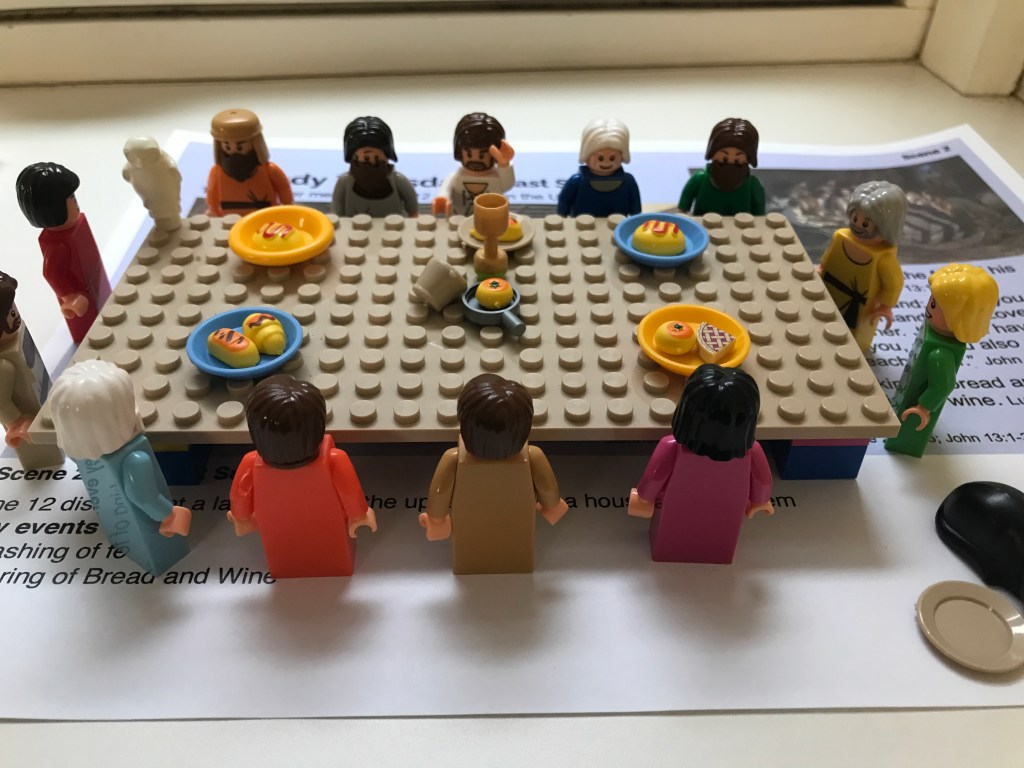
I spotted these Lego vignettes of Holy Week in the Sunday School classroom where the writing group I facilitate meets each week. Holy Play!

Book Report: March Round-Up

This was a 12 book month–maybe because March was more like a lion than a lamb. Reading was definitely the cozy thing to do on snowy and cold days.

Fiction: Seven Books

  • My favorite this month was A Town Called Solace (2021) by Mary Lawson. One of my favorite books of 2021 was her first book Crow Lake, and this month I have already read another in her backlist. In my book journal notes I wrote, “If I wrote fiction, I would like to write a book like this.” The characters in her books, which are set in northern Canada, are real, flawed, vulnerable, and likable, sometimes lovable. Clara is eight years old and worried about her older sister who has run away. She is also worried about her neighbor Mrs Orchard who is in the hospital. At least that is what she is told. Clara takes care of Moses, her neighbor’s cat, but how to do that when she realizes someone else is living in the house?
  • I also loved The Floor of the Sky (2006) by Pamela Carter Joern. Lila, age 16, is pregnant and comes to live on her grandmother Toby’s ranch in the Sandhills of Nebraska. Toby is in danger of losing the ranch to back taxes –her backstory is revealed slowly, gently, and lovingly. Like the characters in the Lawson book, these characters entered my heart.
  • Another one of my favorite books in 2021 was This Is Happiness by Niall Williams, and now I am exploring his backlist. This past month I read Four Letters of Love (1997). Also set in Ireland, this is a story of two families. The father in one wants to devote his life to painting and the father in the other writes poetry and as a prize in a writing contest is given a painting by the other man. This is the story, as many novels are, of love and loss and discernment, but also miracles. Here is an example of one beautifully written passage (p.209):

The priest shushed them, and waved them hopelessly back towards the gate. He was a quiet man who sought quietness, and was suddenly alarmed at what landed in his parish. Panic prickled in his lower stomach like a bag of needles. It was the kind of thing you wished on your worst enemy this: miracles. Let the bishop have them, give them to Galway, but not here. Why were they always happening in out-of-the-way rural places? God! His shaven jaw stung in the salt wind and he rued the new blades he had bought at O’Gormans.

  • Jacqueline Winspear’s newest in her Maisie Dobbs series was published in March, and I didn’t hesitate to get my copy of A Sunlit Weapon. Maisie Dobbs is a psychologist and private investigator in post WWI London. This latest book is set during WWII and we get fuller views of Maisie with her American husband and their adopted daughter. While I don’t anticipate re-reading these books as I have done with the Louise Penney books, each one is a good read. I recommend reading them in order. The first book in the series is Maisie Dobbs (2003).
  • I enjoyed both Marjorie Morningstar (1955) by Herman Wouk, which I found in a Little Free Library, and The Bastard of Istanbul (2007) by Elif Shafak. (I will probably read Shafak’s The Forty Rules of Love at some point.) I did not particularly enjoy The Camomile Lawn (1984) by Mary Wesley and am not sure why I didn’t set it aside without finishing. It is set in the early years of WWII in England and focuses on a decadent and sometimes abusive family. Some nice writing, but I won’t be reading more by this author.

Nonfiction: Five Books

  • I have already written a review of Spirit Car, Journey to a Dakota Past (2006) by Diane Wilson https://livingonlifeslabyrinth.com/2022/03/24/book-report-spirit-car-journey-to-a-dakota-past-by-diane-wilson-2006/ and highly recommend it.
  • If you are in a discernment process of any kind, I also highly recommend Decision Making and Spiritual Discernment, The Sacred Art of Finding Your Way (2010) by Nancy Bieber. I have used this book more than once and am so glad it is still on my shelf and once again, it was just the help I needed.
  • The Making of an Old Soul, Aging as the Fulfillment of Life’s Promise (2021) by Carol Orsborn is a slim book, but packed with wisdom. She maintains the “purpose of life may be to clarify our essence,” and the book illuminates how awakening to that essence is possible to our final page. Previously, I appreciated a book she co-authored with Robert L. Weber, The Spirituality of Age, A Seeker’s Guide to Growing Older (2015).
  • Not as high on my recommended list are two other books read in March. The Salt Path (2018) by Raynor Winn and Soul Therapy, The Art and Craft of Caring Conversation (2021) by Thomas Moore. The Salt Path is the true story of Winn and her husband Moth who undertake a 630 mile walk in the UK. They are homeless and broke, and this is a brave, but not always wise decision, especially since husband Moth has serious health issues. The story is important, but the writing was not always strong. I have loved earlier books by Moore, including The Re-Enchantment of Everyday Life and Care of the Soul, but this most recent book is not his strongest. I like the notion, however, that therapy is really care of the soul, and I like this quote:

…you are the servant and secretary, not the one who heals and saves. You are the priest and minister, but not the cause of success. Your job is to assist at the healing but not do the work first hand. Sometimes I think of my job as that of sacristan. I keep the temple clean and well-supplied.

An Invitation:

What did you read in March and what do you recommend? I would love to know.