Book Report: Shopping my Library for Books on Spiritual Practices

February 23, 2023

Get ready for a barrage of books.

Yesterday was Ash Wednesday, leading those of us in the Christian faith into the Lenten season. Lent seems like a good time to reflect on the role of spiritual practices in our lives. Even though I have written about and offered workshops and talks on this topic many times before, I know I can still learn more. My ongoing hope is to demystify the nature of spiritual practices and to explore ways to integrate spiritual practices into our daily lives.

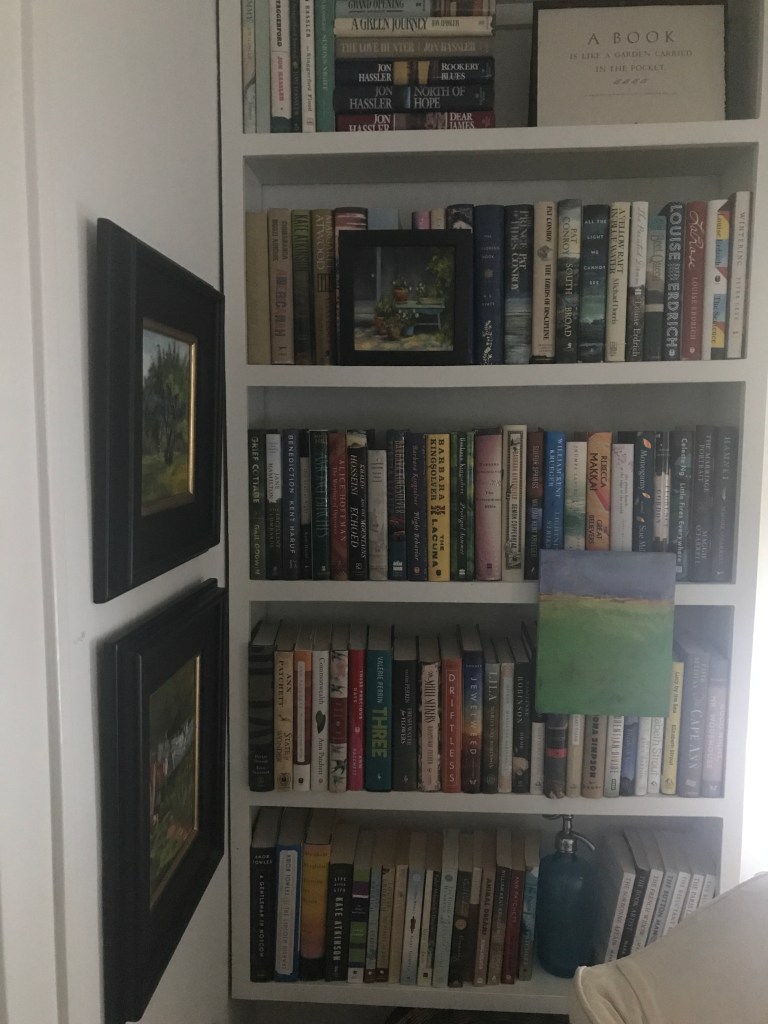
Often the place I begin is in my own library. What have I underlined in books I have read? What books feel like a classic resource in my own spiritual development? What books opened me to something new? What books no longer fit my evolving faith? Which books have become a presence in my life? Which books deserve another look?

Well, it is quite a rabbit hole, but here are a few impressions and notes from my recent browsing:

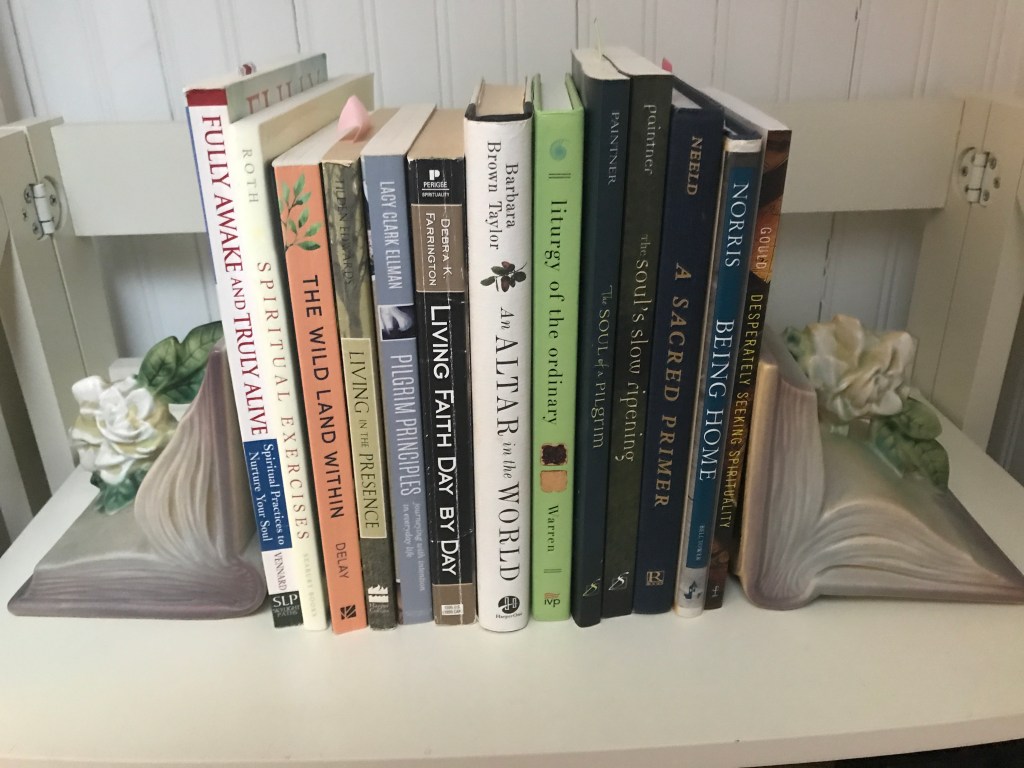
Jane Vennard in Fully Awake and Truly Alive, Spiritual Practices to Nurture Your Soul introduced me to the Buddhist terms, “on-cushion practices” and “off-cushion practices,” and changed the way I think about spiritual practices. “On-cushion practices are the more intentional, formal, perhaps traditional kinds of practices like meditation and centering prayer. “Off-cushion practices” are less formal and more spontaneous experiences, like pausing to look at a sunset and feeling connected to all of creation or sending blessings when you see the neighbor children walking to school every morning. The poetry/meditations of Being Home by Gunilla Norris have helped me be aware of the many opportunities for off-cushion practices throughout my days.

from "Choosing What to Wear"

I stand by the closet door
barefooted before this choice.
When I pick now I want to remember
that You have picked me--
no self-made woman, but one brought forth
by the lives that have gone before me,
lives that have made mine possible...
from the first single-celled creatures,
those ancient ancestors,
to the dear ones I call parents.

Liturgy of the Ordinary, Sacred Practices in Everyday Life by Tish Harrison Warren also starts with the possibilities for spiritual practice in each day, the overlooked moments and routines, like sitting in traffic or checking email. She examines these moments as doorways to the sacred and to living a life of deeper awareness of the holy.

I want to learn how to spend time over my inbox, laundry, and tax forms, yet, mysteriously, always on my knees, offering up my work as a prayer to the God who blesses and sends.

page 100

I have consulted and even re-read in their entirety several of these books, including An Altar in the World, A Geography of Faith by Barbara Brown Taylor and two of Christine Valters Paintner’s books, The Soul’s Slow Ripening, 12 Celtic Practices for Seeking the Sacred and The Soul of a Pilgrim, Eight Practices for the Journey Within. All three of these books have become sacred texts for me.

Whoever you are, you are human. Wherever you are, you live in the world, which is just waiting for you to notice the holiness in it. So welcome to your own priesthood, practices at the altar of your own life. The good news is that you have everything you need to begin.

An Altar in the World, p xvii

Some of the books I have had on my shelves for a long time, and they continue to inform and inspire me. I think I bought Tilden Edwards’ Living in the Presence, Spiritual Exercises to Open Our Lives to the Awareness of God when I was in spiritual direction training in the 90’s–one of those basic texts. Not as dense, lighter, but no less wise is A Sacred Primer, The Essential Guide to Quiet Time and Prayer by Elizabeth Harper Neeld. Another title that has served me well is Living Faith Day By Day, How the Sacred Rules of Monastic Traditions Can Help You Live Spiritually in the Modern World by Debra K. Farrington. Farrington approaches spiritual practices from the structure of creating a rule of life for one’s life. That may sound daunting, but she makes it approachable and desirable.

The topic continues to be relevant, and I continue to add books to my collection, including Pilgrim Principles, Journeying with Intention in Everyday Life by Lacy Clark Ellman, The Wild Land Within, Cultivating Wholeness Through Spiritual Practice by Lisa Colon Delay, and another with an intriguing title, Desperately Seeking Spirituality, A Field Guide to Practice by Meredith Gould. Each one of these books feels like a generous and welcoming companion. One more –a book I have acquired, but not yet read, Essential Spirituality, The 7 Central Practices to Awaken Heart and Mind, by Roger Walsh. Stay tuned for a further evaluation.

Several of the books refer to spiritual practices that include specific ways the body is a tool for care of the soul, but one book stands out, Spiritual Exercises, Joining Body and Spirit in Prayer by Nancy Roth. This book reminds us that walking and doing Pilates and yoga and T’ai Chi and dancing and receiving a massage are also ways to experience the movement of God.

More…More…More

My library includes separate shelves with books on aging and spirituality. Several of those titles address spiritual practices, including Aging as a Spiritual Practice, A Contemplative Guide to Growing Older and Wiser by Lewis Richmond, A Season of Mystery, 10 Spiritual Practices for Embracing A Happier Second Half of Life by Paula Huston, and Pilgrimage into the Last Third of Life, 7 Gateways to Spiritual Growth by Jane Marie Thibault and Richard L. Morgan. I will save reflections on these books for another time.

A Gentle Reminder

As much as I love books and as much as book enriches my spiritual life, reading about spiritual practices does not substitute for practicing. Writing posts in my blog is one of my spiritual practices.

An Invitation

What are your spiritual practices? I would love to know.
Book Report: Writing Books By Eric Maisel

February 16, 2023

I love to read.

I love to write.

I love to read about writing.

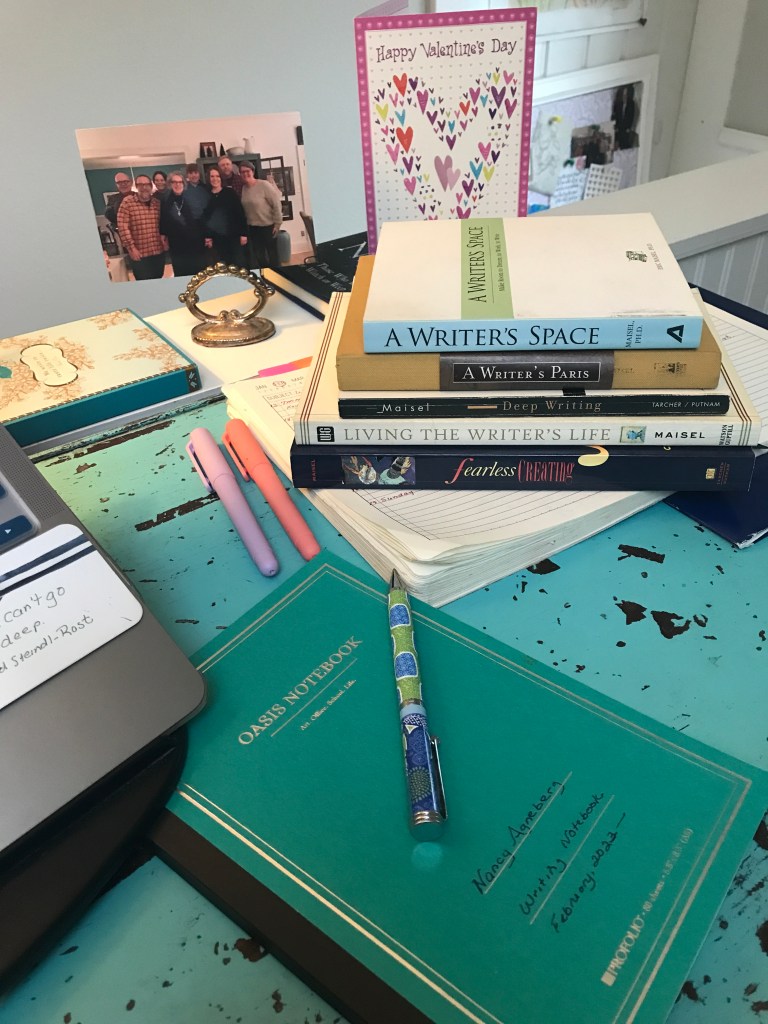
One of my favorite writers about writing, as you can see in this stack of five books, is Eric Maisel. I have other favorites, of course. Natalie Goldberg, Anne Lamott, Elizabeth Jarrett Andrew, and more recently, I loved the book, Memoir as Medicine by Nancy Slonim Aronie. And you will see a collection of Julia Cameron books on my writing bookshelf, too.

There is something about Maisel’s books, however, that resonate with me, and I make it a point to re-read at least one of his books each year. Most often the EM book of choice is A Writer’s Paris, A Guided Journey for the Creative Soul. (2005). The book, small, easy to hold, the size of a small journal or travel guide, is a call to follow your fantasy image of yourself as a writer and where better to do that, but Paris?

What might it mean to your creative life if you included, as part of your education as a writer, a risky experience like running off to Paris to write? Something on that order may be needed to unlock the trunk and let out those thousand poems, those hundred short stories, that full shelf of novels or narrative nonfiction.

pp. 2-3

I have been to Paris just once and even sat in a cafe and wrote in my journal, but I don’t have plans to go to Paris for a writing retreat. If I did, I would take this book, which hovers between fantasy and reality, for it has practical hints for living in Paris, but also addresses ways each of us wannabe writers can live that life now. Here and now.

I write in a garret. Yes, it is in St Paul, Minnesota, USA, but somedays it is easy to think of it as a French garret in some centuries old building. I imagine walking down several flights of smooth stone stairs and crossing the street to a boulangerie, greeting the baker and buying the day’s ration of bread and then returning, walking back up those same smooth stone stairs, flight after flight, to my garret. My view today, however, is not of Parisian rooftops, but instead our garage roof and an occasional bird sitting on the electrical wire. My Paris. My here and now.

I begin to write.

And in the summer I write in a secluded small garden I call “Paris.” I sit at a bistro table and write. I can see neighbors walking by, but it is rare I am noticed. True, this little garden is not beyond the French doors of a Paris apartment, but I can pretend, and sometimes I do.

This little book reminds me to “access the Paris already inside of you. There is a Paris-of-the-mind that resides in each of us…It is available to you right now.” p. 191

I may not have gone to Paris to write, but many years ago I did go to Bainbridge Island, Washington to write, and I have given myself solo writing retreats in a cabin on one of Minnesota’s lakes, as well as writing retreats led by other writers. I have found ways to create Paris for myself, including in the garret.

Recently, I pulled Maisel’s A Writer’s Space, Make Room to Dream, to Work, to Write off my bookshelf, and the book opened to this:

The writing life is defined by the succession of choices you make, primary among them whether or not you will write.

p. 54

I have been lucky over the years, no matter where we lived, to have a room of my own, but that is only part of the issue. The other aspect is creating time to write and devoting energy to do that. I looked at my calendar recently and realized that with one small change I could create Writing Wednesdays. Yesterday was my third Writing Wednesday, and I devoted the day to working on an essay about walking labyrinths.

I write on other days of the week–my twice-weekly blog posts, for example, and most mornings I write in my journal as part of my daily devotion and meditation routine, but setting apart a day to work on something that has been percolating or been in process, but set aside honors myself as a writer. How good this decision feels.

An Invitation

What do you need to make room for in your life? I would love to know.

NOTE: Eric Maisel is a psychotherapist, teacher, coach who focuses on helping creative and performing artists meet their emotional and practical challenges, and his list of books is long. https://ericmaisel.com

Book Report: Our Missing Hearts by Celeste Ng

February 9, 2023

I gave my daughter this book, Our Missing Hearts by Celeste Ng for Christmas, knowing eventually I would get it back from her and then I could read it. Smart, huh? The word she used when she passed it on to me is “exquisite,” and it is. Every word, every sentence is perfect. Not a word wasted. Not an overblown or unnecessary sentence. Exquisite.

The book, a dystopian novel, is also chilling and upsetting.

So often dystopian novels are far-fetched, and truly stretch our imaginations, but as I read this book, I had to often remind myself that the book is fiction and not nonfiction. The references to books taken off library shelves, to the crimes against Chinese Americans, to children separated from parents at our southern borders, and to the fear and systems created to “protect” American culture are all too relevant.

The main character is Bird, a 12 year-old Chinese American boy, whose mother is a poet. Her poem “Our Missing Hearts” becomes a slogan, an icon for protesters, and she leaves her family and becomes a fugitive. Bird, after finding some clues, attempts to find her. You will fall in love with Bird.

The book also lifts the power of words and of story. And memories.

I don’t want to say more, except READ THIS BOOK, but instead I share two of my favorite passages. The first is Bird’s father’s reflections about his wife, Bird’s mother. And the second is almost at the end of the book and brought tears to my eyes.

…this unshakable belief that the world was a knowable place. That by studying its branches and byways, the tracks it had rutted in the dust, you could understand it. For her the magic was not what words had been, but what they were capable of: their ability to sketch, with one sweeping brushstroke, the contours of an experience, the form of a feeling. How could they make the ineffable, how could they hover a shape before you for an eye blink, before it dissolved into the air. And this, in turn, was what he loved about her–insatiable curiosity about the world, how for her it could never be fully unraveled, it held infinite mysteries and wonders and sometimes all you could do was stand agape, rubbing your eyes, trying to see properly.

p. 176

When does she stop speaking? When are you ever done with the story of someone you love? You turn the most precious of your memories over and over, wearing their edges smooth, warming them again with your heat. You touch the curves and hollows of every detail you have, memorizing them, reciting them once more though you already know them in your bones. Who ever thinks, recalling the face of the one they loved who is gone: yes, I looked at you enough, I loved you enough, we had enough time, any of this was enough?

p. 302

My one complaint about the book is the cover. Did I miss the relevance of the feather? Yes, the boy is named Bird, but the flock of birds on the cover doesn’t seem to represent him. Did those responsible for the cover art read the book? Oh well.

An Invitation

What books make you shout, READ THIS BOOK? I would love to know

Book Report: JanuaryRound-UP

February 2, 2023

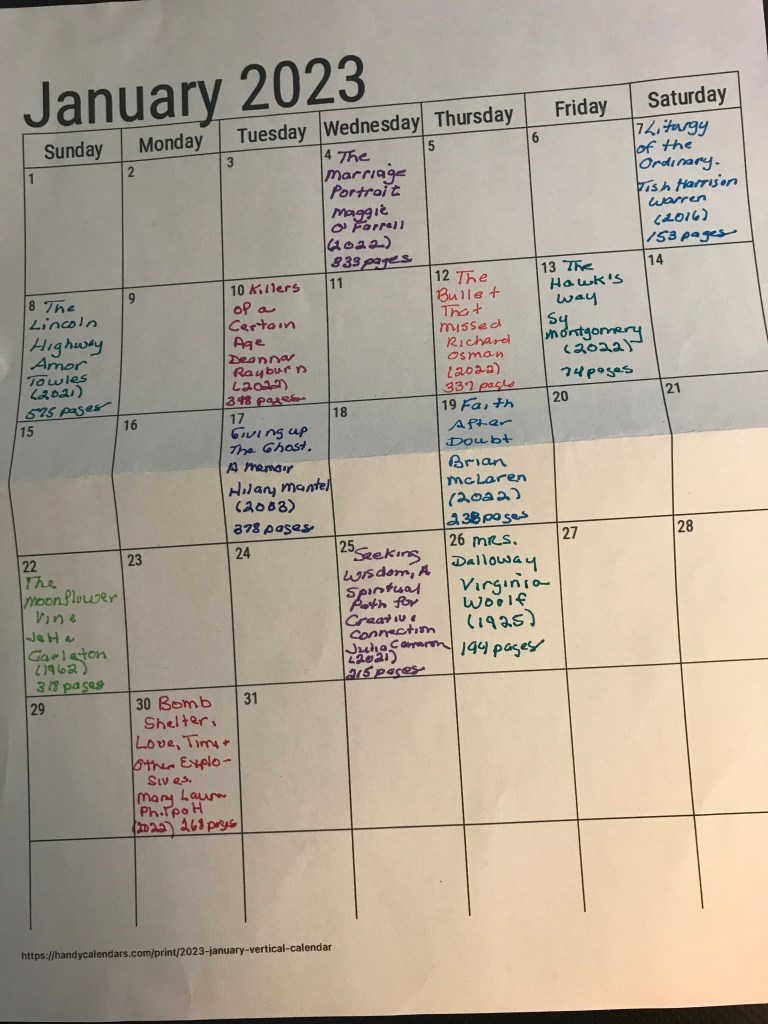
I was in a bit of a reading slump towards the end of January. It may not look that way on paper, but I rejected several books I started and just couldn’t immerse myself in what I thought I wanted to read. Why was that I wonder? Is it because the first books I read this year, which I wrote about in earlier posts, were so good, and finding something to meet that quality just didn’t happen? Or was I simply preoccupied with other tasks? and activities that took lots of energy? Or am I building energy for something new? Am I in some sort of shifting sands time?

I’m not sure it matters, for I still read a good pile of books.

During the deepest part of COVID many people who had considered themselves devoted readers had a hard time focusing on books. That didn’t happen to me. There have been other times in my life, however, when I’ve not been able to concentrate on reading in the way that had always been normal for me. Mainly, those have been times of grief and loss, and I am paying attention to that.

January’s Last Two Books

  1. I decided to re-read Virginia Woolf’s Mrs Dalloway. I can’t remember the first time I read it, but I think it was sometime post-college and probably early motherhood years. I have a vague memory of immersing myself in her books then, experiencing especially the power and relevancy of A Room of One’s Own. I often think of that when I walk up the stairs to my garret. What a privileged person I am. This time I read Mrs Dalloway for the beauty and breadth and depth of the language. Her writing makes me very aware of the importance of commas! This is a book I wish I had studied in a class, as a way to explore the layers and the layering of characters and the times they lived in.
  2. Bomb Shelter, Love, Time and Other Explosives by Mary Laura Philpott is a book of essays. Philpott characterizes herself as a worrier, but at the same time someone who believes that “as long as she cared enough, she could keep her loved ones safe.” So much for theories: Philpott’s teenage son is diagnosed with epilepsy. And life goes on in all its joys and sorrow, fears and acceptances.

There will always be threats lurking under the water where we play, danger hiding in the attic and rolling down that street on heavy wheels, unexpected explosions in our brains and our hearts and the sky. There will always be bombs, and we will never be able to save everyone we care about. To know that and to try anyway is to be fully alive. The closest thing to shelter we can offer one another is love, as deep and wide and in as many forms as we can give it.

p. 268

Now it is time to go through my TBR list and request from the library whatever most tempts me. And I will stand in front of one or more of my own bookshelves and listen to a call, “Reread me!” I’ll let you know what rises to the top.

An Invitation

What kind of a reading month did you have? I would love to know.

Book Report: My Love Affair with Public Libraries

January 26, 2023

My last trip to the library was a bonanza of books. A pile I had placed on hold were waiting for me, and I returned home eager to determine which one I would read first. (Moonflower Vine by Jetta Carleton won, by the way–and it is a gem.)

I knew that more than likely I would decide not to read each one. I would at least read the first few pages of each one, but not more than a few pages if what I read didn’t appeal, didn’t spark interest in the characters, the writing, or the plot to come. I no longer feel obligated to read something because it is on my list or someone has recommended it or because I think it is a book I “should” read. I have a long TBR list and even though I am a fast reader and dedicate parts of everyday for reading, I know I will never read every title I want to read. (An aside: I hope when I die I have a book in my hand.)

How grateful I am for the library. I request books knowing I can test the temperature, dip my toe in, but then I can retreat to shore if the book is too cold or too warm. And then I can return the book to the library for someone else’s pleasure.

Public libraries will always be on the top of my favorites list, so when I heard about what lawmakers in North Dakota are trying to do, I could feel my own temperature begin to boil.

A bill has been proposed by the House Majority Leader of Dickinson, ND to ban books with sexually explicit material and books that depict gender identity from PUBLIC libraries. Librarians who refuse to remove banned titles could face up to 30 days in prison. https://www.nbcnews.com/nbc-out/out-politics-and-policy/north-dakota-weighs-ban-sexually-explicit-library-books-rcna66271

This proposed bill is not about protecting children or anyone else, but it is about censorship.

If you live in North Dakota or have ties to North Dakota, it is time to speak up and support the gift of freedom that public libraries offer. Wherever you live, support your public libraries and librarians.

An Invitation

What do you love about your public library? I would love to know.

Book Report: Books by Brian D. McLaren

January 19, 2023

I begin most days sitting in my Girlfriend Chair in the garret, meditating, praying, writing in my journal, and reading a book that will stretch me into deeper spiritual growth.

Currently, I am reading Faith After Doubt, Why Your Beliefs Stopped Working and What To Do About It by Brian D. McLaren. Each time I read one of his books or listen to his podcast, (Learning How to See with Brian McLaren, https://cac.org/podcast/learning-how-to-see/) I can almost feel my limbs being pulled, my brain enlarging, and my heart expanding. Easy reads? Not exactly, although McLaren is such a good writer, making the experience of confronting tough issues and below the surface thoughts, a pleasure. Not only does McLaren become a real person with his own challenges, but he invites the reader into the conversation. In fact, each chapter includes questions for reflection and action.

McLaren was a conservative evangelical pastor who struggled with issues of belief versus faith for many years. Eventually, he left his formal role as a congregational pastor to write (over 15 books so far) and to live his faith as an activist and public theologian. He is on the faculty of the Living School at the Center of Action and Contemplation founded by Richard Rohr.

The first book I read by McLaren was The Great Spiritual Migration, How the World’s Largest Religion is Seeking a Better Way to be Christian (2016). I don’t know how I became aware of him–perhaps through Diana Butler Bass whose work is also important in my spiritual development. Once I had read The Great Spiritual Migration, I knew I needed to read some of his earlier books.

I read A New Kind of Christianity, Ten Questions That Are Transforming the Faith (2010). Those ten questions continue to be relevant.

  • What is the overarching story line of the Bible?
  • How should the Bible be understood?
  • Is God violent?
  • Who is Jesus and why is he important?
  • What is the Gospel?
  • What do we do about the church?
  • Can we find a way to address human sexuality without fighting about it?
  • Can we find a better way of viewing the future?
  • How should followers of Jesus relate to people of other religions?
  • How can we translate our questions into answers?

You may think you know the answers to those questions (and maybe you do), but I invite you to read McLaren’s explorations. You will learn something new and maybe feel something new.

Next I read We Make the Road by Walking, A Year-Long Quest for Spiritual Formation, Reorientation, and Activation (2014). Books with “spiritual formation” in the title are always a reason for me to look beyond the cover. Even though the book follows the liturgical year, I didn’t wait to read season-designated sections. I started and just kept reading, but with Lent starting soon, I may re-read those chapters under the heading “Alive in a Global Uprising.” As I look at the table of contents I note several chapters I have marked with a star: “Women on the Edge,” “Your Secret Life,”, “Moving with the Spirit,” “Spirit of Love: Loving God,” and “Spirit of Love: Loving Self.” Perhaps I need to re-read those chapters and see what so appealed to me.

I still have two unread books on my shelf by McLaren. The first is Why Did Jesus, Moses, the Buddha, and Mohammed Cross the Road, Christian Identity in a Multi-Faith World ((2012). I’ll get to it, I promise, for I agree with McLaren’s premise that we need a new faith alternative built on “benevolence and solidarity rather than rivalry and hostility.”

Before reading that book, however, and as soon as I finish Faith After Doubt, I will read his latest book, Do I Stay Christian, A Guide for the Doubters, the Disappointed, and the Disillusioned (2022). Several people I know have read this book and have encouraged me to read it, but once buying it, I realized I first needed to read Faith After Doubt, and I am almost done reading that book in which McLaren proposes a model of faith development.

  • Stage One: Simplicity
  • Stage Two: Complexity
  • Stage Three: Perplexity
  • Stage Four: Harmony

Along with defining and describing each of these stages, especially their limitations and consequences, he goes further to highlight the potential gifts of moving through the stages. He encourages faith communities to become four-stage communities because they “produce spiritual activists, harmony activists, whose faith expresses itself in socially transforming love, politically liberating love and ecologically restoring love.” (p. 184)

The operative word in Stage Four, by the way, is LOVE.

When you read a McLaren book, don’t overlook his footnotes, and have your highlighter in your hand, for you will need it.

Now back to reading the last chapter in Faith After Doubt.

An Invitation

What spiritually stretching books have you read?

Book Report

January 12, 2023

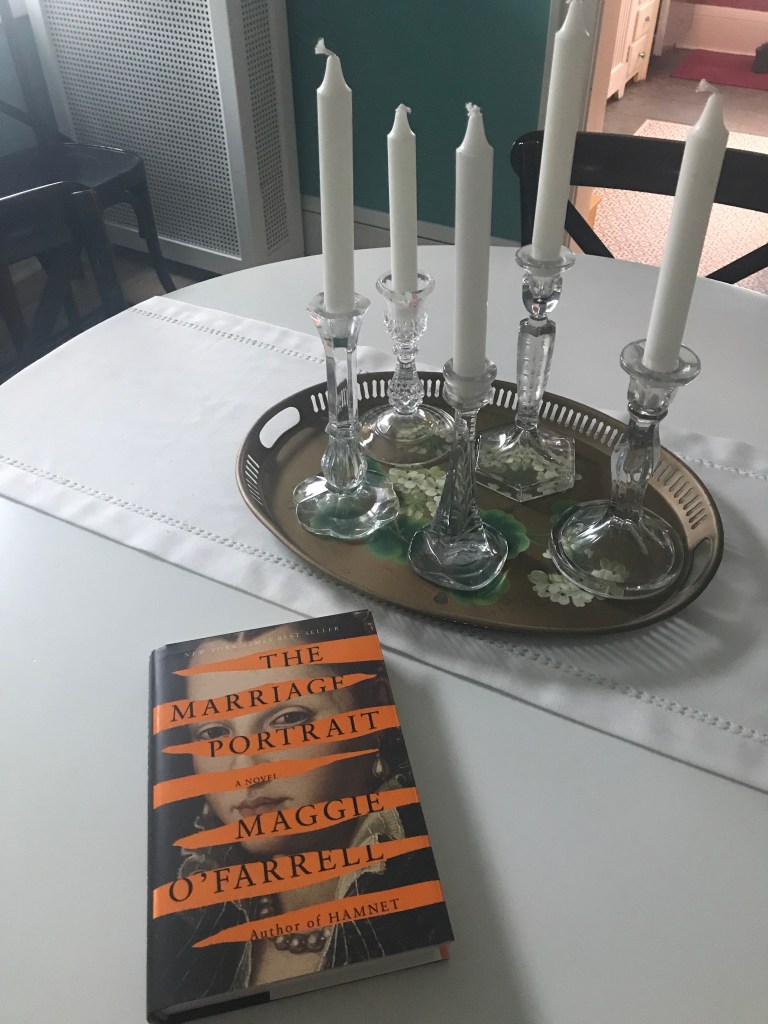
It is only January 10, and I have already read a book that for sure will be on my Favorite Books of 2023 list: The Marriage Portrait by Maggie O’Farrell.

This is the first book I read in the new year, and it sets the standard high for my reading life this year. (An Aside: The second book was The Lincoln Highway by Amor Towles and while it doesn’t surpass The Marriage Portrait, it is good, very good, indeed.)

Lucrezia is a young noble girl in 1550’s Florence, daughter of the grand duke, and she finds herself married to another duke after her older sister dies. She is intelligent, curious, an amazing artist, imaginative, active, not passive, but her role in life is to produce an heir. Her husband shows tenderness and care for her, but…

He bends at the waist and, sliding a hand around her neck, stoops and presses his lips to hers–a brief, emphatic pressure. It reminds her of her father, bringing is seal down on top of a document, marking it as his.

p. 138

The characters are well-developed, as is the setting. The writing is impeccable, and as for the plot, well, I felt my heart race as I read the last few pages.

I have read other books by O’Farrell, including her memoir I Am, I Am, I Am; Seventeen Brushes with Death, and she is a writer who clearly gets better and better with each book. I remember not being excited about reading her 2020 book, Hamnet, which was about Shakespeare’s wife and young son. That was probably because as a decades ago English major and teacher, I read so much Shakespeare, but the book was a gift and all the reviews were excellent, so…. Needless to say, I loved it. Now I think I will add Hamnet to my re-read list.

Now I am reading a fun palate cleanser, Killers of a Certain Age by Deanna Rayburn.

An Invitation

What’s your first book of 2023? I would love to know.

Book Report: December Round-Up

January 6, 2023

I read a lot in December–not my usual December activity, but, thanks to a crummy cold, I spent more time curled up with good books. VERY good books.

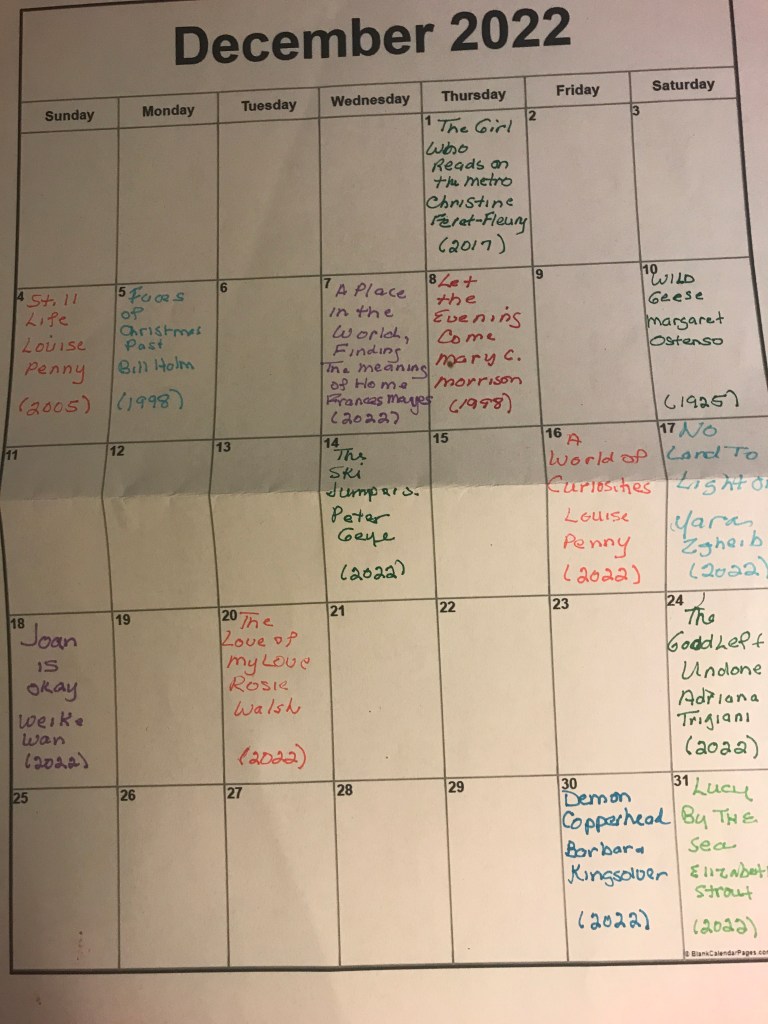
I’ve already written about the latest Louise Penny book, A World of Curiosities, which I loved, and I re-read her first book, Still Life, but the month was full of other book delights, too.

Nonfiction

  • Faces of Christmas Past by Bill Holm. A friend loaned me this charming memoir written by a Minnesota author who was a frequent guest on Prairie Home Companion. He died in 2009. The premise of this short book was writing the annual Christmas letter, whose purpose is to declare, “I am alive, it says, still on the planet. I have not forgotten you. The thread, whether of blood, nostalgia, or friendship, that sews us together has not been cut.” p. 15.
  • Let Evening Come, Reflections on Aging by Mary C. Morrison. I re-read this book before leading a conversation about what those of us 55+ hold in our hearts. Full of wisdom, simply, beautifully stated.

Mystery–it is all around us, and we do not know it. But sometimes when we give it time and space, whether in deep peace or great anguish, it will come up behind us, or meet us face to face, or move within us, changing the way we see everything, and filling our hearts with joy and an upbringing of love that needs no direct object because everything is its object.

p. 87
  • A Place in the World, The Meaning of Home by Frances Mayes. Best known for Under the Tuscan Sun, a bestselling book that also became a movie, Mayes writes so evocatively about creating and being in home. Reading this book made me think about the many homes I’ve lived in and loved and how hometending remains a key spiritual practice in my life. Mayes says, “My house became my icon” (p. 126), and I understand and identify with that.

Fiction

  • The Girl Who Reads on the Metro by Christine Ferat-Fleury. This small, one-sitting book is a love letter to books and reading and matching people to the right book at the right time, along with the power books hold to change one’s life.
  • Wild Geese by Margaret Ostenso. I love it when I am led to an author from the past whom I’ve not known about. Ostenso, originally from Canada lived much of her life in Minnesota, and this book, a psychological and sexual drama, caused quite a sensation when published in 1925. The patriarch of a family on the Canadian plains controls his family, always threatening to expose his wife’s secret of an out-of-wedlock child. Written beautifully, this would be a terrific book club selection.
  • The Ski Jumpers by Peter Geye. I have enjoyed other books by this author, such as Wintering, and I am glad I read this one, too. However, at times I was irritated by the ongoing barroom scenes and sometimes the chronology was confusing, but the characters intrigued me–the brothers who followed in their father’s footsteps and became ski jumpers at early ages. We meet them as grown men–one has become a writer–and many secrets are revealed along the way.
  • No Land to Light On by Yard Zgheib. I was so impressed with this book about the plight of refugees in this country that I gave a copy to our college granddaughter for Christmas, and I am eager to hear what she thinks about it. A Syrian grad student at Harvard married another Syrian who returns to Syria for his father’s funeral and then because of the presidential order is not allowed to return to this country. I’m not sure what I feel about the ending. Read it and let me know your thoughts.
  • Joan is Okay by Weike Wang. A young female of Chinese descent is a physician in NYC right before the pandemic. Working in the ICU is the totality of her life. At first she just seemed quirky to me, but the book becomes more serious as it explores immigration, relationships between generations, and the role of women.
  • The Love of My Life by Rosie Walsh. I was sucked in to this book almost on the first page. SECRETS!!! The wife in the couple has much in her past that her husband knows nothing about, but as an obituary writer for a newspaper he begins to question some contradictions. The author keeps the reader guessing in a masterful way.
  • The Good Left Undone by Adriana Trigiani I have not read any of this author’s previous books, but may in the future, for she tells a good family saga. The story is set in both Italy and Scotland mainly around the years of WWII. The family background is unveiled as the matriarch is dying.
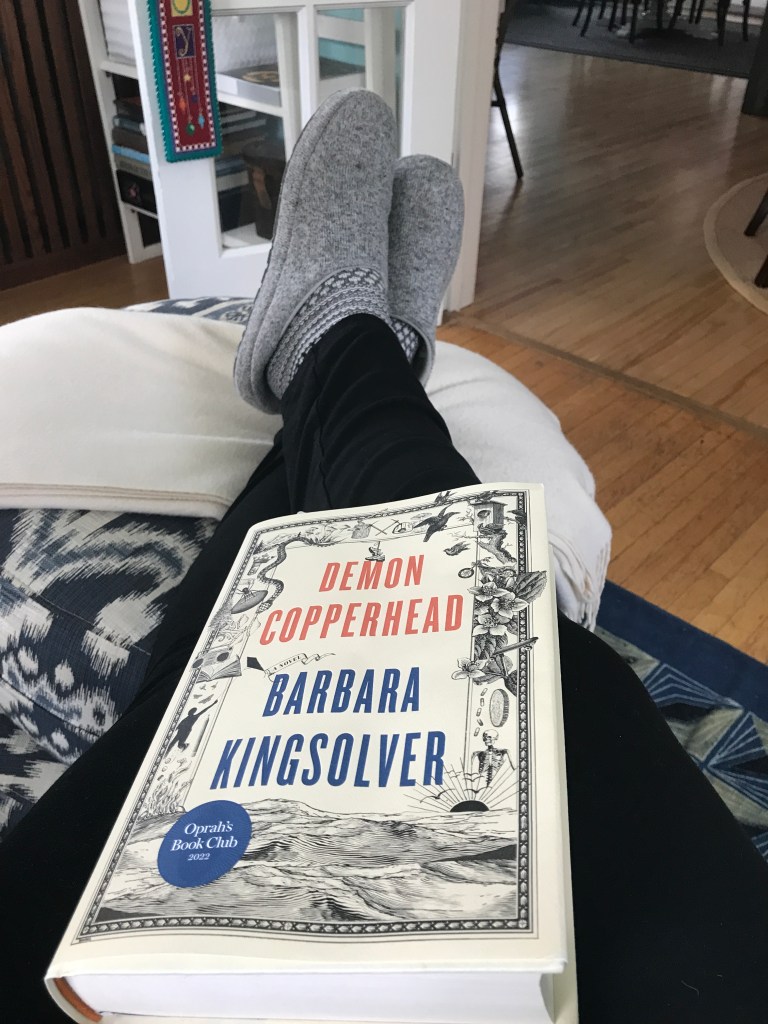
  • Demon Copperhead by Barbara Kingsolver. I received this book for Christmas, and if that had not been under the tree for me, I would have bought it the next day. What a book! No surprise–the writing is lush, and if I had started underlining favorite lines, the whole book would be a pink mess. David Copperfield by Dickens inspired this story of a boy who suffers terribly as a foster child in Appalachia. Sometimes the subject matter makes it hard to read–he was always hungry, for instance–but don’t stop. This character and his desire to love and be loved made me continue turning the page. And the Big Picture message about poverty and opioid addiction and stereotypes about a region in this country are profound. This book definitely needs to be added to my favorites of 2022 list.
  • Lucy By the Sea by Elizabeth Strout. As lush as Kingsolver’s writing is, Strout’s sentence structure is simple and clear. I read this in one day, but that doesn’t mean it is a simple book. The time period is the pandemic and Lucy’s former husband decides they should move together from NYC to Maine. Lucy is grieving the loss of her second husband who died just a year ago, and her adult daughters are going through their own struggles. This book can be read without reading the previous books in which these characters are developed, (My Name is Lucy Barton and Oh, William!) but do read the trio. Strout wrote the books Olive Kitteridge and Olive, Again, too and that character is mentioned in this recent book. You get a whole family and community when you read Strout books.

Not that it matters, but I am often asked about the number of books I read in a year. This year I read 150 books–101 fiction and 49 nonfiction. But who’s counting! In 2021 I read 120 books. Why the increase? Well, I will think about it and let you know, if I come up with a theory.

Here we are in January and a whole year of reading is ahead. My TBR list continues to grow, especially since I just received the most recent copy of BookWomen http://www.bookwomen.net with its list of ‘best reads” submitted by readers, including me. I am moving slowly into 2023, but this coming week I will return to my normal Book Report days on Thursday.

An Invitation

Did you receive any book gifts this past month? I would love to know.

Book Report: The New Louise Penny

December 22, 2022

NOTE: I’m taking a holiday break from the blog and will be back the first week in January.

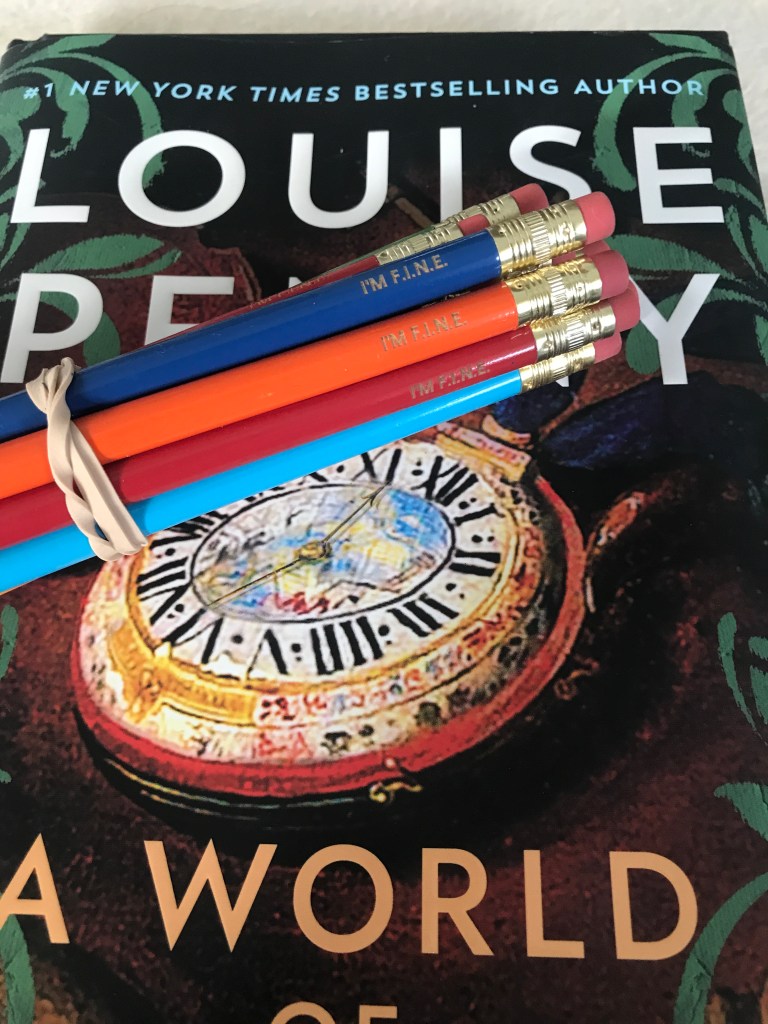
Louise Penny’s latest book is A World of Curiosities, and, no surprise, I loved it.

Although it was released (and on my doorstep) on November 29, I just read it last week. My husband devoured it right away, but lest you think I am an incredibly generous soul, my plan was to read it after Christmas when I could immerse myself in it without a long list of Christmas tasks pulling me away. And preferably, on a cold and snowy day. Well, I got the cold and snowy days, and thanks to my own lingering cold and lack of full energy, I snuggled in with the book earlier than planned.

This book seemed even more complex to me than earlier books–lots of characters, old and new; a hidden room; a puzzling painting; old cases, all connected, of course. One of the themes is forgiveness, but also the belief that there is always more than meets the eye, a statement made more than once in the book.

How good it was to be back in Three Pines with the people we faithful readers have come to love. And the cover is beautiful.

Two More Things

  1. You may have noticed in the photo a bunch of pencils with the inscription I’M F.I.N.E. I subscribe to a couple Louise Penny fan blogs and entered a drawing to win these pencils. I’M F.I.N.E. is the title of one of Ruth’s books of poetry and in true Ruth style F.I.N.E. stands for “fucked up,” “insecure,” “neurotic,” and “egotistical.” Perfect pencils for a writer!
  2. Yes, I watched the Three Pines Amazon series and enjoyed and recommended them–and hope there will be more. Is Gamache as I pictured him? To some degree, but I didn’t imagine his hair and eyes quite so dark. I had a softer look in mind, but his demeanor is very much the way I think of him.

I’ve been reading more this month than I normally do in December and there is still over a week left. With a predicted blizzard on the way, there may be even more reading time than anticipated. My hope, however, is that our loved ones arrive as planned, and we are too busy enjoying family time for more than bedtime reading. I will post my December Book Report early in January.

An Invitation

What books do you hope to receive and what books are you giving? I would love to know.

Book Report: Christmas Books

December 15, 2022

I have a plan.

Some snowy and grey day before Christmas (oh let’s be real, maybe the week after Christmas or even later. After all, Christmas lasts till Epiphany, January 7) I’m going to fix some hot cider with a dried orange slice for extra flavor, and I am going to wrap myself in a shawl and get cozy in the snug. Here’s the important part: I’m going to browse our collection of Christmas books and read whatever appeals to me in the moment.

To be honest, I plan to do this every Christmas season, but then shopping and baking and writing Christmas cards and wrapping presents and… and… takes precedence. I enjoy all those activities, so I don’t feel too sorry for myself, but still… This year the desire for this kind of gentle luxury feels more necessary. Maybe it’s the crummy cold I’ve had that has lasted far too long or more likely it is the need to sit quietly with the sadness I feel about the death of a friend. I am also aware that my age, being an elder, lures me towards the simple pleasures more and more.

Over the years we’ve passed on many of the books we collected when our kids were growing up, and what remains are some special favorites plus a few old books I’ve found when antiquing. At the top of the pile is a small paper copy of A Child’s Christmas in Wales by Dylan Thomas. Bruce was in a reader’s theater version of the story when we were in college, and one of the first presents he gave me was a copy of the book with lovely wood prints. I might begin my immersion into my Christmas books by reading it aloud–even if it is just to myself.

…I can never remember whether it snowed for six days and six nights when I was twelve or whether it snowed for twelve days and twelve nights when I was six…

Looking through my bedroom window, out into the moonlight and the unending smoke-colored snow, I could see the light in the windows of all the other houses on our hill and hear the music rising from them up the long, steadily falling night. I turned the gas down, I got into bed, I said some words to the close and holy darkness, and then I slept.

Next I will smile my way through my favorite picture book version of The Nativity. Mary, as imagined by illustrator Julie Vivas, is not exactly beatific. Rather she is LARGE with child and has a very hard time getting on the donkey and is exhausted by the labor. There is a reason it is called LABOR.

I also love Tomie De Paola’s illustrations of Miracle on 34th Street by Valentine Davies and the De Paola book that will always be my favorite, Clown of God about the juggler, Giovanni and the miracle of his gift. Both of our books are signed by De Paola from the days decades ago when I worked in an independent book store in St Paul, Odegards.

I am just as delighted with Susan Branch’s illustrations and also her calligraphy. In the Christmas stack are two of her books, Christmas From the Heart for the Home and Christmas Joy. Branch encourages us to “Light candles, say a prayer holding hands, play music, dress up, take pictures, kiss everyone within 5 feet of the mistletoe, and keep your senses alive so you can remember THIS Christmas all year long.”

One of the books I have not read in years is The Story of Holly and Ivy by the English author Rumer Godden who wrote for both children and adults. In this story Ivy is an orphan and Holly is a doll left all alone in a toyshop window on Christmas Eve. It won’t be a surprise that there is a happy ending to the story. which in this version is illustrated by Barbara Cooney.

I’ve read a few of the stories in the Everyman’s Pocket Classic, Christmas Stories, such as Green Holly by Elizabeth Bowen, The Turkey Season by Alice Munro, and several times Truman Capote’s A Christmas Memory about making the traditional fruitcake with his distant cousin.

A woman with shorn white hair is standing at the kitchen window. She is wearing tennis shoes and a shapeless gray sweater over a summery calico dress. She is small and sprightly, like a bantam hen; but due to a long youthful illness, her shoulders are pitifully hunched. Her face is remarkable–not unlike Lincoln’s, craggy like that, and tinted by sun and wind; but it is delicate, too, finely boned, and her eyes are sherry-colored and timid. ‘Oh my, ‘ she exclaims, her breath smoking the windowpane, ‘it’s fruitcake weather!’

The book that entices me most, however is also called Christmas Stories, but it is by Charles Dickens. This old, small red leather-bound book with tiny print and pages you can almost see through just feels good to hold. In the last year or so I have been feeling a tug to read some of the Dickens books I have never read like Bleak House or The Old Curiosity Shop. I loved Great Expectations when I read it in 8th grade, and I think reading that book was influential in my decision to teach English. Perhaps reading some of these stories will be the beginning of a Dickens year.

I have a plan, and my shawl and mug of cider, and books wait for me. What a good Christmas present that would be to give myself. And it’s snowing!

An Invitation

What Christmas books do you enjoy reading year after year? I would love to know.