Book Report: A Controversial Book–American Dirt by Jeanine Cummins

May 11, 2023

When American Dirt by Jeanine Cummins was published in 2020 and selected for the Oprah Book Club, controversy erupted. I remember hearing and reading about the objections–that the author who identified as white, although her grandmother was from Puerto Rico, had indulged in stereotypes and didn’t accurately portray the truth of migrant experiences. A conversation arose about who has the right to tell a story, and that conversation continues.

I didn’t rush to read it, but kept the title on my TBR, and there it remained until last week.

I was moved by it, often feeling tears on my cheeks, and I sometimes needed to remind myself to breathe, as I worried about the fate of the characters. One criticism is that it was too easy of a read–a book meant for the screen. I didn’t find it easy on the emotions, however, and should s book be criticized because it eventually, through a long and arduous process, finds its way to the screen? (American Dirt has not yet been translated to film, by the way.)And just because a book is a page-turner does that make it any less worthwhile?

The main character is Lydia who owns a bookstore in Acapulco. Her husband Sebastien is a journalist who writes about Mexican cartels, and he and many members of their family are murdered after he writes a particularly incriminating article. Lydia and her young son, Luca, realize they need to flee because one of her customers is head of a cartel, although initially she was not aware of that fact, and he has fallen in love with her. The bulk of the novel is their harrowing movement towards el norte. I read the chapters describing the dangers of accessing and traveling, illegally, of course, the trains called La Bestia, with my mouth open and my heart pounding.

I rooted for Lydia and Luca and for some of their companions as they did what they needed to do to escape. The ethical and moral issues raised are as harrowing as the physical dangers and demands. I realize that this is one picture, one story, one perspective, but the depiction of fear and strength and hope seems authentic.

Something to Think About: Two Passages

The first passage is about Luca, the remarkable young son, learning about his own situation. Rebeca, mentioned in the section, is a teenage girl also trying to get to el norte.

As Rebeca reveals what scraps of story she does have to Luca, he starts to understand that this is the one thing all migrants have in common, this is the solidarity that exists among them, though they all come from different places and different circumstances, some urban, some rural, some middle-class, some poor, some well-educated, some illiterate, Salvadoran, Honduran, Guatemalan, Mexican, Indian, each of them carries some story of suffering on top of that train and into el norte beyond. Some, like Rebeca, share their stories carefully, selectively, finding a faithful ear and then chanting their words like prayers. Other migrants are like blown-open grenades, telling their anguish compulsively to everyone they meet, dispensing their pain like shrapnel so they might one day wake to find their burdens have grown lighter. Luca wonders what it would feel like to blow up like that. But for now he remains undetonated, his hours sealed tightly inside, his pin fixed snugly in place.

p. 166

We are invisible, Luca says to himself, and he closes his eyes. We are desert plants. We are rocks. He breathes deeply and slowly, taking care that his chest doesn’t rise and fall with the cycle of the breath. The stillness is a kind of meditation all migrants must master. We are rocks, we are rocks. Somos piedras. Luca’s skin hardens into a stony shell, his arms become immovable, his legs permanently fixed in position, the cells of his backside and the bottoms of his feet amalgamate with the ground beneath him. He grows into the earth. No part of his body itches or twitches, because his body is not a body anymore, but a slab of native stone. He’s been stationary in this place for millennia. This silk tassel tree has grown up from his spine, the indigenous plants have flourished and died here around his ankles, the fox sparrows and meadowlarks have nested in his hair, the rains and winds and sun have beaten down across the rigid expanse of his shoulders, and Luca has never moved. We are rocks.

p. 333

I think this book is well worth reading. At the same time I have no doubt there are major discrepancies in the white publishing world and that people of color do not get deserved recognition or financial support and payment in the same way that white writers do. Perhaps the debate about this book will make a difference.

An Invitation

What authors and books about migrants and immigration do you recommend? I would love to know.
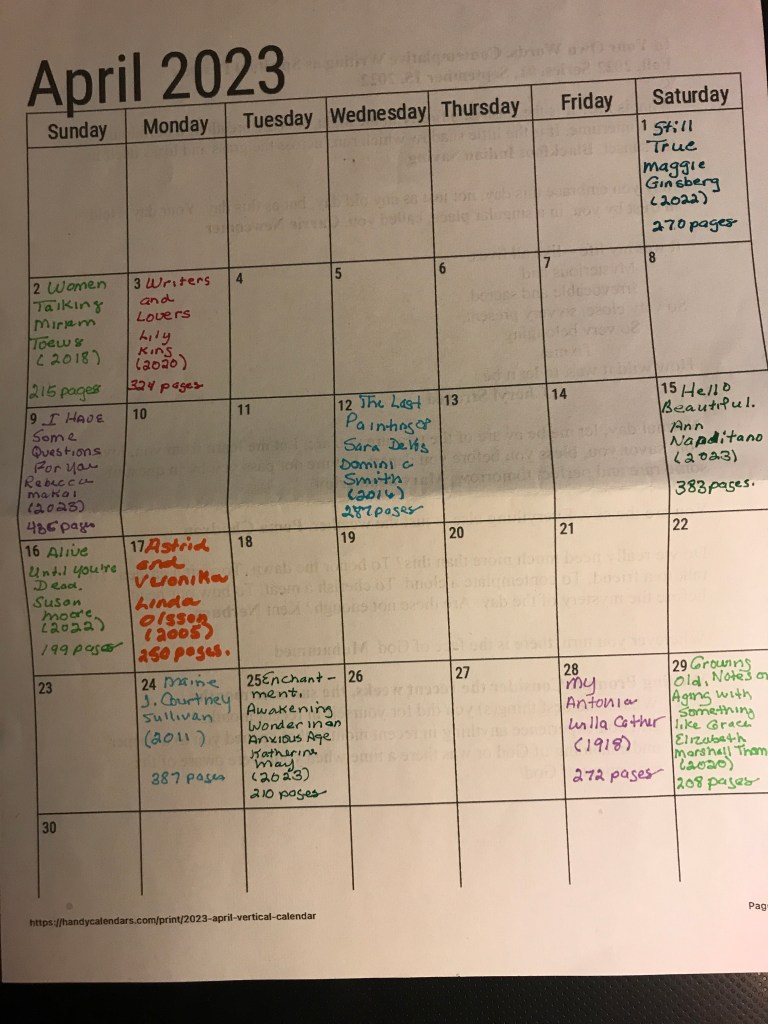
Book Report: April Round-Up

May 4, 2023

Have you noticed I read far more fiction than nonfiction?

Part of the reason is, quite simply, that I prefer fiction. My first career was as an English teacher—reading novels and short stories and poetry, too, was just part of the deal. That preference has only grown throughout my life. Another reason relates to my reading routine. I often read a book related to spirituality during my meditation time, and I tend to read those books more slowly–perhaps, only a few pages in one sitting. Finally, one of my daily reading times is in bed before turning out the light, and many nonfiction books require more concentration than that posture allows. Most of the time I read a nonfiction book alongside a novel, but the novel is usually my first choice during my reading times.

This month I read three nonfiction books. Two were about aging. I have an extensive library of books about that topic, which is becoming more and more relevant in my own life, but I am also becoming more choosy about what I add to that collection. I decided to keep only one of the two I read in April and put the other in the basket for a Little Free Library.

  • Alive Until You’re Dead, Notes on the Home Stretch by Susan Moon. Moon is a Buddhist and has written extensively about aging, challenging readers to be curious about this stage of life. I need to think more about her desire to “release my grip on my preferences. I wanted to stop worrying about whether what I was doing was the very thing that I most wanted to be doing.” (p. 23) I find myself thinking more and more about what it is I most want or most need to do; how I want to spend my time and energy, so Moore’s perspective interests me. The book includes an excellent chapter on practices to contemplate death, including walking in cemeteries, reading obituaries, and making a day of the dead altar. This book has found its place on my bookshelves.
  • Growing Old, Notes on Aging with Something Like Grace by Elizabeth Marshall Thomas. I appreciate the author’s sense of humor and her common sense treatment of loss, including losing one’s hearing or keys and other things, along with losing significant people in one’s life, but the picture of her on the back cover lighting her cigarette with a birthday candle seemed inappropriate and not funny. I am not keeping this book.

The other nonfiction book I read was Enchantment, Awakening Wonder in an Anxious Age by Katherine May. Perhaps you’ve read her earlier book, Wintering, The Power of Rest and Retreat in Difficult Times. I had intended to buy Enchantment, but before I did I spotted it on the Lucky Day shelf at the library. Lucky Day shelves hold current and widely requested books–just your luck to find one–but they can’t be renewed. By the time I was done reading it, the pages were dotted with colorful sticky tabs highlighting passages. I don’t often buy a book I have already read, but that’s exactly what I did in this case.

It occurs to me that I am resting. It is not the same as doing nothing. Resting, like this is something active, chosen, alert, something rare and precious. (p. 26)

I tend to think that God is not a person, but the sum total of all of us, across time. That only makes the imperative greater. We have a duty to witness the broad spectrum of humanity, rather than to defend our own corner of it. That is the work I crave: the sense of contact. The possibility that it might change me in ways that I can’t predict. The possibility that I might one day do better. (p. 100)

Play is a disappearance into a space of our choosing, invisible to those outside the game. It is the pursuit of pure flow, a sandbox mind in which we can test new thoughts, new selves. It’s a form of symbolic living, a way to transpose one reality onto another and mine it for meaning. Play is a form of enchantment. (p. 137)

April Fiction

I read nine novels in April and in earlier April posts wrote about three of them, each book memorable: Still True by Maggie Ginsburg and Women Talking by Miriam Toews https://wordpress.com/post/livingonlifeslabyrinth.com/1934 and Hello Beautiful by Ann Napolitano. https://wordpress.com/post/livingonlifeslabyrinth.com/1982

Out of the remaining six my least favorite was Maine by J. Courtney Sullivan. My main objection to the book, a family saga, is that the characters, mainly women, didn’t grow or change in any significant way. If these characters were real, I am not sure I would choose to spend time with them.

The other five were well worth reading, and I recommend each one.

  • Astrid and Veronika by Linda Olsson. A friend recommended this book to me. (Thank you!) In fact, she has bought several copies and given them away as “must reads.” Set in Sweden, Veronika, whose fiancé has recently died in an accident, rents a home next to an older woman, Astrid, whom the village sometimes refers to as a witch. She prefers her solitary life. The two women gradually become close friends; a model of intergenerational relationships, I think. They share their pasts, hurts, secrets, and develop deep trust with one another. They often shared a meal together –a kind of sacred ritual. Veronika is a writer and there were many lovely passages about writing.

It was as if the story were a fragile cobweb, and she had to take the utmost care not to rip the thread…The words on the screen in front of her seemed to paint an almost forgotten landscape. It was as if she were slowly unpacking, pulling out one scene after another and exploding them to this bleak light. The effort was enormous. Here, now, each passage seemed out of place, like clothes bought on holiday.

pp. 17-18

One of my favorite passages is about change.

It is in the nature of things to change. Nothing can last beyond its given time. And I think instinctively we know what time is. What is it that makes us know when the summer turns? The smallest shift in the light? The slightest hint of chill in the morning air? A certain rustling of the leaves of the birches? That is how it is–suddenly, in the midst of the summer heat, you are overcome by a tightening of your heart. The realization that it will all come to an end. And that brings a new intensity to everything: the colours, the smells, the feeling of sunshine on your arm.

p. 72

Now I want to read Olsson’s back list.

  • My Antonia by Willa Cather. I decided to sign up for a series of zoom events sponsored by the Willa Cather Foundation, https://www.willacather.org and the first book discussed was My Antonia. I needed to miss that conversation, unfortunately, but oh, how I loved reading this book again, my third time. The story is told by Jim Burden, who as a boy was orphaned and leaves Virginia to live with his grandparents in Nebraska. The day he arrives on the train so does a Bohemian immigrant family, the Shimerdas, including daughter, Antonia. Antonia’s spirit sustains her, and she is loved by all who know her. She is not the only character in the book, however, who displays a hardworking and resilient nature, hopeful and strong.

The landscape is a major character, too, and reading the descriptions made me want to drive to the prairie right now.

As I looked about me I felt that the grass was the country, as the water is the sea. The red of the grass made all the great prairie the colour of wine-stains, or of certain seaweeds when they are first washed up. And there was so much motion in it, the whole country seemed, somehow, to be running…I felt motion in the landscape, in the fresh, easy-blowing morning wind, and in the earth itself, as if the shaggy grass were a sort of loose hide, and underneath it herds of wild buffalo were galloping, galloping…

pp. 17-18

One of my favorite books of all time is Giants in the Earth by O. E. Rolvaag, another immigrant story, and I am drawn after reading My Antonia to reading that once again. I read someplace that books are like nesting dolls–one leads to another. How true that seems.

  • Writers and Lovers by Lily King. I had read this before and didn’t much care for it, but recently I heard a conversation about it and decided to re-try it. This time I really liked it, which goes to show how much mood and timing enter into an assessment of a book. Casey is a struggling writer living in a potting shed (!) and her awful landlord says to her, “I just find it extraordinary that you think you have something to say.” (p. 2). She becomes involved with two men–one, a writer her age and the other, older and a successful writer with children who adore her. How will it turn out?
  • I Have Some Questions For You by Rebecca Makai. I loved her earlier book, The Great Believers, and I am happy to say I really liked this one, too. Bodie returns to teach at the boarding school where she was once a student –and where her roommate was murdered. She becomes obsessed with investigating this murder, convinced the man convicted was not guilty. There are lots of threads in this book, but Makai is a deft writer, preventing confusion for the reader. A couple favorite lines;

“When my husband passed,” Sheila said, “it was like losing the bookend to a row of books. We all tipped over sideways.”

p. 82

Not a single cell of his body was the same as it had been in 1995. But he was still himself, just as I was still, despite everything, my teenage self. I had grown over her like rings around the core of a tree, but she was still there.

p. 418
  • The Last Painting of Sara DeVos by Dominic Smith. A good novel about an art restoration expert, a young woman, and the man who owns the painting she forges. The original was painted by a Dutch woman in the 1600s. The art forger and the art collector develop a relationship (of course!), but it is told beautifully and not stereotypically. They meet again 40 years later when the painting is part of an exhibit. Good story. Good writing.

Wow–that’s a lot of books to share! Hope this didn’t detract too much from your reading time. Perhaps your TBR has just grown, however.

An Invitation

Any recommendations from April? I would love to know.

Book Report: Reading Dilemmas

April 27, 2023

Recently, I received an email from the Willa Cather Foundation about a virtual study course for four of Cather’s books, My Antonia, A Lost Lady, The Professor’s House, and Death Comes to the Archbishop. Benjamin Taylor, whose biography of Cather will be published in November, 2023, will host the series. I love each of those books, and I am tempted to sign-up for the series and, of course, reread the books.

Here’s the dilemma: each book I re-read means I don’t read something on my TBR list. Each time I sink into a much loved book, I am not reading a new release that sounds really good. And in the meantime the attraction to books, new and old, and the ongoing growth of my TBR list continues.

This week I got an email from the New York Times with the headline, “12 Books You Should Be Reading Right Now.” RIGHT NOW! EEEK! I probably should not have read further, but I did and was pleased to see I have read one of the titles, Hello Beautiful by Ann Napolitano, and I am even more pleased to report I did not add any other titles to my TBR list. But how long will that restraint continue? Anne Bogel of Modern Mrs Darcy and the podcast “What Should I Read Next” will soon release her acclaimed Summer Reading Guide, and a plethora of other summer reading lists are just on the horizon.

If I ignore them, I may miss a book that would be a truly good match for me. Plus, I confess I like to be in the know about new books, an interest nurtured by working in an independent bookstore decades ago. I read a variety of book review sources, and bookstores are truly my happy place.

Perhaps I should think of this passion as a hobby, like knitting or bird-watching.

My TBR Lists

I keep elaborate book lists in my book journal. At the beginning of 2023, I transferred 57 unread titles from 2022. I have been working on that list steadily since then and am happy to report I have only 16 left on the list. I hasten to add I have not read, beginning to end, the remaining 41. I have at least started each of them, but only decided to complete a handful of them. If a book doesn’t appeal when I start reading it, I quickly discard it, usually returning it to the library or if I own it, adding it to the Little Free Library pile.

Of course, I have a 2023 TBR list, but I am trying to be more selective about what I add to that list. As of today, I have 59 titles on that list and have read or discarded 21 of those titles. Then there is my lists of acquired books and mystery series and the British Library Women Writer Series and books I want to re-read.

So far this year, by the way, I have read 45 books.

Current Thoughts About My Reading

I just finished reading Enchantment, Awakening Wonder in an Anxious Age by Katherine May, who wrote Wintering, The Power of Rest and Retreat in Difficult Times. In this new book, which I am so glad I read, she decides it is time to

reset my terrifying “to be read” pile to zero and allow myself the possibility of choosing new books for this age I’ve landed in.

p. 150

Is that what I need to do? Close my book journal, except, course, to record what I’ve read. Forget the TBR list entirely–not an easy prospect for someone who loves to make lists almost as much as she loves to read. Perhaps I need to just read what is on my shelves already—the great majority are books I have already read and can imagine re-reading.

Obviously, as problems go, this is not major, but as a devoted and voracious reader what to read next is an issue, as is how to approach reading time. At age 75 there is more sand in the bottom of the hour glass than in the top.

I am aware that I am more and more attracted to re-reading old favorites, and at the same time reading older books I missed along the way or reading the backlist of an author when I read a current title.

What I suspect is that I will continue to muddle along –reading as much as I can, picking and choosing based on unscientific criteria, breaking my own rules, and quite simply loving the journey.

An Invitation

As you age, are you noticing anything different about your reading routine or rules, reading desires or interests? I would love to know.

NOTES:

Willa Cather Foundation https://www.willacather.org

Anne Bogel blog and podcast https://modernmrsdarcy.com https://modernmrsdarcy.com/what-should-i-read-next/

Book Report: Hello Beautiful by Ann Napolitano

April 20, 2023

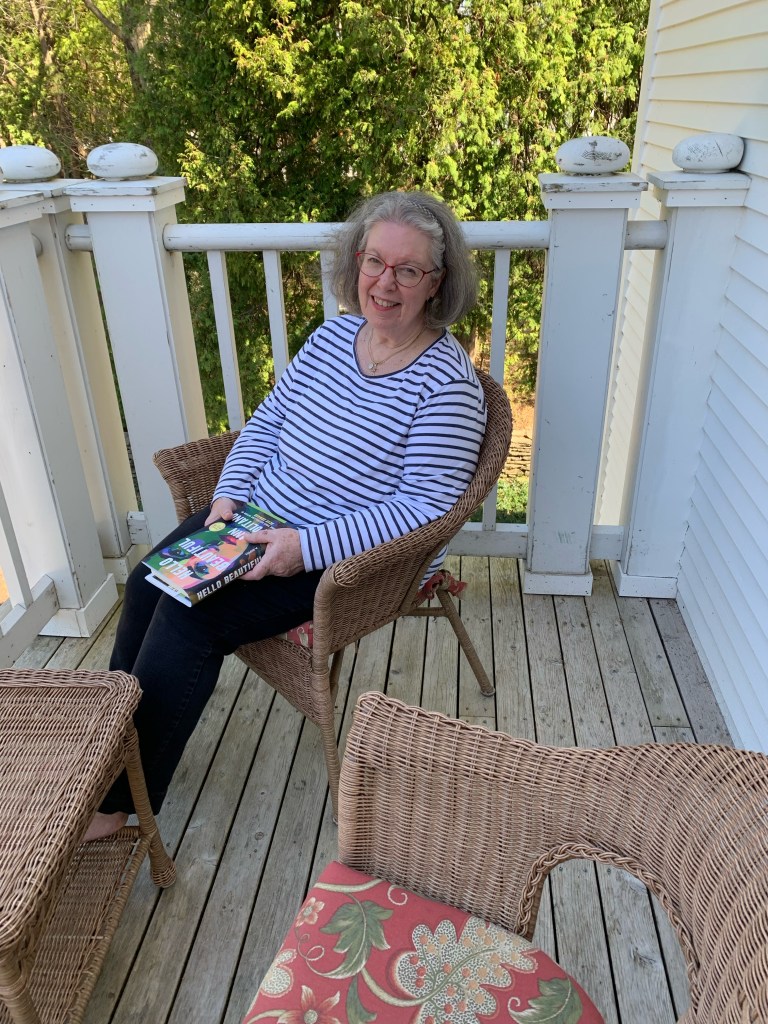
Sitting on a balcony in beautiful Door County, WI, reading a stunning book–what could be better than that? Well, maybe a balcony with a water view, but no whining allowed.

So far the books I’ve read this month have all been worthwhile, even memorable. I wrote about two of them in an earlier post this month, Still True by Maggie Ginsberg and Women Talking by Miriam Toews, and in my April summary on Thursday, May 4 I will share the other titles. I couldn’t wait, however, to tell you about Hello Beautiful by Ann Napolitano.

I loved the characters, even when I didn’t like them. Sometimes I wanted them to be something more than who they were, but I admired the growth and the recognition of the pain they held within themselves.

I loved the writing, the impeccable sentences, and the fullness of the descriptions without being overwrought.

I loved the pace of the plot, Not too slow. Not too fast.

I loved that each chapter focused on one of the characters. The point of view, third person narrator, stayed the same, but somehow I experienced each person’s perspective.

I loved the overwhelming love, the humanity of that love, so tenderly, but sometimes so fiercely expressed. Powerful, redemptive, heartbreaking love. At times as a reader I wanted them to relax into that love.

Loosely based on Little Women, with emphasis on the word “loosely,” the characters have their times of being Beth or Meg or Jo or Amy. And there is a Laurie, too, in the character of William. We are absorbed into this family of sisters who don’t seem to need others until they do. A friend who loaned me her copy of the book said it made her envious of women who have sisters, and it made me think a bit more about my mother who was the oldest of four sisters and what her reaction to this book might have been.

Ok, the plot: William Waters grew up almost invisible in his own family when his parents could not cope with tragedy. He found solace in basketball and then in the love of Julia, the oldest sister. As each sister discovers her own identity and as William experiences a mental breakdown, all are forced to change and meet new challenges. I don’t want to say more.

A Few Favorite Passages

Julia experiencing the birth of her child:

She was a mother. This identity shuddered through her, welcome like water to a dry riverbed. It felt so elemental and true that Julia must have unknowingly been a mother all along, simply waiting to be joined by her child. Julia had never felt like this before. Her brain was a gleaming engine, and her resources felt immense. She was clarity. (p. 107)

They were dismantling their habits and routines, and it was like pulling up floorboards and finding joy underneath. (p. 349)

At their father’s wake, a young paper-factory worker said, It’s impossible he’s gone. And that man had been right–that had been an impossible loss…But perhaps what felt impossible was leaving that person behind. When your love for a person’s so profound that it’s part of who you are, then the absence of the person becomes part of your DNA, your bones, and your skin…the losses ran like a river inside her. (pp. 360-361)

“When an old person dies,” Kent said, “even if that person is wonderful, he or she is still somewhat ready, and so are the people who loved them. They’re like old trees, whose roots have loosened in the ground. They fall gently. But when someone dies…–before her time–her roots get pulled out and the ground is ripped up. Everyone nearby is in danger of being knocked over.” (p. 371)

Independent Bookstore Day is coming up on April 29. This would be a good book to purchase then. I guarantee there is already a long “Hold” list at your library, so unless you have the patience of Job or can borrow a copy from someone else who has had the wisdom to buy it, buy yourself a copy.

An Invitation

What book is tempting you these days? I would love to know.

Book Report: Blizzard Books

April 6, 2025

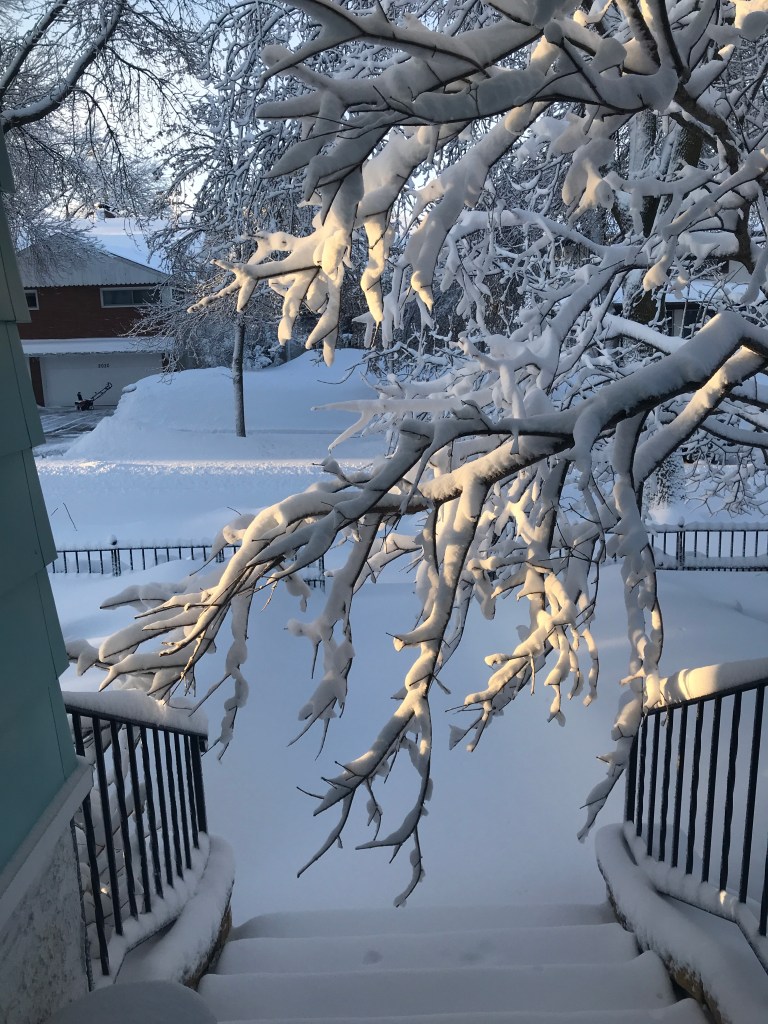
Welcome April 1! This was the view out our front door Saturday morning. Not only that, but we had no power for most of the day. What to do? Read, of course.

The sun was pouring into the snug, giving me plenty of light. I wrapped up in a blanket and read and read and read. In fact, I finished one book and most of another, and they were both excellent.

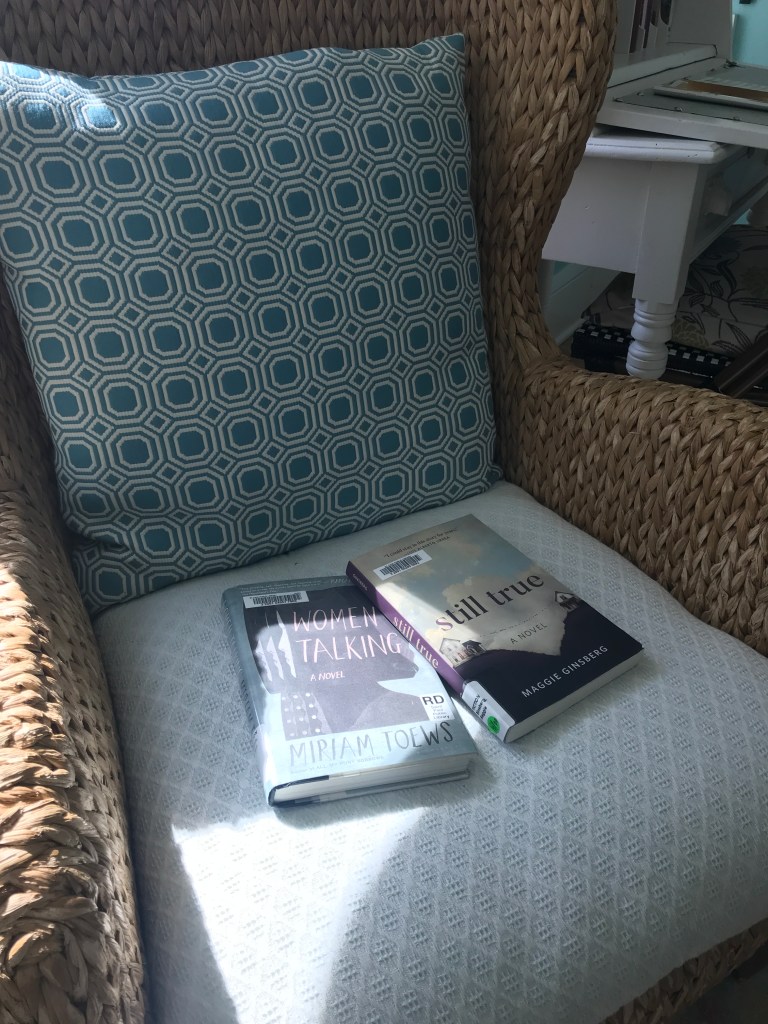
Still True by Maggie Ginsberg was a recommendation several months ago in the newsletter of one of my favorite bookstores, Arcadia Books in Spring Green, WI. https://www.readinutopia.com Ginsburg is a senior writer at Madison Magizine, but I hope she leaves enough time to write a second novel, for this one is stellar. You may recall that one of my favorite books of 2022 was Beneficence by Meredith Hall. Well, this book needs to sit on the shelf next to Beneficence. https://wordpress.com/post/livingonlifeslabyrinth.com/774

The plot is fairly complicated, as I think about explaining it, but as I read, it didn’t feel that way. I think that says a great deal about the polished, smooth and compelling writing. Secrets, lies, grace are all themes in this story about a devoted, long-time married couple, Jack and Lib, who don’t live in the same house. Also, key to the story is Charlie, a young boy who has recently moved to Anthem, WI with his parents, and he becomes Jack’s buddy. Enter Matt who is Lib’s son, whom she left when he was baby. This is news to Jack. And Matt becomes involved with Charlie’s mother. See what I mean? Just read the book and ponder the questions, What is truth? What is true? Are some lies worse than others?

Maybe this is what grace felt like. Maybe the best things were too big and good to be understood. maybe what was holy, by definition, couldn’t be truly comprehended by mortal man. Maybe that was what he’d always sensed in the two of them, and in everything they held dear: that together they were so much bigger than the sum of their respective working parts.

p. 270

Women Talking by Miriam Toews is the book that inspired the award-winning recent movie by the same name. Read the book. See the movie. Both are excellent. The novel is based on a true story about a Mennonite community in Columbia, South America. The women, who have not been allowed to learn how to read, have been sexually-abused, and they struggle with a decision — to do nothing, to stay and fight, or to leave. These women may not be able to read, but they can think, and their deliberations will challenge and impress the ethicists, philosophers, and theologians of the world. They struggle with what they have been taught, with what the men have told them is in the Bible, as they clarify three things they are entitled to. “We want our children to be safe…We want to be steadfast in our faith…We want to think.” p. 153. One of the women says,

I believe that my soul, my essence, my intangible energy, is the presence of God within me, and that by bringing peace to my soul, I am honoring God.

p. 109

The author, by the way, was raised Mennonite and left her family at the age of 18.

I think my April reading is off to a good start. Now, if only the snow would melt.

An Invitation

What books have you read recently that challenged your thinking? I would love to know.

Book Report: March Round-Up

March 30, 2023

I know here it is only the 30th and there are 31days in March, but I am eager to enter April, so why not post the summary of this month’s reading now. And what a month it has been!

NONFICTION

I finished two books I mentioned in a previous posts this month.

  • The Heartbeat of Wounded Knee, Native America from 1890 to the Present by David Treuer. I read it slowly, trying to absorb facts, and stories, and reflections. Such an important book. Perhaps the section that most fascinated me was the detailed analysis, which he included near the end of the book, about the protests at Standing Rock. Don’t be deterred by the length of the book, for it is well-worth the time and energy you give it.
  • Weaving Sundown in a Scarlet Light, 50 Poems for 50 Years by Joy Harjo. I loved many of the poems, but I also loved her notes about each of the poems, their content, inspiration, and often the mechanics of the poem, also. Such a good companion this was to the David Treuer book. April is National Poetry Month, and I recommend this book as a way to celebrate poets and poetry.

I also read two other books in the broad nonfiction category. One is a book of meditations and the other, a memoir.

  • Embers, One Ojibway’s Meditations by Richard Wagamese (1944-2017). A beautiful book in appearance and in its short reflections. I read a few pages in this book each morning during my meditation time. The author says morning meditation is his time to reclaim himself, and I concur with that sentiment. The book is divided into seven sections: Stillness, Harmony, Trust, Reverence, Persistence, Gratitude, and Joy. He writes this in the very first meditation:

I am my silence. I am not the busyness of my thoughts or the daily rhythm of my actions. I am not the stuff that constitutes my world. I am not my talk. I am not my actions. I am my silence. I am the consciousness that perceives all these things. When I go to my consciousness, to that great pool of silence that observes the intricacies of my life, I am aware that I am me. I take a little time each day to sit in silence so that I can move outward in balance into the great clamour of living.

p. 15
  • Leaving the Pink House by Ladette Randolph. This book made me nostalgic about living in the country during our years at Sweetwater Farm. Randolph and her husband buy a dilapidated house outside of Lincoln, Nebraska, and she describes the year spent renovating it and making it habitable, but she also reflects on the years that led to this decision and about changes in her faith along the way;. Randolph refers to herself as a “devotee of the quotidian,” and her writing draws us into her daily sights and experiences.

I best understand my life through the houses where I’ve lived. I have only to remember a particular house to summon clear memories of a given time and place. Like many adults, I’ve returned to those places–both in memory and in person–seeking from this exercise I’m not sure what: some part of myself, some time in the past I want to better understand. Houses are often the archives for my deepest, most resonant memories, the places where I’ve curated life stories.

from Introduction

FICTION

I read ten novels this month, and will highlight five of them.

  • Afterlife by Julia Alvarez. Perhaps you read some of her earlier books, including How the Garcia Girls Lost Their Accents or In the Time of the Butterflies. If so, you know what a good writer she is. Antonia’s family, which includes her three sisters, immigrated from the Dominican Republic. Antonia is now 66, a widow, and poet and English professor. Her eldest sister, who is mentally unstable, disappears and the sisters rally to try and find her. At the same time Antonia becomes involved with a teenage unwed mother who is undocumented, and along the way Antonia faces her own “dragons.”
  • The Swimmers by Julia Otsuko. What starts as a playful writing style and content (Has one writer ever used so many parenthetical phrases and done it so effectively?) becomes a poignant view of a dementia patient in a memory care unit. Alice is a faithful swimmer, but when the pool closes for good, her issues become more unmanageable. Sad and revealing and well-written.
  • Island of the Missing Trees by Elif Shafak. A treasure of a book. Set in Cyprus in the 1970s and then again in 2000s and also in London, a Turkish woman and Greek man fall in love, but are separated, eventually reuniting. They have a daughter Ada who in her teens mourns the death of her mother. Her mother’s sister plays a role in helping Ada heal and also fills in the blanks of her parents’ lives. The father, Kostas, has brought a fig tree with him to London from Cyprus, and the fig tree tells its own story. I know this seems strange, but I believed in the fig tree just as much as the human characters.
  • What Are You Going Through? by Sigrid Nunez. A woman dying of cancer ask a friend to be with her as she plans to take life-ending drugs. The woman is estranged from her daughter and has asked others to be with her, but all have said “no.” The friend, more of a distant friend from previous times in their lives, does agree, however, and they become closer and closer. The story is written from the friend’s point of view, but she relays everything the woman tells her. Brilliantly written.
  • The White Lady by Jacqueline Winspear. Many of us eagerly wait for the next book in the Maisie Dobbs series. Well, we need to wait longer, for this new book by Winspear is a stand-alone, but definitely a good read. The main character, Elinor White, however could be Maisie Dobbs’ soul sister, for she is also courageous, compassionate, and intelligent. White was a spy both in WWI and then again in WWII, and she carries demons with her during her retirement years in an English village. She is drawn out of her quiet life to help a neighboring family who want to remain separate from the husband’s organized crime family.

Waiting for me are two books from the library, Still True by Maggie Ginsburg and Women Talking by Marian Toews. I saw the acclaimed movie,Women Talking, and now am eager to read the book.

An Invitation

What have you read this last month? I would love to know.

Book Report: Sick Time, Reading Time

March 23, 2023

I suppose you could accuse me of milking the situation, for I just had a cold. Nothing serious. We all get colds, but my end of the week schedule was quite open, and I certainly didn’t want to spread my germs, so I declared a time-out. I moved into the snug with books and a blanket and spent most of two days reading and napping, napping and reading. Voila! I am back to normal!

Here’s my report:

  • At the beginning of each reading session I read a poem or two in Joy Harjo’s Weaving Sundown in a Scarlet Light, 50 Poems for 50 Years. Harjo was the Poet Laureate of the United States from 2019-2022. My favorite poem so far is “Remember” and here are the opening lines:
Remember the sky you were born under,
know each of the star's stories.
Remember the moon, know who she is.
Remember the sun's birth at dawn, that is the
strongest point of time. Remember sundown
and the giving away to night.
  • I finished reading a novel The Long-Shining Waters by Danielle Sosin. In this case the waters refers to Lake Superior in all its mystery, majesty, power and beauty. Sosin tells the story of three different women in three different time periods, 1622, 1902, and 2000. One of the women owned a bar on the North Shore and after the bar burns down she decides to drive all round the perimeter of the lake, and now I want to do that. I admit some of the descriptions seemed obscure to me, but perhaps I need to spend more time under the lake’s spell.
  • I continued reading The Heartbeat of Wounded Knee, Native America from 1890 to the Present by David Treuer. Much of Louise Erdrich’s lecture that we attended recently focused on the Termination Act of 1953, which Treuer describes in this way:

It proposed to fix the Indian problem once and for all by making Indians–legally, culturally, and economically–no longer Indians at all.

p. 250

Under termination and relocation, unemployment skyrocketed and so did the number of Indians living under the poverty line. By 1970 half of all the Indians lived in urban areas, the single largest demographic and cultural shift in Indian country in a century and arguably more pervasive and transformative than the reservation system established in the mid-nineteenth century. A total of 1, 365, 801 acres of land were removed from trust status during this period and twelve thousand Indians lost their tribal affiliation

p.278
  • Finally, I read a short novel, The Swimmers by Julie Otsuka. The story begins in a playful way about swimmers at an underground pool. The writer’s use of parentheses engaged me, as if in conversation with her.

The rules at the pool, though unspoken are adhered to by all (we are our own best enforcers): no running, no shouting, no children allowed. Circle swimming only (direction counterclockwise, always keeping to the right of the painted black line). All Band-Aids must be removed. No one who has not taken the compulsory two-minute shower (hot water, soap) in the locker room may enter the pool. No one who has an unexpected rash or open wound may enter the pool (the menstruating among us, however, are excepted). No one who is not a member of the pool may enter the pool. Guests are permitted (no more than one per member at a time), but for a nominal daily fee.

p. 6

One of the swimmers, Alice is in the early stages of dementia and one of the rules is to “be nice to Alice.”

And even though she may not remember the combination to her locker or where she put her towel, the moment she slips into the water she knows what to do. Her stroke is long and fluid, her kick is strong, her mind clear. “Up there,” she says, “I’m just another little old lady. But down here, at the pool, I’m myself.”

p. 4

When the pool unexpectedly closes, life changes for Alice. As does the tone of the book –from playful to poignant. Alice’s dementia progresses, and it is necessary to place her in a memory care unit. Life at Bellavista pulls at the heart, as well as this trauma faced by Alice’s husband and their daughter, a reality facing so many. So well-written, but I am glad it was not longer than its 175 pages.

Before I emerged from the snug, I started another novel, The Island of Missing Trees by Elif Shafek. So far very good, but you will have to wait for a full report in a later post.

An Invitation

What would you want to read if you had a cold? I would love to know.

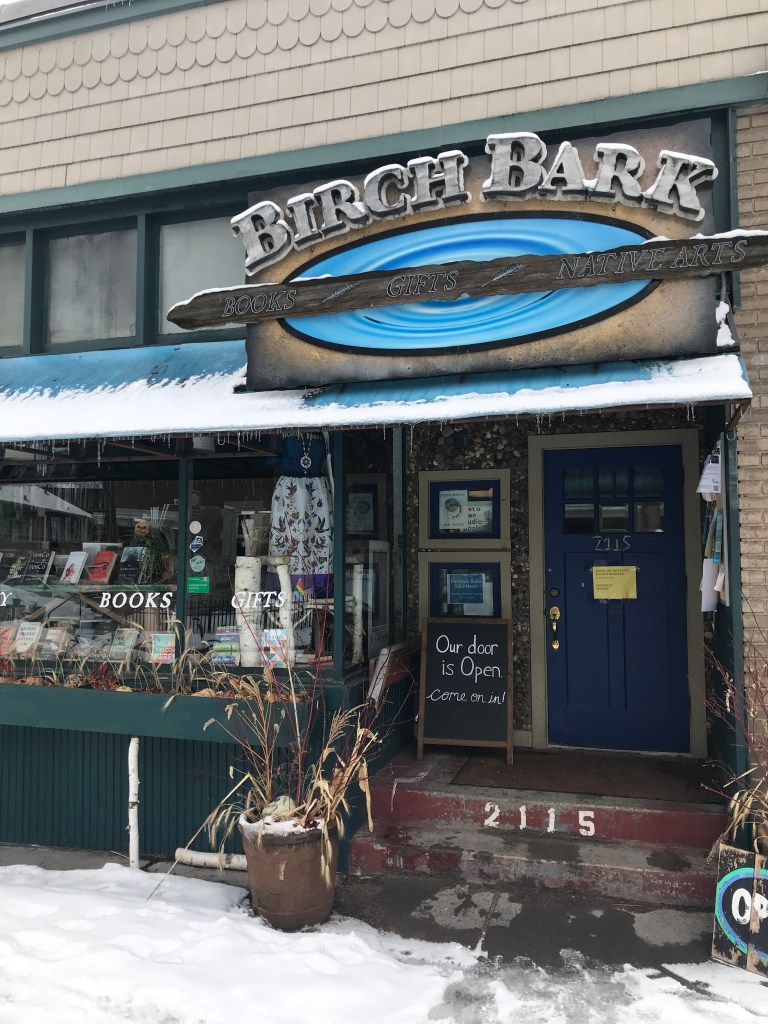
Book Report: A Trip to Louise Erdrich’s Book Store, Birchbark Books

March 16, 2023

Last week, on International Women’s Day, my husband and I, along with a full auditorium of other fans, attended “An Evening with Louise Erdrich.” Not exactly an intimate event, but how good to be in her presence.

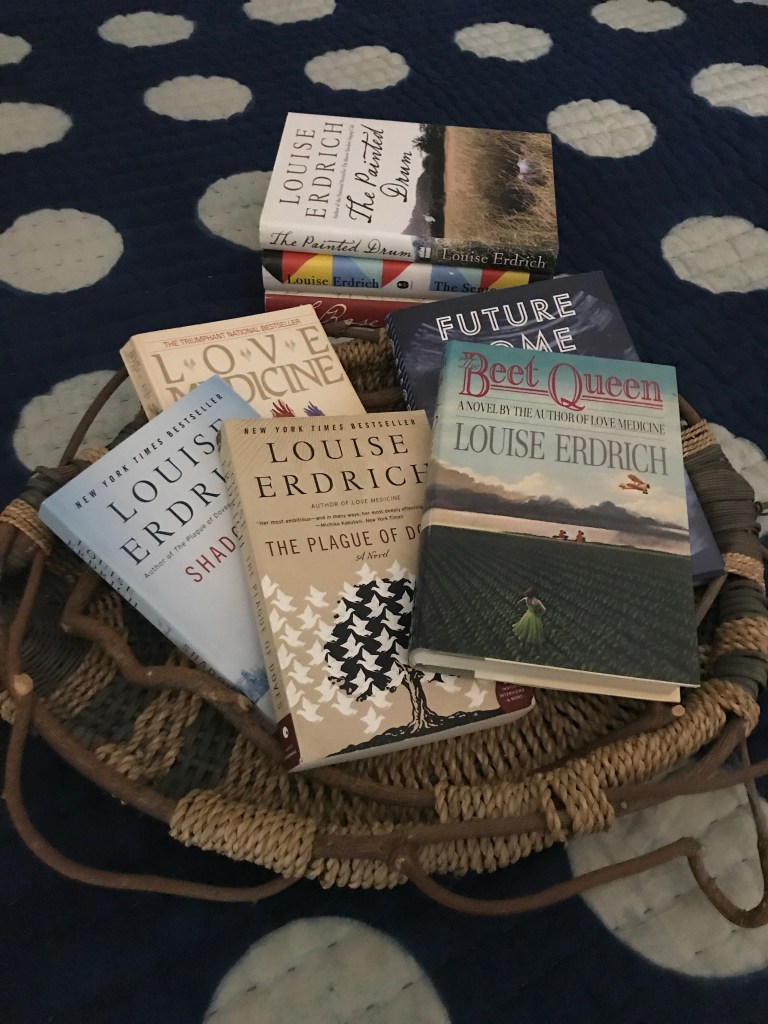
I have read most of her books, but can imagine re-reading several, especially The Sentence and The Nightwatchman, which my husband is re-reading now. And Love Medicine, which was published in 1984 and was the first of an eight book series. One of the books mentioned that evening was Books and Islands in Ojibwe Country: Traveling Through the Land of My Ancestors (2003), which is a blend of history, mythology, and memoir. I remember being entranced by that book and wish I still had my copy. Now why didn’t I buy another copy when we made a long overdue return visit last week to Erdrich’s bookstore, Birchbark Books in Minneapolis?

I guess I was just too overwhelmed as I found several books on my TBR list. I guess I will just have to return soon. Such a problem! Here’s what did come home with me:

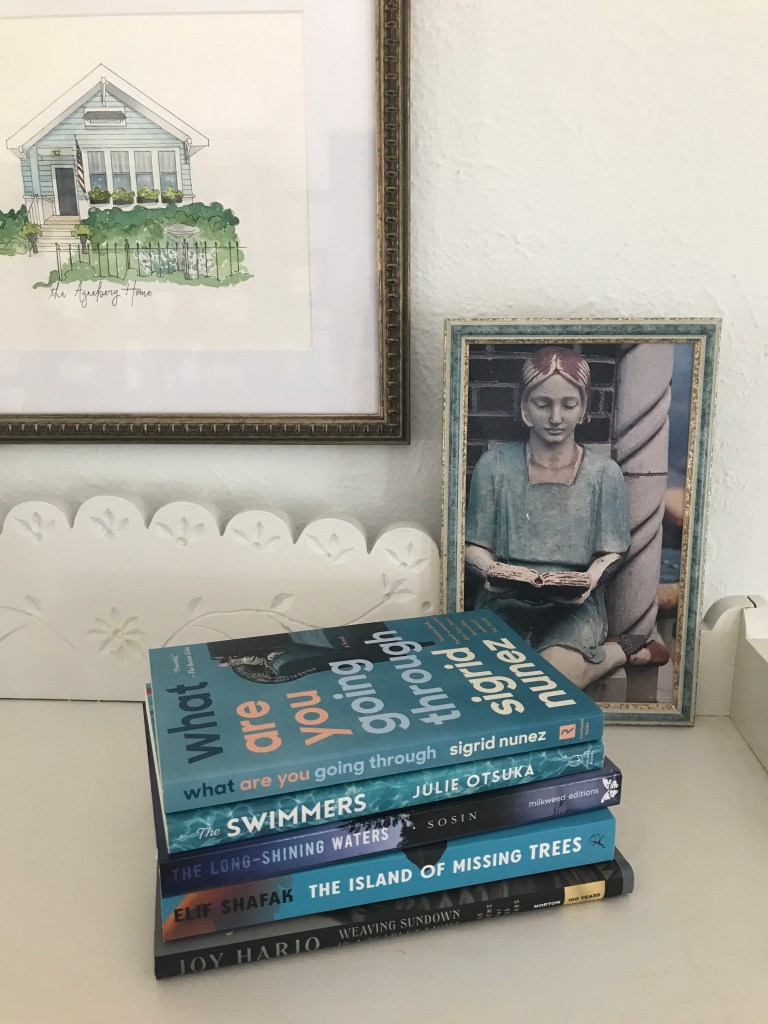
  • Weaving Sundown in a Scarlet Light, 50 Poems for 50 Years by Joy Harjo. Harjo, who is a member of the Muscogee (Creek) Nation, was the nation’s poet laureate from 2019 to 2023. I loved her memoir Poet Warrior–another book for the re-read list. I am keeping this book in the snug and each time before settling into read whatever is my current book, I read a couple poems in this book. Only after I read about 10 of the poems did I realize that at the end of the book Harjo has included notes about each poem, giving the context and notes about her process. I have decided to begin the book again and this time read the notes, too.
  • What Are You Going Through by Sigrid Nunez.
  • The Swimmers byJulie Otsuko who wrote The Buddha in the Attic (2011), which I remember loving.
  • The Island of Missing Trees by Elif Shafak.
  • The Long-Shining Waters by Danielle Sosin. I am especially eager to read this book for it is about three women living on the shores of Lake Superior at different times in history. I only heard recently about this book, which was published in 2011 by Milkweed and won their national fiction prize. It sounds wonderful. Maybe I need a reading retreat to the North Shore.

After making our purchases we had lunch right next door at The Kenwood, one of our favorite restaurants.

Such a good day!

An Invitation

Have you read any books by Louise Erdrich? If so, what are your favorite’s? I would love to know.

Links: https://birchbarkbooks.com

https://www.thekenwoodrestaurant.com

Book Report: Temptations to Re-Read

March 9, 2023

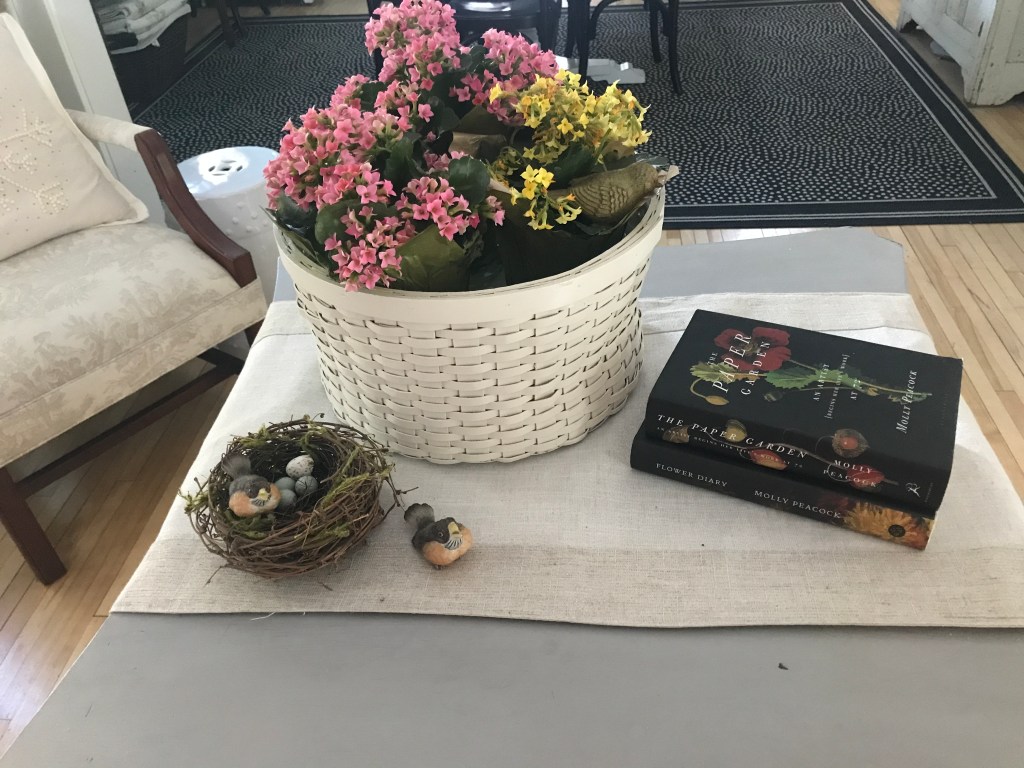
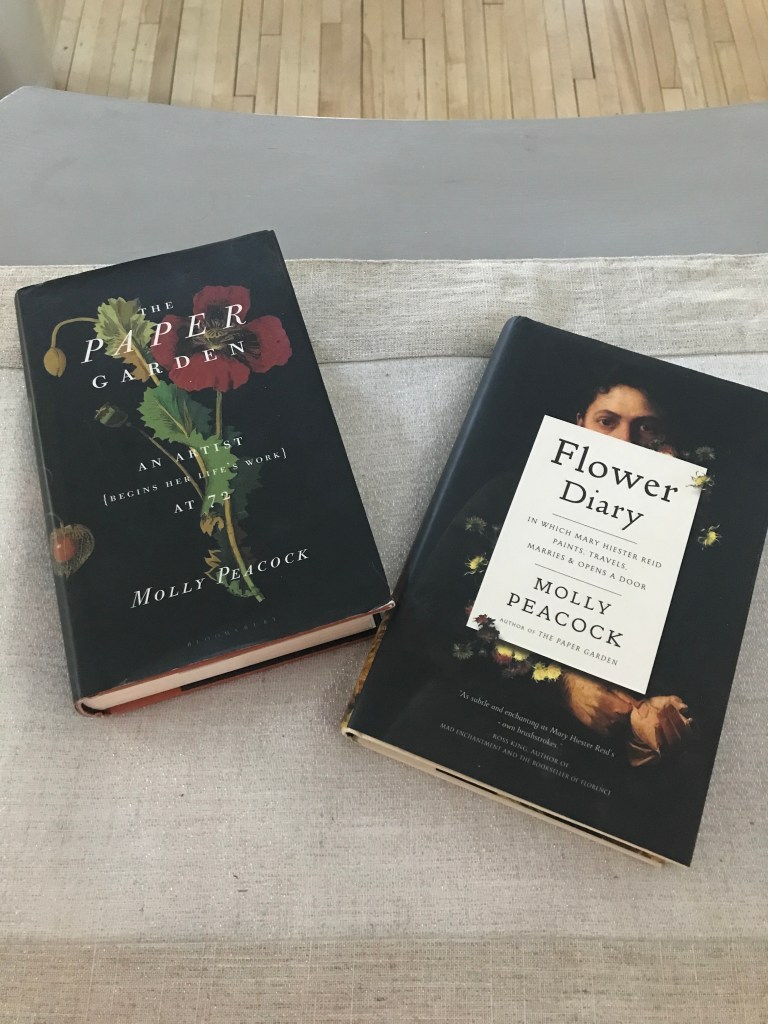
In last week’s Book Report I mentioned the book A Friend Sails in on a Poem by Molly Peacock, which I enjoyed, but then also remembered how much I loved the two biographies Peacock wrote, The Paper Garden, An Artist Begins Her Life’s Work at 72 (2010) and also Flower Diary, In Which Mary Hiester Reid Paints, Travels, Marries and Opens a Door. (2021)

I want to re-read both of these books and added them to the “Books to Re-read” list in my book journal.

More and more I feel drawn to re-reading favorite books or immersing myself in the entire backlist of a favorite authors like Barbara Kingsolver or Ann Patchett or Jon Hassler.

Often reading a new book leads me to the desire to re-read an earlier book by the same author. For example, I loved The Marriage Portrait by Maggie O’Farrell and now I want to re-read Hamnet. Or if a book I loved is mentioned on a podcast about books and reading, I sigh and think “Oh, I want to read that again.” That happened this week when I listened to the most recent episode on “What Should I Read Next?” (episode 370) when the host Anne Bogel suggested Plainsong by Kent Haruf to her guest.

Dusting my bookshelves has become a problem for me, because I see books I want to read again, Like The Children’s Book by A. S. Byatt and A Lost Lady by Willa Cather or Fresh Water for Flowers by Valerie Perrin or A Gentleman in Moscow by Amor Towles or The Sentence by Louise Erdrich or Prince of Tides by Pat Conroy or….. (The solution is to NOT dust!)

Over the years I have re-read all the Jane Austen books. Pride and Prejudice several times. And in 2021 I read all of the Louise Penney books written to that point, and I know I would enjoy reading them again. My fingers are twitching as titles come flooding in my brain.

I consider not reading newly released books and only re-reading favorite books, but then there is the FOMO (Fear of Missing Out) side of me. How could I not read the new book by Jacqueline Winspear, The White Lady, coming out later this month? And I am eager to read I Have Some Questions for You by Rebecca Makai because I loved her earlier book, The Great Believers.

I have this ongoing battle between my TBR list and my Re-Read list. I play games with myself: I will re-read one favorite book for every three new (at least to me) titles on my list, but then books I have requested from the library suddenly are available or our weekly roaming just happens to include the stop at a bookstore. Or someone I trust mentions a new book they loved, and I add it to my TBR list.

What am I doing writing this post? I need to stop immediately and read. What am I doing requesting more and more titles–mainly new ones from the library, when I have all these books here on my shelves? And why do I love going to independent bookstores, knowing I will walk to the check-out counter with a fresh stack of books when I have piles waiting for me at home?

Well, Nancy, this is a first world problem. Relax. Get over it. You will never read or re-read all the books you want to.

Last night I finished The Cloisters by Katy Hay, a new book which I enjoyed, but I know it is not a book I will ever re-read. There is some relief in that. But now comes the challenge? What should I read next? I have three books from the library.

  • 2 A.M. at the Cat’s Pajamas by Marie-Helene Bertino
  • Leaving the Pink House by Ladette Randolph
  • Case Study by Graeme Macrae Burnet

Or do I re-read one of the Molly Peacock biographies? Stay tuned.

An Invitation

What is on your re-read list? I would love to know.

Book Report: February Round-Up

March 2, 2023

My reading month started well and ended well, and in between the books were uneven.

Fiction

In an earlier post I wrote about Our Missing Hearts by Celeste Ng. https://wordpress.com/post/livingonlifeslabyrinth.com/1721 A glowing report of a book exquisitely written and a story powerfully told. While visiting a small new bookstore, I heard another customer say she had just finished a book that she loved and was so well-written. She was talking about Our Missing Hearts, and I joined in the conversation, agreeing completely. I have yet to meet anyone who has read the book who did not love it.

The last fiction book I read this month was Gone Like Yesterday, a debut novel by Janelle Williams, and I think this writer has the potential in future novels to attain Celeste Ng’s status. Of course, that is impossible to know, but I hope nothing gets in the way of Williams’ writing and growing and perfecting her skills. Her writing is lyrical and the plot, while involved, is interesting, as are her characters. Zahra is a young black woman who helps privileged high school students write their college admissions essays. She is introduced to Sammie, a another young woman, black, bright, nurtured by her uncle and grandmother, and also applying to colleges. When Zahra learns her brother is missing, Sammie and her uncle pose driving Zahra to Atlanta to look for him. Here’s the tricky part–the presence and sound of moths. Surrounding the car, floating above their heads. hovering in their ears. Are they real? What do they mean? A touch of magical realism. Sometimes it works, but sometimes it doesn’t. I think Williams tries to do too much in this book, but still I am glad I read it.

Three of the other books are mysteries: # 2 and #3 in the series by Ausma Neharat Khan about Canadian police detective Esa Khattak and his colleague Rachel Getty. Although I like, but don’t love these books, at some point I will read more in the series. The third mystery I read is part of the British Library Crime Series, Crossed Skis, An Alpine Mystery by Carol Carnac, which was published in 1952. A well-known trope in British mysteries is the house party concept and this one is similar–a group of young people who don’t all know each other go on a skiing vacation and…. well, read it to find out.

I read two books I truly did not like, and I wonder why I finished them. I usually make quick decisions about whether to finish reading a book or not. Oh well. The first is O Caledonia by Elspeth Barker and even after reading my summary of the book in my book journal, I have little memory of the book. The other book is historical fiction by the popular writer, Marie Benedict. Perhaps I finished this because she is a writer often recommended by others, and I kept hoping I would find something redeeming in the book. The book is The Mitford Affair about the English Mitford sisters, especially Nancy, Unity, and Diana. Set on the brink of WWII, Unity and Diana are big supporters of Hitler, and they manage to become part of his inner circle. Nancy eventually and hesitantly shares with Winston Churchill — the Mitfords are distant relations — some of her sisters’ plans and efforts. I need to like at least one of the main characters in any book I read, and I didn’t like anyone in this book.

Nonfiction

I can recommend all four nonfiction titles without hesitation–depending on your own personal interests.

  1. Memoir as Medicine, The Healing Power of Wiring Your Messy, Imperfect, Unruly (but Gorgeously Yours) Life Story by Nancy Slonim Aronie. I try to read books about the craft of writing frequently, and a writing friend recommended this. Wonderful prompts. Great examples from her own memoir. This book inspired me to establish Writing Wednesdays for myself. Yesterday was my my fifth one, and I plan to continue that schedule.
  2. A Friend Sails in on a Poem by Molly Peacock. I am not a poet, but I loved this memoir of the friendship between two women who are poets, Peacock and Phillis Levin. Peacock is the author of two of my all-time favorite books, both biographies, The Paper Garden: An Artist Begins Her Life’s Work at 72 and Flower Diary: in Which Mary Hiester Red Paints, Travels, Marries and Opens a Door.
  3. Prayer in the Night, For Those Who Work or Watch or Weep by Tish Harrison Warren. Using the words of the compline prayer (Several months ago I wrote this prayer on a small card that sits on my nightstand. Even on mights I don’t pray the words, the intention of those words lives in my heart.) Warren’s writing is simple and clear and at the same time profound, “We need practices that don’t simply palliate our fears or pain, but that teach us to walk with God in the crucible of our own fragility.” Warren shares her fragilities and encourages us to open to our own and to share them with God.
  4. Do I Stay Christian? A Guide for the Doubters, the Disappointed, and the Disillusioned by Brian McLaren. I actually owned this book before I bought McLaren’s previous book, Faith After Doubt, Why Your Beliefs Stopped Working and What to do About It, but I quickly realized it was important to read Faith After Doubt first. I did that in January. Do I Stay Christian? builds on Faith After Doubt, and wow, there is much to process. Part I answers the question, “No.” Part II, “Yes,” and Part III, “How.” Part I is the most upsetting, and Part III is the most challenging. Chapters in Part II include “Because….Where Else Would I go?” “Because I’m Human,” and “Because of Our Legendary Founder.” McLaren is such a good writer (and speaker–I often listen to his podcast, “Learning to See.” ) In the Appendix to the book he writes

We are all friends around this table. All equals. All unique. All welcome. Who we are is who we are. There is no need to pretend. Some of us have a lot of beliefs and very few doubts. Some of us have a lot of doubts and very few beliefs. Some of us love God, but we’re not sure about Jesus, and some of us love Jesus, but we’re not so sure about God. Some of us aren’t sure about anything, and others feel very sure about almost everything. Some of us gladly call ourselves Christians. Some of us barely call ourselves Christians. Some of us once were Christians, but not anymore. Some of us aren’t sure we were ever Christians, or aren’t sure what that means, or whether it matters. But this we share: we welcome one another to this circle just as we are, for we all are part of one web of life on this precious planet in this amazing universe.

p. 229

See my post on books by Brian McLaren here: https://wordpress.com/post/livingonlifeslabyrinth.com/1658

One last note: My husband and I visited a new bookstore in town recently and if you live in the Minneapolis/St Paul area I encourage you to stop by. The name is Comma, and it is the Linden Hills area of Minneapolis.

An Invitation

Anything to recommend from your February reading? I would love to know.