Book Report: Louise Penny and Susan Hill

July 20, 2023

For many years August was marked by the release of a new Louise Penny mystery. More recently, however, her new book was been published in the fall. This year? Does anyone know if a new Inspector Gamache will join the ranks of the previous 18 books? I have not seen or heard anything, and I started to panic that I may need to re-read them all again –for the third time.

Fortunately, I have a new plan. I will read all twelve of Susan Hill’s Simon Serraillier mysteries. Years ago I read The Various Haunts of Men, the first in the series probably about the time it was published in 2005 and before the second one was released. I remember enjoying it very much and am delighted to have rediscovered this series. And now there are twelve of them!

Last week I read #2, The Pure in Heart. I suspect I will want to re-read the first one, but this book does a good job of refreshing my memory about #1.

Simon Serraillier is a police detective in the English village of Lafferton. There is a charming map at the beginning of the book–that’s always a plus for me. Simon is on a vacation in Venice, however, at the beginning of this book. He has gone to relax and recover from the death of a colleague. Along with being a detective he is an artist and is preparing for an exhibition, which apparently happens in a future book.

He returns home when he learns that his younger sister, who has been severely handicapped since birth and resides in a care home, seems to be be dying. Soon after returning home a young boy in the village is kidnapped, and that serves as the main plot line.

The plot is important, of course, but I am intrigued by the characters, many of whom I assume will be continued presences in the next books. Simon has another sister, Cat, who is a physician and is pregnant with her third child, and a brother who lives in Australia. They are triplets. One of the side stories involves what Simon considers to be a casual relationship with an older woman, Diana, who wants the relationship to be more serious. And there is also his “sidekick” Nathan Coates–how important those sidekicks are in police procedurals.

I have been adding so many titles to my TBR lists in recent weeks, but they may each take a back seat to this series. The third one is called The Risk of Darkness. Excuse me while I make a trip to Half-Price Books in hopes of acquiring that one and any others in the series. Oh, and by the way, Susan Hill is more properly known as Dame Susan Elizabeth Hill. Lady Wells.

An Invitation

Do you enjoy reading series? Which ones have you loved? Are you waiting for the “next one” in a series? I would love to know.

Reading Days

July 13, 2023

Actually, to be accurate, one reading day became several reading DAYS.

Since we had no plans for the 4th of July or the weekend leading up to it and because it was so hot, I declared a time-out, and for me that always means reading time. My husband, who loves to read, too, posed no arguments, but he did suggest a field trip to mark the beginning of our reading days.

One year when our children were young and we couldn’t afford to go away on a vacation, we had a staycation. One of the days that week was B Day, which stood for “Bookstores, Bakeries and Batman.” (The first Batman movie had just been released.) We went to more than one bakery and more than one bookstore, where we each could choose a book –or was it two–and then we ended the day by going to the movie. A day we all remember fondly.

We decided to honor the last day of June and the entrance to July with a B Day with a slight modification. One bakery. One bookstore. And no Batman.

First Stop: A Bakery

We had a hard time choosing what to eat right then and what to bring home from this new french Vietnamese bakery. I guess we’ll have to go back.

Second Stop: A Bookstore.

A small, but oh so deliciously packed bookstore dedicated to mysteries and thrillers and true crime books. A little overwhelming, but I had my list, and Bruce was looking for more books by C. J. Box. We both left with a nice stack. I especially appreciated a section dedicated to books that are first in a series. I bought the first in the Vera Stanhope series and the first in the Shetland series, both by Ann Sleeves because we have enjoyed watching the BBC TV series over the years.

Along with the Ann Cleeves books, The Crow Trap and Raven Black, I bought:

  • Death at Darkening Mist by Iona Whishaw. This is #2 in the Lance Winslow series. I am willing to give this a try, even though I have not read #1. Lance Winslow is a former British Intelligence officer who yearns for a nice, quiet life, but alas, the body of a Russian man is found in the local hot springs and…
  • The Pure in Heart by Susan Hill, #2 in the Simon Serrailer series. Serrailer by the way, is described as a “dashing detective,” and that’s good enough for me. Years ago I read the first in the series, The Various Haunts of Man, and I remember so liking it, but nothing else about it. Perhaps I will need to re-read #1 before reading #2.
  • Murder Flies the Coop by Jessica Ellicott. a Beryl and Edwina Mystery–most certainly in the English cozy category. This was the wild card of the day, and I admit the pleasing cover influenced me, but doesn’t this description sounds fun: “One would hardly call them birds of a feather, but thrill-seeking American adventuress Beryl Helliwell and quietly reserved Brit Edwina Davenport do one thing very well together–solve murders…”

Third Stop: Back Home and My Favorite Reading Chairs

For the next few days–right through the 4th of July, I read and read and read. I didn’t read any of the recently purchased books from Once Upon a Crime, but instead selected from other books waiting for me on my TBR shelf.

  • Our Woman in Moscow by Beatriz Williams. First, I finished reading this book, which was my wild card selection from an earlier bookstore field trip, and I thoroughly enjoyed it. Williams writes historical fiction, and this book, set mainly during the Cold War, is inspired by the spy ring, known as the Cambridge Five. However, the main characters and the story that unfolds is fiction. In 1948 Iris Digby vanishes from her London home with her American diplomat husband and their two children. Several years later her twin sister receives a postcard from Iris expressing the need for help. And the plot thickens…
  • The Midnight Library by Matt Haig. This book has been on the bestseller list for such a long time and is now finally in paperback. A fantasy in which the main character, Nora seeks to end her life, but instead is given a chance to explore paths she could have taken. Each book in “the midnight library” offers the opportunity to undo regrets. This is a book to read in one sitting on a hot day, such as we just experienced, or on a cold blizzard day. Oh, my favorite chapter title is “If Something Happens to Me, I Want to Be There,” and I also like the term used throughout the book, one’s “root life.” Not a great book, but a pleasant diversion from whatever demands diversion.
  • The Stationery Shop by Marjan Kamala. This book showed me how timing is everything. I had checked this book out of the library when it was first released and quickly discarded it. I have no idea why, but I recently heard some reviews of this book and decided to give it a second chance. I am so glad I did, for I Ioved it. Set mainly in Tehran in 1953, a time of revolution, two young people meet in a stationery shop. Of course, they fall in love. And then there is a coup, and I don’t want to reveal anything more about the story, except that I cried two different times while reading it.
  • Sea of Tranquility by Emily St John Mandel. This woman can write! I loved Station Eleven, but for whatever reason put off reading this 2022 title. Yes, this is time travel, which normally doesn’t appeal to me, but this treatment is subtle and compelling. Set in four different time periods, early 1900s, 2020, 2203, and 2401, one of the characters is on a mission to uncover an event that crosses all of those years—without changing what happens in the future. A favorite quote:

“—and my point is, there’s always something. I think, as a species, we have a desire to believe that we’re living at the climax of the story. It’s a kind of narcissism. We want to believe that we’re uniquely important, that we’re living at the end of history, that now, after all these millennia of false alarms, now is finally the worst that it’s ever been, that finally we have reached the end of the world.”

  • Writing the Sacred Art, Beyond the Page to Spiritual Practice by Rami Shapiro and Adam Shapiro. I like to read a few pages in a book about writing before I work on an essay. I finished this book during the days of reading and noted material to adapt for the writing group I facilitate. The chapter, “Writing to Open the Mind,” was especially compelling.

So…five books in five days. My idea of heaven. Why not try a B Day or Days for yourself?

An Invitation

Have you ever given yourself a reading day or days? I would love to know.

Book Report: June Round-Up

June 29. 2023

NOTE: I am going to take a blog break next week. I will resume posting on July 11.

What is reading? Reading is…

…an activity whose value, while broadly proclaimed, is hard to specify. Is any other common human undertaking so riddled with contradiction? Reading is supposed to teach us who we are and help us forget ourselves, to enchant and disenchant, to make us more worldly, more introspective, more empathic and more intelligent. It’s a private, even intimate act, swathed in silence and solitude, and at the same time a social undertaking. It’s democratic and elitist, soothing and challenging, something we do for its own sake and as a means to various cultural, material and moral ends.

A. O. Scott in “The Reading Crisis,” New York Times Book Review, June 25, 2023

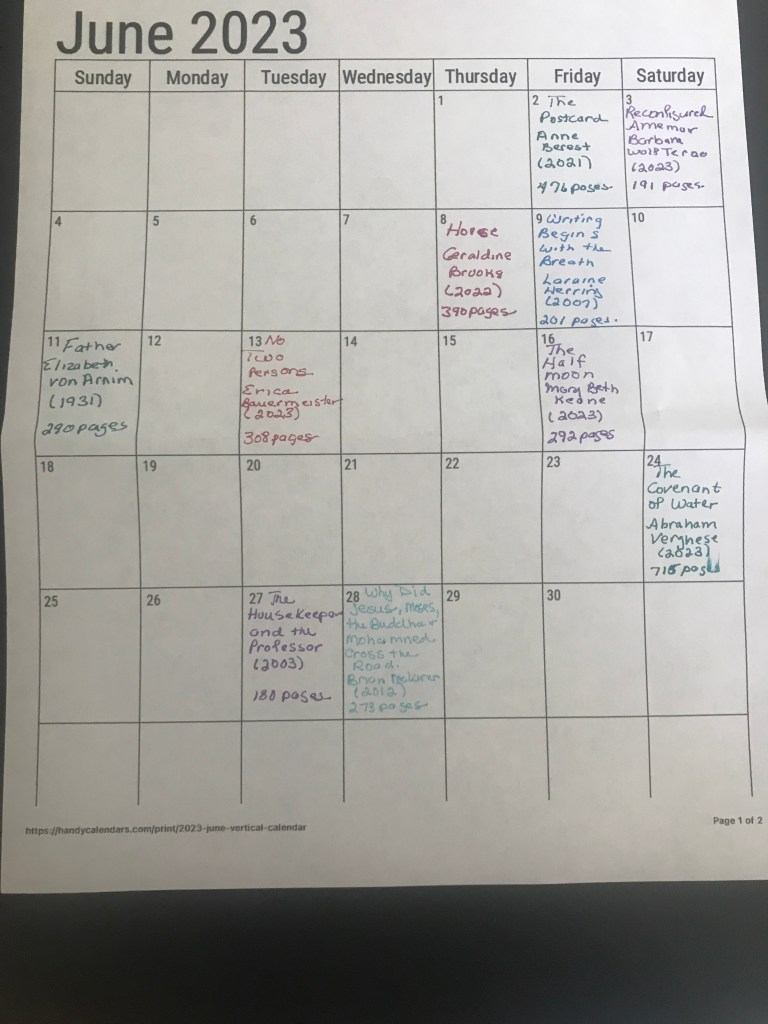
This month’s reading included many of the “shoulds” as listed in A. O. Scott’s essay, as well as the contradictions–reading as a private act, as well as a social undertaking. So here goes–a summary of June’s reading hours.

Fiction

Earlier this month I wrote about The Postcard by Anne Berest and Father by Elizabeth Von Arnim and my appreciation for both, although wildly different books. (Posts on June 8 and June 15)

  • Horse by Geraldine Brooks. I always enjoy Brooks’ books, and this one was no exception, although the “horse world” doesn’t much interest me. However, with all her books, there is more than one layer. The book weaves the story about one particular horse, Lexington, a race horse at the end of the Civil War, with finding the skeleton of that horse over a hundred years later at the Smithsonian. On its own the story of the horse’s trainer/groom, a slave named Jarrett, was fascinating, but I also enjoyed the contemporary figures in the story–a graduate student in art history and a woman who works at the Smithsonian. The story is based in fact, and now the skeleton of the horse is on view at the horse museum in Kentucky.
  • No Two Persons by Erica Bauermeister. The epigraph for this book is “No two persons ever read the same book or see the same picture.” The Writings of Madame Swetchine, 1860. At times I thought the book was a bit contrived, but still I enjoyed the concept of the book. Alice has written a novel called Theo, and the rest of the book is about certain readers and how they related to it. The readers include the woman at a literary agency who “discovered” the book and passed the manuscript on to the agency’s owner; a teenage girl who is homeless; a movie intimacy consultant; and others. Two quotes I like:

The story on Alice’s computer screen had been finding its way into words for more than five years, or maybe forever. Over that time, it had grown, changed, creaked, flown, gone silent, and then gained its voice again, its plot taking unexpected paths, its characters turning into people she hadn’t thought they would be, just as she had. This glowing screen, the one constant. p. 5

Because if that wasn’t what art was all about, in the end, mentally shoplifting your way through the world around, the thoughts inside you. p. 105

  • The Half Moon by Mary Beth Keane. This is a portrait of a marriage in which each individual has a passion that threatens to destroy the marriage. Jess desperately wants a child and Malcolm wants to own the bar, The Half Moon, where he has worked for years. Their individual yearnings get in the way of being honest with each other. The ending was a bit too fantastic I thought, but I hurt for both of them and rooted for their marriage.
  • The Covenant of Water by Abraham Verghese. A BIG book. 715 pages. Usually when I read a book of this size, I want to be swept away by it, but that was not the case for me with this book. There were times when that happened–quite a few actually, but I was not enamored of all the medical references and descriptions. Others will be intrigued by them, I am sure. Also, the frequent use of Indian words in italics distracted me, although usually I was able to figure out the meaning from the context. (I am embarrassed by how privileged I sound!) That being said, I liked each of the characters and their stories, beginning with a 12 year old girl in 1900 who enters an arranged marriage in southwestern India. (That marriage does turn out to be happy, however.) The book ends in 1977 and along the way we meet many characters, many of whom are affected by a medical “condition.” Yes, there is sadness and even tragedy along the way, but these are good people attempting to live a good life. Ultimately, I liked this book, but I didn’t love it.
  • The Housekeeper and the Professor by Yoko Ogawa. Translated from the Japanese by Stephen Snyder. Who would have thought I would so enjoy a book that involves so much about mathematics and, as if that weren’t enough, baseball. The professor is a math genius who has a traumatic brain injury and only has 80 minutes of short term memory. That means his housekeeper and her 10 year old son, who spends time there each day after school, have to introduce themselves to him everyday. They form a family of sorts and each of them care and caretake in their own way.

The Professor loved prime numbers more than anything in the world. I’d been vaguely aware of their existence, but it never occurred to me that they could be the object of someone’s deepest affection. He was tender and attentive and respectful; by turns he would caress them or prostrate himself before them; he never strayed far from his prime numbers. Whether at his desk or at the dinner table, when he talked about numbers primes were most likely to make an appearance. At first, it was hard to see their appeal. They seemed so stubborn, resisting division by any number but one and themselves. Still, as we were swept up in the Professor’s enthusiasm, we gradually came to understand his devotion, and the primes began to seem more real, as though we could reach out and touch them. I’m sure they meant something different to each of us, but as soon as the Professor would mention prime numbers, we would look at each other with conspiratorial smiles. Just as the thought of a caramel can cause your mouth to water, the mere mention of prime numbers made us anxious to know more about their secrets.

pp. 60-61

Nonfiction

  • Reconfigured, A Memoir by Barbara Wolf Terao. I was asked to read an advanced copy of this book, which will be released on July 18. The book is about the author’s breast cancer journey in the context of an unhappy marriage. How important it is to be able to tell our story about traumatic times in our lives, and I admire the author’s ability to honestly wrestle with both the physical and the emotional challenges. I have read a few cancer memoirs, since experiencing cancer in my own life–over 20 years ago–as well as the lives of friends and family, and I think what we look for in these memoirs is a deeper understanding of why we responded the way we did and how we cope and if we are lucky, how we grow and change in life-affirming ways. This book explores how to have the “strength to be a survivor.” The author respond to people’s perception of her bravery in this way.

I would come to hear that phrase from many people over the course of my treatments, and it was never a comfort to me because I knew I was not brave. I was doing what I had to do to stay alive. Inside, I was kicking and screaming about this turn of events–and what I was required to do to my body. I wondered if people lauded my bravery as a way of distancing themselves from cancer and the fears conjured up by that word, and if so, I really didn’t blame them.

pp. 81-82
  • Writing Begins with the Breath, Embodying Your Authentic Voice by Laraine Herring. This book focuses on the writing of fiction, but there was lots applicable to the writing of nonfiction. I read a chapter each of my Writing Wednesdays and especially appreciated her chapters on a “deep writing process.” If I started including quotes in this post that resonated with me, I would have a very long post indeed. If you are a writer, add this title to your TBR list. She has also written The Writing Warrior, Discovering the Courage to Free Your True Voice. I have only read a few chapters in that book, but it is very good, too.
  • Why Did Jesus, Moses, the Buddha, and Mohammed Cross the Road? Christian identity in a Multi-Faith World by Brian D. McLaren. I am a big McLaren fan. He always makes me think and often gives voice to issues I have, but didn’t necessarily know I had. In this book he asks two key questions: Can you be a committed Christian without having to condemn or convert people of other faiths? and Is it possible to affirm other religious traditions without watering down your own? In his usual fashion, he writes in an accessible way, but each page also includes helpful and clarifying footnotes.

SO that was June and now it is on to July. I am planning to use some of my non writing time in the coming days to read–I hope on the patio and in my secret garden, “Paris.”

An Invitation

What did you read this last month? Any recommendations? I would love to know.
Book Report: Books and More

June 22 2023

Last week my husband and I roamed, and you know what that means–checking out bookstores and libraries. Our destination was Spooner and Hayward in Wisconsin’s lake country. For many years my parents owned a lake home on Teal Lake outside of Hayward, so when our children were young we made that trip many, many times–most every weekend in the summer. Lots of wonderful memories.

Going to the lake always included packing books. What might we want to read on the deck or the beach or the pontoon or in front of the fireplace? There was no time for reading on this recent day trip, but we did buy books to take back home with us.

Our first stop was Northwind Book and Fiber, and it almost could have been our last stop, for I kept finding books I just had to have. Only my husband tempting me with a donut from the bakery a couple doors away speeded up my selection process. This store carries a terrific selection of backlist titles, and I quickly decided not to buy any brand-new titles, but to look for some older ones on my TBR list. I did well! This bookstore is now one of my personal favorites.

I was especially pleased to find The Housekeeper and the Professor by Yoko Ogawa. I have had this on my “hold” list at the library for a LONG time, but someone keeps renewing or not returning the two copies. This book, by the way, is the last one I have left to read on my fiction 2022 TBR list. A bonus: the store owner said it is one of her all-time favorite books, and she always has a copy on the shelf. I suspect she has already placed an order for a replacement copy.

My WILD CARD selection is West With Giraffes by Lynda Rutledge. I know this has been recommended to me, but I had not added it to my TBR list–who knows why. Well, seeing it, reading the first couple pages, I knew I needed to add this to my stack.

I am embarrassed to say I have not read Emily St John Mandel’s acclaimed Sea of Tranquility. Not sure why, especially since I loved Station Eleven. My granddaughter is a big fan of Mandel’s and that’s reason enough to read more of Mandel’s work.

I’m a little concerned I have already read The Female Persuasion by Meg Wolitzer, for I have enjoyed other books by her. I don’t own it, however, and it is just one of those books that feels good to hold–chunky and inviting. It has occurred to me to read not only all of her books, but those by her mother, Hilma Wolitzer. Another enticing book project.

The other three books, Red at the Bone by Jacqueline Woodson, The Stationery Shop by Marjan Kamali, and The Dictionary of Lost Words by Pip Williams have all been recommended to me by more than one source. Yum!

And what did my husband buy?

  • Open Season by C.J. Box
  • A Double Death on the Block and A Small Death in the Great Glenn both by A.D. Scott
  • The Language of Trees, A Rewinding of Literature and Landscape by Katie Holton.

From Spooner we continued to Hayward, which was so packed with tourists, we decided not to linger, but instead drove further to a small little town called Cable. We remembered taking our kids to the charming little library there, and I was thrilled to see it was still there. Jammed with books–such a cozy place to browse and read.

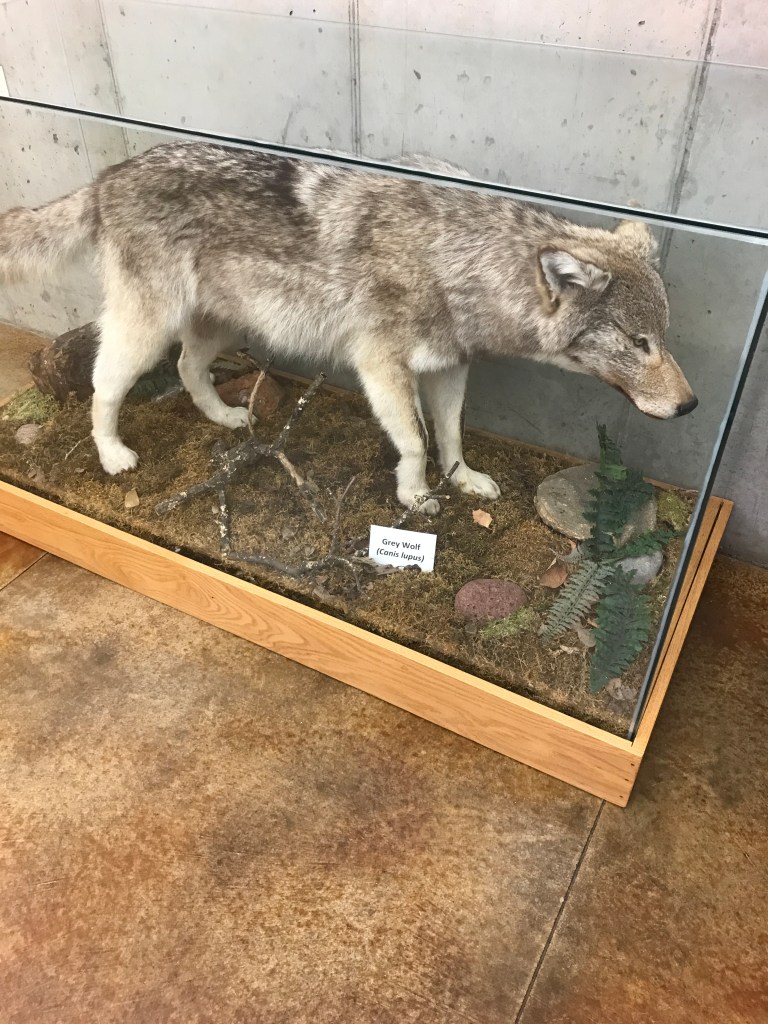
Part of the library at one time was a small natural history museum with scenes of flora and fauna. Now there is a big new natural history museum where I chatted briefly with my totem animal, canis lupus.

Cable also has a small independent bookstore, Redbery Books. Bruce bought Spider Lake, A Northern Lakes Mystery by a Wisconsin writer, Jeff Nania, but I was more restrained. For once.

Outside the library, by the way, is this sweet carving. The book the bear is reading is Where the Wild Things Are.

Not only do we use our plat map books when we roam, preferring back roads to the main ones suggested by Google maps, but we also consult the Midwest Indie BookStore Road Map. We wouldn’t want to miss any independent bookstore on our route!

Oh, and one more fun book treat. A friend who is a retired University of Minnesota librarian sent me this new version of Monopoly. How fun is this. I have printed the image for my book journal, and we’ll see how well I play in the coming months.

One last thing–I promise. What am I reading now? I have finally started reading The Covenant of Water by Abraham Verghese. I am surprised to say it is taking me some time to get into it, but maybe that is good or otherwise I wouldn’t be doing anything else. I will keep you informed about my progress.

An Invitation

Do you have any book related treats to report? I would love to know.

LINKS: https://www.northwindbook.com https://www.redberybooks.com

Book Report: A Jane Austen Companion–Father by Elizabeth Von Arnim

June 15, 2023

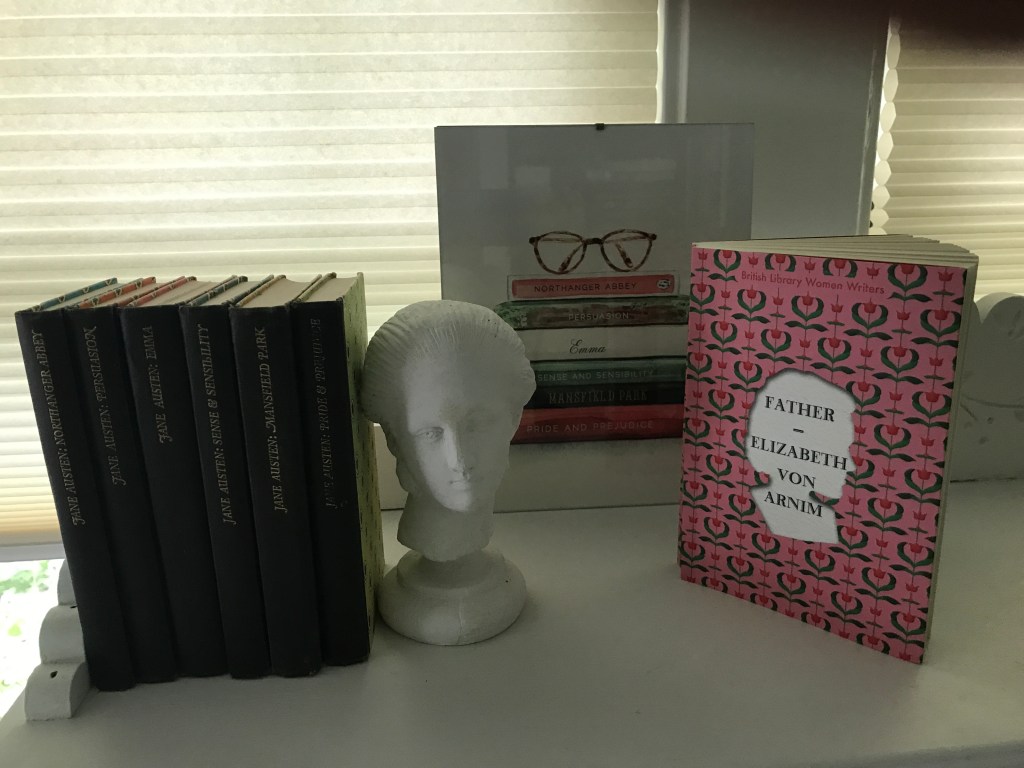
What a treat this book was! Father by Elizabeth Von Arnim (1866-1941) is one of the books in the British Library Women Writers series. I have read books by a few of the series’ writers, including E.M. Delafield, Mollie Painter Downes, and May Sinclair, and even another title by Von Arnim, The Enchanted April. However, I have not read any of the titles in this series, and I admit I was attracted to Father’s perky pink cover.

The book is so much more than its pleasing cover, I am happy to report, and I think Jane Austen would be pleased to have Von Arnim as a colleague, a fellow observer of life and love and the roles of women in a specific time period.

In fact, I imagine the following quote could just as easily be from Pride and Prejudice or one of Austen’s other books.

In that quiet village, where nothing ever was different, the coming of a stranger was anyhow an event, and when the stranger was a spinster with no apparent raison d’etre for living there such as writing or painting, the event might as well be called stirring. Certainly it would stir the parish. The thing to aim at was that it shouldn’t stir James, True that if it did, thought Alice remembering the new tenant’s appearance, he must be really morbidly stirrable. Still–propinquity; a bachelor, a spinster, separated only be a handful of tombstones…

p. 65

I chuckled. Outloud. And that was not the only time.

The basic plot, which is set in post WWI around 1930, is that Jennifer, age 33, has promised her dying mother that she will care for her father, who is a novelist. In fact, she is trapped, unappreciated and without any life of her own. Her father unexpectedly marries a woman younger than Jennifer and while they are on their honeymoon Jennifer sees an opportunity to escape. She yearns to live in the country and leases Rose Cottage from the local vicar and is determined to live on the small yearly amount of money her mother left her. The bachelor vicar is James whose older sister Alice, also unmarried, lives with and runs his life. And the plot with all its ins and outs and improbabilities goes on from there…

I realize not everyone will be attracted to this book, but I love long, involved sentences and the unraveling of inner and often contradictory thoughts. I enjoy a book where there is a clear sense of place and attachments to homes and gardens. Rose Cottage is dilapidated and an uncared for mess, but Jennifer is delighted with its simplicity and with the opportunity to make the gardens and the small home her own. I was reminded of a very early reading experience in my life, a book my grandmother gave me, Dandelion Cottage by Carroll Watson Rankin (1864-1945) about four young girls who turn a rundown little house into their summer playhouse.

This book has historical significance, too, for it was written at a time when there were 1.7 million more women than men in the U.K. Marriage was not always possible, even if it was desirable. Also, in 1928, Virginia Woolf gave a lecture stating that women need an income and a room of their own. A version of the lecture was published as A Room of One’s Own the following year.

Does Father adjust to Jennifer’s escape? Do James and Jennifer marry? What happens to Alice? And I haven’t even mentioned another vicar named Denilish whom Jennifer in her mind refers to as “Devilish.”

Quite simply, I loved it.

An Invitation

Have you ever chosen a book because of its cover? Did it live up to its promise? I would love to know.

Book Report: The Postcard by Anne Berest

June 8, 2023

But not only people were killed, also all the books they had to write. All the paintings they had to paint. All the music they had to compose. I think that is why we, the children and grandchildren of the survivors, are obsessed with working and writing books.

Anne Berest

The Postcard, a 2021 French novel translated by Tina Cover and now available in the U.S., is a lightly fictionalized account of the author’s own family. The central narrative is true. In 2003 Anne’s mother receives a postcard. On the front is a photograph of the Opera Garnier in Paris and on the back are the names of Anne’s great-grandparents and her great-aunt and -uncle. Ephraim, Emma, Noemie and Jacques. All four died at Auschwitz. There is no signature and no return address.

Why was it sent and by whom?

Such a good premise for a novel, and the author Anne and character Anne along with her mother, eventually begin the quest to find those answers. This book is so much more, however, than the unraveling of a mystery.

This book is another reminder of the need to remember the Holocaust and its chilling effects. For example, 76,000 Jews were deported from France.

Have you ever had the experience when reading a book of wanting not to read more, but there was no way you could stop. That’s how this book felt to me, and I remember feeling the same way when as a pre-teen I read The Diary of Anne Frank for the first time. Or years ago when I read Suite Francaise by Irene Nemirovsky, which is referred to in The Postcard, and I think I need to read again. As much as I didn’t want to read the truths in either of these books, I knew I needed to know them, and I am grateful to the authors of these books for their abilities to portray truth.

So many scenes in The Postcard remain with me, but I mention just two.

Anne attends a Seder, her first actually, for even though she is Jewish by birth, she has not been a practicing Jew. She is unexpectedly moved by the ritual.

Everything seemed familiar: passing the matzos around, dipping the bitter herbs in salted water, letting a drop of wine fall from fingertip onto my plate, resting my elbow on the table…My ears already seemed to know the Hebrew chants. It was as if time had stopped…I could feel hands sliding into my own, inhabiting them.”

During the years we lived in Cleveland dear friends often invited us to Passover dinners, and I remembered not just feeling privileged to be there, but also a sense of universality and timelessness. I am not Jewish, and I certainly do not know Hebrew, but I connected to that heritage, to that ritual of honoring the past, to the awareness of the presence of God. Being there strengthened and broadened my own sense of what it means to be beloved by God. Such a gift.

The other scene is close to the end of the book. After the war ends and the concentration camps are liberated, French survivors are returned to Paris in the very same buses that earlier transported them to the camps that were the last stop before stock cars and trains took them further East.

They can see the eyes of the Parisians widen as they pass, the pedestrians and drivers pausing for a few seconds, wondering where these hairless beings in striped pajamas flooding into their city have come from. Like creatures from another world.

The survivors are taken to a hotel where they are questioned and received ID papers, a sum of money and vouchers for bus and trains tickets. Then they are allowed to rest there for a few days.

The deportees lie on the floor because they can’t sleep on the softness of mattresses anymore. Often, three or four of them need to lie together, pressed against one another, in order to fall asleep. They are ashamed of their shaved heads and the sores and abscesses covering their bodies. They know just how horrific the sight of them is.

Horrific, indeed. And we need to be reminded of the horror, for we are living in dangerous times.

In many ways this book doesn’t feel like a novel, but more like a nonfiction book. The writing is often almost matter of fact. This happened and then this happened and this person is related to this person etc. Don’t let that fool you, for the simplicity of the words, the factual tone, is perhaps the only way we can get through the reality of what seems too impossible to be true.

Anne Berest has said that writing the book is her “mitzvah,” which has come to mean a kind of good deed; something you do for your community. She has more than accomplished that.

An Invitation

What books have opened your eyes and your heart to something you wish you didn’t need to know? I would love to know.

Book Report: May Round-Up

June 1, 2023

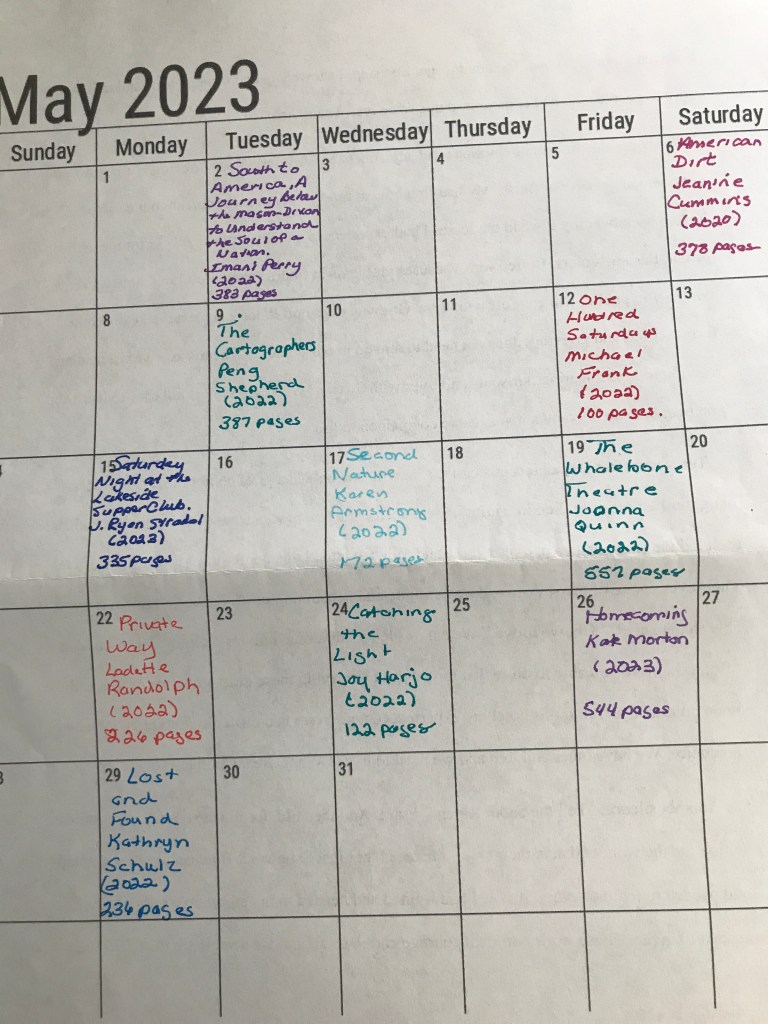
Five Nonfiction Books.

Six Novels.

No duds! Now that’s a good month. I should say, however, that I quickly discard a book, if it doesn’t engage me in the first few pages, so the chances of being disappointed by a book is less and less. I am sure I miss some books because of such fast judgment, but so many books, so little time is becoming more true with each birthday. Sometimes, however, I know a particular book just isn’t the right one at the moment, and I don’t discount returning to it at another time.

Thus, the reading adventure continues.

Fiction

Three of six novels read in May receive the “I couldn’t put it down.” rating

  • The Cartographers by Peng Shepherd. I initially thought of this book as a good “palate cleanser” book after reading American Dirt by Jeanine Cummins, the first book I read in May and highly recommend. (See May 11, 2023 post ). I needed something lighter, but the further I read the more engrossed I became in the story, which focuses around a group of mapmakers, map experts. Much of the story is set in the New York Public Library, but also in a town that doesn’t exist. Mystery, some fantasy. A good summer read–and just out in paperback.
  • The Whalebone Theatre by Joanna Quinn. I have not seen this on any other list and only heard about it through Minnesota Public Radio’s book newsletter, The Thread. I am so glad I was led to this book–even though there are so many books about WWI and WWII right now. The story is about three siblings (complicated–different fathers, different mothers) who grow up in rural England and are devoted to one another. One day a dead whale washes up on the shore and Christobel, the oldest, claims the skeleton and uses the bones to build an outdoor theater. She later becomes a spy in France. Well, the plot is involved, but I loved the characters and the writing was fresh and even at 50 pages kept moving.
  • Homecoming by Kate Morton. I don’t know why, but I didn’t expect this book to be as good as it was. I think I expected a fluffier, more lightweight book, but I was impressed with how the story kept unfolding, revealing new facts, new information, new aspects of the characters. Set in Australia in two times–1959 and 2018. A mother and three of her children ( a 4th, a baby, is missing) are found dead at a picnic site. The same day the visiting sister-in-law, who is pregnant, has her baby early. In 2018 that woman is dying and her granddaughter Jess, who was raised by her, returns to Australia from England to be with her–and the story begins to unfold. Lots of secrets. I like this quote from close to the end:

Being old, he had come to realize, was like being stuck inside an enormous museum with hundreds of rooms, each crammed full of artifacts from the past.. He understood now why the elderly could sit, seemingly still and alone, for hours on end. There was always something else to take out, to look at from a fresh angle and become reacquainted with.

p.531

As mentioned earlier, I started the month reading American Dirt. I also read Saturday Night at the Lakeside Supper Club by J. Ryan Stradal, a Minnesota author, and the book is set in Minnesota. The story is about a family, with emphasis on the women, who has owned a supper club for generations. A pleasant read. One other novel on the May list is Private Way by Ladette Randolph. Earlier this year I read and liked her memoir Leaving the Pink House. (March 30, 2023 post.) Set in Lincoln, Nebraska, I liked parts of Private Way very much, especially the references to reading Willa Cather’s books, but I thought the premise of the book–why the main character leaves her life in California and rents a home in Lincoln– a bit of a stretch. She learns much about herself along the way and develops key relationships, and I am not sorry I read it, but it was a bit uneven.

Nonfiction

The star on May’s nonfiction book is One Hundred Saturdays, Stella Levi and the Search for a Lost World by Michael Frank, which I wrote about in the May 18, 2023 post, but I can easily recommend four other titles.

  • South to America, A Journey Below the Mason-Dixon to Understand the Soul of a Nation by Imani Perry. A remarkable book. I didn’t always understand each of the references, especially related to music, but repeatedly I felt stunned by her insights and revelations. Perry examines specific states/cities in the South–a chapter on each– and in that way it reminded me of Clint Smith’s How The Word Is Passed (see December 1, 2022 post). No matter how much we know about the terror of slavery, more needs to be understood, along with the legacy of that time. This would be a good book to read in a group, one section at a time.
  • Sacred Nature, Restoring Our Ancient Bond with the Natural World by Karen Armstrong. In her brilliance and her exhaustive research, Armstrong’s books are never easy reads, but worth the effort. This book looks not only at the dire straights we are in because of how we have separated ourselves from nature, but also the views of a variety of religions about nature. In Christianity and Judaism, nature hasn’t played much of a role, but that is not true in other traditions.
  • Catching the Light by Joy Harjo. I am so attracted to her words, and this little book in the “Why I Write” series is no exception. I loved her memoir and also her book of 50 poems for 50 days. (See post on March 30, 2023.) Harjo writes to remember (“The old ones urge and remind us, remember. Remember to remember.” p. 42)–and we white privileged need to read about and understand the ways we colonizers have traumatized indigenous people.
  • Lost and Found, Reflections on Grief, Gratitude, and Happiness by Kathryn Schulz. This is another book now full of my underlining. At times, I admit, I found the book a bit tedious–for example, when she wrote about how the last letter of the alphabet was not “Z,” but “&”. Interesting, but what most engaged me was the focus on the dying and death of her father and the finding of love. And then the “and” of life; how life goes on. Beautifully written, which is no surprise because she is a writer for The New Yorker. One quote out of so many I could share:

This type of circular mourning, the grieving of grief itself, is perfectly normal and possibly inevitable yet also misguided and useless. There is no honor in feeling awful and no betrayal in feeling better, and no matter how dark and salted and bitter cold your grief may be, it will never preserve anything about the person you mourn. Despite how it sometimes feels, it has never kept anyone alive, not even in memory. If anything, it keeps them dead: eventually, it you cannot stop mourning, the person you love will come to be made only of grief.

p. 67.

So now that it is June, summer reading begins. I have started The Postcard by Anne Berest. You can check out my thoughts about summer reading in my May 25, 2023 post. Happy Reading.

An Invitation

Did you read anything this past month that deserves the “I couldn’t put it down rating”? I would love to know.

Re-reading Amanda Gorman’s “The Hill We Climb”

May 30, 2023

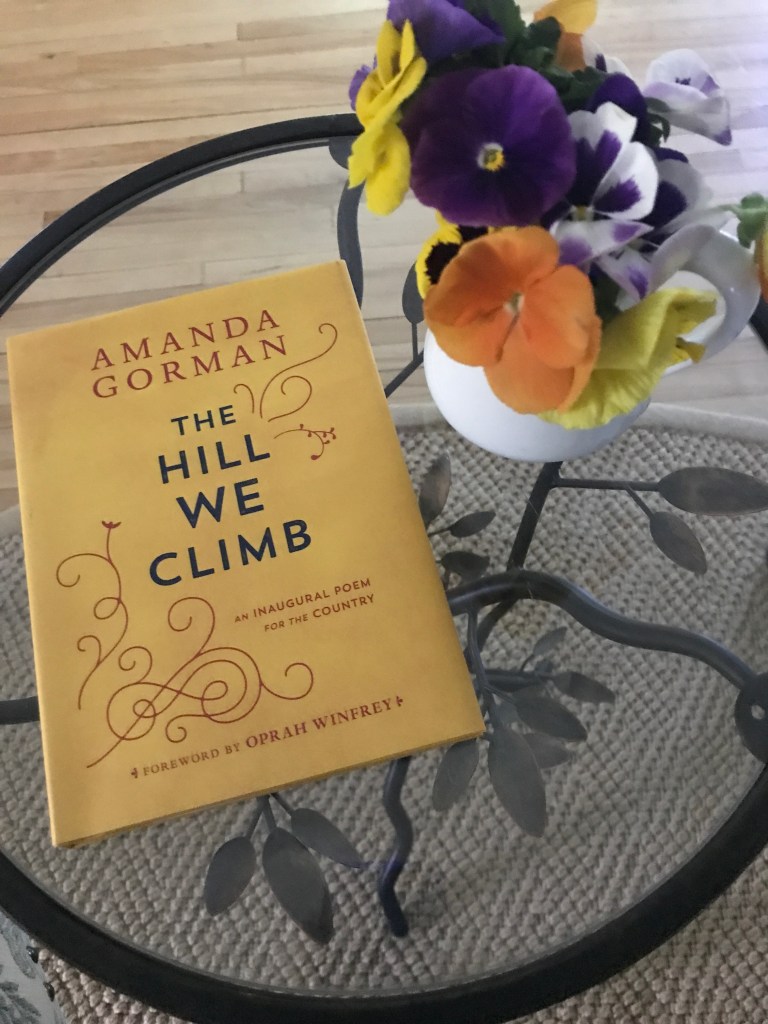
My mouth dropped open when I heard the reports about Amanda Gorman’s poem, “The Hill We Climb,” being removed from shelves in the elementary school section of the library in a K-8 Florida school. One parent said the poem included “hate messages” that served to “cause confusion and indoctrinate students.” The objection to the book did not include examples from the poem to support the parent’s argument.

I always wonder when I hear about yet another book being banned (or in this case, the school argues, it was not banned, but rather, “moved.”) if those who are so concerned about a specific book have actually read the book. In this case I also wondered if they had seen Amanda Gorman read her poem at President Biden’s inauguration–days after the January 6 attack on the Capitol.

When I heard the reports about the attack on her poem, I remembered how striking this young woman appeared in her tailored yellow coat, a column of gold, standing and speaking confidently as our country’s leaders sat behind her listening intently. I remember the beauty of her hands –motioning not in accusation, but beckoning all of us to climb the hill of justice, the people we have always said we want to be. I’m afraid I don’t remember what Biden said in his speech, although I remember thinking, “Good job. This is a good start.” But I do remember, however, Gorman’s play on words: “‘just is’ isn’t always justice.”

I don’t remember words of hate.

I don’t remember thinking “Oh dear, this could be really confusing for young children to read or hear.”

But then again I am an old woman and I forget where I put my phone and just this morning I misplaced a favorite pen, so perhaps I needed to read “The Hill We Climb” again. I had purchased a copy of the poem, with its Forward by Oprah Winfrey –the complainant said Winfrey was the author–as soon as the book was published.

I read the whole poem aloud. And then I read it again, pausing often, asking myself, “Is this phrase full of hate?”

Somehow, we've weathered and witnessed
A nation that isn't broken, but simply 
    unfinished
...
To compose a country committed
To all cultures, colors, characters,
And conditions of man.
And so we lift our gazes not
To what stands between us,
But what stands before us.
We close the divide,
Because we know to put
Our future first, we must first
Put our differences aside.
...
We seek harm to none, and harmony for all.
...
We will rebuild, reconcile, and recover,
In every known nook of our nation,
In every corner called our country,
Our people, diverse and dutiful.
We'll emerge, battered, but beautiful.
...

I found no hate. I found hope wound in an out of the hard work required of us all.

In a way I am glad this decision by a Florida school has come to our attention, for it highlights the gift of Gorman’s words. Jo Harjo, the twenty-third Poet Laureate of the United States, in her book Catching the Light refers to poets when she writes, “As scribes of our generation, we are called to remember what matters.” (p. 39) She also says every poem is a prayer, and Gorman led us in prayer.

I found no hate.

One more note. I believe children generally know what they can handle, what they are ready to read–and it is usually more than what we give them credit for. People who want material removed from libraries or classrooms often do that, they claim, in order to protect their children from things they aren’t old enough to understand, from what might be confusing or might influence them in an unhealthy way. I am more inclined to believe that those parents are protecting themselves from the need to explore hard questions with their children and from confronting their own contradictions and fears. I wonder if they aren’t afraid they might not really believe what they say they believe if they open themselves to a different vision.

The new dawn blooms as we free it,
For there is always light,
If only we're brave enough to see it,
If only we're brave enough to be it.

An Invitation

Can you recall a time when a book led to a serious or deep conversation with a child? I would love to know.
Amnda Gorman reciting her poem at Biden Inauguration: https://www.youtube.com/watch?v=LZ055ilIiN4

Book Report: Summer Reading

May 25, 2023

This is the time of year when lists of books for summer reading appear. Often summer reading is lighter. Beach reads. Vacation reading. Summer reading often appeals to people who don’t feel they have enough time to read during other months

Well, I am a voracious reader all year round and always have been, so what I read or if I read is not dictated by the time of the year. What changes for me is where I read. Not only do I continue to read in the snug or in bed, but during the summer I also read on the patio and in our side garden, “Paris.” However, I am still attracted to those summer reading lists, and one of my favorite summer reading lists is Anne Bogel’s guide. I listen to her podcast, “What Should I Read Next” and get her “Modern Mrs Darcy” newsletter/blog. https://modernmrsdarcy.com I have browsed the new guide and know I will spend more time with it, weighing which titles to add to my TBR lists.

In the meantime I have a number of books waiting for summer reading time on my shelves.

  • For Mother’s Day I received two books: The Postcard by French author Anne Berest is getting lots of attention, even though it is long and some have called it “weighty,” but compelling. The other book is The Lost Journals of Sacajewea by Indigenous author, Debra Magpie Earling. Both books are appealing, and my daughter was delighted she selected books I have not already read or purchased myself.
  • The Covenant of Water by Abraham Verghese. Through some great luck I was at the top of the library hold list. I loved Verghese’s earlier novel Cutting for Stone and based on the reviews I know I will love this new one. It is a long book–over 700 pages–which is not a problem for me, but I want to savor it and not worry about returning it on time. Plus, I am quite sure my husband will want to read it and perhaps others in the family, so I returned the library copy and bought my own.
  • At the same time I bought the Verghase book I bought The Midnight Library by Matthew Haig. This book has just been released in paperback after a long life on bestseller lists as a hardcover. Here’s an intriguing sentence from the back cover: “We all have regrets–choices we could have made differently, paths we didn’t take, other lives we might have led. But what if you were given a chance to fix your past? Enter The Midnight Library.”
  • At that same trip to a favorite bookstore, I bought two other books from my TBR lists: Lost and Found, Reflections on Grief, Gratitude, and Happiness by Kathryn Schulz; Indiana, Indiana by Laird Hunt (I loved his National Book Award finalist title Zorrie. The character Zorrie is introduced in this book.); and a title I had not heard about but it just appealed, and was my Wild Card purchase of the day, Our Woman in Moscow by Beatriz Williams. She has a long backlist, so this could be a great discovery!
  • Earlier this spring I bought one of the titles in the British Library Women Writers series, Father by Elizabeth von Arnim This is a case of being attracted to the look of a book. Pretty. The whole series appeals to me because of the focus–female authors who enjoyed broad appeal in their day. The fictional heroines in these books experienced life at a time when the role of women changed radically. Von Arnim (1866-1941) is perhaps best known for her book, The Enchanted April.

If I have a goal for my summer reading it is to finish the books on my 2022 TBR lists. I have only four more novels to read, and I am currently reading one of them, Private Way by Ladette Randolph and another is waiting for me at the library, Flight by Lynn Steger Strong. And I have three titles left on the nonfiction TBR. One of those is Lost and Found, mentioned earlier.

I have no doubt I will veer from this pile of proposed books for summer, but shouldn’t summer be all about fun and discovery and being open to what presents itself. Needless to say, I will keep you updated on my June, July, and August reading.

An Invitation

Do you have any reading plans for summer. I would love to know.

Book Report: One Hundred Saturdays, Stella Levi and the Search for a Lost World by Michael Frank

May 18, 2023

I waited for this book for a long time. The library only had two copies and the people who checked it out must have renewed it more than once and then not returned it on its final due date. Finally, I received the notice that it was my turn. I must admit I wondered if the wait would be worth it. It was.

Stella Levi grew up in the Jewish area called Juderia on the Aegean Island, Rhodes. That Jewish community had existed there for half a millennium until the Germans seized control of the island in September, 1943. The following July all 1650 residents were deported to Auschwitz. It was a mystery why, when Germany was so close to being defeated and the end of the war so near, they went to all this expense and effort, but that is the nature of war, I guess.

Stella survived and eventually immigrated to the U.S. As an elder she met Michael Frank who was interested in her story, and this book is the result of 100 Saturday visits over a period of six years. Frank listened, asked respectful questions, and over time she trusted him, and they developed a rich friendship.

I’ve read many books about WWII and the Holocaust, but in each one I learn something new and come just a bit closer to imagining the horror of that time, but there are also moments of rejoicing when people somehow live beyond the terror and the evil. Stella is one of those people.

“You have to remember that the first time I ever left Rhodes was when they took us to Athens and from Athens through Europe by train. I looked out the window, I watched the stations flash by: here was the continent I’d dreamt about for so long. And afterward…afterward in the camps themselves, we met the French women and Madame Katz and Paula, who were from Belgium. They spoke about Paris, Lyon, Brussels. They had actually seen and experienced, or were connected to, the places I had longed to know and to visit. They’d lived there. They were from there, of there…”

Under the unlikeliest of circumstances, the wider world came closer.

p. 68

“Very early on, almost from the beginning, something curious happened. I detached myself from the Stella who was in Auschwitz. It was if everything that was happening to her was happening to a different Stella. not the Stella I was, not the Stella from Rhodes, the Stella I knew. I watched this person, this other Stella, as she walked through this desert, but I was not this person.”

After a moment she adds, “There was no other way.”

p. 140

About Stella’s relationship with Frank:

“And then you came along and were curious. And patient with me, even though I wasn’t always so…so easy. And in speaking to you I have learned a good deal about myself. As I tell you my stories, I learn. One thing I learn is that there is no single truth; there is a changing truth…and you understand a good deal from going back, returning, and more than once, to what you thought you knew, and felt, and believed.”

p. 208

A bonus in this book is that it is illustrated by Maira Kalman who is the author and illustrator of over 30 books for adults and children, and her work is exhibited in museums around the world.

This is her portrait of Stella.

One of my favorite books she illustrated is the classic The Elements of Style by William Strunk, Jr and E. B. White. Her illustrations make grammar palatable.

Here are Strunk and White:

And here is Maira Kalman.

An Invitation

What books have you waited for? Have they fulfilled your expectations or been a disappointment? I would love to know.