Book Report: The Need to Savor, Not Devour Books

October 12, 2023

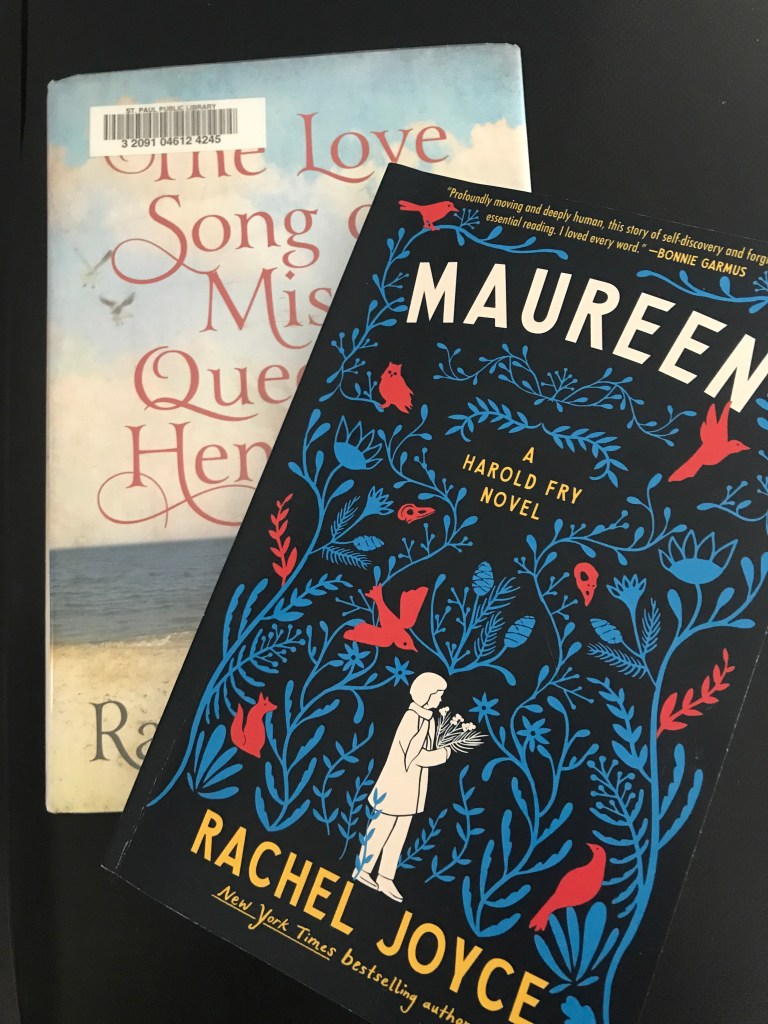
If you’ve read Rachel Joyce’s The Unlikely Pilgrimage of Harold Fry, you must also read the companion book, The Love Song of Miss Queen Hennessy, and then the story of Harold’s wife, Maureen. I had read and loved the Harold Fry book when it was first published in 2012, but until I read a post in Joanne’s Reading Blog, I didn’t know about the other two books. Each book is tender and human and highlights the ways we are each vulnerable in our loves and our losses. Just as these characters became my companions, thanks to Joyce’s good writing, I felt myself becoming a companion to these characters, too.

What they experience is not my story, not in any factual way, but aren’t we each on a pilgrimage and don’t we each need others to guide and support us on that pilgrimage?

But here’s something else that happened as I neared the end of Maureen. This book is short–only 132 pages and after an evening of reading in the snug, I only had 15 pages left to read. How easily I could have read those last pages in bed before turning off the light, but, instead, I decided to read them the next day. To not rush to the end. I was tired and knew I could not fully appreciate the end of the journey–just for the sake of finishing the book. I wanted to savor the experience.

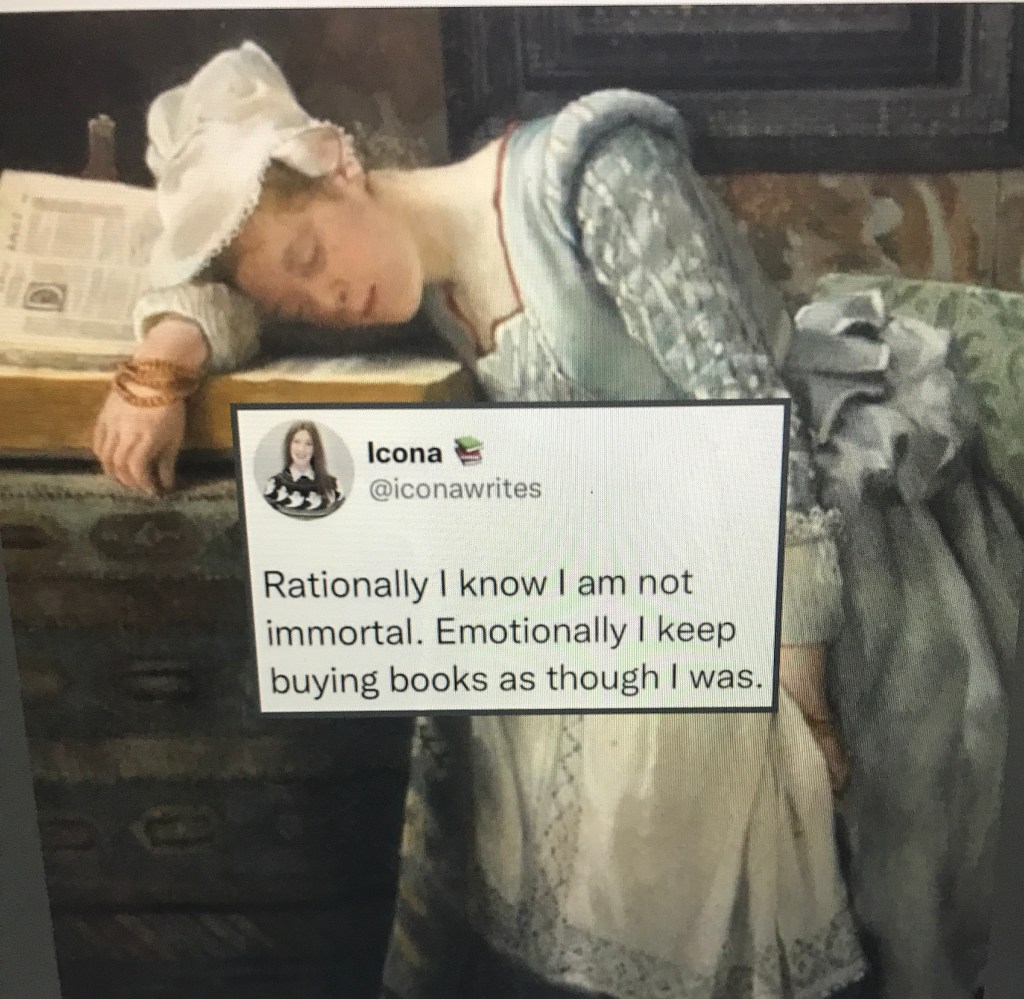
I am a fast reader, but sometimes–often–that means I don’t get the full impact. I miss some important details. I don’t live fully with the characters, the story, or the setting. What would happen if I challenged myself to slow down?

Well, most likely I wouldn’t read as many books on my TBR. I might not be able to read my 100+ books a year. Last year I read 150 books, and I know, unconsciously at least, I want to beat my own record and at least read 151 books this year. Really? What does that matter?

Recently, writing an article, “How Do I Keep Track?” for BookWomen about keeping lists of what I want to read and what I have read (Thanks to all of you who contributed your methods and ideas about book journals and To Be Read lists.) made me re-evaluate this passion for reading as many books as I can. Soon after submitting the article, I read or heard somewhere (can’t recall where) that TBR lists can be treated as a menu, rather than a To Do list. Suggestions. Possibilities. Not something to be completed and conquered. Who eats everything on a menu! What a concept!

  1. Recently, I re-read Unsheltered by Barbara Kingsolver (See my October 5, 2023 review.) and I wondered, as I immersed myself in this excellent book, how much I had missed when I read it the first time. I have this urge to re-read many favorite books, but perhaps that desire reflects a need to slow down and savor, as well.
  2. While fixing the first batch of applesauce this season, I watched a long interview with Abraham Verghese, author of Cutting for Stone and his latest book, The Covenant of Water. I loved the first book, but only liked, rather than loved the more recent book. (See my June 29, 2023 post.) I now want to re-read the new book, for I think I read it too fast. I want to savor it.

I like what novelist Yiyun Li says.

I once asked some students how fast they could read, and one of them said she could cover 100 pages in an hour, so I decided to use Housekeeping (Marilynne Robinson) to teach the students how to do slow reading…they read word by word, sentence by sentence, and they ponder over an unfamiliar word choice, a fleeting gesture, the shadow of an image, and the ripple of a sentence seen in the following sentence…It’s a testament to the art of reading with not only five senses but also with memory and imagination. And I hope it’s the most important thing I can teach my students: not merely the crafts of writing but the importance of paying attention, to the world in a book and to the world beyond a book.

“By the Book,” New York Times Book Review, September 10, 2023

Here’s my new challenge to myself: Read to savor, rather than to devour.

Stay tuned.

Do you have a reading challenge? I would love to know.

Joanne’s Reading Blog: https://joannesreadingblog.wordpress.com

BookWomen: http://bookwomen.net

Abraham Verghese Interview: Talking Volumes Abraham Verghese on http://Youtube.com

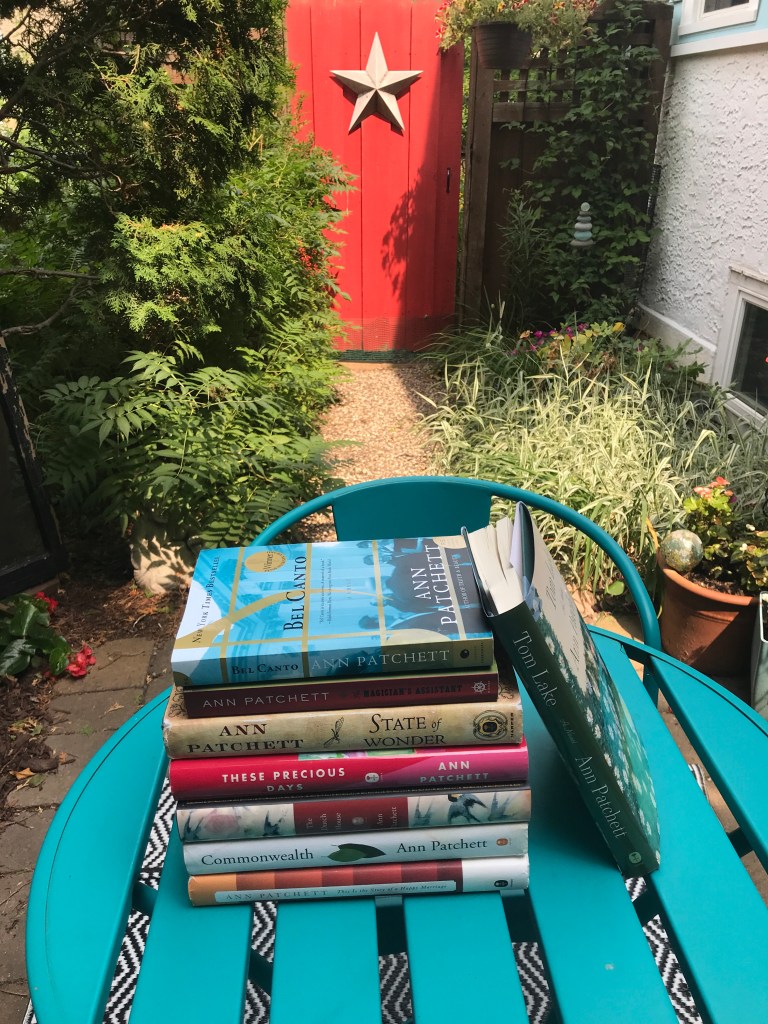
I also recommend watching Talking Volumes Ann Patchett on http://Youtube.com
Book Report: September Summary and Visit to Ann Patchett’s Bookstore

October 5, 2023

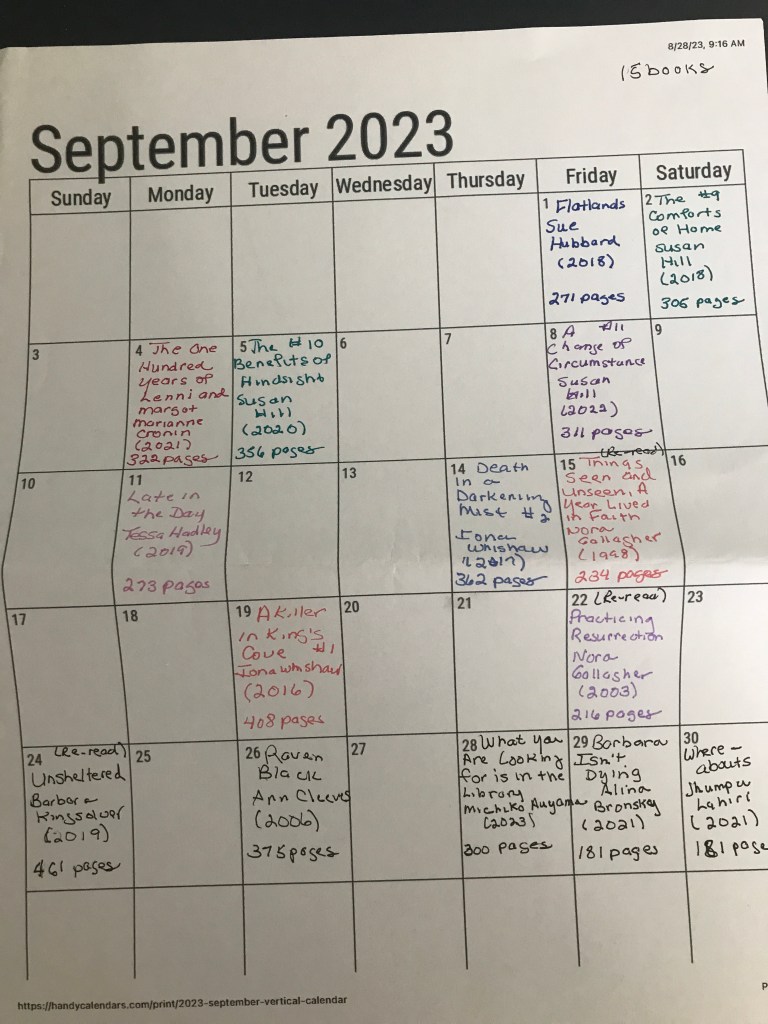
From the looks of my book calendar, I could be accused of not doing much else other than reading during September. I assure you that is not the case, but I don’t deny this was a good reading month.

Here’s what I read while on our road trip:

  • Raven Black by Ann Cleeves. This is the first book in the Shetland series. Perhaps you have watched the BBC series, Shetland. Cleeves also wrote the Vera series. Although I enjoyed this book, I probably won’t continue reading the series, but rather continue reading the Lane Winslow series by Iona Whishaw, which I mentioned in the September 21st post. (I read the first two titles in this series this month: A Killer in King’s Cove and Death in a Darkening Mist.)However, I do love books set in the Shetland Islands, and Cleeves knows how to tell a tale.
  • What You Are Looking For Is In the Library by Michiko Aoyama, translated from the Japanese by Alison Watts. This book got me at the title. A sweet, gentle book in which each chapter features one character who is dissatisfied with his or her life–a man who has recently retired, a new mother whose job has been downsized, a young man who loves to draw but has never found the right job match, and others. They each are directed to the library in the neighborhood community center where the reference librarian instinctively seems to know what books –books that on the surface make no sense–will change their lives and give them confidence or a new perspective. No violence. No sex. No objectionable words. Instead, an uplifting and encouraging book.
  • Barbara Isn’t Dying by Alina Brodsky, translated from the German by Tim Mohr. I chuckled as I read the first few pages, but although the sarcastic and ironic tone continues, it becomes more serious. Barbara, who clearly has run her home efficiently and without assistance from husband Walter says she is tired and retires to her bed, leaving a puzzled Walter in charge. He has no idea how to make coffee, let alone anything else, and grocery shopping is a whole new world, but he does his best and develops new skills. In the meantime their children take Barbara to their doctor, and the news, which is never shared and which Walter ignores, is not good. An exercise in classic denial. The book is well-written, insightful, and often tender.
  • Whereabouts by Jhumpa Lahiri. This book got lots of attention when it was released in 2021 because Indian-American writer Lahiri wrote it in Italian, not her native language, and then she translated it into English. The book is a series of vignettes told in first person by a woman, an academic, who lives in Italy. However, no names or people or places are ever given. We know few facts about the the narrator, but we learn much about her inner life, and we receive the gift of her observations. Lovely writing in short chapters.
  • Unsheltered by Barbara Kingsolver. I finished reading–actually, re-reading–this book at the beginning of the vacation. It was neither short (461 pages) nor was it a fast read, but never mind, for Kingsolver’s books are a reminder of what it means to read such good writing, and her books are always engrossing and interesting and out-of the ordinary. Reading a Kingsolver book means immersing oneself in the best. There are two story lines in this book, but both are set in the same place–a crumbling, tumbledown mansion in New Jersey, and the stories relate and overlap. One story line is set in contemporary times: Willa is a writer/editor whose magazine position has ended and her husband Iano is a college professor who keeps moving in search of tenure. Money problems and family dysfunction dominate. The other story focuses on Thatcher Greenwood, a science teacher, and his family who live in the same house, although much earlier. Mary Beech, a botanist, who corresponds with Darwin, lives next door. She is based on a real historical figure, by the way. So much more could be said, but better to read Kingsolver’s book than my review. After reading and loving Demon Copperhead, I feel compelled to re-read her earlier books.

Before leaving on our road trip I read two nonfiction books. In the September 21 post I wrote about re-reading Things Seen and Unseen, A Year Lived in Faith by Nora Gallagher, and I decided to re-read the sequel Practicing Resurrection, A Memoir of Work, Doubt, Discernment, and Moments of Grace. In this book she writes about her discernment process about becoming an Episcopalian priest. She examines writing as a call, as well, and there are lovely passages about sandhill cranes, spiritual direction, and marriage. A favorite line: “Perhaps God doesn’t know all the parts either, but cranes her neck toward us listening.” p. 163. Both of these books are leading me to re-read some favorites from my own extensive library of books about spirituality and theology.

What else haven’t I mentioned?

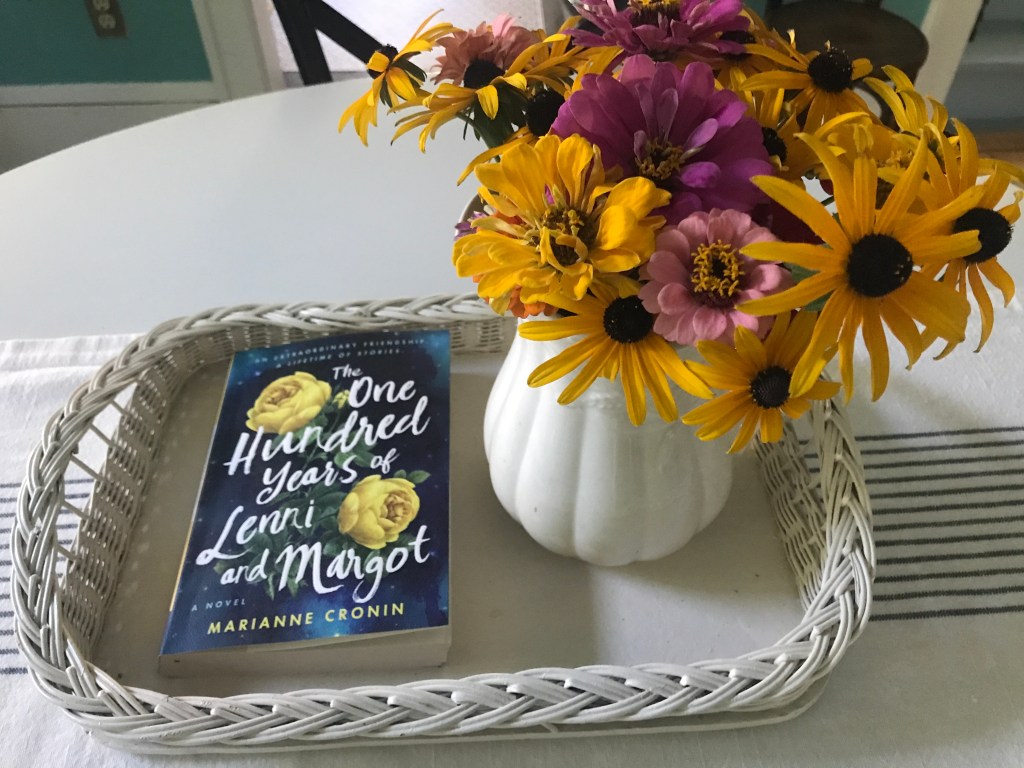
  • The One Hundred Years of Lenni and Margot by Marianne Cronin. See the September 14 post.
  • Three more books in the Simon Serailler mystery series by Susan Hill: The Comforts of Home (#9), The Benefits of Hindsight (#10), and A Change of Circumstance (#11). The next one in the series, #12, will be released this month.
  • Flatlands by Sue Hubbard. This book was one of my “wild cards” from a trip to a mystery bookstore in Madison, WI, but it isn’t a mystery. Rather it is a tale of unlikely friendship between a young girl who is an evacuee from London and an artist and conscientious objector during WWII. The landscape of the wild wetlands of the English fens is almost another character.
  • Late in the Day by Tessa Hadley. Another excellent “wild card” book. Two married couples are the main characters and when one of the husbands dies, the dynamics change. I appreciated the careful “not too much” writing–deep and yet not navel gazing.

Most people go to Nashville for the music, but not me. Parnassus Books, owned by brilliant bestselling author, Ann Patchett was on my Bookstore Bucket List, and it didn’t disappoint.

Fortified by a delicious lunch at True Food and armed with a list of titles on my TBR list, I took a deep breath and opened the door. My husband who also loves to read, but is more casual, I would say, about what he reads, assured me I could take all the time I wanted.

My strategy was to first check the shelves for all the books on my list and then to take another deep breath and open myself to other possibilities–books I call my Wild Cards. Bruce periodically checked in with me, asking if he had read this book or that or if we owned it. I often replied that I had read the book in question, but couldn’t remember if we still owned it or if we had passed it on to a Little Free Library. That’s one reason I keep a list of what I want to read– remembering all the titles in my reading life is impossible!

One of the pleasures of browsing in a bookstore is encountering so many good books from my reading past. A kind of life review. As I moved slowly along the fiction shelves, I kept saying to myself, “Oh, I loved that book” or “What a good book that is” or “I want to re-read that book.

In my mind a good bookstore is one that doesn’t only have the latest and greatest or maybe latest, but not so greatest, but also is intentional about stocking good books from the past, earlier books written by a current author. Parnassus passed that test.

Another mark of a good bookstore is knowledgeable and engaged staff. Another star for Parnassus Books. As I browsed I could hear conversations between staff and customers. Not only did the staff KNOW books, but when a customer asked about a book unfamiliar to them, they were eager to know more. When it came time for me to purchase my pile, the bookseller clearly was selling books and not socks or computer paper or laundry detergent. She looked at each book, sometimes commenting on a title, and as I handed her my credit card, she said, “You’ve got a great pile here.” She seemed totally sincere.

I always feel a sense of camaraderie in a good bookstore–chatting with other customers seems possible, and, in fact, often happens. In this case, two young women were wondering about reading Emily St James Mandel’s book, Sea of Tranquility, which I read this summer. I interjected myself into the conversation, asking if they had read Station Eleven. They didn’t seem bothered by this old lady reader eavesdropping, and I noticed they bought the most recent Mandel book. Somehow I don’t think I would have asserted myself in that way if I had been in Barnes and Noble.

The only way Parnassus Books failed me is that they were out of their bookmarks. Darn! Oh, and I have a wish list for bookstores in general: better religion and spirituality sections. More and more I have to order a title I am interested in sight unseen. Lately, I have been looking for You Are Here: Keywords for Life’s Explorers by David Stenidl-Rast and The Eloquence of Silence by Thomas Moore, but no such luck yet.

From My TBR List: (All Fiction);

  • The Stranger Diaries by Elly Griffiths
  • Whereabouts by Jhumpa Lahiri
  • Barbara Isn’t Dying by Alina Bronsky
  • What You Are Looking for Is In the Library by Michiko Aoyama
  • Maureen by Rachel Joyce

Wild Card Selections:

  • The English Teacher by Lily King
  • The Golden Hour by Beatriz Williams
  • Andy Catlett by Wendell Berry
  • Fox and I, An Uncommon Friendship by Catherine Raven (memoir)

Oh, and I bought two Ann Patchett books bags. How could I resist! What a good day!

What defines in your mind a good bookstore? I would love to know.

Book Report: Things Seen and Unseen by Nora Gallagher and a Mystery Series by Iona Whishaw

September 21, 2023

One book leads to another. A truism.

In this case, a friend mentioned to me that she found a novel, Changing Light, written by Nora Gallagher in a Little Free Library. She loved it and decided to re-read a memoir by Gallagher called Moonlight Sonata at the Mayo Clinic. She recalls reading it when it was first published in 2013, but didn’t care for it much. The second time, however, she liked it more and is now thinking about reading other books by Gallagher.

I have two Nora Gallagher books in my library: Things Seen and Unseen, A Year Lived in Faith (1998) and Practicing Resurrection, A Memoir of Work, Doubt, Discernment, and Moments of Grace (2003). I remember enjoying them both. I also read Moonlight Sonata, but didn’t care for it as much. I wonder if I would appreciate it more now.

Yup, one book leads to another.

I decided to re-read Things Seen and Unseen, and I am so glad I did. The theme of each chapter is one of the liturgical seasons of the church year–Advent, Christmas, Epiphany and moving onward to the last season, Ordinary Time. Ordinary Time follows Pentecost and is the last season before Advent. I am Lutheran, and we don’t call this season “ordinary time,” but instead count the Sundays after Pentecost. Last Sunday, for example, was the 16th Sunday after Pentecost. Who knows why this decision was made, but I love how the name points me to the idea of finding the extraordinary in the ordinary. Gallagher says, “The road to the sacred is paved with the ordinary.” Another truism.

Gallagher writes evocatively about her involvement in an Episcopalian parish in Santa Barbara, specifically as a volunteer in the soup kitchen run by the church, but also her own spiritual seeking and struggles of faith in the midst of community. It is not an easy year for her. Her brother faces a terminal illness, other friends die of AIDS and cancer, and the vestry must make a decision about whether to call a gay priest as their rector in a time when the larger church struggled with issues of sexuality. Let’s be honest, the church still struggles with sexuality, but reading this book makes me more aware that there has been progress. In this way at times Things Seen and Unseen feels like a historical document.

I was taken by something she wrote about her husband and his views of the church.

When he attacks some part of the Church, he’s often attacking something that doesn’t exist anymore. Part of the reason is that changes in religion are meaningless to him; part is that the Church and the media are equally bad at publicizing religion or religious concerns; and part is that he remains rooted in the past…

p. 54

I underlined much more in this current reading than I did initially, and I especially appreciated the chapter on Pentecost in which she writes about creating a labyrinth. She quotes Lauren Artress, who is known as a proponent of the labyrinth as a spiritual practice.

It’s a container. You can literally walk into it and because it has boundaries and because it has a beginning and an end, you can walk into a whole other world that’s set aside as a spiritual place.

p. 160

This chapter also includes a letter from one of my spiritual heroes, John S. Spong. In this letter he affirms the right to ordain gay people.

How glad I am to have re-read this book and now I think I will re-read Practicing Resurrection. One book leads to another, you know.

I don’t know where I first heard about this series, which is set in British Columbia soon after WWII, but here is a case where the cover as much as the description of the series grabbed me. The main character is Lane Winslow who was with the British Secret Service during the war. She moves to Canada, looking for some peace and quiet. Plus, she hopes to spend her time writing. Well, no surprise, murders happen practically in her backyard, and she is drawn in to solving them. Oh, and there is a handsome police detective, Inspector Darling.

Critics have compared this series to the Maisie Dobbs series by Jacqueline Winspear and the Bess Crawford series by Charles Todd. I am a fan of both of those series. One review says the Lane Winslow series is “In the vein of Louise Penny…a compelling series that combines a cozy setting, spy intrigue storylines, and police procedural elements–not an easy task, but one that Whishaw pulls off.”

I have now read the first two books: A Killer in King’s Cove (2015) and Death in a Darkening Mist (2017), and I am sure I will read the other nine at some point. Yes, one book leads to another.

Can you think of any “one book leads to another” experiences you have had in your reading life? I would love to know.

An essay I wrote, “My View From Here,” has just been published in a lovely online publication, Sage-ing, The Journal of Creative Aging. You can read my essay –and, in fact, the the entire publication at this link.

http://www.sageing.ca Let me know what you think.

I will take a bit of a break from posting: Tuesday, September 26 through Tuesday, October 3. I will return with a post on Thursday, October 5.

Book Report: The One Hundred Years of Lenni and Margot by Marianne Cronin

September 14, 2023

Some books simply feel like good companions, and The One Hundred Years of Lenni and Margot by Marianne Cronin is one of those books.

I’m not aware that “Good Companions” is an actual genre, but perhaps it should be. A good companion book, according to me is one that

  • Is easily put down and picked up.
  • Has likable, but not perfect characters.
  • Can be read on public transportation or a long plane trip.
  • Fills a lazy weekend or unplanned time.
  • Balances plot with character development, but is not overly descriptive.
  • Ends the way you thought it probably would, but still elicits an emotional connection.
  • Offers meaning or a slightly new perspective without being heavy-handed.

I think of good companion books as a kind of “palate cleanser.” A book to read after or before embarking on a bigger, more involved, maybe more serious book. Good companion books are not controversial and don’t include topics with the “ugh” factor, but instead are charming, endearing.

Now you may call that a “beach book” or a “summer read,” but I don’t think of a books having an appropriate season. Good companion books fit anytime of the year. And when you read the last page, you can honestly, say, “I’m so glad I read that.”

The setting of The One Hundred Years of Lenni and Margot is the Glasgow Princess Royal Hospital where seventeen-year-old Lenni lives on the Terminal Ward. Margot is eighty-three and has serious heart problems. When they meet in an arts and crafts class, they realize that between the two of them they have lived one hundred years and they decide to create one hundred paintings about their lives. They share their stories and along the way touch the lives of others, including the hospital chaplain, Father Arthur and New Nurse, who is never named, and even Paul the Porter. We learn of their pasts and we see them both grow into forgiveness and acceptance.

On the first couple pages Lenni describes herself as terminal and she compares that to airport terminals. She also thinks God is like ” a cosmic wishing well.” (p. 5)

I love this insight into the Lord’s Prayer:

There are some words in the Lord’s Prayer that I don’t know. But I do know the word art. It’s a necessary infusion, I think. We should all be artists. Especially if God is doing art in heaven; we should follow his example.

p. 248

This quote may sound as if the book is religious in nature. It’s not, but more spiritual perhaps. With a light touch. Who among us couldn’t benefit from a book that leans into forgiveness and acceptance.

  • Astrid and Veronica by Linda Olson
  • No Two Persons by Erica Bauermeister
  • Love and Saffron, A Novel of Friendship and Love by Kim Fay
  • Zorrie by Laird Hunt
  • Miss Benson’s Beetle by Rachel Joyce
  • A Single Rose by Muriel Barbery
  • The Reading List by Sara Nisha Adams
  • The Girl Who Reads on the Metro by Christine Feret
  • Meet Me at the Museum by Anne Youngson
  • Lessons from Yellowstone by Diane Smith
  • Three Things about Elsie by Joanna Cannon
  • My Mrs Brown by William Norwich
  • The Garden of Small Beginnings by Abbie Waxman
  • Like a Mule Bringing Ice Cream to the Sun by Sarah Lidipomanyika
  • One Night Two Souls Went Walking by Ellen Cooney
  • Perestroika in Paris by Jane Smiley
  • A Guide to the Birds of East Africa by Nicholas Drayson

Have you read any good companion books lately? I would love to know.

Book Report: August Round-Up

August 31, 2023

Susan Hill and I have been best buddies this August. Or should I say the characters in her Simon Serrailer mystery series? I read #4 through #8 this month, and 9, 10, and 11 are waiting for me on my TBR shelf. The next book in the series, #12, will be released in October, and I suspect I won’t be able to wait till it comes out in paperback a year later to read it.

What I find so intriguing about these Susan Hill books is that often the crime to be solved by police detective Simon Serrailer is not the most important plot thread in the book. The more important story may involve Simon’s sister Cat, a physician whose professional love is hospice work, and her family or may involve her stepmother and father or other characters we come to know throughout the series. The truth is that Simon can be quite infuriating, but each book reveals more about him, why he is the way he is. Hill is an excellent writer, and since a new Louise Penny does not appear to be imminent, I am thrilled I have more Hill books to read.

That reminds me I remember reading years ago a nonfiction book by Hill, Howard’s End is on the Landing, A Year of Reading from Home, which is about reading what she already owns, instead of making new purchases. She reads books she has never read but owned for years, as well as re-reads favorites. I remember being intrigued, but not enough to try it myself. Could I ever accept that challenge?

  • Tom Lake by Ann Patchett. I reviewed this book in my August 24th post. I loved this book. Sometimes I am surprised when not everyone loves a book I loved, but oh well. To each his own, right? I felt the same way when I declared undying love for Dutch House and others didn’t like it at all. I have not loved equally each of her books, but I am in awe of her writing skills and her ability to tell a story and create memorable characters. That is no small thing, and I will read anything she writes.
  • The Bookbinder by Pip Williams. Some of the characters in this book, which is set in the Oxford University Press in the early 1900s, were also in The Dictionary of Lost Words, a favorite book read in July. In this book Peggy and her twin sister work in the press’s bindery. Their mother had also worked there. Peggy yearns to go to university, but she’s “town, not gown,” and is responsible for the care of her mentally challenged sister. WWI refugees from Belgium figure in the story, too; a story that has lots of layers–class, war, women’s issues, plus insight into the physical making of books. A good read, indeed.
  • The Glass Hotel by Emily St James Mandel. No, this is not just about a Ponzi scheme or about an older man and his much younger “wife,” Vincent, who is named after Edna St Vincent Millay. Each character in this book, which reads easily and compellingly, is complex. These are people who are capable of being more than one persona. Are any of them likable? Not really, and yet I read on. Vincent says she lives in the “kingdom of money”–until she doesn’t. Another character comments towards the end, “We move through the world so lightly,” and yet the actions of Jonathan, the mastermind of the scheme and his minions certainly do not have light effects on others. Another line –“it’s possible to both know and not know something”–illustrates the power of denial and of not wanting to know. I have read both Station Eleven and Sea of Tranquility and was amazed by both of them–the depth and the quality of writing and the ability to engage–but in each case, as with The Glass Hotel, I have resisted reading them. Now why is that? I have not read Mandel’s earlier novels, Last Night in Montreal, The Singer’s Gun or The Lola Quartet, and I think I probably should. The Glass Hotel, by the way, was one of Barak Obama’s favorite books of 2020.
  • The Lost Journals of Sacajawea by Debra Magpie Earling. This was not an easy book to read because of the content, the language, and the culture of which I lack knowledge. Sacajawea is taken into slavery as a child by a white man. Eventually she has a baby, learns English, and while much is made of that in summaries of the book, it really doesn’t play much of a part in the book nor does the connection to Lewis and Clark. Rather, what is significant is the ongoing rape of Native women. The language is poetic and enthralling, but there is much I don’t understand. Is “Weta” God? Is “agai” the sun? I would have loved a glossary, but perhaps the reason for not providing one is to make me aware of what it is like to be forced into another culture.
  • Love and Saffron, A Novel of Friendship and Love by Kim Fay. I have always enjoyed epistolary books. The most notable is 84 Charing Cross Road by Helene Hanff but The Guernsey Literary and Potato Peel Pie Society by Mary Ann Shaffer and Annie Barrows is another favorite. Love and Saffron consists mainly of letters between Joan and her older friend Immy. Immy writes a column called “Letters from an Island,” and they begin corresponding because of their mutual love of food. Over time they develop a deep and meaningful friendship.
  • West with Giraffes by Lynda Rutledge. In 1938 two giraffes are driven across the United States to the San Diego Zoo, which at that time was headed by Belle Benchley, a historical figure–the first woman in that role. This was not an easy trip for many reasons, given the times, the end of the Depression, the overlap of the Dust Bowl, the limited views of women, and the undeveloped highway system. The main character, outside of the giraffes themselves, is Woody Nickel who is fleeing his own demons. A good story, but it could have been even better, I thought, with some additional editing.

I have made a dent on my TBR shelf, but danger lurks, for I recently learned about another new book store in our area, and it is important to support local independent bookstores. Plus, at the end of September we are going on a road trip that will take us to Nashville specifically to visit Ann Patchett’s bookstore. Stay tuned.

Anything stand out from your end of summer reading? I would love to know.

Book Report: Tom Lake by Ann Patchett

August 24, 2023

Sunday afternoon, a cool and pleasant day before the cover of heat returned once again, I sat outside and finished reading Tom Lake by Ann Patchett. I wanted to finish it, but that doesn’t mean I wanted it to end. The NYT review by Alexandra Jacobs felt understated and even at times a bit snarky calling Patchett, “Aunt Patchett,” “as always slyly needlepointing her own pillowcase mottos,” but I LOVED THIS BOOK.

I waited to read Tom Lake until I had conquered a couple major deadlines. In fact, I didn’t dare have it in the house until the retreat I facilitated was completed, and the article I had been asked to write was sent off to the editor. My weekend was spacious, and the time belonged to Patchett.

Have I said how much I LOVED THIS BOOK?

Tom Lake, by the way, is not a person, but the name of a lake in Michigan.

The story has two narratives. One narrative begins when the main character, high school student Lara, is cast as Emily in Thornton Wilder’s Our Town and then follows her acting career, which includes a movie in Hollywood. More importantly, Lara plays Emily again in a summer stock production of Our Town. During that summer she has an affair with another actor, Peter Duke.

The other narrative is set during the pandemic. Lara is married with three grown daughters, Emily, Maisie, and Nell, who return to their parents’ cherry farm in Michigan, and as they pick cherries, the women ask Lara to share the stories of her earlier life. She has much to tell, but chooses not to tell everything.

Sometimes following two time periods is confusing, but anyone who has read Patchett knows how expert she is at bringing the reader along with her, wherever she decides to go.

In an interview on PBS News Hour (Thursday, August 17) Patchett said the idea for the book grew from the play, Our Town, not with a character, and in the opening pages she refers to the feelings people in New Hampshire, which is where Our Town is set, have about the play.

We felt about the play the way other Americans felt about the Constitution or the “Star-Spangled Banner.”

p. 1

Rumor had it certain women wanted to play Emily forever. They criss-crossed New Hampshire town to town, year after year, trying to land the part.

p. 11

Many have said that Our Town is America’s most important play ever written, and it is always being performed somewhere. This spring our granddaughter Maren was in a senior thesis abbreviated production of the play at Lewis and Clark College in Portland, OR.

And this summer Bruce and I saw a production at the American Players Theater, Spring Green, WI.

Is there something about Our Town that we need right now? Wait a minute, am I reviewing Our Town or Tom Lake? Perhaps the two will always be linked in my heart and mind from now on.

Back to the book. Each character is so clear, so well-defined, but with their own obscurities. Each one of the daughters could become a book on their own, and yet they belong together–something the pandemic gave them another chance to experience.

They stack their dishes in the sink and head out the door together, Maisie holding the end of Emily’s braid the way one elephant will use its trunk to hold another elephant’s tail. Nell slips her finger through Maisie’s belt loop. Joe and I used to say that if lightning struck one of these girls all three would go up in flames.”

p. 91

This book would have been good, very good, without the context of the pandemic. No doubt Patchett would have found a way for her daughters to return to the farm for a chunk of time and no doubt there would have been reasons for such ongoing storytelling, but the pandemic becomes the open hands of the story.

I stay behind to make the lunch, which I should have been working on while I was talking all this time. The past need not be so all-encompassing that it renders us incapable of making egg salad. The past, were I to type it up, would look like a disaster, but regardless of how it ended we all had many good days. In that sense the past is much like the present because the present–this unparalleled disaster–is the happiest time of my life: Joe and I here on this farm, our three girls grown and gone and then returned, all of us working together to take the cherries off the trees. Ask that girl who left Tom Lake what she wanted out of life and she would never in a million years have said the Nelson farm in Traverse City, Michigan, but as it turned out, it was all she wanted.

p. 253.

The story continues to unfold to the last page, but it doesn’t feel like a great reveal–only the way life happens. Day by day. Year by year.

There is no explaining this simple truth about life: you will forget much of it. The painful things you were certain you’d never be able to let go. Now you’re not entirely sure when they happened, while the thrilling parts, the heart-stopping joys, splintered and scattered and became something else. Memories are then replaced by different joys and larger sorrows, and unbelievable, those things get knocked aside as well, until one morning you’re picking cherries with your three grown daughters and your husband goes by on the Gator and you are positive that this is all you’ve ever wanted in the world.

p. 116

One more thing: I made a crucial decision as I started reading the book. I decided not to underline sentences and paragraphs I loved, for I knew immediately, there would be so many. Instead I marked passages with a subtle light blue x in the margin, keeping the book a bit more pristine and fresh, like the daisies on the cover. (I didn’t understand the cover design choice, by the way until almost the end. Why weren’t there cherry trees on the cover I wondered. Trust me, there is a reason.)

May these days, as we move from late summer into fall, find you engrossed in just the right book.

Are you an Ann Patchett reader? What’s your favorite?

I enjoyed reading this interview with Patchett. https://www.shondaland.com/inspire/books/a44654107/tom-lake-is-a-meditation-on-a-love-that-could-never-be-family-and-the-quiet-beauty-of-our-town/

Women Who Dared to Write

August 17, 2023

I was an English major in college, graduated in 1970. For the most part the classes offered were well-taught and prepared me to for my life as a reader and as a high school English teacher. However, there was a major hole in the curriculum. No female writers.

Oh, maybe we read a few poems by Emily Dickinson or Elizabeth Barrett Browning, but in the American Novel class, during which we read and wrote a paper about a different book every week. We read Henry James and Nathaniel Hawthorne and even Philip Roth’s Goodbye Columbus, but no Willa Cather or Edith Wharton. In none of my classes was I introduced to George Eliot or Virginia Woolf. I do remember reading Jane Austen’s Sense and Sensibility in high school, but if I recall, it was not assigned. I chose to read it for an independent study.

After that steady diet of male authors, I decided during my years of young motherhood to read books mainly by women. I wish I still had my book lists from those years, but they are long gone. I do remember feeling I had been deprived of women’s voices for far too long, and I gobbled up book after book, broadening my own perspective and education.

As I started reading A Life of One’s Own, Nine Women Writers Begin Again by Joanna Biggs, I felt myself drawn into the world of women writers again; women who paved the way for women writers today.

Each chapter of A Life of One’s Own, which is a play on Virginia Woolf’s treatise, A Room of One’s Own, focuses on an important female writer: Mary Wollstonecraft, George Eliot, Zora Neale Hurston, Virginia Woolf, Simone de Beauvoir, Sylvia Plath, Toni Morrison, and Elena Ferrante. Joanna Biggs, newly divorced, turns to these writers, these women, and their books, for clues about how to live fully a life of freedom and intellectual fulfillment as a woman. The resulting book is a combination of memoir, literary criticism, and biography.

True confessions: I have not read Wollstonecraft’s A Vindication of the Rights of Women nor have I read deBeauvoir’s The Second Sex nor do I intend to do so at this stage of my life. I do feel more of a gap, knowing I have not read Eliot’s Middlemarch, and perhaps the next time I am allowed to take only one book with me for a week of confinement in a remote cabin, this will be the book. I do want to read it, but that means not reading a pile of other books. Another confession: I have only read the first book, My Brilliant Friend, in Elena Ferrante’s quartet, and it just didn’t grab me. Women friends who know me have expressed surprise that I didn’t love it, so what did I miss? This past weekend my husband and I stopped in a sweet little used bookstore when we were roaming, and I practically tripped over My Brilliant Friend. I took it as a sign, bought it, and added it to my TBR pile for another go. I will let you know.

I have read books by the other authors: The Bell Jar by Plath and some of her poetry; Their Eyes Were Watching God by Hurston, which I re-read in 2021; several books, The Bluest Eye, Sula, and Beloved by Morrison; and a number of Virginia Woolf books. In fact, I just read Monday or Tuesday, a slim volume of short stories or are they essays? The genre is not always clear and doesn’t need to be. My favorite in this book is “A Society,” about a group of women who created a “society for asking questions.”

One of us was to visit a man-of-war, another was to hide herself in a scholar’s study, another was to attend a meeting of business men; while all were to read books, look at pictures, go to concerts, keep our eyes open in the street, and ask questions perpetually. We were very young. You can judge of our simplicity when I tell you that before parting that night we agreed that the objects of life were to produce good people and good books. Our questions were to be directed to finding out how far these objects were now attained by men. We vowed solemnly that we would not bear a single child until we were satisfied.

p. 39-40

Decades ago I worked in an independent bookstore and I remember when three volumes of Woolf’s arrived —Mrs. Dalloway, A Room of One’s Own, and To The Lighthouse. By then I had read each of these books, but I had to own these lavender hardcover editions, each in their own slipcase. They never made it to the store’s bookshelves and remain treasures today in my personal library.

I was particularly taken by the chapter on Toni Morrison. Biggs says Morrison started writing “because she wanted something to read. What she wanted to read didn’t exist yet, so she wrote it.” I wonder if that isn’t true for each of the women writers profiled in Biggs’ book.

I also love this Morrison quote.

A grown-up–which I think is a good thing to be–is a person who does what she has to do without complaining, without pretending that it’s some enormous, heroic enterprise.”

p. 213

All in all, this was a pleasant read, a reminder of the gifts and legacy of women writers. I wish Biggs had written a final chapter focusing more on what she learned and discovered about herself as a woman, as a woman who writes. In addition, the subtitle of the book, Nine Women Writers Begin Again, doesn’t seem accurate. These women found ways to write, no matter what. They continued to write, rather than stopping and then beginning once again. And I am always intrigued by cover art. While this is a lovely painting called 2nd Street View by Lois Dodd, it didn’t feel evocative of the book’s theme and topics. I know–picky, picky, picky!

An Invitation

Are there any female writers who wrote in the past who you are just now discovering? I would love to know.

Reading and Aging. Aging and Reading

August 10, 2023

“How can you read so many books?” I’m often asked.

A few months ago a friend wondered if I read as many as 50 books a year, and I felt a bit sheepish when I said, “Actually, this past year I read 150.”

How is that possible? Well, again, sheepishly I admit I often read, instead of doing something else I should make more time for in my life, like walking and other exercise. I suppose I could listen to audio books then, however, and my book totals would not change that much.

I am a fast reader and sometimes I exhort myself to slow down. I know I sometimes miss something I would appreciate more if I took my time, but oh well.

I think one reason I am able to read so many books is that I only read what I want to read. I quickly discard a book and move on, if it doesn’t grab me right away. I’m not willing to suffer through a book that doesn’t appeal to me when I could be reading a book that absorbs me. Perhaps that is why I am no longer interested in being in a book group–I want to read what I want to read. Yes, I know by making a quick “yes/no” decision I miss out on reading something that would have become memorable, but oh well…

Reading is a pleasurable habit. It is an integral part of my life–not just an add on when there is nothing else to do. While I have always loved to read and considered it one of life’s great pleasures, I have not always been able to read to the degree I can now.

Last Saturday I had a busy hometending day: making a grocery list and then grocery shopping, making a batch of pesto with basil from our garden, doing some laundry, and cleaning the first floor of the house.

In the past I would have moved determinedly from one task to another and not thought much about it. Just a normal hometending day, but now what I need to do is to pace myself. I need to pause between tasks and take a break.

For example, when I had put away the groceries and harvested the basil, I grabbed my book and read for 20 minutes before getting out the food processor and the pesto ingredients. Then after making the pesto and putting away what I used, doing a quick washing of the counters, I moved back into the snug for more reading time.

That back and forth continued until the kitchen and bathroom were scrubbed clean and I had put away the vacuum cleaner and other cleaning supplies. The house looked fresh, AND I had read a big chunk of the mystery I was currently reading.

In my younger version of myself, I would have done all the required tasks, bing, bing, bing, still leaving enough energy to write a blog post or some letters or work on an essay or take a walk or whatever. Not anymore.

I am trying to pay attention to my energy levels and to match those to what I feel I must or need to do. And while I still manage to accomplish a great deal, I need to spread tasks over more time. I need to pace myself and build in more rest and recovery time.

And the winner of this new state of being is more time for reading!!!!! Yahoo!

Are you reading more or less as you age? I would love to know.

I am writing an article for BookWomen about keeping a book journal and TBR (To Be Read) lists. I would love to hear from you about the ways you keep track of what you read or want to read. OR if you don’t record your reading life, why not? Do you use Good Reads or another online method? Do you have a physical book dedicated to book lists? What else do you keep track of in your reading life? Number of pages read? A summary of each book read? Do you give books stars to evaluate what you’ve read? I would love to learn it all.

Book Report: July Round-Up

August 3, 2023

Before I share the highlights of my July books, I have a request. I am writing an article for BookWomen about keeping a book journal and TBR (To Be Read) lists. I would love to hear from you about the ways you keep track of what you read or want to read. OR if you don’t record your reading life, why not? Do you use Good Reads or another online method? Do you have a physical book dedicated to book lists? What else do you keep track of in your reading life? Number of pages read? A summary of each book read? Do you give books stars to evaluate what you’ve read? I would love to learn it all. Send me an email at nagneberg48@gmail.com and do it soon, please. I have an August 20th deadline, so I am working on this now. Thanks–and I hope to hear from you.

The shortest summary is to say –Lots of hot days created lots of reading time!

As noted in my post on July 13, I entered the month taking a time -out from other activities to read, read, read. The reading pace slowed down a bit the rest of the month, but I can easily report another good book month.

Beyond the books mentioned previously in my July posts, can I pick a favorite book of the month? Tough one. Here are two in contention:

  • The Female Persuasion by Meg Wolitzer. I was surprised I had not read this book in the past, for it is just my kind of book–strong female characters coming into their own. Faith Frank is an influential feminist and Greer hears her speak when she is in college, eventually going to work for Frank’s foundation. The side stories–Greer’s high school/college boyfriend Cory and her best friend, Lee–are all engrossing as well. A favorite line, although there were many.

You know, I sometimes think the most effective people in the world are introverts who taught themselves how to be extroverts.

p. 45
  • The Dictionary of Lost Words by Pip Williams. This intriguing novel is based on the true story about the creation of the Oxford English Dictionary in the early 20th century against the background of women’s suffrage in the UK and also WWI. The main character is Esme, whose father is a lexicographer, and she is present with him in the scriptorium from a very early age. She falls in love with words, especially the words discarded by the dictionary men. Those are the words used by women and by other classes. Esme goes on to create a dictionary of those lost words. I loved her personal story, too–how she surmounts a sad chapter in her life and is supported by women, including the servant Lizzy.

We can’t always make the choices we’d like, but we can try to make the best of what we must settle for. Take care not to dwell.

p. 200

By the time you read this, I will have finished a new book by Pip Williams, The Bookbinder. Set in the same time period and at the Oxford Press, it includes some of the characters from The Dictionary of Lost Words. I love this book, too.

I also loved Red at the Bone by Jacqueline Woodson, which I think pairs well with Maud Martha (See the July 27 post.). Each chapter is short with short, almost stand-alone paragraphs. One character is the focus of each chapter and is written in third person, but in such a way that it felt like first person. The story evolves from the birth of a child to a 16 year old couple, Iris and Aubrey. The three live with Iris’s parents until Iris leaves Brooklyn and goes to Oberlin College in Ohio. Set in contemporary times, but there is also reference to the Tulsa Massacre in 1921. I almost started re-reading this book when I finished the last page, for it was so beautifully written, and I would take more care reading it a second time with the readers’ guide questions in mind.

One of my purchases at Once Upon A Crime bookstore was the first book in the Vera Stanhope series by Ann Cleeves, The Crow Trap. (I like the Vera tv series.) I enjoyed the book, despite the fact that Vera doesn’t even appear until page 125, but the story is interesting and the ending, surprising. I may read more in the series eventually, but right now I am more intrigued with the Simon Serailler series by Susan Hill. I read #2, The Pure in Heart and #3, The Rock of Darkness and #4 and #5 are waiting for me on my TBR shelf.

Our car could be labelled a “bookmobile.” This past weekend we visited two favorite bookstore: Arcadia Books in Spring Green, WI, and Mystery to Me in Madison, WI. I found several books on my TBR list:

  • A Change of Circumstance by Susan Hill
  • The Bookbinder by Pip WIlliams
  • The Prodigal Women by Nancy Hale (Arcadia recently did a review of the re-issue of this book published in the 40’s)
  • Unsheltered by Barbara Kingsolver (A book I have been wanting to re-read.)
  • French Exit by Patrick DeWitt
  • The One Hundred Years of Lenin and Margot by Marianne Cronin
  • A Life of One’s Own, 9 Women Writers Begin Again by Joanna Biggs

When I visit a destination bookstore, I also like to buy something not on my TBR list–a wild card. This time I bought Flatlands by Sue Hubbard and Late in the Day by Tessa Hadley.

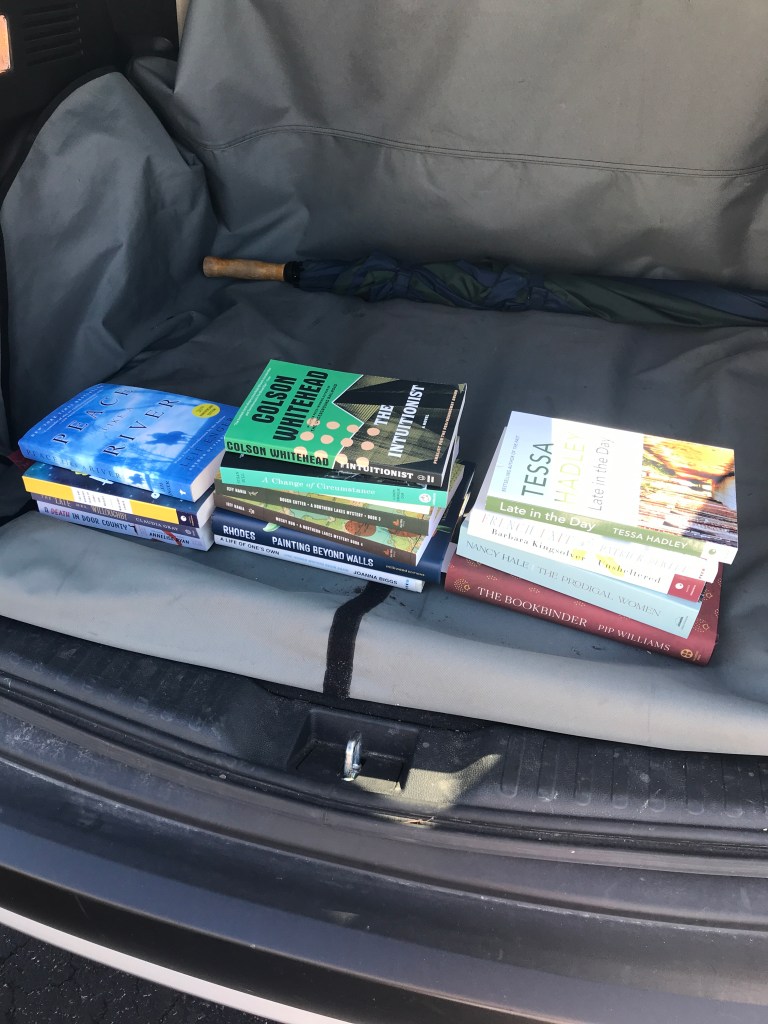
Bruce did well, too, as you can see from the pile in the trunk.

Any wild cards in your reading life? I would love to know.

Book Report: Maud Martha by Gwendolyn Brooks

July 27, 2023

In 1972 or ’73 I taught an English class at Webster Groves High School called “The Outnumbered.” I assume I was assigned that class because I was the youngest, least experienced member of the English department, and the chairs of the department thought I might relate to the “nontraditional” content more than some of the other teachers. In reality I was a white privileged woman who had received a classical English education, but I dug in and was determined to teach “relevant” material to my integrated classes in that St Louis suburb.

I remember introducing this poem by Gwendolyn Brooks.

We real cool. We
Left school. We

Lurk late. We
Strike straight. We

Sing sin. We
Thin gin. We

Jazz June. We
Die soon. 


I wish I could remember if there was any discussion about the poem, but I imagine that some of my students who had escaped inner city life knew much more about the meaning of this poem than I did. Over the years I read other poems by Gwendolyn Brooks and her famous counterparts like Langston Hughes and later one of her students, Nikki Giovanni, and I remember reading her children’s book, Bronzeville Boys and Girls, but I remember the illustrations by Faith Ringgold more than the words. I knew she was famous and celebrated. In fact, she was the first Black woman to be given the Pulitzer Prize for Poetry (Annie Allen in 1950) and in 1985 she was the first Black woman to be named as the consultant in poetry to the Library of Congress (a role now known as poet laureate), and she was given the National Medal of the Arts in 1995. The list goes on….

Until recently, I had not read any of her novels, but a friend sent me Maud Martha (1953), a short book of only 180 pages, and I read it almost in one sitting–not just because it is short, but because the language, the rhythm of her sentences and the insights into the life of an African American woman in the ’50s was vivid, moving, and revealing.

But dandelions are what she chiefly saw. Yellow jewels for everyday, studding the patched green dress of her back yard. She liked their demure prettiness second to their everydayness; for in that latter quality she thought she saw a picture of herself, and it was comforting to find that what was common could also be a flower.

p. 2

My favorite chapter, perhaps, was”Kitchenette Folks,” which included descriptions of the people who lived in the building where Maud Martha, her husband Paul, and daughter Paulette lived. Marie “wore flimsy black nightgowns and bathed always once and sometimes twice a day in water generously treated with bath crystals…” or Clement Levy, a little boy. “Lewy life was not terrifically tossed. Saltless, rather. Or like an unmixed batter. Lumpy.”

There were also insights into black-white interactions.

Mrs Teenie Thompson. Fifty-three; and pepper whenever she talked of the North Shore people who had employed her as housemaid for ten years. ‘She went to hugging’ and kissin’ of me –course I got to receive it–I got to work for ’em. But they think they got me thinkin’ they love me. Then I’m supposed to kill my silly self slavin’ for ’em. To be worthy of their love. These old whi’ folks. They jive you, honey. Well, I jive ’em just like they jive me. They can’t beat me jivin’. They’ll have to jive much, to come anywhere near my mark in jivin’.’

p. 119

I know there is so much good contemporary fiction to read by persons of color, but consider spending time with a classic.

An Invitation

Have you read any “classics” recently? I would love to know.

A Request:

I am writing an article for one of my favorite publications about books and readers, BookWomen. http://www.bookwomen.net The topic is keeping a book journal and TBR lists. I would love to hear from any of you who keep lists of what you want to read and/or what you have read and any details about that process. Email me at nagneberg48@gmail.com