Book Report: December Reading? Not So Much

December 21, 2023

Last December I read at my usual rate of 10+ books. In fact, I read 13 books, including Demon Copperhead by Barbara Kingsolver and Lucy By The Sea by Elizabeth Strout, and a memoir by Frances Mayes, A Place in the World, The Meaning of Home.

This year I have read 3 books. THREE BOOKS! Granted those three, which are each books I have read and loved before, are hefty tomes, but THREE!!!! I intended to re-read another favorite, but after 100 pages I put it back on the shelf.

Before I reflect on possible reasons for this change in my reading, here are the three I did read –re-read.

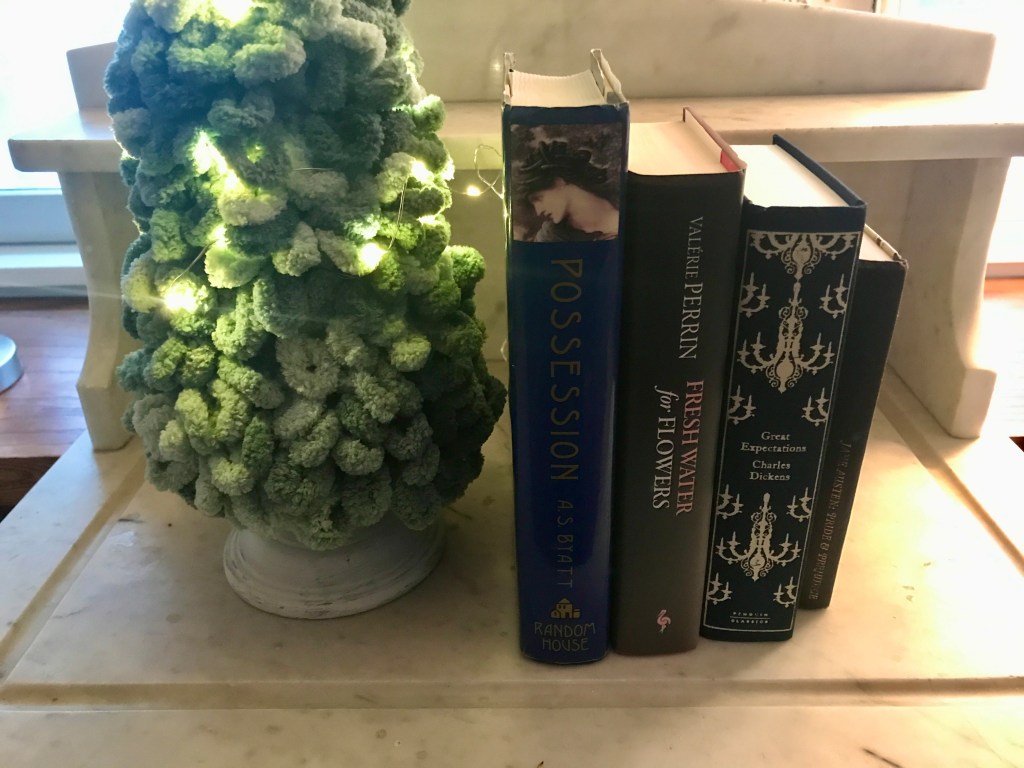
  • Pride and Prejudice by Jane Austen. I am not sure how many times I have read this book, but what I do know is that I will read it again and again. Maybe it will be my new Advent tradition and treat for myself.
  • Fresh Water for Flowers by Valerie Perrin. This is one of my favorite books, too. The main character, Violette, is a cemetery keeper in France. Love and death. Misguided love. Misunderstood love. Beautifully written.
  • Great Expectations by Charles Dickens. I remember reading this in 8th grade, and I think it influenced me to become an English teacher. I have not read this book since that time and now realize what I read must have been an abridgment, for at almost 500 pages this book was at times quite the slog. (Saying that feels so sacrilegious.) At other times I reveled in the language and the descriptions. I cheered Pip, the main character, but also pointed my finger at him in frustration. Dickens didn’t miss a human emotion in this book! One of the movies I have re-watched this month–while wrapping presents–was The Man Who Invented Christmas about Dickens writing A Christmas Carol. Delightful.

I started, but did not finish re-reading Possession by A. S. Byatt. I will at some point, but it felt too dense, too slow, and it demands more focus that I am able to give it at the moment. Instead, I am reading one of the mysteries by Anthony Horowitz, The Sentence Is Death, and that seems to be just what I need.

So what’s the deal with my reading this month? The usual Christmas activities and tasks have taken up the space of my usual reading time this year, I think. As I age I have less energy and in December I needed that energy in ways not normally necessary. When I haven’t been engaged with my Christmas list, I have been more inclined to watch a movie or stream a series than read a book.
Also, instead of devoting or immersing myself to a book, I am grazing.

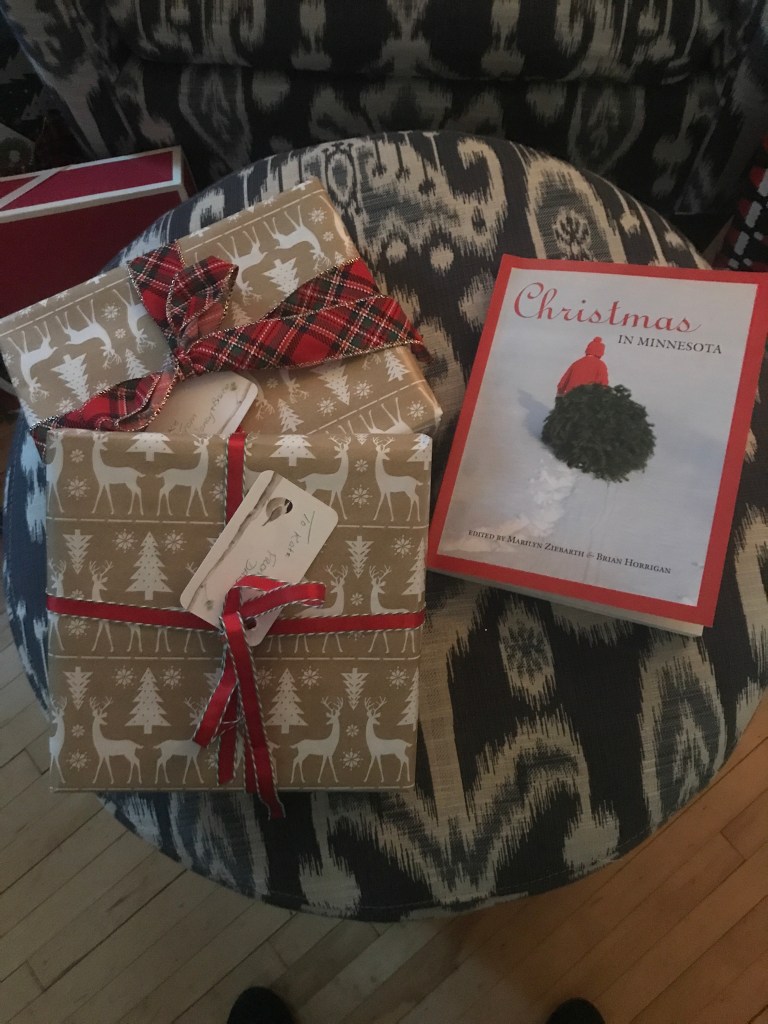
A friend sent me a wonderful anthology, Christmas In Minnesota, edited by Marilyn Ziebarth and Brian Horrigan, and it is a seasonal treasure. Stories and essays and memoir, along with nostalgic drawings and photographs. I can dip into Christmas moments, as shared by Minnesota writers–Garrison Keillor, Susan Allen Toth, F. Scott Fitzgerald, Sinclair Lewis, Jon Hassler, Faith Sullivan and so many more. Sometimes I read an offering from beginning to end, but other times I just open the book and read a paragraph or two wherever I land. I have no intention of reading this book from cover to cover, at least not this year, but instead this book is like an unexpected encounter with a friend in the grocery store or receiving a Christmas card from someone who has not been present in my life for quite some time.

Am I concerned that the number of books read this month has plummeted from my usual number? No, not at all. I can already feel myself looking forward to wintry days devoted just to reading. But I can also feel myself loosening my grip on the number of books I read and how much time I devote to reading. At this stage of my life, I have more freedom to make those decisions in the moment.

Have you taken time to read this month? Is there a book you are eager to read in the new year? I would love to know.

I am going to take a brief holiday break, but will begin posting again on January 2.

Book Report: Favorite Nonfiction Books Read in 2023

I am always more inclined to read fiction, rather than nonfiction, but oh my, there are memorable books on this list of favorites. I am aware that most of the books I list have not shown up on various media “Best of 2023” lists, and, in fact, many, if not most, of the books were not published in 2023, but this list reflects my personal taste plus the direction of my heart and my interests. I imagine your list is as individual as mine.

I have listed books in the order in which I read them–within the created categories. Browse at your leisure!

Part of my meditation time each morning is to read a book classified as spirituality or theology. All of these books, by the way, are housed in my garret where I write and meet with spiritual directees.

  • Liturgy of the Ordinary, Sacred Practices in Everyday Life by Tish Harrison Warren
  • Faith After Doubt, Why Your Beliefs Stopped Working and What To Do About It by Brian D. McLaren
  • Do I Stay Christian, A Guide for the Doubters, the Disappointed, and the Disillusioned by Brian D. McLaren
  • A Prayer in the Night, For Those Who Work or Watch or Weep by Tish Harrison Warren
  • Embers, One Ojibway’s Meditations by Richard Wagamese
  • Alive Until You’re Dead, Notes on the Home Stretch by Susan Moon
  • Enchantment, Awakening Wonder in an Anxious Age by Katherine May
  • Sacred Nature, Restoring our Ancient Bond with the Natural World by Karen Armstrong
  • Lost and Found, Reflections on Grief, Gratitude and Happiness by Kathryn Schulz
  • Why Did Jesus , Moses, The Buddha and Mohammed Cross the Road? Christian Identity in a Multi-Faith World by Brian D. McLaren
  • Things Seen and Unseen, A Year Lived in Faith by Nora Gallagher (Re-read)
  • Practicing Resurrection, A Memoir of Work, Doubt, Discernment, and Moments of Grace by Nora Gallagher. (Re-read)
  • Winter Grace, Spirituality and Aging by Kathleen Fischer (Re-read)
  • The Summer of the Great-Grandmother by Madeleine L’Engle (Re-read)
  • Wintering, The Power of Rest and Retreat in Difficult Times by Katherine May (Re-read)
  • Memoir as Medicine, The Healing Power of Writing Your Messy, Imperfect, Unruly (but Gorgeously Yours) Life Story by Nancy Slonin Aronie
  • Writing Begins with the Breath, Embodying Your Authentic Voice by Laraine Herring
  • The Hawk’s Way, Encounters with Fierce Beauty by Sy Montgomery (nature)
  • A Friend Sails in on a Poem by Molly Peacock
  • Bomb Shelter, Love, Time, and Other Explosives by Mary Laura Philpott (essays)
  • Leaving the Pink House by Ladette Randolph (memoir)
  • The Heartbeat of Wounded Knee, Native America From 1890 to the Present By David Treuer
  • South to America, A Journey Below the Mason-Dixon to Understand the Soul of a Nation by Imani Perry
  • One Hundred Saturdays, Stella Levi and the Search for a Lost World by Michael Frank
  • Catching the Light by Joy Harjo (memoir, poetry)
  • Fox and I, An Uncommon Friendship by Catherine Raven (memoir, nature)
  • You Could Make This Place Beautiful, A Memoir by Maggie Smith

What nonfiction books read in 2023 do you recommend? I would love to know.

Book Report: Favorite Novels of 2023—And More.

December 7, 2023

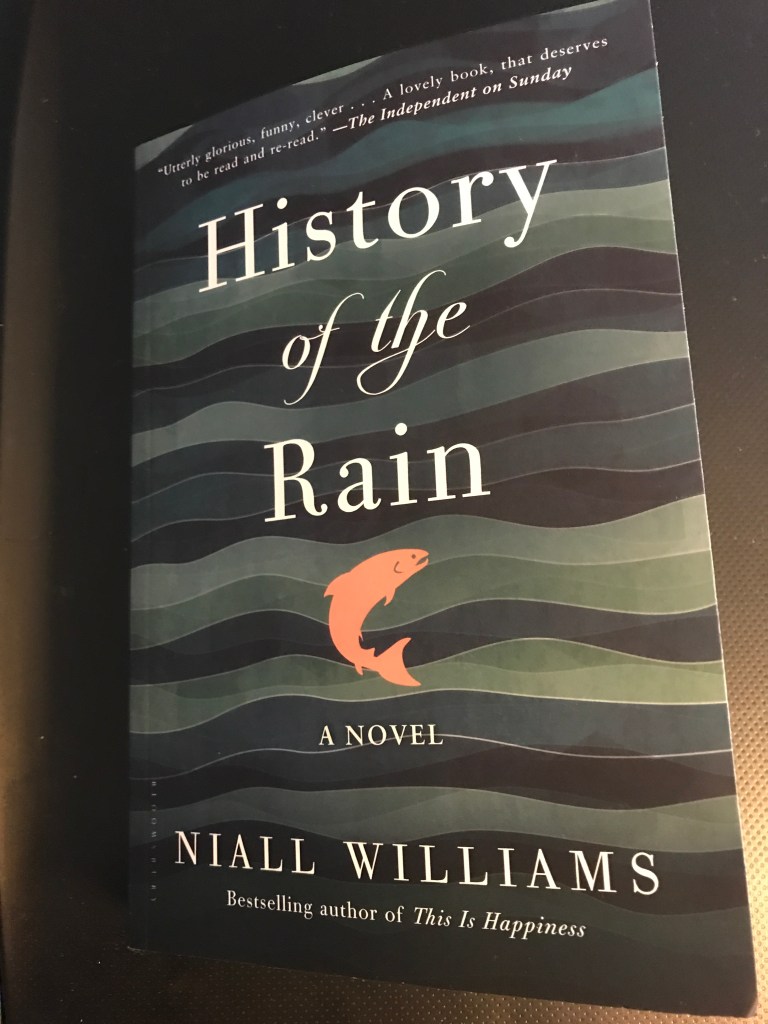
I was thrilled to find this earlier book (published in 2014) by Niall Williams at Northwind Books in Spooner, WI. I loved his most recent book, This Is Happiness (2019), and also an earlier book (1997) Four Letters of Love. And, no surprise, I loved this book, too.

As in his other books, The History of Rain is set in rural Ireland. I have never been there, unfortunately, but this book transported me there without a passport. Nineteen-year-old Ruth Swain relates her strange family history, even as her own story of being confined to bed with an unidentified and debilitating blood disorder is strange as well. What is not strange is the writing–always lyrical and poetic, sometimes comedic –I laughed outloud at times–but always warm, even as it teases. I shed a few tears along the way, too.

Ruth’s father was a poet, and she inherited all 3,958 of his books crammed into her bedroom where she sleeps in a bed shaped like a boat. I loved the bookishness of the narration, noting when a book is mentioned its specifics in the collection. “The Brothers Karamazov (Book 1,777, Penguin Classics, London)” or “The Prime of Miss Jean Brodie (Book 1,980, Penguin Classics, London). Books by Dickens are mentioned so often that I have decided to re-read this month one of my all-time favorites, Great Expectations.

A review in The Guardian says the book is “pure eccentric entertainment,” and that feels right. Some may get irritated by the wanderings, but I loved the quirkiness of it all. Yes, it is about life in County Clare and about her family. (Her mother doesn’t fall in love when she first meets the man she will marry, but she “falls in Curiosity, which is less deep but more common.” p. 176.) But it is also about fishing for salmon and about the rain that falls without end. And about stories.

We tell stories. We tell stories to pass the time, to leave the world for a while, or go more deeply into it. We tell stories to heal the pain of living.

p. 176

I underlined so many passages in this book. Don’t get me started. Instead, read the book and decide for yourself what to underline.

My plan this month is to re-read some favorites. The only exceptions will be if a book I have requested from the library becomes available. After all, let’s not be rigid when it comes to our reading!

I started the month re-reading Jane Austen’s Pride and Prejudice for the ____ time. I have lost count, but never lose interest or delight. Now I want to re-watch the various film versions of this classic. Re-reading P&P may become my new Advent tradition.

Now I am re-reading Fresh Water for Flowers by French novelist Valerie Perrin. How could a book set in a cemetery be so charming? Well, take my word for it, it is! And it is moving and revealing about the many ways we love.

I intend to re-read Great Expectations by Charles Dickens and also Possession by A.S. Byatt this month, but who knows what book distractions I will encounter as the month progresses.

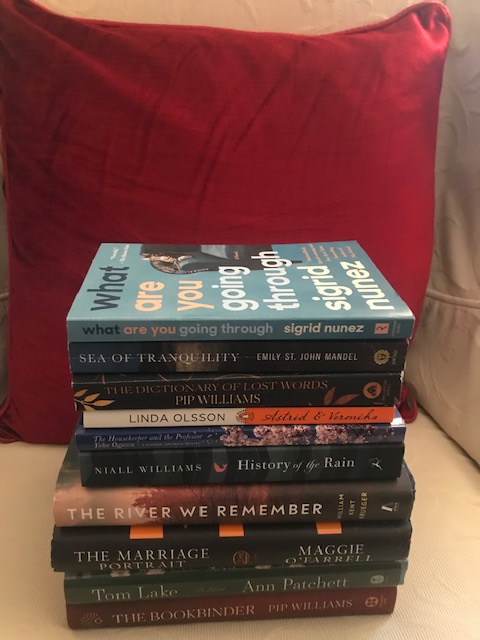
I read a lot of fiction. Out of the 99 novels I read in 2023, here are my top 25. However, if I sat down and listed my top favorites on another day, the list might look different, for I read very few books I didn’t like. I think I have mentioned this before, but I quickly discard a book if it doesn’t hold my attention in the first few pages or if I don’t think it is written well–or if I am not in the mood. Therefore, what I read I generally like.

For descriptions/summaries/evaluations of my favorites, I’m afraid you, dear reader, will need to do some of your own work. I have listed my favorites in the order in which I read them and I have written about them in my Thursday Book Report posts.

Now for the list. May I have a drumroll, please?

  • The Marriage Portrait by Maggie O’Farrell
  • Our Missing Hearts by Celeste NG
  • Gone Like Yesterday by Janelle Williams
  • The Woman in the Library by Susan Gentill
  • The Island of Missing Trees by Elif Shafak
  • What Are You Going Through by Sigrid Nunez
  • The White Lady by Jacqueline Winspear
  • Still True by Maggie Ginsberg
  • I Have Some Questions for You by Rebecca Makai
  • Hello Beautiful by Ann Napolitano
  • Astrid and Veronica by Linda Olsson
  • My Antonia by Willa Cather (for the 3rd time)
  • The Whalebone Theatre by Joanna Quinn
  • Homecoming by Kate Morton
  • Horse by Geraldine Brooks
  • The Postcard by Anne Berest
  • The Half-Moon by Mary Beth Keane
  • The Housekeeper and the Professorbby Yoko Ogawa
  • Sea of Tranquility by Emily St John Mandel
  • The Dictionary of Lost Words by Pip WIlliams
  • The Bookbinder by Pip Williams
  • Tom Lake by Ann Patchett (Perhaps my TOP FAVORITE)
  • The River We Remember by William Kent Krueger
  • So Late in the Day by Claire Keegan
  • History of the Rain by Niall Williams

What’s missing? Well, there aren’t many books by men. Also The Covenant of Water by Abraham Verghese, even though it is a major favorite of many, is a book I liked, but didn’t love. Lessons in Chemistry is not on the list because I haven’t read it yet, but at some point, I will. There is no new Louise Penny listed because there was not a new LP in 2023! Boo! And I am embarrassed to say there aren’t many books written by people of color on the list–I read more than the list indicates, but, alas, they aren’t among my very favorites.

So that’s it!

What were your favorite books of 2023? I would love to know.

I will list my favorite 2023 nonfiction books in my Book Report post on Thursday, December 14.

Book Report: November Summary

November 30, 2023

One can read more when not fixing Thanksgiving dinner. (My husband and I enjoyed our Thanksgiving dinner at a favorite restaurant while our St Paul family was traveling. We even had some leftovers to bring home.) I must be honest, however, about the number of books I read this last month.

Several books I read this month were less than 200 pages. I didn’t set out to read short books, but several rose to the top of the pile.

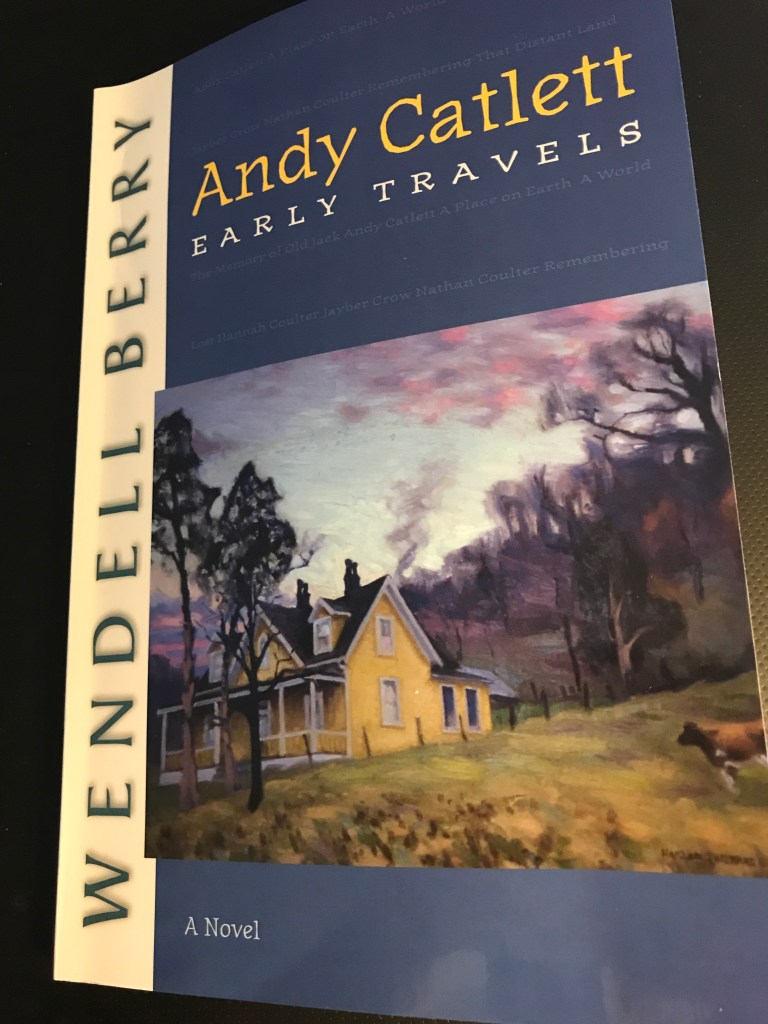
  • Andy Catlett, Early Travels by Wendell Berry (fiction) 141 pages. See my review in my November 16th post.
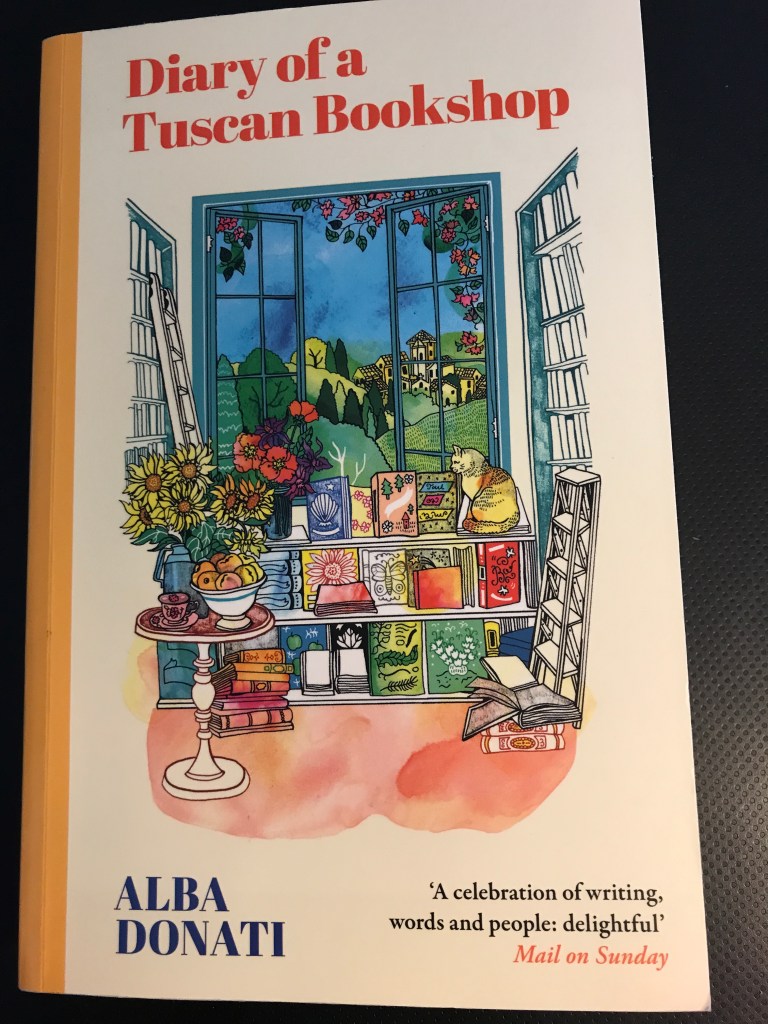
  • Diary of a Tuscan Bookshop by Alba Donati (nonfiction) 193 pages. Also in my November 16 post.
  • The English Understand Wool by Helen DeWitt (fiction) 69 pages. Ann Patchett is wildly enthusiastic about this book, so how could I resist, and I did love it–and even read it twice. This book is part of New Directions publishers’ Storybook ND series, which publishes books that offer “the pleasure of reading a great book from cover to cover in an afternoon.” Love that! The book (story?) is described as a “modern morality drama” about a seventeen year old girl raised in Marrakech by a French mother and English father. The predominant theme in her life, as emphasized by the woman she knows as her mother, is to avoid mauvais ton or “bad taste.” The truth of her life is revealed, and she is confronted by the “publishing sharks of New York city.” Read it!
  • So Late in the Day by Claire Keegan (fiction) 118 pages. I love each book I have read by Irish writer Keegan (Foster and Small Things Like These). She writes with such clarity that one is almost fooled, thinking each story is simple. But oh there is so much going on below the surface, in the internal lives of her characters. So Late in the Day is the title story in this book of three short stories. The other two are The Long and Painful Death and Antartica. The book is small and would fit easily in a favorite reader’s Christmas stocking.
  • The English Teacher by Lily King. I wasn’t sure how I would feel about this book by the end or what I wanted the ending to be. The English teacher is Vida Avery, who is a stellar teacher–until she isn’t. She teaches at a private school and has a quiet, private life with her teenage son, Peter. Unexpectedly, she marries, a recent widower with three children, and this new status opens her to an earlier trauma in her life.
  • Two books in the Lane Winslow mystery series by Iona Whishaw. #3, An Old, Cold Grave and #4, It Begins in Betrayal. Set in Canada, post WWII, Winslow is happy to be away from her life as a British spy, but at the same time she becomes involved as an unofficial detective when murder occurs in her small village. The 4th in the series takes place mainly in London, however, when her romantic interest, Canadian Inspector Darling, is accused of a war crime. I will definitely continue reading this series.
  • The Door-to-Door Bookshop by Carsten Henn. See my review in my November 23 post.
  • Day by Michael Cunningham. I loved Cunningham’s earlier book, The Hours–loved the movie, too–but I must say I liked this book, but didn’t love it. I did like the structure of the book. One family, the same day of the year in three different years –2019, 2020, 2021–and how their lives change during the pandemic. There is no question that Cunningham writes beautifully, and I often stopped to re-read a sentence or paragraph, simply to enjoy the flow of the words, but I tired of the characters: Isabel, married to Dan, who is an old wannabe rock star hoping for a comeback, and Isabel’s gay brother Robbie, who lives with them, until they need the room for the two growing children in the family.
  • A Likely Story by Leigh McMillan Abramson. A good read. Ward Manning is a famous novelist, but seems to be losing his touch. Claire his wife dies suddenly and their daughter Isabelle discovers a novel written by her mother. Isabelle edits and finishes the novel, presenting it as her own, and the novel Underpainting, becomes a bestseller. Dysfunctional family!

Ward Manning has given his daughter the legacy of being his. Having him as a father was a biographical sparkler bright enough to light up the rest of her life. Even if she did nothing.

p. 76.
  • The Wind Knows My Name by Isabel Allende. In many ways this reads like a nonfiction book–about immigration into this country, but Allende’s narration kept me going. There were two main threads in this book that eventually were woven together. Samuel, an Austrian Jew, is separated from his family in 1938 and sent to England where he lived in a series of homes. He becomes a famous violinist who settles in California. The other strain involves a child, Anita, who is separated from her El Salvadoran mother. Serena, a social worker, and Frank, a lawyer take on her case –and you will have to read it to discover how it all comes together.

I just noticed the theme of Isabel (Isabelle) in this month’s reading!

Except for The Diary of a Tuscan Bookseller, the other three nonfiction books I read this month are all books I have read before.

  • The Summer of the Great-Grandmother by Madeleine L’Engle. This book is #2 in L’Engle’s Crosswicks Journal series, which includes #1, A Circle of Quiet and #3, The Irrational Season. I read #2 again because it deals with dementia, which at the point of history in which this book was written is referred to as senility, a term we no longer use. A number of people in our lives are suffering from forms of dementia, and I knew L’Engle would write honestly and compassionately about this disease. She refers to the Greek word, ousia, which means the “essence of being” — a helpful reminder as dementia is a disease of so much loss. After the death of the great-grandmother dies, L’Engle writes,

My memory of my mother, which is the fullest memory of anybody living, is only fragmentary. I would like to believe that the creator I call God still remembers all of my mother, knows and cares for the ousia of her, and is still teaching her and helping her to grow into the self he created her to be, her integrated, whole, redeemed self.

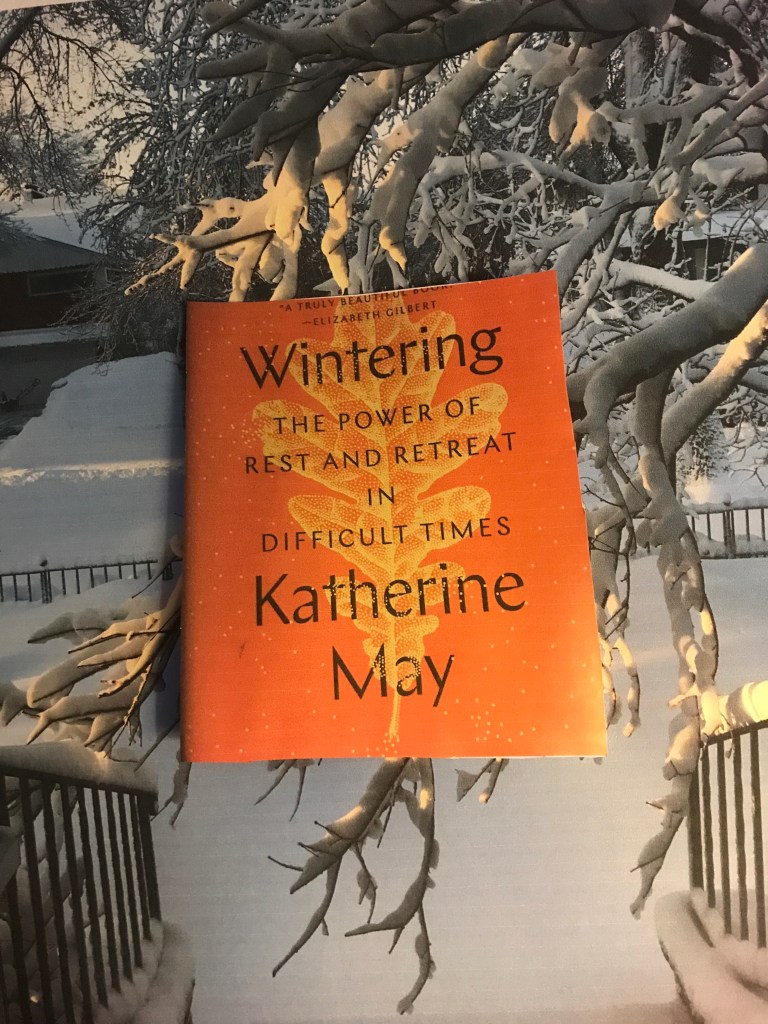
  • Wintering, The Power of Rest and Retreat in Difficult Times by Kathering May. I underlined more than the first time i read it, but that is often the case when re-reading a book. A couple quotes reveal what is true for me and my wintering times.

Everybody winters at one time or another; some winter over and over again.

p. 10

We may never choose to winter, but we can choose how. Some winters are big, some small.”

p. 13
  • Wayfaring, A Gospel Journey into Life by Margaret Silf. I read this book slowly throughout the whole month, usually only half a chapter during each of my morning meditation times. Silf invites the reader to use the imagination to meet the truths in the Gospel, but from the world of one’s daily life; to join Jesus in the Gospel stories and become part of those stories. She calls this “imaginative prayer.” One of the Gospel stories I continue to explore is the story of Martha and Mary when they invite Jesus to their home for a meal. I have seen myself as both Martha and Mary at different times, but this time as I read this story I was led to explore Jesus’s need for a “bolt hole,” from the world’s demands on him. Enlightening –and opened me to yet more dimensions. I expect I will use much of this material in the coming months in the contemplative writing group I facilitate.

My intention in the coming month is to re-read old favorites, but that can change depending on which of the library books I have requested become available. Another issue is deciding which of my favorites I choose to read. Stay tuned.

What books did you give thanks for in the last month? I would love to know.

Book Report: The Door-To-Door Bookshop by Carsten Henn

November 223, 2023

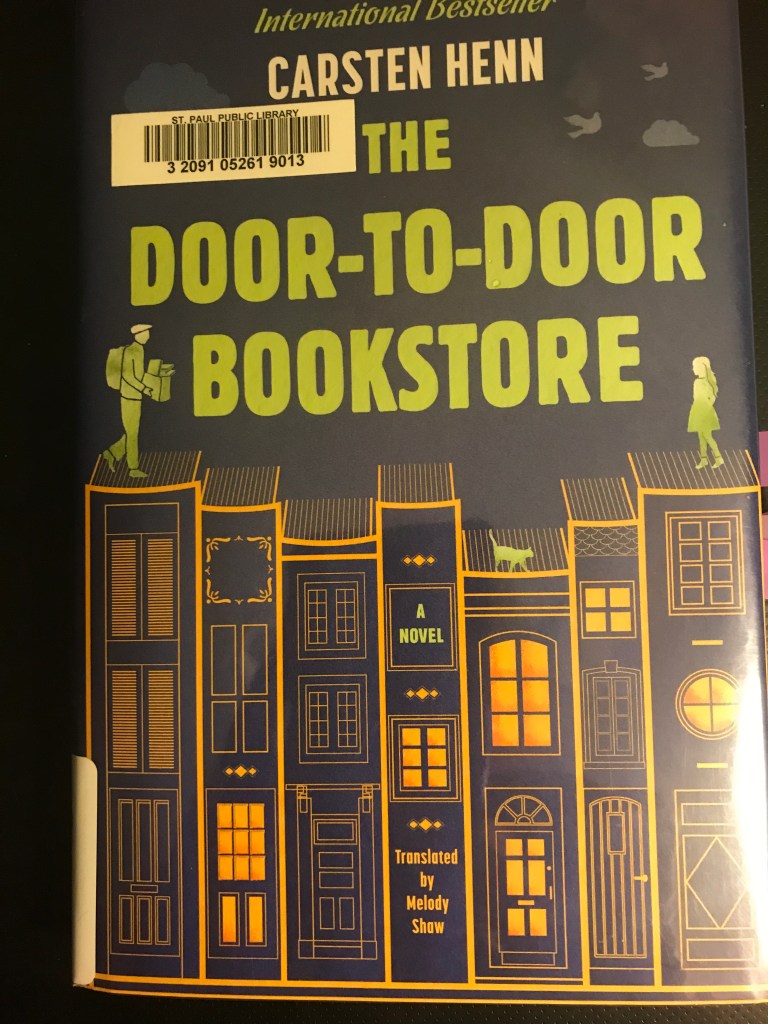
While everyone else is watching football or snoozing after eating too much turkey and all the sides, treat yourself to this gentle and charming book, The Door-to-Door Bookshop by Carsten Henn, translated from the German by Melody Shaw. However, since independent bookstores are not open today, stop at your favorite bookstore during the wild Friday shopping to buy this book as a Christmas treat for yourself.

Carl’s favorite task at the bookshop where he works is to pick out just the right books and deliver them to housebound readers. A young girl, Schaschas, begins to join him on his rounds, calling him a BookWalker. She is wise beyond her years and has opinions about the kinds of books his customers need, in order to make their lives better. Of course, there are villains along the way, especially the bookshop’s daughter who inherits the store and does not think delivering books is necessary. Clearly, she is not a book person.

Instead of describing some of the customers, here are few representative quotes about books.

Books with green covers were not to be trusted.

p. 16

Even when an extraordinary book ends at precisely the right point, with precisely the right words, and anything further would only destroy that perfection, it still leaves us wanting more pages. That is the paradox of reading.

p. 135

Then he read his favorite novel, The Uncommon Reader, a slim volume by a renowned author; he allowed himself to read it only once a year, looking forward to it each time like a connoisseur anticipating the first asparagus of the season.

p. 71

At various points in the book Henn compares readers to certain animals: hares who race through a book, fish who allow a book to carry them along their current, lapwings who jumped ahead to the ending, and tortoises who fall asleep often after a single page and take months to finish a book.

I think I’m a combination hare and fish.

Gentle and charming.

What books would you describe as gentle and charming? I would love to know.

Before sending today’s post I moved into the snug for my morning meditation time. This morning I re-read a section about the Thanksgiving holiday from Diana Butler Bass’s book, Grateful, The Transformative Power of Giving Thanks. She quotes from this prayer by Adam Lee:

May this sharing of food foster peace and understanding among us, may it bring us to the recognition that we depend on each other for all the good we can ever hope to receive, and that all the good we can hope to accomplish rests in helping others in turn.

May it remind us that as we reach out to others to brighten their lives, so are our lives brightened in turn.

p. 131

May today, however you choose to be in it, be a day of awareness of the blessings that abound in your life, but also a day of intention to increase the blessings for those who experience scarcity or fear or pain.

Thank you for reading my posts. I am grateful.

Two Book Covers I Love

November 16, 2023

Of course, what is inside the book is most important, but unless I am looking for a specific title or author, the book cover is what first engages me. These two are winners.

  • Andy Catlett, Early Travels by Wendell Berry. I bought this book at Ann Patchett’s book store, Parnassus Books. It wasn’t on my TBR list, but I have read and loved other books by Kentucky author Berry, including Hannah Coulter and Jayber Crow. This cover reminded me, as does some of the descriptions in the book, of our Sweetwater Farm in Ohio.

The book, which is part of Berry’s Port William series, is set in 1943 and young Andy Catlett takes the bus by himself to visit both sets of grandparents. Although much of the book has a nostalgic feel Berry also reflects on the role of racism in the community and among the people he loves. “Dick,” a Black man was a “hired hand,” and Andy reflects,” Whereas my grandfather’s life had been shaped by the effort to keep what he had, Dick’s had been shaped by the effort implied in not having.” pp. 24-25.

Also.

It was a circumstance that was mostly taken for granted. It was inexcusable, and yet we had the formidable excuse of being used to it. It was an injustice both accommodated and varyingly obscured not only by daily custom, but also the exigencies and preoccupations of daily life. We left the issue alone, not exactly by ignoring it, but by observing an elaborate etiquette that permitted us to ignore it…What is hardest to get used to maybe, once you are aware, is the range of things humans are able to get used to. I was more used to this once than I am now.

pp. 75-76

Much of what Berry describes reminds me of my Grandma and Grandpa Hansen’s farm in southern Minnesota and life in the early 50’s when I was growing up. Like a button box.

No worn out garment then was simply thrown away. When it was worn past wearing and patching, all its buttons were snipped off and put into the button box. And then when something old needed a new button, the button box provided. Grandma’s was an old shoe box better than half full of buttons of all sorts. it was a pleasure just to run your fingers through like running your fingers through a bucket of shelled corn.

p. 62

The book is short–only 140 pages–but so rich with descriptions of time and place and people. As I read it, I paused often to re-read passages–wanting to fully absorb the beauty of the writing. This is a book where plot is not the focus, but I didn’t miss it. Not at all.

  • Diary of a Tuscan Bookshop by Alba Donati. A friend gave me this nonfiction book, which she bought on a trip to the UK. What could be lovelier than to be remembered by a friend when she is traveling. If I had seen this book in a bookstore, no doubt, I would have bought it, for the cover is so pleasing. I want to spend time in that setting. Donati is a poet, and she opens a small bookstore in a small Italian town, Lucignana, which would have been enough of a challenge, but she opens it during the pandemic. The book is written in a series of diary entries, and I think it would have been better, if written in more of a narrative style. In a diary one tends to reference lots of information relevant only to the writer. I did love, however, the list of the day’s book orders at the end of each entry. Both Italian and English. An example:

Drive Your Plow Over the Bones of the Dead by Olga Tokarczuk, L’istante largo by Sara Bruner, White Fang by Jack London, The Handmaid’s Tale by Margaret Atwood, Loving Frank by Nancy Horan, Learning to Talk to Plants by Marta Orriols.

p. 69

I would love to know about the readers of those books. Why then? And how did they learn about them?

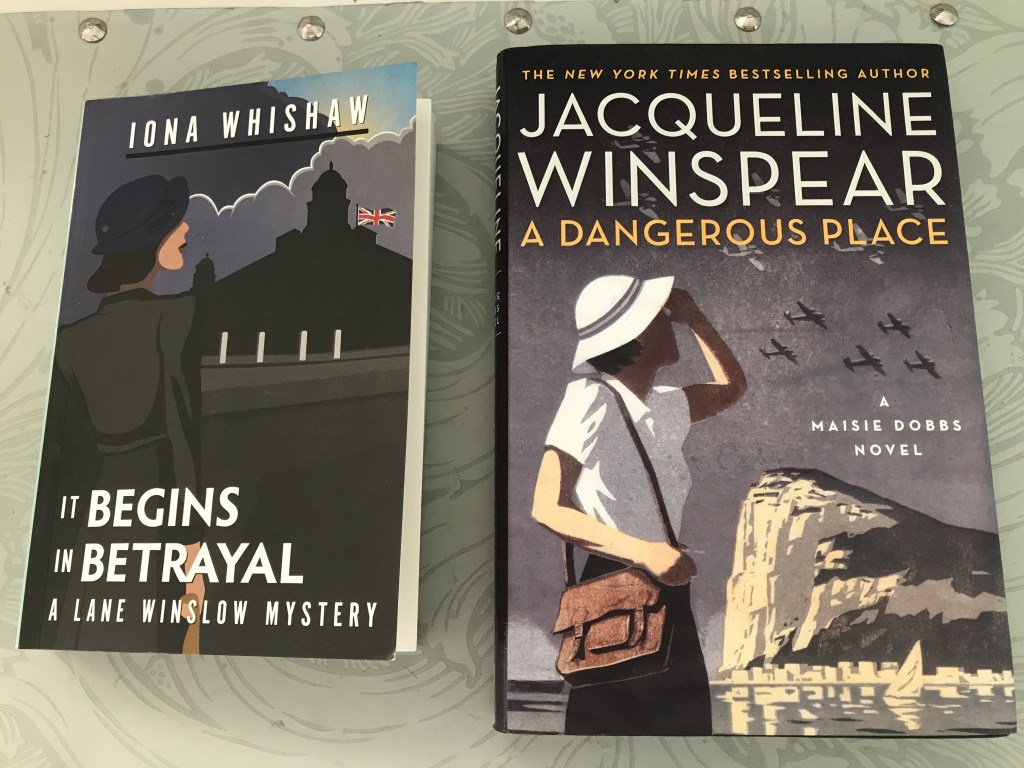
Right now I am reading #4 in the Lane Winslow mystery series by Iona Whishaw, and the covers in these editions remind me so much of the Maisie Dobbs series by Jacqueline Winspear.

Have you been influenced to read or buy a book based on its cover? I would love to know.

Book Report: Wintering by Katherine May

November 8, 2023

I don’t have much in common with Katherine May, the author of Wintering, The Power of Rest and Retreat in Difficult Times. She is much younger than I am and has a young son. She lives in the UK. She was diagnosed with Aspergers as an adult. But I identify with much of what she writes in this book.

The title alone spoke to me, for the idea of “wintering” totally seduces me. I am a winter person.

I bought and read this book when it was first published in 2020, but recently I felt tugged to re-read it. Actually, re-reading favorite books right now interests me more than reading books new to me, but that will be the topic of another post. Stay tuned.

Yes, she writes about the season of winter. The structure of the book follows the movement of the season beginning with September’s coming of winter to the almost spring of March.

For example she writes, “Winter opens up time,” and then shares her reading habit during the winter months.

In the high summer, we want to be outside and active; in winter, we are called inside, and here we attend to all the detritus of the summer months, when we are too busy to take the necessary care. Winter is when I reorganize my bookshelves and read all the books I acquired in the previous year and failed to actually read. It is also the time when I reread beloved novels, for the pleasure of reacquainting myself with old friends. In summer, I want big splashy ideas and trashy page-turners, devoured while lounging in a garden chair or perching on one of the breakwaters on the beach. In winter I want concepts to chew over in a pool of lamplight–slow, spiritual reading, a reinforcement of the soul. Winter is a time for libraries, the muffled quiet of book stacks and the scent of old pages and dust. In winter, I can spend hours in silent pursuit of a half-understood concept or a detail of history. There is nowhere else to be, after all.

p. 210

Excuse me while I take a time-out to rearrange my bookshelves.

I’m back.

“Wintering also refers to the emotions of being in a winter season of our lives. May writes, “Everybody winters at one time or another; some winter over and over again.” (p. 10) and “We may never choose to winter, but we can choose how.” (p. 13) She adds that some winters are big and some small.

This passage seems especially fitting when I think about the winter stage of my life, these elder years:

…you’ll find wisdom in your winter, and once it’s over, it’s your responsibility to pass it on. And, in return, it’s our responsibility to listen to those who have wintered before us. It’s an exchange of gifts in which nobody loses out. …Watching winter and really listening to its messages, we learn that effect is often disproportionate to cause; that tiny mistakes can lead to huge disasters; that life is often bloody unfair, but it carries on happening with or without our consent. We learn to look more kindly on other people’s crises, because they are so often portents of our own future.

pp. 122-123

I enjoyed the sections about wolves, wild swimming, saunas, the Sami people and reindeer, Santa Lucia, and the winter solstice. Winter is a rich season, indeed.

May is also author of Enchantment, Awakening Wonder in an Anxious Age (2023) and The Electricity of Every Living Thing: A Woman’s Walk in the Wild to Find Her Way Home (2018). Her podcast is How We Live Now and her newsletter is The Clearing. https://katherinemay.substack.com

An Invitation

How do you respond to the concept of “wintering”? I would love to know.

Book Report: October Summary

November 2, 2023

Three Nonfiction

Ten Fiction

Two Authors’ Backlists

Four books under 200 pages

One Book Re-read

One book set in Maine

Uncounted hours of Contented Reading

  • Fox and I, An Uncommon Friendship by Catherine Raven. A fox started showing up at Raven’s remote cottage in Montana. Raven, who is a biologist, begins reading aloud The Little Prince to him, and they develop a friendship. Friendship has been rare in Raven’s solitary life, and she contemplates what it means to have an “unboxed animal” as a friend. The writing is lyrical, but also true to her scientific background. (Sometimes more detailed than I needed.)

Fox was easier to understand than people because he couldn’t use words to deceive me. p. 257

When you spend time with your pet, they become more like you. When I spent time with Fox, I became more like him. p. 283

  • Winter Grace, Spirituality and Aging by Kathleen Fischer. I think I first read this book around the time I turned 50. No surprise–this book now holds much more meaning for my 75 year-old self. The chapter on older women as well as the chapter on loss were especially good. I am planning a session on spirituality and aging for an upcoming conversation group I facilitate for the Third Chapter, Spirituality as We Age group at our church, and I will use some of Fischer’s material.
  • You Could Make This Place Beautiful , A Memoir by Maggie Smith. First, it is important to know that this is the OTHER Maggie Smith–not the dowager from Downton Abbey! Smith is a well-known and highly praised poet, especially known for her poem “Good Bones.” The memoir is about the demise of her marriage, as well as her life as a mother and a writer. The format of the book is short entries, each with a headline, such as “A Friend Says Every Book Begins With an Unanswerable Question,” which she poses and repeats for herself, “Then what is mine?” One of her responses is “Where did it go?” Of course, she examines her marriage, but more than that or perhaps because of that she reflects on the nature of forgiveness, of moving forward, and about being whole, instead of a half. I loved this book.
  • I wrote about The Love Song of Queen Hennessy and also Maureen, both by Rachel Joyce in my October 12 post. Also, see the October 19 post for a review of Signal Fires by Dani Shapiro and the October 26 post to read about The Golden Hour by Beatriz Williams. I enjoyed all of these books.
  • My favorite novel read in October was William Kent Krueger’s The River We Remember. Perhaps you have read Krueger’s mystery series set in Minnesota featuring Cork O’Connor, but he has also written three stand-alone novels, Ordinary Grace, This Tender Land, and now The River We Remember. Krueger writes with such clarity and also with deep compassion for his main characters, creating the same compassion in me when a character is about to do something that clearly is not a good choice. I want to warn them, and I ache for the choices they make. That happens when a book is as well-written, as this one is. The story is set in southern Minnesota in a small town named Jewel. A man unliked in the community is found dead in the river. Accident? Suicide? Murder? Sheriff Brody does not want it to be murder knowing Noah Bluestone, a Native American will be accused.

Our lives and the lives of those we love merge to create a river whose current carries us forward from our beginning to our end Because we are only one part of the whole, the river each of us remembers is different, and there are many versions of the stories we tell about the past. In all of them there is truth, and in all of them a good deal of innocent remembering. p. 417

  • My least favorite book this month was Days at the Morisaki Bookshop by Satashi Yagisawa. Just ok, and if it had been longer, I probably would not have finished it.
  • I already mentioned the Rachel Joyce books. So satisfying!
  • Books by Linda Olsson. In April I read Astrid and Veronica and so loved it that I wanted to read Olsson’s other books: Sonata for Miriam, The Memory of Love, and A Sister in My House. Of those three my favorite was The Memory of Love, even though there were holes in the story–missing pieces and unanswered questions. Still I was enthralled with Marion, a physician in New Zealand who had a tragic childhood, and also a young boy, Ika, who becomes central to her solitary life. I had a right to my happiness, as well as my life. p. 170

For some reason several slim books were in the queue this month.

  • Maureen by Rachel Joyce
  • The Memory of Love by Linda Olsson
  • Days at the Morisaki Bookshop by Satoshi Yagasawa
  • Winter Grace, Spirituality and Aging by Kathleen Fischer

Winter Grace by Kathleen Fischer. I think I was far too young when I read this the first time!

Margreete’s Harbor by Eleanor Morse. I think I fell in love a bit with these characters. Margreete has dementia, and her daughter Liddie and her family decide to move from Michigan to live with Margreete in the family home in Maine. They all live together for years and manage amazingly well. I was surprised there was not more initially about that transition and sometimes I thought there were too many gaps in the plot, but I truly liked these characters–foibles and all. Also, I appreciated the time period, 1955-1968, my growing up years, and the references to the big events of those years, including the assassinations of Kennedy and Martin Luther King, Jr, and the Vietnam War.

She recalled her mother as a young woman, hanging laundry on the line, burning dinner, running the vacuum to bagpipe music. She was Rubenesque, with arms big enough for everyone, her laugh like an explosion. She blew into a room like wind, hooked rugs with large splashy flowers, turning the wool in her plump hands. That brave, outspoken, mischief-loving, no-nonsense mother had become an ant in high wind, her mind clinging to a straw. p. 18

It’s like watching a picture in a darkroom going backward in a developing tray–every picture is blurry, less contrast, heading towards blank. p 94.

And I am so grateful.

Did you experience hours of contented reading this month? I would love to know.

Book Report: The Golden Hour by Beatriz Williams

October 26, 2023

Thanks to an unexpected allergic reaction to the flu shot I received Friday morning, I didn’t do much of anything for most of the weekend. Instead, I read and dozed, dozed and read. Repeat.

The Golden Hour by Beatriz Willams was my companion on those days of not feeling at the top of my game. Williams is a prolific writer of historical fiction, which is not my favorite genre, but earlier in the year I bought as a Wild Card selection one of her other books, Our Woman in Moscow, and I enjoyed it. A good hot weather read, I noted in my book journal when I read it in July. The Golden Hour, which I bought at Ann Patchett’s bookstore, Parnassus Books, one of my Wild Card selections, was a good “not feeling well” read, although I must admit I became weary of the far too frequent and drawn out sex scenes. The main characters, apparently, didn’t talk to each other very much!

The book is set in two time periods–around the 1900s and then in the early 1940s, and the narrative shifts back and forth between those time periods. Is it my imagination or are more and more books using this technique? I wonder what it would have been like if the book had been written with a more chronological structure. It takes great skill to manage an alternating time line, and Williams does it well.

The more interesting story for me–and the one with more of a historical connection–was set primarily in the Bahamas when the Duke and Duchess of Windsor are in residence. He has been given the post of governor. Leonora Randolph, known as Lulu, is a journalist, and she locates to the Bahamas to write a gossip column about the Windsors. She becomes connected to them, and therein is part of the intrigue. Lulu falls in love with Benedict Thorpe, a botanist, but in that time of war, is, of course, more than that.

Thorpe is the son of Elfriede and Wilfred Thorpe, and their story is set in the 1900s. First married to a German baron, Elfriede suffers from post part depression, after the birth of her son, and is sent to an asylum. It is there she meets and falls in love with Wilfred who is there recovering from pneumonia. You can imagine the complications that follow.

As I write this, it sounds quite melodramatic, but the realities of war and conflict and the changing roles of women are well presented. I anticipated more of a historical connection than there was. It felt more like historical inspiration. As I said, however, this was a good “not feeling well” book, and now I will put it in our Free Library basket–for someone else to enjoy.

Can you recall a book you read when you weren’t feeling well? I would love to know.

Book Report: Savor AND Devour

October 19, 2023

In my Thursday, October 12, 2023 post, I set myself a goal to slow down when I read. To savor, rather than devour.

Now, after reading Signal Fires by Dani Shapiro, I’ve decided I can savor and devour at the same time.

I loved Shapiro’s memoirs, Hourglass: Time, Memory, Marriage (2017) and Inheritance: A Memoir of Genealogy, Paternity, and Love (2019) in part because she says a lot in a short number of pages. No 500 page tome for her. In fact, Signal Fires is only 219 pages long.

The length of a book is not enough to recommend it, however. No, it is what is written on those pages. How well do we, the readers, get to know the characters? Is the plot engaging? What about the setting and the structure? Now I am sounding like a writing teacher, and guess what, Shapiro teaches and writes about writing, too.

Back to the novel. Family ties. Family secrets. Two families and their lives over a span of time. In a less capable writer, the stories in this book would overflow into a much longer tale, but Shapiro reveals just enough, never wasting a word, and does that as she moves back and forth in time.

Some basics: Ben, a physician, and Mimi have two children, Theo and Sarah. The Shenkmans have one son, Waldo, a genius who is obsessed with the constellations in the sky, much to the irritation of his father who wants Waldo to be a “normal” kid. Two events influence the life of these families. One is a tragic car accident when Theo and Sarah are teens, and the other is the emergency delivery of Waldo by Ben in the Shenkman’s kitchen. I don’t want to say more, but here are two favorite quotes. The first is a reference to moving into a new house.

She doesn’t believe in ghosts, but ghosts are all around them…She has to believe that they’re all here. That they’ve made an indelible mark. That all their joys and sorrows, their triumphs and mistakes and hopes and despair are still as alive as they ever were. That no one ever completely leaves.

p. 37

…Ben Wilf has come to believe that we live in loops rather than one straight line, that the air itself is made not only of molecules but of memory; that these loops form an invisible pattern; that our lives intersect for fractions of seconds that are years, centuries, millennia; that nothing ever vanishes.

p. 126

I admit I devoured this book, but sitting this past weekend in the coziness of our house all decked for fall, I also savored it.

I am currently working on an essay about a recent discovery about myself as a writer. Actually, I am struggling with this essay. Perhaps I need to step away and re-read Still Writing, The Perils and Pleasures of a Creative Life. (2013) or at least what I have underlined.

About meditation and writing:

When I sit down to meditate, I feel much the same way I do when I sit down to write: resistant, fidgety, anxious, eager, cranky, despairing, hopeful, my mind jammed so full of ideas, my heart so full of feelings that it seems impossible to contain them. And yet…if I do just sit there without checking the clock, without answering the ringing phone, without jumping up to make a note of an all-important task, then slowly the random thoughts pinging around my mind begin to settle. If I allow myself, I begin to see more clearly what’s going on. Like a snow globe, that flurry of white floats down.

p. 11

It never gets easier. It shouldn’t get easier. Word after word, sentence after sentence, we build our writing lives. We hope not to repeat ourselves. We hope to evolve as interpreters and witnesses of the world around us. We feel our way through darkness, pause, consider, breathe in, breathe out, begin again. And again, and again.

p. 110

Yup, I need to both savor and devour this book.

“She reads books as one would breathe air, to fill up and live.” Annie Dillard

Any books you have savored or devoured lately? I would love to know.