Book Report: Nonfiction Stars–Anne Lamott and Doris Kearns Goodwin

May 25, 2024

I never think twice about buying the latest title by Anne Lamott. The only question is which independent bookstore will I be in when I first see it. This time I was in Excelsior Bay Books and quickly added Somehow, Thoughts on Love, Lamott’s twentieth book, to my pile.

I am an Anne Lamott fan.

I remember hearing her speak to a sold-out crowd in a chapel at Case Western Reserve University in Cleveland following the publication in 1999 of Traveling Mercies, Some Thoughts On Faith. I think I had read Bird by Bird, Some Instructions of Writing and Life (1994) by then, and was already hooked on her. Bird by Bird is one of those books I return to now and then, especially when I need a writing boost. Her words, realistic, encouraging, and down to earth basic, are better than caffeine and sugar, although, I hasten to add, Lamott does not discount the power of caffeine and sugar.

I have not read all of Lamott’s books. In fact, I am not sure I have read any of her fiction, but it is clear from the stack of books on my spirituality/theology bookshelves that Anne Lamott is one of my spiritual guides. That is the case, I think, because she brings humor and humility to the messiness of her own life. Never pretentious. Never hidden. She is generous in her ability to share her own struggles and her own ongoing learning and how others have played active roles in the twists and turns of her life on a labyrinth. I also love how even though she is a famous author who is beloved by so many, she continues to teach Sunday School in her small Presbyterian Church in Marin City, California. (She and President Carter have something in common.)

In this most recent book, Somehow, Lamott draws, as always, from her own experiences, the loves of her life and the ways she has been loved by others and feels the love of God. And sentence after sentence she opens herself in ways readers can understand.

  • P. 7. “God can never tell you not to love someone. God can only tell you to do a better job loving someone.”
  • P. 12 “We are all called to be the love that wears socks and shoes.”
  • p. 23. “We are the ones we’ve been waiting for.”
  • p. 28. “I’ve often been a kind of spiritual ATM for Tim when he has felt stuck and rattled by the powerlessness du jour. I listen and dispense pretty much the same advice every time: breathe, pray, seek wise counsel, be friendly with yourself, and so on. I bore myself blue sometimes, but that’s all I know.”
  • p. 101. “Life is such a mystery that you have to wonder if God drinks a little.”

In the chapter titled “Hinges” she describes hinges as something that fixes something in place, but also helps us open. She says “I don’t know” is a kind of portal, but it is also a hinge. Think about it. And while you are thinking you might keep in mind the acronym WAIT, “Why Am I Talking?” At some point in the book she seeks the advice of a friend about a challenging situation in her life. Lamott wonders if she should confront the person who is causing her pain and the friend says, “Not today.” Think about all the times in your life when that advice could have been beneficial. A pause.

I also appreciated her reference to these two quotes.

Another world is not only possible, she is on her way. On a quiet day I can hear her breathing. Arundhati Roy.

You can survive on your own. You can grow stronger on your own. You can even prevail on your own. But you cannot become human on your own. Frederick Buechner

Perhaps it is time to build your own Anne Lamott library. My collection sits near books by Elizabeth Johnson, Sue Monk Kidd, Buddhist Jack Kornfield, Brian McLaren, and others (Just think of the conversation they must have when I leave the garret!), and includes:

  • 1994. Bird By Bird, Some Instructions on Writing and Life
  • 1999. Traveling mercies, Some Thoughts on Faith
  • 2005. Plan B, Further Thoughts on Faith
  • 2007. Grace (Eventually), Thoughts of Faith
  • 2012. Help Thanks Wow, The Three Essential Prayers
  • 2013. Stitches, A Handbook on Meaning, Hope and Repair
  • 2014 Small Victories, Spotting Improbable Moments of Grace
  • 2017. Hallelujah Anyway, Rediscovering Mercy
  • 2018. Almost Everything, Notes on Hope
  • 2021. Dusk Night Dawn, On Revival and Courage
  • 2124. Somehow, Thoughts on Love

One more word from Lamott. She reminds us that “we all have an unknown expiration date.” p. 101.

Towards the end of Richard Goodwin’s life (died 2018), he and his wife Doris Kearns Goodwin, decide it is time to go through the many boxes of documents and other writing and memorabilia he had saved from his life serving as a speech writer and consultant for JFK, LBJ, Robert Kennedy, and Eugene McCarthy. He even wrote Al Gore’s concession speech. The boxes, which Goodwin called a “time capsule of the decade,” contained an inside view of the turbulent and pivotal 1960s and who better to write this memoir than Doris Kearns Goodwin? She, of course, is known as the author of many books about important figures in American history–Lincoln, LBJ, Eleanor and Franklin Roosevelt, the Fitzgeralds and the Kennedys, and others. The result is An Unfinished Love Story, A Personal History of the 60’s.

Yes, it is history, but it is also history from a personal vantage point, and I loved reading the interactions between the the couple, their different perspectives, her insightful questions, and his willingness to reflect. I was also fascinated by the insights into the process of being a speech writer–the collaborations, the ability to write in someone else’s voice and the restraint of the writer’s ego in favor of the person delivering the speech.

As a teenager in the 60’s I remember many of the events that are central to the book, such as the assassinations of JFK, MLK, Jr, and RFK. I remember the passage of the civil rights and voting rights acts and, of course, the Vietnam War. I graduated from college in 1970 and participated in a number of anti-war demonstrations–peaceful ones. Once again our country is facing scary turbulent times, and it helped me to read how brilliant and wise and caring individuals worked diligently to protect what this country wants to stand for.

Even if you aren’t a big history reader, put this one your list.

After reading both of these books, I had trouble settling into something new. That often happens after I have read something so compelling. During one evening I started and set aside several books. That doesn’t mean they aren’t worth reading or wouldn’t appeal to me at another time, but they just didn’t grab me. Eventually during my meditation time, I started reading How To Walk Into A Room: The Art of Knowing When to Stay and When to Walk Away by Emily Freeman and it is GOOD. More about this later, I am sure. For my fiction reading I am almost done with The Paris Novel by food critic/writer Ruth Reichl and am enjoying that.

Happy reading!

Do you ever have trouble finding the next book to read after finishing a book you loved? I would love to know.
Book Report: So Many Choices

May, 16, 2024

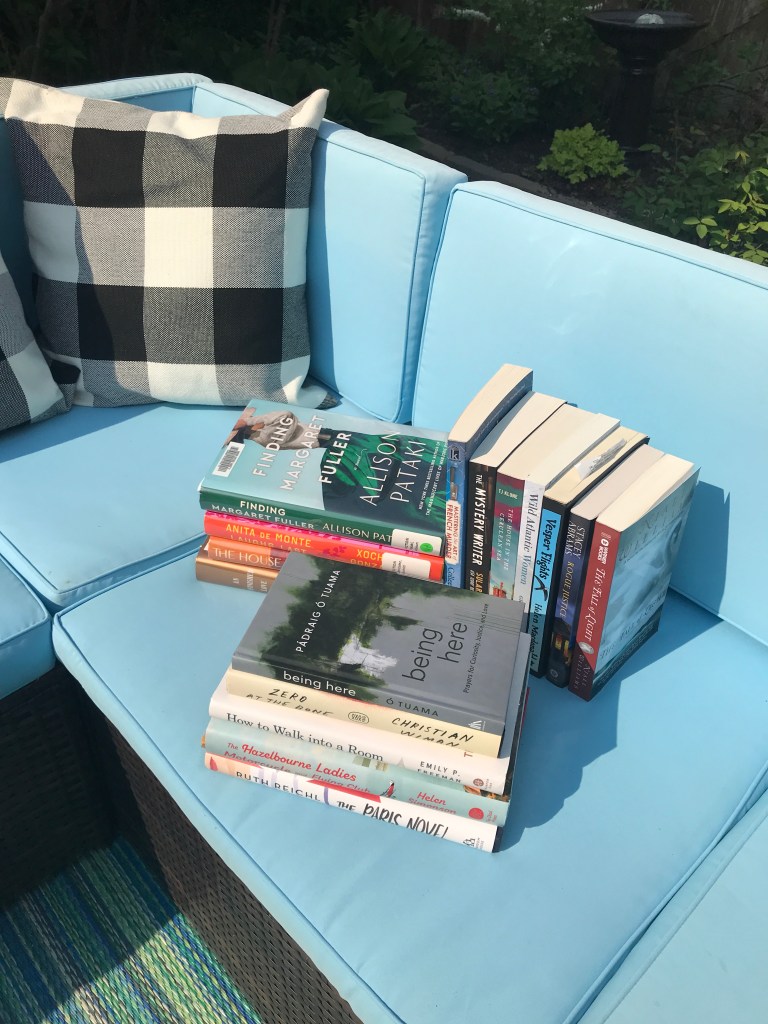
EEEK! My bookshelf of current to be read books overfloweth. My challenge is to accept that as a good problem to have –and not a time-limited contest or a requirement for completion. However, the piles of seductive choices are hard to ignore, and I am greedy. Perhaps it is time to declare some cabin time for myself–stay here at home but pretend I have gone off grid for a few days with books as my only companion. I’ll let you know how that goes!

Here are the books that are currently enticing me.

  • The House of Doors by Tan Tan Eng. Set in 1921 in Penang, Malaysia with the writer Somerset Maugham as one of the main characters.
  • Finding Margaret Fuller by Allison Partake. A historical novel featuring not only Fuller, who becomes a role model to Louisa May Alcott, but Ralph Waldo Emerson, Nathaniel Hawthorne, Edgar Allan Poe, Frederick Douglas, Elizabeth Cady Stanton and so many more.
  • Anita De Monte Laughs Last by Xochitl Gonzalez. I so enjoyed Olga Dies Dreaming by this author and am eager for her second novel, which is the story of an artist who died in 1985, but in the late 1990s is rediscovered by a young art student.
  • Like Happiness by Ursula Villarreal-Maura. Waiting for me at the library. The author says, “I wanted to write the story of a woman who sometimes wasn’t even the main character of her own life.”
  • An Unfinished Love Story, A Personal History of the 1960s by Doris Kearns Goodwin. I am almost done reading this excellent book that documents Goodwin and her husband Richard Goodwin sorting through his archives. He was a speech writer and more for John F. Kennedy, Lyndon Johnson, Eugene McCarthy, and Robert Kennedy. Fascinating.

For Mother’s Day I received The Paris Novel by Ruth Reichl and The Hazelbourne Ladies Motorcycle and Flying Club by Helen Simonson. Both are so tempting I can hardly finish writing this sentence. In the Reichl book, Stella receives an unusual inheritance–a one-way plane ticket and a note saying, “Go to Paris.” Helen Simonson wrote Major Pettigrew’s Last Stand, which I remember loving. Did I miss her The Summer Before the War? I need to look up that book. This new novel focuses on the changes for women at the end of WWI in England–the freedoms women gained are being revoked as men return home.

I also received a bookstore gift card–that’s like gold in my hands, but I am restraining myself at the moment.

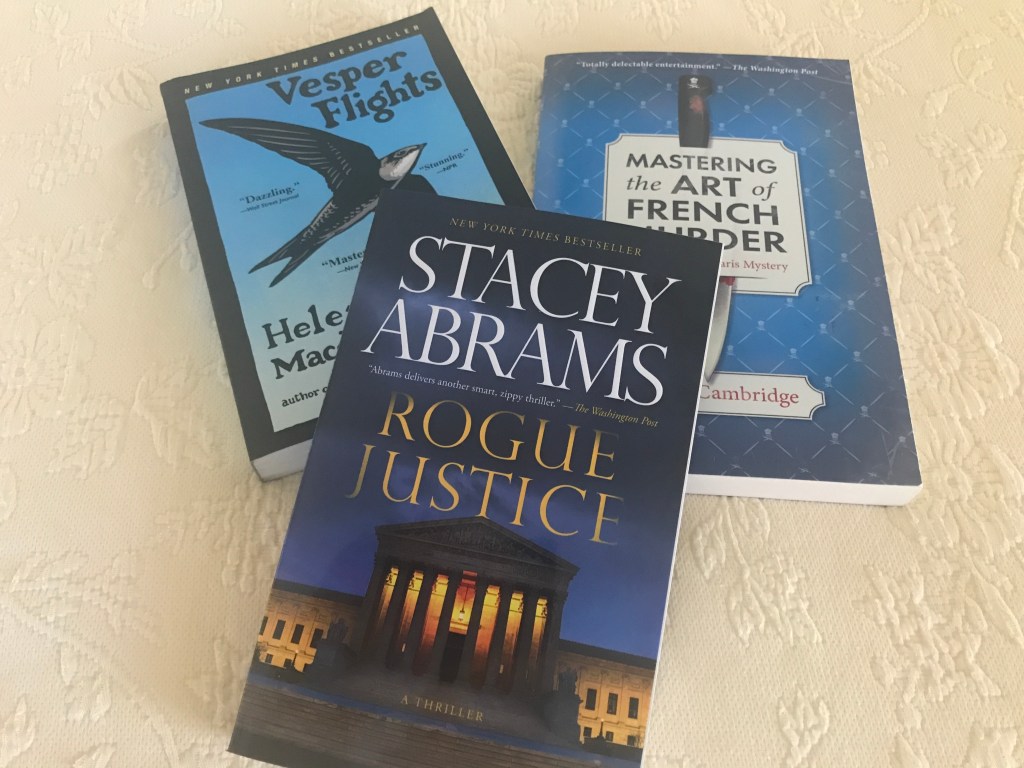
Also on the shelf are the books I received for my birthday, which I mentioned in an earlier post. but have yet to read: Vesper Flights by Helen MacDonald, Mastering the Art of French Murder by Colleen Cambridge, and Rogue Justice by Stacy Abrams. Perfect for cabin days!

  • Zero At the Bone, Fifty Entries Again Despair by Christian Wiman. I am not a person who often, if ever, feels despair, but I so respect Wiman’s insights and reflective voice, so I will read this, but maybe wait till winter.
  • How To Walk into a Room, The Art of Knowing When To Stay and When to Walk Away by Emily P. Freeman. Freeman is a podcaster and spiritual director who offers guidance during times of uncertainty. I have encountered this title in a variety of places—a sign!
  • Being Here, Prayers for Curiosity, Justice, and Love by Padraig O’ Team. Poet. Theologian. Host of Poetry Unbound. Obviously, I couldn’t resist.
  • Somehow, Thoughts on Love by Anne Lamott. I am almost done with Lamott’s latest book and am enjoying it more that her last couple books. Those felt repetitive to me–same books with different titles, but I love this one. I will write more about it in an upcoming post.
  • Books #8 and #9 in the Lane Winslow Mystery series by Iona Whishaw, Lethal Lesson and Framed in Fire are waiting for me. How restrained I am that I have not ordered #10, To Track a Traitor and #11, Lightning Strikes the Silence.
  • A Little Free Library find: Four mysteries by Marcia Muller. Has anyone read these? The copyright for the first in the Sharon McCone Mystery Series is 1977, Edwin of the Iron Shoes. McCone is a private eye In San Francisco. Oh for a rainy day!
  • Still awaiting my attention are four other bookstore finds: Wild Atlantic Women, Walking Ireland’s West Coast by Grain Lyons. The Fall of Light by Niall Williams. I am slowly reading all of his books. The House in the Cerulean Sea by T.J. Klune, which has often been recommended to me, but somehow I have not yet read. It is time. The Mystery Writer by Solari Gentill because I enjoyed her earlier book, The Woman in the Library. These are stand-alone mysteries, but alas, I recently discovered she has written a series, The Rowland Sinclair Series set in Australia in the 1930s and there are ten of them.

And guess what? Anne Bogel of “Modern Mrs Darcy” and her podcast “What Should I Read Next?” is releasing her summer reading recommendations list this week, which is sure to add to my TBR and my bookshelf. Sigh!

I can’t close without paying homage to short story writer Alice Munro, who died this week. I remember at some point in my life immersing myself in her books of short stories. Such a fine writer.

A story is not like a road to follow…it’s more like a house. You go inside and stay there for awhile, wandering back and forth and settling where you like and discovering how the room and corridors relate to each other, how the world outside is altered by being viewed from those windows. Alice Munro, 1931-2024

Happy reading everyone!

What’s waiting on your shelf? I would love to know.

Book Report: April Summary

May 2, 2024

James by Percival Everett.

I didn’t think I wanted to read this novel, which is a re-telling of Mark Twain’s The Adventures of Huckleberry Finn, but a copy was on the Lucky Day shelf at the library, and I decided to say “yes.” Everett’s version turned out to be my favorite novel read during April.

Told from the perspective of Jim/James we meet the Jim white people expect him to be and James, the person he really is. We know this, but this novel is a striking reminder of how speech and language is a tool to clarify and reinforce who we are and/or to hide and reinforce the person someone else wants us to be or thinks we are.

At one point James shares with enslaved children the basic rules for interacting with white people.

Don’t make eye contact. Never speak first. Never address any subject directly. Mumble sometimes so they can have the satisfaction of telling you not to mumble. p. 22.

  • The Little Village of Book Lovers by Nina George. There is so much to love in this novel about love–the transforming power of love and how books can be an aid, a vehicle, a tool in the discovery of love. One of the characters, Marie-Jeanne can see the mark of love, a glowing, shimmering light, and she becomes a matchmaker, even as a young girl. She awaits that shimmer for herself. I loved all the wonderful words about the power and glory of books, as well. If you loved one of my favorite books, Fresh Water for Flowers by Valerie Perrin, you will love this.
  • Ana Turns by Lisa Gornick. As Ana turns 60, she reflects on her life now. A physician husband who medicates to cope with back pain; a lover who demands little from her; a child who has realized they are trans; a mother who can only criticize her, a rich brother who is the one favored by her mother, and two nieces she adores. Lots of side stories, all beautifully told.
  • The Underground Library by Jennifer Ryan. This book is based on a true story about the establishment of a library in the London underground during WWII and is a good example of “Blitz spirit.” Juliet, the deputy librarian of a library, starts a book club and nightly readings in the underground after the library is bombed. Along the way she is supported by a wonderful array of women, and, of course, there is a love story, too.
  • Lessons in Chemistry by Bonnie Garmus. Am I the last person to read this book that has been on bestseller lists since its publication in 2022? The book focuses on the treatment of women and women’s views of themselves in the 1960s. When her husband dies in an accident, chemist Elizabeth is left to raise their daughter Madeleine (MAD), the most unusual and precocious kindergartner ever, for her reading skills alone. Work at a research lab is intolerable, and she gets a job on TV, a show called Supper at Six, in which she explains the chemistry of cooking and food. Such interesting characters plus a spirit of resilience, courage and love, and I laughed outloud often. I did tire, however, of the total separation of religion and science, but I thought even that softened towards the end.

I read only three nonfiction books in April, but each one was so worthwhile. I mentioned House Lessons in my April 25th post. The other two are:

  • The Eloquence of Silence, Surprising Wisdom in Tales of Emptiness by Thomas Moore. I think a stronger and clearer title would have been The Eloquence of Emptiness, for the book focuses more on the gifts of emptiness. The tendency is to think of emptiness as something negative or to be feared, but Moore explores how when we are too full, too busy, nothing unexpected can happen. “You can’t make fresh discoveries, and you will have few surprises and revelations.” p. 66. I underlined so much in this book and copied many passages into my journal. I have loved several books by Moore, including Care of the Soul, The Soul’s Religion, The Re-Enchantment of Everyday Life, and Dark Nights of the Soul. His book just prior to this one, Ageless Soul, was not one of my favorites, but this one truly resonated with me.
  • Birding While Indian, A Mixed-Blood Memoir by Thomas Gannon. Gannon is a professor of Native American literature at University of Nebraska Lincoln and a birder, who says birding is a kind of addiction for him. As he encounters birds, he also explores his heritage and his life as a Native person. Often the book was too detailed for me, a casual enjoyer of birds, but I was moved by the ways he connected his passion with his own struggles and background. Plus, I learned so much about how white colonialism has attempted and often succeeded in destroying the lives and culture of Native peoples. I made copies of several passages in this book, like the section on the Crazy Horse monument in South Dakota, in which he writes “that gigantic carving up of our sacred mountain is just another form of racism.” p.115. My husband and I spent time at the monument a couple years ago, and I would never have interpreted it that way, but I am now grateful for this perspective. He also reflects on one of my favorite books and authors, My Antonia by Willa Cather in which the narrator Jim views the Plains “as if he were face-to-face with a geographical nothing.” Burden sees no road, no fences, no creeks or trees or hills or fields. Gannon reminds the reader that “the land was teeming with the ‘countries’ of other species–and the tribes of other humans…”p. 37. Oh, how much I have left to learn and understand.

April 11: Float Up Sing Down by Laird Hunt https://wordpress.com/post/livingonlifeslabyrinth.com/3372

April 18: A Council of Dolls by Mona Susan Power; Wandering Stars by Tommy Orange. https://wordpress.com/post/livingonlifeslabyrinth.com/3365

April 25: An Irish Country Courtship by Patrick Taylor; A Match Made for Murder by Iona Whishaw; One Woman Show by Christine Coulson; and the memoir House Lessons, Renovating a Life by Erica Bauermeister. https://wordpress.com/post/livingonlifeslabyrinth.com/3425

I’m currently reading The Hunter by Tana French, and I am sure I will report on it in May.

What was memorable in your April reading life? I would love to know.

Fear of Not Having Enough To Read (FONHETR)

April 25, 2024

Packing for a trip, even one that just means being away from home a couple days, is never easy for me. Deciding on what clothes to bring is only half the problem. The other half is deciding what books to bring.

What if I don’t like a book I have packed? Then what will I read?

What if I finish a book faster than anticipated? What will I read then?

What if I have more time to read than anticipated? (A good problem to have, as far as I’m concerned.) Will I have enough to read?

For me, these are bigger questions than deciding how many changes of clothes to bring with me. The good news is that generally we travel in our car, so I have room for a stockpile of reading material.

My most recent book decision dilemma was our weekend in Door County.

After hemming and hawing, I selected 4 books for this three day vacation (Two of the three days were mainly in the car.) I had just read two serious literary fiction books, Wandering Stars by Tommy Orange and A Council of Dolls by Mona Susan Power (see April 18 post.) and I knew I needed something lighter.

  • An Irish Country Courtship by Patrick Taylor. I have read others in this charming series and know I will read others in the future. This one focuses on the “love life” of physician Fingel O”Reilly, as he courts Kitty. He has mourned the death of his wife for a long time, and Kitty is sensitive to his hesitancy about a new relationship in his life. In the meantime his associate has been fluffed off by a woman he thought was “the one,” and now he wonders if life as a village GP is enough for him. He ponders a decision.

In these short months he’d certainly had a fair sampling of the medical side of general practice, but he hasn’t been prepared for the village. Gradually, he’s come to learn it wasn’t simply a collection of houses, shops, a pub, and a couple of churches. It was an entity, and as an animal was the whole of its parts, so too was the village a many faceted, living organism. p. 287.

I’m grateful the author includes a glossary of Irish words and terms in the book. This time my favorite word is “harpled,” walking awkwardly, favoring a sore leg or back.

  • A Match Made for Heaven #7 in the Lane Winslow series by Iona Whishaw. Much of this book is set in Tucson, AZ, rather than Canada and for a very good reason. I don’t want to say why for those you of you who have not gotten this far in the series yet. This was perfect vacation reading. I will soon start reading #8.
  • One Woman Show by Christine Coulson. This was my “just in case” book. Just in case I finished both of the other books. This is a short, new novel, meant to be read in one sitting. The book documents much of the life of Kitty (1911-1998), but it is the structure that is most interesting. Her life is described as a series of art works, with an entry on each page.
BRIDE, AGED 19, 1926
Mrs. William Wallingford III (known as Kitty)
Collection of William Wallingford III (known as Bucky)
Ex-Collection of Martha and Harrison Whitaker

Considered the apex of early twentieth-century production.
Kitty is thoroughly polished, bound in white silk, and decorated with a clutch of pristine lily of the valley. The rest of her garniture joins her, but with deliberately less polish and packaging. The great and the good gather to see the exhibition and rave about the elegant lines and immaculate condition. Kitty glistens in the light of her new pedestal and foolishly considers herself now unbreakable.

Clever and thought-provoking.

  • The Eloquence of Silence, Surprising Wisdom in Tales of Emptiness by Thomas Moore. This books is one of my current devotion companions. Good food for reflection.

I selected my vacation book companions well–finished the Patrick Taylor, which I had started at home, and read in its entirety the Iona Whishaw mystery and read a couple chapters each day in Thomas Moore’s book. I saved One Woman Show and read it when we got home.

So well-done, Nancy. But then we discovered a bookstore new to us in Sturgeon Bay, which is at the entrance of the main part of the Door County Peninsula, and the book bag bulged. What a lovely and well-curated bookstore with a knowledgeable storeowner/bookseller, and you can bet we will stop there each trip we make to Door County.

Here are my selections:

  • The Mystery Writer by Solari Gentil. I read and enjoyed her earlier book, The Woman in the Library and so am eager to read this one. I also discovered that she has written a mystery series set in WWII, the Rowland Sinclair series. When I have completed all 11 of the Iona Whishaw books, I am sure I will investigate these.
  • An Irish Country Welcome by Patrick Taylor. This follows the one I just read, An Irish Country Courtship. The covers of these books, by the way, are so lovely.
  • Wild Atlantic Women, Walking Ireland’s West Coast by Grainne Lyons. To continue the Irish theme!
  • House Lessons, Renovating a Life by Erica Bauermeister. Bauermeister is the author of several novels as well, which I have not yet read, but this memoir is so beautifully written that I may add her other titles to my TBR. When I go to an independent bookstore I like to buy a WILD CARD book, meaning a book I have not heard of before, but for whatever reason it appeals. This was true for this book and the Wild Atlantic Women book, as well. Both my husband and I have now read House Lessons and loved it. Bauermeister and her husband live in Seattle, but decide to buy a ramshackle house in Port Townsend, WA. This is the story of that renovation, but also the life lessons learned along the way–the ways one’s life is a kind of ongoing renovation.

This weekend away was to celebrate my birthday and, no surprise, my favorite present is a new book. My husband is always nervous about buying me a book, anticipating I may have already read what he selects, but he did well. Now on my TBR bookshelf are these three–two mysteries and a nonfiction title.

  • Rogue Justice by Stacey Abrams
  • Mastering the Art of French Murder by Colleen Cambridge (Notice a similarity in title and cover to Julia Child’s masterpiece?)
  • Vesper Flights by Helen MacDonald. I loved H is For Hawk, but have not yet read this one.

Soon we will go on a road trip to visit our son and daughter-in-love in Cleveland and then spend a few days in Michigan, so the dilemma of what books to bring will resurface once again. Such a problem!

Do you take books on vacation? How do you decide what to bring with you? I would love to know.

I will post my April Book Report Summary on May 2.

Two Novels by Indigenous Authors: The Council of Dolls by Mona Susan Power and Wandering Stars by Tommy Orange.

April 18, 2024

Both books are powerful.

Both books are beautifully written.

Both books are stories of generational trauma and intergenerational healing.

Both books offer windows into a culture that is being rediscovered and treasured.

Both books reveal injustice and yes, evil.

Both books reference the Carlisle Indian Boarding School.

Both books follow the lives of multiple generations.

Both books are about institutional violence and oppression.

A Council of Dolls by Mona Susan Power

Mona Susan Power is an enrolled member of the Standing Rock Sioux Tribe and currently lives in St Paul. Perhaps someday I’ll see her in one of our coffee shops or the grocery store, and if I do I will tell her how important her book is, and how I hope she continues to tell the stories. Following the great success of her first novel, The Grass Dancer, Power experienced deep depression and learned she was suffering from P. T. S. D., as well. How grateful I am that she has found resilient reserves within herself to continue her writing

I’m sorry I didn’t buy this book, rather than read a library copy. Maybe I will buy it now, so I can read it again and underline favorite passages. Power says she is an “intuitive writer,” meaning the story and the characters come to her. Maybe that’s why the human and the doll characters seems so real.

The story follows the lives of three generations of Dakota girls/women: Sissy (b. 1961), Lillian (b. 1925) and Cora (b. 1880s) and their dolls. It is up to the reader to decide if the dolls are real, spirits with powers to heal and save the girls from further tragedy or are the products of the girls’ imaginations. I must admit, although my growing up couldn’t be more different from these women, I thought about the dolls in my life as a young girl and how they often brought me comfort and gave me a sense of purpose even.

Favorite Passages

Cora telling about her father says,

My father says that we should welcome all stories to see if they are worth remembering. “You can put ideas on and off just like moccasins. You can wear them and set them aside, hold onto those you find meaningful. Don’t be afraid of learning something beyond what we’re able to teach you. Even the wisest person doesn’t know everything, But it’s also important to preserve the ideas that make sense to you, even in the face of resistance–someone telling you that you’re wrong and only they know the truth. Such boasting is evidence of a fool, perhaps a dangerous one.”

p. 141

A last word from the dolls:

We’ve learned that healing the present doesn’t only clear waters flowing into the future, recovery also flows backward and alleviates the suffering of ancestors. So they can set down their tears and dark memories, their guilt and shame, their vengeance. And because Time is our relative, a flexible being that moves through every thought and memory, branching into a million rivers of possibility, healing even one of its streams will eventually heal the world.

p. 286

Wandering Stars by Tommy Orange

I admit it took me longer to read this book than Council of Dolls, and I’m sorry I didn’t wait longer after finishing “Dolls” to read it. By the end I just wanted the painful stories of addiction and loss to end, but perhaps that is the point.

Tommy Orange is an enrolled member of the Cheyenne and Arapaho Tribes of Oklahoma who was born and raised in Oakland, California, and this book often references the challenges of finding and knowing other Indian people in that part of the country. Wandering Stars is both prequel and sequel to his earlier much acclaimed novel There There. I suggest reading There There first, but it isn’t necessary. I am grateful for the family tree at the beginning of the book and referred to it often.

The book follows the descendants of the 1864 Sand Creek Massacre, moving through the generations to the present day. The references to Richard Henry Pratt, who became the founder of the Carlisle Indian Boarding School, both the cause and the result of so much evil, are harrowing.

“Stars” refers both to the family descendants in the Bear Shield and Red Feather families, but also to one of the characters who is shot at a Pow Wow.

One of the doctors, who wore a faded-ass baseball cap with a fish on it he didn’t think the guy should have been wearing on the job, told him the bullet shard in him was shaped like a star, like that was some cool shit. Then the doctor told him he should be grateful that it stopped moving, that an exit wound could be what kills you. The doctor said they would keep an eye on it, the star shard, because, he warned, they’ve been known to wander, parts of them getting into your bloodstream and poisoning you. And then the doctor, still apparently trying to comfort him about the bullet staying in, said it wasn’t bullets that killed but the path they took, This seemed to him like some dumb-ass bumper-sticker wisdom, like: Guns don’t kill people, people kill people, or, The journey is the destination.

p. 119

There were so many times in the book I wanted to shout, “Don’t do it.” An indication of how well-drawn these characters are. And so many times I cheered for these characters, as they rose above addictions.

I felt good talking to my son and eating the bread I made there in our kitchen, on our land, in our home. I had a family now and the drinking was behind me. I’d lived enough life, almost died enough times to know when a good thing came along, a thing you didn’t know could fill you right up, which only when it filled you let you know there’s been a hole in you before.

p. 34-35

I initially went to using as a way to feel the world, when I’d learned somewhere along the way to numb it. But I wanted to feel the world without having to use, and not simply become obedient to the cold demands of a cruel world, or to an equally cruel addiction.

p. 304

Such good books. Heavy and meaningful. And now I’m ready for something lighter, but still well-written. Stay tuned.

What emotionally hard to read books have you read? I would love to know.

Book Report: Float Up, Sing Down by Laird Hunt

April 11, 2024

This is not the book I intended to review today.

A visit to the library earlier this month yielded two surprise books on the Lucky Day shelf–both on my hold list and both with a large number ahead of me on that list. Needless to say, I grabbed both books, hoping there was nobody standing behind me ready to intimidate me into sharing at least one of them.

The two books were A Council of Dolls by Mona Susan Power and Wandering Stars by Tommy Orange. Both books are by contemporary indigenous authors. After reading (and loving) A Council of Dolls, I started reading Wandering Stars and realized I needed to read another book between those two books. In part, so I wouldn’t mix up the content–one in the other–but more to let each of those books breathe fully and for me to receive their breath. I promise you I will write more about each of these books in my April 18th post.

Sometimes after finishing a book that has fed me so completely, I need a palate cleanser kind of book–a cozy mystery, often. A book with a lighter touch. I wasn’t sure if Float Up, Sing Down, a book of linked short stories by Laird Hunt would fulfill that need, but I loved the cover, and it was in my pile of library books.

I don’t often read collections of short stories, but linked short stories are more appealing to me. Besides I so enjoyed Zorrie, Hunt’s 2021 novel, set in the same farming community in Indiana. Well….such good choice.

As I’ve written before, “quiet” novels, character-driven novels are my favorite kind of books, and that is true of Float Up, Sing Down. Each of the 14 chapters focuses on a single day in the life of each of the town’s residents. I can’t do better than the inside cover’s summary:

Candy Wilson has forgotten to buy the paprika. Turner Davis needs to get his zinnias in. Della told her mother she was going to the Galaxy Swirl, but that’s not where she’s really headed on her new Schwinn five-speed.

The residents of this rural town have their routines, their preferences, their joys, grudges, and regrets. Gossip is paramount. Lives are entwined. Retired sheriffs climb corn bins and muse on lost love. French teachers throw firecrackers out of barn windows, and teenagers borrow motorcycles to ride black roads..

Zorrie makes an occasional appearance, too.

Meet Horace, who “liked to know what the day had in store.” (p. 49) Horace had fought on D-Day, not that he liked to think about that time in his life, except for his encounter in Crete with Rose-Alice, whose Scottish archaeologist father had overseen excavations in Crete before the war. Now even in land-locked Indiana he can smell the sea. On this day, however, he needed to mow the lawn.

There had been quite a few in the community over the years who had been soft on him. Horace had always gone easy on the eyes, and old as he was getting, this was still true. Time wasn’t in any great hurry with him was the way Myrtle had put it. He wasn’t especially tall, but he was naturally lean, didn’t sweat too much, and looked good in a pressed cotton shirt. Like Gary Cooper but shorter, Alma Dunn had once said. He had taken her on three dates. She had gotten pretty worked up about things. He hadn’t married her or anyone else though. For a while there had been whispers of the nasty variety, but they hadn’t stuck. There hadn’t been anything for them to stick to.

p. 50

My favorite line is in the Myrtle chapter: “She was a good egg. It wasn’t just any old chicken that had laid her.” p. 158

Think Willa Cather, Wendell Berry, Elizabeth Strout. Think Our Town.

Do you need to read a “palate cleanser” after reading a particularly engrossing or “important” book? I would love to know.

Book Report: March Summary

April 4, 2024

Some of the books I read this month were surprises, meaning I was surprised by how much I liked and appreciated them. Other books didn’t surprise me at all, for I was quite certain they would not disappoint, and I would love them.

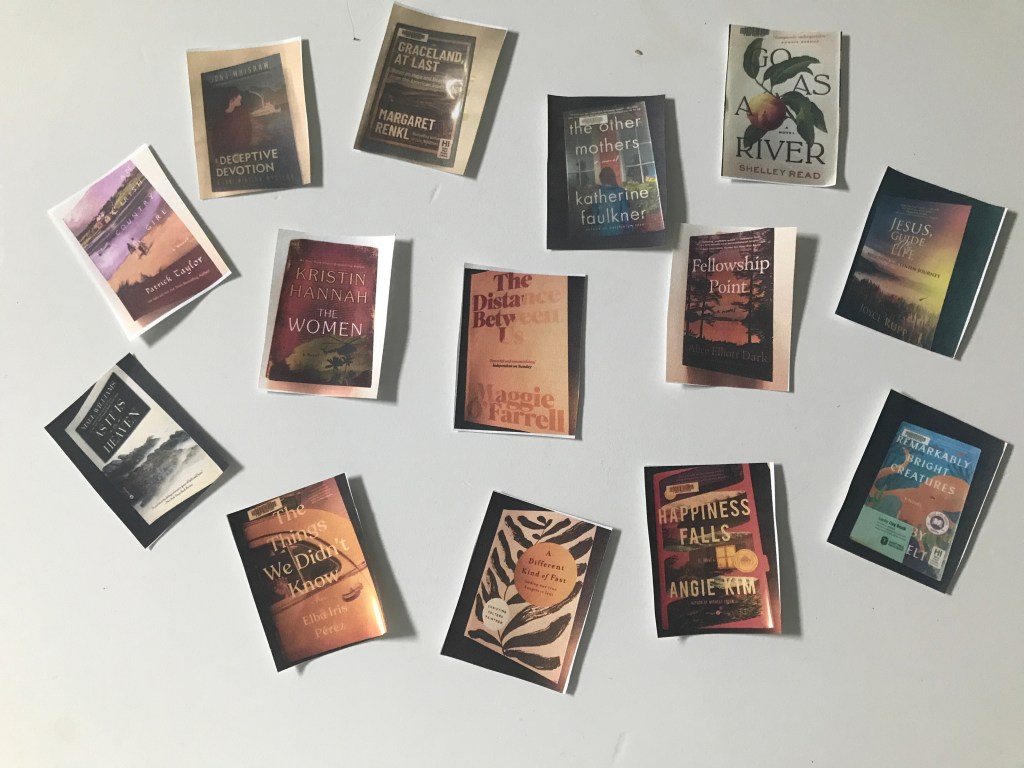
I’ve already reviewed some of my “No Surprise” books:

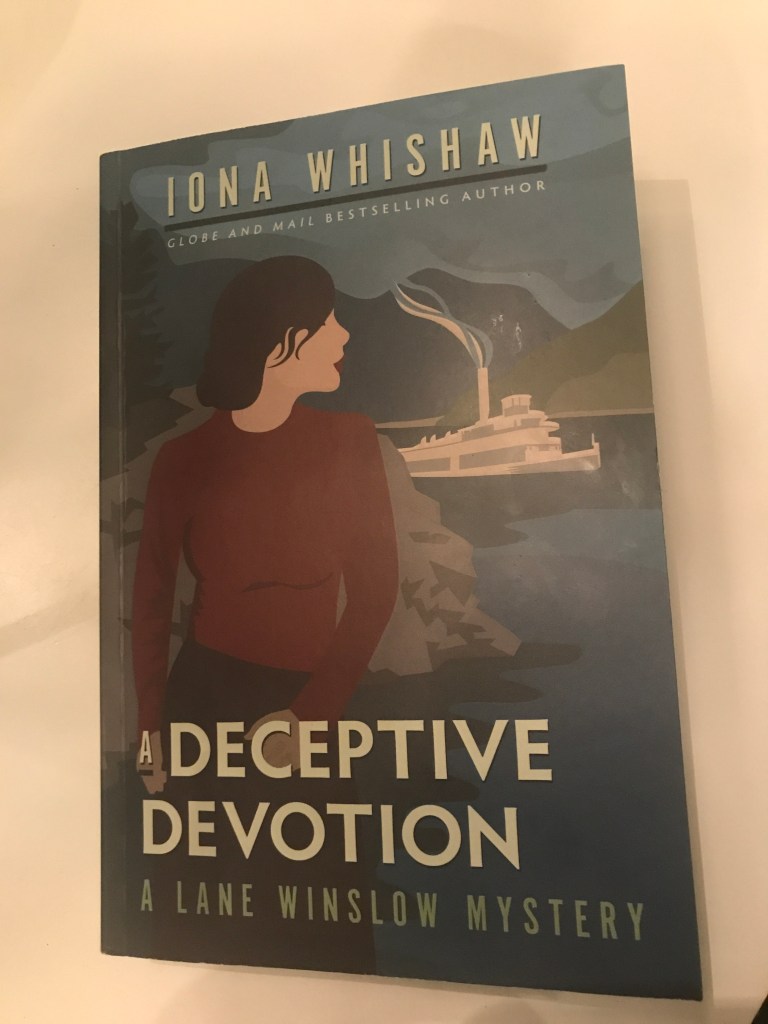
  • A Deceptive Devotion, #6 in the Lane Winslow Mystery Series by Iona Whishaw (See March 14 post.)
  • As It Is In Heaven by Niall Williams (See March 14 post.)
  • Graceland, At Last. Notes on Hope and Heartache From the American South by Margaret Renkl (See March 7 post)

Two other novels I read in March were also “No Surprise” books:

  • The Distance Between Us by Maggie O’Farrell. I have now read all of O’Farrell’s books and can easily say she is one of my favorite contemporary novelists. This title, one of her early books, is not my favorite of hers. However, how two seemingly separate stories, the story of Jake who grew up in Hong Kong and the story of Stella and her sister Nina who grew up in the UK, eventually entwine kept me reading. Now I can re-read my favorite O’Farrell books, including Hamnet and The Marriage Portrait, but also earlier ones, such as The Hand That First Held Mine and After You’d Gone.
  • An Irish Country Girl by Patrick Taylor. I have read two previous books in this series, An Irish Country Doctor and An Irish Country Village. I own An Irish Country Courtship and intend to read that soon. These books, set in Northern Ireland, are fresh air, a palate cleanser, a gathering of old and dear friends, stories shared around a cozy fire, and a touch of nostalgia of a time you may yearn for.

The two books I read as part of my Lenten devotion time were also no surprise, for over the years I have come to trust both of these writers for their wisdom and insight.

  • A Different Kind of Fast, Feeding Our True Hungers in Lent by Christine Valters Paintner. Each week of Lent is further subdivided into a practice for each day: lectio divina, breath prayer, visio divina, meditation with the desert elders, contemplative walk, imaginative prayer, and a ritual for the senses. As always, Paintner is so adept at engaging the readers in spiritual practices.
  • Jesus, Guide of My Life, Reflections for the Lenten Journey by Joyce Rupp. Such a good Lenten companion this book was. I admire how in two pages for each day, Rupp is able to impart an insight that leads to deeper reflection.

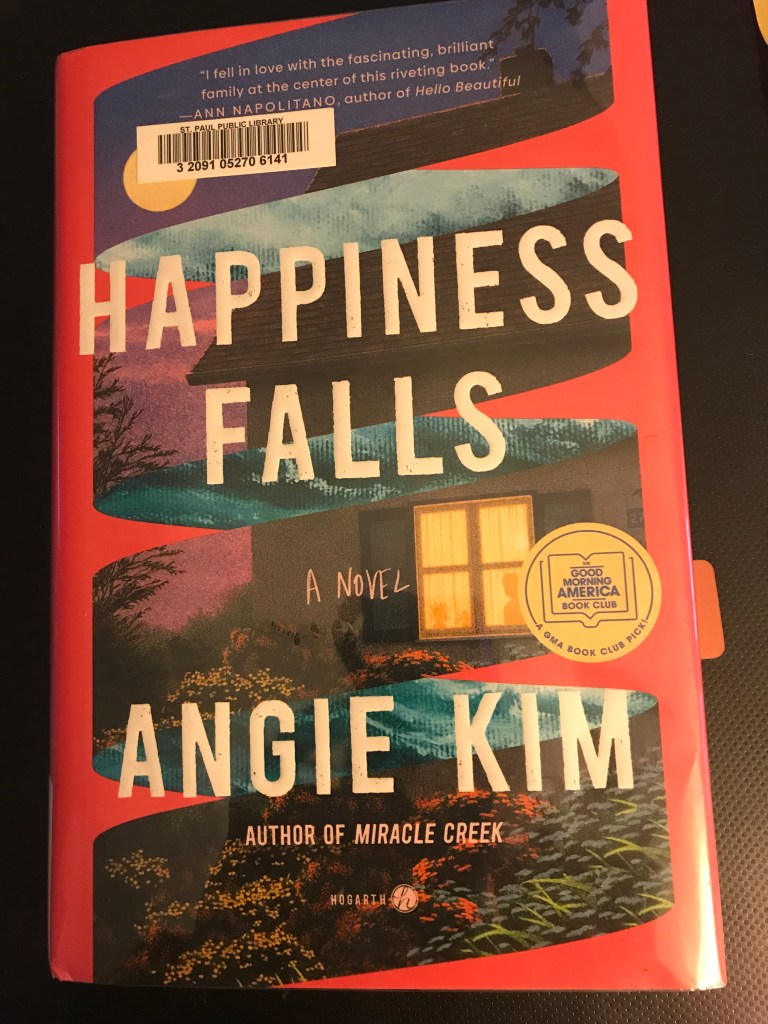
Three of the “surprise” novels I reviewed in one of my Thursday posts already: Go As A River by Shelley Read, Happiness Falls by Angie Kim (both on March 21), and The Women by Kristin Hannah (March 28). Today’s Book Report Summary, however, allows me to recommend all three of these books again.

Three others were pleasant surprises, too.

  • The Things We Didn’t Know by Elba Iris Perez. A fast read. A good read about a Puerto Rican family in the 1950s-1970s. Parts of the book are set in Puerto Rico and parts in Woronoco, Massachusetts, an enclave for Puerto Ricans who move to the mainland. Much of the book focuses on the conflict between remaining true to Puerto Rican values and assimilating into and adopting “white” values and culture.
  • Fellowship Point by Alice Elliot Dark. I loved this book. I repeat, I loved this book, even though I had a hard time keeping straight in my head the title–too close to Happiness Falls, which I also read in March. The stories are in no way similar to each other, however. First of all, I loved the setting in Maine, but I loved the characters even more. Agnes Lee is a children’s book author, but also has written anonymously a series for adults. Her closest friend is Polly, whose husband,a retired philosophy professor, never gives her much credit for anything. Both women are in their 80s and have summer homes in Maine and want to make sure the area is saved as a land trust and not developed. Polly’s sons have other ideas–that’s just one of the subplots. Mainly, however, this book is rich in character development. And such good writing

Writing is waiting. That’s the whole of it. If you sit in your chair not doing anything else for long enough, the answer will come. You do have to be in your chair, though, ready to write it down.

p. 570

But there was a last time. An unforeseen and uncomforted last time. I don’t remember it. That more than anything describes aging to me–the letting go of one activity after the next, with no fanfare. Just realizing later that the last time has come and gone.

p. 117
  • Remarkably Bright Creatures by Shelby Van Pelt. I resisted this book for quite some time. A talking octopus did not appeal to me, but many whose taste I trust recommended it to me, and I was surprised by its charm. I liked the main character, Tova, an older woman who cleans the local aquarium facility every night. That’s how Marcellus the octopus becomes her friend. Her life becomes entwined with Cameron, a young man who is a lost soul, abandoned by his mother and his father, unknown. Let go of your need for plausibility, and just enjoy this tale of friendship and connection.

The main character in The Other Mothers by Katherine Faulkner is convinced a nanny’s death was a murder, not accidental death. I was with the unfolding of the mystery till almost the end, but the last 25 pages or so felt both rushed and meandering. Kind of a mess. And the ending was both disappointing and frustrating and even immoral. Sorry, but I can’t recommend this one.

That’s it for March: 14 books. 11 fiction. 3 nonfiction.

Now it’s on to April.

What books read in March can you recommend? I would love to know.

Book Report: The Women by Kristin Hannah

March 28, 2024

Author of historical fiction, Beatriz Williams in her New York Times review said The Women by Kristin Hannah “gathers women into the experience with moving conviction.” The experience is the Vietnam War –as it was experienced by military nurses both in Vietnam itself, but also when they return to the United States. This is a novel that needed to be written, and Hannah has done it well, indeed.

Frances “Frankie” McGrath is inspired when a friend of her older brother about to leave for duty in Vietnam says to her, “Women can be heroes.” In spite of the lack of support from her family Frankie enlists and becomes an army nurse-fresh out of nursing school and totally unprepared for what she will face in Vietnam. But she learns fast and overcomes her fears. She saves lives. She honors those whose lives she cannot save. She plays hard, loves deeply, and creates a new perspective on who she is and is capable of being.

Once her tour of duty ends and she is back home she faces not only the protests against the war, but the disbelief of others, including vets, who insist there were no women in Vietnam. She struggles with how to live her life without her identity as an Army nurse, often making bad choices. She is sustained, however, by the friendships of other women with whom she served.

Hannah is a master both of research and an ability to translate that research into clear and evocative scenes. A friend who has read the book says it is a “flashback to our era, music, and clothing.” As a woman who was in her 20’s during those years, I recognize the name of every song and remember the bellbottoms once in my closet. I graduated from college in 1970 and so remember going on marches to protest the war and, of course, the references to Kent State, and Walter Cronkite and other people and events of the times.

I was overwhelmed and amazed by the graphic scenes of events in the evacuation hospital where Frankie worked. How could Hannah not have been an Army nurse herself! And all those powerful scenes were balanced equally effectively by down time in the O Club and other brief interludes when the wounded were not incoming. We see and feel all this through the eyes of a woman, just as we saw and felt the experiences of the soldiers in Tim O’Brien’s classic, The Things They Carried–one of my most memorable books of all time.

Now first let me say that I don’t demand perfection. To love and recommend a book doesn’t mean I have to love everything about a book.

I have not read all of Hannah’s books (and she has written many), but when I read The Great Alone (2017) I seem to remember feeling there were a few scenes too many of things going wrong or the character making bad decisions. I don’t recall that feeling when I read The Nightingale (2015), which I loved, and I have not read The Four Winds (2021), which is the book prior to The Women.

I didn’t feel there were too many illustrations of the ugliness of war and the heroics that took place over and over again, but I did feel once Frankie returns home that her struggles, which are all valid, could have been treated more concisely and still delivered the same point.

Oh, and the men in her life and how she responds to them….well, you read it and let me know what you think. And the ending… well, again, let me know what you think.

Yes. This novel is a well-written and vivid book of those Vietnam years. Even though I lived in those years, I confess I never thought about the powerful presence of nurses during the war, and for those who were not alive then, this book brings those years to life, a part of our history we must not forget. In recent years so many novels have been written about WWII, including The Nightingale, but Vietnam has been shoved into silence. The Women gives voice to those years, especially the women’s roles. Bravo.

What novels about a time in history have given you a new perspective or exposed you to something you did not know? I would love to know.

I just listened to episode 422 of the podcast What Should I Read Next? with Anne Bogel, and if you are someone who loves “quiet” books, I recommend listening to this episode. https://podcasts.apple.com/us/podcast/what-should-i-read-next/id1073499086?i=1000650473926

Two Notable Novels: Go As A River by Shelley Read and Happiness Falls by Angie Kim

March 21, 2024

Set on a Colorado peach farm, this book far exceeded my expectations. I enjoy family sagas, but often I don’t remember them beyond the last page. This one will stay with me–both for the excellent descriptive writing, but also because of the characters and their resilience and strength.

Victoria’s mother died in a car crash, and at age 17 she is left to run the household, which includes her hardworking and unsympathetic father, wild and mean and alcoholic brother, and a paralyzed war veteran uncle. She falls in love, almost at first sight, with Wilson Moon, a Native American, and this is not acceptable in racist 1948.

I am tempted to tell you more, but, instead, I hope you will read this debut novel.

There he stood and eyed me so long I thought I’d melt like chocolate in the last rays of sun reaching lost across the porch. He said nothing, but I felt as if he knew impossible things about me. He moved closer. I took my first deep smell of him, musky and sharp and strangely inviting, and stared for an instant into his bottomless dark eyes.

p. 15.

But it is often the small fateful twist that alters our lives most profoundly–the beckoning cry of a coal train whistle, a question from a stranger at an intersection, a brown bottle lying in the dirt. Try as we might to convince ourselves otherwise, the moments of our becoming cannot be carefully plucked like the ripest and most satisfying peach from the bough. In the endless stumble toward ourselves, we harvest the crop we are given.

p. 18.

I had chosen to meet on these shores because my rising wisdom understood that I must carry my whole past alongside the new space I had created in myself for hope.

p. 300.

I zoomed through this book. The basic story is unremarkable, a plot line that has been used many times: a father has gone missing. That’s where the similarities to other missing person stories ends. First, this is a biracial Korean American family. The father has become a stay at home Dad, which means his brilliant wife can pursue her career in linguistics. They have three children, 20 year old twins, John and Mia, and also Eugene, age 14, who is autistic and has a rare genetic condition, Angelman syndrome, and cannot speak.

Eugene returns to the house when only Mia is there. He is wild, out-of control, and bloody. The father does not return from their outing. As the investigation begins, the family wonders if the father has a secret life, and the police seem to think Eugene has harmed his father. LOTS of twists and turns, and the book begins to develop a true crime feel. In part that is because Mia, who is the story’s narrator, includes footnotes in the text, along with an occasional chart, as well as analyzing her father’s research into “happiness.”

The only thing that irritated me a bit about the book was frequent statements like, “If only I had known…” or “We would soon realize we should have…” or “it didn’t occur to me until later that…”

Even as the plot kept me intrigued, I was fascinated by the philosophical reference to the importance of language. For example, this footnote:

19 It’s a common mistake, saying verbal to refer to oral speech. It’s a pet peeve of mine when people say ‘verbal, not written,’ because written is verbal. So why do we call non speakers ‘nonverbal,” use the label ‘nonverbal autism’? It leads to the unwarranted assumption that those people are wholly without words. I’ve brought this matter up to people, and they dismiss it as ‘just semantics.’ But sometimes semantics matter. Words matter. They influence our thinking.

p. 229.

Kim has written another novel Miracle Creek, by the way, which received critical acclaim and a handful of awards. TBR anyone?

Is plot or character more important to you? I would love to know.

Book Report: Two Favorite Authors–Iona Whishaw and Niall Williams

March 14, 2024

Reading the next book in a series and another book by a favorite author feels like coming home. The refrigerator is stocked with my favorite foods and beverages, and the light is glowing by my favorite reading chair. This feels especially true if a recent read was less than satisfying, and I need “a sure thing.”

I can count on Iona Whishaw’s Lane Winslow Mystery series when I need a pleasing, not too heavy, but also not too predictable book. Set in post WWII Canada, former English spy Lane Winslow somehow becomes involved in intrigue and murders in picturesque Kings Cove. And Inspector Darling often needs her help, even when he doesn’t know it.

A Deceptive Devotion, the sixth book in the series, involves a mysterious older Russian woman looking for her missing brother. Lane, who speaks Russian becomes her host and her translator. Is this woman who she says she is? Complications build when a lone hunter is found murdered near by. Is there a connection between these two plot threads?

One of the things that is important to me when I read a series is that the characters continue to develop, and that is true in these books. Lane and Inspector Darling have evolved, grown since their first appearance in book #1. Plus, I love getting to know the other characters in the book, including Constable Ames, who often provides some comic relief, and Lane’s neighbors –the postmistress Eleanor and the Hughes ladies who are master gardeners, and a variety of others, who all care for Lane. And then there is the ongoing relationship between Lane and Darling.

This is not deep reading, but is perfect when I feel the need for distraction. While I wait for the next Louise Penny and the next Maisie Dobbs by Jacqueline Winspear how grateful I am to have four more in the Lane Winslow series available.

The first novel I read by Irish author Niall Williams was This Is Happiness published in 2019, and that led me to his first novel Four Letters of Love (1997), which I also loved. This past year I read History of Rain (2014). Again, another big love. Finally, I realized this writer never disappoints, and I need to read the rest of his back list.

I just finished As It Is In Heaven (1999). Yes, I loved it. Sorry to be so repetitive. The book grabbed me with its opening lines:

There are only three great puzzles in the world, the puzzle of love, the puzzle of death, and between each of these and part of both of them, the puzzle of God. God is the greatest puzzle of all”

p. 3

Stephen Griffin is a lackluster teacher who falls in love with an Italian violinist, Gabriella, the first time he hears her play. His father, Phillip, who continues to grieve the death of his wife and daughter in a car accident, realizes his son is in love as they play chess.

The magic begins. The miracles begin. And the writing takes my breath away over and over again.

I don’t want to say more, because I want you to discover this on your own.

How happy I am that I still have three more novels left to read: The Fall of Light (2001), Only Say the Word (2005), and John (2008). Plus, he has written several nonfiction books about his beloved Ireland.

Happy reading!

What book has inspired you to read all the books written by that author? What series of books do you love? I would love to know.