Book Report: March Round-Up

This was a 12 book month–maybe because March was more like a lion than a lamb. Reading was definitely the cozy thing to do on snowy and cold days.

Fiction: Seven Books

  • My favorite this month was A Town Called Solace (2021) by Mary Lawson. One of my favorite books of 2021 was her first book Crow Lake, and this month I have already read another in her backlist. In my book journal notes I wrote, “If I wrote fiction, I would like to write a book like this.” The characters in her books, which are set in northern Canada, are real, flawed, vulnerable, and likable, sometimes lovable. Clara is eight years old and worried about her older sister who has run away. She is also worried about her neighbor Mrs Orchard who is in the hospital. At least that is what she is told. Clara takes care of Moses, her neighbor’s cat, but how to do that when she realizes someone else is living in the house?
  • I also loved The Floor of the Sky (2006) by Pamela Carter Joern. Lila, age 16, is pregnant and comes to live on her grandmother Toby’s ranch in the Sandhills of Nebraska. Toby is in danger of losing the ranch to back taxes –her backstory is revealed slowly, gently, and lovingly. Like the characters in the Lawson book, these characters entered my heart.
  • Another one of my favorite books in 2021 was This Is Happiness by Niall Williams, and now I am exploring his backlist. This past month I read Four Letters of Love (1997). Also set in Ireland, this is a story of two families. The father in one wants to devote his life to painting and the father in the other writes poetry and as a prize in a writing contest is given a painting by the other man. This is the story, as many novels are, of love and loss and discernment, but also miracles. Here is an example of one beautifully written passage (p.209):

The priest shushed them, and waved them hopelessly back towards the gate. He was a quiet man who sought quietness, and was suddenly alarmed at what landed in his parish. Panic prickled in his lower stomach like a bag of needles. It was the kind of thing you wished on your worst enemy this: miracles. Let the bishop have them, give them to Galway, but not here. Why were they always happening in out-of-the-way rural places? God! His shaven jaw stung in the salt wind and he rued the new blades he had bought at O’Gormans.

  • Jacqueline Winspear’s newest in her Maisie Dobbs series was published in March, and I didn’t hesitate to get my copy of A Sunlit Weapon. Maisie Dobbs is a psychologist and private investigator in post WWI London. This latest book is set during WWII and we get fuller views of Maisie with her American husband and their adopted daughter. While I don’t anticipate re-reading these books as I have done with the Louise Penney books, each one is a good read. I recommend reading them in order. The first book in the series is Maisie Dobbs (2003).
  • I enjoyed both Marjorie Morningstar (1955) by Herman Wouk, which I found in a Little Free Library, and The Bastard of Istanbul (2007) by Elif Shafak. (I will probably read Shafak’s The Forty Rules of Love at some point.) I did not particularly enjoy The Camomile Lawn (1984) by Mary Wesley and am not sure why I didn’t set it aside without finishing. It is set in the early years of WWII in England and focuses on a decadent and sometimes abusive family. Some nice writing, but I won’t be reading more by this author.

Nonfiction: Five Books

  • I have already written a review of Spirit Car, Journey to a Dakota Past (2006) by Diane Wilson https://livingonlifeslabyrinth.com/2022/03/24/book-report-spirit-car-journey-to-a-dakota-past-by-diane-wilson-2006/ and highly recommend it.
  • If you are in a discernment process of any kind, I also highly recommend Decision Making and Spiritual Discernment, The Sacred Art of Finding Your Way (2010) by Nancy Bieber. I have used this book more than once and am so glad it is still on my shelf and once again, it was just the help I needed.
  • The Making of an Old Soul, Aging as the Fulfillment of Life’s Promise (2021) by Carol Orsborn is a slim book, but packed with wisdom. She maintains the “purpose of life may be to clarify our essence,” and the book illuminates how awakening to that essence is possible to our final page. Previously, I appreciated a book she co-authored with Robert L. Weber, The Spirituality of Age, A Seeker’s Guide to Growing Older (2015).
  • Not as high on my recommended list are two other books read in March. The Salt Path (2018) by Raynor Winn and Soul Therapy, The Art and Craft of Caring Conversation (2021) by Thomas Moore. The Salt Path is the true story of Winn and her husband Moth who undertake a 630 mile walk in the UK. They are homeless and broke, and this is a brave, but not always wise decision, especially since husband Moth has serious health issues. The story is important, but the writing was not always strong. I have loved earlier books by Moore, including The Re-Enchantment of Everyday Life and Care of the Soul, but this most recent book is not his strongest. I like the notion, however, that therapy is really care of the soul, and I like this quote:

…you are the servant and secretary, not the one who heals and saves. You are the priest and minister, but not the cause of success. Your job is to assist at the healing but not do the work first hand. Sometimes I think of my job as that of sacristan. I keep the temple clean and well-supplied.

An Invitation:

What did you read in March and what do you recommend? I would love to know.
Book Report: Books by Jan Richardson

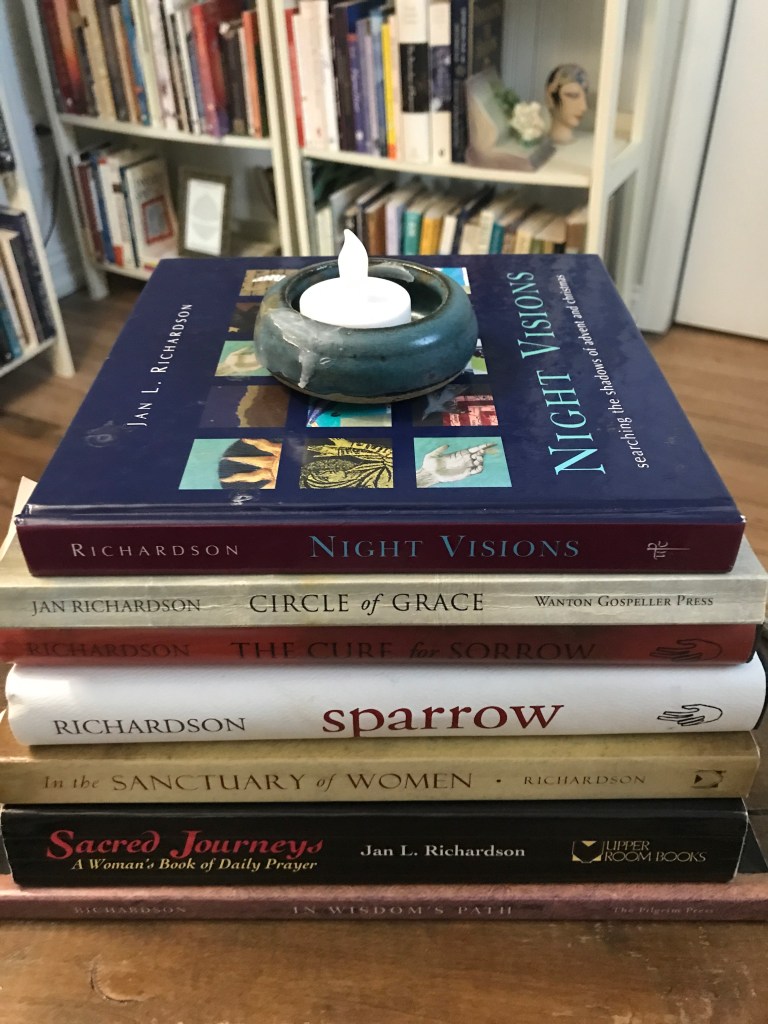
Jan Richardson is one of my “go-to” writers. Her books of prayers and blessings and reflections sustain and enrich me. Enlighten and open me.

On these Lenten mornings I read and re-read and sit with the blessings for the Lenten season in Circle of Grace, A Book of Blessings for the Season (2015), as I have for many previous Lenten times. This year the book falls open almost automatically to page 117:

Next you must trust
that this blessing knows 
where it is going,
that it understands
the ways of the dark
that it is wise
to seasons
and to times.

As I move through a period of discernment, these words reassure me and lift me and lead me towards whatever is next. Easter is coming--beyond what seems dark. 

Two other books accompany me during the seasons of the church year: In Wisdom's Path, Discovering the Sacred in Every Season (2000) and Night Visions, Searching the Shadows of Advent and Christmas (1998). 

Both of these books are beautifully illustrated by Richardson as well.

On the first page in the section on Lent in the book In Wisdom’s Path Richardson writes:

The season begins with ashes and invites us into a time of stripping away all that distracts us from recognizing the God who dwells at our core. Reminding us that we are ashes and dust, God beckons us during Lent to consider what is elemental and essential in our lives…we find the building blocks for creating anew.

p. 53.

Each year when I read those words it is as if for the first time, as if I have never considered those thoughts, and at the same time, they feel so familiar and touch what I have always knows. Richardson has that ability in both her writing and her art work. That is also true as she guides the reader through each week of Advent in Night Vision with themes of “Darkness,” “Desire,” “Preparing a Space,” “Hope,” and then on to themes of “Birthing,” “Welcoming,” and “Thresholds” for Christmas and Epiphany. I know that season seems far off as we continue the rounds of Lent, but I suggest you add this book to your devotion plans for later in the year.

Two other books highlight the spiritual journeys of women.

Sacred Journeys, A Woman’s Book of Daily Prayer (1996) also follows the liturgical year, and each week includes an invocation, biblical text, context of the scripture, daily readings, questions for reflection, a meditation, and a blessing. Along with her own words, Richards quotes women from across the ages, a rich diversity of voices. One Lent many years ago a friend and I each read the daily devotions in this book and then emailed our comments to one another–what a meaningful Lenten journey that was.

The other book specifically focuses on women, In the Sanctuary of Women, A Companion for Reflection and Prayer (2010. Each chapter highlights a wise woman of the past, including Eve, Brigid, the Desert Mothers, and Hildegard of Bingen. I knew something about each of those women, but not about Harriet Powers, the subject of a chapter called “The Mysteries of Making.”

Powers grew up in slavery and when she become emancipated, she and her husband purchased a farm in Georgia. She worked as a seamstress and created quilts. Two of her quilts, known as Bible quilts created using appliqué techniques, have survived and speak to her creative gifts and her love of God.

A dear friend gave me this treasured book and inscribed it to me:

May you always keep the vision to recognize the door that is yours, courage to walk through it, and when you’ve gathered the wisdom that is yours in that room, move on and find another door.

I think Richardson would applaud this sentiment.

Finally, two books are the result of deep grief in Richardson’s life: The Cure for Sorrow, A Book of Blessings for Times of Grief (2016) and Sparrow, A Book of Life and Death and Life (2020). Richardson’s husband and creative partner, the singer/songwriter Garrison Doles died unexpectedly after a routine surgery, and she did what she knew how to do: she wrote blessings; blessings not always easy to read, such as “Blessing for My First Day as a Widow.” But she also wrote blessings of solace and hope.

When I was asked to speak at a friend’s memoir gathering, I read the blessing, “Where Your Song Begins Again,” which includes these words:

Let it be
that you will make your home
in the chamber 
of our heart

where your story
does not cease,
where your words
take flesh anew, 
where your song
begins again.

Sparrow, which explores the first few years after Gary’s death, is written in more of a narrative style and includes journal entries. The title is based on the sparrow imagery in Psalm 84, “Even the sparrow finds a home…” This line inspired one of Gary’s songs, “I Will Be a Sparrow.” The book is the honest, compelling and often raw exploration of the key question in her life without her loved one, “Who am I, when the person who saw and knew me best in all the world is gone from this world?” I am grateful I have not lost that person, but I have had my own losses and with each one I am aware of the need to address anew, “Who am I now?”

How grateful I am for Richardson’s grace and wisdom and her companionship on my own journey.

Richardson’s website is https://www.janrichardson.com/books. You can buy her books and art prints, as well as access her blog and occasional retreats on this site.

An Invitation:

What books accompany you on your spiritual journey? I would love to know.
Book Report: Spirit Car, Journey to a Dakota Past by Diane Wilson (2006)

On November 7, 1862, a four-mile train of mostly women and children was forced to march to the concentration camps at Fort Snelling. Many of our people died on this trip. The townspeople from Henderson, New Ulm, and Sleepy Eye threw bricks as they passed by, they threw stones, one woman even threw boiling water.

Some people ask why we need to remember this, why we can’t just let it go. The march has never been acknowledged for the tragic event that it was. It’s been covered up and forgotten. It’s time for the Dakota people to remember their ancestors, to grieve for their families who were part of this march. This used to be Dakota land. It was all taken away from us. When you allow these things to be covered up, that’s part of colonization.

p. 186, Wilson quoting Chris Mato Nunpa, professor of Indigenous Nations and Dakota Studies at Southwest Minnesota State University, Marshall, MN

Sometimes you don’t know what you don’t know.

We live just a few miles from Fort Snelling in St Paul, and I had no idea until a few years ago about this horrific forced march and how so many native peoples had been imprisoned there. Our congregation participated in a Sacred Sites tour and visited not only this area, but other nearby places sacred to the Dakota people. It was a sobering day, to say the least.

Spirit Car, Journey to a Dakota Past by Diane Wilson, who wrote one of my favorite novels of 2021, The Seed Keepers, is the record of Wilson’s journey to discover her own history and the story of her ancestors. It is a complicated story, although the writing is clear and beautiful. The story is complicated because so much has been hidden and distorted, and repressed. Wilson’s father was Swedish-American and her mother of Dakota heritage. Her mother and sisters had been sent to a boarding school on the Pine Ridge Reservation in South Dakota and were rarely able to return home. Imagine the trauma involved in that? Wilson’s great-great grandmother, Rosalie Marpiya Mase or Iron Cloud, was married to a French fur trader, and Wilson explores how mixed marriages were part of the strategy to take over native culture and lands.

In December, 1862, 38 Dakota men were hanged in Mankato, MN, in view of an estimated 4,000 spectators. Just imagine. Here’s where I am in the ongoing process of learning what I don’t know. When I was in the sixth grade, I lived in Mankato. At that time the social studies focus during the sixth grade was Minnesota history. Did we learn about the hanging? Did we learn about the forced march or why that happened? Did we learn anything about the land our school was built on? Nothing. Not one thing.

This book is part of my ongoing education, and I hope it will be part of yours.

Eventually, ambitious dairy farmers chopped down the forests, sold the timber to build houses for settlers, and paved the old trails. But was the past so very far away? Beneath the pavement, there remained the imprint of moccasins and the tracks of wagon wheels. They never really disappear, they simply became invisible to our eyes.

p. 203

An Invitation

Are you reading anything to fill in the blanks of your own education? I would love to know.
Book Report: Browsing My Bookshelves

One book leads to another. And another.

One of my favorite projects each week is preparing for the writing group I facilitate at my church. Along with creating a writing prompt, I offer short quotations to support the subject of the prompt. Finding appropriate quotes becomes a rabbit hole of pleasure and memory. Sometimes, I confess, browsing my bookshelves becomes a diversion, a distraction from the task in front of me. Oh well.

An example: My morning meditation these days includes reading the prayers for Lent in Jan Richardson’s Circle of Grace, A Book of Blessings for the Seasons. (2015). One of those blessings led me to this week’s writing prompt –a prompt about telling our own stories. Great–I had both the content for the prompt and one illustrative quote.

Let the browsing begin.

I remembered a workshop on storytelling as a spiritual practice that I took from Diane Millis a couple years ago, so found her book, Re-Creating a Life, Learning How to Tell Our Most Life-Giving Story (2019) on one of my shelves. As I paged through the book, I remembered an exercise Millis led at the workshop and wrote a note to myself to consider adapting that for a future writing group. I also noticed a reference to one of my favorite books, Composing A Life (1990) by Mary Catherine Bateson.

Here’s where the rabbit hole gets deeper. I pulled that book, autographed by Bateson, off my shelf, and as I noted what I had underlined and where I had written comments, I remember the evening I heard Bateson speak at a private girls’ school in Cleveland. Her book, Peripheral Visions, Learning Along the Way (1994), had recently been published, and, of course, I bought that book, too, and had her sign it.

We had moved to Cleveland from Minnesota just months before, and I still felt quite lost and unsure of what my next steps in composing my own life would be. I remember having a lovely conversation with Bateson and being surprised by the time she took to share her wisdom and perspective with me. I don’t remember her words, but am sure I wrote about it in my journal. I resist digging out that journal, for I might never climb out of that rabbit hole! An aside: Many years later I learned that a woman who became a friend had also attended that lecture.

Also on my shelf is Composing A Further Life, The Age of Active Wisdom (2010), and I am so tempted to begin re-reading this book right this very minute. The chapter titles, “Thinking About Longevity,” “A Time for Wholeness,” and “Knowledge Old and New” beckon me and I suspect are even more relevant for me now, but I set it aside. For the moment. And then I remember another of her books that I found at a Little Free Library, Willing to Learn, Passages of Personal Discovery (2004), but have yet to read. It awaits on a different shelf, where I keep TBR nonfiction books.

I slap my hands, reshelve the Bateson books, and turn to the shelves with my writing books. There are lots of temptations on those shelves. I start with two books: The Story of Your Life, Writing a Spiritual Autobiography (1990) by Dan Wakefield and Your Life as Story, Writing the New Autobiography (1997) by Tristine Tainer. The Wakefield book introduced me to the term and the idea of “spiritual autobiography,” which is now more commonly thought of as “spiritual memoir,” and the Rainer book reminds me of her earlier book The New Diary, How to Use A Journal for Self-Guidance and Expanded Creativity (1978), which I used as a text when I taught a series of journal writing classes way back when! All three books are full of notes to myself.

I have found what I need for the writing group and force myself to re-shelve the pile of books on my desk, but that leads to another round of browsing.

The Diane Millis book is right next to a collection of Thomas Merton books and close by are Thomas Moore books. The Bateson books are near books by a current favorite, Diana Butler Bass, including her latest Freeing Jesus, Rediscovering Jesus as Friend, Teacher, Savior, Lord, Way, and Presence (2021). I notice I have starred the last two chapters, “Way” and “Presence,” and I am tempted to re-read those chapter right now. Plus, I notice a Dan Wakefield book I have not yet read, Releasing the Creative Spirit, Unleash the Creativity in Your Life (2001), and I am certain just what I need could be found on those pages.

Behave yourself, Nancy, and focus. Finish the task at hand.

An Invitation:

What books are waiting for you on your bookshelves? I would love to know.
Book Report: Library Holds

March 10, 2022

Nothing makes me much happier than an email from my library informing me that books I have requested are waiting for me, especially since I am about to finish a a big novel.

Off I go with my canvas book bag from the New York Public Library, a recent gift from my sister.

Here’s my loot:

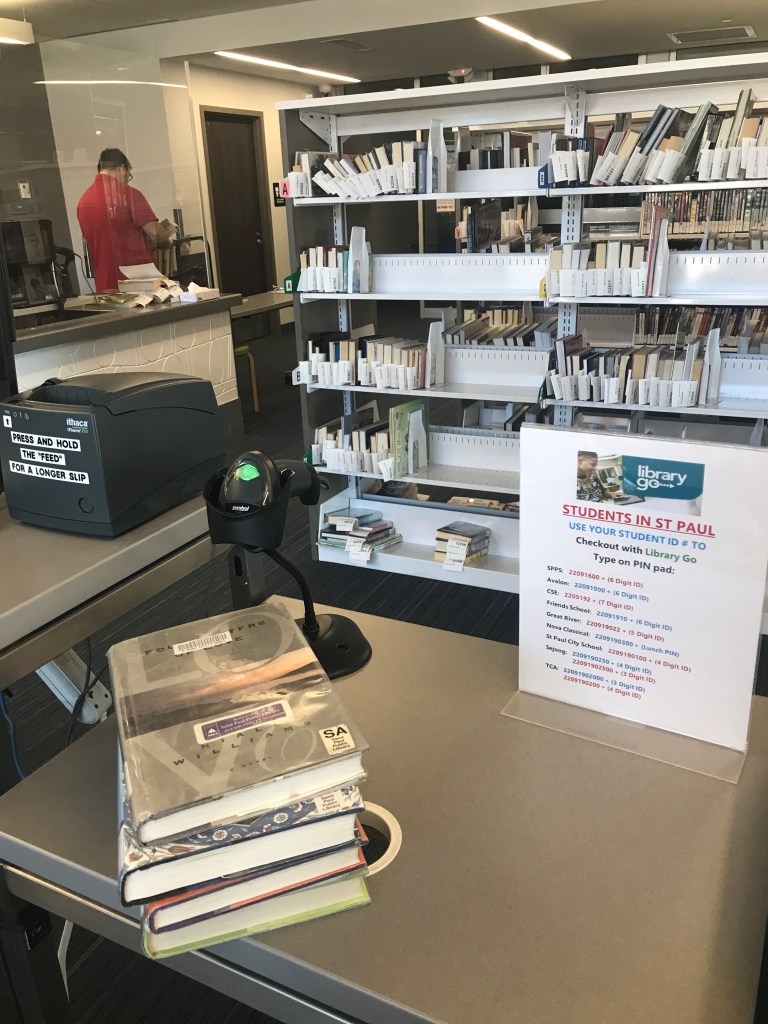
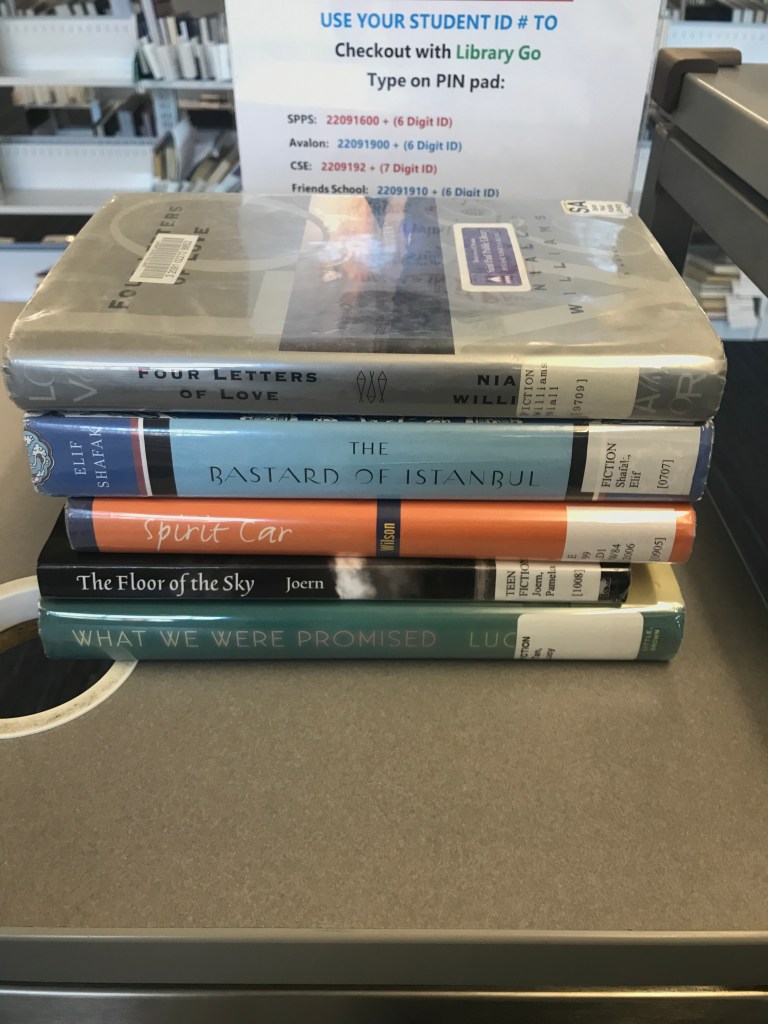
  1. Four Letters of Love by Niall Williams. (1997) His more recent book This is Happiness was one of my 2021 top favorites, and I am eager to read more by him. This is also set in Ireland, and the book jacket describes it as a “novel about destiny, acceptance, the tragedies and miracles of everyday, and about how all our stories meet in the end.”
  2. The Bastard of istanbul by Elif Shafak (2007). This book was recommended by one of my readers and is the story of two families–one Turkish and one Armenian American.
  3. The Floor of the Sky by Pamela Carter Joern (2006). I am embarrassed I have not read this book or her other books, for she is a Minnesota writer and writes about the Midwest. A friend nudged me to order this book, which is set in the Nebraska Sandhills.
  4. What We Were Promised by Lucy Tan (2018). When I first heard about this book, I thought it was by AMY Tan, and I realized I have not read her more recent books, including a memoir. More for the TBR list. In the meantime I look forward to this debut novel by LUCY Tan about a family who moves back to China.
  5. Spirit Car, Journey to a Dakota Past by Diane Wilson (2006). You may have read Wilson’s celebrated novel, The Seed Keepers, and if not, I recommend it. Wilson explores her family’s history as Dakota people in South Dakota and Nebraska.

Which book beckons me first? I am eager to sit in my Mama Bear Chair and browse each book. First, of course, I will finish the novel I am currently reading, Marjorie Morningstar by Herman Wouk (1955). I found this book in a Little Free Library and am quite sure I have never read it before. I thought it might be dated –and parts are–but the story and characters are engrossing and don’t always feel as if the book is set in the mid to late 1930s.

An Invitation:

Do you use the library? Do you have a “hold” list? I would love to know.

Book Report: February Round-Up

I tend to read more fiction than nonfiction, but month seven of the twelve I read were nonfiction. I read more than one book at a time–generally one that is nonfiction and the other, fiction. This month I read a long, 900+ page novel, and by the time I finished that I had several nonfiction books finished or underway.

Nonfiction

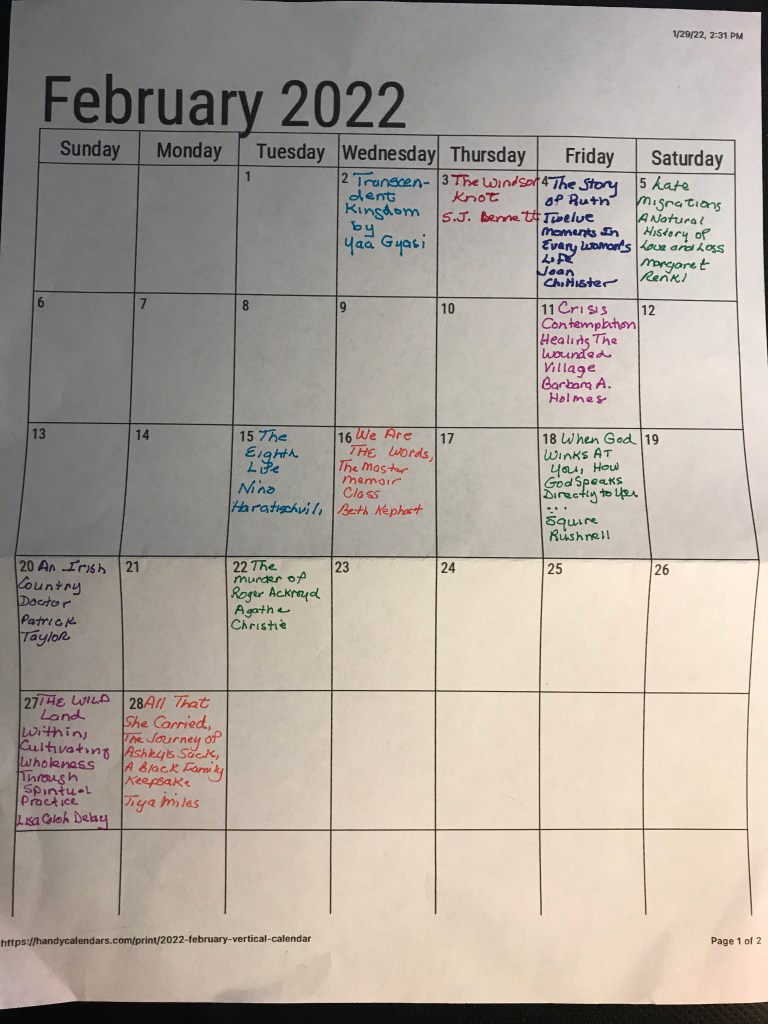
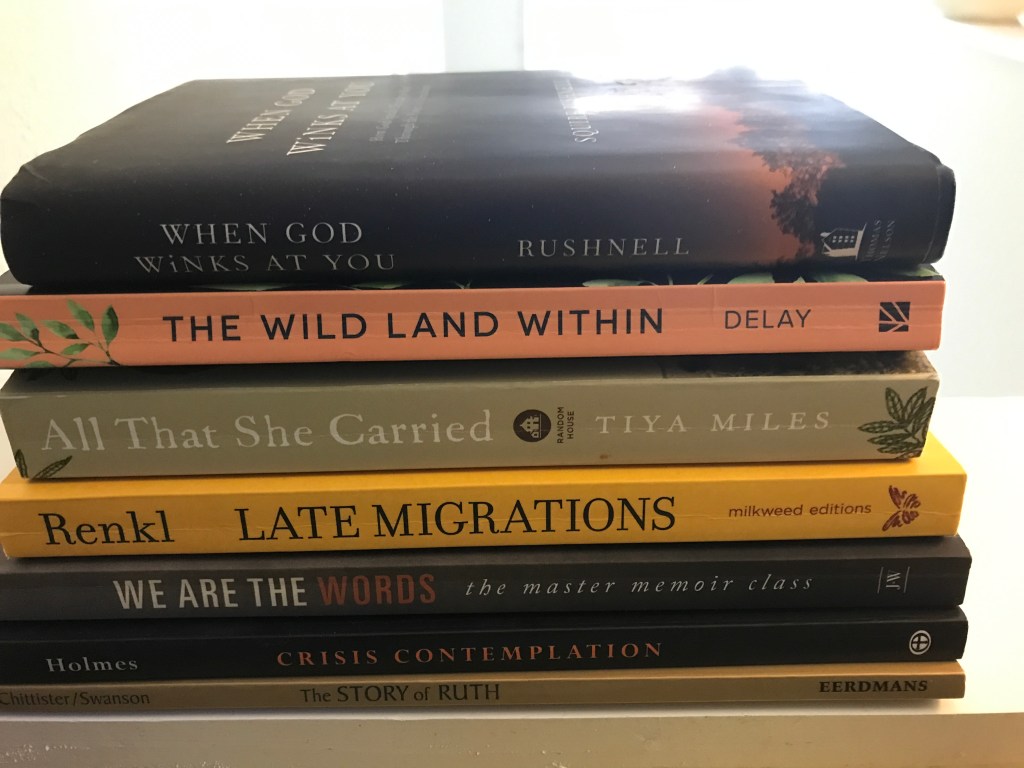
In earlier Thursday Book Report posts this month, I have written about three of the books I read this month: The Wild Land Within, Cultivating Wholeness Through Spiritual Practice by Lisa Colon Delay (2021), Crisis Contemplation, Healing the Wounded Village by Barbara Holmes (2021), and The Story of Ruth, Twelve Moments in Every Woman’s Life by Joan Chittister (2000). I benefited from reading each one.

Here are two more to add to your own TBR (To Be Read) list.

  1. Late Migrations, A Natural History of Love and Loss by Margaret Renkl (2019). This collection of brief essays goes back and forth between reflections on the nature and portraits of her parents and her own personal history. The two threads enhance each other. At times I felt I was peeking into her own journal, although the writing was far more accomplished than what is normally found in a journal. One example might be a list, “Things I Didn’t Know When I Was Six,” which may have grown from one or more journal entries.

The God you believe in acts nothing like the God other people believe in…

No black people live in your neighborhood even though black people work in every house in your neighborhood…

Your mother wants to work too, but there are rules that don’t let mothers work…

Your mother’s tears are not your fault.

pp.36-37

I have so many favorite lines–too many to note here–but I can’t resist one more:”Everyday the world is teaching me what I need to be in the world.” p, 126.

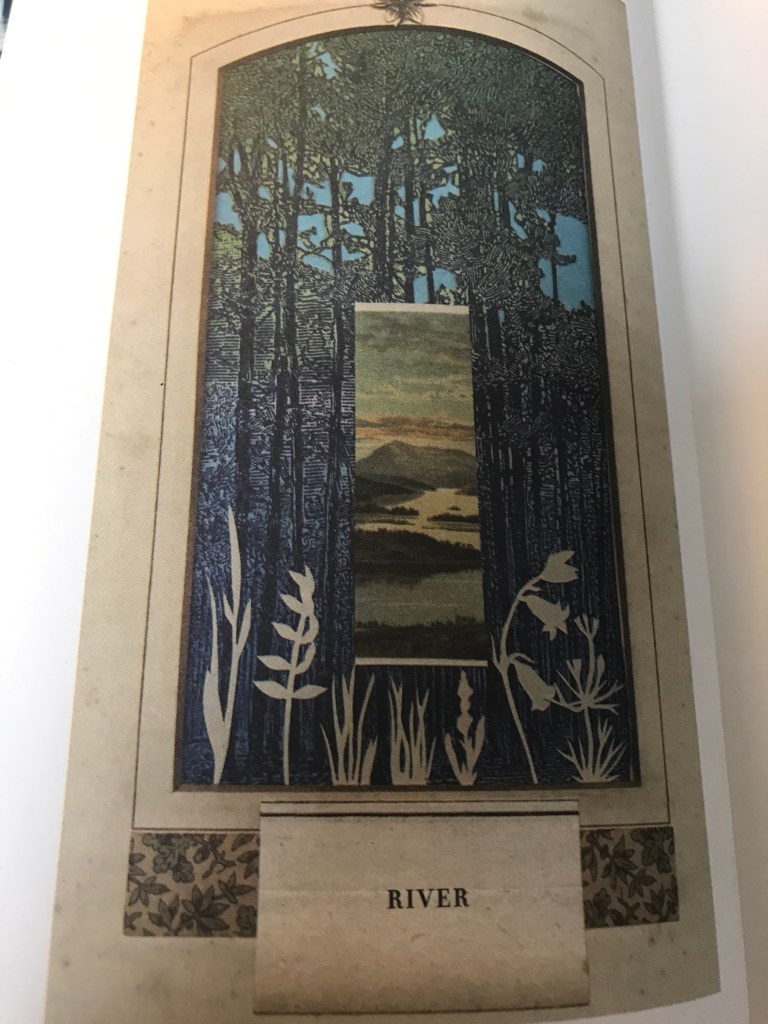
The book moves chronologically in time, beginning with her mother’s birth to her mother’s death and also the author’s life from childhood to adulthood with the loves and losses along the way. A bonus in this book is the gorgeous artwork by the author’s brother Billy.

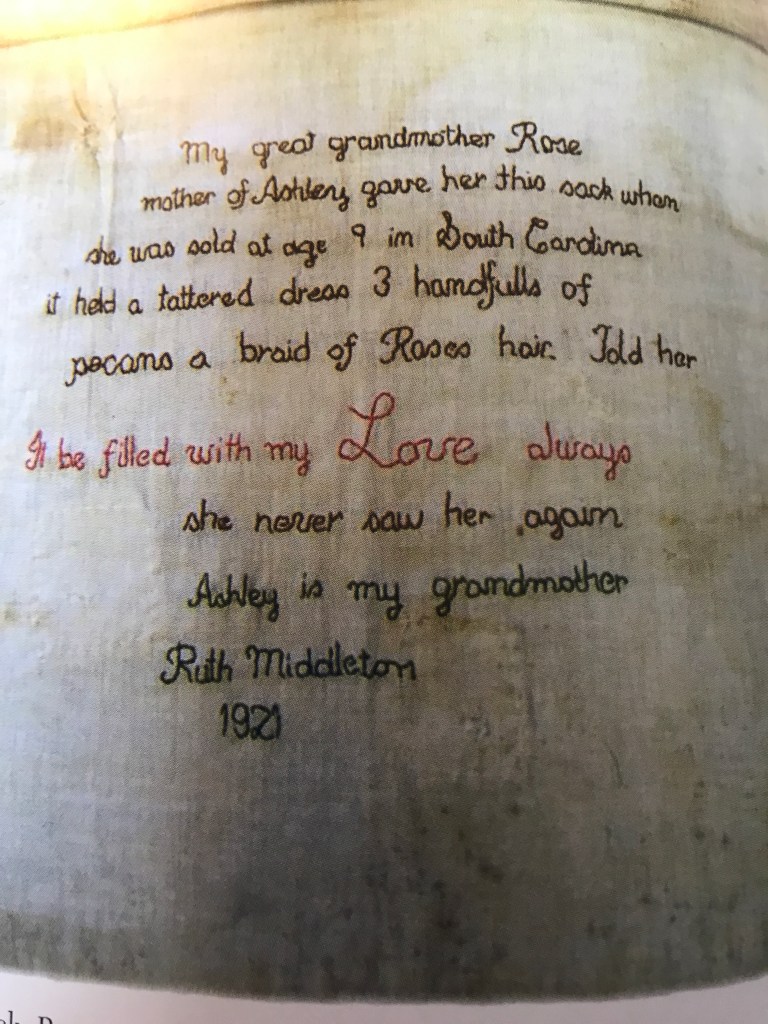
2. All That She Carried, The Journey of Ashley’s Sack, A Black Family Keepsake by Tiya Miles (2021). Rose was a slave in 1850s South Carolina and when her daughter Ashley was going to be sold, she packed a cotton bag for her with a few items, a tattered dress, three handfuls of pecans, a braid of her own hair. The sack was also filled with love. Decades later, Ashley’s grandmother Ruth in 1921 embroidered the contents and the briefest of family history on the sack itself. Sounds simple and charming, doesn’t it?

But first, consider how Ruth even came to have the sack in her possession.

When I first heard about this book, I was reminded of one of my favorite books of all time, Tim O’Brien’s The Things They Carried (1990), a novel, about the possessions soldiers carried during the Vietnam War and about what is important to hold and cherish.

But remember, slaves weren’t allowed to have many possessions nor did they have the ability to maintain family ties.

Yes, this is a book of remarkable scholarship and a book of enlightened history (Did you know that many slaves were required to wear a badge made of copper or tin that said “Servant” or “House Servant” to indicate which slaves had permission from their owners to do errands in town, for example? p. 82, or did you know that South Carolina was the only state in the union that didn’t have a two-party system or popular elections for the presidency, the governor, or other state and local positions, p. 174?), but it is also a book of heart-wrenching emotion.

Consider how the battle continues for how history is presented and learned in this country.

Fiction

I’ll just mention two.

  1. Transcendent Kingdom by Yea Gyasi (2020). The main character Gifty is a Phd candidate in neuroscience at Stanford. She has been drawn to the field because her brother who was a star athlete died of a drug overdose, and she wants to understand how that happens. Her mother, who immigrated from Ghana, is suicidal and moves in with Gifty. Her father returned to Ghana. The story moves back and forth between past and current storylines and includes many reflections about science vs religion and the role of the church in the lives of these characters. Excellent book.
  2. The Eighth Life (for Brilka)by Nino Haratischvili (2019) This book at 900+ pages took commitment, but I am glad I read it. As often is the case in a book this size, it is a family saga. Beginning with the Russian Revolution the story extends across a century. One Georgian family is highlighted–a family who owes its success to a delicious chocolate recipe passed down through the generations. Love, loss, war, ghosts, joy, massacres, tragedy, hopes, dreams. It is all here, and I can’t quite believe I read this as once again we are witnessing Russian imperial ambitions.

An Invitation:

What did you read in February? I would love to know.

Book Report: Morning Meditation Basket

As promised in my recent post (Tuesday, February 21, 2022, “Morning Meditation”), today’s Book Report shares my current morning meditation and devotion materials.

My collection of materials change as I finish reading a specific book, but also as the seasons in the church year change and as my personal needs change. However, two books always remain: the Bible and a journal. I only have a few pages left in my current journal and need to choose a replacement soon. That is on this week’s list.

Here are the other books in the basket:

  • Celtic Treasure, Daily Scriptures and Prayer by J. Philip Newell. (2005). This may be the third time I have returned to daily use of this book. Right now I am focusing on chapter five, “Songs of the Soul,” but other chapters include “Stories of Creation,” “Power and Justice,” and “Letters of Love.” Each day in the seven week cycle, begins with the same words, “We light a light in the name of the God who creates life, in the name of the Saviour who loves life, and in the name of the Spirit who is the fire of life.” After encouragement to “Be still and aware of God’s presence within and all around,” Newell retells a piece of scripture and offers a prayer. The brief and simple, but oh, so lovely daily meditation always ends in the same way.

The blessings of heaven,

the blessings of earth,

the blessings of sea and of sky.

On those we love this day

and on every human family

the gifts of heaven,

the gifts of earth,

the gifts of sea and of sky.

The illustrations from the Book of Kells plus children’s drawings are lovely, too.

This book provides a framework for my meditation practice right now. I begin with the opening prayer and readings and end with the closing words.

  • The Wild Land Within, Cultivating Wholeness through Spiritual Practice by Lisa Colon Delay (2021). I first learned about this book on Christine Valters Paintner’s website, Abbey of the Arts. https://abbeyofthearts.com The author describes the book as

an invitation to explore your own flyover country. This book serves as a companion to search the inner and unseen but very real territory of yourself. As we attend to this land within, our journey will involve some issues you may know little or nothing about. There are places of rough and even terrifying terrain. We will learn what makes spiritual growth unnecessarily difficult or extra confusing. To explore this land within means encountering climate and storms, negotiating treacherous topography, and finding creatures both wounded and wild. p. 2

Delay, who is a writer, teacher, and spiritual director and originally from Puerto Rico, broadens my white cultural context with references to Native American, Black, Latinx, and others and asks me to define what have been my main influences and how those influences have affected my spiritual growth.

In an early section Delay spends time reflecting on the four soils parable recorded in Matthew 13:1-23, Mark 4:1-20, and Luke 8:4-15. I have been re-reading those pieces of scripture now myself, and using the practice of lectio divina, I ask what meaning they have for me after walking on the earth for almost 74 years. Ongoing exploration.

I am moving slowly, deliberately through this book. My plan is to read a chapter every day, but I keep returning to what I read previous days, finding more openings for learning and reflection. Chapter Five, by the way, is called “Weather Fronts,” and that seems perfect for the winter storm watch we experienced as I wrote this.

One more thing: Delay has a podcast, Spark My Muse. I have not yet listened to it, but I will.

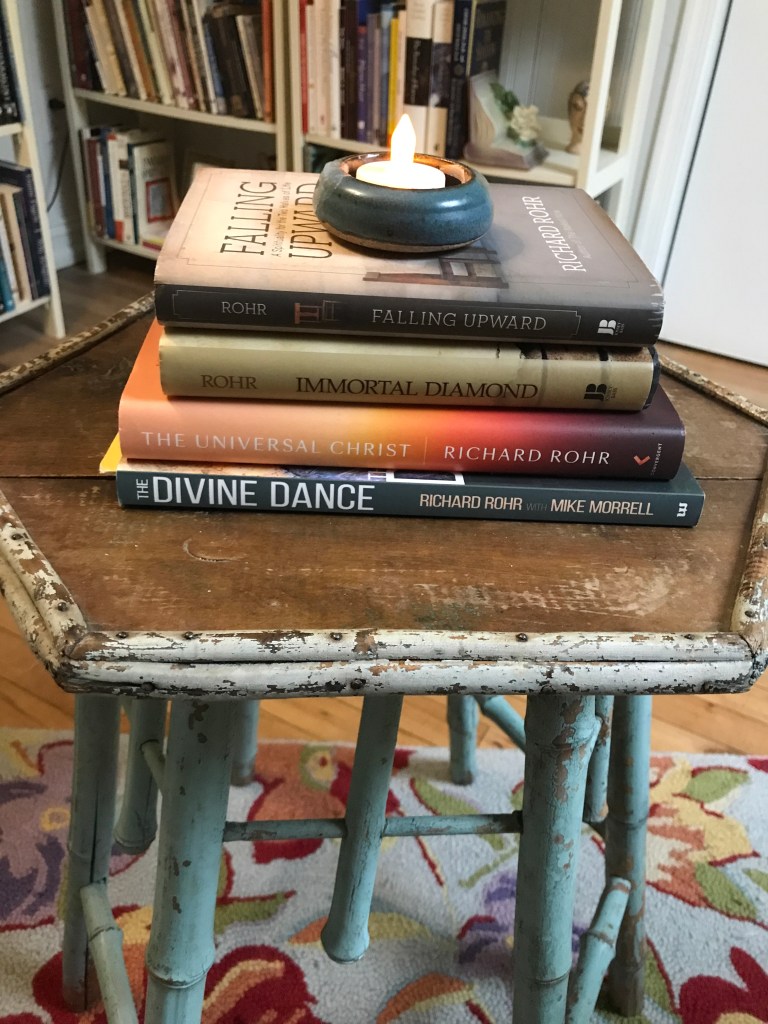
  • The Divine Dance, The Trinity and Your Transformation by Richard Rohr with Mike Morrell (2016) It seems I always have a Richard Rohr book in my meditation basket. If I think I am reading Delay’s book slowly, I am reading this one at an slower pace. I dip into this book, reading two or three pages, when I am willing to set aside the next task.

I was first attracted to this particular book because of the cover art, the famous icon of The Trinity created by Russian iconographer Andrei Rublev in the fifteenth century. I love that icon and the mystery it draws me towards. I was also attracted to the title of the book itself.

Whatever is going on in God is a flow, a radical relatedness, a perfect communion between Three–a circle dance of love.

And God is not just a dancer; God is the dance itself. p. 27

This book will be in my basket for a long time. Oh, I also have a publication from Richard Rohr’s Center for Action and Contemplation: Oneing, An Alternative Orthodoxy. Volume 9, No. 2 focuses on The Cosmic Egg.

  • Soul Therapy, The Art and Craft of Caring Conversations by Thomas Moore (2021) This is another book I dip into when the spirit moves me. Moore’s books, especially Care of the Soul, have been important landmarks in my spiritual growth. Directed towards “helpers,” including psychologists, social workers, ministers, spiritual directors and others, the book reminds me to continue my own soul work as I sit with others doing their own soul work.
  • The Making of an Old Soul, Aging as the Fulfillment of Life’s Promise by Carol Orsborn, Ph. D (2021) I have not yet cracked open the cover of this book, but I enjoy Orsborn’s blog https://carolorsborn.com and I really liked her earlier book The Spirituality of Age. More than likely, I will report on this book later.

My basket runneth over!!

An Invitation: What books or other materials do you turn to for reflection and soul work? I would love to know.

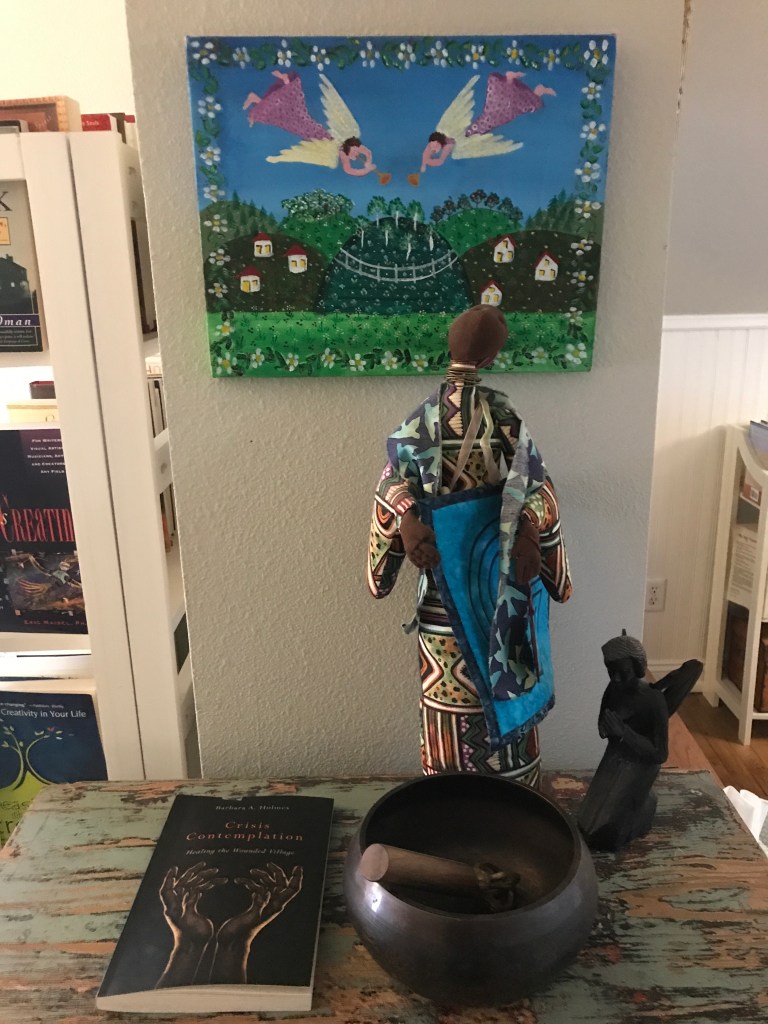
Book Report: Crisis Contemplation, Healing the Wounded Village by Barbara A. Holmes (2021)

We can identify three common elements in every crisis: The event is usually unexpected, the person or community is unprepared, and there is nothing anyone could do to stop it from happening…Bereft of words, all of us hold the same question: How could this be happening? Crisis Contemplation, p. 21

We don’t need to think very hard or very deep to identify crises in the last couple years. You may have experienced a personal crisis, alongside the communal ones our society has been enduring.

I don’t imagine many of us respond by moving into contemplation when a crisis strikes. Our more immediate response is action. This book does not negate that response, but at the same time Holmes encourages us to “allow for the possibility of contemplative refuge, respite, and renewal. To slow down and be still is to allow both the source of our troubles and options for recovery to emerge.” (42)

This is hard work and as Holmes points out this work does not mean retreating to our meditation pillows. She points out that “Contemplative porch practices are no longer required of me; they are part of me.” (42). Yes! I often urge my spiritual direction clients and my readers to develop spiritual practices now, before the unexpected, which will come, for sure. Ground yourself in your contemplative practice and they will be with you.

As I read this book, I felt as if I was sitting in the back of a room where Holmes was exploring and reflecting with BIPOC peoples. I had the privilege and pain of listening, opening my heart (I hope) to the trauma, the wounds across the generations and so present now. I attempted to read this book as a contemplative practice.

Rev. Dr. Barbara Holmes, author and scholar of African-American spirituality and mysticism, is on the faculty of Center for Action and Contemplation (CAC) under the leadership of Fr. Richard Rohr, https://cac.org and it was in one of CAC’s daily meditations where I was introduced to her wisdom. I know I will eventually read one of her earlier books, Joy Unspeakable: Contemplative Practices of the Black Church (2017). And I am drawn back to books by Richard Rohr.

The Universal Christ, How a Forgotten Reality Can Change Everything We See, Hope For, and Believe (2019) has become a touchstone book for me.

As I was writing this post, I remembered another book on my shelf, one I have recommended when personal crisis hits, The Ten Things to Do When Your Life Falls Apart, An Emotional and Spiritual Handbook by Daphne Rose Kingma (2010). This book focuses more on individual issues, but still, there is much to contemplate here. The ten things, by the way are:

  • Cry your heart out
  • Face your defaults
  • Do something different
  • Let go
  • Remember who you’ve always been
  • Persist
  • integrate your loss
  • Live simply
  • Go where the love is
  • Live in the light of the Spirit.

As always, one book leads to another and another.

An Invitation: When you have been in the midst of a crisis, has there been a book that has been helpful or meaningful? I would love to know.

Book Report: The Story of Ruth by Joan Chittister

I’m always happy to spend time with Benedictine nun and theologian, Joan Chittister. I have heard her speak many times, often at the Chuautauqua Institution in New York, but other places as well, and, of course, I own and have read many of her books. I return to her The Gift of Years, Growing Older Gracefully (2008) frequently, but value many of her other titles, also, including Following the Path, The Search for a Life of Passion, Purpose, and Joy (2012); The Time is Now, A Call to Uncommon Courage (2019); The Art of Life, Monastic Wisdom for Every Day (2012); and Between the Dark and the Daylight, Embracing the Contradictions of Life (2015). Many years ago when I was preparing lectures for a weeklong retreat on spiritual friendship her book The Friendship of Women, A Spiritual Tradition (2000) was a guiding star.

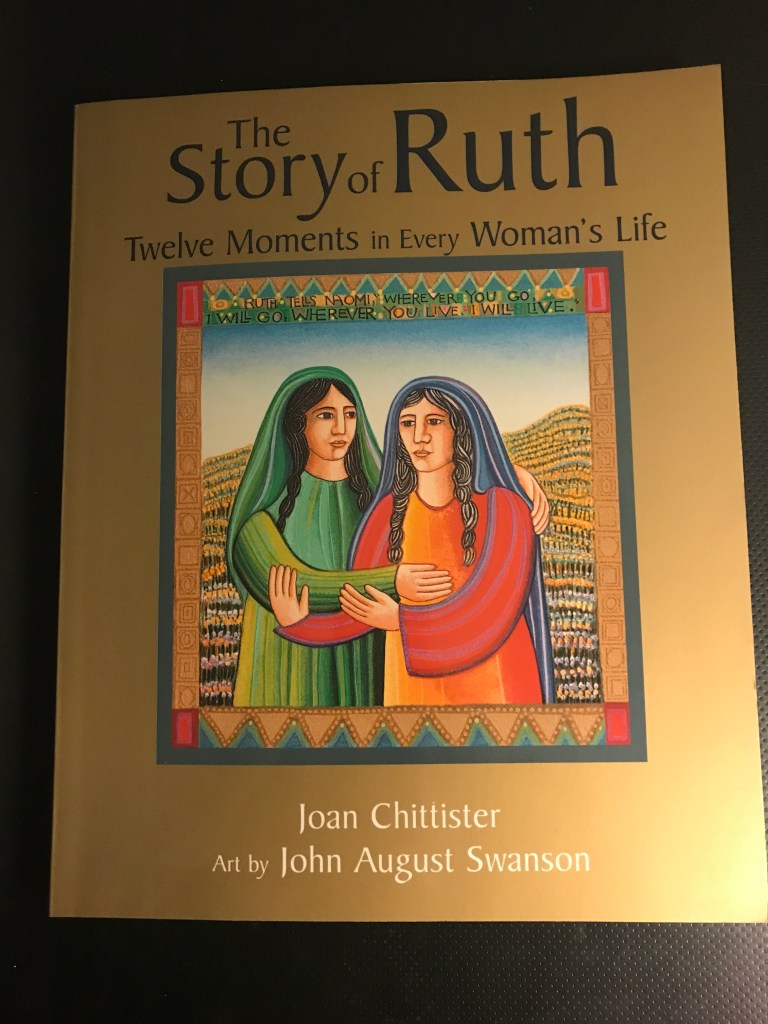
The Story of Ruth, Twelve Moments in Every Woman’s Life is a gentle and wise, but compelling reflection of the Biblical story of Ruth and Naomi. Who isn’t familiar with the verses:

Where you go, I will go; where you lodge, I will lodge; your people will be my people, and your God my God. Where you die, I will die–there will I be buried. (Ruth 1: 16-17)

I’m not sure what drew me to this book at this stage of my life. I probably read some reference to it in someone’s blog, but what a welcome companion it has been recently. How good it is to be in the company of women as they meet the challenges, or as Chittister calls them, “moments” of their lives and how God calls us to become who we were created to be.

The book leads us through the Biblical story, highlighting the ways Naomi and Ruth, mother-in-law and daughter-in-law, meet the challenges following the deaths of their husbands. Chittister relates those challenges to the challenges all women face, especially as women continue to struggle with inequality and stereotypical limitations. Each chapter examines one of those challenges, including respect, recognition, invisibility, and empowerment.

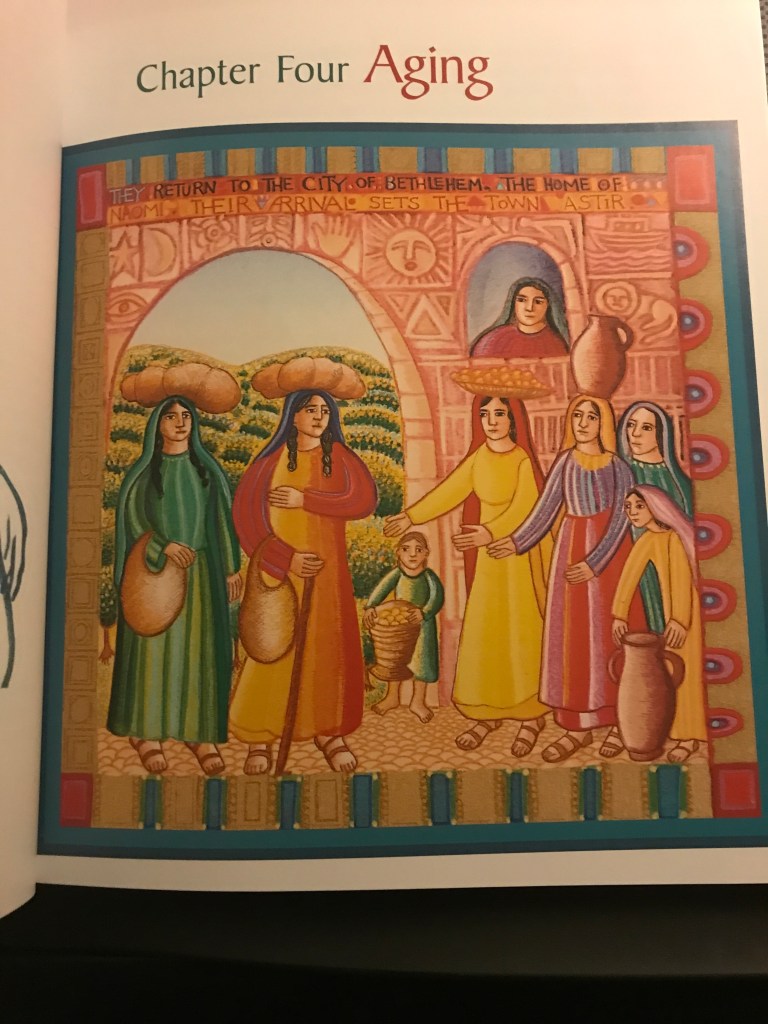
I suspect if I had read this book earlier in my life I would have been drawn to different chapters, but as a woman in her 70’s, I was most drawn to the chapters on loss, aging, and the last chapter, fulfillment. In the chapter on aging, Chittister writes:

There are lessons that come with age that come no other way. Age is a mirror of the knowledge of God. Age teaches that time is precious, that companionship is better than wealth, that sitting can be as much a spiritual discipline as running marathons, that thinking is superior doing, that learning is eternal, the things go to dust, that adult toys wear thin with time, that only what is within us–good music, fine reading, great art, thoughtful conversation, faith, and God–remains. When our mountain climbing days are over, the elderly know, these are the things that will chart the setting of our suns and walk us to our graves. All the doings will wash away; all the being will emerge. (p. 33)

And in the chapter on fulfillment:

What we do as women to bring ourselves to fullness makes the world around us a fuller place as well. (p. 87)

A wonderful bonus in the book is the art by John August Swanson.

An Invitation: What Biblical stories have new meaning for you as you age? I would love to know.

Books Added This Week to My TBR (To Be Read) List

  • The Heartbeat of Wounded Knee by David Treuer (2019). This actually is already on my list, but needs to move higher. Nonfiction
  • The Love Songs of W.E.B. DuBois by Honoree Fannone Jeffers (2021) Fiction
  • Cabin by the Lake Mystery Series by Linda Norlander: Death of an Editor; Death of a Starling; and Death of a Snow Ghost (May, 2022)

Book Report: January Round-Up

January has been a cold month here in Minnesota, but I have been content to stay inside and read.

Such good books. My intention was to select one or two favorite fiction titles and one or two nonfiction titles, but I could not decide which books not to mention.

Fiction

  • The Sentence by Louise Erdrich. I love books set in a bookstore, and any book written by Erdrich calls to me, so this was a winning combination. Erdrich’s actual bookstore in Minneapolis, Birchbark Books, is one of my favorites and the fictional representation of the store is just as appealing. The basic plot is that one of the employees is haunted by a customer who has died, but that is far too simplistic a description. The book is set during the pandemic and also refers to the murder of George Floyd and the days following that. I am so grateful for Erdrich’s ongoing elucidation of indigenous history, culture, and current realities.
  • Celine by Peter Heller. I read his more recent book The River and liked it, but didn’t love it. However, a favorite bookseller recommended this book to me, and the main character, a 68 year-old woman who is a private investigator, is intriguing. At first I was confused by lots of names and places and wasn’t sure where the focus was going to be, but Celine, who comes from an “old” family, wears Armani scarves when she tracks her prey, uses guns comfortably, and is married to Peter, a “Mainer” who doesn’t drive, kept me turning the pages. I hope Heller writes another book about these two. The story itself–searching for a young woman’s father who supposedly was killed by a bear in Yellowstone–is well done, too.
  • Songbirds by Christy Lefteri. Set in current times in Cyprus, where a maid, originally from Sri Lanka disappears. She has fallen in love with a man who poaches song birds and sells them to restaurants as forbidden and exotic treats. That’s disturbing enough, as it is, but even more so is the indentured servant conditions of the maids and that the main character, Nisha, is not the only one.
  • Oh William! by Elizabeth Strout. I loved this book. William and Lucy Barton were once married and had two daughters, now grown. Lucy’s second husband has died and William’s current wife leaves him. William asks Lucy to help him confront a missing piece of his life story. Lucy, by the way, is a successful writer, but feels invisible and inadequate. Ah, the mysteries of marriage and relationships and as Strout (Lucy) says, “how we lived our lives on top of this.” After reading this book, I re-read the earlier one My Name is Lucy Barton and discovered I liked it much more the second time around.
  • The School for Good Mothers by Jessamine Chan. Think The Handmaid’s Tale by Margaret Atwood. Not as chilling, perhaps, at least not on the surface, but…. Frida, a divorced mom with a young child, has a “bad day” and makes a mistake for which she is sentenced to a training school for mothers. There is a right way and a wrong way. One way. In the school she is assigned to a robotic doll to practice the right way. Ripe for a movie, I am guessing.
  • The Thursday Murder Club by Richard Osman. Set in a retirement community in the UK, a “gang” of residents meet to solve unsolved murders and, of course, get involved in a real murder (or more than one). Interesting characters with interesting backgrounds (Elizabeth was former secret service), and I am eager to read the next book in the series. I assume there will be more after #2.
  • The Phone Booth at the Edge of the World by Laura Imai Messina. This is my “wild card” of the month–a book I just happened upon. I knew nothing about it, but the summary sounded intriguing, and it was one of those books that just felt right. The plot is based on the true story of a tsunami in Japan in 2011. People who have lost loved ones come to talk to them in a disconnected phone booth at the site of the tsunami. Two of those are Yui, whose daughter and mother died, and Takeshi whose wife died. Such a beautiful story of the rhythms of grief and re-entry into life and love.
  • Mrs March by Virginian Feito. This is the least favorite novel I read this month, but I finished it. (I discarded a few others along the way.) Mrs March is married to a successful novelist, and she has many emotional problems. I got tired of the grinding perspective of her paranoia, but still there was some nice writing.

Nonfiction

  • The Inner Work of Age, Shifting from Role to Soul by Connie Zweig. I read this book slowly during my morning meditation time. Zweig’s main message is to become an Elder, which means doing the necessary inner soul work, becoming who we were created to be and embracing the hidden spiritual gifts of age. She doesn’t ignore the challenges; for example, life-changing illness, but instead urges each of us to become aware of our own shadow–the obstacle(s) that prevent our own authenticity. So much here. I added many quotes in my journal and used many of the reflection questions at the end of each chapter. This is a book to move us beyond being elderly and instead, to live our elderhood with awareness.
  • Wife/Daughter/Self, A Memoir in Essays by Beth Kephart. I have loved Kephart’s books on writing and this book gave me insight into who she is as writer and teacher, but much more beyond that. Each section was divided into snatches, short pieces, but the book didn’t feel disconnected. I did think, however, that the section on “wife” was the strongest. The book made me think about how roles change or even end, but the self remains.
  • In the Country of Women by Susan Straight. Straight is a white woman who was married to a black man from the neighborhood where she grew up. They had three daughters and even after they divorced they remained connected in healthy ways. Plus, she was very connected to his large and complicated family. I couldn’t always keep every one straight and how they were related to one another, but the weaving of the stories, the texture of the connections, like the braiding of hair, which she mentioned often, were memorable. This was an unexpected gift.
  • 16 Ways to Create Devotional Writing to Renew the Spirit and Refresh the Soul by David J. Sluka. A book to keep on my shelf for the day, if that comes, when I decide to write devotions for women elders.

It is already February 3, and I have read….sorry, you have to wait till my February Round-Up.

An Invitation: What were your favorite January reads? I would love to know.