Book Report: Two Novels by Favorite Authors

June 27, 2024

While my husband was manning his garage sale last weekend (A big success. Thanks for asking and for those of you who stopped by, thanks for shopping and for donating to Lutheran Social Service programs for youth experiencing homelessness.)–ok, back to books.

While my husband was manning his garage sale, I was engrossed in two novels: The Comfort of Ghosts by Jacqueline Winspear, the last in her 18 book Maisie Dobbs series and Forgotten on Sunday by Valerie Perrin, her first book, which has only recently been translated from French to English and published here in the US.

Located right below my full shelf of Louise Penney books and right above the Willa Cather and Virginia Woolf collections, live the Maisie Dobbs books, plus the two stand-alone novels written by Winspear–The White Lady (2023) and The Care and Management of Lies (2014). I have read all of the Maisie Dobbs books, but don’t own them all. However, I anticipate correcting that situation, for I know at some point, perhaps this winter, I will decide to read them all again. (I have re-read all of Louise Penny’s books, one after another, and I imagine reading them a 3rd time.)

The Comfort of Ghosts is set in London, 1945, which means we have known Maisie Dobbs since the end of WWI when she was a nurse. Maisie, contrary to acceptable behavior, becomes a private investigator, owning her own business. We follow her through the years, including two marriages, being a widow, adopting a child, and being a good and loyal friend to many. It seems appropriate that this book is set in the reality of the UK attempting to move on after WWII, for in this book we feel Maisie moving into a new future, too. The challenges around her are many, and Maisie becomes involved with a group of four homeless children who were trained as resistant workers, young as they are. Many around her, including her dear friend Priscilla and her former mother-in-law, Lady Rowan are in the midst of change, but once again Maisie exhibits resilience and warmth and intelligence. In a conversation with one of the orphaned children she responds to what is said about keeping thoughts to oneself, “But I was once told by a very wise man to do pretty much the same because keeping the thought close gives you an opportunity to consider a bit more, like looking at all the difference facets of a diamond. When you’ve done that, turned the stone around a few times, you have more to offer by way of an observation.” p. 165

Here’s Winspear’s farewell to Maisie: https://newsletter.jacquelinewinspear.com/i6m4k3q7m7

A poignant and bittersweet book.

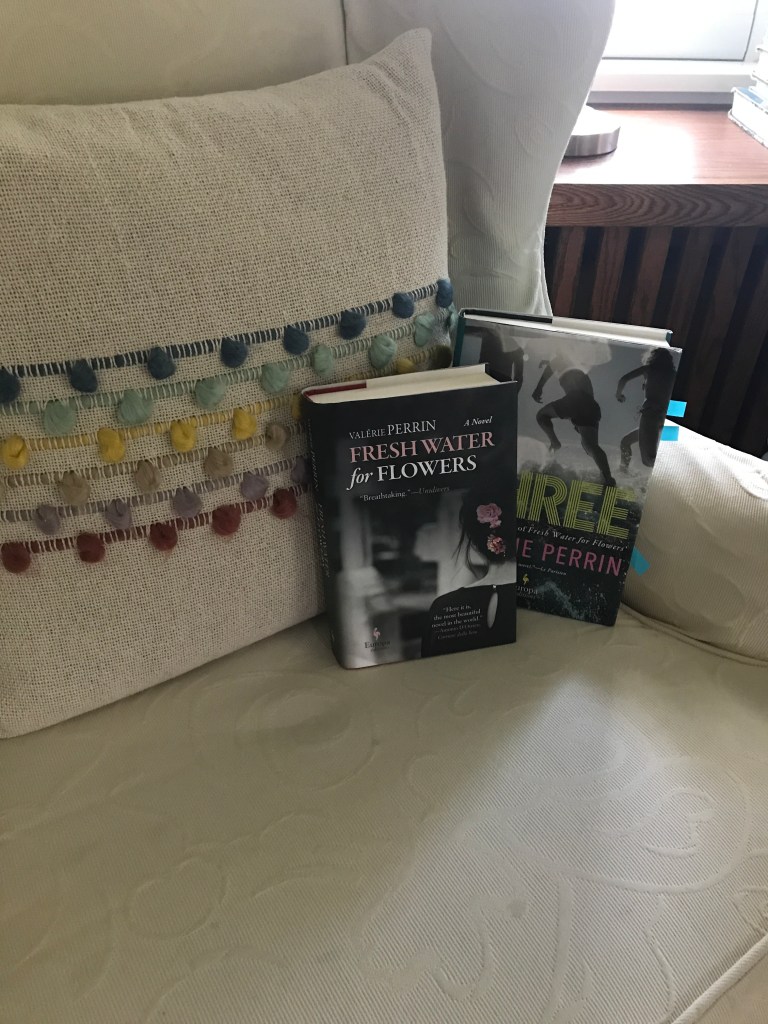
Fresh Water for Flowers (2018) by French writer Valerie Perrin is one of my all-time favorite books, and I have read it twice. Yes, there will be a third time at some point. I enjoyed her most recent book as well, Three (2020), and think it is worth re-reading, also. That’s a good track record, and I was thrilled to discover that Perrin’s first novel was finally being published in the US– Forgotten on Sunday (2015), but at the same time I was nervous about reading her debut. Would it measure up or would I be disappointed?

I thoroughly enjoyed this book, too. For those of you who prefer to read a book in which the narrative moves chronologically from beginning to end, this book is not for you. There are several threads over a range of time periods, but Perrin is so good at developing characters that we can’t help but fall in love with them, and we readers want them to find the love they seek. Is it because she is French, but oh, she writes so tenderly, so wisely about love. It is not a romance book, but it is in many ways a romantic book.

Justine is the narrator. She and her cousin Jules were orphaned when their parents were killed in a car accident. They were raised by their fathers’ parents. Justine, now an adult, is a nursing assistant in a nursing home and more than anything she loves hearing her patients’ stories. One of her patients is Helene, the other main character in the book. The entwining of their lives and all they discover along the way–secrets revealed–is sensitively told, as is Perrin’s style. The title refers to residents of the nursing home who are rarely visited by friends and family.

My one quarrel with the book is the cover, which distorts the profile of the woman on the beach. This black and white photograph seems an odd choice for the cover and unlike what Europa Editions generally chooses. Oh well.

Do you have favorite authors whose new books you will read without question? I would love to know.

Summer Blessings, Summer Routines

June 25, 2024

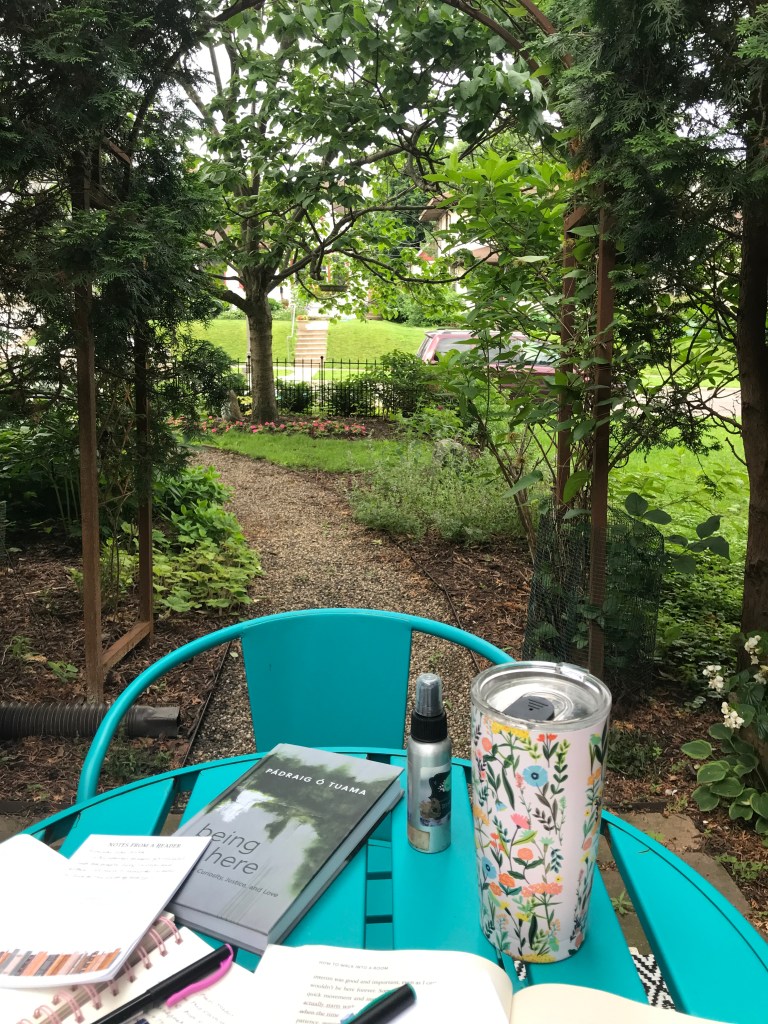
My favorite way to begin a summer day is first to go on a walk and then to return to our side patio, an area I call “Paris, for devotion time. I have not followed that routine often yet this summer, although most days I have gone for a walk. Often, however, by the time I return it is raining or threatening to rain. How good it was Monday morning to say to myself, “Do it, Nancy. Go to Paris.”

And I did, after first bathing in a natural essence insect repellent spray.

I began by reading Padraig O’ Tuama’s opening prayer in his book Being Here, Prayers, for Curiosity, Justice, and Love. This book is my companion this month. Each of the 31 daily meditations begin in the same way:

Turning to the day
and to each other
We open ourselves to the day
and to each other.

This is the day that the Lord has made
and a day we'll have to make our way through.

...

Because this is a way of living
That's worth living daily.

Each day O’ Tuama offers a reading, a piece of scripture, a collect of the day, and a “Remembering Prayer.” Often I reread the Remembering Prayer before going to bed at night.

In my post “Tree Work,” https://wordpress.com/post/livingonlifeslabyrinth.com/3582 I shared the form for writing collects:

  1. Address someone or something
  2. Say more.
  3. Ask one thing.
  4. Say more.
  5. End.

In that post I shared a collect I wrote addressing the trees and since then I have occasionally written other collects. Sitting in Paris yesterday morning, I wrote,

Oh, Pleasing "Paris"
provider of sanctuary,
even as I peer beyond the entrance,
my place of inspiration,
of contemplation,
may I enter this day,
in the same way I enter this space:
open to beauty,
open to a new day, a new week,
open to moments of pause,
open to the Presence.
Amen.

I wrote in my journal. I reread a chapter in Emily Freeman’s How To Walk into A Room, The Art of Knowing When to Stay and When to Walk Away. I read this book fairly quickly in May, underlining so much and noting questions and sections that demanded more reflection. Sitting in Paris, I was ready to enter into deeper conversation with that book.

Today’s chapter, “Remembering Your Path,” reminds me once again to name my personal core values: “What embodies you with God and gets you back to yourself?” (p. 72). I paused and allowed the words I have identified for myself to rise yet again.

Being a presence.

Knowing the Presence.

This morning time–walking and sitting in Paris–brings me into the present, strengthens the way I live in the world, and deepens my awareness of the movement of God.

Once again I was ready to walk through our garden gate, where a Swahili word is posted, “karibu,” which means “hospitality.” I was ready to be present to the fullness of the day.

What summer routine increased your awareness of the movement of God? I would love to know.

Summer Reading Plan

June 20, 2024

Here’s the plan:

  • Finish reading the books I’ve requested from the library.
  • Request no books from the library till fall.
  • Focus on books on my own bookshelves waiting to be read.
  • Choose one shelf at the library and read any of the books that appeal to me.

It is now three weeks into June. How am I doing so far?

It has taken me most of this month to complete my library “hold” list. I wrote in an earlier post https://wordpress.com/post/livingonlifeslabyrinth.com/3634 about three of those books, Long Island by Colm Toibin, The Cemetery of Untold Stories by Julia Alvarez and Family Family by Laurie Frankel. All three are winners. The last book on the “hold” list was Lucky by Jane Smiley, and I liked that very much, too. I will write about that in my June Summary post on July 4th.

So far I am sticking to my intentions and have not added any titles to my library hold list. This is NOT easy for me, especially as I read about new releases like This Strange Eventful History by Claire Messud, Caledonian Road by Andrew O’Hagan, The Ministry of Time by Kaliane Bradley, The Midnight Feast by Lucy Foley and….

I know when I begin to create a hold list in the fall, there will be a long waiting list for each of these books. Sigh. And I know my TBR list will continue to grow, as well, but I tend to be obsessed with reading what is new–perhaps that relates to working in an independent bookstore decades ago–and I think it is time to lighten up! Now that being said, I am not opposed to adding new titles to my own bookshelf. After all, summer includes visiting some favorite bookstores, and purchases will be made! Top of my list, by the way, is Sandwich by Catherine Newman.

So far this month I have read just one of my own books: The Hazelbourne Ladies Motorcycle and Flying Club by Helen Simonson, and I will write about it in my June Summary. Simonson is the author of Major Pettigrew’s Last Stand, by the way, which I own and liked very much. I can imagine reading it again, but first there are other delights awaiting me. I am going to start with the latest (and, alas, last) Maisie Dobbs mystery by Jacqueline Winspear, The Comfort of Ghosts and then I will read Forgotten Sunday by Valerie Perrin who wrote one of my all-time favorite books, Fresh Water for Flowers.

Trust me, I have more than enough books both in the snug and the garret, let alone the living room and the lower level, to keep me happy and engaged for a long time. And did I mention there will be trips this summer to bookstores where it will be impossible not to add to my collection?

How fondly I remember browsing the library shelves when I was a child. There was the thrill of discovering an author or a title unfamiliar to me. I didn’t have a TBR list, but rather was simply open to possibilities, bringing home piles of books. Library trips were a kind of pilgrimage, leading me on new paths and introducing me to new companions.

I realized I rarely browse in the library these days. I go to the library to pick up a requested book when it is available, and I usually check the Lucky Day shelf, but that’s it.

I admit I fear going down the deep rabbit hole of library stacks these day, so instead decided to adopt one shelf; a shelf I will browse in this summer. I decided to focus on Fiction Shelf #14 (I was born on April 14). My intention is not to read all the books on that shelf nor is it to start at the beginning of the shelf and move towards the end. Instead, I will read whatever I want to on the chosen shelf, and if I exhaust what I want to read on that shelf, I will select another one.

My only rule for the Wild Card Shelf is that I will check out only one book at a time.

On #14 are several titles and authors totally unfamiliar to me, including several books by Sebastian Barry. And there is an old book I read many years ago that I think I will enjoy reading again, Love for Lydia by H.E. Bates (1952). But I was most delighted to see three books by Erica Bauermeister. In April I read a nonfiction book by her, which I loved, House Lessons, Renovating a Life (2020) and in 2023 I read one of the novels on this shelf, No Two Persons, another enjoyable read. I decided to start with one of the Bauermeister books.

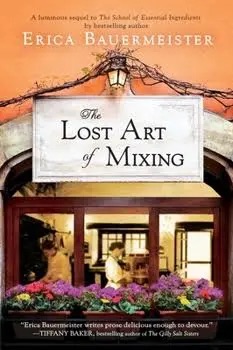
The Lost Art of Mixing by Erica Bauermeister (2013) is engaging and insightful, a perfect kind of summer reading experience, whether the day is rainy or too hot and steamy for movement. The book introduces us to a variety of characters who in some way are connected to Lillian, a restaurant owner. Al is the accountant who has a surprising avocation; Chloe, a budding chef lives with Isabelle, who is slipping into dementia. Finnegan is tall and steady as a tree, but almost unseen. And others, each examples of shadow and light in their characters and their lives. A few quotes, and trust me, I could include many others:

Lillian was a woman in love with a kitchen. It was not the love of an architect, the deep satisfaction in a lay-out of counters and cabinets designed to make the act of cooking effortless. Nor was it the love of a grown-up  for the kitchen of her childhood, nostalgia soaked into every surface. Lillian's love for her kitchen was the radiant gratitude of an artist for a space where imagination moves without obstacles, the small quiet happiness of finding a home, even if the other people in it are passing through--maybe even a bit because of that. p 68

Isabelle was used to surprises these days, to playing hide-and-seek with the world. She didn't even need to count before words and ideas, faces and memories would scatter off into corners where she couldn't find them. Sometimes they came back; other times they were simply gone. Isabelle liked to think that perhaps some of them had found each other, had struck up friendships and gone out for coffee, or were hidden behind the couch making love. It was better than thinking they were never coming back. p. 132

It was intriguing how people came at their stories, Finnegan thought as he listened to Isabelle. He had learned to watch the gap between question and answer, having realized that the less obvious the connection the more interesting the material left unsaid. Diving into the gap yourself was rarely productive, but if allowed to talk uninterrupted, the storyteller would eventually build bridges across it, bridges made of memories that felt safe and familiar, anecdotes that had turned solid and durable with the retelling. After a while, you could go fishing. p. 241.

Do you have a summer reading plan? I would love to know.

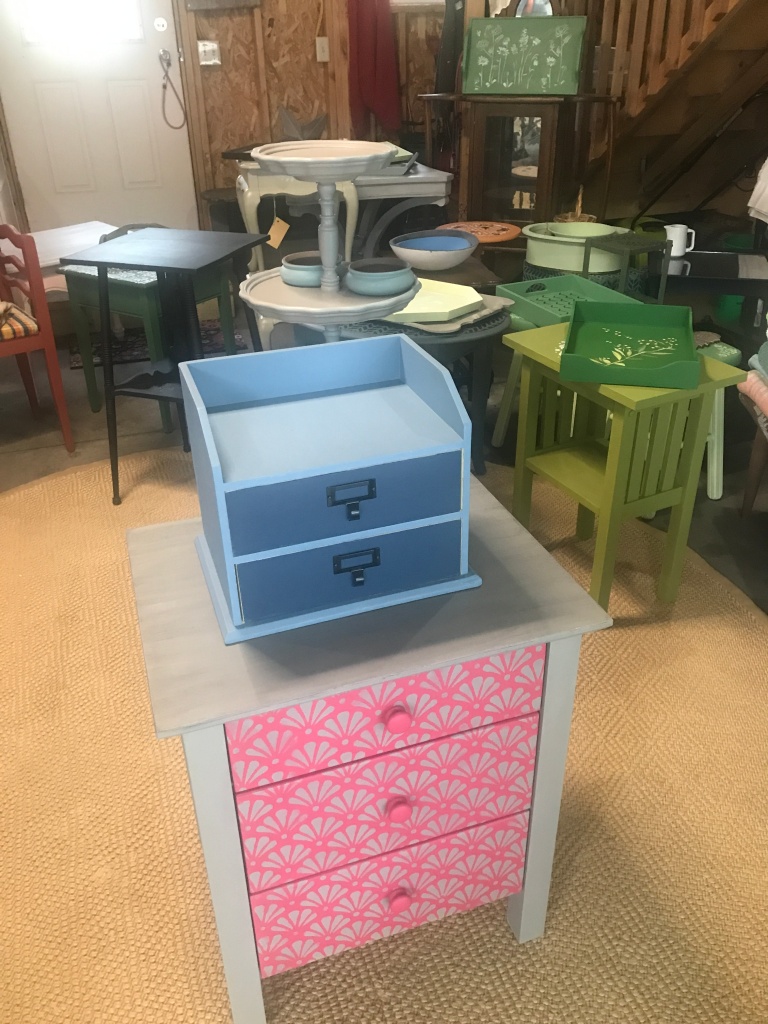
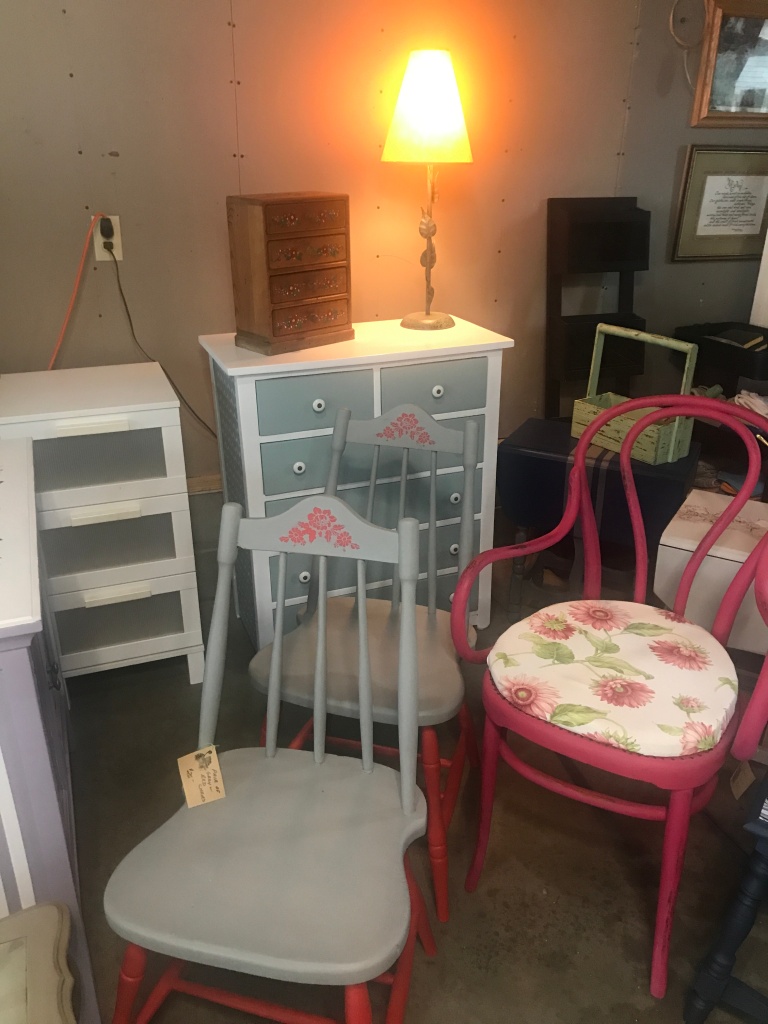
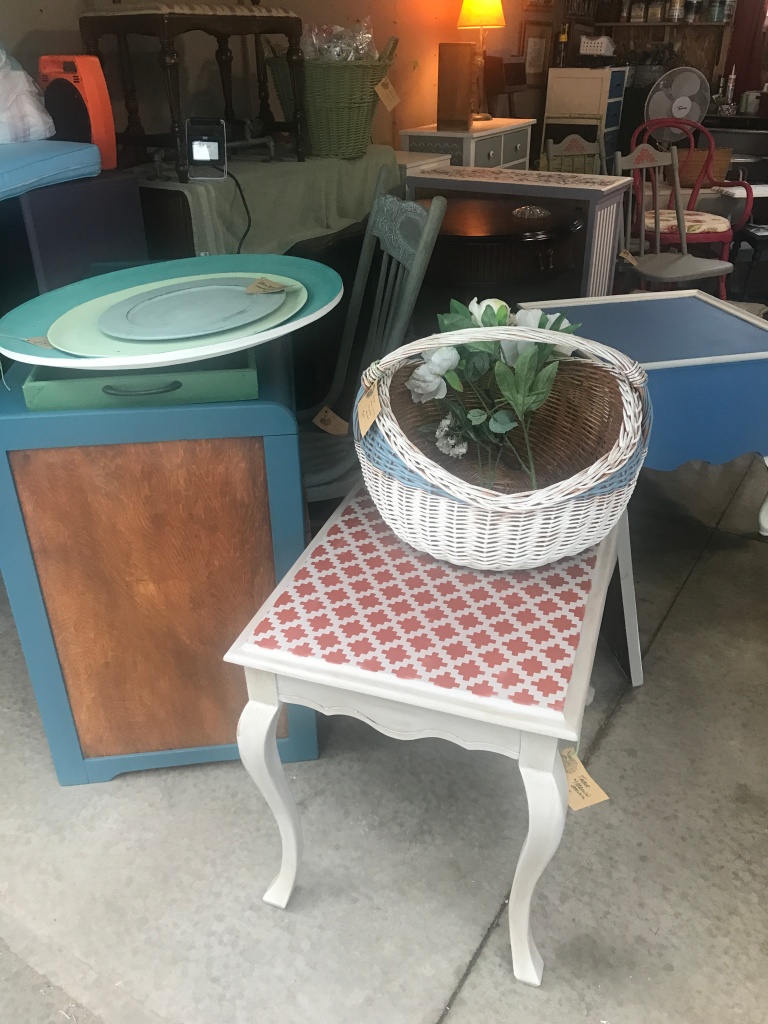
Many of you have shopped my husband’s annual garage sale in the past and know what magic he creates by painting old unwanted furniture. He transforms chairs and dressers and tables and whatever gets in his way!!! (See pictures on Tuesday’s post.) This year’s sale is Friday and Saturday, June 21-22 from 8:00 am to 4:00 pm. 2025 Wellesley Ave, St Paul.

All proceeds go to benefit Lutheran Social Services programs for youth experiencing homelessness.

Access to the sale is through the alley only (between Wellesley and Stanford).

A Rainy Day—Again

June 18, 2024

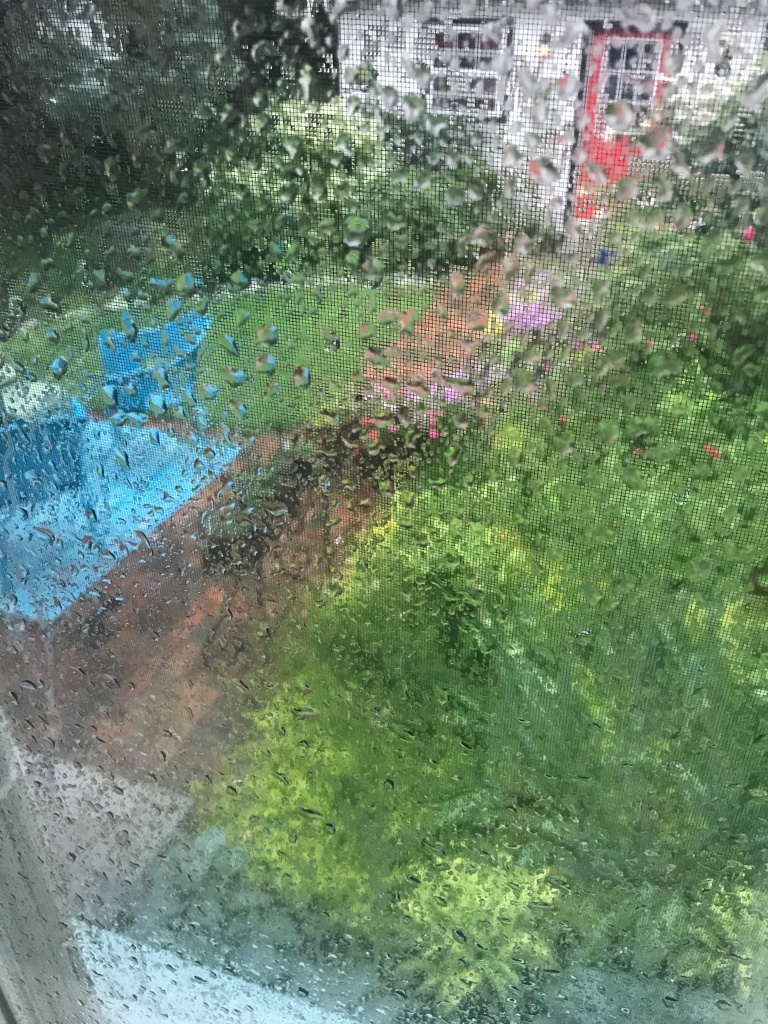
Part of my making the bed ritual each morning is to look out the window at the back yard. I give thanks for another night of rest and greet the day. This is what I saw when I lifted the shade yesterday morning. Rain. Again.

Yes, it was a gentle rain; the kind of rain that nurtures growth and green. Nonetheless, rain. Again. We have had a lot of rain recently and at first, we hesitated to complain because last summer the refrain was “Oh no, another day without rain.” We crawled through the dry, hot days. We despaired in the drought. We sighed in the dusty and dying lawns.

Now we say, “Our prayer was heard,” but underneath that relief, we mutter in irritation, “Why does it have to rain every weekend?” and “Enough is enough.”

Are we never satisfied? (No, probably not.)

Underneath our Minnesota Nice exterior, and yes, that is a thing, we Minnesotans tend to complain about the weather. A Lot. And when we have the weather we want, we wonder when the other shoe will drop. We shake our heads knowingly, saying, “This won’t last.”

Last winter we had no snow. Oh, a couple minor snowfalls, but no blizzards, no “Snow Days,” and not even severe cold. Snowblowers stayed in the garages and our warmest, heaviest Norwegian sweaters were hardly worn. All our preparations for the kind of winter we know and understand were not needed this past year.

More than one person was heard to announce, “We’ll pay for this.”

And then much to our surprise, we experienced a spring that was truly a spring with cool to warm temperatures and flowers and trees that unfolded their beauty. So often here we seem to be granted a day or two of spring, and then summer lands heavy and hot. That was not the case this year and we charged to garden centers and planted window boxes and set up the patio furniture. “What a gorgeous spring,” we rejoiced to one another.

However, more than one person was heard to announce, “We’ll pay for this.”

And now right on schedule when we are all set to enjoy days outside doing all the things we love to do in the summer in this state of 10,000 lakes, here we are inside looking out through rain-splattered windows. It’s apparently payback time.

And soon, far too soon, someone will say, “We better enjoy these days because winter will soon be here.”

Does the weather affect your mood? I would love to know.

Many of you have shopped my husband’s annual garage sale in the past and know what magic he creates with old unwanted furniture. He transforms chairs and dressers and tables and whatever gets in his way!!! This year’s sale is Friday and Saturday, June 21-22 from 8:00 am to 4:00 pm. 2025 Wellesley Ave, St Paul.

All proceeds go to benefit Lutheran Social Services programs for youth experiencing homelessness.

Access to the sale is through the alley only (between Wellesley and Stanford).

Book Report: Summer Reading in the Garden

June 13, 2024

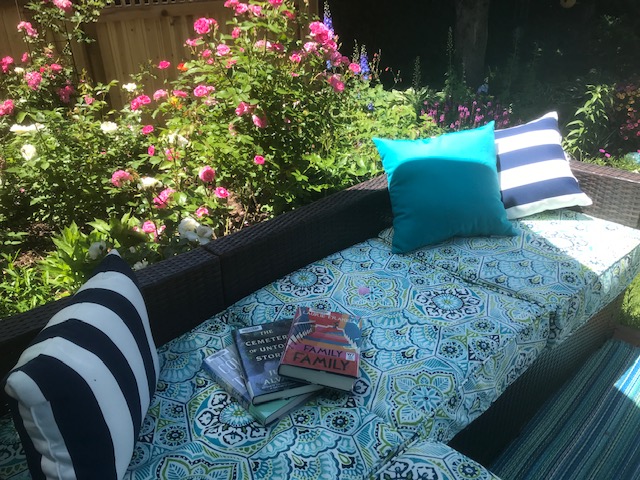
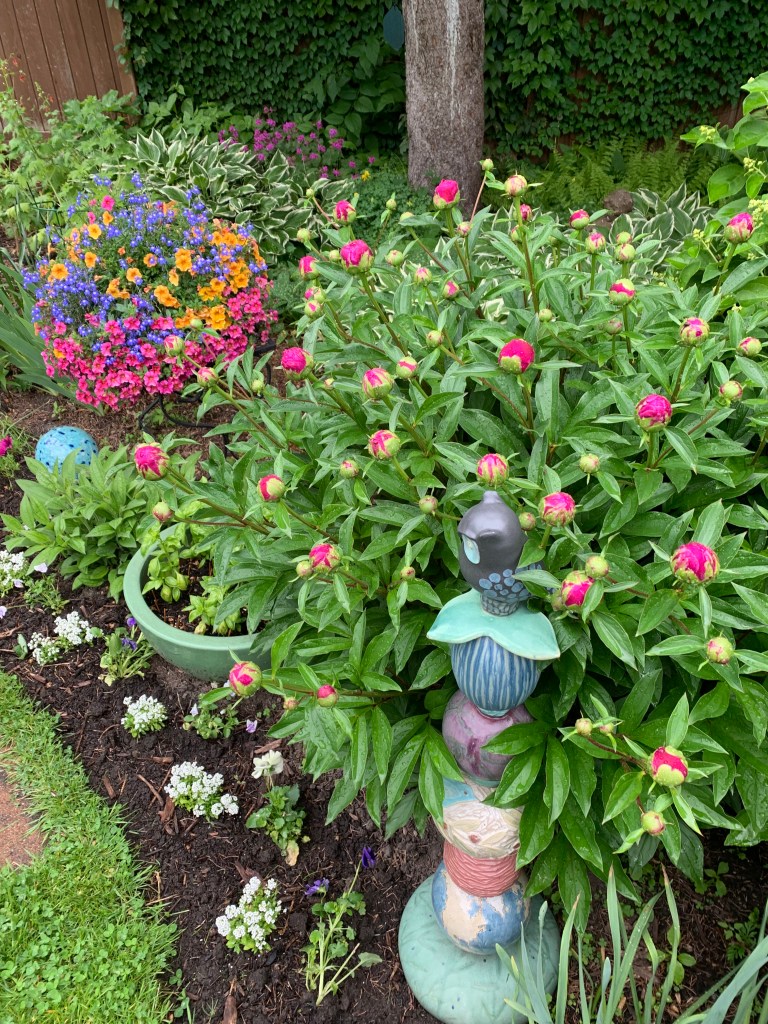
Summer reading deserves lovely summer settings, and on perfect summer days, this is where I like to read–our own patio and garden. Now I hasten to add, I have done nothing to make this space so perfect. All credit goes to my husband the genius and hardworking gardener. We have lived in this house for ten years, and he has created a private paradise.

My self-proclaimed job in the garden is to read so I can recommend books to you. Here’s three to put on your TBR list.

  1. Long Island by Colm Toibin (2024), 294 pages. If you have read Brooklyn (2009), you will already be familiar with the main character, Eilis Lacey, an Irish immigrant. The plot of this book begins when a stranger shows up on her doorstep to inform her that his wife is pregnant by Eilis’s Italian-American husband Tony, and the minute that baby is born, he plans to leave it on her doorstep. She wants nothing to do with this baby, but doesn’t confront Tony with his infidelity. Her mother-in-law, who, trust me, is a piece of work, has a plan. Eilis comes up with her own plan: go to Ireland to visit her mother who is turning 80–and, again, trust me, she is another piece of work. Eilis reconnects with a man from her younger years who has never married, but he’s secretly engaged to Nancy. These are complicated characters, each one of them, richly drawn, even if they are at times frustrating. The ending makes me wonder if this book will be #2 of a trilogy. An excellent summer read.
  2. The Cemetery of Untold Stories by Julia Alvarez (2024), 237 pages. This book did not disappoint. Alma Cruz is a writer, a successful writer, born in the Dominican Republic and one of several sisters, who frankly, I couldn’t keep straight. It doesn’t matter. When their father dies, Alma inherits a piece of land in the Dominican Republic, and she decides that is where she wants to bury her untold/unfinished stories. She commissions an artist to make the monuments and hires a groundskeeper, Filomena. Of course, the stories are not content to be buried, and the characters in the stories talk to each other and to Filomena and to us, the readers. In many ways the stories and characters are connected and related and that is part of the fun, the intrigue, and the richness in this book by a masterful storyteller. I love that Alvarez quotes this piece of scripture from the Gospel of Thomas, “If you bring forth what is inside you, what is inside you will save you. If you do not bring forth what is inside you, what is inside you will destroy you.”
  3. Family Family by Laurie Frankel (2024), 380 pages. India is pregnant the last year of high school and decides to have the baby placed for adoption. She always insists on the word “place,” rather than “give up.” She goes on to attend a prestigious acting school, her dream, and has great success. But guess what? She gets pregnant again in her senior year and places that baby up for adoption. She becomes a famous actress on Broadway, but also in Hollywood where the work is more regular and allows her to maintain a more stable life with her two children –not the two children who were adopted as babies. After she makes a movie with adoption as a theme, she expresses what turns out to be controversial ideas about adoption–that it isn’t always a trauma for the birth mother or the children or the adoptive parents–and she becomes a social media target. The result? I’m not telling. I especially appreciated the author’s skill with dialogue. Each character has his/her own voice. My daughter listened to this book and thoroughly enjoyed it too. One favorite quote:
It seemed to her that women did this all the time, weathered things that were hard and heartbreaking, but also chosen and even strived for. It seemed to her they often made tough decisions to let go, to lay down, in order to pick up something else because they knew--maybe in their bones, maybe having learned it again and again--that having all the things you wanted all at the same time was rarely on the table. It seemed to her that the people who had decided all birth mothers were regretful and unhappy and had been forced to do something they didn't want to do were probably men. p. 238

I am almost done with Lucky by Jane Smiley and like it very much. Stay tuned for a review. This book is the last of the books I had on my library hold list, and I’m forcing myself not to reserve others. Instead, I plan to read books on my personal hold list, including the newest (and last) Maisie Dobbs book by Jacqueline Winspear, The Comfort of Ghosts; Forgotten on Sunday by Valerie Perrin; The Hazelbourne Ladies Motorcycle and Flying Club by Helen Simonson; and two more books in the Lane Winslow mystery series by Iona Whishaw.

This doesn’t mean I haven’t been adding to my TBR list, however. Here are a few of those titles:

  • The Ministry of Time by Kaliane Bradley
  • Housemates by Emma Copley Eisenberg
  • Real Americans by Rachel Khong
  • Sandwich by Catherine Newman
  • You Are Here by David Nichols
  • This Strange Eventful History by Claire Messud
  • Sipsworth by Simon Van Booy
  • All the Colors of the Dark by Chris Whittaker
  • How to Read a Book by Monica Wood
  • Safekeep by Yale var der Wouden
  • This Is Where I Leave You by Jonathan Tropper

And even some nonfiction:

  • Life After Doom, Wisdom and Courage for a World Falling Apart by Brian McLaren
  • Shopkeeping: Stories, Advice and Observations by Peter Miller
  • Any Person is the Only Self (essays) by Elisa Gabbert
  • The Editor: How Publishing Legend Judith Jones Shaped Culture in America by Sara B. Franklin.

Where do you most enjoy reading in the summer? I would love to know.

A Postcard Primer

June 11, 2024

Stephen Carter in his book, Civility: Manners, Morals, and the Etiquette of Democracy offers a list of rules of civility. For example:

Civility has two parts: generosity, even when it is costly, and trust, even when there is risk.
Civility requires a commitment to live a common moral life.
Civility requires that we express ourselves in ways that demonstrate our respect for others.
Teaching civility by work and example is an obligation of the family.
Religions do their greatest service to civility when they preach not only love of neighbor but resistance to wrong.

As I prepare to work on another postcard campaign to encourage voting, I think about the simple ways we can promote civility–and how much that is needed. Making sure that every eligible voter is able to vote, feels comfortable voting, knows how and when to vote without impediment, and does not take this right for granted seems to me to be signs of a civil society.

In my April 9, 2024 post https://wordpress.com/post/livingonlifeslabyrinth.com/3340 I shared my practice of working on postcard campaigns. That is certainly not the only way to become involved during this crucial campaign year, but it is one thing I can do. Yes, it does take time, and there is a financial cost, for postcard stamps are not cheap (.53 each) and you need to buy postcards as well. I like to buy my postcards on Etsy, for not only are they attractive and colorful, but I also support working artists that way. A double win. https://www.etsy.com/search?q=etsy+postcards+for+voters&ref=search_bar

I have signed up to write postcards for the following organizations and invite you to check out their websites.

  1. Postcards to Voters: https://postcardstovoters.org
  2. Activate America: https://www.activateamerica.vote/postcard

You can choose campaigns that fit your time frame and also the campaigns that specifically interest you. And you can decide how many addresses you want to receive. I usually sign-up for 50 names/addresses, but sometimes a last-minute request comes to send a smaller amount, 5 or 10, and I try to do those, too. That means having supplies on hand–postcards and stamps; both can be ordered online, of course.

Both organizations give you specific instructions that include the deadline for mailing, the specific script to write on each postcard, along with the name and address of the recipient. You sign the postcard with only your first name.

I work on postcards while watching a movie or waiting for the pasta water to boil or sometimes after my morning meditation, which includes a prayer for our country, I write a few postcards. It all adds up.

I also recommend Jessica Craven’s website, Chop Wood, Carry Water, https://chopwoodcarrywaterdailyactions.substack.com/p/chop-wood-carry-water-67-eef and encourage you to subscribe to it, for at the end of each post she gives very specific actions, including scripts for phone calls and letter writing and postcard campaigns.

The newsletters written by Robert Hubbell and Heather Cox Richardson comment on current issues, along with judicial and historical references, giving you motivation as well as factual back-up for working to save our democracy.https://roberthubbell.substack.com/p/november-5th-will-be-our-d-day https://heathercoxrichardson.substack.com/p/june-7-2024-36d

Here’s a thought: gather friends for a postcard party. You can supply the postcards and stamps. Request the names and addresses ahead of time and give each guest a script and a certain number of names/addresses. Drinks and snacks are, of course, a must! Voila–you’ve got a stack of postcards to mail, and you’ve made a difference.

I am getting ready to work on two campaigns. One is for voters in Milwaukee, WI, encouraging them to vote. The other is for Sherrod Brown, running for re-election as senator from Ohio. This is a tight and critical race, but the words of Martin Luther King, Jr inspire me. “I have a dream…” and “Let Freedom ring.”

Feel free to share this post and/or the links included in the post with others who might be wondering what they can do during this scary and stressful time. We each can make a difference.

Tree Work

June 6, 2024

Turning to the day
and to each other
We open ourselves to the day
and each other.

This is the day that the Lord Has made
and a day we'll have to make our way through.
from Being Here, Prayers for Curiosity, Justice and Love by Padraig O Tuama

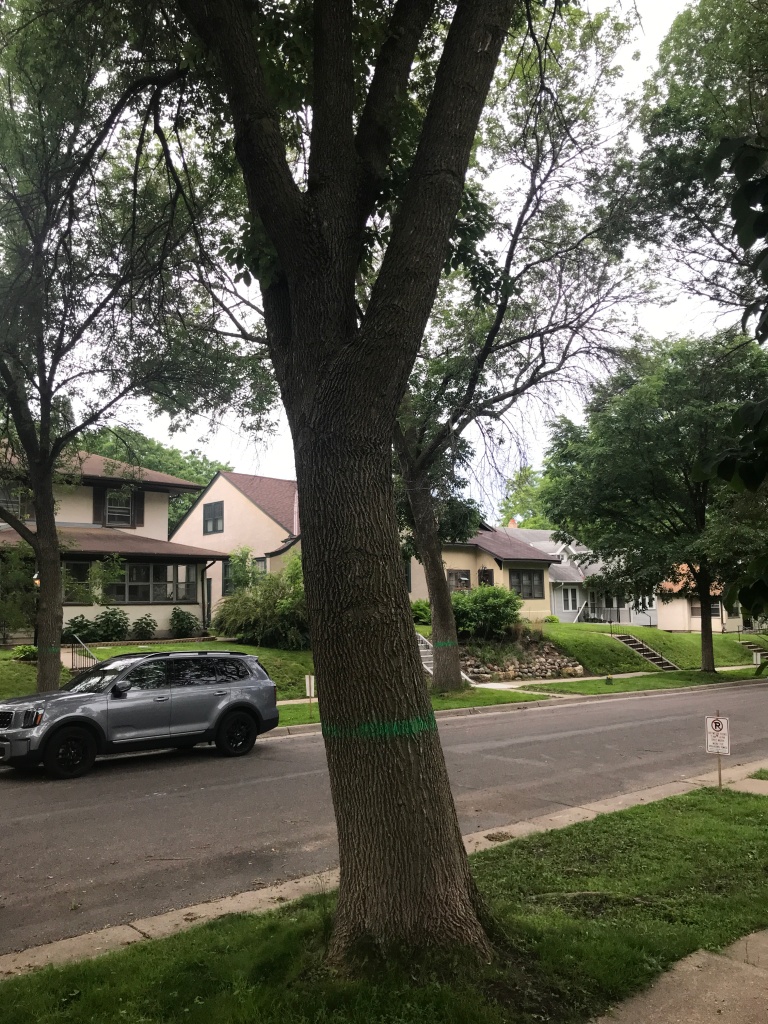
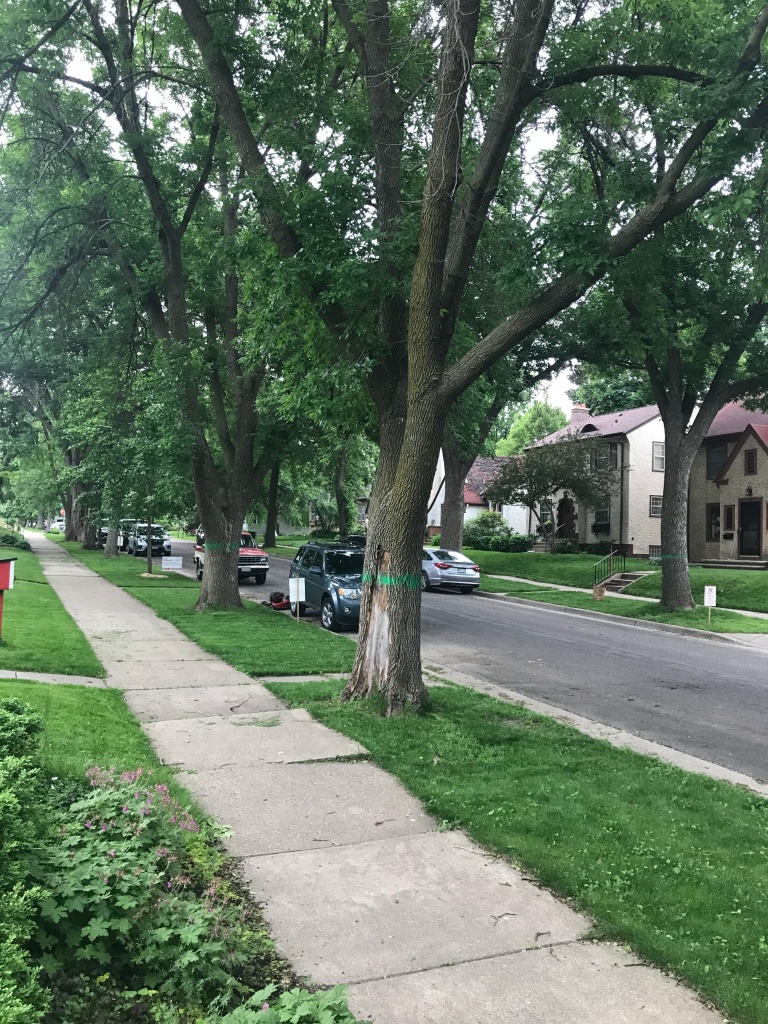
What a sad week for our block. We lost fourteen friends earlier this week. Diseased ash trees marked for destruction.

I took a memorial Monday morning, saying goodbye to the tress marked with a green end of life ring. I thanked them for their gifts of beauty and shade and shelter for birds and squirrels. To those allowed to live, I encouraged them to continue growing and to stay well. I thanked them for their ongoing presence.

We have been told that trees communicate with each other, and I wonder what their last conversations were. Did they say goodby to each other? How did they recognize and honor one another?

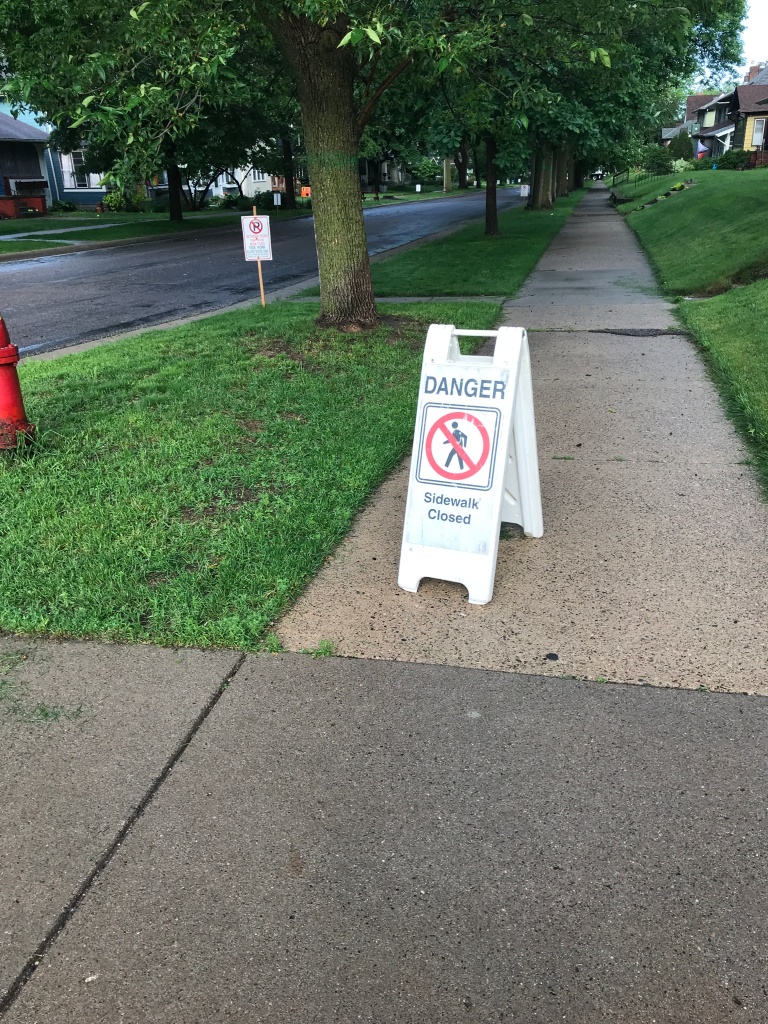
Before arriving home from my walk the trucks and workers had arrived, and the signs blocking sidewalks and streets were in place.

I defied the warning of danger and walked the last block home, instead of the alley. A couple neighbors stood on their steps as the action began, and I greeted them, “It’s a sad day.” “How different it will be,” one replied.

I was drawn to the snug, the room at the front of the house, feeling a need to be a witness to the lives that were ending. I moved my laptop from the garret to the desk in the snug, even though I knew the noise would be disruptive. That felt like the least I could do.

The noise began and as each tree lost its life, I heard a kind of death rattle. The men in their yellow vests did their jobs. Expertly, respectfully, but even though I know trees have life spans, too, and are subject to disease, this felt like a failure. And now those of us left will need to adjust to a new reality. That includes the birds and the squirrels. Some may lose their nests, even, but at the very least a playground, their perch and window on the world.

As Padraig O Tuoma says in his prayer, “This is the day that the Lord has made and a day we’ll have to make our way through.

In Being Here, O Tuoma’s new book of prayers, he includes a collect for each of the 31 days of meditations. A collect, pronounced with the emphasis on the first syllable, COLLect, is a form of “collecting something; namely your intention and desire, your reflection and attention, your gratitude, and your need for containment.” O Tuoma explains that the collect has five folds:

  1. Name the one you’re praying to
  2. Unfold the name of the one you’re praying to
  3. Name one desire
  4. Unfold the desire you’ve names
  5. Finish with a bird of praise

Bird of praise? Well, O Tuoma, doesn’t really know either, but says why not? Most collects I’ve read end simply with an Amen.

He simplifies the form even more:

  • Address
  • Say more
  • Ask one thing
  • Say more
  • End

Here is an example of a collect from Being Here:

Grandmothers of Jesus,
In your stories we hear of your
courage and creativity,
your tenacity,
and the things you faced down.
Here, today, we stand in the time after you
and look back,
with gratitude for stories like yours
that help us live today.
Help us live today
in all the stories of our lives
so that we can stand in your great
ache and wash.
Amen.

It occurs to me to write a collect, addressing the trees on our block, as a way to mark the day. Collects most often address God, by the way, but that is not always the case. In fact, Sunday I wrote a collect to my calendar and list for the week, giving thanks for the ways they remind me to be in the world, to use my gifts and energy, and to remember to pause. Here’s my collect for the trees:

Oh dear trees, sacred trees
Signs of God's love for all creation.
Reminders of the genius and beauty
of diversity, of transformation, of the need
for both grounding and stretching.
You have graced us with your presence,
given shelter and protection,
inspired us
as teachers, revealers, companions.
May our lives, even as we mourn your loss,
be signs of God's divinity on earth.
May we nurture new growth
both within our hearts
and along the avenues of our lives.
Amen.

Has there ever been a special tree in your life? I would love to know.

Book Report: May Summary

June 4, 2024

  1. Three Mysteries
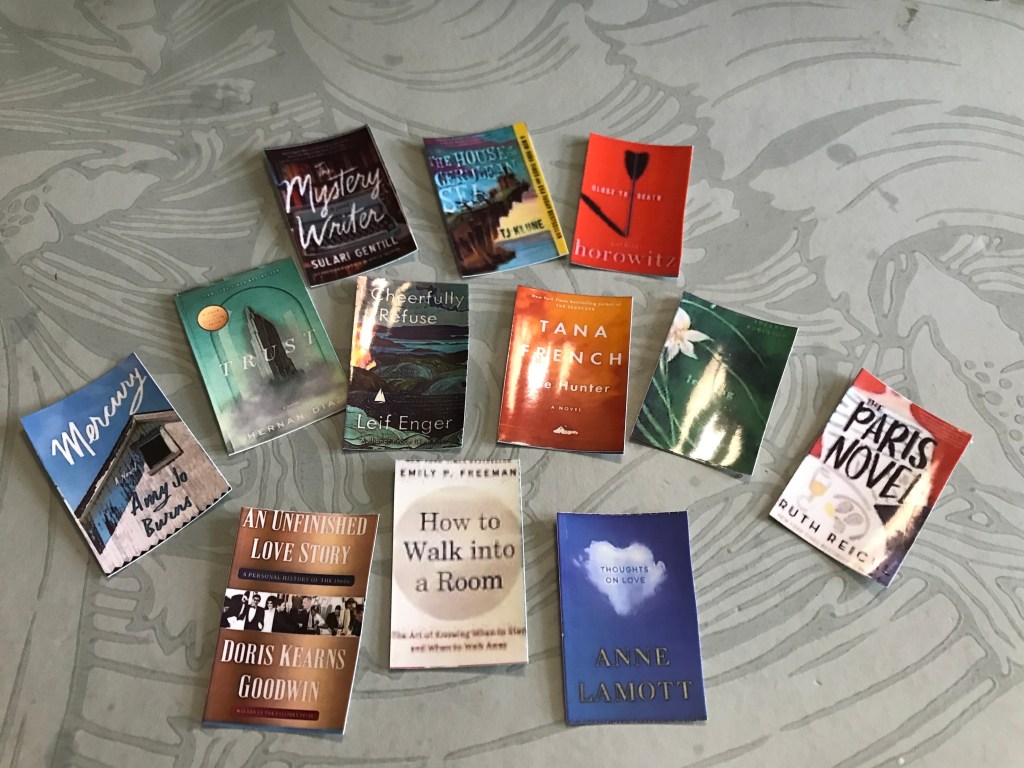
  • The Hunter by Tana French (2024) 467 pages. I probably should have read her earlier book, The Searcher, to know some of the backstory set in Ireland, but I think I followed it ok. Cal is a retired policeman from Chicago who has no connection to the village but has found home there and has created a new avocation for himself as a woodworker. The story involves a scam–supposedly discovering gold in the mountains there. Lots of ins and outs, but I loved some of the Irish vernacular. “She’s ninety-two years of age, hasn’t left the house since God was a child…” p. 339.
    Don’t keep me hanging about, I’ve a mouth on me like Gandhi’s flip flops.” p. 347.
  • Close to Death by Anthony Horowitz (2024). I didn’t enjoy this book as much as Horowitz’s earlier books, but that may be because I read it in small chunks and didn’t feel the flow. A resident of Riverview Close is murdered with a crossbow; a man who was disliked by every one in that community of old homes.
  • The Mystery Writer by Solari Gentil (2024) 366 pages. Again, an ok mystery and I liked her earlier book, The Woman in the Library much better. Plus, the number of proofreading errors, more than I’ve ever noticed in a book, distracted me. A young writer meets an older writer, and they have an affair. His literary agents shows interest in the younger writer’s book. Get ready for conspiracy theories and survivalist groups.

2. Two Family Sagas

  • Mercury by Amy Jo Burns (2023) 315 pages. The story of the Joseph family: father Mick, Mother Elise and three grown sons, Baylor, Waylon, and Shay –all with complicated personalities. “In the Joseph family Mick aimed for the impossible, Waylon hoped for the best, Baylor planned for the worst. And Shay? Shay baby was all right, always. Like the mail coming every weekday at four, like Lake Erie freezing over in January.” (p. 136) Waylon is married to Marley and they all live in the same house. Marley tried to create order in the family’s roofing business and to assert her individuality. The story unravels. “At some point a marriage must become a junkyard of things, unfinished sentences and earring backs scattered across the floor.” (p. 274) Well worth reading.
  • Leaving by Rosanna Robinson (2024) 327 pages. See my review of this book in my May 30 post. I loved this book.https://wordpress.com/post/livingonlifeslabyrinth.com/3557

3. One Book Set in the Future: I Cheerfully Refuse by Leif Enter (2024) 329 pages. Ron Charles book reviewer for the Washington Post calls this book a “sweet apocalyptic novel,” and that feels about right. Set in the near future on Lake Superior, Rainy is a musician married to Lark who owns a bookstore–a dangerous occupation. He embarks unexpectedly on an odyssey after tragedy upends his life. Climate crisis, economic disparity and political decay are in the background of this book, along with references to 16 wealthy families called “astronauts” who control everything, book banning, closed libraries, and an illiterate president. I was not surprised to like this book by Enger, for I have loved his other books, Peace Like a River, So Brave, Young and Handsome, and Virgil Wander, but I was surprised by the dystopian quality.

4. One Book Where Structure is Almost a Character. Trust by Hernan Diaz (2022) 402 pages. See my review of this book in my May 30 post.https://wordpress.com/post/livingonlifeslabyrinth.com/3557

5. One Book Set In Paris. The Paris Novel by Ruth Reichl (2024) 265 pages. No surprise, this book is charming! No surprise because the author is food critic/writer, this book includes lots of references to food. Mouth-watering food. When Stella’s estranged mother Celia dies, she leaves her tickets to Paris; a trip that brings Stella home to herself. Along the way she meets wonderful people and offers her a mission–the search for paintings by a woman who had been a model for many famous male artists. That part of the story is true. I loved all the references to the famous bookstore, Shakespeare and Company, too.

6. One Fantasy. The House in the Cerulean Sea by T. J. Klune (2020) 396 pages. Many people have recommended this book to me, and I am so glad I finally read it. Linus Baker is a case worker for the DCOMY, the Department in Charge of Magical Youth, and he is sent to investigate an orphanage on an island. He sets off with his ever-present book of Rules and Regulations, but he didn’t count on being intrigued by the children he met there. For example, Talia is a female gnome who has a beard; Phee is a sprite; Lucy is short for Lucifer and you know what that means. The master is Parnassus and turns out to be a …..read the book and find out. This is a book about tolerance and believing in one’s self and standing up for what is right and also, true love.

  1. An Unfinished Love Story, A Personal History of the 60s by Doris Kearns Goodwin. (2024) See my review of this wonderful book in my May 25th post. https://wordpress.com/post/livingonlifeslabyrinth.com/3525
  2. Somehow, Thoughts on Love by Anne Lamott (2024) 191 pages. I reviewed this book, which I also really liked, in that same May 25th post. https://wordpress.com/post/livingonlifeslabyrinth.com/3525
  3. How To Walk into a Room, The Art of Knowing When to Stay and When to Walk Away by Emily P. Freeman. (2024) 218 pages. Ok, now that I have devoured this book and underlined almost everything, I intend to re-read it slowly, carefully. Freeman is the a spiritual director, author of The Next Right Thing and has a podcast of the same name, and she often focuses on questions of discernment, using the metaphor of rooms. Is it good to stay in a “room,” or is it time to leave? And what about the “hallways” of our life? I like her acronym, PRAY which stands for point and call, remember your path, acknowledge presence, and yield to the arrows. Freeman offers both practical guidelines and inspiration for deeper reflection. I have been recommending this book to everyone–and now to you!

Twelve Books in May–and now on to June!

Have you read any of the books I mention? I would love to know.

Book Report: Two Novels — One I Loved and One I Appreciated.

May 30, 2024

Love found. Love lost. Love found again. Love –well, that would be a spoiler wouldn’t it?

Sarah and Warren meet and fall in love in college and move towards getting married, but when Warren proposes embarking on what Sarah considers a dangerous and unwise trip, she has second thoughts about who he is. They go their separate ways and marry other people. Decades later they recognize each other at an opera and soon begin an affair. Sarah is divorced and Warren’s marriage, he realizes, is unfulfilling. As Warren begins divorce proceedings, he faces not only deep distress from his wife, but also the wrath of his daughter who threatens to cut him out of her life completely. Both Sarah and Warren confront the moral responsibilities of their love for and history with their families and each other.

This book is an example of much of what I love in a book: complex, but believable characters. Characters who struggle to learn about themselves and one another and grow. The ending doesn’t need to be happily ever after, but it must make sense. Along with being well-written–a must–I want to learn something about myself on the pages. In this case I thought about all the different lives possible within us with just a slight change of direction or a different decision.

And this book is not just well-written, but beautifully written. One example is early in the book as Sarah and Warren become reacquainted:

“I wanted to hear about your life,” she says. ” You go along from year to year and you think you’re part of the lives of everyone you’ve known. You sort of feel you own them, even if you don’t see them, because they live inside your mind. Then you’re sixty, and you realize the people you knew have been leading their lives apart from yours. Remember in To The Lighthouse, when someone tells Mrs. Ramsay about friends she hasn’t seen in years? They’ve built a conservatory. Mrs. Ramsay remembers the time they went on the river together, and she was so cold. She can’t believe that they’re the sort of people who would build a conservatory. She’s shocked to realize that they have been carrying on their lives without her.” She smiles at him. “I wanted to know what happened to you. If you’d built a conservatory.” p. 42

It doesn’t hurt that they are the kind of people who read and loved Virginia Woolf, but more than that I love the intelligent and sensitive and deep conversations and interactions. I must say, however, I found both Sarah’s and Warren’s adult children annoying and not as well drawn.

Robinson has written other novels and short stories and a biography of Georgia O’Keefe, which I think I may have read. More for the TBR?

What stands out for me in this book is the intriguing construction.

The book is divided into four sections, beginning with a novel within the novel: Bonds about 1930’s Wall Street tycoon Benjamin Rask and his wife Helen. The next section, My Life, is notes for another book, similar to Bonds. Andrew Bevel narrates his life in finance and his philanthropic wife Mildred. The reader wonders, “What is going on here?” The third section introduces Ida Partenza, the daughter of an Italian immigrant who is hired by Bevel as his secretary and ghostwriter. Bevel’s intention is to refute the version told of his life in Bonds. He wants to set the record straight. And the 4th section, well, it’s Bevel’s wife’s Mildred turn to share her version. Huh? Really?

I supposed I should not have been surprised that a book titled Trust invites the reader to question everything. What is fact? What is fiction? Whom and what should I trust?

Trust is a 2023 Pulitzer Prize winner, along with Demon Copperhead by Barbara Kingsolver–a book I loved. I admire Trust as a mastery of manipulation and I, like many reviewers thought about Edith Wharton and Henry James as I read this book. And also The Great Gatsby and even the song about money from the musical Cabaret. I am glad I read it and I encourage you to read it, too, but it felt more like an intellectual exercise than a companion.

I just learned, thanks to Anne Bogel’s Summer Reading Guide https://members.modernmrsdarcy.com/product/2024-summer-reading-guide/ that French author Valerie Perrin’s first novel, Forgotten Sunday, will be released here in June. Her book Fresh Water for Flowers is one of my all-time favorite novels, and I will set aside anything I am reading for this work by her.

Thanks to Anne, I have added a number of other books to my TBR:

  • Real Americans by Rachel Khong
  • Sandwich by Catherine Newman
  • You Are Here by David Nicholls
  • All the Colors of the Dark by Chris Whitaker
  • How To Read A Book by Monica Wood
  • Shopkeeping: Stories, Advice and Observations by Peter Miller

Both Parnassus Books (Ann Patchett’s book store in Nashville) and Arcadia Books, Spring Green, WI have forced me to add these books to my TBR.

  • The Rachel Incident by Emma O” Donoghue (now in paperback)
  • Safekeep by Yale van den Wooden
  • Housemates by Emma Copley Eisenberg

Next Thursday, June 6, I will post the summary of my May reading and also my intentions for summer reading. Stay tuned and happy reading!

Have you added anything to your TBR recently? I would love to know.

Savoring Summer Spirituality

May 28, 2024

Summer days –and nights–stretch out in front of us. Many of us wait for these summer months throughout the long winter months and the sometimes indecisive days of spring. How often do we daydream in March about what we will do, where we will go, and whom we will see when Memorial Day finally leads us into summer?

Several years ago I led an adult forum about summer spirituality at our church. The following material is adapted from that forum and the guide book I wrote as part of that presentation. I invite you to consider how you might savor this summer season.

Before immersing yourself in summer activities, sit in a comfortable and favorite outdoor space where you won’t be disturbed. Close your eyes lightly, not tightly. Take a couple deep cleansing breaths and ask yourself, “How am I as I enter this summer season? What do I need now? Do I need rest? Change? Inspiration? Connection?

What have I learned during the winter months that will enhance these summer months? Is God directing me in a new or different way?

Consider the following themes. Which ones seem to shimmer for you? Which ones open your heart? Or challenge you?

  • Summer Spaciousness. In what ways does summer feel more spacious? How is summer different from other seasons? In what way is summer a time of rest and restoration? Is there anything that needs to be released, to be set aside?
  • Summer Senses. The senses are doorways into the holy and offer us opportunities to encounter God. Explore the senses–the tastes, touches, smells, sights, sounds of summer. What dazzles you? What sensual memories do you have of summers in your younger years?
  • Summer Simplicity. Summer invites us to discern what is essential. In what ways are summer days easier, simpler? If you travel this summer, can you pack lightly?
  • Summer Shifts. What signals the start of summer for you? What changes in your life during the summer? What do you notice about yourself in the summer that is different from other seasons? Where do you feel that shift in your body?
  • Summer Sacred Space. A sacred space is where you sense the presence of Spirit. Where are your summer sacred spaces–in the present and in the past? How do you create sacred space during the summer?
  • Summer Silliness. What role does play and silliness have in your life, especially in the summer? How does summer encourage you to “lighten up”? What memories do you have of fun and silly times?
  • Summer Stillness. In stillness you listen to yourself and to the voice of God within, clearing the space for new ideas, new connections, new deeper awareness. Where and when do you experience stillness in the summer? How does that feel?
  • Summer Stretching. Are there areas your life–body, mind, or spirit–that could benefit from stretching your perspectives, your ways of living and moving and being in the world? What physical activities engage you in the summer and how do they enliven and open you? Remember the summer activities of the past. How did they form who you are today?
  • Summer Celebrations. What do you celebrate during the summer? What are your summer rituals? In what ways do you celebrate the ordinary?
  • Summer Support. Where do you find community in the summer? Is it different from other times of the year? What support do you need this year? Who do you know who could use your support this summer?
  • Summer Sadness. As much as we look forward to summer, there can be disappointments–plans that don’t materialize, weather changes etc. How do you cope? How flexible are you? Do you have sad, difficult, or challenging memories of summers past? Is it time to let them go or allow them to transform into growth?

Is a new spiritual practice beckoning you or is summer a chance to adapt your ongoing spiritual practice? For example, move your prayer and meditation time outside. Practice yoga or T’ai Chi outside, instead of inside.

Here are some possible summer spiritual practices:

  • Keep a summer journal. Pilgrims carried a small book with them, a vade mecum, which means “go with me.” They wrote prayers, poems and insights in the journal. Write what you notice and learn on these summer days. Where do you notice the movement of God?
  • Practice visio divina (sacred seeing), which is similar to lectio divina (holy reading). See with the eyes of your heart. Pay attention to what shimmers, what invites you, what startles or amazes you. Perhaps commit to taking one photo a day and at the end of summer print your photos. Do you notice any patterns? Where did God appear to you?
  • Go on Meditation Walks. For 30 minutes walk slowly and silently. Stroll. Amble. Pay attention to your senses. Stop and linger when you are attracted to something–birdsong, the colors in a garden, the scent of freshly mowed grass. Be in the moment.

Other summer practices include extending hospitality to guests, gardening, walking outdoor labyrinths, spending time in nature, stargazing, cloud gazing, volunteering in a new way, learning something new, sketching or painting outdoors. Change your routine in some way and notice what opens for you.

Invite a loved one into a practice of daily sharing with each other a gift, an expression of God, noticed or experienced?

May the God of summer give us beauty.
May the God of summer give us rest.
May the God of summer give us joy.
May the God of summer give us inner light
May the God of summer give us what we need for healing.
May the God of summer give us a sense of satisfaction in the work of our hands.
May the God of summer lead us to amazing discoveries as we travel the inner roads of our souls.
Amen.
adapted from Joyce Rupp

What comes to mind when you think of summer spirituality? I would love to know.

Here is a post I wrote in 2023 about summer spirituality. https://wordpress.com/post/livingonlifeslabyrinth.com/2216

Also, the photos were taken in our glorious backyard. I happen to live with a master gardener!