Settling Into Lent

February 27, 2023

Ash Wednesday was almost a week ago and yet, I still don’t feel settled into Lent.

I haven’t chosen a specific book of devotions for my morning meditation time, although I have been re-reading the Lenten section in my favorite Circle of Grace, A Book of Blessings by Jan Richardson.

If you would enter
into the wilderness,
do not begin
without a blessing.

Do not leave
without hearing
who you are:
Beloved,
named by the One
who has traveled this path
before you.


I have not decided on a specific Lenten practice. Earlier this year I decided I would plan my future memorial service during this time, and I will do that, but that doesn’t feel like enough. (What is enough?, you ask. Good question.)

In years past I have listened for a word of the day, filling in a daily chart. https://wordpress.com/post/livingonlifeslabyrinth.com/681 Other years I have written and sent one letter or note every day. And then there were the years when I focused on my extensive collection of spirituality and theology books, choosing at least one to discard each day. Each year my collection deceased by at least 100 books. That practice has made me more aware and disciplined about the books I decide to keep and to acquire.

But what about this year? Richardson’s words guide me:

Let us say
this blessing started
to shed all
it did not need,...

What do I no longer need?

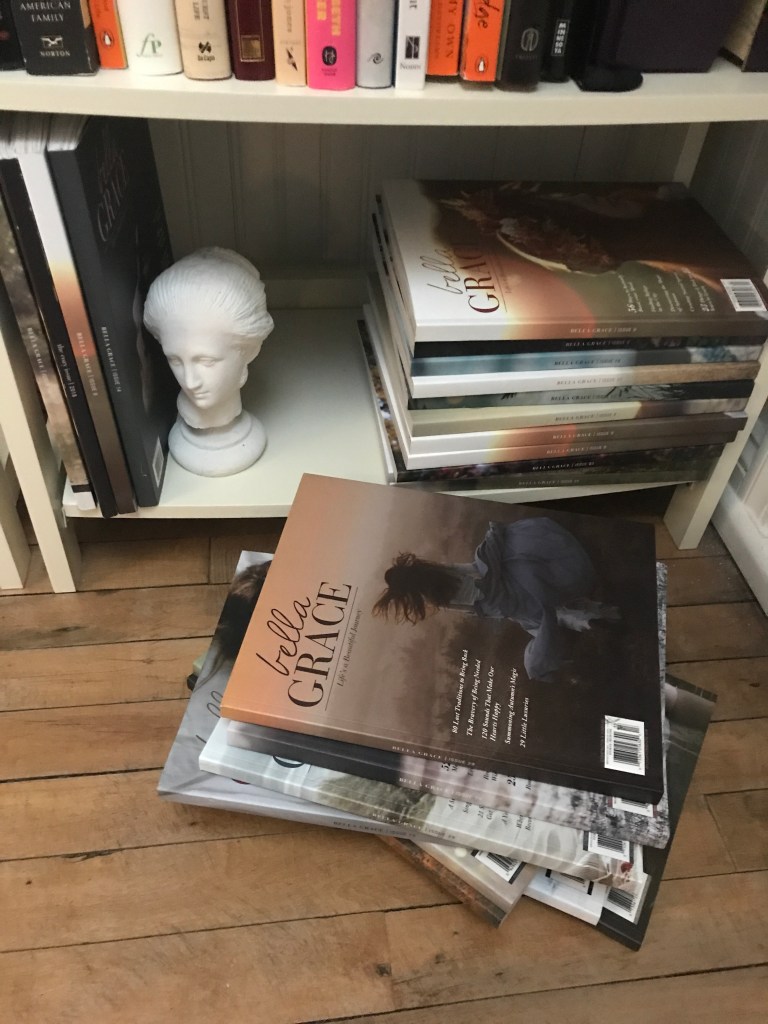
A new issue of the quarterly publication, Bella Grace arrived in the mail, and I added it to the stack of previous issues I have barely glanced at. When I first started subscribing to it, I set aside time to immerse myself in the lush photography, the inspirational essays, and the suggestions for appreciating the beauty of everyday life. I even submitted my own essays to the publication and was thrilled when several were published. One, “The Comfort of Shawls” was even reprinted in one of their other publications, The Cozy Issue, and another, “The Magic of Reading in Bed” was published in the Bella Grace blog.

Although I hav continued to submit essays, such as “Porch Envy” or “Window Wishes,” none have been accepted the last couple years. Disappointing, of course, but I have come to realize and accept that as a near 75 year old woman, I am no longer their audience. The magazine is geared to much younger women. Women during the child-raising years. Women managing careers and family life. Women discovering who they are.

I’m still discovering who I am, but now in a much later decade. Not only is Bella Grace no longer a good fit for my writing, but Bella Grace is not a good fit for me, and yet, I have stacks of past issues on my bookshelves. Ok, Lenten Lady, it is time to clear the space. But first, I decide to page through each one, saving some photos and quotations I may want to use as writing prompts for the church writing group I facilitate.

Good. I like the idea of having one more almost empty book shelf, although I am keeping the issues in which my essays were included, but this activity, this decision is not only about letting go, but also about acceptance and awareness. Accepting who I am now and awareness of who I want and need to be now. A Lenten practice.

It's true that
you may need
to do some crumbling,
yes.
That some things
you have protected
may want to be
laid bare,
yes. 
That you will be asked
to let go
and let go,
yes.

But listen.
This is what
a desert is for.

The true spiritual practice for me this year, perhaps every year I am blessed to have, is to pay more attention to how I am to love and live right now. Right now, right here. What does each day call me to do, to be? What bookshelves in my inner life need to be emptied and in what ways am I holding that sacred space? How do I carry this sacred season of Lent with me? And how do I notice the movement of God?

How does being an elder become my spiritual practice?

I am my silence. I am not the busyness of my thoughts or the daily rhythm of my actions. I am not the stuff that constitutes my world. I am not my talk. I am not my actions. I am my silence. I am the consciousness that perceives all these things. When I go to my consciousness, to that great pool of silence that observes the intricacies of my life, I am aware that I am me. I take a little time each day to sit in silences so that I can move outward in balance into the great clamour of living.

Embers, One Ojibway’s Meditations by Richard Wagamese

As Jan Richardson would say, “this is where the breath begins,” and perhaps, this is where my Lenten practice emerges.

An Invitation

What spiritual practices are emerging in your life right now? I would love to know.
Book Report: Shopping my Library for Books on Spiritual Practices

February 23, 2023

Get ready for a barrage of books.

Yesterday was Ash Wednesday, leading those of us in the Christian faith into the Lenten season. Lent seems like a good time to reflect on the role of spiritual practices in our lives. Even though I have written about and offered workshops and talks on this topic many times before, I know I can still learn more. My ongoing hope is to demystify the nature of spiritual practices and to explore ways to integrate spiritual practices into our daily lives.

Often the place I begin is in my own library. What have I underlined in books I have read? What books feel like a classic resource in my own spiritual development? What books opened me to something new? What books no longer fit my evolving faith? Which books have become a presence in my life? Which books deserve another look?

Well, it is quite a rabbit hole, but here are a few impressions and notes from my recent browsing:

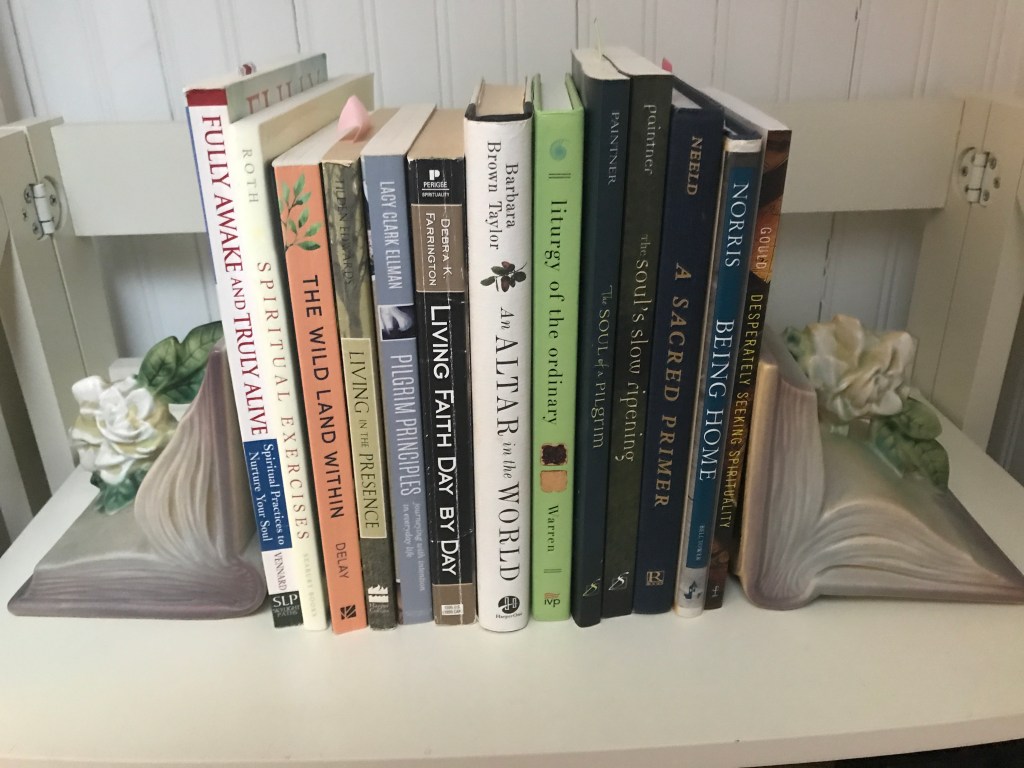
Jane Vennard in Fully Awake and Truly Alive, Spiritual Practices to Nurture Your Soul introduced me to the Buddhist terms, “on-cushion practices” and “off-cushion practices,” and changed the way I think about spiritual practices. “On-cushion practices are the more intentional, formal, perhaps traditional kinds of practices like meditation and centering prayer. “Off-cushion practices” are less formal and more spontaneous experiences, like pausing to look at a sunset and feeling connected to all of creation or sending blessings when you see the neighbor children walking to school every morning. The poetry/meditations of Being Home by Gunilla Norris have helped me be aware of the many opportunities for off-cushion practices throughout my days.

from "Choosing What to Wear"

I stand by the closet door
barefooted before this choice.
When I pick now I want to remember
that You have picked me--
no self-made woman, but one brought forth
by the lives that have gone before me,
lives that have made mine possible...
from the first single-celled creatures,
those ancient ancestors,
to the dear ones I call parents.

Liturgy of the Ordinary, Sacred Practices in Everyday Life by Tish Harrison Warren also starts with the possibilities for spiritual practice in each day, the overlooked moments and routines, like sitting in traffic or checking email. She examines these moments as doorways to the sacred and to living a life of deeper awareness of the holy.

I want to learn how to spend time over my inbox, laundry, and tax forms, yet, mysteriously, always on my knees, offering up my work as a prayer to the God who blesses and sends.

page 100

I have consulted and even re-read in their entirety several of these books, including An Altar in the World, A Geography of Faith by Barbara Brown Taylor and two of Christine Valters Paintner’s books, The Soul’s Slow Ripening, 12 Celtic Practices for Seeking the Sacred and The Soul of a Pilgrim, Eight Practices for the Journey Within. All three of these books have become sacred texts for me.

Whoever you are, you are human. Wherever you are, you live in the world, which is just waiting for you to notice the holiness in it. So welcome to your own priesthood, practices at the altar of your own life. The good news is that you have everything you need to begin.

An Altar in the World, p xvii

Some of the books I have had on my shelves for a long time, and they continue to inform and inspire me. I think I bought Tilden Edwards’ Living in the Presence, Spiritual Exercises to Open Our Lives to the Awareness of God when I was in spiritual direction training in the 90’s–one of those basic texts. Not as dense, lighter, but no less wise is A Sacred Primer, The Essential Guide to Quiet Time and Prayer by Elizabeth Harper Neeld. Another title that has served me well is Living Faith Day By Day, How the Sacred Rules of Monastic Traditions Can Help You Live Spiritually in the Modern World by Debra K. Farrington. Farrington approaches spiritual practices from the structure of creating a rule of life for one’s life. That may sound daunting, but she makes it approachable and desirable.

The topic continues to be relevant, and I continue to add books to my collection, including Pilgrim Principles, Journeying with Intention in Everyday Life by Lacy Clark Ellman, The Wild Land Within, Cultivating Wholeness Through Spiritual Practice by Lisa Colon Delay, and another with an intriguing title, Desperately Seeking Spirituality, A Field Guide to Practice by Meredith Gould. Each one of these books feels like a generous and welcoming companion. One more –a book I have acquired, but not yet read, Essential Spirituality, The 7 Central Practices to Awaken Heart and Mind, by Roger Walsh. Stay tuned for a further evaluation.

Several of the books refer to spiritual practices that include specific ways the body is a tool for care of the soul, but one book stands out, Spiritual Exercises, Joining Body and Spirit in Prayer by Nancy Roth. This book reminds us that walking and doing Pilates and yoga and T’ai Chi and dancing and receiving a massage are also ways to experience the movement of God.

More…More…More

My library includes separate shelves with books on aging and spirituality. Several of those titles address spiritual practices, including Aging as a Spiritual Practice, A Contemplative Guide to Growing Older and Wiser by Lewis Richmond, A Season of Mystery, 10 Spiritual Practices for Embracing A Happier Second Half of Life by Paula Huston, and Pilgrimage into the Last Third of Life, 7 Gateways to Spiritual Growth by Jane Marie Thibault and Richard L. Morgan. I will save reflections on these books for another time.

A Gentle Reminder

As much as I love books and as much as book enriches my spiritual life, reading about spiritual practices does not substitute for practicing. Writing posts in my blog is one of my spiritual practices.

An Invitation

What are your spiritual practices? I would love to know.

Snow Days and Found Time

February 21, 2023

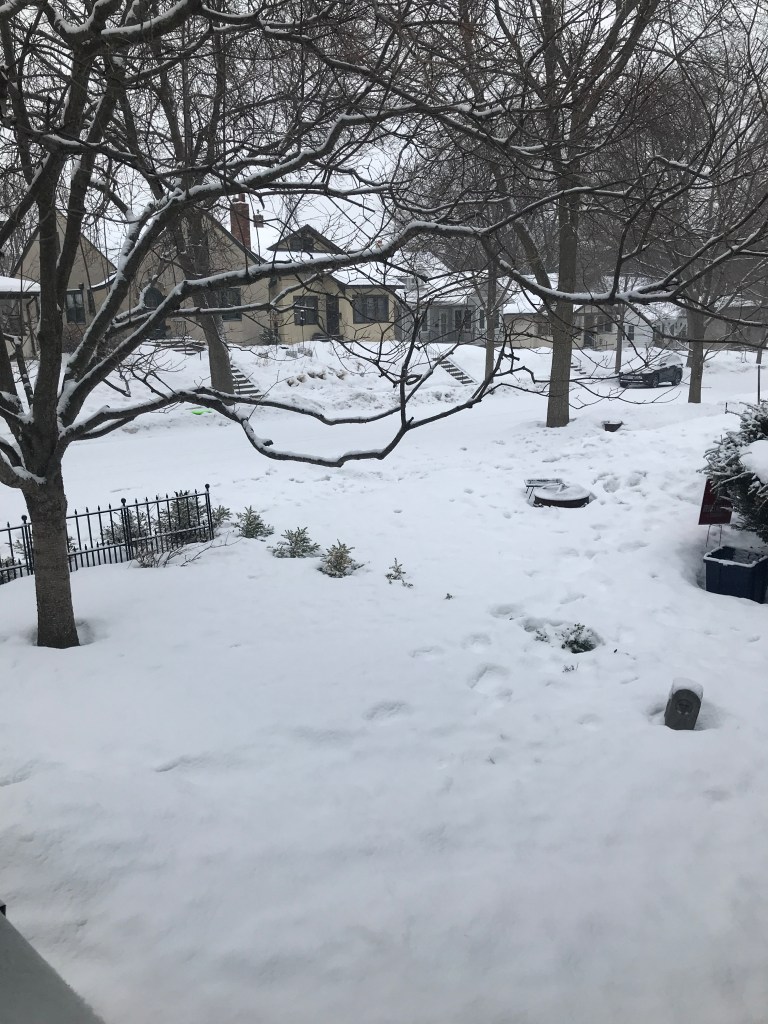
The prediction is that this part of the world will get 20-30 inches of snow this week. Fresh snow everyday beginning Monday and continue snowing through Thursday. I chuckled Monday morning when I looked at the hourly forecast and read “Snow stopping in 39 minutes, starting again in 7 minutes.” I thought about setting the timer on my phone.

When I was decades younger, this kind of weather meant rearranging schedules and planned activities and figuring out how to do what must be done. Would school be cancelled? What would be the easiest, safest way to get to work? Do we have enough milk? Or in more recent years, I called my Dad to make sure he was ok and wouldn’t be venturing out.

During the years of raising children and working full-time, the pre-retirement years, predictions of debilitating weather certainly raised my anxiety levels.

Now, however, as a privileged woman in her mid70’s, my immediate concerns are far less. Yes, I have a couple dates with friends this week, but we will put a new date on the calendar. And appointments with clients can either be reset or we can meet on zoom. If my church writing group can’t meet this week, I will email them some snow day writing prompts.

I so hope we can get to one of the Ash Wednesday services, but if that isn’t possible I will create my own contemplative time, minus the ashes, and will enter the new season in that way. It won’t be the same, but it will be whatever it is.

In the past I have written about the concept of “found time,” the space that is created when something is cancelled or changed. Instead of feeling frustrated by the necessary and sometimes inconvenient changes, I decided years ago to breathe into that space. Oh, surprise, I have a bit more time to read or write or bake cookies or do nothing at all. And that is how snow days can feel. (Easy for me to say–my husband is the one who does all the shoveling.)

Lately, I have also realized that I can create more “found time” in my life not just on snow days, but on any day, if I am willing to let go of worries and concerns, of a need to control, and to the way I think things should be or the roles I have had in the past.

Christine Valters Paintner is offering a Lent retreat called “A Different Kind of Fast” https://abbeyofthearts.com/calendar/a-different-kind-of-fast-lent-retreat-2023/ in which she suggests fasting from what gets in the way of living fully.

  • Multitasking and inattention
  • Anxiety
  • Speed and rushing
  • Strength and holding it all together
  • Planning and deadlines
  • Certainty

If you fasted from any of the items on this list, what would your day look like? How would you feel? In what ways might you become more aware of the movement of God in your life?

Instead of clinging to what feels necessary and familiar, dwelling in the lost, can you rejoice in the found?

How about envisioning this found time as a kind of Sabbath?

God is not found in the soul by adding anything but by subtracting.

Meister Eckhart

More God is the only thing on my list…When you live in God, your day begins when you lose yourself long enough for God to find you, and when God finds you, to lose yourself again in praise.

Barbara Brown Taylor

An Invitation

What does “found time” look like for you? I would love to know.

Book Report: Writing Books By Eric Maisel

February 16, 2023

I love to read.

I love to write.

I love to read about writing.

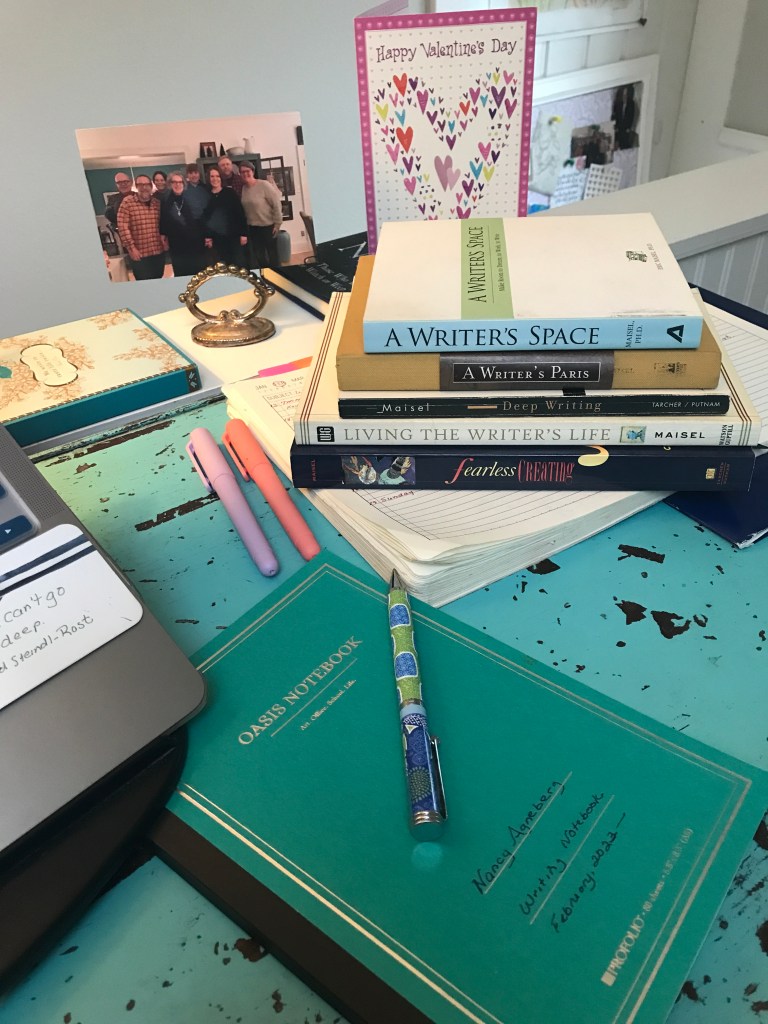
One of my favorite writers about writing, as you can see in this stack of five books, is Eric Maisel. I have other favorites, of course. Natalie Goldberg, Anne Lamott, Elizabeth Jarrett Andrew, and more recently, I loved the book, Memoir as Medicine by Nancy Slonim Aronie. And you will see a collection of Julia Cameron books on my writing bookshelf, too.

There is something about Maisel’s books, however, that resonate with me, and I make it a point to re-read at least one of his books each year. Most often the EM book of choice is A Writer’s Paris, A Guided Journey for the Creative Soul. (2005). The book, small, easy to hold, the size of a small journal or travel guide, is a call to follow your fantasy image of yourself as a writer and where better to do that, but Paris?

What might it mean to your creative life if you included, as part of your education as a writer, a risky experience like running off to Paris to write? Something on that order may be needed to unlock the trunk and let out those thousand poems, those hundred short stories, that full shelf of novels or narrative nonfiction.

pp. 2-3

I have been to Paris just once and even sat in a cafe and wrote in my journal, but I don’t have plans to go to Paris for a writing retreat. If I did, I would take this book, which hovers between fantasy and reality, for it has practical hints for living in Paris, but also addresses ways each of us wannabe writers can live that life now. Here and now.

I write in a garret. Yes, it is in St Paul, Minnesota, USA, but somedays it is easy to think of it as a French garret in some centuries old building. I imagine walking down several flights of smooth stone stairs and crossing the street to a boulangerie, greeting the baker and buying the day’s ration of bread and then returning, walking back up those same smooth stone stairs, flight after flight, to my garret. My view today, however, is not of Parisian rooftops, but instead our garage roof and an occasional bird sitting on the electrical wire. My Paris. My here and now.

I begin to write.

And in the summer I write in a secluded small garden I call “Paris.” I sit at a bistro table and write. I can see neighbors walking by, but it is rare I am noticed. True, this little garden is not beyond the French doors of a Paris apartment, but I can pretend, and sometimes I do.

This little book reminds me to “access the Paris already inside of you. There is a Paris-of-the-mind that resides in each of us…It is available to you right now.” p. 191

I may not have gone to Paris to write, but many years ago I did go to Bainbridge Island, Washington to write, and I have given myself solo writing retreats in a cabin on one of Minnesota’s lakes, as well as writing retreats led by other writers. I have found ways to create Paris for myself, including in the garret.

Recently, I pulled Maisel’s A Writer’s Space, Make Room to Dream, to Work, to Write off my bookshelf, and the book opened to this:

The writing life is defined by the succession of choices you make, primary among them whether or not you will write.

p. 54

I have been lucky over the years, no matter where we lived, to have a room of my own, but that is only part of the issue. The other aspect is creating time to write and devoting energy to do that. I looked at my calendar recently and realized that with one small change I could create Writing Wednesdays. Yesterday was my third Writing Wednesday, and I devoted the day to working on an essay about walking labyrinths.

I write on other days of the week–my twice-weekly blog posts, for example, and most mornings I write in my journal as part of my daily devotion and meditation routine, but setting apart a day to work on something that has been percolating or been in process, but set aside honors myself as a writer. How good this decision feels.

An Invitation

What do you need to make room for in your life? I would love to know.

NOTE: Eric Maisel is a psychotherapist, teacher, coach who focuses on helping creative and performing artists meet their emotional and practical challenges, and his list of books is long. https://ericmaisel.com

Always More to See

February 14, 2023

The day was too glorious–warm, sunny, clear– to spend at my desk, checking off my list what had not yet been accomplished. Even though making those check marks nourishes my soul in a certain way, what I needed was nourishment I could feel radiate throughout my whole body. I needed to roam and am grateful my husband had a plan.

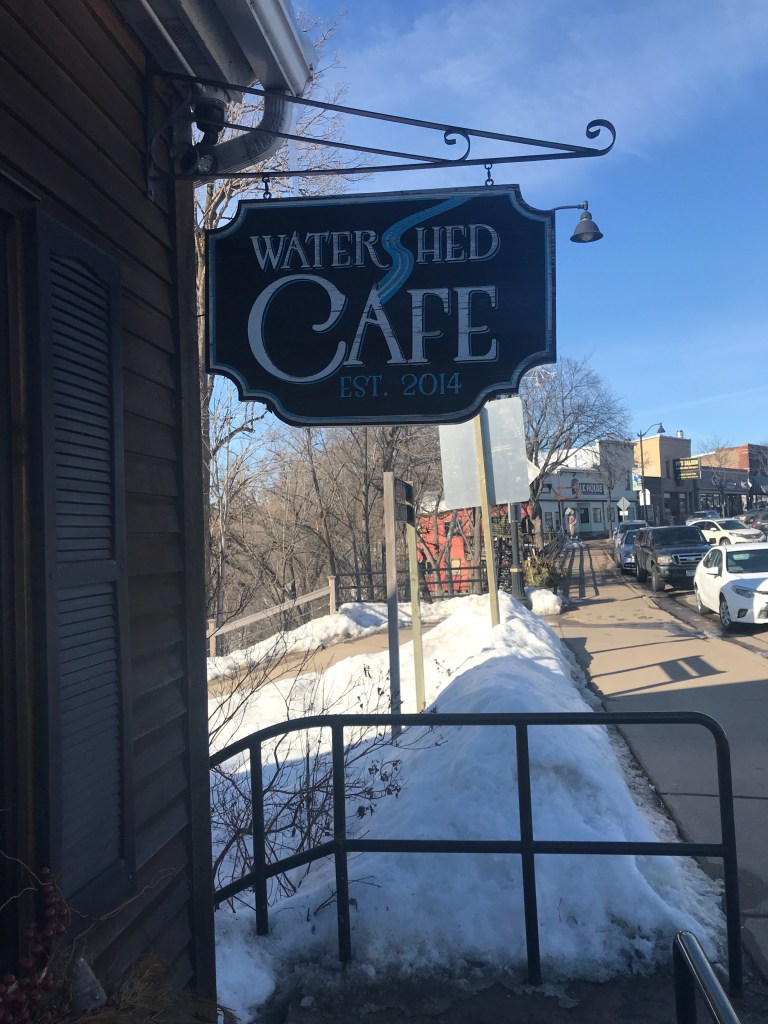
His plan was to drive up the Minnesota side of the St Croix River and then cross over the river into Wisconsin at Taylor’s Falls. We remembered a charming cafe near a waterfall in one of the small Wisconsin towns, but which one? That’s what makes roaming interesting–when you “kind of, sort of know,” but who knows what you’ll see or discover in the meantime.

We love this drive at anytime of the year, but during the summer and fall months, the route is crowded with others who have the same idea–enjoy the colors, explore the river, walk, hike, visit fun little shops, wineries, garden nurseries along the way. In the winter, however, the same route is quiet. The invitation is to savor.

I felt the lingering items on my list languish as I gazed across expanses of snow. From here to where? Remnants of harvested corn poked through the crusty snow, and smoke rose daintily out chimneys of solitary homes. I imagined the river views sweetening the life in those homes. A horse here and a small herd of cattle there, puffing steam through their nostrils. I know tending animals in the winter is a challenge, but for the moment it seemed like an idyllic way of life.

And the river–no boats, of course. No waterskiing, no parties of sun gods and goddesses reveling. Only stillness on the surface, leaving underwater life to our imaginations. This is the river’s own time, which does not have to be shared with others, it seems. I hoped our roaming didn’t interfere with the needed rest, the solitude of sanctuary.

We congratulated ourselves when we found the remembered cafe. Our lunch was delicious and our conversation the kind of catch-up we needed. On the way back to the car I stopped to take a picture of the falls. I suppose I should have recorded the sound of the rushing water, but, oh well, I didn’t. I just wanted a simple souvenir of the day, of the nourishment I was receiving.

What Do You See?

Only when I inserted that photo of the falls, which are barely visible, did I notice the real reason for the image.

Look at the tree in the foreground on the right.

The eye. The large, unblinking eye, looking right at me, and now, you.

In fact, I see the profile of a face—an arched eyebrow, nose and turned down mouth.

You may see something different in this image or you may derive a totally different meaning of the eye or none at all, but here’s what it means to me. There is always more to see. There is always more than meets the eye, especially at first glance. And in my seeing, I am seen.

We took a different route on our way home, one we had not driven before that led us gradually back home to our urban life. Back home to my lists, of course, but they could wait for another day.

An Invitation

What have you seen lately that has nourished you? I would love to know.

NOTE: The cafe we enjoyed was the Water Shed in Osceola, WI.

Book Report: Our Missing Hearts by Celeste Ng

February 9, 2023

I gave my daughter this book, Our Missing Hearts by Celeste Ng for Christmas, knowing eventually I would get it back from her and then I could read it. Smart, huh? The word she used when she passed it on to me is “exquisite,” and it is. Every word, every sentence is perfect. Not a word wasted. Not an overblown or unnecessary sentence. Exquisite.

The book, a dystopian novel, is also chilling and upsetting.

So often dystopian novels are far-fetched, and truly stretch our imaginations, but as I read this book, I had to often remind myself that the book is fiction and not nonfiction. The references to books taken off library shelves, to the crimes against Chinese Americans, to children separated from parents at our southern borders, and to the fear and systems created to “protect” American culture are all too relevant.

The main character is Bird, a 12 year-old Chinese American boy, whose mother is a poet. Her poem “Our Missing Hearts” becomes a slogan, an icon for protesters, and she leaves her family and becomes a fugitive. Bird, after finding some clues, attempts to find her. You will fall in love with Bird.

The book also lifts the power of words and of story. And memories.

I don’t want to say more, except READ THIS BOOK, but instead I share two of my favorite passages. The first is Bird’s father’s reflections about his wife, Bird’s mother. And the second is almost at the end of the book and brought tears to my eyes.

…this unshakable belief that the world was a knowable place. That by studying its branches and byways, the tracks it had rutted in the dust, you could understand it. For her the magic was not what words had been, but what they were capable of: their ability to sketch, with one sweeping brushstroke, the contours of an experience, the form of a feeling. How could they make the ineffable, how could they hover a shape before you for an eye blink, before it dissolved into the air. And this, in turn, was what he loved about her–insatiable curiosity about the world, how for her it could never be fully unraveled, it held infinite mysteries and wonders and sometimes all you could do was stand agape, rubbing your eyes, trying to see properly.

p. 176

When does she stop speaking? When are you ever done with the story of someone you love? You turn the most precious of your memories over and over, wearing their edges smooth, warming them again with your heat. You touch the curves and hollows of every detail you have, memorizing them, reciting them once more though you already know them in your bones. Who ever thinks, recalling the face of the one they loved who is gone: yes, I looked at you enough, I loved you enough, we had enough time, any of this was enough?

p. 302

My one complaint about the book is the cover. Did I miss the relevance of the feather? Yes, the boy is named Bird, but the flock of birds on the cover doesn’t seem to represent him. Did those responsible for the cover art read the book? Oh well.

An Invitation

What books make you shout, READ THIS BOOK? I would love to know

A Time-Out

February 7, 2023

What could be better than a trip to the Minnesota Landscape Arboretum on the coldest day of the winter. So far, that is. The temperature was well below zero, but the first day of the spring flower show enticed us to bundle up and treat ourselves to color and creativity and promises of the season to come.

The day before we had received some unexpected and unsettling news, (Thanks for worrying, but I am fine and so is our whole family.) and we needed to take a deep, cleansing breath.

I needed to step back, even if for only a brief time. Not in denial. Not in false comfort, but as a reminder of the varied ways God is visible. Pausing in front of each of the displays, the easy rhythm of my breath was restored. Instead of my mind swirling with questions which I had no way to answer, my heart beat, steady and sure, invited me to be present to the beauty in front of me in that moment.

Later, while having lunch in the arboretum dining room, the beauty of the present moment continued, but in a surprising way. The dining room was full of colorful plants and artwork, but what drew me was the view out the large windows. The winter view on that cold, cold day.

Chickadees filled the bare branches waiting their turn at the various bird feeders. Squirrels performed gymnastic feats as they attempted to pilfer what was not meant for them. Downy woodpeckers seemed still, stationary, on the suspended suet. And cardinals–three of them, dazzlingly lipstick red against the expanse of white– feasted.

This was what I needed. I thought what I was after was some relief. From winter’s intensity. From what ached in my heart.

But what I really needed was the clarity of those bare branches full of life. The movement of God could not be missed as I looked out the window. Yes, I oohed and aahed at the colorful, let’s pretend it’s spring displays, but the winter view was reality, and it was just as stunning.

I’ve been reading Prayer in the Night, For Those Who Work or Watch or Weep by Tish Harrison Warren, who is an Episcopalian priest. The book examines phrase by phrase the compline or evening prayer.

Keep watch, dear Lord, with those who work, or watch, or weep this night, and give your angels charge over those who sleep. Tend the sick, Lord Christ; give rest to the weary, bless the dying, soothe the suffering, pity the afflicted, shield the joyous; and all for your love’s sake.

The Book of Common Prayer

In the chapter on suffering, Warren writes, “The suffering need soothing, not just numbing. We need real hope, the kind that can carry us through the night.” p. 131

I delighted in the spring flowers, but I found hope in the clarity of the bare branches.

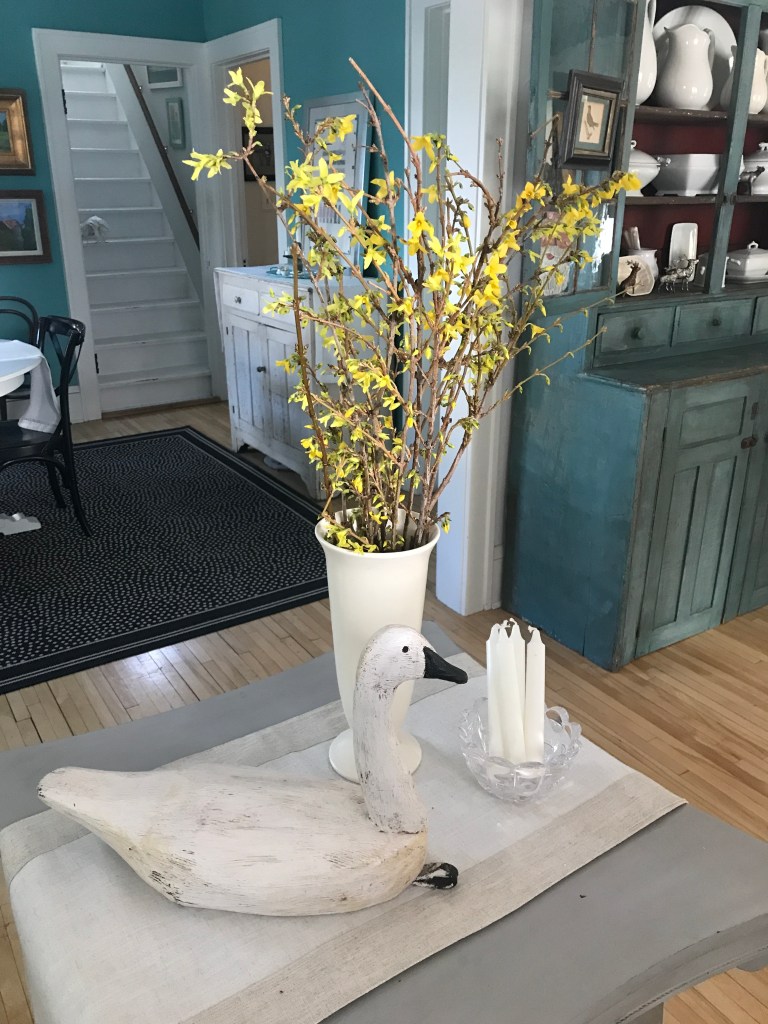
Earlier in the week I bought forsythia branches. The branches were bare, no blossoms yet, but over the next few days, look at what happened. What was bare is now full with delicate, sweet yellow blooms. Once more I witness the movement of God.

An Invitation

Where has God been visible for you in these winter days? I would love to know.

Book Report: JanuaryRound-UP

February 2, 2023

I was in a bit of a reading slump towards the end of January. It may not look that way on paper, but I rejected several books I started and just couldn’t immerse myself in what I thought I wanted to read. Why was that I wonder? Is it because the first books I read this year, which I wrote about in earlier posts, were so good, and finding something to meet that quality just didn’t happen? Or was I simply preoccupied with other tasks? and activities that took lots of energy? Or am I building energy for something new? Am I in some sort of shifting sands time?

I’m not sure it matters, for I still read a good pile of books.

During the deepest part of COVID many people who had considered themselves devoted readers had a hard time focusing on books. That didn’t happen to me. There have been other times in my life, however, when I’ve not been able to concentrate on reading in the way that had always been normal for me. Mainly, those have been times of grief and loss, and I am paying attention to that.

January’s Last Two Books

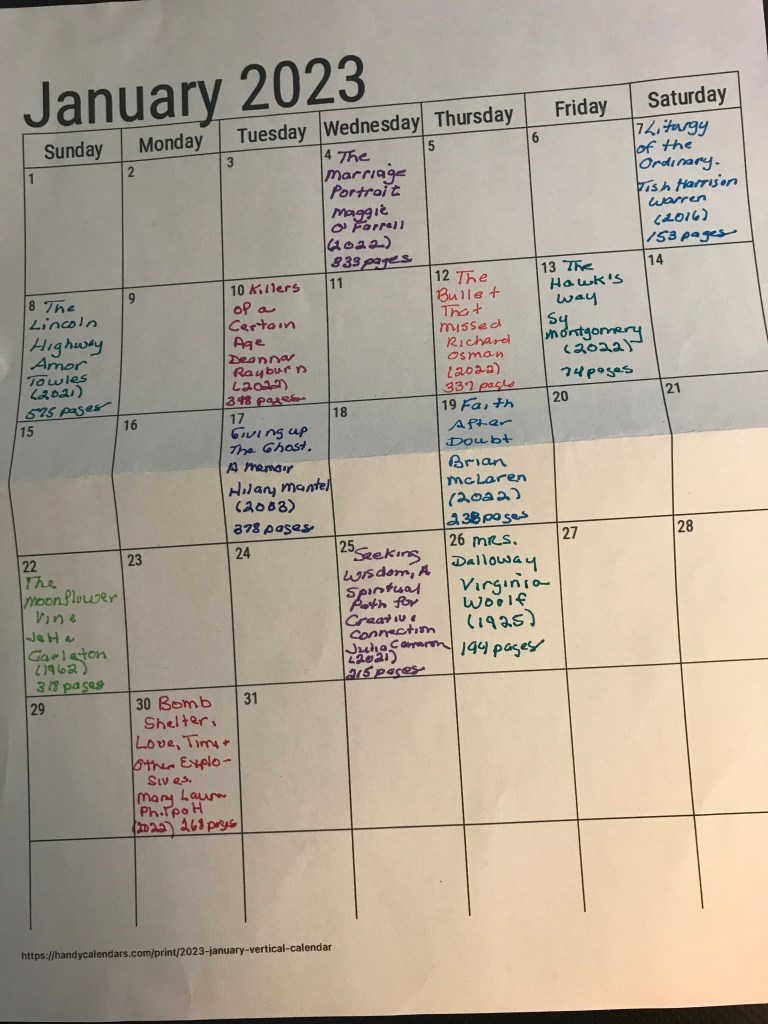
  1. I decided to re-read Virginia Woolf’s Mrs Dalloway. I can’t remember the first time I read it, but I think it was sometime post-college and probably early motherhood years. I have a vague memory of immersing myself in her books then, experiencing especially the power and relevancy of A Room of One’s Own. I often think of that when I walk up the stairs to my garret. What a privileged person I am. This time I read Mrs Dalloway for the beauty and breadth and depth of the language. Her writing makes me very aware of the importance of commas! This is a book I wish I had studied in a class, as a way to explore the layers and the layering of characters and the times they lived in.
  2. Bomb Shelter, Love, Time and Other Explosives by Mary Laura Philpott is a book of essays. Philpott characterizes herself as a worrier, but at the same time someone who believes that “as long as she cared enough, she could keep her loved ones safe.” So much for theories: Philpott’s teenage son is diagnosed with epilepsy. And life goes on in all its joys and sorrow, fears and acceptances.

There will always be threats lurking under the water where we play, danger hiding in the attic and rolling down that street on heavy wheels, unexpected explosions in our brains and our hearts and the sky. There will always be bombs, and we will never be able to save everyone we care about. To know that and to try anyway is to be fully alive. The closest thing to shelter we can offer one another is love, as deep and wide and in as many forms as we can give it.

p. 268

Now it is time to go through my TBR list and request from the library whatever most tempts me. And I will stand in front of one or more of my own bookshelves and listen to a call, “Reread me!” I’ll let you know what rises to the top.

An Invitation

What kind of a reading month did you have? I would love to know.

It’s Your Body and Your Funeral

January 30, 2023

Looking for something to do on a cold January day?

How about planning your funeral/memorial service?

Does that sound like fun? Well, maybe not, but let’s face it, we are each going to die, and we will each leave loved ones who will be faced with many decisions during an emotional time. Wouldn’t it be a helpful, even a gift, if we provided some guidance ahead of time?

Recently, the pastors at my church offered a session about funerals/memorial services–their purpose and how they fit into our faith tradition. So informative and uplifting. Then the following week, as part of our church’s programming for those of us in the Third Chapter of life (ages 55+), I hosted an informal conversation about funeral planning. This was an opportunity to explore and open to ideas about this key event in our lives. I invited the group to not only listen to others, but also to pay attention to what they were feeling, for this topic forces us to face our own mortality.

The conversation was lively and inspiring and helpful, and like an earlier Third Chapter conversation about downsizing, planning my memorial service is a process. I may be sure of some things, like the fact that I want my service to be at my church, but other aspects, like which pieces of scripture I want read may still be in flux.

After some time of silence and an opening meditation, I invited everyone to share a hymn they would like sung at their service. I shared my two choices: “Beautiful Savior” because my parents loved that hymn (I can still hear my father singing the tenor line.) and also because it is almost the “national anthem” of the college I attended, St Olaf College. It touches a very deep place inside me. The other hymn is “Mourning Has Broken” made famous by Cat Stevens. You don’t suppose he would come sing it at my service, do you?”

Morning has broken like the first morning;
blackbird has spoken, like the first bird.
Praise for the singing! Praise for the morning! 
Praise for them springing fresh from the Word.

Sweet the rain's new fall, sunlit from heaven,
like the first dew-fall on the first grass.
Praise for the sweetness of the wet garden,
sprung in completeness where God's feet pass.

Mine is the sunlight! Mine is the morning,
born of the one light Eden saw play!
Praise with elation, praise every morning,
God's recreation of the new day!


So many wonderful possibilities were offered by others in the group, however. Hymns I have loved and love to sing. Choices!

What was more important than picking out hymns to sing during the service, however, was sharing thoughts about other key questions:

  • What is the purpose of planning your funeral now?
  • How does it feel to do this?
  • What are you learning about what you hold to be true, about your faith, your fears, your hopes as you undertake this process?
  • What experiences have you had planning a funeral or attending funerals and how does that inform the kind of service you would like to have?
  • What’s important to you? What “not so much”?
  • Have you had conversations with your loved ones about your desires? How has that gone?
  • What’s the balance between your desires and the needs of your loved ones?
  • How is the service a gift for those who attend?

I’m sorry you weren’t there to hear all that was shared, but you can have this same conversation with your peers, your family, your faith community, and I encourage you to do so.

Funeral Planning as a Spiritual Practice

I encouraged those who attended to approach this process not just as something to cross off your list (“Good, Now I’ve planned my funeral.), but instead to think of this as a spiritual practice. In what ways do you experience the movement of God in the planning and considering, and also in what ways do you express the movement of God in your life through the service you plan?

My husband and I have done some planning. For example, we have decided on green cremation and have paid the funeral home in advance. Even though I have thought about other aspects of the service, such as meaningful scripture and that I want time in the service for silence using the Psalm line, “Be still and know that I am God,” I have not yet written it all down and then handed the completed form over to the church office where it will be kept until it is time to use it.

I have decided doing that will be my Lenten spiritual practice. Stay tuned.

One More Thought

I used to think I didn’t care about my funeral. When the subject came up, I generally laughed and reminded people, “I won’t be there. The rest of you can organize whatever helps you –sitting in a mournful circle or telling edited stories about me or partying, if you like.” But I am realizing that the occasion will bring together people who might not otherwise come into conversation and that it may be a ministry to them in their grieving. My service can be a message of love and God willing, an occasion of grace.

A Faithful Farewell, Living Your Last Chapter With Love by Marilyn Chandler McIntyre

An Invitation

What are your thoughts about planning your funeral/memorial service? I would love to know.

Book Report: My Love Affair with Public Libraries

January 26, 2023

My last trip to the library was a bonanza of books. A pile I had placed on hold were waiting for me, and I returned home eager to determine which one I would read first. (Moonflower Vine by Jetta Carleton won, by the way–and it is a gem.)

I knew that more than likely I would decide not to read each one. I would at least read the first few pages of each one, but not more than a few pages if what I read didn’t appeal, didn’t spark interest in the characters, the writing, or the plot to come. I no longer feel obligated to read something because it is on my list or someone has recommended it or because I think it is a book I “should” read. I have a long TBR list and even though I am a fast reader and dedicate parts of everyday for reading, I know I will never read every title I want to read. (An aside: I hope when I die I have a book in my hand.)

How grateful I am for the library. I request books knowing I can test the temperature, dip my toe in, but then I can retreat to shore if the book is too cold or too warm. And then I can return the book to the library for someone else’s pleasure.

Public libraries will always be on the top of my favorites list, so when I heard about what lawmakers in North Dakota are trying to do, I could feel my own temperature begin to boil.

A bill has been proposed by the House Majority Leader of Dickinson, ND to ban books with sexually explicit material and books that depict gender identity from PUBLIC libraries. Librarians who refuse to remove banned titles could face up to 30 days in prison. https://www.nbcnews.com/nbc-out/out-politics-and-policy/north-dakota-weighs-ban-sexually-explicit-library-books-rcna66271

This proposed bill is not about protecting children or anyone else, but it is about censorship.

If you live in North Dakota or have ties to North Dakota, it is time to speak up and support the gift of freedom that public libraries offer. Wherever you live, support your public libraries and librarians.

An Invitation

What do you love about your public library? I would love to know.