Finding Purpose as We Age

April 4, 2023

“I have time now to try new things, but also the need to use this time well.”

” I feel called to do something, to create community.”

“How important it is to be intentional.”

“This time keeps evolving and one thing seems to lead to another.”

“How can I best use my energy?”

“I sometimes say to myself, ‘I get to do this,’ and that brings me joy.”

Last week I facilitated a Third Chapter conversation called “What Now? An Informal Conversation about Purpose and Meaning in the Elder Years.” Third Chapter activities and opportunities are designed for those 55+ and focus on ways to grow spiritually and to explore both the gifts and the challenges of these years. In recent months many have gathered to share insights and thoughts, as well as questions and concerns about a variety of topics, including downsizing and decluttering, choosing the next place to live, making plans about funerals and memorials, and nurturing intergenerational relationships. In preparation for this conversation, I realized I needed to create a purpose statement for myself; some guiding words as a way to sort and focus how I choose to use my energy and time and gifts. First, I browsed a number of books in my personal library about aging to see what resonated with me:

  • Pay attention to your inner compass.
  • What is asking for more attention?
  • This is a time to come home to the self, the person I was created to be.
  • Know yourself. Know your boundaries. Know your gifts. And then be generous.
  • Aging is the gift of continuing on.
  • Cultivate your power to inspire. Be a muse and a guiding spirit.

My next step was to think about what I love to do, what I am currently doing, and what I feel I do well. And I thought about how those things relate to my spirituality, my relationship to the Divine, and to my ongoing quest to understand who I am created to be. And then I thought about what is possible, given my age, my energy, my relationships and my community.

David Steindl-Rast’s words, “When you can’t go far, go deep,” have become a guiding mantra for me in recent years. In my case, what I choose is to go deep. And, to help others go deep as well. Ah, I could feel myself growing closer to defining my purpose, or if you prefer, “call,” or even “vocation,” although that word sounds more applicable to an earlier time of life.

No surprise, I then sat with my journal and tried on some words and phrases to see how they fit. I realized, as the words came together quickly and easily, that thoughts about this stage of my life have been percolating and evolving and emerging.

My purpose is to deepen awareness of the movement and presence of God in my own life and the lives of others.

I took a deep breath after writing those words, letting them flow through me, inviting them to float around me. Do they sound pompous? Pious? “Holier-that-Thou?” I thought about questions I ask my spiritual direction clients frequently. How are you noticing the movement of God in your life now? When have you experienced the presence of God? I ask myself these questions, too, all the time, whispering to myself, “May I feel the presence and be the presence.”

Yes, this is my purpose statement, I told myself, but how is it I intend to live this statement right now, right here.

  • By writing.
  • By facilitating groups.
  • By listening and asking questions.
  • By living a contemplative life.

Over time these specific ways to live my purpose may change, may evolve, and I imagine if I live many more years, my focus will be on the gifts of a contemplative life, but my overriding purpose statement feels as if it can live within me for the rest of my days.

I wrote my purpose statement and intentions on a small card that sits in front of me on my desk, and I practice saying it aloud, sharing it with others. My hope is to fully integrate the words into both actions and contemplation.

How grateful I am for the wisdom and insights shared during our Third Chapter conversations, and for the opportunity those times offer to learn from and to support one another during this time of our lives, for as Joan Chittister says, “The gift of these years is not merely being alive–it is the gift of becoming more fully alive than ever.”

An Invitation

What is the purpose and meaning of your life at this stage of life? Have you written a purpose statement? I would love to know.

NOTE:

An essay I wrote, “Actually, Your Children May Want (Some of) Your Stuff” recently appeared in Next Avenue, a digital publication produced by Twin Cities PBS(TPT), which is dedicated to covering issues that matter most as we age. Here’s the link: https://www.nextavenue.org/your-children-may-want-your-stuff/ I hope you will read and share with others.

Book Report: March Round-Up

March 30, 2023

I know here it is only the 30th and there are 31days in March, but I am eager to enter April, so why not post the summary of this month’s reading now. And what a month it has been!

NONFICTION

I finished two books I mentioned in a previous posts this month.

  • The Heartbeat of Wounded Knee, Native America from 1890 to the Present by David Treuer. I read it slowly, trying to absorb facts, and stories, and reflections. Such an important book. Perhaps the section that most fascinated me was the detailed analysis, which he included near the end of the book, about the protests at Standing Rock. Don’t be deterred by the length of the book, for it is well-worth the time and energy you give it.
  • Weaving Sundown in a Scarlet Light, 50 Poems for 50 Years by Joy Harjo. I loved many of the poems, but I also loved her notes about each of the poems, their content, inspiration, and often the mechanics of the poem, also. Such a good companion this was to the David Treuer book. April is National Poetry Month, and I recommend this book as a way to celebrate poets and poetry.

I also read two other books in the broad nonfiction category. One is a book of meditations and the other, a memoir.

  • Embers, One Ojibway’s Meditations by Richard Wagamese (1944-2017). A beautiful book in appearance and in its short reflections. I read a few pages in this book each morning during my meditation time. The author says morning meditation is his time to reclaim himself, and I concur with that sentiment. The book is divided into seven sections: Stillness, Harmony, Trust, Reverence, Persistence, Gratitude, and Joy. He writes this in the very first meditation:

I am my silence. I am not the busyness of my thoughts or the daily rhythm of my actions. I am not the stuff that constitutes my world. I am not my talk. I am not my actions. I am my silence. I am the consciousness that perceives all these things. When I go to my consciousness, to that great pool of silence that observes the intricacies of my life, I am aware that I am me. I take a little time each day to sit in silence so that I can move outward in balance into the great clamour of living.

p. 15
  • Leaving the Pink House by Ladette Randolph. This book made me nostalgic about living in the country during our years at Sweetwater Farm. Randolph and her husband buy a dilapidated house outside of Lincoln, Nebraska, and she describes the year spent renovating it and making it habitable, but she also reflects on the years that led to this decision and about changes in her faith along the way;. Randolph refers to herself as a “devotee of the quotidian,” and her writing draws us into her daily sights and experiences.

I best understand my life through the houses where I’ve lived. I have only to remember a particular house to summon clear memories of a given time and place. Like many adults, I’ve returned to those places–both in memory and in person–seeking from this exercise I’m not sure what: some part of myself, some time in the past I want to better understand. Houses are often the archives for my deepest, most resonant memories, the places where I’ve curated life stories.

from Introduction

FICTION

I read ten novels this month, and will highlight five of them.

  • Afterlife by Julia Alvarez. Perhaps you read some of her earlier books, including How the Garcia Girls Lost Their Accents or In the Time of the Butterflies. If so, you know what a good writer she is. Antonia’s family, which includes her three sisters, immigrated from the Dominican Republic. Antonia is now 66, a widow, and poet and English professor. Her eldest sister, who is mentally unstable, disappears and the sisters rally to try and find her. At the same time Antonia becomes involved with a teenage unwed mother who is undocumented, and along the way Antonia faces her own “dragons.”
  • The Swimmers by Julia Otsuko. What starts as a playful writing style and content (Has one writer ever used so many parenthetical phrases and done it so effectively?) becomes a poignant view of a dementia patient in a memory care unit. Alice is a faithful swimmer, but when the pool closes for good, her issues become more unmanageable. Sad and revealing and well-written.
  • Island of the Missing Trees by Elif Shafak. A treasure of a book. Set in Cyprus in the 1970s and then again in 2000s and also in London, a Turkish woman and Greek man fall in love, but are separated, eventually reuniting. They have a daughter Ada who in her teens mourns the death of her mother. Her mother’s sister plays a role in helping Ada heal and also fills in the blanks of her parents’ lives. The father, Kostas, has brought a fig tree with him to London from Cyprus, and the fig tree tells its own story. I know this seems strange, but I believed in the fig tree just as much as the human characters.
  • What Are You Going Through? by Sigrid Nunez. A woman dying of cancer ask a friend to be with her as she plans to take life-ending drugs. The woman is estranged from her daughter and has asked others to be with her, but all have said “no.” The friend, more of a distant friend from previous times in their lives, does agree, however, and they become closer and closer. The story is written from the friend’s point of view, but she relays everything the woman tells her. Brilliantly written.
  • The White Lady by Jacqueline Winspear. Many of us eagerly wait for the next book in the Maisie Dobbs series. Well, we need to wait longer, for this new book by Winspear is a stand-alone, but definitely a good read. The main character, Elinor White, however could be Maisie Dobbs’ soul sister, for she is also courageous, compassionate, and intelligent. White was a spy both in WWI and then again in WWII, and she carries demons with her during her retirement years in an English village. She is drawn out of her quiet life to help a neighboring family who want to remain separate from the husband’s organized crime family.

Waiting for me are two books from the library, Still True by Maggie Ginsburg and Women Talking by Marian Toews. I saw the acclaimed movie,Women Talking, and now am eager to read the book.

An Invitation

What have you read this last month? I would love to know.

The In-Between Time: Moving Towards Spring

March 28, 2023

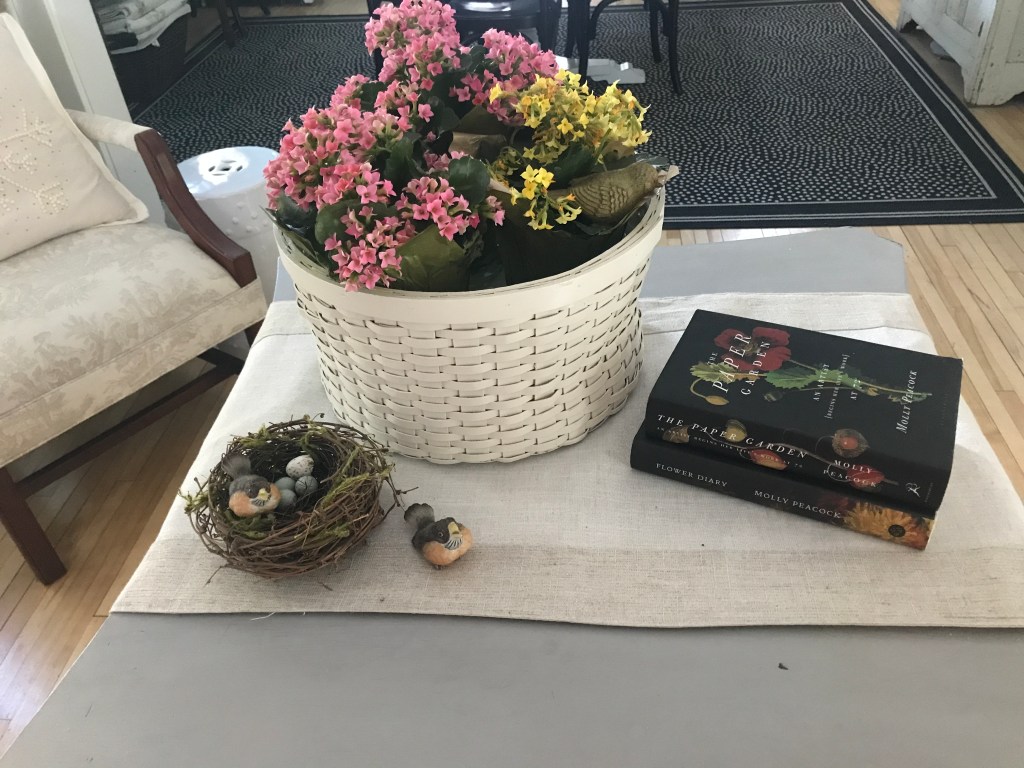
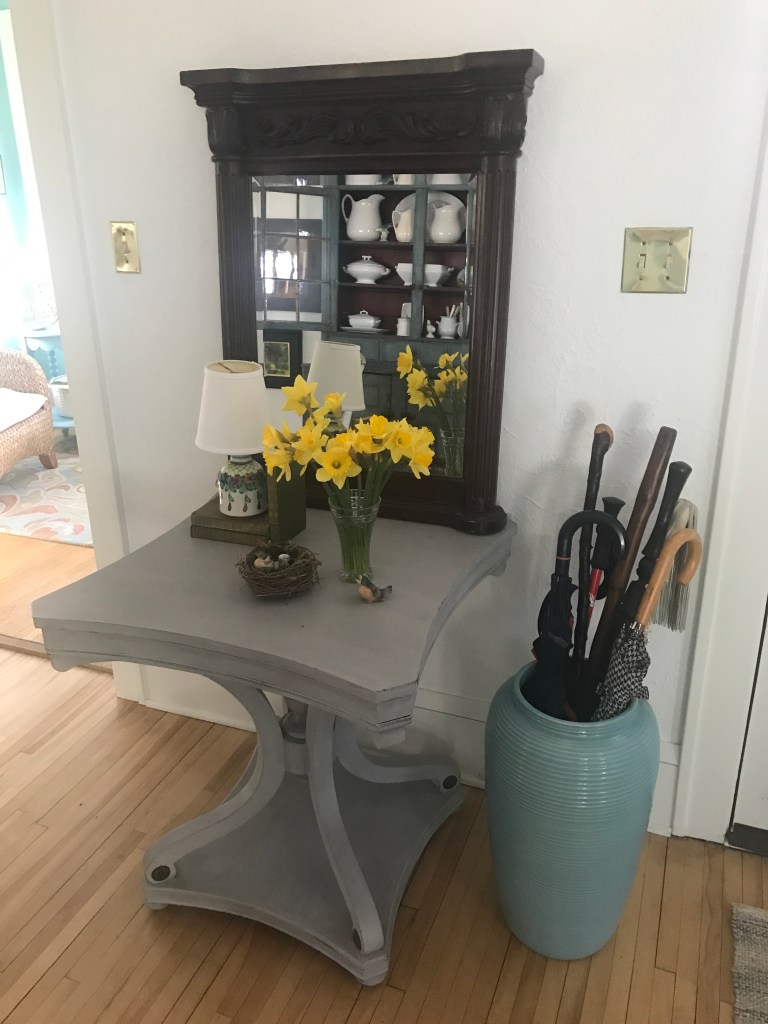
Just because it is officially spring doesn’t mean it is actually spring. Not with snow still much in evidence, but still the air feels different, lighter, fresher, brighter. There is no sign of green yet, but I bought the first bunches of daffodils. And I rearranged furniture.

This is transition time, and I often feel a bit itchy, restless in the in-between times. Often I channel that need for some kind of change by changing what I see, by doing more than the usual weekly hometending.

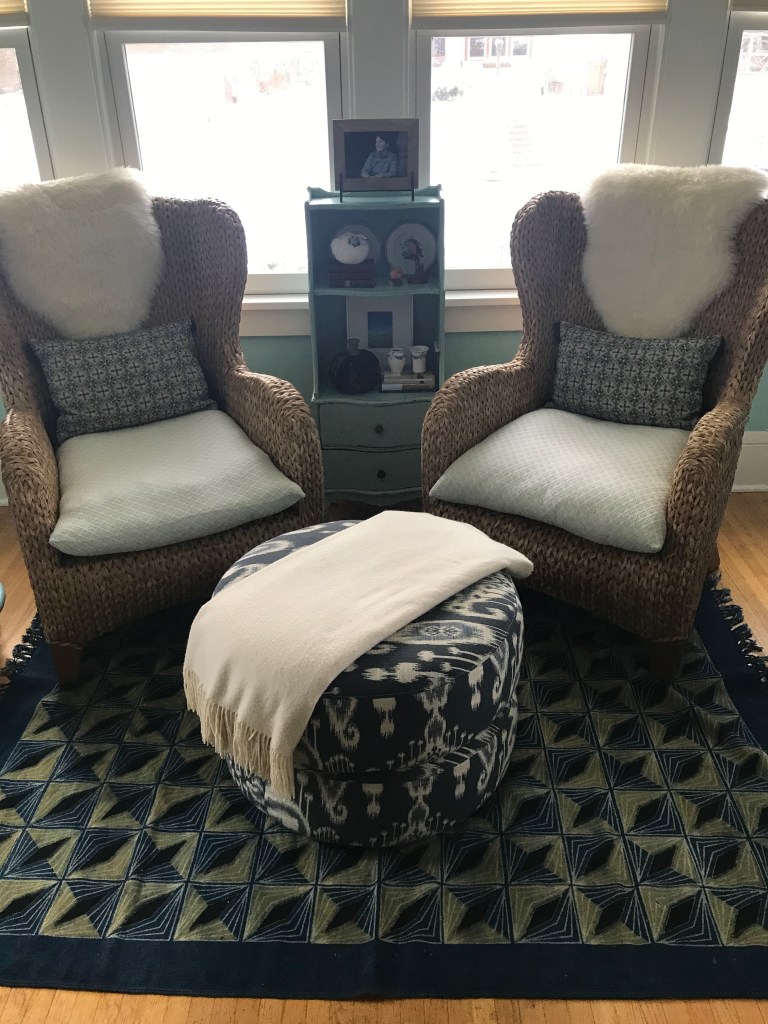
The snug transformed from this arrangement. (The pictures were taken in the fall — the pumpkins have long been packed away!)

To this:

One thing leads to another. Because I moved the desk into the snug from where it had been located next to the front door since we moved into this house, that meant changing the entry area, too. I moved the center table (top picture) to the desk wall and that left all sorts of space for this:

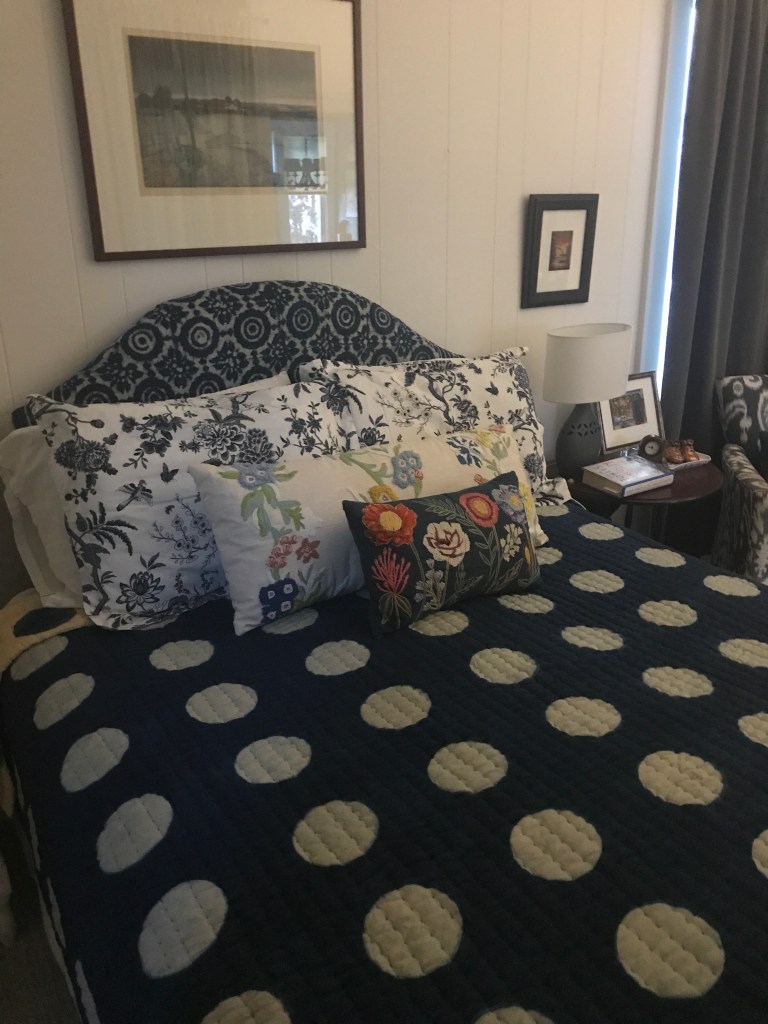
Voila! Another reading area and a place for one of the tables from the snug! The chair had been in the bedroom, by the way, which was changed from a heavier to a lighter look, too.

Of course, along the way, I washed floors and rearranged tabletops, shopping the house. Now instead of feeling winter cozy, the house has more breathing space and seems fresher, lighter, brighter, just like these days.

Winter Reflections

As I’ve written before in this blog, hometending is one of my spiritual practices and is a form of creativity for me. Doing this kind of re-envisoning space and our surroundings, however, is not just about changing what is visible, but for me it is also a bridge, a way to transition. As I shuffled piles of books and tweaked pillows and pictures, I thought about what changes I have noticed or deliberately made in the previous season. And what that might mean for the season just ahead. These domestic surges give me a chance to evaluate, to consider directions in my own life.

This particular winter season has been a challenging one, weather-wise, but I have noticed in myself more ability and willingness to adjust, to let go and to be with whatever is happening outside. How grateful I have been for our cozy, pleasant home, for the safety and comfort, which I realize my privilege allows me. At the same time I feel more ready for spring than I do most years. I am eager to walk without fear of slipping on the ice.

This winter has been a time to adjust to the death of a dear friend. More and more I am aware of how this time of my life, as I approach my 75th birthday, includes losses. An ongoing challenge is to accept the loss and at the same time open to the gifts of each day.

This winter has been a time when I have been more aware of how I choose to use my time. I cleared space in my week to create Writing Wednesdays, and that has become precious to me. I am working on an essay about walking the labyrinth and have submitted a couple shorter essays to online publications. In the coming months I hope at least part of Writing Wednesdays will be spent writing in our “Paris” garden.

This winter has been blessed with activities I love; for example, facilitating the church writing group as well as monthly Third Chapter Conversations, meeting with my spiritual directees, and writing my twice a week posts on this blog. As I move into spring, I know I want to continue in these endeavors, but I pray I will know when it is time to let go of any of them and that I do that with grace.

This winter has included some strife in our congregation, but what I see is that the community is stronger than one person and that we will continue to grow in ways we can’t even imagine yet.

This winter has included good health for Bruce and myself. A couple colds, true, but no trips to the doctor. No broken bones or concerns about mental or physical well-being. How grateful I am.

This winter has included my usual morning meditation routine, beginning with a short devotion in Henri Nourwen’s You Are the Beloved. My word of the year “beloved” resonates throughout the day.

Spring–Almost

Sunday my husband and I drove along the Wisconsin side of the Mississippi River, one of our favorite routes. How good to see so much open water and bare ground. Along with seeing eight eagles and two hawks, we think we saw a flock of tundra swans. Although there was not yet any sign of greening, the earth seemed ready for change, for movement. Should we call these days “Sprinter” or perhaps “Wing”? These are the in-between days when we can begin to envision what is to come, but at the same time recognize what we bring with us into the new season.

An Invitation

How are you living these in-between days? I would love to know.

Book Report: Sick Time, Reading Time

March 23, 2023

I suppose you could accuse me of milking the situation, for I just had a cold. Nothing serious. We all get colds, but my end of the week schedule was quite open, and I certainly didn’t want to spread my germs, so I declared a time-out. I moved into the snug with books and a blanket and spent most of two days reading and napping, napping and reading. Voila! I am back to normal!

Here’s my report:

  • At the beginning of each reading session I read a poem or two in Joy Harjo’s Weaving Sundown in a Scarlet Light, 50 Poems for 50 Years. Harjo was the Poet Laureate of the United States from 2019-2022. My favorite poem so far is “Remember” and here are the opening lines:
Remember the sky you were born under,
know each of the star's stories.
Remember the moon, know who she is.
Remember the sun's birth at dawn, that is the
strongest point of time. Remember sundown
and the giving away to night.
  • I finished reading a novel The Long-Shining Waters by Danielle Sosin. In this case the waters refers to Lake Superior in all its mystery, majesty, power and beauty. Sosin tells the story of three different women in three different time periods, 1622, 1902, and 2000. One of the women owned a bar on the North Shore and after the bar burns down she decides to drive all round the perimeter of the lake, and now I want to do that. I admit some of the descriptions seemed obscure to me, but perhaps I need to spend more time under the lake’s spell.
  • I continued reading The Heartbeat of Wounded Knee, Native America from 1890 to the Present by David Treuer. Much of Louise Erdrich’s lecture that we attended recently focused on the Termination Act of 1953, which Treuer describes in this way:

It proposed to fix the Indian problem once and for all by making Indians–legally, culturally, and economically–no longer Indians at all.

p. 250

Under termination and relocation, unemployment skyrocketed and so did the number of Indians living under the poverty line. By 1970 half of all the Indians lived in urban areas, the single largest demographic and cultural shift in Indian country in a century and arguably more pervasive and transformative than the reservation system established in the mid-nineteenth century. A total of 1, 365, 801 acres of land were removed from trust status during this period and twelve thousand Indians lost their tribal affiliation

p.278
  • Finally, I read a short novel, The Swimmers by Julie Otsuka. The story begins in a playful way about swimmers at an underground pool. The writer’s use of parentheses engaged me, as if in conversation with her.

The rules at the pool, though unspoken are adhered to by all (we are our own best enforcers): no running, no shouting, no children allowed. Circle swimming only (direction counterclockwise, always keeping to the right of the painted black line). All Band-Aids must be removed. No one who has not taken the compulsory two-minute shower (hot water, soap) in the locker room may enter the pool. No one who has an unexpected rash or open wound may enter the pool (the menstruating among us, however, are excepted). No one who is not a member of the pool may enter the pool. Guests are permitted (no more than one per member at a time), but for a nominal daily fee.

p. 6

One of the swimmers, Alice is in the early stages of dementia and one of the rules is to “be nice to Alice.”

And even though she may not remember the combination to her locker or where she put her towel, the moment she slips into the water she knows what to do. Her stroke is long and fluid, her kick is strong, her mind clear. “Up there,” she says, “I’m just another little old lady. But down here, at the pool, I’m myself.”

p. 4

When the pool unexpectedly closes, life changes for Alice. As does the tone of the book –from playful to poignant. Alice’s dementia progresses, and it is necessary to place her in a memory care unit. Life at Bellavista pulls at the heart, as well as this trauma faced by Alice’s husband and their daughter, a reality facing so many. So well-written, but I am glad it was not longer than its 175 pages.

Before I emerged from the snug, I started another novel, The Island of Missing Trees by Elif Shafek. So far very good, but you will have to wait for a full report in a later post.

An Invitation

What would you want to read if you had a cold? I would love to know.

Gifts, Blessings, Treasures, Offerings

March 21, 2023

Some weeks seem to sparkle with unexpected gifts, blessings, treasures, and offerings, and last week, much to my surprise, was one of those times.

In spite of getting more snow and more cold temperatures, and an actual cold, requiring lots of kleenex, cold meds, and naps, my quiet life was full of treats, including delicious scones baked and delivered by friends after we needed to cancel our wine date with them. Isn’t the old axiom “Starve a fever, but feed a cold’? Or is it the other way around. Never mind, the scones were sooo good, and the gesture deeply appreciated. (The inside of the card that came with the scones said “Scones conquer Colds.”)

Other gifts may not have been edible, but were no less pleasing. And each one arrived in my email inbox.

  • The copy of an article about a day walking several different labyrinths, “Prelude” by Nancy Nordenson.

“Don’t expect an epiphany,” the instruction sheet warned us. I know, I know: don’t expect anything and you won’t be disappointed, but I’m wired for expectation like a kid who knows she’s just going on a quick errand with her dad, there and back, yet nevertheless hopes he’ll pull the car into Dairy Queen on the way.

  • The link to music for Lent sung and played by Steve Bell. https://www.youtube.com/watch?v=Yg-rAwIuF_M
  • Notice about a new show at the Minneapolis Institute of Arts (MIA), Eternal Offerings Chinese Ritual Bronzes. This exhibit is described as an “immersive experience designed to evoke the mystery of heavenly and ancestral worship.” Sounds like a field trip to me. https://new.artsmia.org
  • A number of notes from dear women in my life, including one who is awaiting chemotherapy and another who has decided not to continue treatment. Each note, a kind of prayer.
  • Another friend wrote about studying the Hebrew book of Micah, which if you didn’t know is between the book of Jonah and Nahum. Does that help? Anyway, she mentioned Micah 6:8″ …and what does the Lord require of you but to do justice, and to love kindness, and to walk humbly with your God?” I am planning the next session of Third Chapter Conversations at my church, and the topic is purpose and meaning. This verse is a perfect way to begin the conversation.
  • One of the participants in the church writing group sent me her essay, a work-in-progress, about the power of invitation. As I read her examples of intentional invitations, I thought about the many ways I have felt invited in my own life and yes, the times I have extended invitations.
  • An interview with Allison Townsend who wrote one of my favorite books of 2022, The Green Hour, A Natural History of Home. https://www.youtube.com/watch?v=sYCftVFFBjM&t=585s I read much of this book aloud as Bruce and I were driving to Cleveland last fall. We especially loved her descriptions of the Wisconsin landscape, but perhaps this is my favorite quote:

I tell my students. “It’s the lives we make despite those wounds and the stories we tell about them that matter.” And I quote again Isak Dinesen’s beautiful words: “All suffering is bearable if it is seen as part of the story.” “You must believe this,” I tell my students. “You must tell your stories”

p. 215

Weekly, sometimes daily, I receive meditations from Richard Rohr, Glenn Mitchell of Oasis Ministries, and Diana Butler Bass, and poetry from Steve Garnaas Holmes and Jim Borgschatz. I receive writing blogs from Jeannine Ouellette and Elizabeth Jarret Andrew. I listen to podcasts, Learning How to See with Brian McLaren, On Being with Krista Tippett, Love Period with Jacqui Lewis, and What Should I Read Next? with Anne Bagel. Each one is a gift, a blessing, a treasure, an offering.

And all this entered my life in one week.

I am blessed.

An Invitation

What gifts, blessings, treasures, offerings have you received recently? I would love to know.

Book Report: A Trip to Louise Erdrich’s Book Store, Birchbark Books

March 16, 2023

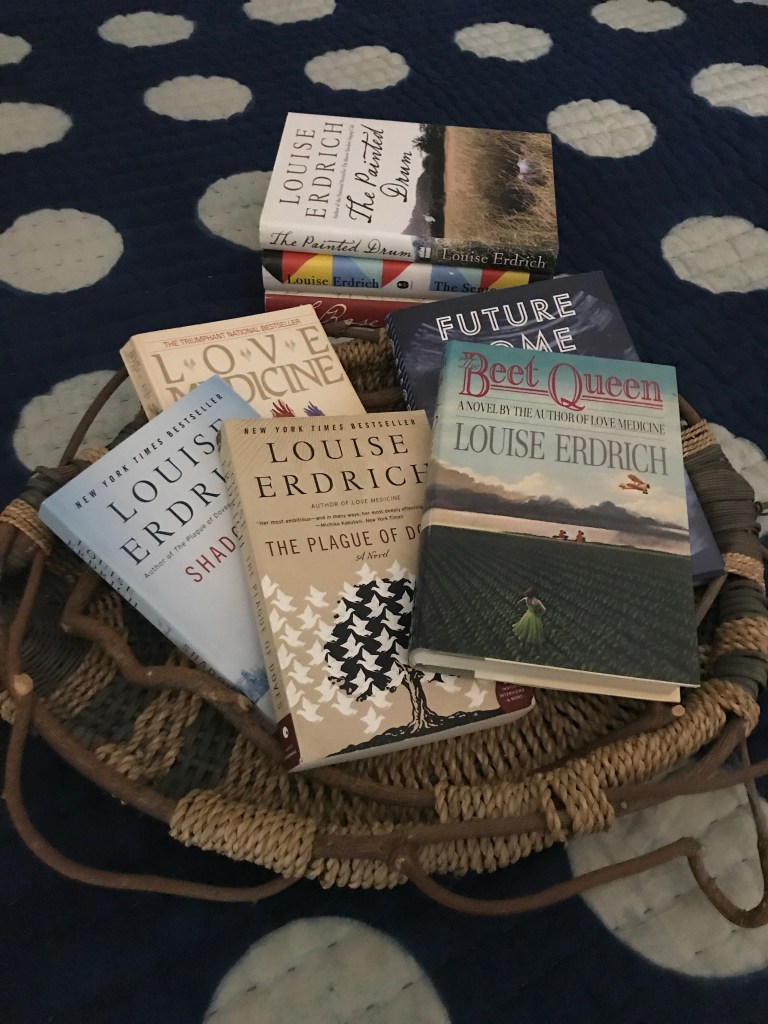
Last week, on International Women’s Day, my husband and I, along with a full auditorium of other fans, attended “An Evening with Louise Erdrich.” Not exactly an intimate event, but how good to be in her presence.

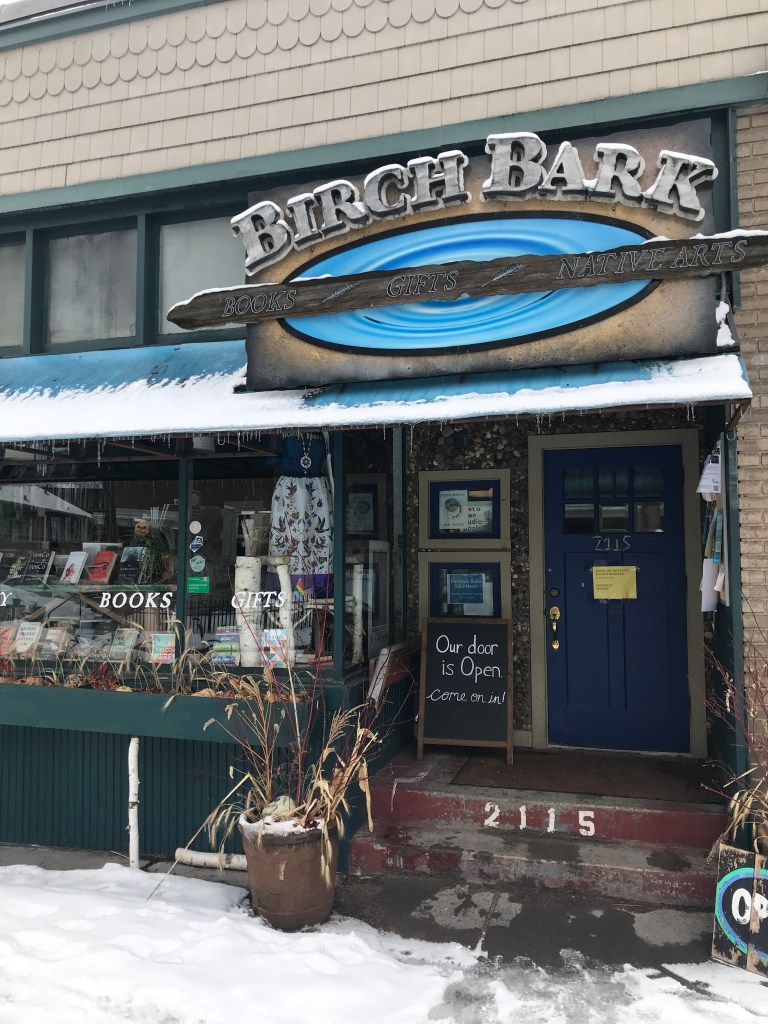
I have read most of her books, but can imagine re-reading several, especially The Sentence and The Nightwatchman, which my husband is re-reading now. And Love Medicine, which was published in 1984 and was the first of an eight book series. One of the books mentioned that evening was Books and Islands in Ojibwe Country: Traveling Through the Land of My Ancestors (2003), which is a blend of history, mythology, and memoir. I remember being entranced by that book and wish I still had my copy. Now why didn’t I buy another copy when we made a long overdue return visit last week to Erdrich’s bookstore, Birchbark Books in Minneapolis?

I guess I was just too overwhelmed as I found several books on my TBR list. I guess I will just have to return soon. Such a problem! Here’s what did come home with me:

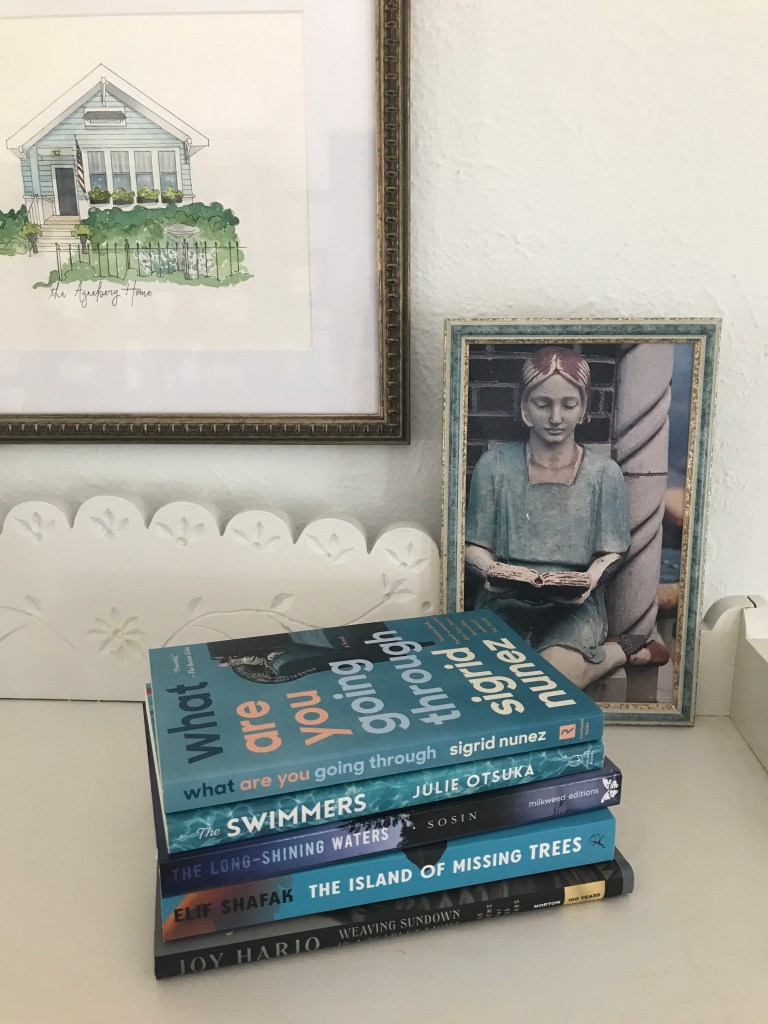
  • Weaving Sundown in a Scarlet Light, 50 Poems for 50 Years by Joy Harjo. Harjo, who is a member of the Muscogee (Creek) Nation, was the nation’s poet laureate from 2019 to 2023. I loved her memoir Poet Warrior–another book for the re-read list. I am keeping this book in the snug and each time before settling into read whatever is my current book, I read a couple poems in this book. Only after I read about 10 of the poems did I realize that at the end of the book Harjo has included notes about each poem, giving the context and notes about her process. I have decided to begin the book again and this time read the notes, too.
  • What Are You Going Through by Sigrid Nunez.
  • The Swimmers byJulie Otsuko who wrote The Buddha in the Attic (2011), which I remember loving.
  • The Island of Missing Trees by Elif Shafak.
  • The Long-Shining Waters by Danielle Sosin. I am especially eager to read this book for it is about three women living on the shores of Lake Superior at different times in history. I only heard recently about this book, which was published in 2011 by Milkweed and won their national fiction prize. It sounds wonderful. Maybe I need a reading retreat to the North Shore.

After making our purchases we had lunch right next door at The Kenwood, one of our favorite restaurants.

Such a good day!

An Invitation

Have you read any books by Louise Erdrich? If so, what are your favorite’s? I would love to know.

Links: https://birchbarkbooks.com

https://www.thekenwoodrestaurant.com

Community as a Spiritual Practice

March 14, 2023

Most of Sunday was spent in community, my faith community.

There have been years in my life when I have existed without community. Oh, there were bits and pieces of community along the way–groups I have participated in, volunteer work I’ve done–but those all felt temporary and dependent upon specific people or an interest in a particular cause. They were valuable and important communities, but at a certain point I moved on, and there was a natural ending.

Around eight years ago, after moving back to Minnesota, my husband and I joined Gloria Dei Lutheran Church. As genetic Lutherans, it was not a hard decision. Plus, our daughter and family were already members there. Being in the same congregation with them is a real bonus, but our life within this community is so much more. It is a place of belonging, but it is also a place of growing and caring a nd showing up. Of grounding and stretching.

Sunday was such a good day of “encountering others” which is how Barbara Brown Taylor refers to the spiritual practice of community, and such good encounters the day offered — lots of hugs and one-on-one conversations–but even more than that, the reinforcement of intentions to encounte others through the various aspects of our proclaimed mission.

First, we gathered for adult forum, a weekly time of education for adults. This week poets, who are members or who are connected to our congregation in some way, read poems they had written or poems that had meaning for them. One woman read a poem she had written following the death of her beloved father. Another read her own poems, but also shared her experience of reading poetry to people in a memory care unit. One woman remarked how wonderful it is to be part of a congregation that values poetry. What a privilege it was to be in the presence of such creativity and depth.

Next, we attended worship. Each week we sing together, pray together, confess together. We open our hearts and our ears to words that encourage us to grow in our understandings. We receive the bread and the wine. We are reminded of the gifts we received at our baptism. We greet one another and we welcome new members. We lift up and hold one another. We restore and prepare for the challenges in our lives and the life of our community.

Then we ate together. Our Fellowship Hall filled with hungry members, and we enjoyed a potluck–for the first time since the pandemic. It was quite the feast! (I brought lemon pound cake, an Ina Garten recipe.) Was there enough food? Of course, there was, as fulfilled in the scriptures!

Eating and conversation was followed by our annual meeting. The meeting opened first with prayer and then a reading of our Land Acknowledgment Statement.

Gloria Dei Lutheran Church recognizes that its building stands on traditional Dakota land near Bdote Mini Sota, the confluence of the Minnesota and Mississippi rivers, the center of creation for Dakota people and also sacred to Ojibwa. The congregation acknowledges that this land was taken from Indigenous people by exploitation and violence. Given the deep significance of this sacred ground, as well as its painful history, the congregation recognizes its responsibility to use this land, its building and mission for the work of reconciliation and healing with Native people. The congregation repents of this injustice that continues to harm Native communities and pledges to work for justice, peace and the wellbeing of all creation.

The main purpose, of course, was to pass the budget for the year, which includes reparations to Native people. It passed unanimously. Even though our congregation is in the midst of an unexpected challenge, the feeling in the room was one of gratitude and a willingness to grow towards greater strength. We are open to the invitation, even if we can’t quite define what that invitation is yet.

I realize, of course, that there are others ways to experience and participate in community, and I also realize a commitment to community is not always easy and sometimes belonging to a community is synonymous with exclusion. Choose your community wisely, and keep it healthy through your active participation, in order for it to live beyond and after you.

I like what Debra K. Farmington says:

When we live with community we give ourselves the opportunity to learn about the faces of God that we would not ordinarily see. It is in the community that our image of God is tested and refined, where we are held accountable for what we believe and how we act, and ultimately where we meet God in the fullest possible way.

It is also within community that we find love and encouragement and support on the spiritual path. We find others who pray with us and for us, who celebrate our lives and ask us to celebrate theirs. In community we find laughter as well as tears; we find people to play with, as well as ones who can mourn with us when times are rough. It may even be that we have gifts and skills that would not manifest themselves outside of community. By failing to use them or by hoarding them for ourselves, we miss what God has so graciously given us.

Living Faith Day By Day, p. 154.

Like Barbara Brown Taylor, I am an introvert, and I know I need to balance community time with alone time. Monday was a day when I practiced solitude, but also a day when I tenderly held the awareness of the gifts of community. Sunday had not only been a full day, but a day of fullness.

An Invitation

Where have you experienced the gifts and the challenges of community? I would love to know.

Book Report: Temptations to Re-Read

March 9, 2023

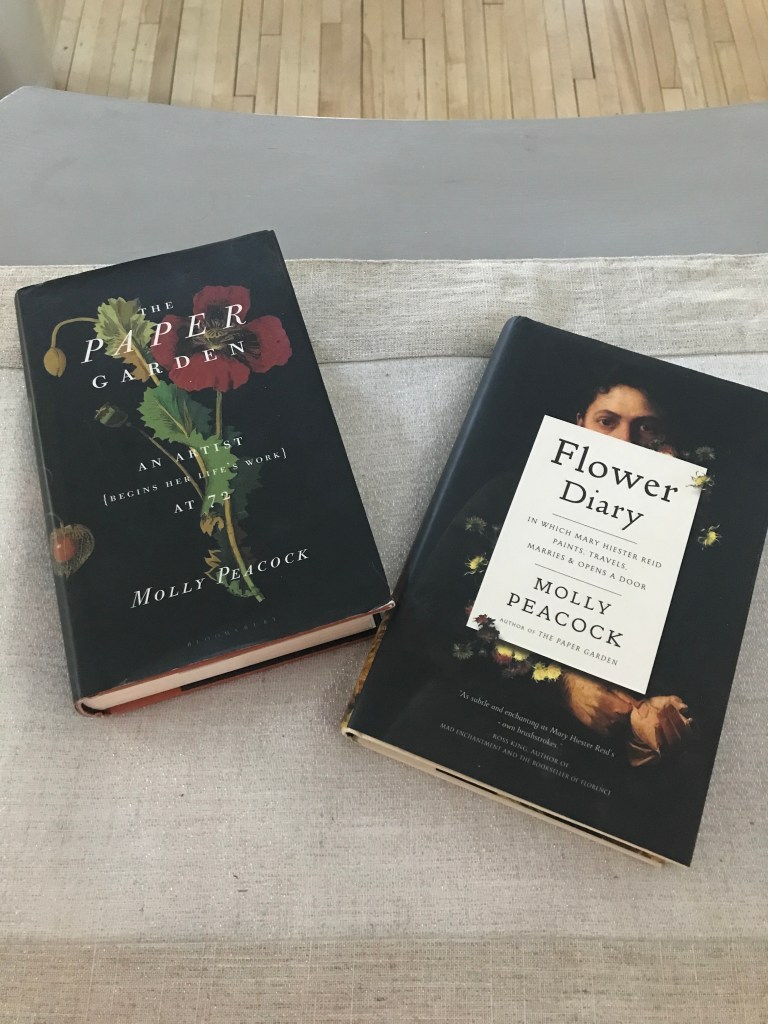
In last week’s Book Report I mentioned the book A Friend Sails in on a Poem by Molly Peacock, which I enjoyed, but then also remembered how much I loved the two biographies Peacock wrote, The Paper Garden, An Artist Begins Her Life’s Work at 72 (2010) and also Flower Diary, In Which Mary Hiester Reid Paints, Travels, Marries and Opens a Door. (2021)

I want to re-read both of these books and added them to the “Books to Re-read” list in my book journal.

More and more I feel drawn to re-reading favorite books or immersing myself in the entire backlist of a favorite authors like Barbara Kingsolver or Ann Patchett or Jon Hassler.

Often reading a new book leads me to the desire to re-read an earlier book by the same author. For example, I loved The Marriage Portrait by Maggie O’Farrell and now I want to re-read Hamnet. Or if a book I loved is mentioned on a podcast about books and reading, I sigh and think “Oh, I want to read that again.” That happened this week when I listened to the most recent episode on “What Should I Read Next?” (episode 370) when the host Anne Bogel suggested Plainsong by Kent Haruf to her guest.

Dusting my bookshelves has become a problem for me, because I see books I want to read again, Like The Children’s Book by A. S. Byatt and A Lost Lady by Willa Cather or Fresh Water for Flowers by Valerie Perrin or A Gentleman in Moscow by Amor Towles or The Sentence by Louise Erdrich or Prince of Tides by Pat Conroy or….. (The solution is to NOT dust!)

Over the years I have re-read all the Jane Austen books. Pride and Prejudice several times. And in 2021 I read all of the Louise Penney books written to that point, and I know I would enjoy reading them again. My fingers are twitching as titles come flooding in my brain.

I consider not reading newly released books and only re-reading favorite books, but then there is the FOMO (Fear of Missing Out) side of me. How could I not read the new book by Jacqueline Winspear, The White Lady, coming out later this month? And I am eager to read I Have Some Questions for You by Rebecca Makai because I loved her earlier book, The Great Believers.

I have this ongoing battle between my TBR list and my Re-Read list. I play games with myself: I will re-read one favorite book for every three new (at least to me) titles on my list, but then books I have requested from the library suddenly are available or our weekly roaming just happens to include the stop at a bookstore. Or someone I trust mentions a new book they loved, and I add it to my TBR list.

What am I doing writing this post? I need to stop immediately and read. What am I doing requesting more and more titles–mainly new ones from the library, when I have all these books here on my shelves? And why do I love going to independent bookstores, knowing I will walk to the check-out counter with a fresh stack of books when I have piles waiting for me at home?

Well, Nancy, this is a first world problem. Relax. Get over it. You will never read or re-read all the books you want to.

Last night I finished The Cloisters by Katy Hay, a new book which I enjoyed, but I know it is not a book I will ever re-read. There is some relief in that. But now comes the challenge? What should I read next? I have three books from the library.

  • 2 A.M. at the Cat’s Pajamas by Marie-Helene Bertino
  • Leaving the Pink House by Ladette Randolph
  • Case Study by Graeme Macrae Burnet

Or do I re-read one of the Molly Peacock biographies? Stay tuned.

An Invitation

What is on your re-read list? I would love to know.

Some Days Need More Than One Spiritual Practice

March 7, 2023

Some days feel like this.

And perhaps like this:

Even the Buddha can have an off day.

What I first need to remember is that it is March in Minnesota, and even those of us who love winter become weary of yet another forecast of more snow.

The next thing I need to remember is what helps when I feel a bit blue or antsy and itchy or bored (that happens rarely for me) or worried or disappointed or overwhelmed or….

I admit my first response often is chocolate. Or a grilled cheese sandwich is good, too.

Or if I have been working at my desk, especially if the writing is not going well or if I feel overwhelmed by the TO DO List, which seems to have too many DO NOW items than can physically be done NOW, I try to remember to close the laptop, walk down the garret stairs, and move into the snug to read my current library book. If I could, I would go for a walk, but oh yeah, there’s the snow and ice and a memory of falling and breaking an ankle. The snug will have to do.

Eventually, I remember what helps –even more than chocolate.

I take a deep cleansing breath. More than one. I close my eyes lightly, not tightly. That may seem like an unnecessary reminder, but notice how you feel when you close your eyes tightly. Your whole face squinches up, ogre-like, and instead of breathing, you hold your breath. So close your eyes lightly, not tightly. And then breathe in and out gently, finding your own rhythm.

Often that is enough. I breathe my way to relaxing into the next step or the loving outlook. Or feeling beloved myself.

But sometimes that isn’t enough, and I need to move to the next step in my spiritual practice repertoire: Sitting in silence.

For me that means moving to my Girlfriend Chair in the garret and allowing myself to be enfolded in silence. The majority of my garret time is quiet. I don’t work with music playing, and especially in the winter with the windows closed and the kids next door off to school, all is calm, all is still. I sit with my feet firmly planted on the floor, and I feel the silence enfold me. Sometimes it is so quiet, I can hear my inner voice, the voice I hope echoes the Divine. I listen. I really listen.

Often it is surprising what I hear.

“I love you. Now and forever.”

“Send your love to someone else.”

“Enough. You have enough. You are enough. Enough”

“Trust yourself. You are doing good work. Just stay on the path.”

“Really? You are willing to spend your precious time whining.”

Or if I’m really lucky, “Have another piece of chocolate.”

Sometimes I write in my journal during that silent time or read some sacred words. And prayer of one kind or another is sure to follow.

Whatever has caused my restlessness or anxiety hasn’t disappeared because I have turned to one (or two or three) of my spiritual practices, but I am more centered. I am more present.


We realize that we are in the center, and that from there all that is and all that takes place can be seen and understood as part of the mystery of God’s life with us…’All these other things,’ which so occupied and preoccupied us, now come as gifts or challenges that strengthen and deepen the new life that we have discovered.

Henri Nouwen

I am my silence. I am not the busyness of my thoughts or the daily rhythm of my actions. I am not the stuff that constitutes my world. I am not my talk. I am not my actions. I am my silence. I am the consciousness that perceives all these things. When I go to my consciousness, to that great pool of silence that observes the intricacies of my life, I am aware that I am me. I take a little time each day to sit in silence so that I can move outward in balance into the great clamour of living.

Richard Wagamese, Embers, One Ojibway’s Meditations

An Invitation

What spiritual practices help you return to the center? I would love to know.

Book Report: February Round-Up

March 2, 2023

My reading month started well and ended well, and in between the books were uneven.

Fiction

In an earlier post I wrote about Our Missing Hearts by Celeste Ng. https://wordpress.com/post/livingonlifeslabyrinth.com/1721 A glowing report of a book exquisitely written and a story powerfully told. While visiting a small new bookstore, I heard another customer say she had just finished a book that she loved and was so well-written. She was talking about Our Missing Hearts, and I joined in the conversation, agreeing completely. I have yet to meet anyone who has read the book who did not love it.

The last fiction book I read this month was Gone Like Yesterday, a debut novel by Janelle Williams, and I think this writer has the potential in future novels to attain Celeste Ng’s status. Of course, that is impossible to know, but I hope nothing gets in the way of Williams’ writing and growing and perfecting her skills. Her writing is lyrical and the plot, while involved, is interesting, as are her characters. Zahra is a young black woman who helps privileged high school students write their college admissions essays. She is introduced to Sammie, a another young woman, black, bright, nurtured by her uncle and grandmother, and also applying to colleges. When Zahra learns her brother is missing, Sammie and her uncle pose driving Zahra to Atlanta to look for him. Here’s the tricky part–the presence and sound of moths. Surrounding the car, floating above their heads. hovering in their ears. Are they real? What do they mean? A touch of magical realism. Sometimes it works, but sometimes it doesn’t. I think Williams tries to do too much in this book, but still I am glad I read it.

Three of the other books are mysteries: # 2 and #3 in the series by Ausma Neharat Khan about Canadian police detective Esa Khattak and his colleague Rachel Getty. Although I like, but don’t love these books, at some point I will read more in the series. The third mystery I read is part of the British Library Crime Series, Crossed Skis, An Alpine Mystery by Carol Carnac, which was published in 1952. A well-known trope in British mysteries is the house party concept and this one is similar–a group of young people who don’t all know each other go on a skiing vacation and…. well, read it to find out.

I read two books I truly did not like, and I wonder why I finished them. I usually make quick decisions about whether to finish reading a book or not. Oh well. The first is O Caledonia by Elspeth Barker and even after reading my summary of the book in my book journal, I have little memory of the book. The other book is historical fiction by the popular writer, Marie Benedict. Perhaps I finished this because she is a writer often recommended by others, and I kept hoping I would find something redeeming in the book. The book is The Mitford Affair about the English Mitford sisters, especially Nancy, Unity, and Diana. Set on the brink of WWII, Unity and Diana are big supporters of Hitler, and they manage to become part of his inner circle. Nancy eventually and hesitantly shares with Winston Churchill — the Mitfords are distant relations — some of her sisters’ plans and efforts. I need to like at least one of the main characters in any book I read, and I didn’t like anyone in this book.

Nonfiction

I can recommend all four nonfiction titles without hesitation–depending on your own personal interests.

  1. Memoir as Medicine, The Healing Power of Wiring Your Messy, Imperfect, Unruly (but Gorgeously Yours) Life Story by Nancy Slonim Aronie. I try to read books about the craft of writing frequently, and a writing friend recommended this. Wonderful prompts. Great examples from her own memoir. This book inspired me to establish Writing Wednesdays for myself. Yesterday was my my fifth one, and I plan to continue that schedule.
  2. A Friend Sails in on a Poem by Molly Peacock. I am not a poet, but I loved this memoir of the friendship between two women who are poets, Peacock and Phillis Levin. Peacock is the author of two of my all-time favorite books, both biographies, The Paper Garden: An Artist Begins Her Life’s Work at 72 and Flower Diary: in Which Mary Hiester Red Paints, Travels, Marries and Opens a Door.
  3. Prayer in the Night, For Those Who Work or Watch or Weep by Tish Harrison Warren. Using the words of the compline prayer (Several months ago I wrote this prayer on a small card that sits on my nightstand. Even on mights I don’t pray the words, the intention of those words lives in my heart.) Warren’s writing is simple and clear and at the same time profound, “We need practices that don’t simply palliate our fears or pain, but that teach us to walk with God in the crucible of our own fragility.” Warren shares her fragilities and encourages us to open to our own and to share them with God.
  4. Do I Stay Christian? A Guide for the Doubters, the Disappointed, and the Disillusioned by Brian McLaren. I actually owned this book before I bought McLaren’s previous book, Faith After Doubt, Why Your Beliefs Stopped Working and What to do About It, but I quickly realized it was important to read Faith After Doubt first. I did that in January. Do I Stay Christian? builds on Faith After Doubt, and wow, there is much to process. Part I answers the question, “No.” Part II, “Yes,” and Part III, “How.” Part I is the most upsetting, and Part III is the most challenging. Chapters in Part II include “Because….Where Else Would I go?” “Because I’m Human,” and “Because of Our Legendary Founder.” McLaren is such a good writer (and speaker–I often listen to his podcast, “Learning to See.” ) In the Appendix to the book he writes

We are all friends around this table. All equals. All unique. All welcome. Who we are is who we are. There is no need to pretend. Some of us have a lot of beliefs and very few doubts. Some of us have a lot of doubts and very few beliefs. Some of us love God, but we’re not sure about Jesus, and some of us love Jesus, but we’re not so sure about God. Some of us aren’t sure about anything, and others feel very sure about almost everything. Some of us gladly call ourselves Christians. Some of us barely call ourselves Christians. Some of us once were Christians, but not anymore. Some of us aren’t sure we were ever Christians, or aren’t sure what that means, or whether it matters. But this we share: we welcome one another to this circle just as we are, for we all are part of one web of life on this precious planet in this amazing universe.

p. 229

See my post on books by Brian McLaren here: https://wordpress.com/post/livingonlifeslabyrinth.com/1658

One last note: My husband and I visited a new bookstore in town recently and if you live in the Minneapolis/St Paul area I encourage you to stop by. The name is Comma, and it is the Linden Hills area of Minneapolis.

An Invitation

Anything to recommend from your February reading? I would love to know.