Book Report: A Controversial Book–American Dirt by Jeanine Cummins

May 11, 2023

When American Dirt by Jeanine Cummins was published in 2020 and selected for the Oprah Book Club, controversy erupted. I remember hearing and reading about the objections–that the author who identified as white, although her grandmother was from Puerto Rico, had indulged in stereotypes and didn’t accurately portray the truth of migrant experiences. A conversation arose about who has the right to tell a story, and that conversation continues.

I didn’t rush to read it, but kept the title on my TBR, and there it remained until last week.

I was moved by it, often feeling tears on my cheeks, and I sometimes needed to remind myself to breathe, as I worried about the fate of the characters. One criticism is that it was too easy of a read–a book meant for the screen. I didn’t find it easy on the emotions, however, and should s book be criticized because it eventually, through a long and arduous process, finds its way to the screen? (American Dirt has not yet been translated to film, by the way.)And just because a book is a page-turner does that make it any less worthwhile?

The main character is Lydia who owns a bookstore in Acapulco. Her husband Sebastien is a journalist who writes about Mexican cartels, and he and many members of their family are murdered after he writes a particularly incriminating article. Lydia and her young son, Luca, realize they need to flee because one of her customers is head of a cartel, although initially she was not aware of that fact, and he has fallen in love with her. The bulk of the novel is their harrowing movement towards el norte. I read the chapters describing the dangers of accessing and traveling, illegally, of course, the trains called La Bestia, with my mouth open and my heart pounding.

I rooted for Lydia and Luca and for some of their companions as they did what they needed to do to escape. The ethical and moral issues raised are as harrowing as the physical dangers and demands. I realize that this is one picture, one story, one perspective, but the depiction of fear and strength and hope seems authentic.

Something to Think About: Two Passages

The first passage is about Luca, the remarkable young son, learning about his own situation. Rebeca, mentioned in the section, is a teenage girl also trying to get to el norte.

As Rebeca reveals what scraps of story she does have to Luca, he starts to understand that this is the one thing all migrants have in common, this is the solidarity that exists among them, though they all come from different places and different circumstances, some urban, some rural, some middle-class, some poor, some well-educated, some illiterate, Salvadoran, Honduran, Guatemalan, Mexican, Indian, each of them carries some story of suffering on top of that train and into el norte beyond. Some, like Rebeca, share their stories carefully, selectively, finding a faithful ear and then chanting their words like prayers. Other migrants are like blown-open grenades, telling their anguish compulsively to everyone they meet, dispensing their pain like shrapnel so they might one day wake to find their burdens have grown lighter. Luca wonders what it would feel like to blow up like that. But for now he remains undetonated, his hours sealed tightly inside, his pin fixed snugly in place.

p. 166

We are invisible, Luca says to himself, and he closes his eyes. We are desert plants. We are rocks. He breathes deeply and slowly, taking care that his chest doesn’t rise and fall with the cycle of the breath. The stillness is a kind of meditation all migrants must master. We are rocks, we are rocks. Somos piedras. Luca’s skin hardens into a stony shell, his arms become immovable, his legs permanently fixed in position, the cells of his backside and the bottoms of his feet amalgamate with the ground beneath him. He grows into the earth. No part of his body itches or twitches, because his body is not a body anymore, but a slab of native stone. He’s been stationary in this place for millennia. This silk tassel tree has grown up from his spine, the indigenous plants have flourished and died here around his ankles, the fox sparrows and meadowlarks have nested in his hair, the rains and winds and sun have beaten down across the rigid expanse of his shoulders, and Luca has never moved. We are rocks.

p. 333

I think this book is well worth reading. At the same time I have no doubt there are major discrepancies in the white publishing world and that people of color do not get deserved recognition or financial support and payment in the same way that white writers do. Perhaps the debate about this book will make a difference.

An Invitation

What authors and books about migrants and immigration do you recommend? I would love to know.

Clearing and Creating New Space

May 9, 2023

Recently, my husband “suggested” that it is time to simplify the kitchen cupboards. After all, we have twelve white plates, but we use the same two over and over.

And bowls–how many bowls are really necessary? Cereal bowls, mixing bowls, pasta bowls, serving bowls. I admit I do have a thing about bowls. One of my favorite bowls is the light blue bowl on the top shelf, and I only use it when I make cherry walnut bread at Christmas time. I suppose I could use it at other times, too, but somehow, that doesn’t seem right. And then there are the 24 small vintage bowls or as my grandmother called them, sauce dishes. I bought them several years ago when we hosted an informal soup supper for Bruce’s colleagues. How likely is it that we will ever again need 24 bowls at the same time?

Over the years we have hosted many dinner parties and parties. I have spent days planning menus and cooking and cleaning and have loved the whole process, but it now seems unlikely that we will host large groups again or even have more than six people for dinner.

Our entertaining style has changed. What we most enjoy now is inviting two people over (We have four comfortable chairs in our living room.) for “4 o’clocks”–a drink and appetizers. Cheese, sausage, crackers. A dip, maybe some fruit. Something hot. Nibbles. Often a recipe I have wanted to try. Most important is the relaxed, but intimate atmosphere for fun and meaningful conversation. Oh, and much easier clean-up. Now with warmer weather we will enjoy our “4 ‘clocks” on the patio.

I realize the issue here is not my deep attachment to a material thing, but instead I sometimes struggle accepting who I am now–my age, my energy. At the same time I have become more and more clear about how I want to spend my time and use my gifts. Still, however, I cling to the earlier images of myself. Those stacks of dishes and a bowl for every purpose under heaven represent the ways I lived in earlier years when I had much more energy. The more the merrier when it came to entertaining.

I still have a good amount of energy and lots of interests and am blessed with many people with whom I enjoy spending time, but how much of a good thing I can hold in a day is more limited. Susan Moon in Alive Until You Are Dead, Notes on the Home Stretch, reflects on what she can do with “joyful effort” in her late 70’s. I love that.

An Ongoing Process

Our daughter and son-in-love have hosted the previous two Thanksgiving dinners, but this coming year they may be visiting our granddaughter, who will spend a semester in Greece. How grand is that! Our son and daughter-in-love usually come for the Christmas holidays, and we love all of us being together. But what does that mean for Thanksgiving? Well, my husband, open and generous person that he is, suggested we should host a friendsgiving for all those in our life who are alone. Only a few years ago I would have rejoiced with the idea, but this time I didn’t respond–at least not aloud. I admit I thought about all the work, all the energy that would take (and the bowls!). I know this is a decision that doesn’t need to be made now, and there are lots of ways to make an event like that happen, but it is another one of those opportunities to pay attention to who I am now.

If you have read my essay in Next Avenue (https://www.nextavenue.org/your-children-may-want-your-stuff/) you know how decluttering and managing the stuff of life is an ongoing process. I suspect that leaving some room on the kitchen shelves will open some space in my heart and mind to more fully live as I age.

Words of Wisdom

When I look around the crowded room and wonder why I am keeping the large desk when a smaller one would do just as well, something inside of me is beginning to change. When three sets of dishes are two sets too many, I have begun to need more than just things. When the house is too crowded and the car is too big and the perfect lawn too much of a bother, I have begun a whole new adventure in life…It is the shaping of the soul that occupies us now. Now, consciously or, more likely, not, we set out to find out for ourselves who we really are, what we know, what we care about, and how to be simply enough for ourselves in the world.

The Gift of Years, Growing Older Gracefully by Joan Chittister, p.91

My Intentions

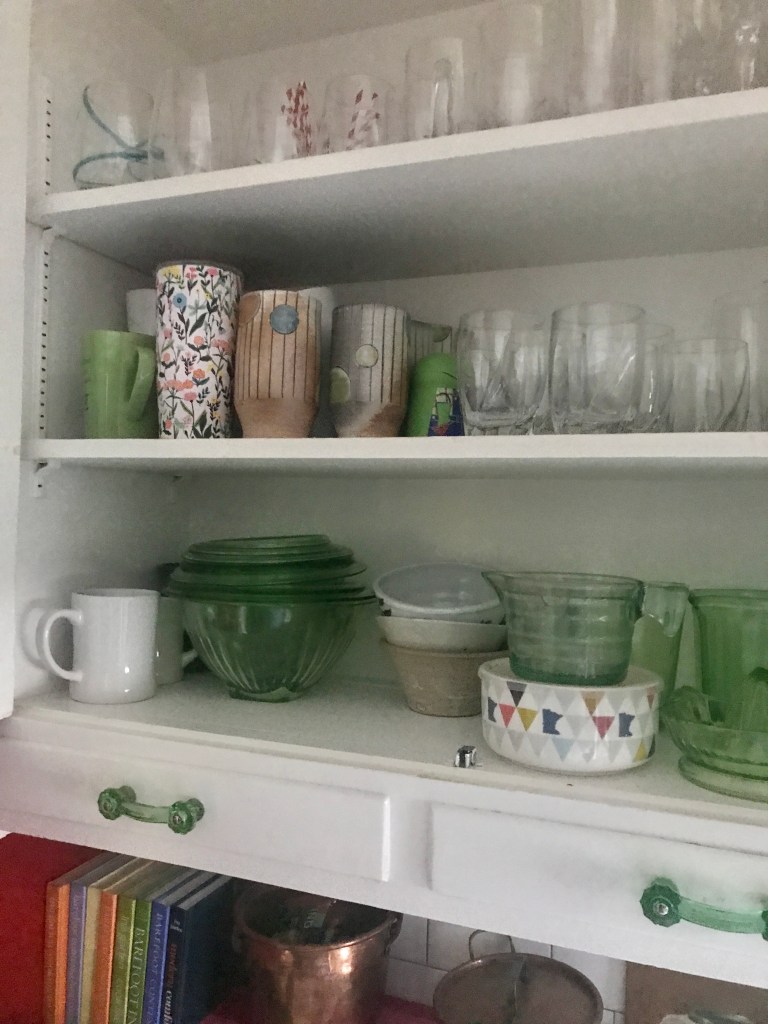
  • I will pay attention to what I actually use–how and when I use what fills my cupboards. Just looking at the above picture, I see two bowls that can go.
  • I will add some of my kitchen treasures to the annual garage sale my husband has in June to sell the discarded furniture he has rescued, painted, and given new life. The proceeds from his sale go to a program for homeless youth.
  • I will simplify the stack of 24 sauce dishes –keep 6 of them. Or maybe 8.

An Invitation

What outer and inner shelves in your life need to be cleared? I would love to know.
Book Report: April Round-Up

May 4, 2023

Have you noticed I read far more fiction than nonfiction?

Part of the reason is, quite simply, that I prefer fiction. My first career was as an English teacher—reading novels and short stories and poetry, too, was just part of the deal. That preference has only grown throughout my life. Another reason relates to my reading routine. I often read a book related to spirituality during my meditation time, and I tend to read those books more slowly–perhaps, only a few pages in one sitting. Finally, one of my daily reading times is in bed before turning out the light, and many nonfiction books require more concentration than that posture allows. Most of the time I read a nonfiction book alongside a novel, but the novel is usually my first choice during my reading times.

This month I read three nonfiction books. Two were about aging. I have an extensive library of books about that topic, which is becoming more and more relevant in my own life, but I am also becoming more choosy about what I add to that collection. I decided to keep only one of the two I read in April and put the other in the basket for a Little Free Library.

  • Alive Until You’re Dead, Notes on the Home Stretch by Susan Moon. Moon is a Buddhist and has written extensively about aging, challenging readers to be curious about this stage of life. I need to think more about her desire to “release my grip on my preferences. I wanted to stop worrying about whether what I was doing was the very thing that I most wanted to be doing.” (p. 23) I find myself thinking more and more about what it is I most want or most need to do; how I want to spend my time and energy, so Moore’s perspective interests me. The book includes an excellent chapter on practices to contemplate death, including walking in cemeteries, reading obituaries, and making a day of the dead altar. This book has found its place on my bookshelves.
  • Growing Old, Notes on Aging with Something Like Grace by Elizabeth Marshall Thomas. I appreciate the author’s sense of humor and her common sense treatment of loss, including losing one’s hearing or keys and other things, along with losing significant people in one’s life, but the picture of her on the back cover lighting her cigarette with a birthday candle seemed inappropriate and not funny. I am not keeping this book.

The other nonfiction book I read was Enchantment, Awakening Wonder in an Anxious Age by Katherine May. Perhaps you’ve read her earlier book, Wintering, The Power of Rest and Retreat in Difficult Times. I had intended to buy Enchantment, but before I did I spotted it on the Lucky Day shelf at the library. Lucky Day shelves hold current and widely requested books–just your luck to find one–but they can’t be renewed. By the time I was done reading it, the pages were dotted with colorful sticky tabs highlighting passages. I don’t often buy a book I have already read, but that’s exactly what I did in this case.

It occurs to me that I am resting. It is not the same as doing nothing. Resting, like this is something active, chosen, alert, something rare and precious. (p. 26)

I tend to think that God is not a person, but the sum total of all of us, across time. That only makes the imperative greater. We have a duty to witness the broad spectrum of humanity, rather than to defend our own corner of it. That is the work I crave: the sense of contact. The possibility that it might change me in ways that I can’t predict. The possibility that I might one day do better. (p. 100)

Play is a disappearance into a space of our choosing, invisible to those outside the game. It is the pursuit of pure flow, a sandbox mind in which we can test new thoughts, new selves. It’s a form of symbolic living, a way to transpose one reality onto another and mine it for meaning. Play is a form of enchantment. (p. 137)

April Fiction

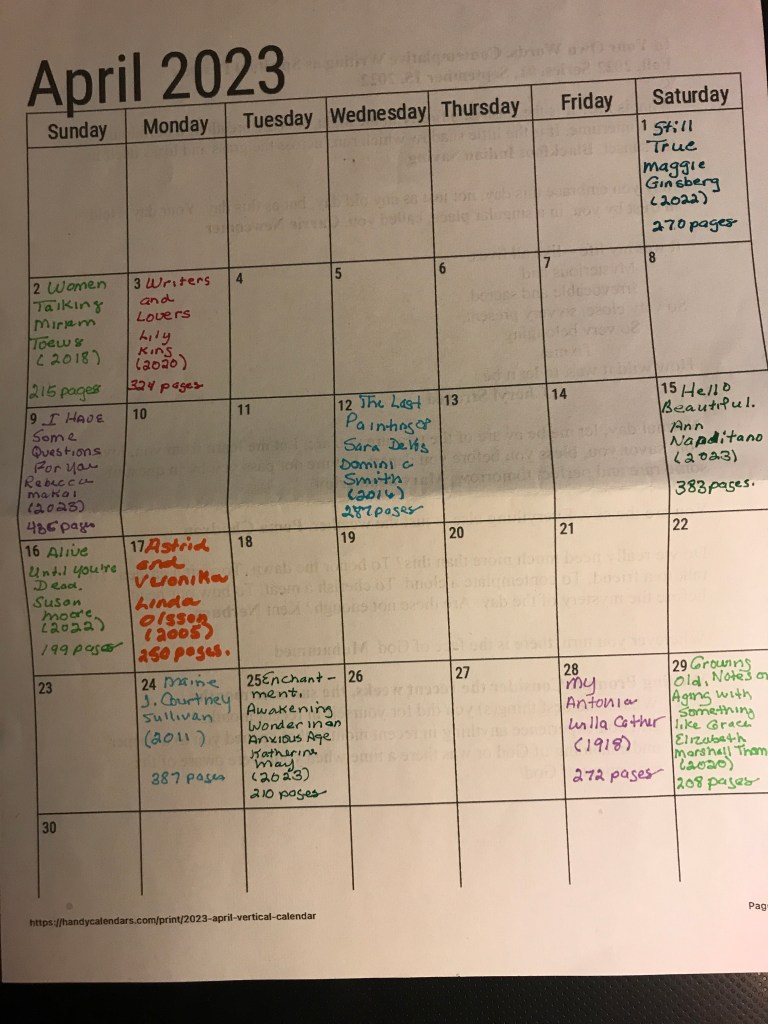
I read nine novels in April and in earlier April posts wrote about three of them, each book memorable: Still True by Maggie Ginsburg and Women Talking by Miriam Toews https://wordpress.com/post/livingonlifeslabyrinth.com/1934 and Hello Beautiful by Ann Napolitano. https://wordpress.com/post/livingonlifeslabyrinth.com/1982

Out of the remaining six my least favorite was Maine by J. Courtney Sullivan. My main objection to the book, a family saga, is that the characters, mainly women, didn’t grow or change in any significant way. If these characters were real, I am not sure I would choose to spend time with them.

The other five were well worth reading, and I recommend each one.

  • Astrid and Veronika by Linda Olsson. A friend recommended this book to me. (Thank you!) In fact, she has bought several copies and given them away as “must reads.” Set in Sweden, Veronika, whose fiancé has recently died in an accident, rents a home next to an older woman, Astrid, whom the village sometimes refers to as a witch. She prefers her solitary life. The two women gradually become close friends; a model of intergenerational relationships, I think. They share their pasts, hurts, secrets, and develop deep trust with one another. They often shared a meal together –a kind of sacred ritual. Veronika is a writer and there were many lovely passages about writing.

It was as if the story were a fragile cobweb, and she had to take the utmost care not to rip the thread…The words on the screen in front of her seemed to paint an almost forgotten landscape. It was as if she were slowly unpacking, pulling out one scene after another and exploding them to this bleak light. The effort was enormous. Here, now, each passage seemed out of place, like clothes bought on holiday.

pp. 17-18

One of my favorite passages is about change.

It is in the nature of things to change. Nothing can last beyond its given time. And I think instinctively we know what time is. What is it that makes us know when the summer turns? The smallest shift in the light? The slightest hint of chill in the morning air? A certain rustling of the leaves of the birches? That is how it is–suddenly, in the midst of the summer heat, you are overcome by a tightening of your heart. The realization that it will all come to an end. And that brings a new intensity to everything: the colours, the smells, the feeling of sunshine on your arm.

p. 72

Now I want to read Olsson’s back list.

  • My Antonia by Willa Cather. I decided to sign up for a series of zoom events sponsored by the Willa Cather Foundation, https://www.willacather.org and the first book discussed was My Antonia. I needed to miss that conversation, unfortunately, but oh, how I loved reading this book again, my third time. The story is told by Jim Burden, who as a boy was orphaned and leaves Virginia to live with his grandparents in Nebraska. The day he arrives on the train so does a Bohemian immigrant family, the Shimerdas, including daughter, Antonia. Antonia’s spirit sustains her, and she is loved by all who know her. She is not the only character in the book, however, who displays a hardworking and resilient nature, hopeful and strong.

The landscape is a major character, too, and reading the descriptions made me want to drive to the prairie right now.

As I looked about me I felt that the grass was the country, as the water is the sea. The red of the grass made all the great prairie the colour of wine-stains, or of certain seaweeds when they are first washed up. And there was so much motion in it, the whole country seemed, somehow, to be running…I felt motion in the landscape, in the fresh, easy-blowing morning wind, and in the earth itself, as if the shaggy grass were a sort of loose hide, and underneath it herds of wild buffalo were galloping, galloping…

pp. 17-18

One of my favorite books of all time is Giants in the Earth by O. E. Rolvaag, another immigrant story, and I am drawn after reading My Antonia to reading that once again. I read someplace that books are like nesting dolls–one leads to another. How true that seems.

  • Writers and Lovers by Lily King. I had read this before and didn’t much care for it, but recently I heard a conversation about it and decided to re-try it. This time I really liked it, which goes to show how much mood and timing enter into an assessment of a book. Casey is a struggling writer living in a potting shed (!) and her awful landlord says to her, “I just find it extraordinary that you think you have something to say.” (p. 2). She becomes involved with two men–one, a writer her age and the other, older and a successful writer with children who adore her. How will it turn out?
  • I Have Some Questions For You by Rebecca Makai. I loved her earlier book, The Great Believers, and I am happy to say I really liked this one, too. Bodie returns to teach at the boarding school where she was once a student –and where her roommate was murdered. She becomes obsessed with investigating this murder, convinced the man convicted was not guilty. There are lots of threads in this book, but Makai is a deft writer, preventing confusion for the reader. A couple favorite lines;

“When my husband passed,” Sheila said, “it was like losing the bookend to a row of books. We all tipped over sideways.”

p. 82

Not a single cell of his body was the same as it had been in 1995. But he was still himself, just as I was still, despite everything, my teenage self. I had grown over her like rings around the core of a tree, but she was still there.

p. 418
  • The Last Painting of Sara DeVos by Dominic Smith. A good novel about an art restoration expert, a young woman, and the man who owns the painting she forges. The original was painted by a Dutch woman in the 1600s. The art forger and the art collector develop a relationship (of course!), but it is told beautifully and not stereotypically. They meet again 40 years later when the painting is part of an exhibit. Good story. Good writing.

Wow–that’s a lot of books to share! Hope this didn’t detract too much from your reading time. Perhaps your TBR has just grown, however.

An Invitation

Any recommendations from April? I would love to know.

Spiritual Practices for My Elder Years

May 2, 2023

When I turned 70, I made a collage to honor that milestone birthday, but also to envision how I hoped to live as I aged.

I quickly sifted through the stash of pictures I kept in a pretty flowered box; pictures torn out of magazines, outdated calendars, and greeting cards too appealing to toss. I sorted them into two piles–the “maybe” pile and the “nope, not today” pile. No judgment. Just a quick “yes” or “no.” Cutting and pasting, I arranged selected images on the paper.

Only later did I sit back and ask, “What are the messages for me in this collage? How can this collage be sacred text for me?”

An image of the labyrinth anchored the center of one side. A candle with wispy smoke and a feather suggested the tentativeness of life. Chairs gathered around a fire and an aged hand that held the model of a house with a red door, just like our house, reminded me of my love of home tending. A big basket seemed to contain memories, as did the leaves gathered into a harvest handful. Of course, there were books stacked along the bottom of the paper. My terra firm.

Almost every collage I have made over the years has included at least one open gate, door, window, or path. This one includes two gates, an open door, and a window, plus a green path, all beckoning me onward, forward, it seemed. I remember, however, feeling some inner hesitation. What was across the threshold? What awaited me down that snow-lined path?

A prickly plant in the corner of the page and a pile of rocks taunted, “Beware. Obstacles ahead.”

Youthful innocence and naïveté were no longer my companions.

An older woman, smiling, pleasant looking, gazed at the labyrinth. I heard her whispering the words I included on the collage:

Choose simplicity.
Keep growing.
Learn something new.
Make room for what matters.
Breathe deeply.


She is my observer, my witness, my companion. My guide.

Being 75

Now I am 75, and I must admit, that age feels a bit daunting,

Since creating my 70th birthday collage, I have experienced losses–the death of my father and a dear friend, for example. I have sent so many sympathy cards and frequently re-order copies of Healing After Loss by Martha W. Hickman to give when someone in my life loses a loved one. And then there were the COVID years. Enough said! My health remains good, however, as does my husband’s, and we both continue to pursue our interests and to serve in ways that matter to us. True, I may not pack as much into a day as I once did, but my days remain full and rich.

I am grateful for these past five years.

I know I need to tend my days wisely, not only not to waste them, but to unfold into the gifts of this time. I’m not done yet, for I am both living and aging, but I respond now more with patience and curiosity, then with urgency and a desire for productivity.

I embrace a posture of contemplation.

A New Spiritual Practice

Recently, while browsing through my library of books about aging, I re-read a section titled “Pebbles of Life” in Aging as a Spiritual Practice, A Contemplative Guide to Growing Older and Wiser by Lewis Richmond. He shares a story about visiting the home of a fellow Zen priest who had a bowl full of pebbles next to a Buddha statue. Richmond’s friend said each pebble represented a week in the rest of his life, based on statistics about average life expectancy. Every Monday morning after his meditation he removes one of the pebbles. One week gone; who knows how many left to go.

“A mindfulness practice.”

The average life expectancy for a woman in the United States is 80. I am 75 so if I live five more years that equals 260 more weeks.

I counted out 260 little glass discs and placed them in a green glass jar. I was a bit dismayed at first that they didn’t fill the jar, and I wished I had started this practice when I was 70 or even younger. I no longer overflow with weeks ahead of me, I thought.

“A mindfulness practice.”

Of course, I have no idea how much longer I will live, but my mother died at 79, several pebbles shy of her 80th birthday. However, my father died just three years ago at age 96. He would have needed more pebbles in his jar.

I realize some of you readers may find this practice depressing or it might make you anxious, but my hope is that when I remove one of the glass discs every Monday morning that I will reflect on a week lived in gratitude and joy. I hope each glass disc will remind me to live in the present moment; to live with purpose and to open to ways I can become more of the person I was created to be.

I hope the words from my 70th birthday collage will continue to direct and honor my days.

Choose simplicity.
Keep growing.
Learn something new.
Make room for what matters.
Breathe deeply.

These elder years are found time. Sacred time.

An Invitation

What are your guiding words and spiritual practices during these elder years? I would love to know.

Book Report: Reading Dilemmas

April 27, 2023

Recently, I received an email from the Willa Cather Foundation about a virtual study course for four of Cather’s books, My Antonia, A Lost Lady, The Professor’s House, and Death Comes to the Archbishop. Benjamin Taylor, whose biography of Cather will be published in November, 2023, will host the series. I love each of those books, and I am tempted to sign-up for the series and, of course, reread the books.

Here’s the dilemma: each book I re-read means I don’t read something on my TBR list. Each time I sink into a much loved book, I am not reading a new release that sounds really good. And in the meantime the attraction to books, new and old, and the ongoing growth of my TBR list continues.

This week I got an email from the New York Times with the headline, “12 Books You Should Be Reading Right Now.” RIGHT NOW! EEEK! I probably should not have read further, but I did and was pleased to see I have read one of the titles, Hello Beautiful by Ann Napolitano, and I am even more pleased to report I did not add any other titles to my TBR list. But how long will that restraint continue? Anne Bogel of Modern Mrs Darcy and the podcast “What Should I Read Next” will soon release her acclaimed Summer Reading Guide, and a plethora of other summer reading lists are just on the horizon.

If I ignore them, I may miss a book that would be a truly good match for me. Plus, I confess I like to be in the know about new books, an interest nurtured by working in an independent bookstore decades ago. I read a variety of book review sources, and bookstores are truly my happy place.

Perhaps I should think of this passion as a hobby, like knitting or bird-watching.

My TBR Lists

I keep elaborate book lists in my book journal. At the beginning of 2023, I transferred 57 unread titles from 2022. I have been working on that list steadily since then and am happy to report I have only 16 left on the list. I hasten to add I have not read, beginning to end, the remaining 41. I have at least started each of them, but only decided to complete a handful of them. If a book doesn’t appeal when I start reading it, I quickly discard it, usually returning it to the library or if I own it, adding it to the Little Free Library pile.

Of course, I have a 2023 TBR list, but I am trying to be more selective about what I add to that list. As of today, I have 59 titles on that list and have read or discarded 21 of those titles. Then there is my lists of acquired books and mystery series and the British Library Women Writer Series and books I want to re-read.

So far this year, by the way, I have read 45 books.

Current Thoughts About My Reading

I just finished reading Enchantment, Awakening Wonder in an Anxious Age by Katherine May, who wrote Wintering, The Power of Rest and Retreat in Difficult Times. In this new book, which I am so glad I read, she decides it is time to

reset my terrifying “to be read” pile to zero and allow myself the possibility of choosing new books for this age I’ve landed in.

p. 150

Is that what I need to do? Close my book journal, except, course, to record what I’ve read. Forget the TBR list entirely–not an easy prospect for someone who loves to make lists almost as much as she loves to read. Perhaps I need to just read what is on my shelves already—the great majority are books I have already read and can imagine re-reading.

Obviously, as problems go, this is not major, but as a devoted and voracious reader what to read next is an issue, as is how to approach reading time. At age 75 there is more sand in the bottom of the hour glass than in the top.

I am aware that I am more and more attracted to re-reading old favorites, and at the same time reading older books I missed along the way or reading the backlist of an author when I read a current title.

What I suspect is that I will continue to muddle along –reading as much as I can, picking and choosing based on unscientific criteria, breaking my own rules, and quite simply loving the journey.

An Invitation

As you age, are you noticing anything different about your reading routine or rules, reading desires or interests? I would love to know.

NOTES:

Willa Cather Foundation https://www.willacather.org

Anne Bogel blog and podcast https://modernmrsdarcy.com https://modernmrsdarcy.com/what-should-i-read-next/

My Morning Meditation Shift

April 25, 2023

In a recent post https://wordpress.com/post/livingonlifeslabyrinth.com/1883 I documented how I rearranged furniture on the first floor of our home. Just because I felt like making a change. The most major of the changes was to move a desk, which I always refer to as my Lady’s Writing Desk, from the entry way into the snug. I confess I have rarely used this desk with all of its cubbies since we moved back to St Paul. Instead, I have almost exclusively used my desk in the garret.

Well, in its new location in the snug I find myself drawn to using it once again–not so much for writing blog posts or working on the content for the writing group I lead or for other writing projects, but perhaps for the use this desk was first intended: correspondence. Thank you notes and birthday and sympathy cards. And letters. This little desk is now stocked with note paper and stationary and favorite pens and stamps.

I love having a window on the world of our block, watching the neighborhood kids racing up and down the sidewalk and the dog walkers and joggers. Bruce even checks in with me much more than when I was tucked away in the garret.

I don’t like how the desk looks from outside the house looking in, but oh well.

In the past year I have worked hard to end my writing work life by 4:00 in the afternoon. I turn off the laptop and the lamp light and retire to the snug to read for awhile before fixing dinner. That is a good thing for me, but at the same time I have noticed a decrease in writing letters and other correspondence; something I have always enjoyed. I like writing at a desk, but if I return to the garret desk, I often end up working on other projects.

Because this desk is in the snug, I feel called to return to a part of my life that has given me so much pleasure in the past.

Another Change

Most mornings I head straight up to the garret, even before I get dressed, for my morning meditation time. I sit in the comfortable Girlfriend Chair, to pray, to meditate, to write in my journal, and to read sacred texts. During COVID when I wasn’t meeting in person with spiritual direction clients, I moved the chair into the larger space in the garret where I meet with most of my clients.

But guess what? My designated meditation chair in the garret is close, very close to my desk, and meditation often becomes muddled with work. Hmmmm.

In warm weather what I often do is walk first thing in the morning and move my meditation time into our Paris garden. But, alas, we have had one day of warm weather so far this month. and while the snow has finally disappeared and walking is possible, sitting in Paris is not. And who knows when that is going to happen.

While writing letters at my Lady’s Writing Desk on Saturday, I had one of those ah-ha moments, Why not start my day in the snug, instead of going up to my garret office right away. Another comfortable chair. Plenty of space to keep my meditation materials, and writing in my journal at a desk is much easier. And there will not be the temptation to answer email or dive into the day’s To Do list.

And it is a change. A change of scene often brings a change of perspective. A change shows me I can be flexible. A change often inspires creativity and problem solving, too. And, if it doesn’t feel right, I can easily move back into the garret.

And when I do go up to the garret later in the morning I will be ready to focus on my work.

So far, so good, but it has only been a couple days. Stay tuned!

Making changes doesn’t mean you’re not content. It means you’re paying attention.

Myquillan Smith

An Invitation

What change have you made recently that has enhanced your life? I would love to know.
Book Report: Hello Beautiful by Ann Napolitano

April 20, 2023

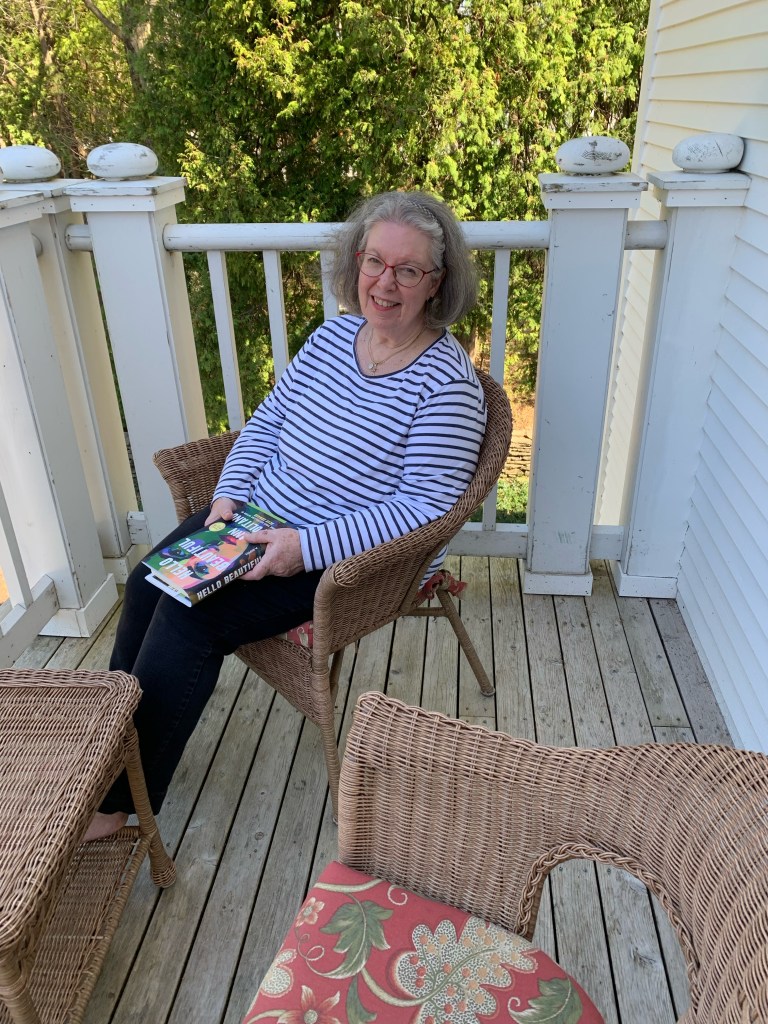
Sitting on a balcony in beautiful Door County, WI, reading a stunning book–what could be better than that? Well, maybe a balcony with a water view, but no whining allowed.

So far the books I’ve read this month have all been worthwhile, even memorable. I wrote about two of them in an earlier post this month, Still True by Maggie Ginsberg and Women Talking by Miriam Toews, and in my April summary on Thursday, May 4 I will share the other titles. I couldn’t wait, however, to tell you about Hello Beautiful by Ann Napolitano.

I loved the characters, even when I didn’t like them. Sometimes I wanted them to be something more than who they were, but I admired the growth and the recognition of the pain they held within themselves.

I loved the writing, the impeccable sentences, and the fullness of the descriptions without being overwrought.

I loved the pace of the plot, Not too slow. Not too fast.

I loved that each chapter focused on one of the characters. The point of view, third person narrator, stayed the same, but somehow I experienced each person’s perspective.

I loved the overwhelming love, the humanity of that love, so tenderly, but sometimes so fiercely expressed. Powerful, redemptive, heartbreaking love. At times as a reader I wanted them to relax into that love.

Loosely based on Little Women, with emphasis on the word “loosely,” the characters have their times of being Beth or Meg or Jo or Amy. And there is a Laurie, too, in the character of William. We are absorbed into this family of sisters who don’t seem to need others until they do. A friend who loaned me her copy of the book said it made her envious of women who have sisters, and it made me think a bit more about my mother who was the oldest of four sisters and what her reaction to this book might have been.

Ok, the plot: William Waters grew up almost invisible in his own family when his parents could not cope with tragedy. He found solace in basketball and then in the love of Julia, the oldest sister. As each sister discovers her own identity and as William experiences a mental breakdown, all are forced to change and meet new challenges. I don’t want to say more.

A Few Favorite Passages

Julia experiencing the birth of her child:

She was a mother. This identity shuddered through her, welcome like water to a dry riverbed. It felt so elemental and true that Julia must have unknowingly been a mother all along, simply waiting to be joined by her child. Julia had never felt like this before. Her brain was a gleaming engine, and her resources felt immense. She was clarity. (p. 107)

They were dismantling their habits and routines, and it was like pulling up floorboards and finding joy underneath. (p. 349)

At their father’s wake, a young paper-factory worker said, It’s impossible he’s gone. And that man had been right–that had been an impossible loss…But perhaps what felt impossible was leaving that person behind. When your love for a person’s so profound that it’s part of who you are, then the absence of the person becomes part of your DNA, your bones, and your skin…the losses ran like a river inside her. (pp. 360-361)

“When an old person dies,” Kent said, “even if that person is wonderful, he or she is still somewhat ready, and so are the people who loved them. They’re like old trees, whose roots have loosened in the ground. They fall gently. But when someone dies…–before her time–her roots get pulled out and the ground is ripped up. Everyone nearby is in danger of being knocked over.” (p. 371)

Independent Bookstore Day is coming up on April 29. This would be a good book to purchase then. I guarantee there is already a long “Hold” list at your library, so unless you have the patience of Job or can borrow a copy from someone else who has had the wisdom to buy it, buy yourself a copy.

An Invitation

What book is tempting you these days? I would love to know.

Home Away From Home: Door County, WI

April 18, 2023

We spent this past weekend in Door County, WI, a place that over the years has become a home away from home, even though we rarely stay at the same place. At breakfast one morning at our favorite place, The White Gull Inn in Fish Creek, we tried to remember all the times Door County has been our vacation, get-away destination. We listed at least 20 times, and I’m sure we missed a few.

For those of you who don’t know, Door County is a peninsula with Green Bay on one side and Lake Michigan on the other. Many have referred to it as the Cape Cod of the Midwest. That’s fine, but I don’t think it needs to be compared to anything–it is its own kind of time-out haven.

My husband planned the trip this time to celebrate my 75th birthday, which seems like a logical time in itself to reminisce and honor the past without neglecting the present or denying the realities of the future. We roamed favorite routes, as we always do, staying alert for sandhill cranes and turkeys, glimpses of spectacular water views, and the pink haze on the cherry trees, moving steadily towards blossom time. We noted what stores and restaurants were still alive and hopefully well, and kept saying, “Remember when…”

A kind of life review of our adult years.

Neither of us could remember how we learned about Door County or when we had first visited, but we obviously fell in love with it and kept returning–sometimes just the two of us, but also family times when our children were little. And later when our children were grown. The summer of 2010, when we lived in Madison, we rented a house for a month. Bruce came for the weekends, and our daughter and family came for a few days, too.

I spent my alone time reading and writing. (No surprise!)

When I was growing up and my family moved frequently, we always went to the same resort in northern Minnesota for a week or two before moving to our new home. That time served as transition time, easing us from one place to another. Whether my parents realized they were doing that or not, that week offered a touchstone, making what was changing and what was ahead and what was left behind not quite so daunting.

Door County has become a similar touchstone–a place where I mark the changes in our lives, not just as memories, precious though they are, but as a timeline of growth and development. I recall many leisurely dinners, lingering over what we came to think of as “daiquiri talk,” dreaming and imagining what our future might hold, could hold. In fact, Door County was where we realized that we wanted to retire back to St Paul and put a plan to do just that into motion.

This past weekend was quiet, for the spring/summer season has not yet begun, and I realized how much less I need “to do,” “to see,” “to visit,” in this stage of my life. How content we were to spend more time reading in our pretty room or on the balcony.

Note the cherry wallpaper! Cherries are a definite theme in Door County.

We have celebrated birthdays and anniversaries in Door County and have been there each season. We have each had alone time there plus been there with friends and family. I don’t need everything to be the same with each visit there, although I would be crushed if the White Gull Inn closed, but instead enjoy seeing the mix of old and new. We’ve been young there, and now we are old there. I feel the span of time there, and it is a good feeling.

Perhaps if we were still living in the home where we raised our family, a home where we lived for decades, I might prefer to vacation always in new places, to cultivate new places, new experiences, but instead, Door County has become the place of returning. The place where time is measured. It is the place where each time we leave, I think about when we might return to our home away from home.

One More Thing:

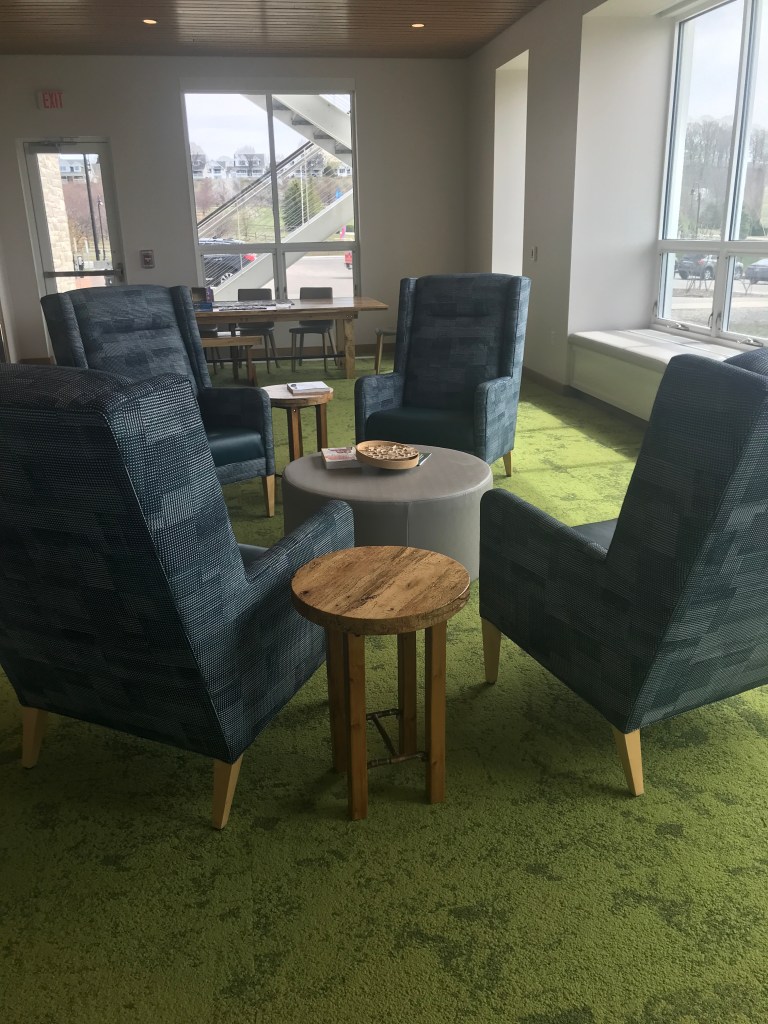
As we often do, when we are out roaming, we visit a library. I think if I were living in Door County, I would spend a good chunk of time in Egg Harbor’s library–with its water view and comfortable places to sit and read.

Not only were there books, but a charming seed library too.

An Invitation

Do you have a home away from home? A place that is an emotional tug? I would love to know.

Spring Break

April 11, 2023

I am taking a brief break, but will begin posting again on Tuesday, April 18, 2023.

An Invitation

Do you need a break? What would that mean for you? I would love to know.

Book Report: Blizzard Books

April 6, 2025

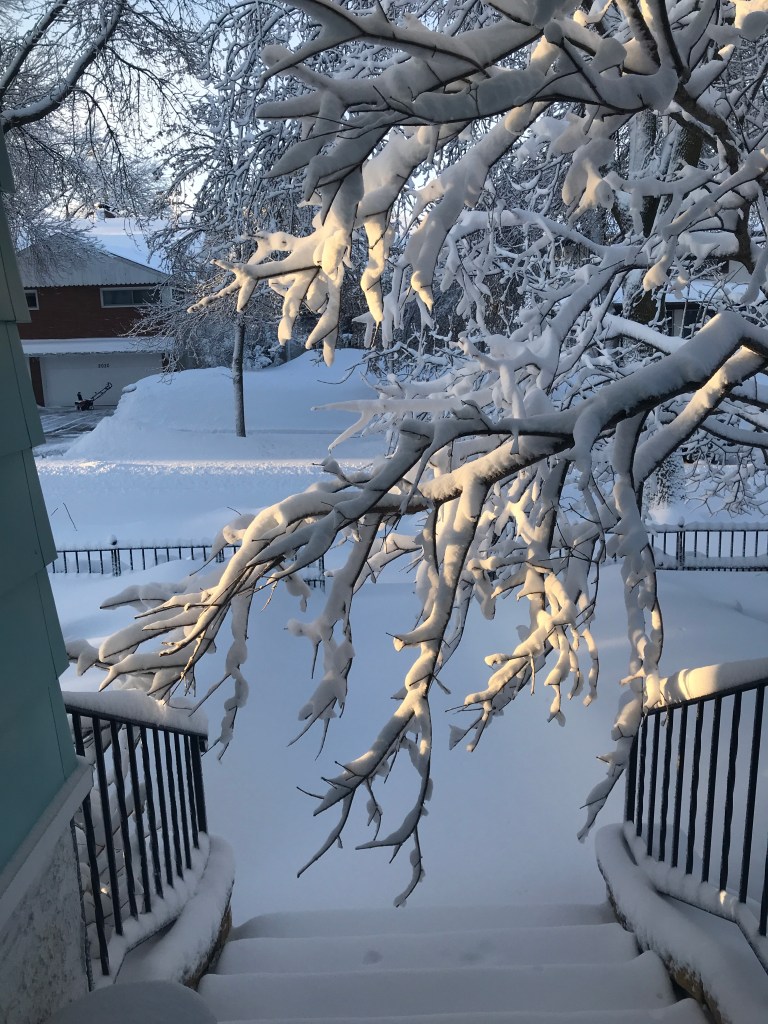
Welcome April 1! This was the view out our front door Saturday morning. Not only that, but we had no power for most of the day. What to do? Read, of course.

The sun was pouring into the snug, giving me plenty of light. I wrapped up in a blanket and read and read and read. In fact, I finished one book and most of another, and they were both excellent.

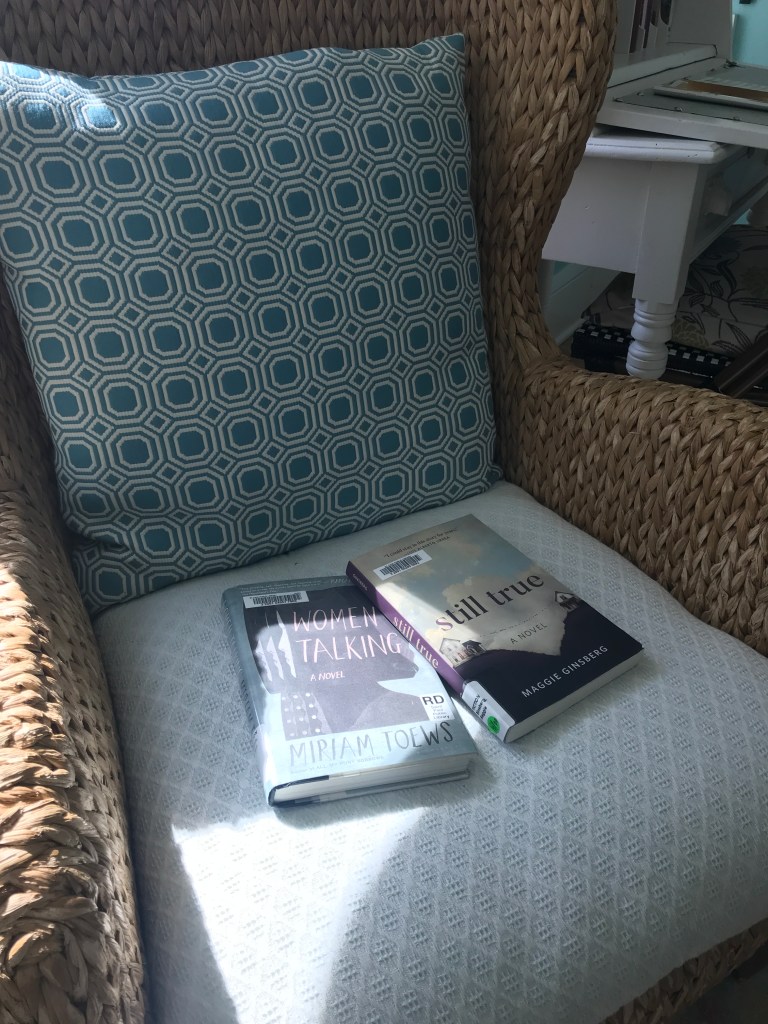
Still True by Maggie Ginsberg was a recommendation several months ago in the newsletter of one of my favorite bookstores, Arcadia Books in Spring Green, WI. https://www.readinutopia.com Ginsburg is a senior writer at Madison Magizine, but I hope she leaves enough time to write a second novel, for this one is stellar. You may recall that one of my favorite books of 2022 was Beneficence by Meredith Hall. Well, this book needs to sit on the shelf next to Beneficence. https://wordpress.com/post/livingonlifeslabyrinth.com/774

The plot is fairly complicated, as I think about explaining it, but as I read, it didn’t feel that way. I think that says a great deal about the polished, smooth and compelling writing. Secrets, lies, grace are all themes in this story about a devoted, long-time married couple, Jack and Lib, who don’t live in the same house. Also, key to the story is Charlie, a young boy who has recently moved to Anthem, WI with his parents, and he becomes Jack’s buddy. Enter Matt who is Lib’s son, whom she left when he was baby. This is news to Jack. And Matt becomes involved with Charlie’s mother. See what I mean? Just read the book and ponder the questions, What is truth? What is true? Are some lies worse than others?

Maybe this is what grace felt like. Maybe the best things were too big and good to be understood. maybe what was holy, by definition, couldn’t be truly comprehended by mortal man. Maybe that was what he’d always sensed in the two of them, and in everything they held dear: that together they were so much bigger than the sum of their respective working parts.

p. 270

Women Talking by Miriam Toews is the book that inspired the award-winning recent movie by the same name. Read the book. See the movie. Both are excellent. The novel is based on a true story about a Mennonite community in Columbia, South America. The women, who have not been allowed to learn how to read, have been sexually-abused, and they struggle with a decision — to do nothing, to stay and fight, or to leave. These women may not be able to read, but they can think, and their deliberations will challenge and impress the ethicists, philosophers, and theologians of the world. They struggle with what they have been taught, with what the men have told them is in the Bible, as they clarify three things they are entitled to. “We want our children to be safe…We want to be steadfast in our faith…We want to think.” p. 153. One of the women says,

I believe that my soul, my essence, my intangible energy, is the presence of God within me, and that by bringing peace to my soul, I am honoring God.

p. 109

The author, by the way, was raised Mennonite and left her family at the age of 18.

I think my April reading is off to a good start. Now, if only the snow would melt.

An Invitation

What books have you read recently that challenged your thinking? I would love to know.